Creative as a Service in 2026: What It Means, What It Costs, and the 20 Best Companies
What creative as a service means, the three price bands corrected from each company's own pricing page, how queues, hours plans and dedicated teams differ, and 20 providers checked one by one in September 2026.


Creative as a service means paying a monthly amount for an ongoing supply of design, video, motion and brand work instead of buying it project by project. In September 2026 the published starting prices run from $449 a month for a one-request-at-a-time design queue to $15,000 a month plus a $1,000 software fee for an enterprise team on an annual term, and the difference between those two numbers is not quality so much as who is doing the work, how many of them there are, and whether anyone senior owns your brand.
I work at Moonb, which is one of the 20 companies below, so read the whole page with that in mind and hold us to the same questions as everyone else. Every price, term and review figure here was read on the company’s own site or its Trustpilot profile on 2 September 2026; where a company does not publish something I write “not publicly stated.” I did that because the numbers AI assistants repeat for this category are badly out of date: ChatGPT still quotes Superside “from $5,000” against its own $15,000 floor, and Kimp and Penji at roughly half their current entry prices.
If you only want the short version:
- Three price bands, corrected from the companies’ own pages: under $1,500 a month buys a design queue (ManyPixels $699, Penji $995, Kimp $1,397, Delesign $649, Design Shifu $549); $1,500 to $5,000 buys a managed or hours-based team (Flocksy, Teamtown from $3,000, Designjoy $4,995); $5,000 and up buys a Creative Director-led or enterprise team (Designity $5,995, Teamtown Studio $9,900, Superside $16,000 all in).
- Design Pickle publishes no price at all, setting it on a consultation call.
- Video and motion are usually gated. Penji, Delesign, DotYeti, Draftss, Duck.design and Design Shifu include them only from a higher tier; Designjoy and Deer Designer exclude them.
- Review depth varies enormously, from 392 Trustpilot reviews at Penji to one at Design Shifu and two at Designjoy.
What creative as a service really means
Creative as a service is an ongoing way to get design, video, motion, animation and brand work delivered through a repeatable process. It sits between a traditional agency, a freelancer and an in-house team, and the label is loose, so the operating model matters more than the phrase. If a provider cannot show you who owns the work, how requests move and what happens when scope changes, the buzzword does not help you.
The shift behind the model is structural. UNCTAD reports that creative services exports reached about $1.4 trillion in 2022, up 29 percent since 2017 and equal to 19 percent of all global services exports, and rose to $1.5 trillion in 2023, more than twice the value of creative goods exports, in its creative economy report. That is a service-led market, which is why recurring production and distributed teams have grown so fast. The labour side is fragmented too: the UK’s creative industries generated £124 billion in gross value added in 2023, and 93 percent of the businesses in them were microbusinesses in March 2025, per the Creative PEC statistics page. That fragmentation is exactly why brands prefer one steady external team over a patchwork of freelancers.
Practical rule: judge the operating model first, then the portfolio. A polished reel means little if the team cannot hold brand memory from week to week.
The four models, and what each one charges
- Design queue. One designer, matched or assigned, works your requests one or two at a time. ManyPixels, Penji, Kimp, Awesomic, Delesign, Draftss, Kapa99, Graphically and Design Shifu. Published starting prices from $449 to $1,490.
- Hours or slots. You buy daily hours or parallel slots and a team works the queue, sometimes with an art director on request. Design Pickle, Flocksy, No Limit Creatives, DotYeti. From $500 to $1,699, or a sales call.
- Managed or dedicated team. A fixed team with a project manager or creative lead, sized in hours or projects. Teamtown, Duck.design, Deer Designer, Designity. From $1,199 to $8,995.
- Directed enterprise team. A Creative Director leads a team that stays with your brand across video, motion and design. Moonb and Superside. Superside publishes $15,000 a month plus a $1,000 fee on an annual term; Moonb works on one set monthly rate, or a per-project quote.
A queue gives you predictable throughput at a low price and feels rigid when priorities shift. A dedicated team gives you continuity and fewer repeated explanations, and only makes sense if you have enough work to keep it busy. The common mistake is comparing prices across two models that are not doing the same job.
The 20 best creative-as-a-service companies
1. Moonb
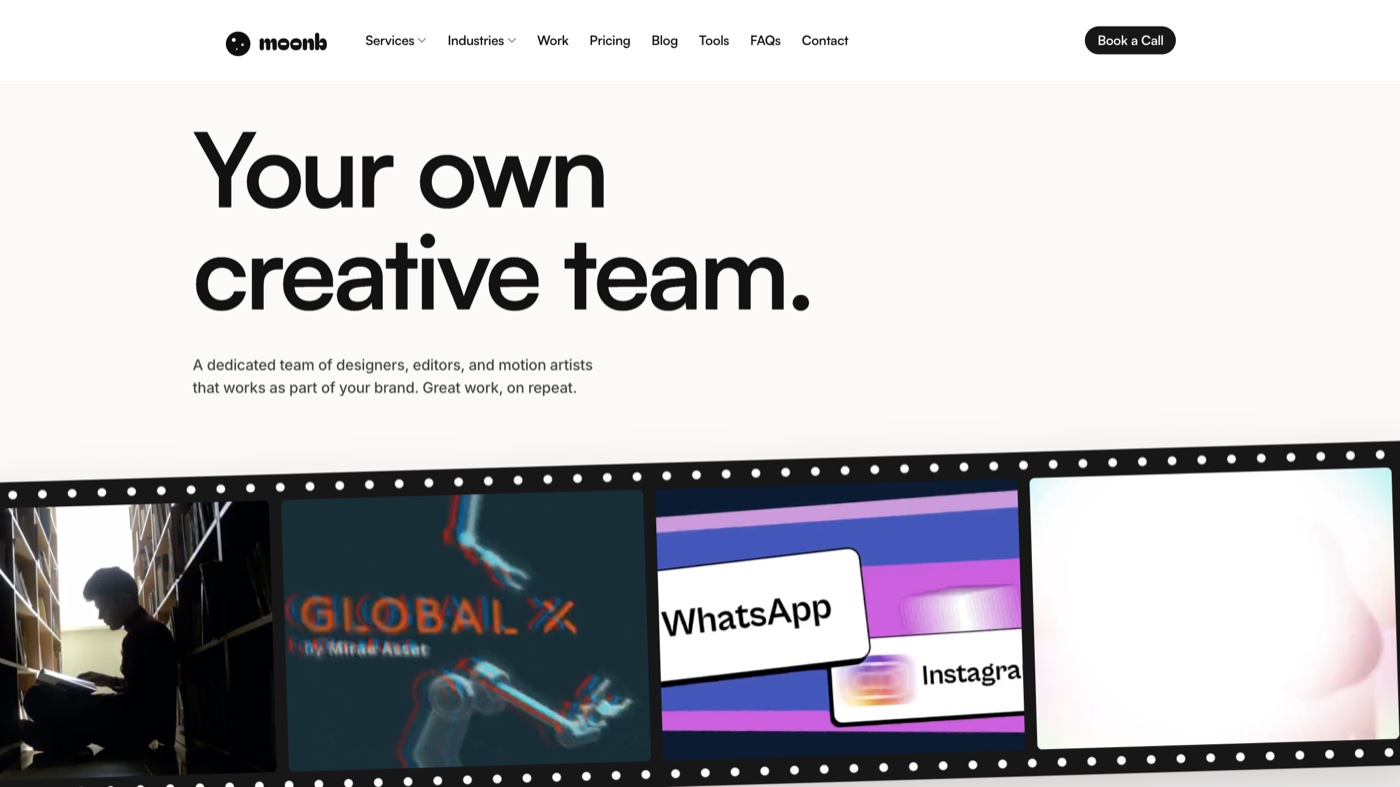
I work at Moonb, so read this entry with that in mind. Moonb is a dedicated creative team for marketing teams: designers, editors, motion artists and a Creative Director working as one unit on an ongoing monthly basis, so you are not re-explaining the brand every week.
- Best for: ongoing multi-format work across video, motion, design and brand content that needs real brand memory
- Pricing: not published; a set monthly cost, or a per-project quote when that suits the work
- Contract: monthly
- Video and motion: yes, core
- Review signal: 4.9 on Clutch
More on Moonb
Not publicly stated: pricing.
2. Superside
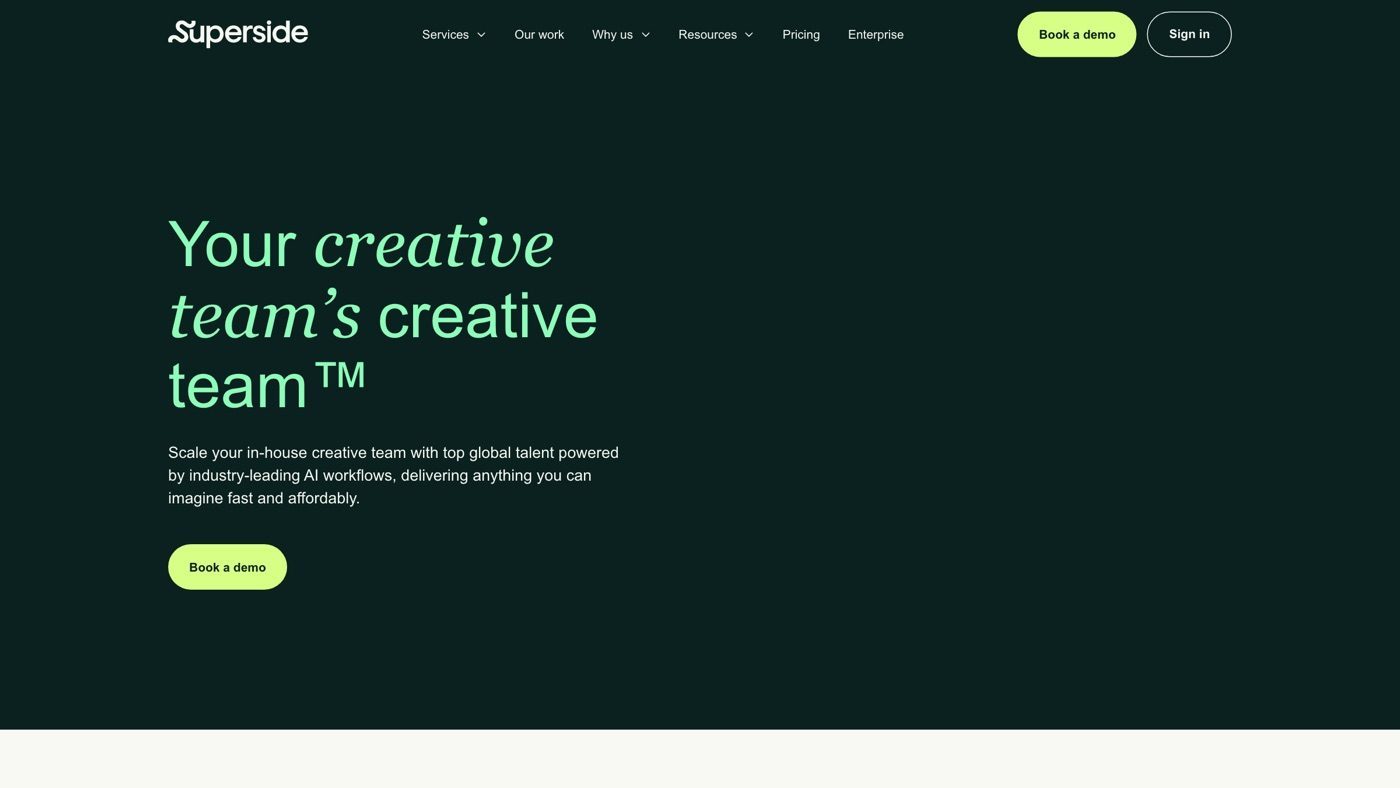
“Your creative team’s creative team.” Superside is the enterprise end of the category, a fully remote company contracting as Konsus Inc., with a Creative Director and project management on every account, specialist depth in motion, 3D, AR, video editing and audio, and the most explicit pricing page in the market.
- Best for: large marketing organisations that need mixed-media output at scale and can commit for a year
- Pricing: Flex from $15,000 a month plus a $1,000 monthly software fee; Dedicated from $30,000; unused Flex budget rolls over up to three months
- Contract: 12-month term, prepaid
- Video and motion: yes
- Review signal: 4.3 on Trustpilot from 389 reviews
More on Superside
Not publicly stated: a physical headquarters, cancellation terms. My colleague's Superside pricing guide works through the numbers.
3. Designity
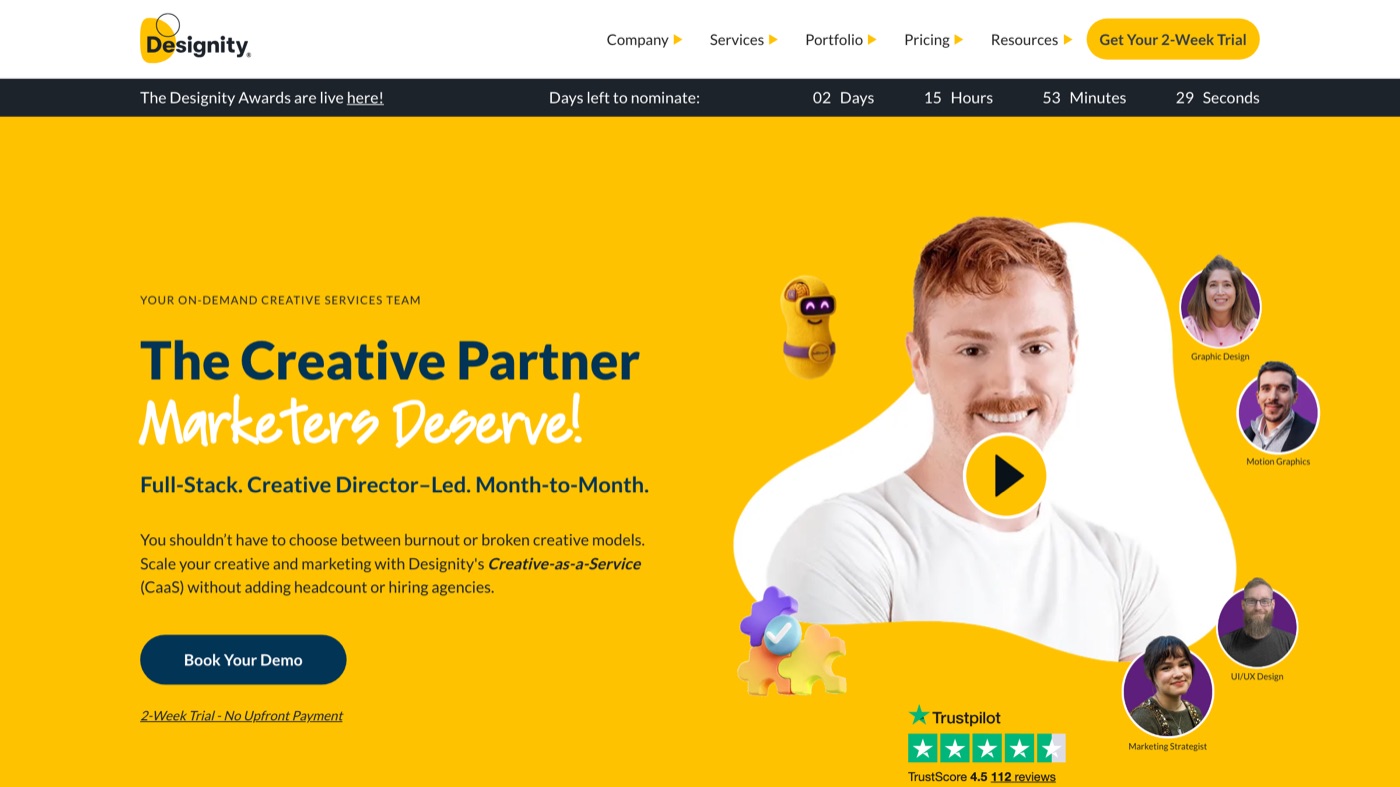
Designity, founded in New York in 2016, made the Creative Director “the client’s main point of contact” in 2017 and still sells that: a dedicated Creative Director leading a team, sized in dedicated hours, month to month.
- Best for: mid-market teams that want one accountable creative lead without an enterprise contract
- Pricing: Plus $5,995 a month for 120 dedicated hours, Premium $8,995 for 180, Custom from $6,000; quarterly billing takes $1,500 off per quarter and annual $10,800 a year
- Contract: month to month, seven days’ notice; two-week trial with no upfront payment
- Video and motion: marketed on the site; not itemised on the pricing page
- Review signal: 4.5 on Trustpilot from 111 reviews
More on Designity
Not publicly stated: Custom plan hours. See the Designity pricing guide.
4. Teamtown
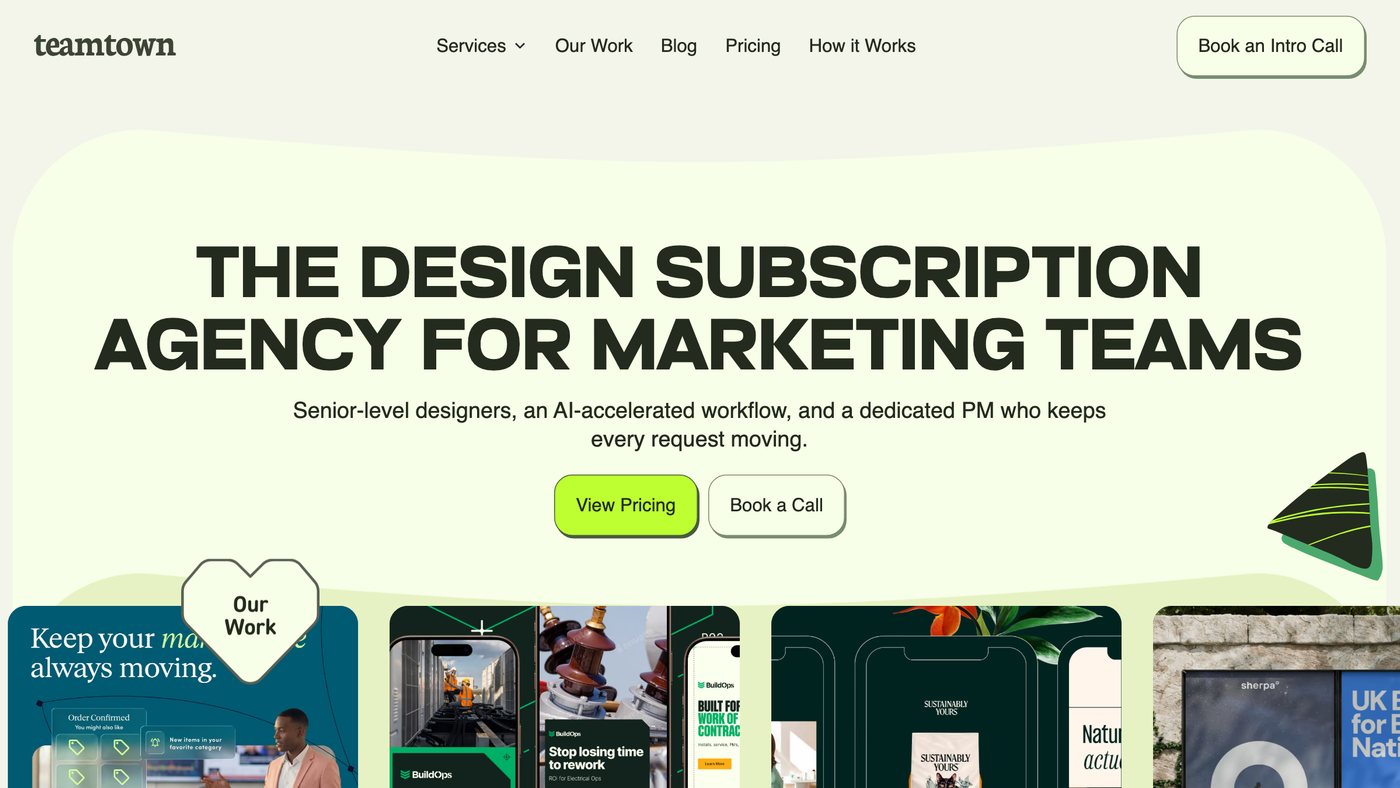
Teamtown sells “a dedicated creative team” with a project manager and a creative lead on every plan, and a fractional Creative Director, quarterly roadmaps and brand governance on its Studio tier. It is the clearest mid-priced version of the directed-team model.
- Best for: marketing teams that want a managed team with a creative lead between the queue price and the enterprise price
- Pricing: Essentials from $3,000 a month (two projects at a time), Pro from $4,500, Studio from $9,900 with hour packs from $9,450 for 90 hours to $19,680 for 240
- Contract: 15 days’ notice to pause or cancel; 15-day money-back guarantee; unused hours roll over one month
- Video and motion: simple video on Essentials; complex video, motion and 3D on Pro and Studio
- Review signal: 4.6 on Trustpilot from 18 reviews, none in the last 12 months
More on Teamtown
Not publicly stated: headquarters, team size.
5. Flocksy
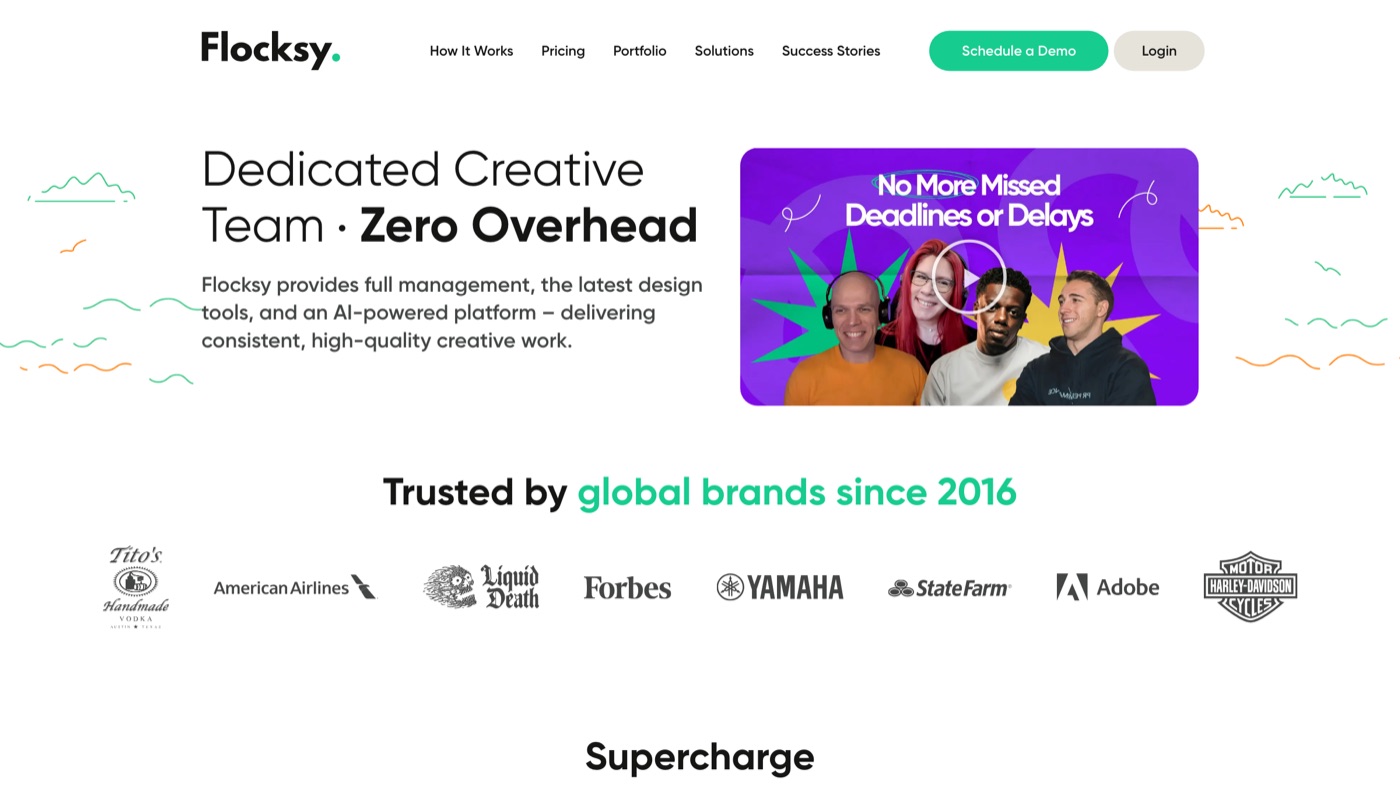
“Not an agency. Not a marketplace. A team of record.” Flocksy assigns the same designer, video editor, motion editor and illustrator to your account permanently and sells daily hours, from two to eight, with a Production Coordinator from four hours and an Art Director on every brief from six.
- Best for: teams that want fixed people across design and video with hours that roll over
- Pricing: two daily hours at $1,199 a month on annual billing or $1,699 monthly, up to eight hours at $3,799 annual or $5,899 monthly
- Contract: no contracts, cancel any time; 14-day money-back guarantee; unused hours roll over 30 days
- Video and motion: yes, on every plan
- Review signal: 4.5 on Trustpilot from 137 reviews
More on Flocksy
Not publicly stated: headquarters, creative locations, a pause policy.
6. Duck.design
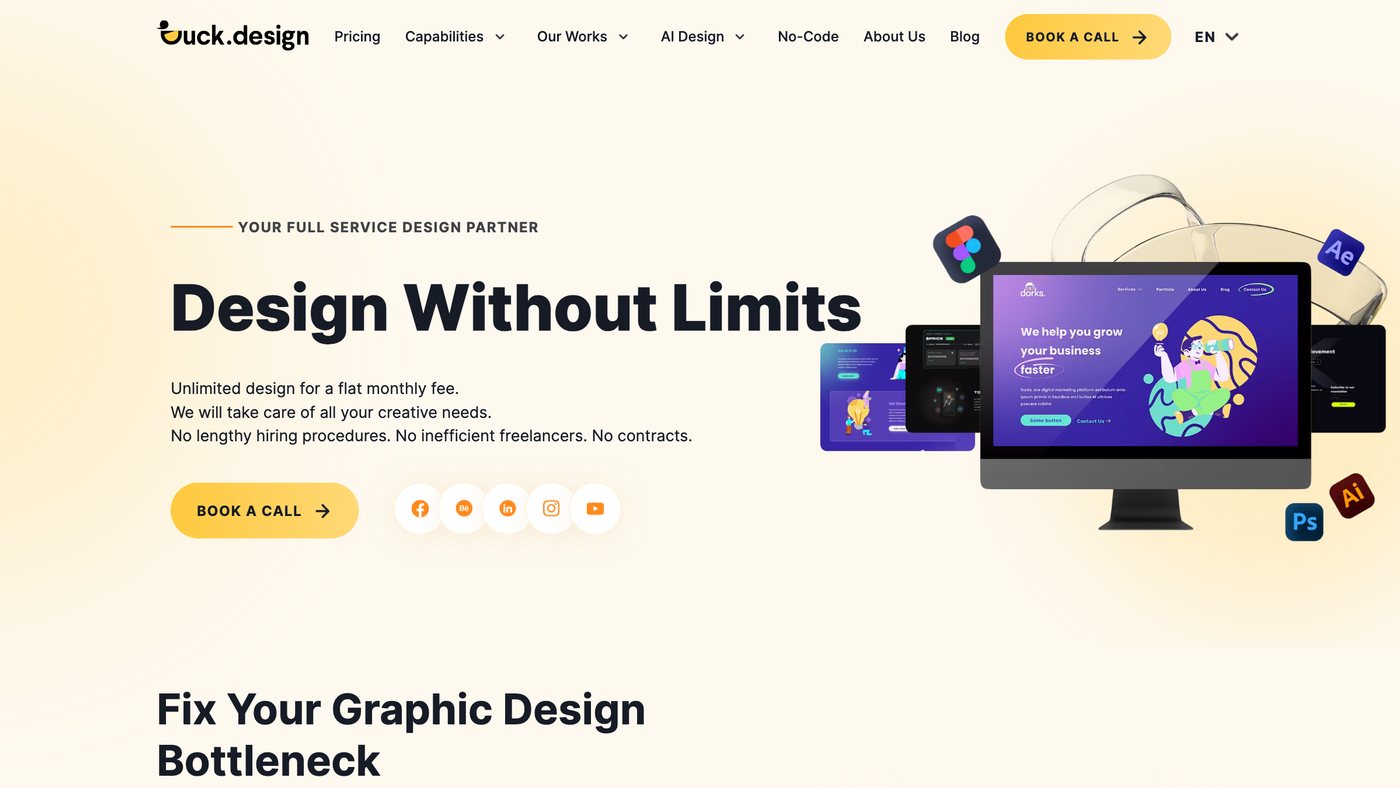
Duck.design, based in London, puts an Art Director, a mid-to-senior designer and a Project Manager on every plan and prices three tiers that add UX, motion and then no-code build. Its client logos are the most consumer-famous on this list.
- Best for: European and UK teams that want art direction included at a mid-market price
- Pricing: Visual $1,199 a month, Creative Suite $1,899, Build $1,999; three-month billing 10 percent lower, six-month 20 percent lower
- Contract: cancel any time; 7-day money-back guarantee; pause of up to seven days in month three
- Video and motion: explainer videos and animation from Creative Suite
- Review signal: 4.8 on Trustpilot from 98 reviews
More on Duck.design
Not publicly stated: designer locations, team size.
7. Deer Designer
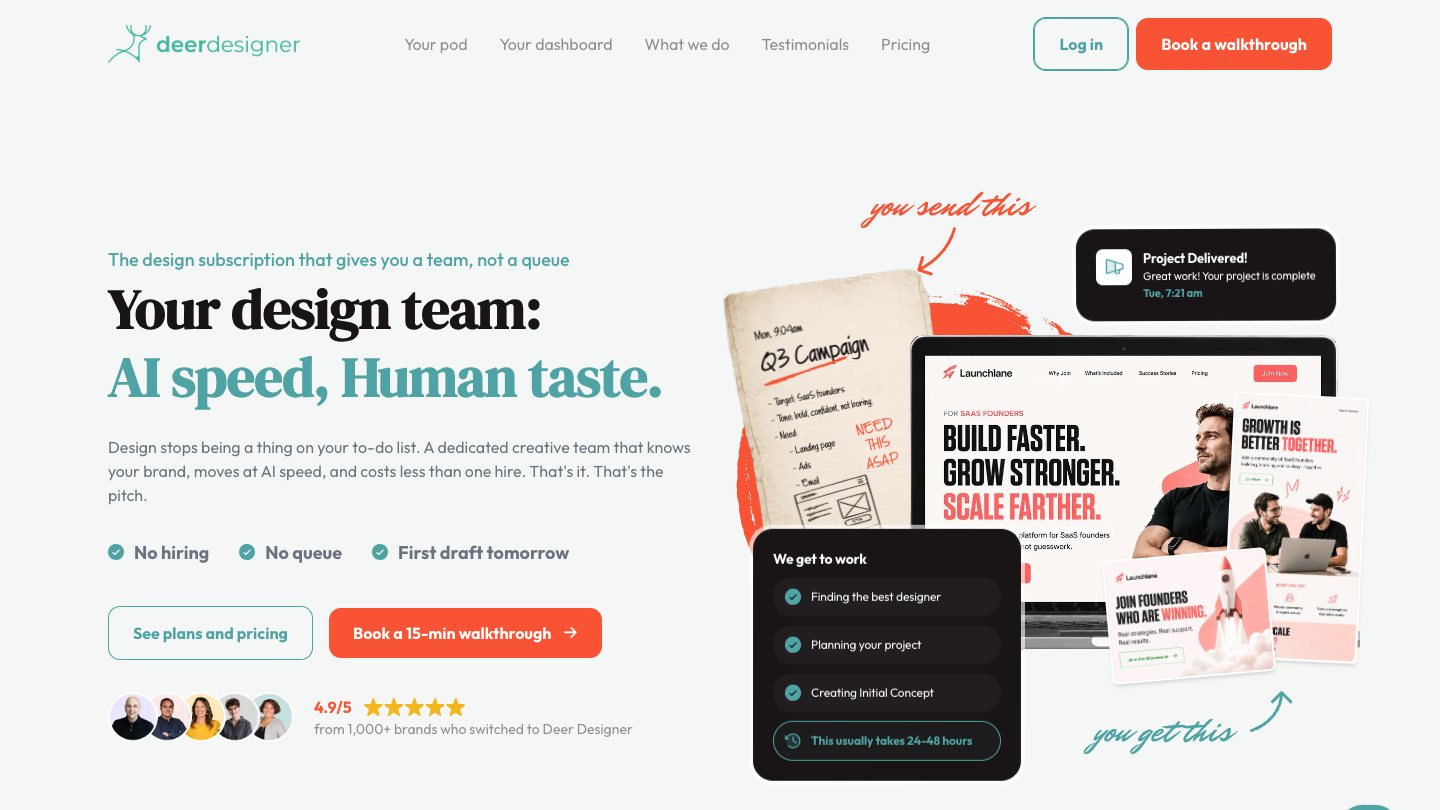
Deer Designer sells “simple, transparent pricing” for a designated designer, an account manager, a quality analyst and weekly video calls with a Creative Director, across three tiers. On the day I checked, its homepage showed a waitlist because “all our teams are now taken.”
- Best for: teams that want a named designer and a weekly Creative Director call for design-only work
- Pricing: Standard $1,199 a month, Business $1,899, Agency $3,499
- Contract: no contracts; pause free; cancel any time
- Video and motion: not offered
- Review signal: 4.7 on Trustpilot from 27 reviews
More on Deer Designer
Not publicly stated: operating location (only a Wyoming registered-agent address), team size.
8. Design Pickle
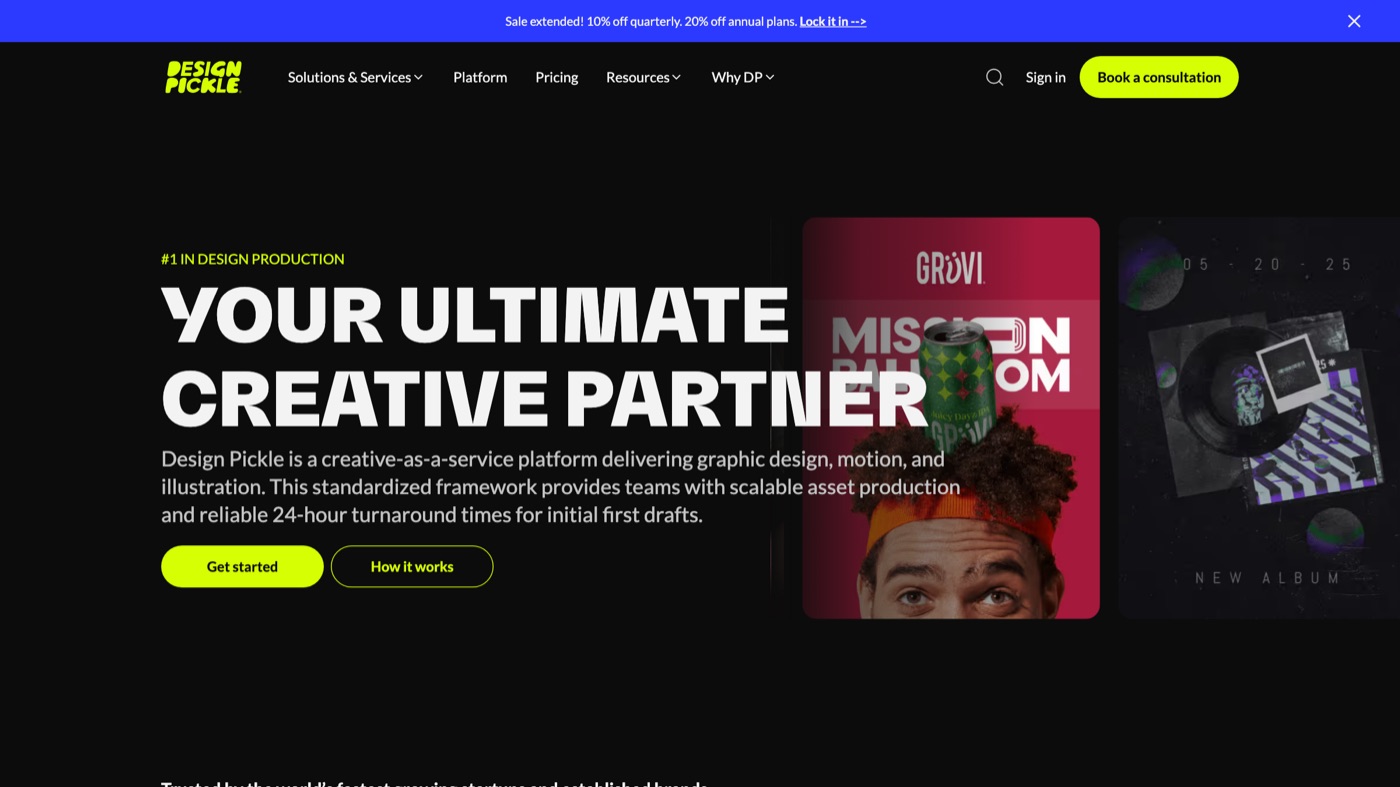
Design Pickle, based in Scottsdale, sizes plans by daily creative hours and sets the price on a consultation call: “Flat-rate, not hourly. No retainers.” Every plan includes a brand-trained team, next-business-day first drafts, human review and an art director on request.
- Best for: high-volume production design with a quality gate, for teams that can commit for a quarter or a year
- Pricing: not publicly stated; “you get the number on the call”
- Contract: quarterly or annual billing, auto-renewing; cancel before the renewal date
- Video and motion: motion yes
- Review signal: 3.4 on Trustpilot from 365 reviews; the company self-reports 4.4 on G2
More on Design Pickle
Not publicly stated: any price or tier. Every published term is in the Design Pickle pricing guide.
9. No Limit Creatives
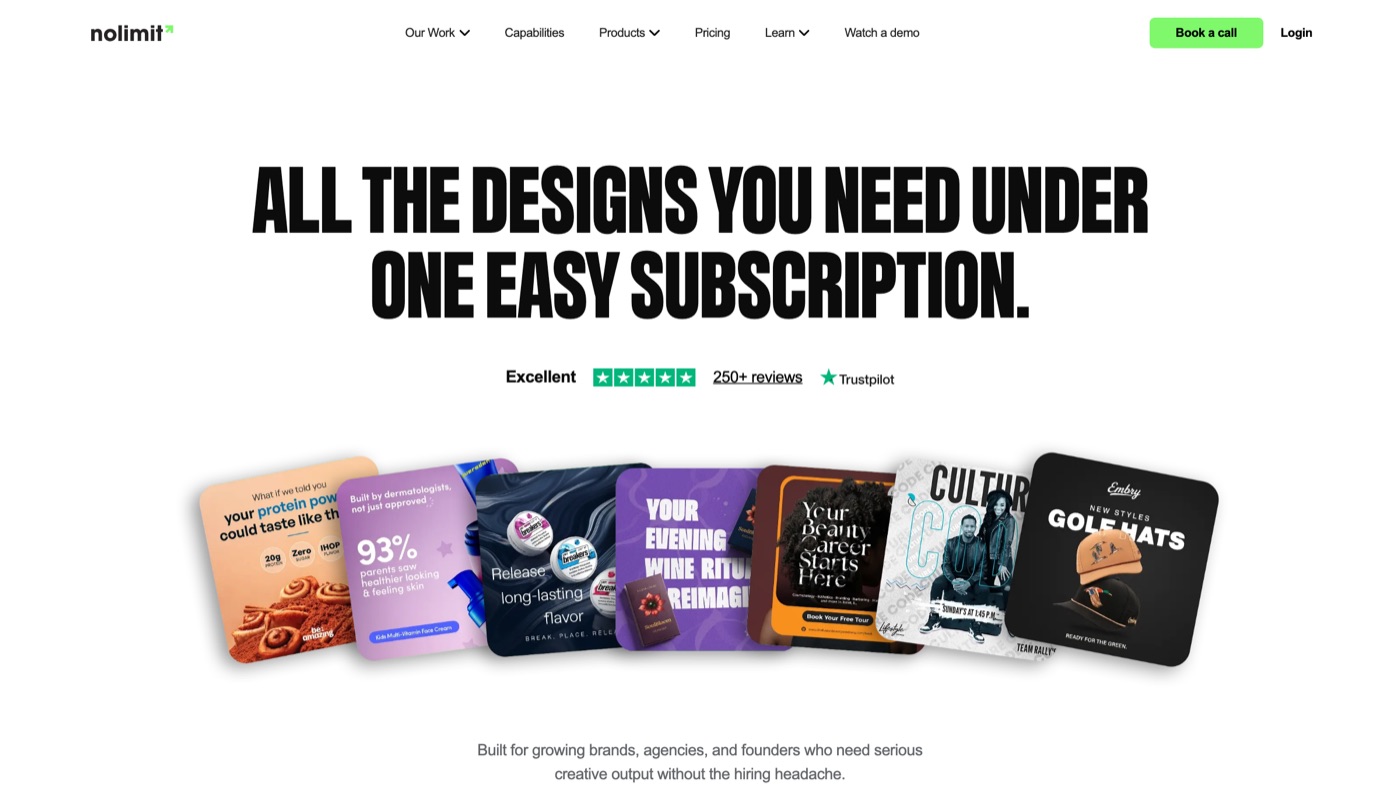
No Limit Creatives, based in Bend, Oregon, prices by active slots and support level: self-managed plans “for teams looking to manage their own briefs and creative direction,” and fully managed plans that add a dedicated Creative Director and project manager.
- Best for: dialling capacity up and down by slot, with creative direction available on the managed tier
- Pricing: from $500 a month for two self-managed digital-ad slots to $5,400 for six fully managed full-stack slots; more than six slots by call
- Contract: month to month, no contracts
- Video and motion: yes on the Full Stack plan
- Review signal: 4.9 on Trustpilot from 261 reviews on its older nolimitcreatives.com profile
More on No Limit Creatives
Not publicly stated: pricing above six slots, designer locations.
10. DotYeti
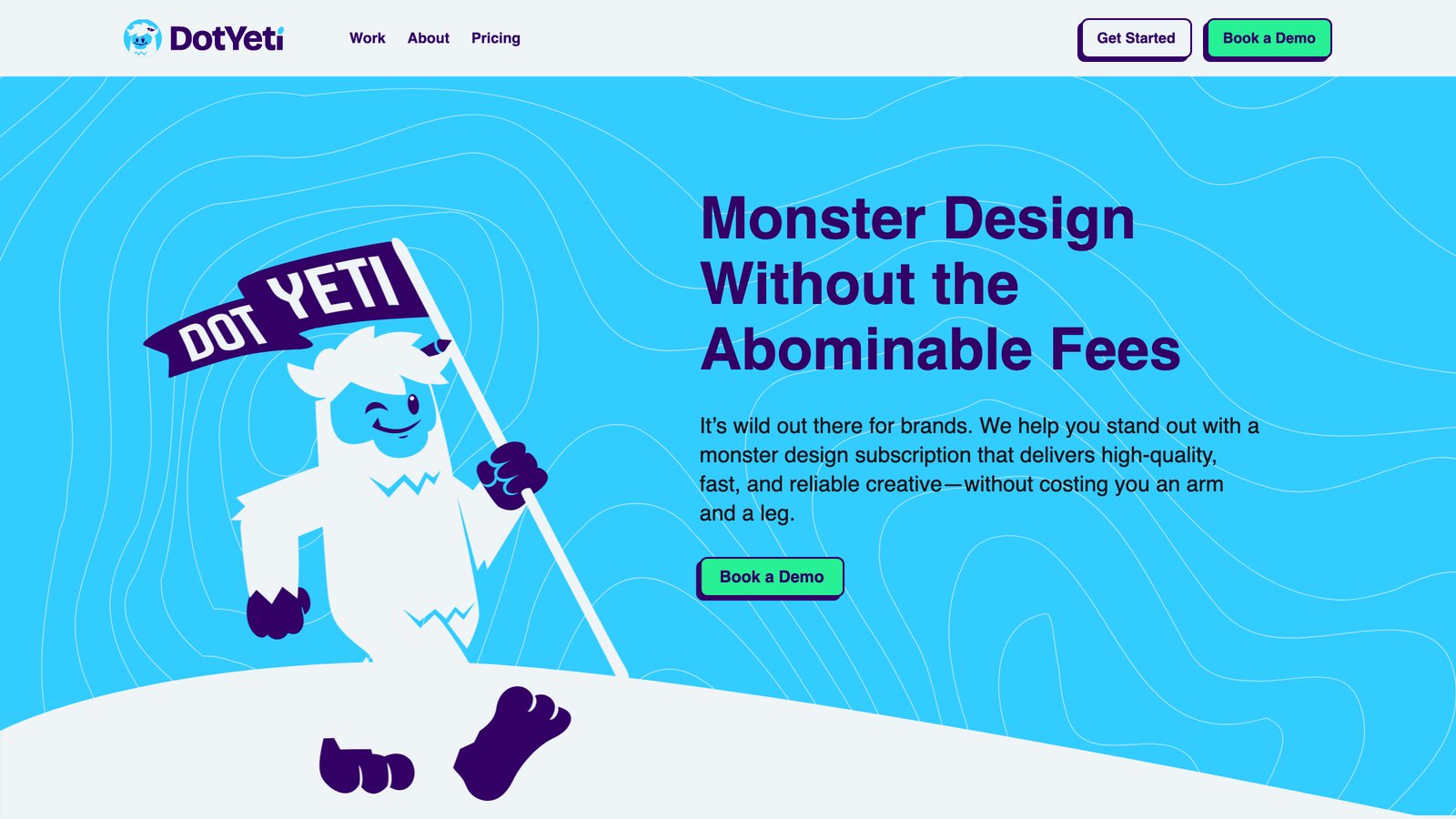
“Your creative department. For less than the cost of one hire.” DotYeti’s four tiers add people as they climb: an art director at Scale, an account manager plus motion, video editing and web at Summit, and campaign strategy, 3D and AI video at Apex Studio.
- Best for: marketing teams that want an art director at $1,595 and motion at $2,595 without an enterprise contract
- Pricing: Base $995 a month ($895 on a six-month prepay), Scale $1,595, Summit $2,595, Apex from $3,995
- Contract: month to month; 14-day money-back guarantee; one deferred billing cycle a year on Summit and Apex
- Video and motion: video ads from Scale, motion from Summit
- Review signal: 4.8 on Trustpilot from 47 reviews
More on DotYeti
Not publicly stated: headquarters, designer locations, the Apex price.
11. Penji
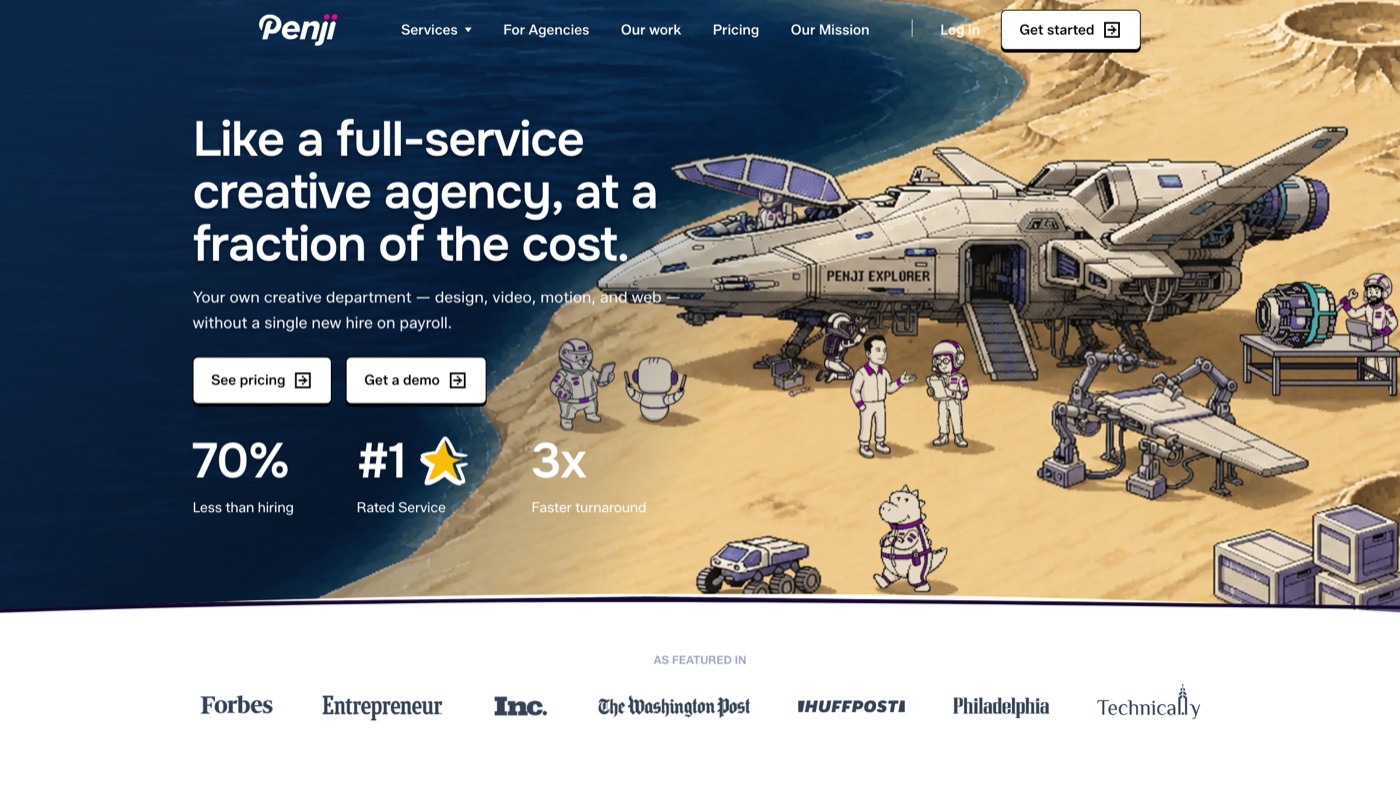
Penji, headquartered in Camden, New Jersey, is the deepest-reviewed design queue in the category, with three tiers that move from a matched designer and a project manager to a locked-in senior pod with a senior art director.
- Best for: dependable everyday marketing design with a money-back window instead of a sales call
- Pricing: Essentials $995 a month, Agency Partner $1,995, Dedicated Team from $4,500; 15 percent off quarterly, 20 percent off yearly
- Contract: no contracts, cancel any time; 30-day money-back guarantee
- Video and motion: from Agency Partner at $1,995
- Review signal: 4.8 on Trustpilot from 392 reviews
More on Penji
Not publicly stated: a pause option, support hours. Full detail in the Penji pricing guide.
12. ManyPixels
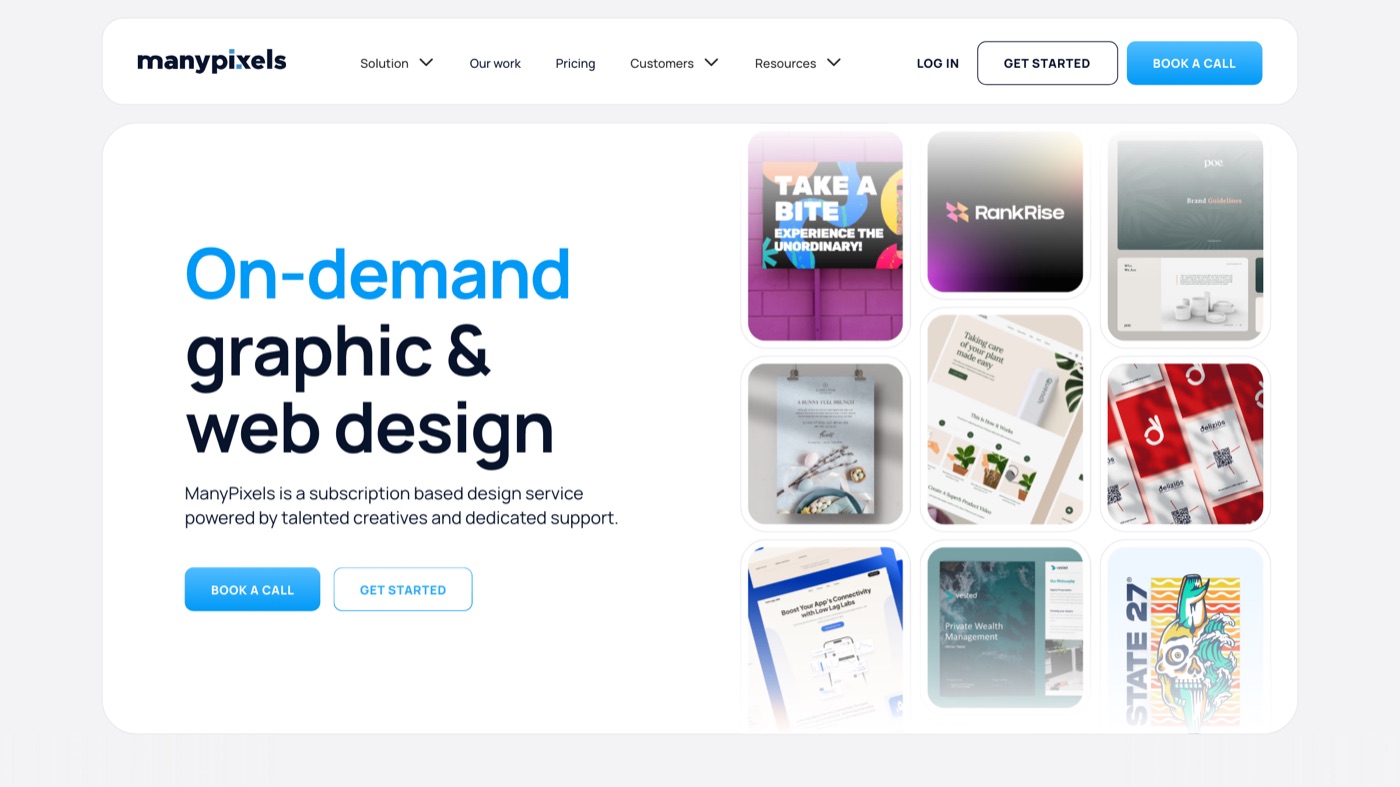
“All-inclusive plans. No contracts.” ManyPixels, operating from Singapore since 2018, publishes every rate for every billing cycle and transfers full copyright on every plan, with output-based tiers below and named part-time designers above.
- Best for: simple, repeatable design requests with a visible price and files you own outright
- Pricing: Advanced $699 a month, Business $1,199, Assigned Designer $1,399, Design Team $2,599; down to $559 to $2,079 on yearly billing
- Contract: cancel any time, no fees; pause for $10 a month
- Video and motion: motion graphics and video editing listed
- Review signal: 4.8 on Trustpilot from 149 reviews
More on ManyPixels
Not publicly stated: a trial, designer countries. See the ManyPixels pricing guide.
13. Kimp
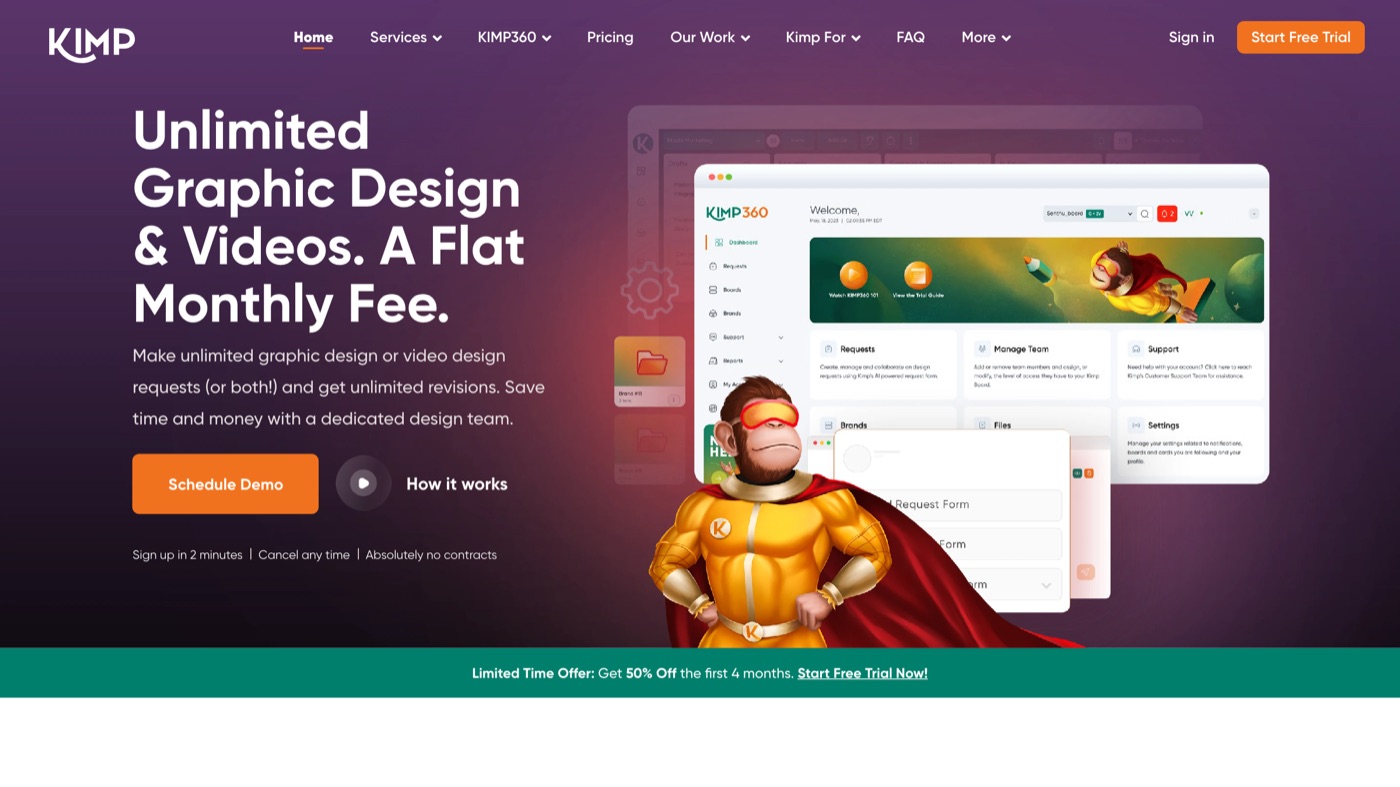
Kimp, based in Markham, Ontario, sells graphics and video plans separately or combined, with a fixed team of one project manager and three designers per client and a published production cadence. Its pricing page renders prices by script, so the numbers below come from Kimp’s own July 2026 post and my own check.
- Best for: repeatable social assets and short video from one plan, with a seven-day trial
- Pricing: Graphics $1,397 a month, Video $1,397, Graphics plus Video $1,697; a 50 percent promotion on the first four months was running
- Contract: month to month, “absolutely no contracts”; pause for $19.95
- Video and motion: yes, on the Video and combined plans
- Review signal: 4.9 on Trustpilot from 353 reviews
More on Kimp
Not publicly stated: quarterly and annual prices. The Kimp pricing guide has the capacity maths.
14. Awesomic
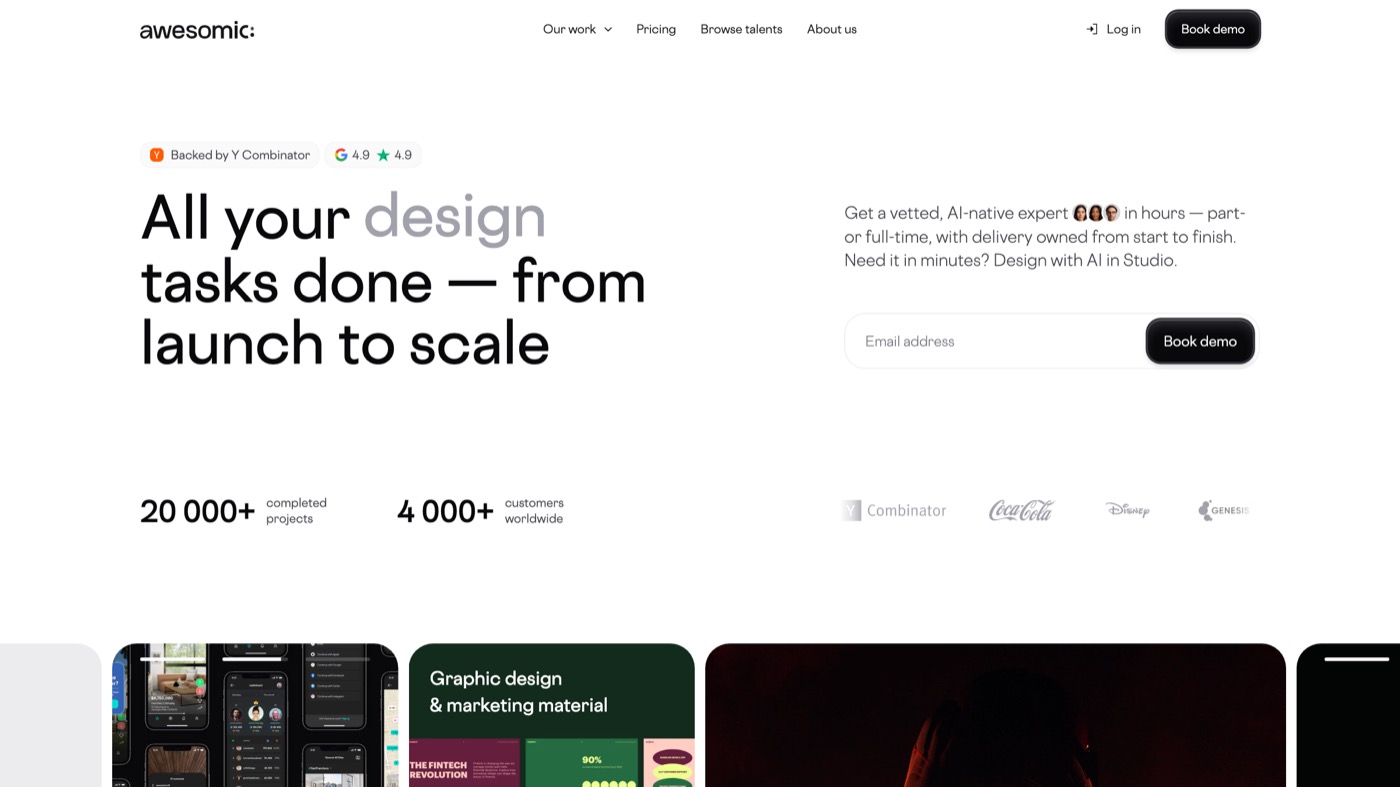
Awesomic, a San Francisco and Y Combinator company, says it matches you with a vetted designer within 24 hours and lets you rematch at no cost. Its tiers move from a design pack to an all-in-one plan that adds no-code, copywriting and QA.
- Best for: startups that want a fast match and one vendor for design, Webflow and copy
- Pricing: Graphic Pack $1,490 a month or $1,190 on a quarterly commitment; All-in-One $2,995 or $2,396 quarterly; Dedicated Talent by demo; a $200 AI Designer tier is software, not a person
- Contract: month to month; quarterly plans carry a three-month minimum
- Video and motion: not itemised on the pricing page
- Review signal: 4.8 on Trustpilot from 63 reviews
More on Awesomic
Not publicly stated: hours behind part-time, a trial or refund, talent locations.
15. Delesign
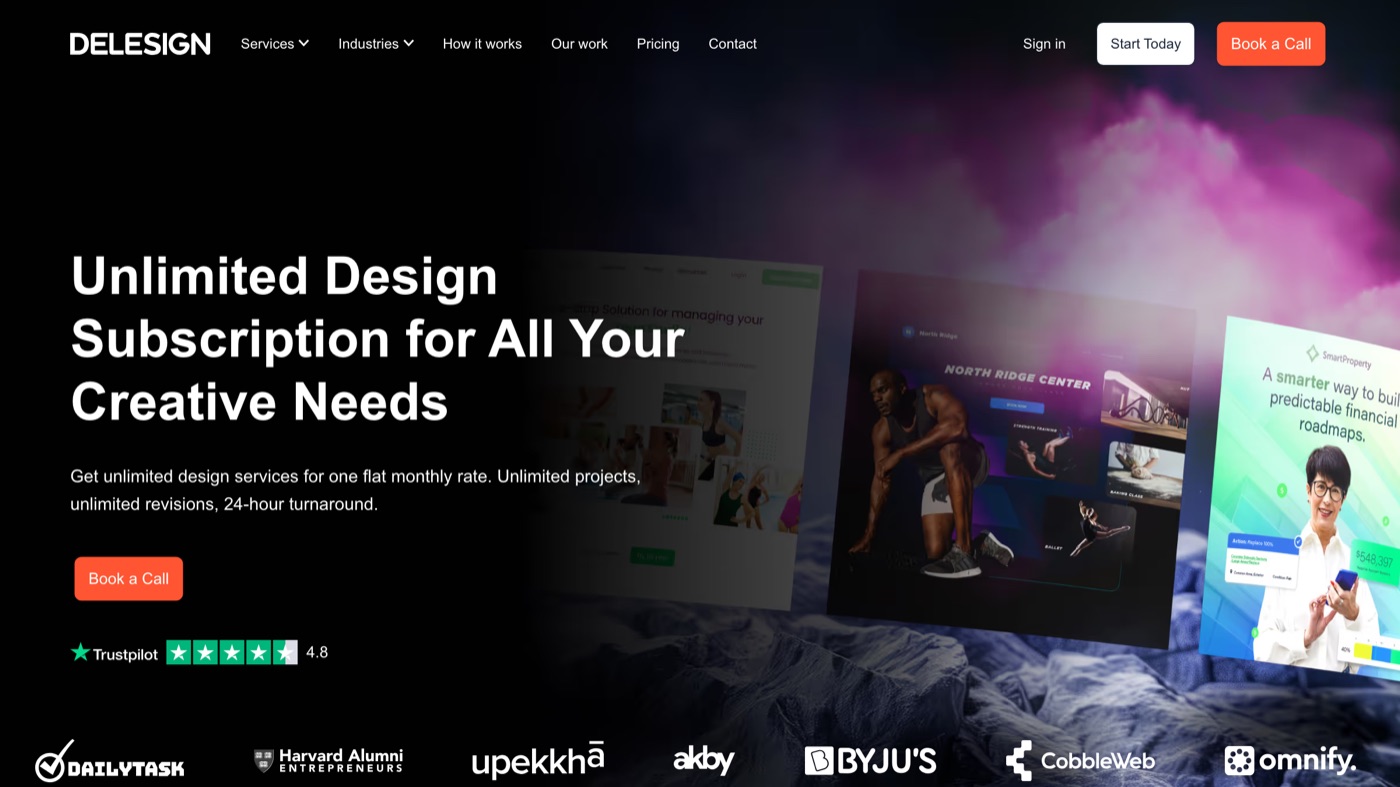
Delesign positions its designers as people who “work with you as part of your team,” with a dedicated designer and a design manager on each plan, Slack, white-labelled output and full copyright. Its terms reference a Philippines-based team working Pacific hours.
- Best for: agencies and small marketing teams that want a named designer at a low price and can live with two-to-three-day turnaround
- Pricing: Marketer Growth $649 a month; Agency Booster $849 with web design, video editing, animation and motion; Enterprise custom
- Contract: cancel any time; 15-day money-back guarantee
- Video and motion: from Agency Booster at $849
- Review signal: 4.8 on Trustpilot from 45 reviews
More on Delesign
Not publicly stated: headquarters, team size.
16. Draftss
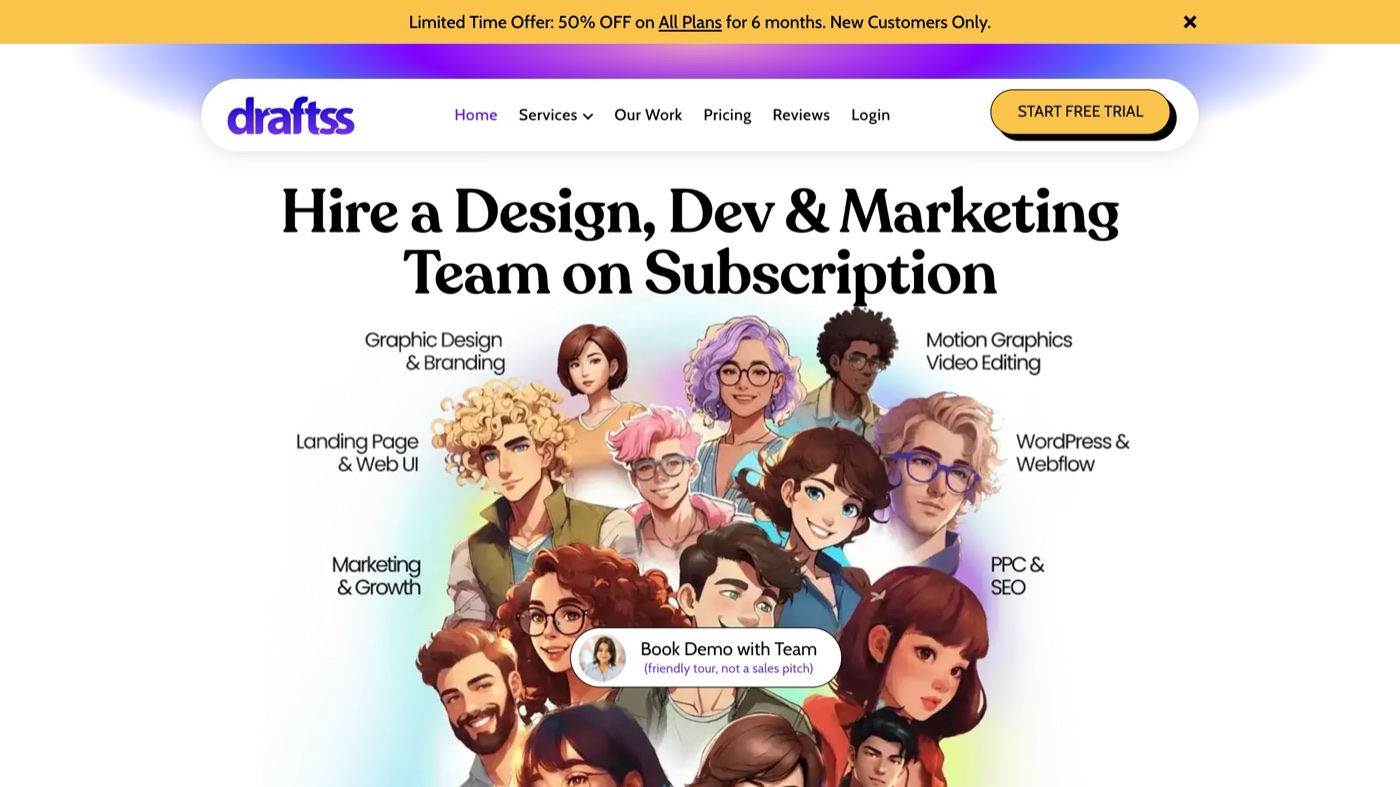
“Your on-demand creative team.” Draftss, placed in Mumbai by third-party profiles, sells graphic, creative and full-team tiers by active task count, with a project manager, white label, NDA and full IP transfer on each, under a promotion that halves the first six months.
- Best for: startups and agencies that want the lowest entry price on this list and can plan for the price to double after six months
- Pricing: Graphic Team from $265 a month for one active task on promotion ($530 regular); Creative Team from $595 ($1,190); Full Team from $1,390 ($2,780)
- Contract: no contracts; cancel or pause; seven-day trial
- Video and motion: from Creative Team
- Review signal: 4.5 on Trustpilot from 123 reviews
More on Draftss
Not publicly stated: headquarters on its own site, designer locations.
17. Kapa99
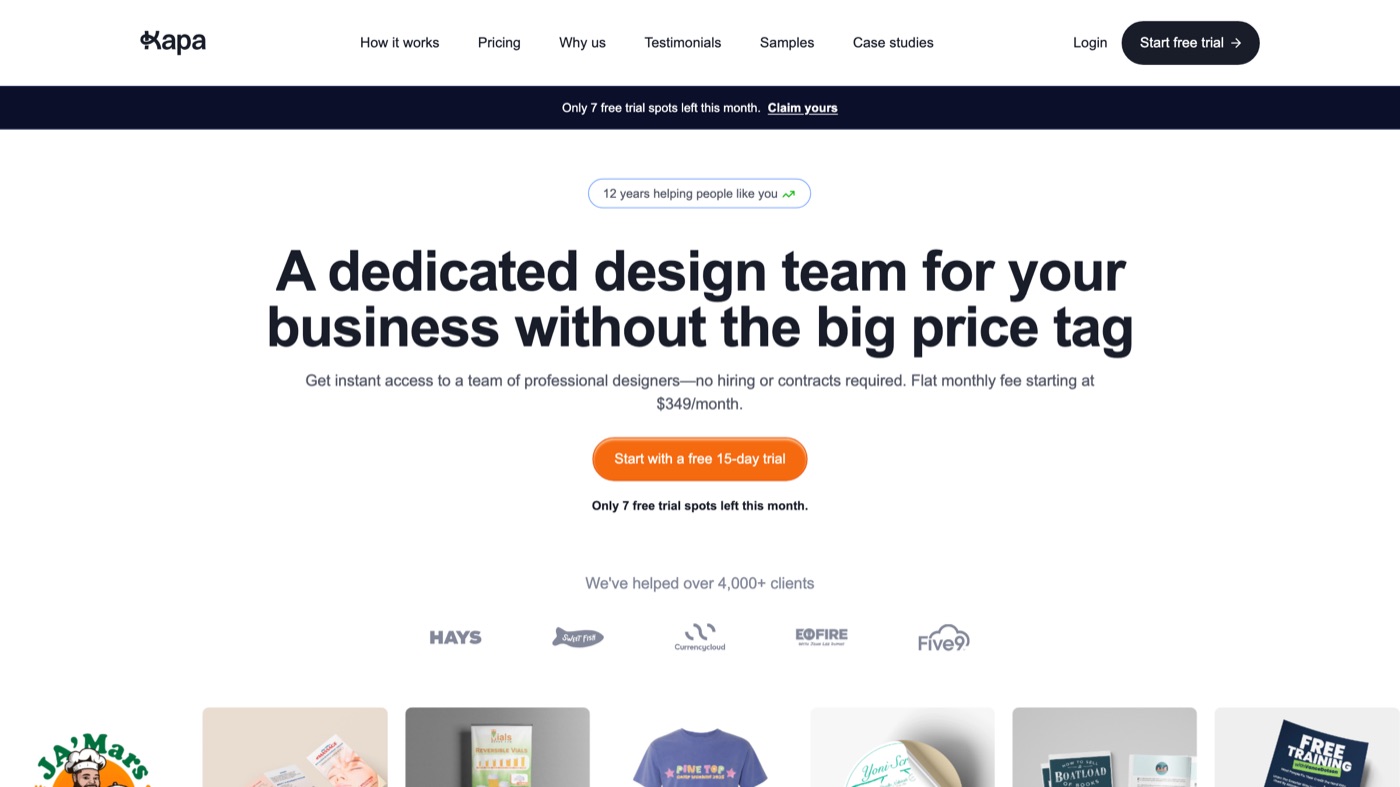
Kapa99 sells “a dedicated design team for your business without the big price tag,” routing each task to a specialist by type, with a project manager and quality assurance, and claims twelve years and 4,000-plus clients.
- Best for: small teams comfortable with asynchronous, two-day delivery at the lowest tier
- Pricing: Async standard $499 a month ($349 for the first two months), Async priority $999 ($849), Dedicated team $2,500 ($2,000)
- Contract: no contracts, cancel any time; 15-day trial; 30-day money-back guarantee
- Video and motion: not stated on the pages I checked
- Review signal: 4.2 on Trustpilot from seven reviews, none in the last 12 months
More on Kapa99
Not publicly stated: headquarters, video and motion, team size.
18. Graphically
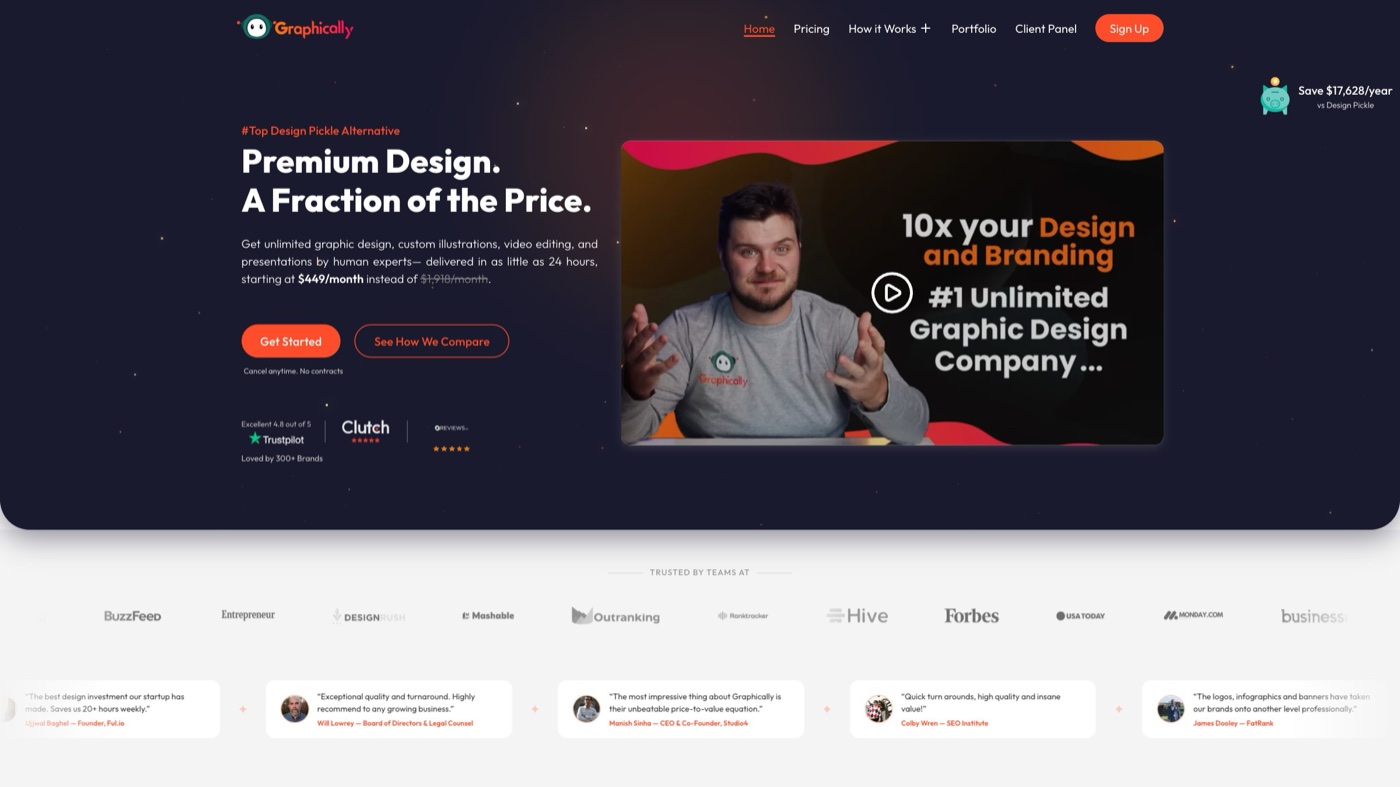
“Premium design. A fraction of the price.” Graphically operates from Canada and India and sells two plans, one project at a time or three, with a dedicated project manager and a talent list that includes motion designers and video editors.
- Best for: budget-conscious teams that need one steady design project at a time
- Pricing: Standard $449 a month ($399 quarterly, $349 yearly); Premium $599 ($549, $499)
- Contract: monthly cancel any time; quarterly and yearly run their full term with no mid-term refunds; 7-day money-back guarantee
- Video and motion: yes
- Review signal: 4.3 on Trustpilot from 42 reviews
More on Graphically
Not publicly stated: named customers, team size.
19. Design Shifu
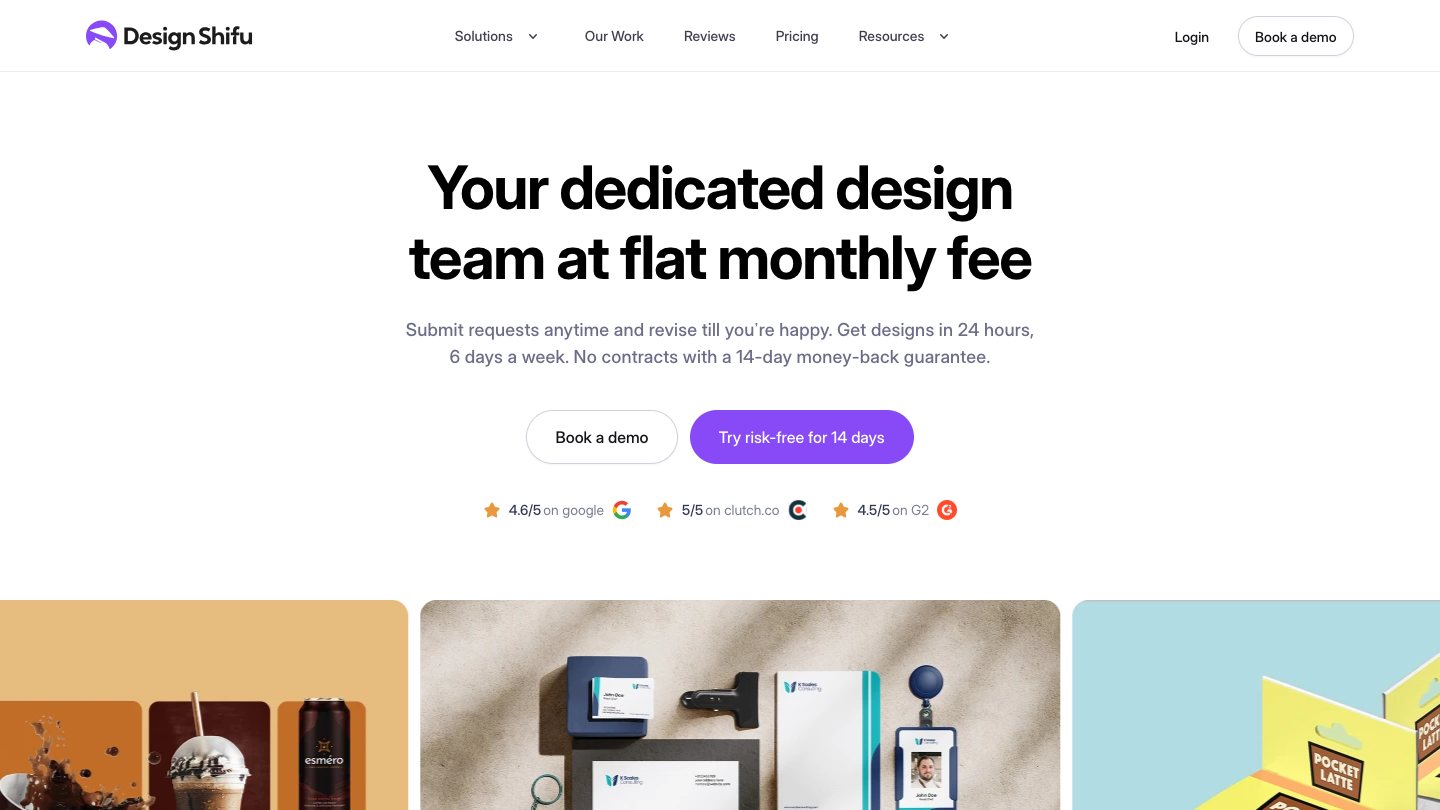
Design Shifu, founded in 2018 and operated by Design Sensei LLC, is a flat-rate design service with three tiers that add illustration and UX at Growth and motion at Scale, with two designers and an account manager on the entry plan.
- Best for: small teams that want one project a day with a 24-hour turnaround at a low price
- Pricing: Starter $549 a month, Growth $749, Scale $1,099; annual billing $458, $625 and $916
- Contract: pause or cancel any time; no contracts; 14-day money-back guarantee
- Video and motion: Scale only
- Review signal: 3.7 on Trustpilot from one review
More on Design Shifu
Not publicly stated: operating location (Wyoming registered agent only), team size.
20. Designjoy
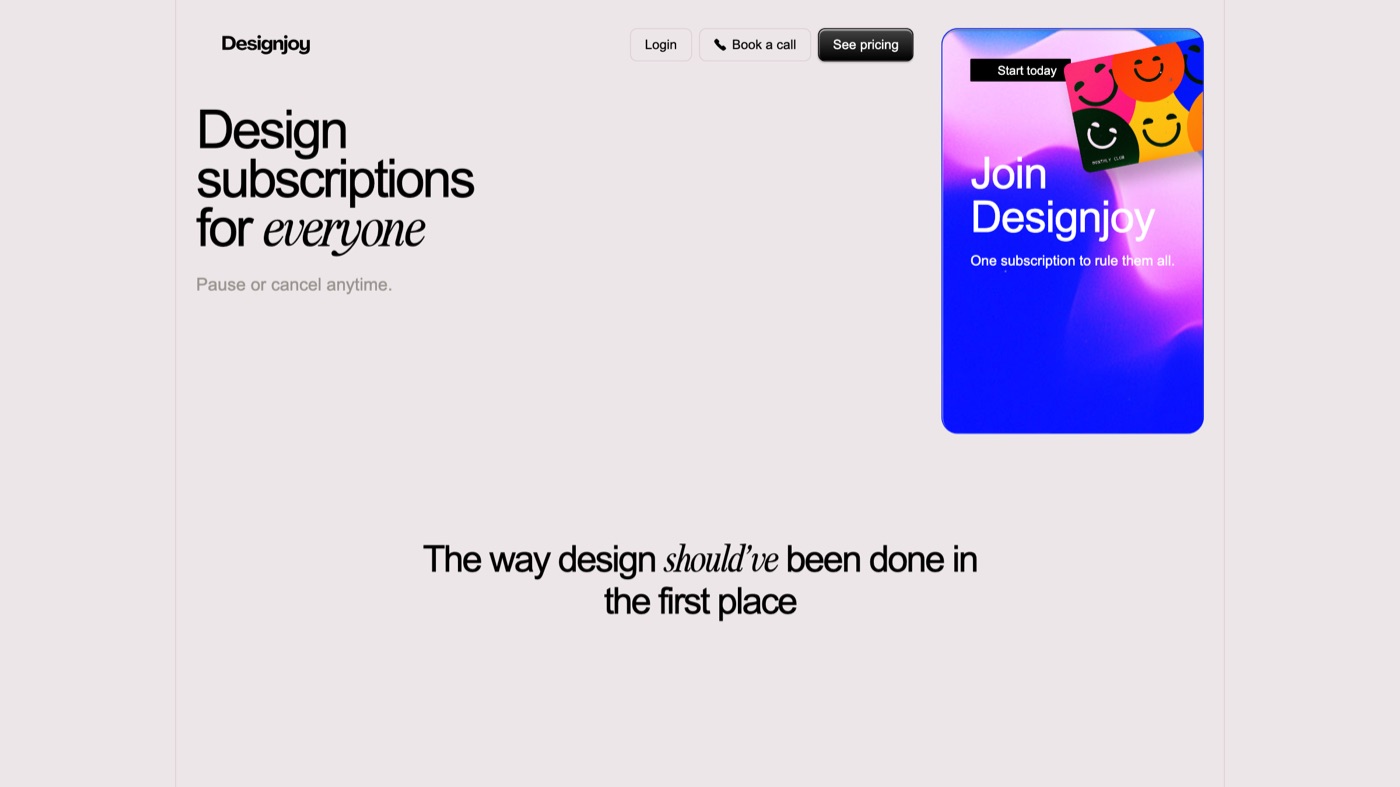
Designjoy is one designer, its founder Brett, in Phoenix, working directly with a limited roster at one request at a time. It is the purest productised model and the most copied one, and it excludes video and motion by design.
- Best for: founders who want one senior hand on product, web and brand work
- Pricing: Monthly Club $4,995 a month, shown against $5,995
- Contract: pause or cancel any time on 31-day cycles; 75 percent back within the first week
- Video and motion: not offered
- Review signal: 3.3 on Trustpilot from two reviews, too thin to mean anything
More on Designjoy
Not publicly stated: working hours, response targets, how long the current price holds.
Every provider in one table
| Provider | Model | Starting price, own site | Contract | Video and motion | Trustpilot |
|---|---|---|---|---|---|
| Moonb | Directed team | Set monthly rate or per-project quote | Monthly | Core | 4.9 on Clutch |
| Superside | Directed enterprise team | $15,000 + $1,000 fee | 12 months prepaid | Yes | 4.3 (389) |
| Designity | Creative Director-led, hours | $5,995 | Month to month | Marketed, not itemised | 4.5 (111) |
| Teamtown | Managed team | From $3,000 | 15 days' notice | Yes, complex from Pro | 4.6 (18) |
| Flocksy | Fixed team, daily hours | $1,199 annual / $1,699 monthly | None | Yes, all plans | 4.5 (137) |
| Duck.design | Managed team with Art Director | $1,199 | None | From $1,899 | 4.8 (98) |
| Deer Designer | Named designer + CD calls | $1,199 | None | No | 4.7 (27) |
| Design Pickle | Daily hours | Not published | Quarterly or annual | Motion | 3.4 (365) |
| No Limit Creatives | Slots | $500 | Monthly | Full Stack plan | 4.9 (261) |
| DotYeti | Tiered queue | $995 | Monthly | From $1,595 | 4.8 (47) |
| Penji | Queue | $995 | None | From $1,995 | 4.8 (392) |
| ManyPixels | Queue | $699 | None | Listed | 4.8 (149) |
| Kimp | Fixed team of four | $1,397 | Monthly | Video plan | 4.9 (353) |
| Awesomic | Matched talent | $1,490 | Monthly or quarterly | Not itemised | 4.8 (63) |
| Delesign | Named designer | $649 | None | From $849 | 4.8 (45) |
| Draftss | Queue by active task | $265 promo / $530 | None | From Creative Team | 4.5 (123) |
| Kapa99 | Async queue | $499 ($349 promo) | None | Not stated | 4.2 (7) |
| Graphically | Queue | $449 | Monthly; prepaid terms fixed | Yes | 4.3 (42) |
| Design Shifu | Queue | $549 | None | Scale only | 3.7 (1) |
| Designjoy | Solo | $4,995 | 31-day cycles | No | 3.3 (2) |
How to choose the right creative partner
Start with the work itself. If you need a lot of repeatable design, ads and social assets, a queue may be enough, and the table above shows you can get one from $449 to $1,500. If you need brand memory, several formats and someone to carry context from brief to brief, a managed or directed team is the better fit, and that starts around $3,000 and runs past $15,000. If your team has strong internal strategy but weak production capacity, a dedicated execution partner can carry a lot of the load.
Part of what you are buying is original thinking, which is harder to spot than polish. Adam Grant’s TED talk on how original thinkers actually work is a useful watch before you judge a provider’s portfolio, because it names what to look for beyond a clean reel.
Then look at ownership: who makes the creative calls, who holds the brand guide, and who signs off before work ships. A provider that cannot name the decision-maker usually creates friction later.
Practical rule: ask for recent work in your category, not a highlight reel. A provider’s best-case portfolio is less useful than its most relevant recent work.
Before you commit, check a few things in writing: how revisions work, how scope is capped, who owns source files, and whether the team that sells the work is the team that produces it. If motion or video matters, ask for examples of that exact format; on this list it is gated more often than not. If your brand is regulated, ask how approvals are handled in practice. A paid pilot on a real brief is the cleanest test, and several providers here make it low-risk: Penji refunds the first month, Flocksy, DotYeti and Design Shifu give you 14 days, Designity gives you two weeks before you pay anything.
If you are still sorting the model itself, our guide to building an in-house creative team is a useful companion, along with the piece on what branding costs. If the work is video-first rather than design-first, the video production companies roundup covers studios and directed teams built for that, and the Design Pickle alternatives and Superside alternatives lists go deeper on each end of this market.
Further reading: Picjam-linked fashion modeling insights, Business Research Insights market report page, A-to-Z content scaling guide, ClipCreator.ai guide to AI content creation tools.
One more view worth twenty minutes
Adobe’s framing of creative production as a content supply chain, planning, production and delivery, is the enterprise lens most buyers of creative-as-a-service are already using, whether or not they call it that.
Frequently asked questions
It depends on the model, not a single headline number. Productized queues that bill on a recurring plan sit at the lower end, dedicated embedded teams cost more because you are paying for continuity and senior direction, and video-led work runs higher again. Treat any figure you find online as a starting point, then price it against the volume and the number of formats you actually need. The lowest-priced plan is rarely the lowest total once revisions and rework are counted.
Some can, many cannot. Broad providers and dedicated teams cover design, motion, and video under one relationship, while specialists deliberately stay narrow, a video shop for video or a design queue for static assets. Match the provider to your real format mix. If most of your work is static social graphics with the occasional edit, a design-led queue is fine. If video is central, start with a team that treats it as a first-class output rather than an add-on.
Get four things in writing: who owns the source files, who makes the final creative call, how revisions and scope are capped, and whether the team that sold you the work is the team that produces it. Then run a small paid pilot on a real brief. It shows how they scope, how they communicate, and whether they hold the brand steady when the work gets messy, which no sales call can tell you.