Design Pickle Pricing in 2026: What You Can Learn Before the Call
Design Pickle no longer publishes prices. Here is everything its own pages do say about how plans are sized, billed, renewed, refunded and paused, plus what to ask on the call.

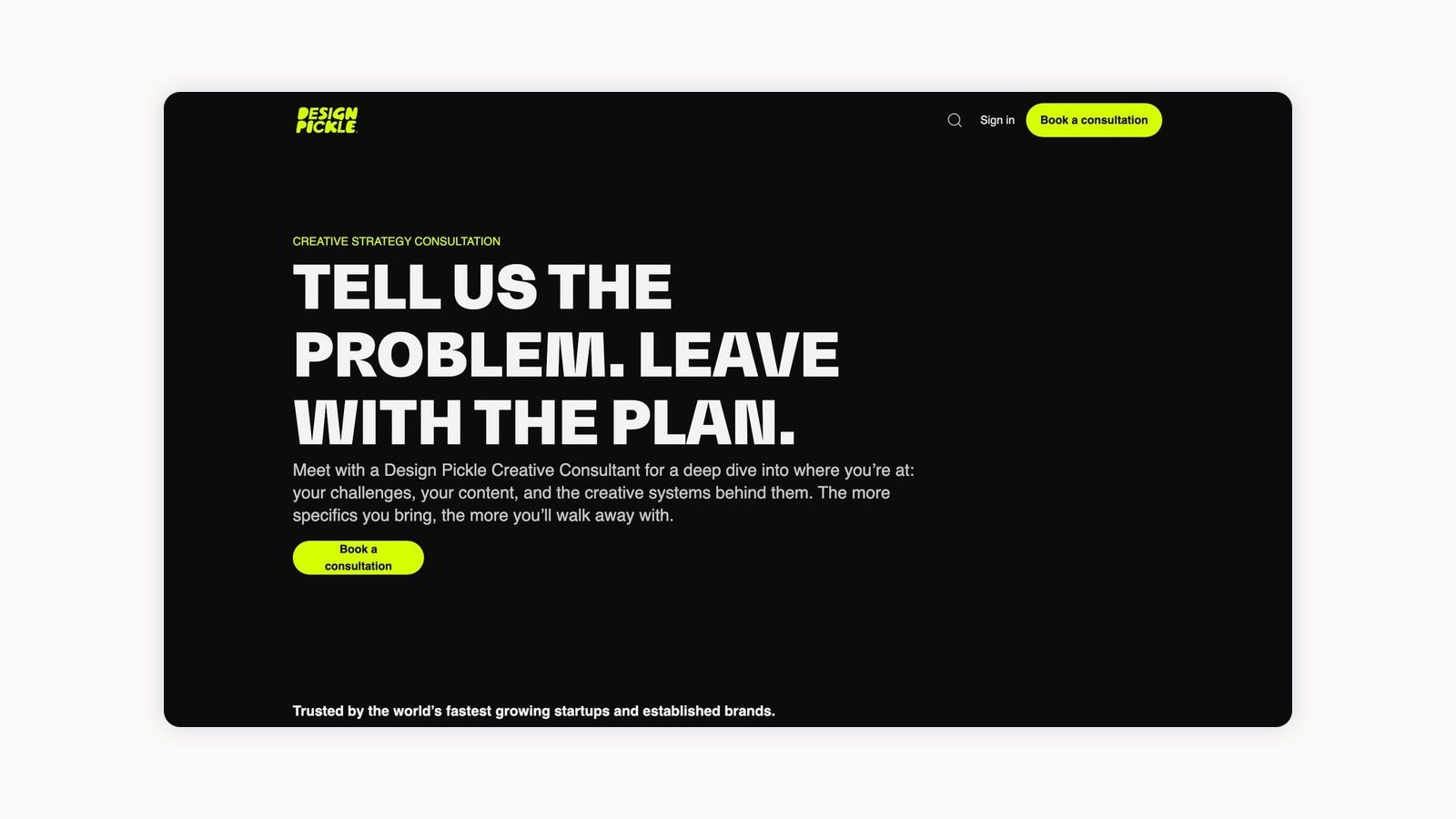
Design Pickle does not publish a price in 2026. Its pricing page is a consultation booking form headed “Tell us the problem. Leave with the plan,” and the one line about money says “Flat-rate, not hourly. No retainers. We size your plan to what you need. You get the number on the call.” What the company does publish, across its help center, is how plans are sized, how billing works, when you can cancel, and what happens to your money if you miss a renewal. That is what this article collects.
I co-founded Moonb, and Design Pickle competes with us, so treat this as a competitor’s careful reading of public pages rather than an endorsement. Every fact links to the page it came from, checked when this was written. Where the company does not publish something, I write “not publicly stated” instead of quoting a number from a third-party roundup, because the old tier prices that still circulate online are exactly that: old.
If you only want the short version:
- Price: not published; set on a consultation call
- How plans are sized: by daily creative hours, starting at two hours a business day
- Billing: quarterly or annual only, auto-renewing
- Refunds: none for unused time once a period renews
- Cancel: before the next renewal date; the account stays active to the end of the paid period
- Pause: move to a platform-only plan without creative services
How Design Pickle sizes a plan
The unit is hours per business day, not requests. The company’s help center describes plans built from “the number of hours your design team needs to dedicate to your account each business day,” and says you can “start with just two hours of daily design time” and scale up. The June 2025 relaunch also introduced a platform with Base and Pro tiers; their prices are not publicly stated either.
That model has a direct consequence for turnaround, and Design Pickle is upfront about it. Its turnaround article gives the example that a two-hour plan handling a ten-hour request takes about five business days, because the team works your queue in daily blocks. If you want faster delivery on bigger pieces, you buy more hours. That is the lever to expect the consultant to size on the call.
Billing, renewals, refunds and pausing
This is the part I would read twice. Design Pickle says it “never has a contract,” but its own contract article adds that “the closest thing we have to a lock-in period is our subscription billing cycle,” and the pricing page confirms that “all plans are on quarterly or annual billing cycles.” So the minimum you will ever pay for is a quarter.
The refund policy is the strictest line on the site: “Once a subscription renews, there are no refunds for unused time on any plan under any circumstances.” You can cancel any time before the next renewal date and keep using the service to the end of the period you already paid for. Miss the date, and you own the next quarter or year.
Pausing exists, but not in the way most people mean it. The company’s platform-only article points paused customers to a platform-only plan, which keeps your account and files without creative services. Whether that platform-only plan carries a charge is not publicly stated. A trial and month-to-month billing are also not publicly stated, and given the quarterly minimum, I would assume neither exists unless the consultant offers one in writing.
What the money buys
The pricing page lists what every plan includes, and it is a solid list: “a matched team that learns your brand and sticks with it,” an art director and a production coordinator “on tap when a project needs it” (both carry an asterisk on the page whose condition is not published), human review of every deliverable, first drafts by the next business day, licensed tools and fonts, Slack integration, a light digital asset manager and an API. The quality review step is a separate check before delivery, and revisions carry “no per-change fees.”
Two caveats from the help center itself. The designer article says “different designers may work on your request queue sometimes,” although you can ask for a specific designer to be excluded. And the production schedule runs Monday to Friday, 9am to 6pm, in Pacific, Eastern, Australian Central and British time, so a request submitted outside those windows waits for the next one. Where the designers physically sit is not publicly stated.
| Published item | What Design Pickle says |
|---|---|
| Plan unit | Hours of creative time per business day, from two |
| Team | Matched, brand-trained team; designers may rotate |
| Creative direction | Art director and production coordinator on request |
| Quality | Human review before every delivery |
| First draft | Next business day |
| Revisions | No per-change fees |
| Hours | Mon to Fri, 9 to 6, in PST, EST, ACST and BST |
| Tools | Licensed tools and fonts, Slack, light DAM, API; custom Canva templates per the homepage |
What the review sites say
Trustpilot is the one to look at before you book. Design Pickle’s profile holds a 3.4 from 365 reviews, which Trustpilot labels “Average.” Its Clutch profile has no reviews and lists Scottsdale, Arizona, founded 2015; Clutch also shows a starting-price figure that the company’s own site no longer publishes, so ignore it. G2 shows 4.4 stars from 228 reviews. The company’s homepage reports a “4.8/5 Customer satisfaction rate,” which is its own figure, not a review platform’s.
I would weigh the 365-review Trustpilot sample more than the two better scores. Trustpilot is where unhappy customers tend to go, and 365 people is enough to see a pattern. Read the one- and two-star reviews and look for the same complaint repeated, then ask the consultant about it directly.
What to ask on the call
Since the number only exists on the call, go in with the questions that decide whether the number is good:
- Daily hours. How many will I be sized at, and what happens to turnaround when a request needs more than a day’s block?
- Renewal date and notice. The exact date, in writing, plus how cancellation is confirmed, because the refund policy gives you no room after it.
- Named designer. Will the same person work my queue, and what does “matched team” mean in headcount?
- Art director. What the art director does and does not cover on my plan, and whether it costs extra.
- Platform-only plan. What it costs and what it includes, since that is your only pause.
- Video. Which motion and video work is included, and what pushes a request into “complex.”
One more number to bring: ask for the price per daily hour, multiply by about 21 business days for the monthly figure, and compare it with Designity’s published plans, which work out to roughly $50 a dedicated hour by my arithmetic.
Who Design Pickle fits, and who should look elsewhere
For services that publish their prices and bill month to month, my colleague’s Design Pickle alternatives roundup is the next read. If you are weighing it against a Creative Director-led model, the Designity vs Design Pickle comparison covers that, and Superside vs Design Pickle covers the enterprise end. The four-way Design Pickle vs ManyPixels vs Penji vs Superside piece puts the published prices side by side.
Where Moonb comes in
I run Moonb, which is why this paragraph is short. We give marketing teams one dedicated creative team, led by a Creative Director, for video, motion and design, on an ongoing monthly basis. We do not publish a price either, so I am not going to pretend the sales-call step is unique to Design Pickle. The difference is what sits behind the call: a Creative Director who owns your brand versus a sized queue with art direction on request. If you want the models explained before you compare vendors, the creative-as-a-service guide does that.
Every published term in one table
| Term | Design Pickle, as published |
|---|---|
| Published price | None; "You get the number on the call" |
| Plan structure | Daily creative hours, from two a day; Base and Pro platform tiers |
| Billing cycles | Quarterly or annual, auto-renewing |
| Contract | "Never has a contract"; the billing cycle is the lock-in |
| Refunds | None for unused time after a renewal |
| Cancellation | Before the renewal date; active to the end of the paid period |
| Pause | Platform-only plan; its price not publicly stated |
| Trial | Not publicly stated |
| Month to month | Not publicly stated |
| First draft | Next business day |
| Revisions | No per-change fees |
| Creative direction | Art director on request |
| Trustpilot | 3.4 from 365 |
| Clutch | No reviews |
| G2 | 4.4 from 228 |
| Headquarters | Scottsdale, Arizona (per Clutch) |
Two videos before the consultation
HubSpot’s explainer on cost-plus, competitive and value-based pricing describes the same three models a vendor uses to build a quote, which helps you hear what the consultant is doing on the call.
Canva Create’s session on building an iconic brand is relevant because Design Pickle is an official Canva partner: if your team lives in Canva, ask on the call how the custom templates and the licensed-tools line work in practice.
Frequently asked questions
Not on its public pages. The pricing page books a consultation, and the help center describes quarterly and annual billing without mentioning a trial or a month-to-month option. If the consultant offers a pilot, get its length, price and renewal terms in writing before any work starts.
You are charged for the next quarter or year, and the company's policy is no refunds for unused time under any circumstances. Put the renewal date in your calendar two weeks early, cancel in writing before it, and keep the confirmation.
Not on its public pages. Plans are ongoing, sized by daily creative hours, with a quarterly minimum. A one-off project is better served by a studio that quotes per piece. The daily-hours model only makes sense when you have recurring work every week.