Superside vs Design Pickle: Enterprise Creative or a Sized Design Team?
Superside vs Design Pickle compared on what each publishes about price, billing cycles, refunds, who runs the account, revisions and review scores, with every fact linked to its source.

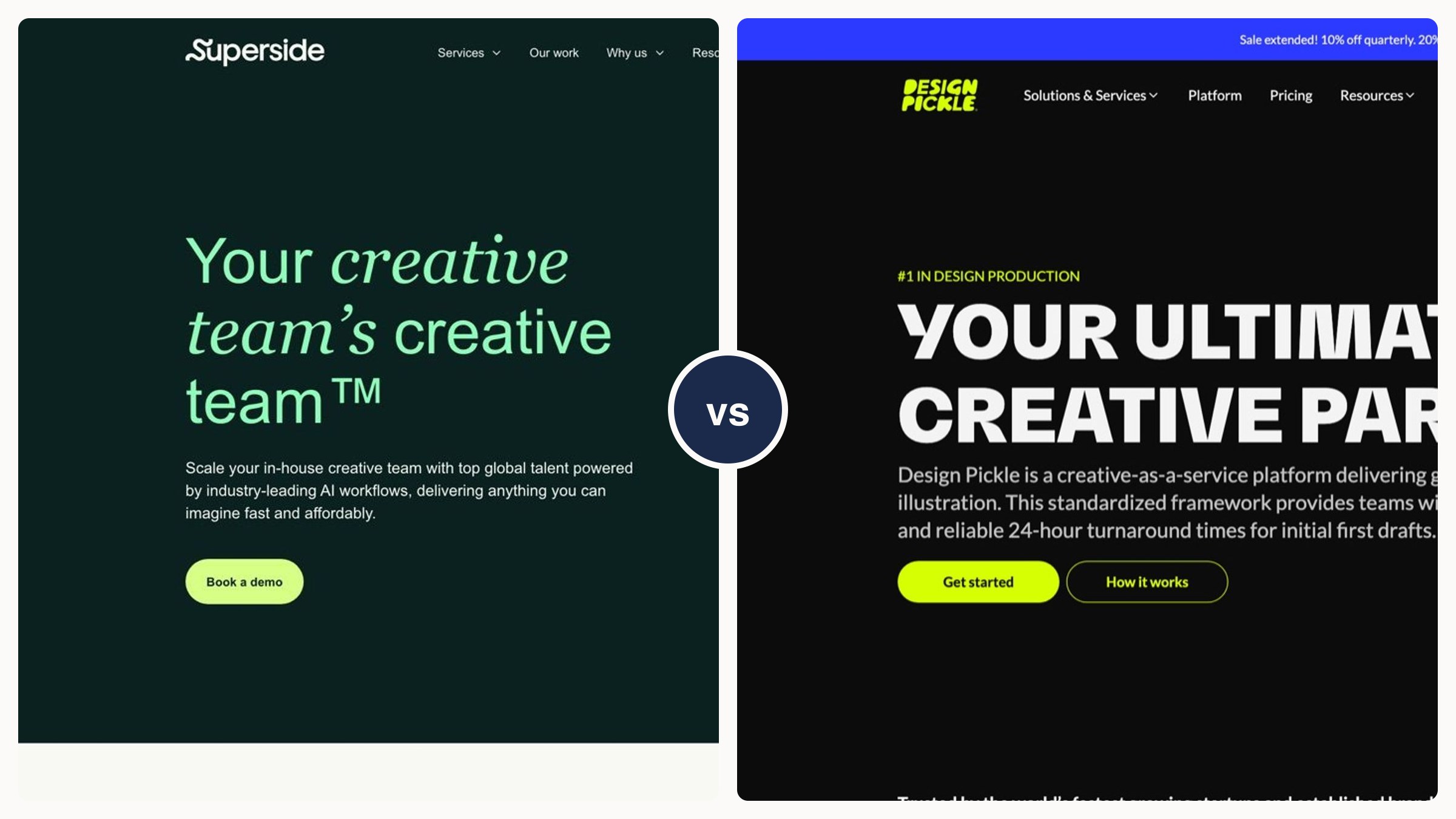
Superside tells you its price before you talk to anyone: $15,000 a month minimum on a twelve-month term, plus a $1,000 monthly software fee. Design Pickle no longer does. Its pricing page is now a consultation booking form that says “you get the number on the call,” with plans sized by daily creative hours and billed quarterly or annually. That difference in how each company sells is worth noticing before you book anything.
I co-founded Moonb, and both of these companies are competitors of ours, so weigh my reading accordingly and use the source links, which are all to their own pages or to review platforms. Where a fact is not published I say so rather than inventing one.
If you only want the numbers:
- Superside: $15,000 a month minimum plus $1,000 software fee, annual term; Dedicated plans from $30,000; no published trial (the $20,000 Quick Start is an AI setup engagement)
- Design Pickle: no published price; plans start at two hours of daily creative time; quarterly or annual billing; no refunds once a period renews
- Revisions: two rounds per project at Superside; “no per-change fees” and endless revisions at Design Pickle
- First drafts: “a few days” at Superside for production work; next business day at Design Pickle
- Reviews: Superside 4.3 on Trustpilot and 2.9 on Clutch; Design Pickle 3.4 on Trustpilot and no Clutch reviews
What they say about themselves
Superside’s homepage calls the company “your creative team’s creative team,” and its overview page calls it “an AI-first creative partner for enterprises.” Its service list is the widest in this category: ad creative, social and digital content, video and motion, print and packaging, presentations, copywriting, illustration, design systems, brand identity, and AI production services such as custom image models and localization. It reports 800-plus people across 67 countries with production hubs in Bogota and Johannesburg, per its talent page.
Design Pickle’s homepage describes “a creative-as-a-service platform delivering graphic design, motion, and illustration.” The categories it lists are brand and identity, marketing and advertising, digital and web, motion and video, print, illustration, ebooks, presentations, packaging, apparel, event design and internal design, plus custom Canva templates as an official Canva partner. Its help center confirms that “graphic design, custom illustrations, presentations, motion graphics, and video editing are all included in the creative services plan.”
The two overlap heavily on paper. The difference is depth and scale: Superside sells video production with physical hubs and a Creative Director leading each team, while Design Pickle sells a design queue with an art director available “on tap when a project needs it.”
Price, billing and what happens when you want out
Superside’s pricing page is unusually explicit for an enterprise vendor. “Superside subscriptions start at a $15,000 monthly minimum on an annual term,” every plan “includes a monthly budget and a $1,000 software fee,” and a Dedicated plan starts “at $30,000 a month, on a 12-month term.” There is no published trial; the “Quick Start” on the same page is “a $20,000, three-week engagement” in which Superside’s AI implementation specialists configure its Brand Brain, sold alongside a plan rather than instead of one. What the pricing page does not say is what cancelling a subscription early costs. The general terms page has a written-notice termination clause with the plan running to month end, so ask whether that applies to annual plans.
Design Pickle’s pricing page says “Flat-rate, not hourly. No retainers. We size your plan to what you need. You get the number on the call,” and its help center explains that plans are built from “the number of hours your design team needs to dedicate to your account each business day,” starting “with just two hours of daily design time.” Billing is quarterly or annual only. The company’s contract article says it “never has a contract” but that “the closest thing we have to a lock-in period is our subscription billing cycle,” and its refund policy states that “once a subscription renews, there are no refunds for unused time on any plan under any circumstances.” You can cancel before the next renewal date, and the account stays active to the end of the paid period.
I read those two pages back to back with a client recently, and the reaction was the one I expected: Superside’s number is high but you can see it, and Design Pickle’s number you cannot see at all. If you are the kind of buyer who has to justify spend to a finance team, that matters more than either company thinks it does.
Two things to do before either call. For Design Pickle, ask for the hours estimate on your three commonest request types, multiply by monthly volume and divide by 21 business days: that is the daily-hours plan you need, and the number they will quote against. For Superside, ask whether unused Flex budget survives the annual renewal, since the page only promises a three-month rollover.
| Term | Superside | Design Pickle |
|---|---|---|
| Published price | From $15,000 a month plus $1,000 fee | None; set on a call |
| Billing | Annual term | Quarterly or annual, auto-renews |
| Trial or pilot | Not publicly stated (Quick Start is an AI setup engagement) | Not publicly stated |
| Refunds | Not on the pricing page; terms page has a month-end written-notice clause | None after a renewal |
| Pause | Not publicly stated | Move to a platform-only plan |
Who does the work and how it flows
Superside “builds a creative team around your needs, led by a Creative Director and supported by Creative Project Managers,” and “your Creative Project Manager is your main point of contact,” according to its FAQ. Each project includes two rounds of revisions, production-focused projects “can be turned around in just a few days,” and the distributed team gives “near-continuous coverage.” That is a structure built for a company running many campaigns at once, where a project manager is a relief rather than a barrier.
Design Pickle gives you “a matched team that learns your brand and sticks with it,” per its pricing page, though its designer article notes that “different designers may work on your request queue sometimes.” An art director and a production coordinator are available when a project needs them, every deliverable passes a quality review, first drafts come next business day, and there are “no per-change fees” on revisions. Turnaround scales with your plan: its turnaround article gives the example that a two-hour plan handling a ten-hour request may take five business days. Production runs Monday to Friday, 9am to 6pm, in Pacific, Eastern, Australian Central and British time.
If I had to reduce that to one sentence for a client: Superside gives you a Creative Director and two revision rounds per project; Design Pickle gives you a queue with endless revisions and an art director you call in when it counts.
What the review sites show
On Trustpilot, Superside holds a 4.3 from 389 reviews. On Clutch it has a 2.9 from six reviews, listing Palo Alto as headquarters. G2 shows 4.5 stars from 115 reviews.
Design Pickle’s Trustpilot score is a 3.4 from 365 reviews, which Trustpilot labels “Average,” and that is the number I would spend ten minutes on before booking the call. Its Clutch profile has no reviews and lists Scottsdale, Arizona, founded 2015. G2 shows 4.4 stars from 228 reviews. Design Pickle’s homepage also reports a “4.8/5 Customer satisfaction rate,” but that is a company-reported number, not a review platform.
Superside, in more detail
More on Superside
Superside is the option for a creative operation that already has budget, process and volume, and wants a partner that can absorb all three. Its enterprise page shows Colgate-Palmolive, Grubhub, Figma, Microsoft, Reddit, Amazon Pharmacy and Pernod Ricard, and it talks about "400+ top global brands." Unused Flex budget rolls over for up to three months, project boosters start at a $15,000 minimum, and the company has been public about pushing production into AI-assisted workflows.
Not publicly stated: Flex pricing above the minimum, per-project prices, service-level hours, plan cancellation terms, and funding beyond the 2021 Series A it lists on its overview page.
Design Pickle, in more detail
More on Design Pickle
Design Pickle rebuilt its offer in June 2025 around daily creative hours and a platform with Base and Pro tiers, then removed public prices from the page. The current pricing page lists a brand-trained team, an art director and production coordinator on request, human review on every deliverable, next-business-day first drafts, licensed tools and fonts, Slack integration, a light asset manager and an API. Its AI page names an AI brief builder, image creation and upscaling, brand imagery and AI video, and claims fewer revisions as a result, a figure I have no way to check. Homepage logos include American VoxPop, ShiftUp, Basata and SmartyPants, with a testimonial from a growth lead at Shopify.
Not publicly stated: any current price or tier, a trial, month-to-month billing, designers per account, where designers are based, and the date public prices came down.
Choose Superside if
You run creative for an enterprise with many campaigns in flight, you need video production and motion at scale, you want a Creative Director leading the account, and a twelve-month commitment at $16,000 a month or more is in proportion to the work. If the number is the sticking point, my colleague’s line-by-line look at what Superside costs is the right next read, and the Superside alternatives roundup covers the field around it.
Choose Design Pickle if
You need a steady flow of graphic design, presentations and motion, you want an art director available without paying for one full time, you are comfortable learning the price on a call, and you can commit to a quarter or a year. If the sales-call step or the quarterly lock-in bothers you, the Design Pickle alternatives guide compares services that publish their prices and bill month to month.
Where Moonb comes in
I run Moonb, so this is the one paragraph you should read with a raised eyebrow. We give marketing teams one dedicated creative team, led by a Creative Director, for video, motion and design, on an ongoing monthly basis. That puts us closer to Superside on the kind of work and the seniority of the lead, and closer to a sized team on how directly you talk to the people making it. We do not publish a price, so I will not fake a column for us in the table below. If you want the models explained before you compare vendors, the creative-as-a-service guide does that job.
Every fact in one table
| Factor | Superside | Design Pickle |
|---|---|---|
| Published price | $15,000 a month minimum plus $1,000 fee | None; set on a consultation call |
| Plan structure | Monthly budget drawn down | Daily creative hours, from two a day |
| Commitment | 12-month term | Quarterly or annual, auto-renews |
| Refunds | Not publicly stated | None after renewal |
| Main contact | Creative Project Manager | Matched team, art director on request |
| Revisions | Two rounds per project | No per-change fees, endless revisions |
| First draft | A few days for production work | Next business day |
| Coverage | 67 countries (talent page), near-continuous | Mon to Fri 9 to 6 in PST, EST, ACST, BST |
| Video | Video and motion with production hubs | Motion graphics and video editing |
| Trustpilot | 4.3 from 389 | 3.4 from 365 |
| Clutch | 2.9 from 6 | No reviews |
| G2 | 4.5 from 115 | 4.4 from 228 |
| Named clients | Colgate-Palmolive, Figma, Microsoft, Reddit | American VoxPop, ShiftUp, SmartyPants |
| Headquarters | Palo Alto (own overview page; fully remote per its careers site) | Scottsdale, Arizona (per Clutch) |
Twenty minutes before the call
This D&AD Festival panel asks whether excellent craft survives when scale is the brief, which is exactly the tension between a two-revision enterprise model and an endless-revision queue.
The In-House Agency Council’s recent recap of how large brands structure in-house teams and partners is worth the time before you commit to a quarter or a year with anyone.
Frequently asked questions
It can be, for high-volume production design with a quality gate. Its public pages describe a queue with art direction on request rather than a Creative Director-led team, and billing runs quarterly or annually. Enterprise teams that need a senior creative lead and real video production usually end up looking at Superside or a dedicated team instead.
Ask how many daily hours you would be sized at and how turnaround changes when a request needs more than that. Ask whether a named designer stays on your account, what the art director does and does not cover, and the exact renewal date and notice period, because refunds stop once a billing period renews.
Not at its entry point. The published minimum is an annual plan; project boosters start at $15,000, and the $20,000 Quick Start is an AI setup engagement rather than a pilot. For a single project, a studio that quotes per piece is usually the better route.