Superside Pricing: What It Costs in 2026
A breakdown of Superside's pricing model, the current entry points, how quotes are built, and how it compares to freelancers, agencies, and ongoing creative teams.


Superside sells access to managed creative production on a recurring model paired with a monthly creative budget or credit system, sold by quote after a sales call rather than a fixed public rate card. As of August 2026, its published subscriptions start at a $15,000 monthly minimum on an annual term, plus a $1,000 monthly software fee, before any creative capacity is consumed.
I work at Moonb, which sits in the same category of ongoing creative teams as Superside, so I have to disclose that upfront. This is a pricing analysis rather than an endorsement of either side. Marketing leaders often want a number for Superside before they book a sales call, and the honest answer is that Superside pricing changes by plan, capacity, disciplines, and commitment, so a single headline figure can mislead. Public references show different plan structures over time, while Superside’s current pricing page frames the purchase as an annual engagement with a recurring creative budget.
The useful question is not only what Superside costs. It is how much creative capacity a quote will provide, and whether your team will use it consistently. That distinction separates a sensible procurement decision from an expensive retainer with unused capacity.
How Superside Actually Charges
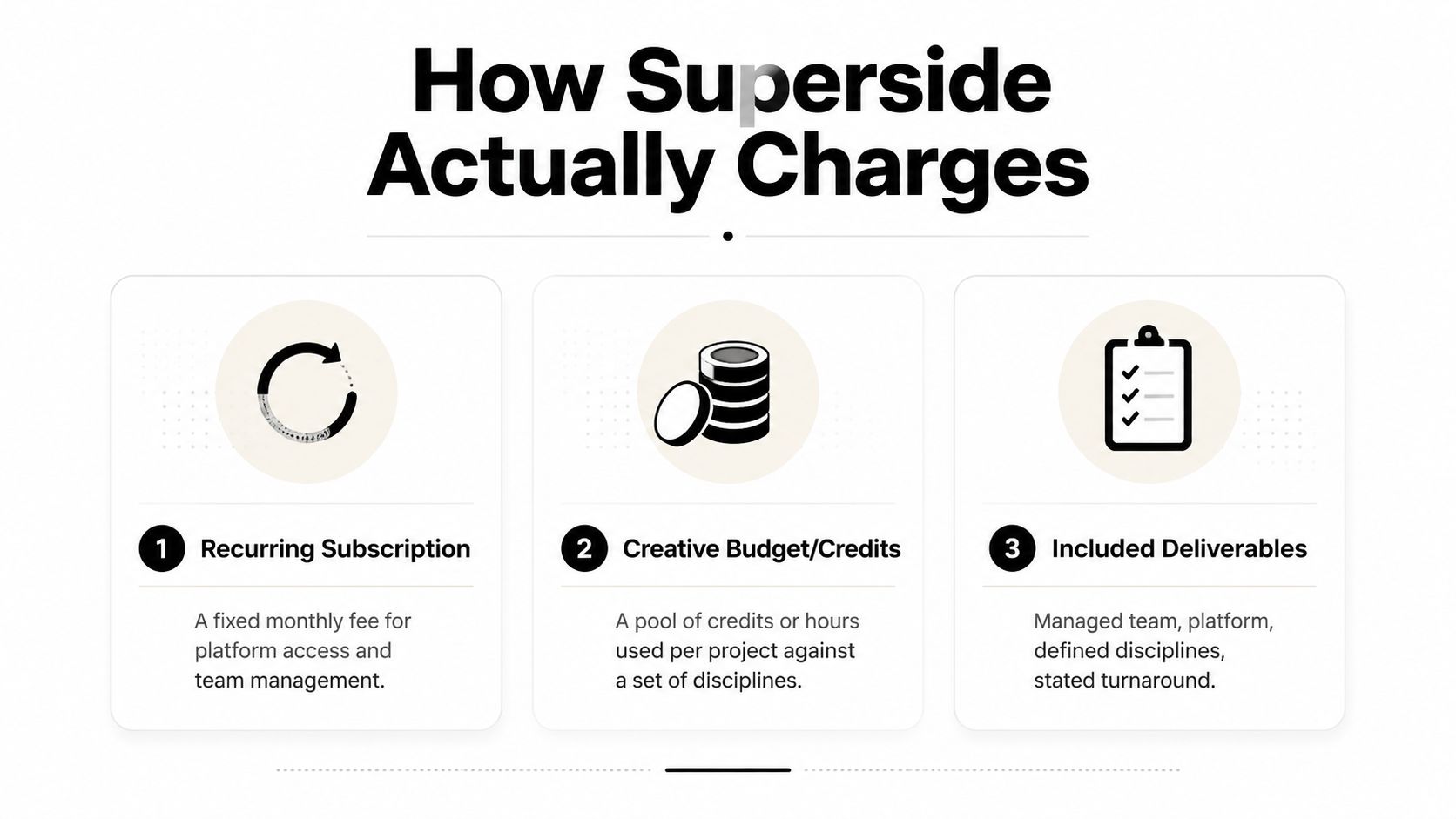
Superside sells recurring access to managed creative production rather than pricing every brief as a separate agency project. As of August 2026, Superside’s pricing page lists subscriptions that start at a $15,000 monthly minimum on an annual term, with a $1,000 monthly software fee on top, which puts the documented entry point at $16,000 per month before any creative work is used. The page shows two subscription shapes, a Flex plan from that $15,000 minimum and a dedicated AI-native team listed from $30,000 a month on a twelve-month term, alongside a $20,000 three-week Quick Start onboarding and one-off Project Boosters that start at a $15,000 minimum.
The service fee and creative allocation serve different purposes. Superside’s help-center explanation describes a fixed service component alongside a monthly creative budget. That budget is then used against the work your team submits, with the exact capacity depending on the plan and scope.
Capacity matters more than the headline
Superside’s earlier published materials show a capacity-band structure tied to hours and price. Examples in the available pricing material include 71 hours for $5,000, 95 hours for $7,500, 100 hours for $9,000, 150 hours for $12,000, and 167 hours for $15,000. Larger examples include 250 hours for $20,000, 287 hours for $25,000, and 500 hours for $40,000 or $45,000 in the published pricing reference from Vidico’s Superside pricing analysis.
Those historical bands shouldn’t be treated as a current rate card. They’re useful because they show how the model has been structured, capacity first, price second. Current plan names and terms can change, so buyers should confirm the live offer directly with Superside.
As of August 2026, unused Flex budget rolls over for up to three months, according to Superside’s pricing page. That helps with pacing, but it doesn’t remove the need to forecast demand. A launch-heavy quarter followed by quiet months can still produce a poor effective cost per asset if the available capacity isn’t used.
For a broader view of how recurring creative models work, Moonb’s creative-as-a-service explainer is a useful comparison point. For teams comparing creator-focused tools rather than managed production, quso.ai pricing for creators provides a different type of cost reference.
Practical rule: Treat the monthly creative allocation as planned production capacity, not as a promise of ongoing output.
Where Superside Fits in the Creative Market
Superside sits toward the enterprise end of managed creative production. It’s structurally different from hiring a freelancer for one campaign, and it also differs from a traditional agency retainer because the commercial model centers on recurring capacity and a managed workflow.
Public references don’t agree on one universal number. A G2 pricing summary lists 2 pricing editions, describes pricing starting around $10,000 and reaching $15,000, and also presents a broader range of $15,000 to $75,000 or more per month. Vendr describes common monthly costs from $5,000 to $25,000 or more, with annual contract values commonly between $60,000 and $300,000 for mid-market and enterprise buyers, as shown in its Superside marketplace listing.
The spread reflects different dates, plans, and ways of describing the offer. It’s a warning against comparing a public estimate with a current quote without normalizing the scope.
| Provider Type | Model | Best for |
|---|---|---|
| Freelancers | Individual specialists hired per project or hour | One-off tasks and a single craft |
| Marketplaces | Multiple freelancers sourced through a platform | Sourcing varied skills on demand |
| Productized creative services | Defined creative capacity and workflow | Repeatable design in a fixed queue |
| Creative-as-a-service platforms | Recurring access to managed production | Steady multi-discipline volume, where Superside sits |
| Independent studios | Senior-led project or recurring studio engagement | Craft-led projects with senior ownership |
| Embedded creative departments | A dedicated external team working alongside marketing | Ongoing output that needs brand continuity |
| Traditional agencies | Strategy, creative direction, production, and account service | Brand platforms and major campaigns |
| In-house hires | Salaried employees plus management and operating costs | Daily control when volume is constant |
The table compares commercial models and best fit, not price, because provider costs vary too much by geography, seniority, discipline, scope, and contract terms for a single common rate to mean anything. Match the model to your need first, then get a real quote for the exact scope.
A freelancer may be the right choice for a focused design task. A traditional agency may be better for a brand platform or major campaign. Superside makes more sense when the need is continuous production across several channels and the team wants one managed operating layer. Moonb’s comparison of creative service models can help clarify the difference between queue-based production, embedded teams, and broader agency engagements.
What Customers Actually Report About Superside
Superside is genuinely well reviewed, and an honest analysis has to start there. On G2 it holds a strong average across more than a hundred reviews, and reviewers repeatedly credit the design quality, the creativity, the responsiveness of the team, and fast turnaround on standard requests, often around 48 hours (Superside reviews on G2). For a company buying high-quality creative volume, those are real strengths, not marketing lines.
The criticisms are just as consistent, and they cluster around a few themes worth knowing before you sign.
- Speed under an always-on cadence. Several reviewers describe turnaround as slow when the need is daily, test-and-learn output rather than considered campaign work. One Trustpilot review sums the mismatch up bluntly, describing a team that wanted volume and speed and felt it got neither (Superside on Trustpilot). The model is tuned for high-quality production, not a constant posting rhythm.
- Revisions are capped. Superside does not offer open-ended revisions, and rush-turnaround work can drop the standard revision rounds, as noted in independent reviews (an honest review of Superside, Hatchwise). That is fine for tightly scoped work and frustrating when a brief keeps moving.
- Communication and tooling friction. Reviewers report delays in communication and difficulty integrating Superside’s workflow with their own internal systems, with the platform sometimes feeling like another layer of process on top of the tools a team already runs.
- Built for larger organizations. Multiple write-ups conclude that the further a company goes with Superside, the more it feels tuned to large enterprises rather than smaller teams, and that pricing detail can be hard to find upfront (My Honest Review of Superside, Logo Design Magazine).
None of that makes Superside a bad choice. It makes it a specific one. The reviews keep pointing at the same question this analysis returns to: does your real cadence match what the model is good at? If you need considered, high-quality campaign creative and can feed a steady but not frantic queue, the strengths line up. If you need fast, always-on volume with room to iterate and a partner who sits close to your own tools, the recurring complaints are the ones to weigh honestly.
What Drives Your Quote Up or Down
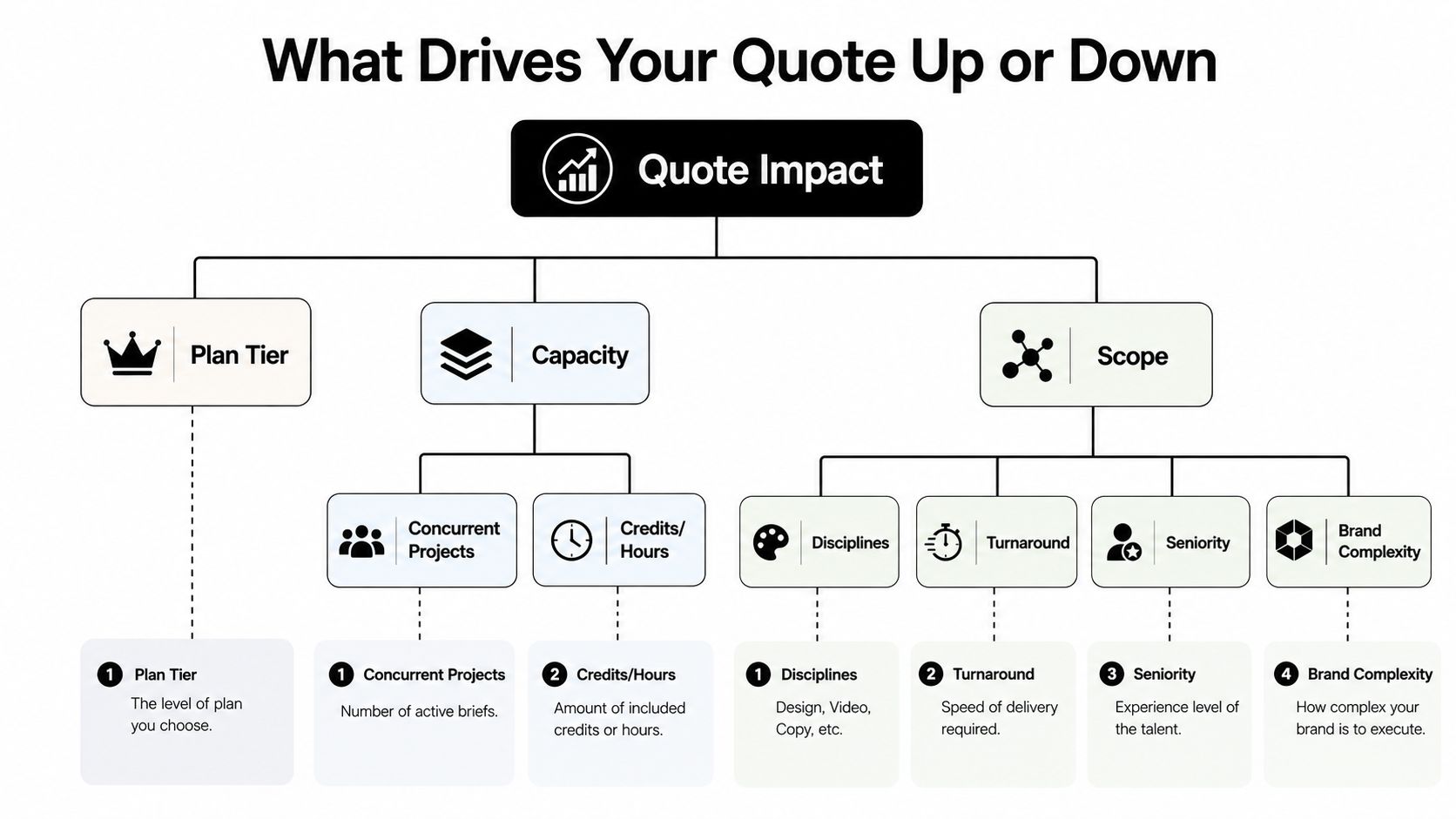
Two companies can receive very different Superside quotes because they’re buying different amounts and types of capacity. A single-discipline design queue with moderate planning needs is a different engagement from a multi-channel program covering video, motion, animation, and campaign production.
The main variables
-
Plan tier: Higher tiers can reflect more capacity, senior involvement, broader service coverage, or stronger operational support.
-
Concurrent projects and credits: Several active briefs consume capacity differently from one sequential project. Ask how the provider defines active work, hours, credits, and queue priority.
-
Disciplines covered: Design, video, motion, animation, and campaign work require different specialist skills. A quote covering several disciplines will usually carry a different scope from one focused on a single design track.
-
Turnaround speed: Rush work requires scheduling flexibility and may reduce the provider’s ability to balance your queue with other work.
-
Team seniority: Senior creative direction and strategic oversight change the commercial shape of the engagement. Production-only work and senior-led concept development shouldn’t be compared as equivalent deliverables.
-
Brand complexity: Multiple brands, regulated messaging, technical products, localization, and extensive asset systems add review and coordination work.
A simple scope contrast
A light engagement might cover one brand, one discipline, a small number of active briefs, standard review cycles, and ordinary turnaround expectations. A heavier engagement might cover design, video, motion, and animation across several brands, with overlapping campaigns, faster delivery, senior creative direction, and more complex approvals.
Both may be described as “creative production,” but they place very different demands on the team. The heavier version needs more coordination and a wider skills mix, even when the final asset count looks similar.
Compare the workstream behind the quote, not only the amount printed at the top of the proposal.
The cost of animation illustrates why asset labels aren’t enough. A simple motion graphic and a character-led product film may both be called animation, but their planning, production, review, and finishing requirements can differ substantially. Moonb’s animation cost guide offers a useful way to think about scope before requesting comparable proposals.
What You Get for the Spend
The spend includes a managed creative team, project management, a platform layer, defined disciplines, and stated turnaround expectations. The exact package depends on the plan and written scope. That combination can reduce the coordination burden for a marketing department managing several specialists. It can also add overhead for a creative director with an established internal workflow who needs a narrowly defined production task.
Confirm the deliverables
Before signing, request a written description of:
-
Included disciplines: Confirm whether design, video, motion, animation, copy, or strategy appear in the quoted scope.
-
Capacity definition: Ask whether capacity is measured in hours, credits, active projects, or another unit. This determines how much of the monthly allocation your team can use.
-
Turnaround: Check the expected time to first draft, the treatment of rush work, and how queue conditions affect delivery.
-
Revision terms: Confirm the included review rounds and what happens when a brief changes materially.
-
Source files and usage rights: Ask who owns editable files, final assets, and intellectual property after delivery.
-
Team structure: Identify the account, project management, creative direction, and production roles assigned to the engagement.
A monthly allocation does not mean ongoing output. The team has finite production time, and capacity utilization depends on brief complexity, assigned specialists, revision volume, and queue demand. A proposal becomes easier to evaluate when the expected workload is normalized into comparable workstreams rather than treated as a single promise of output.
For teams producing explainers or product videos, apply the same review to script development, voiceover, illustration, animation, edit rounds, and final exports. The AI explainer video guide can help buyers separate those production components before comparing providers.
A usable proposal specifies the work, delivery expectations, revision rules, ownership terms, and final handoff. If those details remain vague, compare the scope first and treat the quoted price as provisional. That is the difference between paying for available capacity and paying for capacity your team can consistently use.
Who Superside Fits and Who Should Look Elsewhere
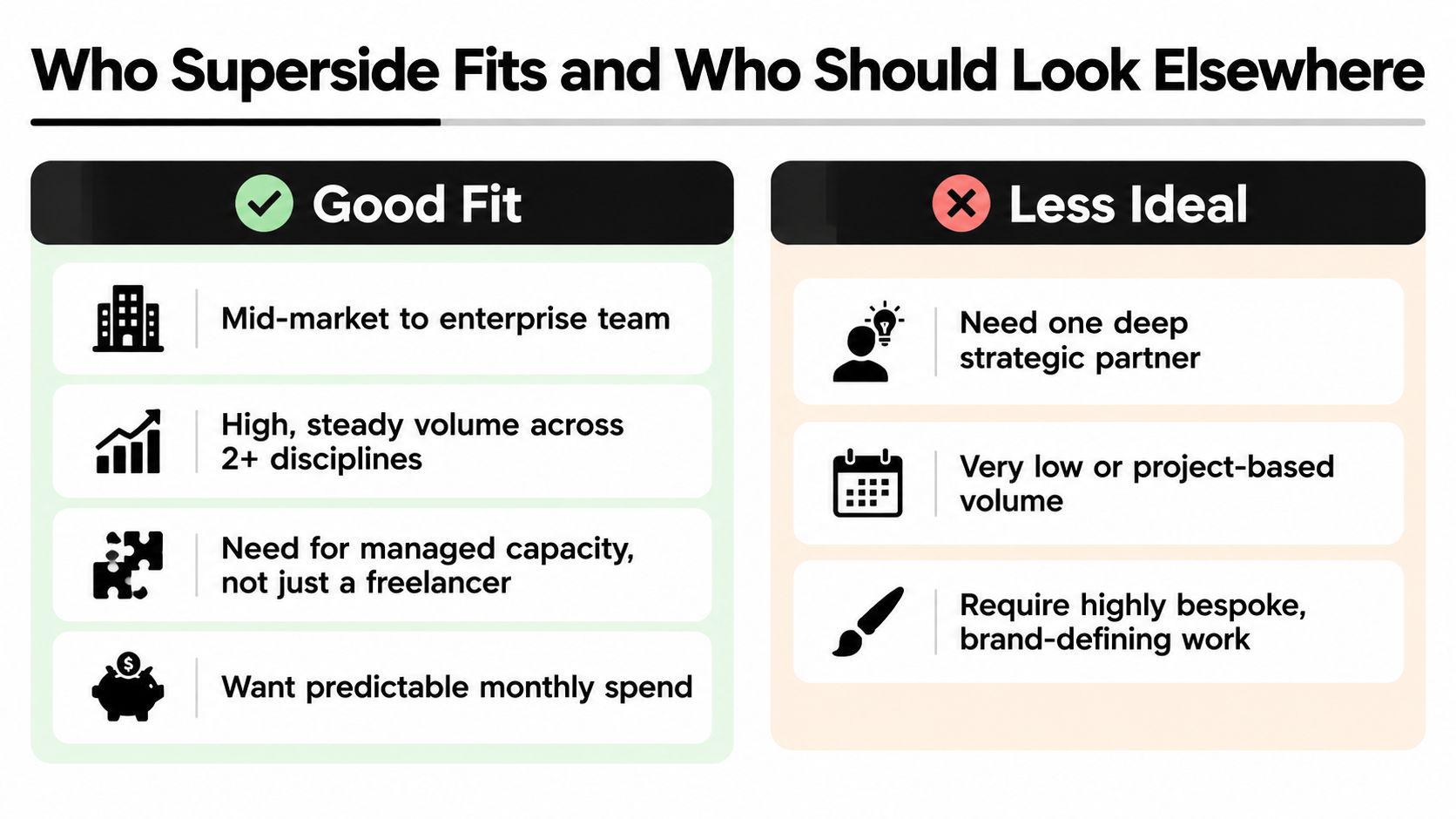
Superside fits mid-market and enterprise teams with steady, high-volume creative demand across multiple disciplines. These buyers may need recurring design, video, motion, animation, and campaign support without hiring every specialist internally.
The entry structure points to that audience. The documented $15,000 monthly minimum plus the $1,000 software fee creates a substantial recurring commitment, so the team needs a dependable queue of work to use the capacity efficiently. Frequent launches across several channels can support that model. Occasional design requests usually cannot.
A practical fit checklist
Likely fit
- A mid-market or enterprise marketing organization.
- Steady demand across two or more creative disciplines.
- Several campaigns, channels, or brands running at once.
- A need for managed capacity rather than one freelancer.
- A preference for predictable recurring spend.
- Internal stakeholders who can provide clear briefs and timely approvals.
Less likely fit
- Very low or project-based creative volume.
- A need for one strategic partner involved at a high level.
- Highly bespoke, brand-defining work requiring close founder or creative-director ownership.
- A team that wants to hire and develop its own creative capability.
- Seasonal demand with long quiet periods and no clear plan for using rolled-over capacity.
Teams seeking brand strategy rather than production may also find the model limited. Managed capacity executes an established direction well, but it does not replace the judgment of a senior brand partner who owns positioning, identity, and long-term creative coherence.
Avoid an absolute “worth it” verdict. Compare your volume, discipline mix, need for senior ownership, and demand predictability with the quoted scope. When those factors align, a sales conversation may make sense. When they do not, a smaller studio, freelancer network, agency project, or internal hire may provide a better operating fit.
Honest Alternatives at Different Spend Levels
Superside is one route to recurring creative capacity. It isn’t the only one, and its enterprise structure won’t suit every team. The right alternative depends on how much ownership you need, how quickly work must move, and whether demand arrives steadily or in bursts.
For lower spend and focused tasks, companies often use freelancers and marketplaces such as Upwork, Fiverr, and Dribbble. This route gives buyers access to individual specialists and lets them scope one project at a time. The trade-off is management overhead. Someone on the client side must write briefs, source talent, review work, manage revisions, and maintain brand context.
Productized providers such as Design Pickle, Kimp, Penji, and ManyPixels sit in the middle. Their offers are generally more structured than a freelancer relationship, with defined workflows and production coverage. They can work well for repeatable design needs, but buyers should check whether video, motion, strategy, project management, or senior creative direction are included at the chosen plan.
Independent studios and embedded creative departments offer a different kind of relationship. They can provide stronger continuity and senior ownership than a rotating project queue, while remaining more flexible than building every role internally. Moonb is one studio option in this category, assigning each client a dedicated Creative Director and delivering video, motion graphics, design, animation, and brand content on a steady weekly rhythm.
At the higher end, traditional agencies combine strategy, creative direction, production, and account service. They’re often a better fit for brand platforms, major campaigns, and complex launches where the central problem is strategic definition. The cost and process can be heavier when the need is mainly recurring execution.
An in-house team offers the deepest day-to-day ownership. Hiring gives the company direct control over priorities, knowledge, and development, but it also adds recruiting, employment, management, tools, and coverage considerations.
For a focused comparison, see Moonb’s Superside alternatives guide. Compare the model, not just the price. The trade-offs are ownership, speed, scope, continuity, and management effort.
How to Compare Quotes Fairly
A fair comparison starts by turning every proposal into the same unit of analysis. Don’t put a recurring capacity plan beside a one-off video quote and choose the lower number. They solve different operating problems.
Use this checklist:
-
Normalize scope and capacity. Record the number of active projects, credits, hours, or deliverables included.
-
List every discipline. Separate design, video, motion, animation, strategy, copy, and production management.
-
Confirm turnaround and revisions. Write down first-draft timing, rush treatment, review rounds, and change requests.
-
Check source files and intellectual property. Confirm what you receive and when ownership transfers.
-
Separate recurring commitments from project pricing. Include the length of the commitment, service components, software charges, and any rollover rules.
Then estimate the effective cost per finished asset using your expected volume, not your optimistic volume. A lower monthly figure can cost more per deliverable if the team produces less, works more slowly, or requires more internal coordination.
Ask every provider for written scope and verify current pricing directly. Superside’s historical pricing references show why this matters. Published plans have changed from earlier capacity bands to newer enterprise plan structures, so an old comparison can create a false sense of precision. Moonb’s guide to branding costs is also useful when a proposal includes identity work alongside production.
The best decision usually comes from the provider whose capacity matches your real queue, whose seniority matches your risk, and whose ownership terms leave no ambiguity.
If you’re evaluating Superside, gather three months of actual creative requests, group them by discipline, and note the deadlines, revision load, and approval steps. Take that scope to Superside and at least one alternative, request written proposals, and compare capacity, ownership, turnaround, and total commitment before booking the engagement.
Frequently asked questions
It depends on utilisation. A quiet quarter with a $15,000 monthly commitment can be far more expensive per asset than a well-utilised senior designer, and a busy quarter across several disciplines can be far cheaper than staffing all of those roles internally. Model your own utilisation and asset volume before comparing headline monthlies; the honest answer is spreadsheet-specific.
The main differences are structure and access. Superside runs a large pool of freelancers with account management on top, which gives breadth of skills but less continuity per brand. A smaller ongoing creative team assigns a fixed group of designers, editors, and a Creative Director to one client, which trades some breadth for more continuity and context. Neither model is universally better; the right pick depends on how much brand-specific memory you need.
Superside's public pricing is enterprise-first, so a low-commitment trial is not the default. If a lower-commitment test is what you need to sign off internally, ask directly for a scoped pilot with a fixed number of deliverables and a hard timebox, then decide from that data instead of a demo call.