Video agency: how to choose the right partner
What a video agency actually owns, how the category splits into five specialist types, how the four pricing models work, and a ten-point checklist for building a shortlist.

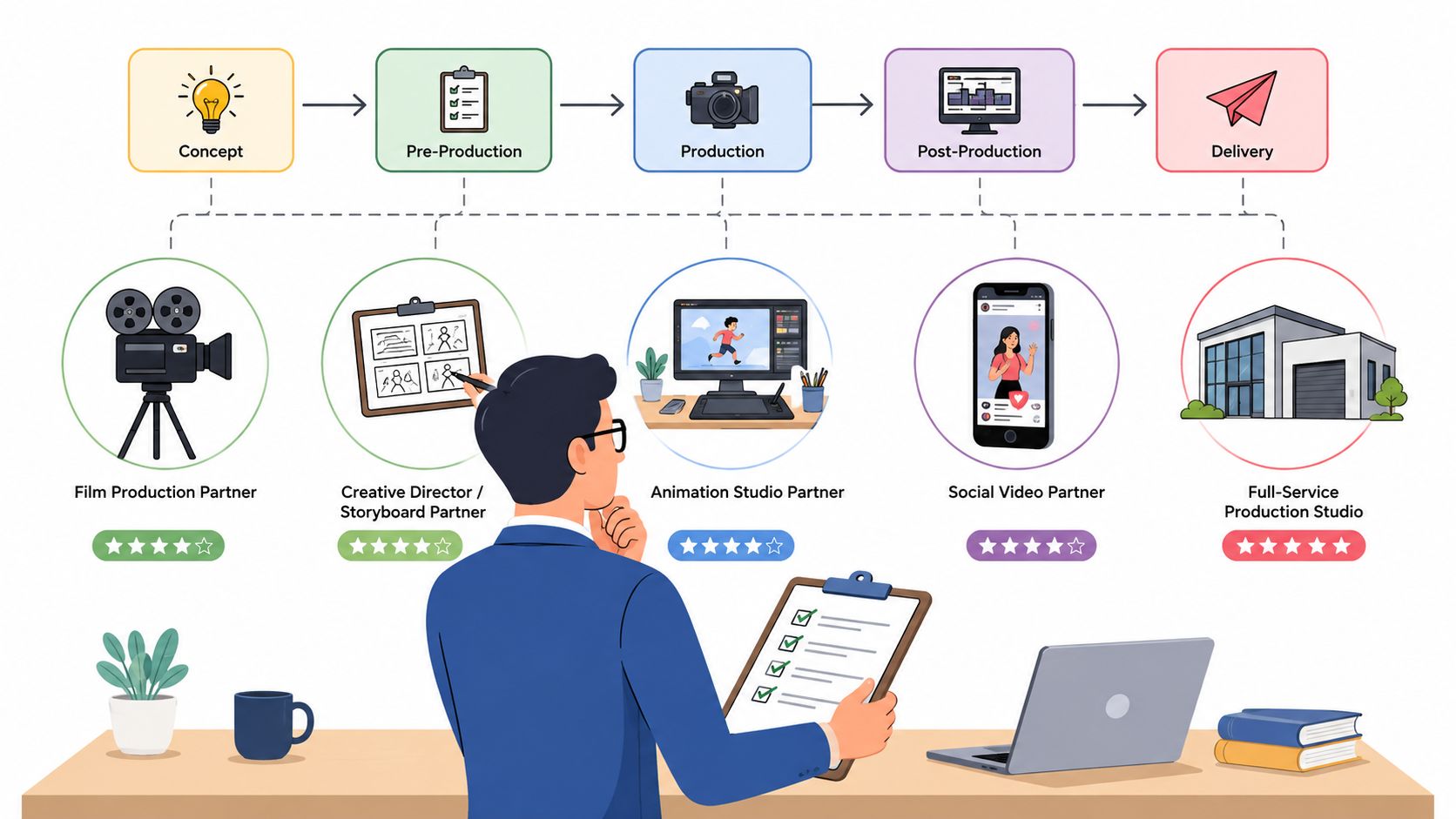
A video agency owns the strategy, creative direction, and production of your video work; a video production company mostly executes a brief you bring to it. That one distinction settles most of the confusion in this category, and it comes down to three questions: what is the video for, how much volume do you need each month, and who owns the idea.
The partner-model conversation is the one I have most often with teams shopping for video help. The pattern is always the same. Every provider’s homepage sells the same promise, while the operating models underneath differ sharply. One team owns the idea and the campaign. Another executes a script, well, and nothing more. A third is the right call for a single shoot and a poor fit for weekly content. The buyer who cannot tell them apart usually finds out mid-project.
This guide maps the category by volume, format, and creative ownership, so you can build a shortlist without leaning on a ranked vendor list.
What a video agency actually is
The useful question is not which video agency is best. It is which partner owns the work your team cannot own right now. If the goal is a single brand film and your concept is already approved, you need production execution. If you need a concept, script, product story, social cutdowns, and channel-specific delivery, you need more ownership upstream.
Volume changes the decision too. A one-off launch video has a different operating model from recurring product demos, paid-social variations, internal communications, or a weekly brand series. The more formats and repeated output you need, the more continuity, planning, and reusable production systems matter.
The last question is the one buyers skip. Who owns the idea? If your creative director has already solved the message, a production company or freelancer may be the efficient choice. If your team has the business goal but needs someone to turn it into a clear creative direction, look for a video agency or an embedded creative studio.
A useful overview of the wider category is our guide to video production services. And if your team runs social publishing alongside the video work, AI social media tools for agencies can carry some of the planning and scheduling load, though no tool replaces creative ownership.
Four partner models compared
The labels overlap in the market, so evaluate the operating model rather than the homepage language. Ask what the team owns, when it enters the process, and whether you are buying a defined deliverable or ongoing capacity.
| Partner | What they own | How you pay | Speed | Best fit |
|---|---|---|---|---|
| Video agency | Goal, strategy, concept, script, production, post, delivery | Per project or retainer | Deliberate upfront, structured through delivery | Campaigns where the partner must own idea and execution |
| Video production company | Pre-production, shoot, crew, footage, often post | Per project or production quote | Fast once the brief is approved | Live action with a clear concept and script |
| Freelance videographer | Filming, with editing depending on the agreement | Day rate or per project | Fast for focused jobs | One-off shoots, interviews, events, simple edits |
| Embedded creative studio | Ongoing execution across video, motion, design, and animation | Set monthly cost | Built for a steady weekly rhythm | Recurring output from a team that learns the brand |
A video agency asks more questions before production because it starts with the business goal. That can feel slow at the beginning, but it places responsibility on the partner to make the idea work across channels.
A production company usually begins at pre-production. You bring the approved concept, script, or treatment, and the company turns it into a shoot. That is often the right model when your internal team already owns the message. It is the wrong model when the brief only says “we need a launch video.”
A freelancer can be excellent when the work is narrow: a founder interview, an event recap, a single-format piece. The fit weakens when the project needs brand strategy, motion graphics, multiple editors, localization, paid-social cutdowns, or a continuing content calendar.
An embedded creative studio sits between an internal hire and a traditional project vendor. It gives you a dedicated team working on a steady weekly rhythm, on brand and ready when needed. Moonb is one example of that embedded model. The trade-off is honest: it pays off with steady volume, and it is the wrong purchase for one isolated shoot.
For a fuller comparison of internal and external models, see our piece on in-house versus agency. Your shortlist should reflect the work your team needs, not the label a provider chooses.
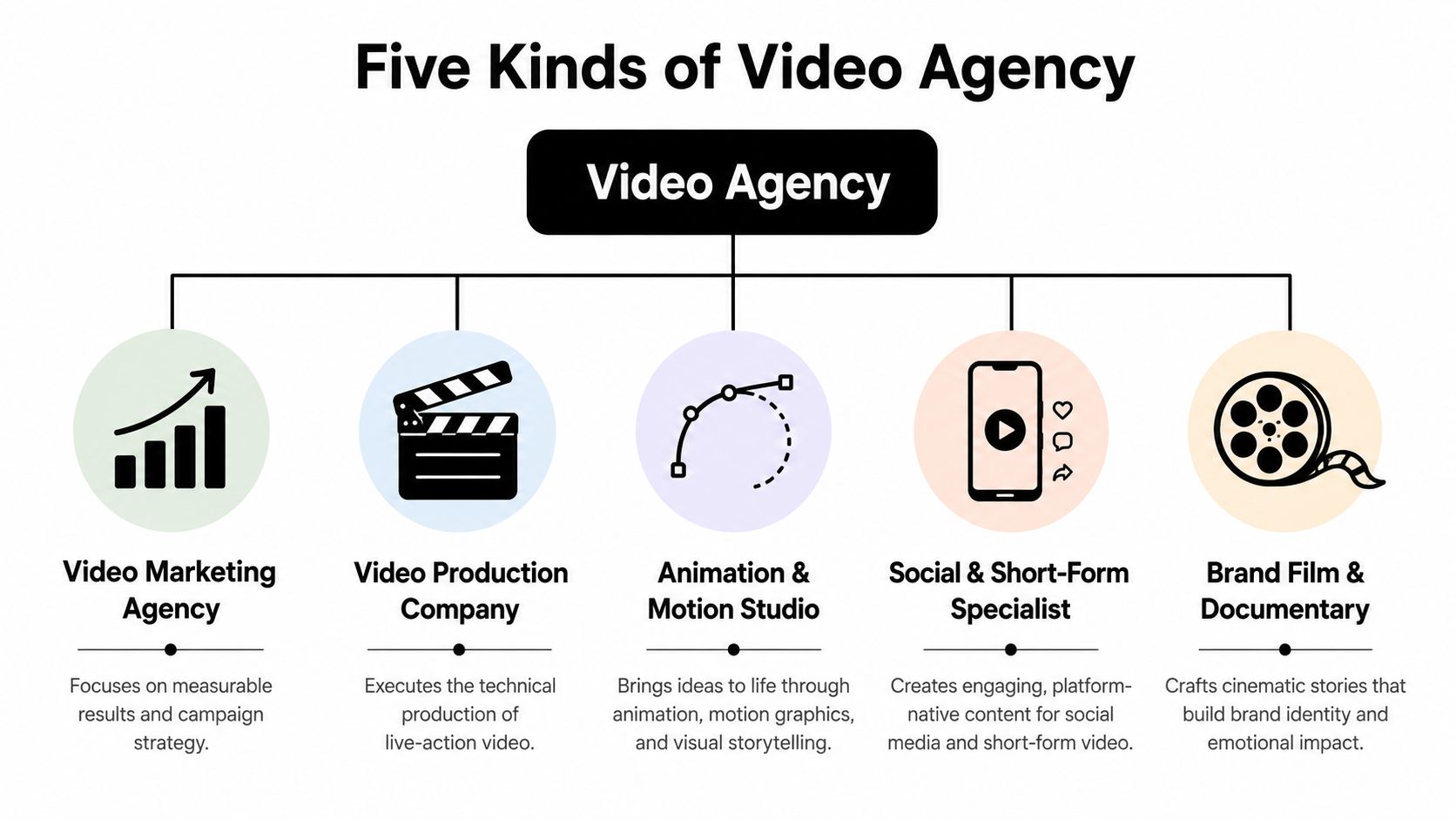
Five kinds of video agency
A video agency can mean several different specialists, and their strengths are not interchangeable. A social-first team may be excellent at hooks and cutdowns but unsuitable for a cinematic commercial. A brand-film house may produce beautiful work but be too heavy for weekly product content.
-
Video marketing agency. Best for campaign strategy, performance creative, product storytelling, and video tied to a broader marketing effort. Our roundup of video marketing companies covers partners that connect the asset to audience, message, channel, and action.
-
Video production company. Best for live-action production where the concept, script, and intended outcome are already clear. Our guide to the best video production companies shows what production-led partners typically cover.
-
Animation and motion studio. Best for explainers, product interfaces, data stories, onboarding, title sequences, and any work that depends on design rather than a physical shoot. Explainer video agencies are the right search when clarity and visual systems matter more than location or cast.
-
Social and short-form specialist. Best for Reels, TikTok, Shorts, paid-social variations, creator-style edits, and fast tests of hooks and formats. Look at a social media video agency if your main challenge is native, repeatable social output.
-
Brand film and commercial house. Best for high-visibility brand stories, commercials, documentaries, and launch pieces where the production itself carries strategic weight. If you are scoping a brand film, the questions on this brand video production page are the ones that belong in that first conversation.
Some providers cover several categories. That breadth can simplify vendor management, but check whether the actual team has depth in each discipline. A production reel does not prove social editing skill, and motion work does not prove the provider can run a complex live-action shoot.
The right shortlist usually includes a primary fit and a credible alternative. Define your dominant need first, then ask whether the partner can handle adjacent formats without forcing every project into the same creative style.
How an engagement runs from first call to delivery
The cleanest engagements begin before anyone opens a camera app. The first conversation should cover the goal, audience, channel, deadline, existing assets, approval process, and intended versions.
The agency then drafts a written brief back to the client. That document should clarify the message, audience tension, call to action, tone, deliverables, and constraints. If the brief still says only “make a video,” the project is not ready for production.
The working sequence
- Discovery call: the team identifies what the video must do and where people will see it.
- Written brief: the agency turns the conversation into an agreed working document.
- Concept and script: the creative team develops the central idea and the words.
- Storyboard or animatic: you review the visual logic before expensive production begins.
- Pre-production: casting, locations, schedules, crew, props, and design boards get resolved.
- Production: the team shoots live action or builds the animation and motion work.
- Post-production: editors shape the cut while motion designers, sound teams, and colorists finish the piece.
- Review rounds: stakeholders give consolidated feedback against the agreed brief.
- Delivery: the team exports the required aspect ratios, cut lengths, captions, and platform versions.
A production company usually enters at step five because the client brings the concept and script. That makes the first frame arrive sooner when the brief is tight. An agency asks more questions up front and takes longer to reach the first frame, but that front-loading tends to reduce reshoots, confused feedback, and revision churn later.
Neither path is automatically better. If your team already has a strong script, storyboard, and channel plan, paying for strategy you do not need wastes time. The honest split: if the problem is “we need someone to execute this idea,” hire for production. If the problem is “we know the business goal but do not yet have the idea,” hire for creative ownership.
A pattern I keep seeing: a software launch goes to a solo videographer first because the day rate looks simple. The footage comes back fine, but there is no script structure, no motion graphics for the product interface, no paid-social cutdowns, and the finished video sits on one landing page. When the work moves to a team with a creative director owning the concept, the same kind of shoot feeds a hero film, ad cuts, and a sales loop. The videographer did not fail; they did the production job they were hired for. The buyer purchased production when the need was strategy plus production.
Post-production is where most of the review churn happens, and where scope quietly hides. This StudioBinder walkthrough shows every step between the last day of shooting and the file you actually receive.
Delivery also needs technical discipline. A common master format for short-form is 9:16 vertical at 1080x1920, usually exported as MP4 or MOV, while maximum length and file-size limits vary by platform. Check each platform’s current upload specs before locking a delivery date; a partner who cannot list them from memory has not shipped much social work.
How video agencies charge
The pricing model changes how the work feels to both sides. Compare the model, scope, and ownership together. A clear quote with the wrong operating model can still create friction.
Per-project quotes
A project quote gives you a defined scope and a clear number for a specific deliverable. It fits a brand film, product launch, commercial, or other contained assignment.
The trade-off is repetition. Every new video can restart discovery, onboarding, scheduling, and negotiation. Change requests are also more likely to create new charges when the quote defines a narrow deliverable rather than a working relationship.
Day rates
Day rates make sense for focused production support. You might hire a videographer, editor, animator, or crew member for a defined block of work. They work when the creative direction already exists and the buyer can manage the brief, feedback, and approvals.
A day rate does not tell you the total cost of the finished asset. Post-production, music licensing, motion graphics, travel, equipment, casting, color, sound, captions, and extra versions may all sit outside the initial estimate.
Monthly retainers
A retainer reserves capacity and can improve priority scheduling. It suits teams with recurring work that can forecast demand but still want project-level scopes.
Ask what the retainer includes. Hours can expire unused, and phrases like “ongoing support” or “included revisions” are too vague to compare. Get the definition of included work, response times, rollover rules, revision limits, and excluded production costs in writing.
Embedded teams at a set monthly cost
An embedded team gives you predictable spend, a creative director who learns the brand, and faster movement across repeat formats. The model only pays off when your team has steady volume; if you need one project every few months, a project quote is cleaner.
The break-even logic is simple. The more often you repeat discovery, briefing, and brand education, the more value continuity provides. One embedded team still will not cover every specialty, and a large live-action shoot may need a separate quote even when the ongoing relationship stays in place.
The money at stake here keeps growing. IAB projects that U.S. digital video ad spend will surpass $80 billion in 2026, growing 11% year over year, which it notes is nearly 20% faster than the total ad market. For sourced cost ranges and scope guidance, use our breakdown of video production cost.
A ten-point shortlist checklist and red flags
A shortlist becomes useful when every provider answers the same questions. Use these in the first call and the proposal review.
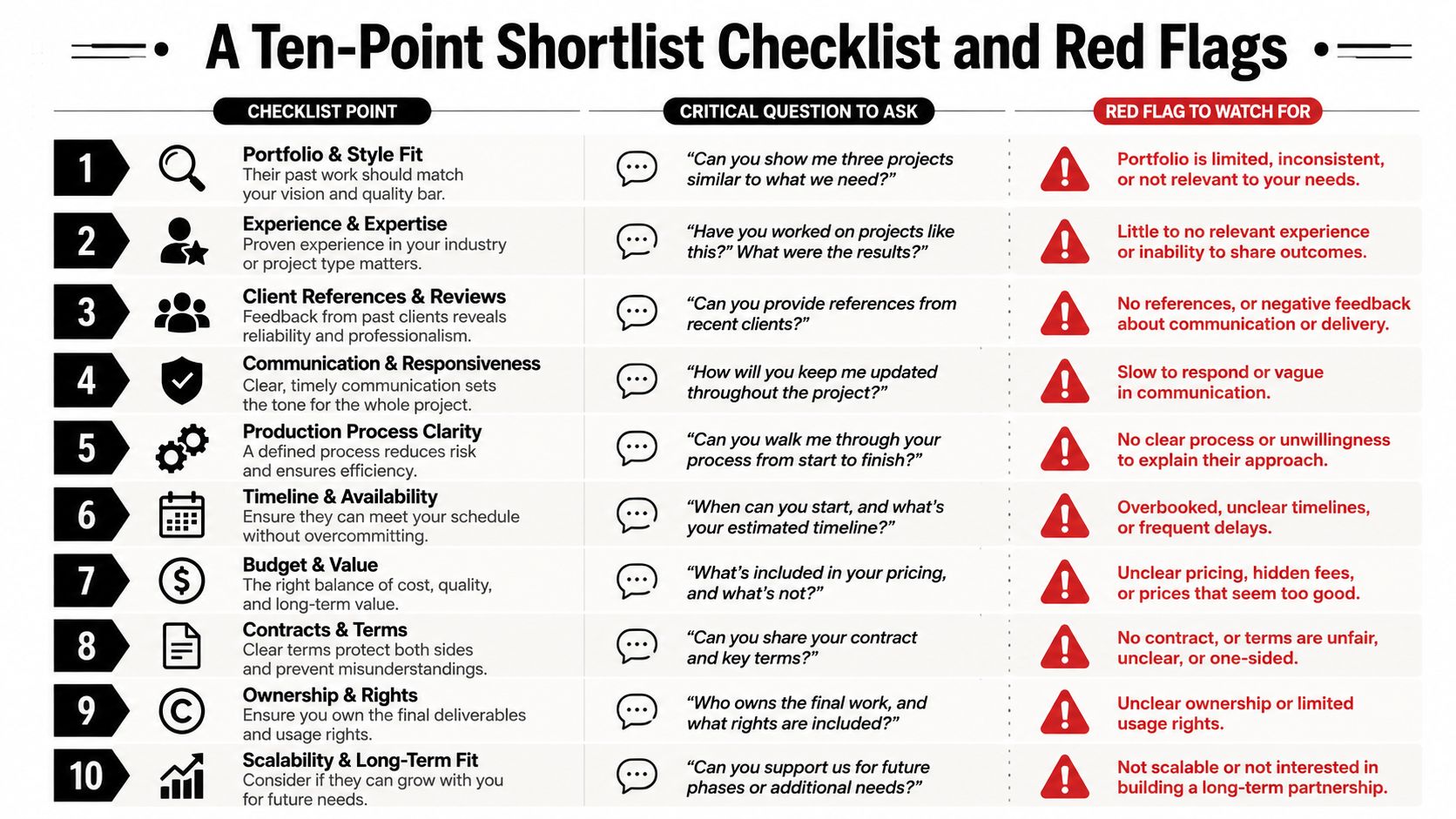
- Verify the portfolio. Ask: “Can you show me three projects similar in audience, channel, and complexity?”
- Confirm the goal. Ask: “What business outcome will this video support?” A provider should be able to discuss more than visual polish.
- Name the channel. Ask: “Where will the primary version run, and what cutdowns are required?”
- Compare equal scopes. Ask: “Do these proposals include the same script, shoot, post-production, versions, and licensing?”
- Identify the actual team. Ask: “Who will do the work, and who will lead creative?” A showreel may represent people who no longer work there.
- Clarify revisions. Ask: “How many review rounds are included, and what counts as a new direction?”
- Secure files and rights. Ask: “Will we receive raw footage, project files, usage rights, and final exports?” Put the answer in the contract.
- Test format coverage. Ask: “Can you deliver motion graphics, social cutdowns, captions, localization, and alternate aspect ratios?”
- Challenge the timeline. Ask: “What decisions must we make, and what could delay delivery?” A launch scheduled too tightly leaves no room for approvals or reshoots.
- Define reporting. Ask: “Which performance and operational metrics will we review after delivery?” The answer should match the video’s job.
Red flags
Drop the conversation when the scope stays vague after direct questions. Be cautious if the provider will not name the people doing the work, refuses to discuss project files or usage rights, or treats every revision as a surprise.
Pressure to sign before a discovery call is another warning sign. So is a portfolio that looks polished but comes with no explanation of the brief, audience, channel, deliverables, or team involved.
A single-format shop can also become a problem if you already know the project needs animation, social versions, localization, or sales enablement assets. Choose for the work you will need after the first export, not only for the hero asset in the proposal.
Metrics that matter and mistakes to avoid
A video should be judged by its job. A brand-awareness film and a sales-demo video do not need the same scorecard.
For awareness, review view-through rate and completion rate against the relevant platform benchmark rather than raw views. For product and demo videos, track watch time to the key moment, click-through to the next step, and assisted pipeline in the CRM. For sales enablement, usage by sales reps and time on page tell you whether the asset helps the team. For social, saves, shares, and cost per qualified view beat impressions. Raw view counts, likes, and an undefined “engagement rate” become vanity metrics the moment they detach from the intended action.
The numbers back up format discipline. HubSpot’s video marketing report (a survey of over 500 video marketers, last updated in 2026) found that 73% of video marketers say video is effective at reaching business goals, with short-form carrying the highest ROI of any format and Instagram ranked the top platform for ROI, engagement, and lead generation. None of that means every brand should make the same video. Channel, audience, and creative quality still decide the outcome.
If paid distribution is part of the job, it helps to know how the platforms themselves think about creative before you brief a partner. YouTube’s own guidance for advertisers is a solid baseline for that conversation.
A few mistakes distort shortlists over and over. Showreel polish is not enough; ask who made the work and whether the same people will work on yours. “We need a video” is not a brief; state the audience, goal, channel, message, deadline, and required versions. Quotes are not comparable when scopes differ, so put scripts, production, post, music, captions, revisions, licensing, and exports side by side. Rights are easy to overlook; confirm ownership of footage, project files, music, talent usage, and final deliverables before production starts. And two weeks before launch is too late for many projects; ask the partner to map decisions, approvals, production, post, and contingency before you commit to a date.
The hiring decision comes down to volume, variety, and ownership. Freelancers fit one-off, single-format work when your team already writes the brief. In-house makes sense when you need daily social output, can keep a videographer and editor busy year-round, and accept a narrower skill range. Choose a video agency or an embedded creative studio when you need several formats each month, strategic direction you do not have internally, or the ability to scale around launches. For many mid-size teams a mixed model works well, with daily social handled in-house and campaigns or brand work assigned externally.
Build your shortlist around your next quarter of work, not a single impressive reel. Write down your goals, expected formats, monthly volume, internal creative ownership, and required delivery dates, then ask each provider to respond to the same scope. The differences become clear fast.
Frequently asked questions
Line up deliverables, not headline prices. Check that each proposal includes the same script, storyboard, shoot days, post-production, music licensing, captions, aspect ratios, review rounds, raw footage, project files, and usage rights. When one quote comes in far lower, something on that list is missing, and it usually resurfaces later as a change order.
Metrics matched to the video's job, agreed before production starts. Awareness work should report view-through and completion rates against platform benchmarks; product videos should report watch time to the key moment and click-through to the next step; sales enablement should report rep usage and time on page. Add operational measures too, such as on-time delivery, revision rounds per asset, and how many versions each shoot produced.
When work arrives every week across several formats. An embedded team keeps a creative director and production capacity on your brand continuously, so repeat formats move faster and you stop re-briefing the basics on every project. For one contained production with an approved concept, a project quote from an agency or production company is usually the cleaner purchase.