How to Choose a Video Marketing Agency
Four video partner models compared, ten interview questions worth asking, the pricing variables that move quotes, and a day-90 scorecard to judge the pick.

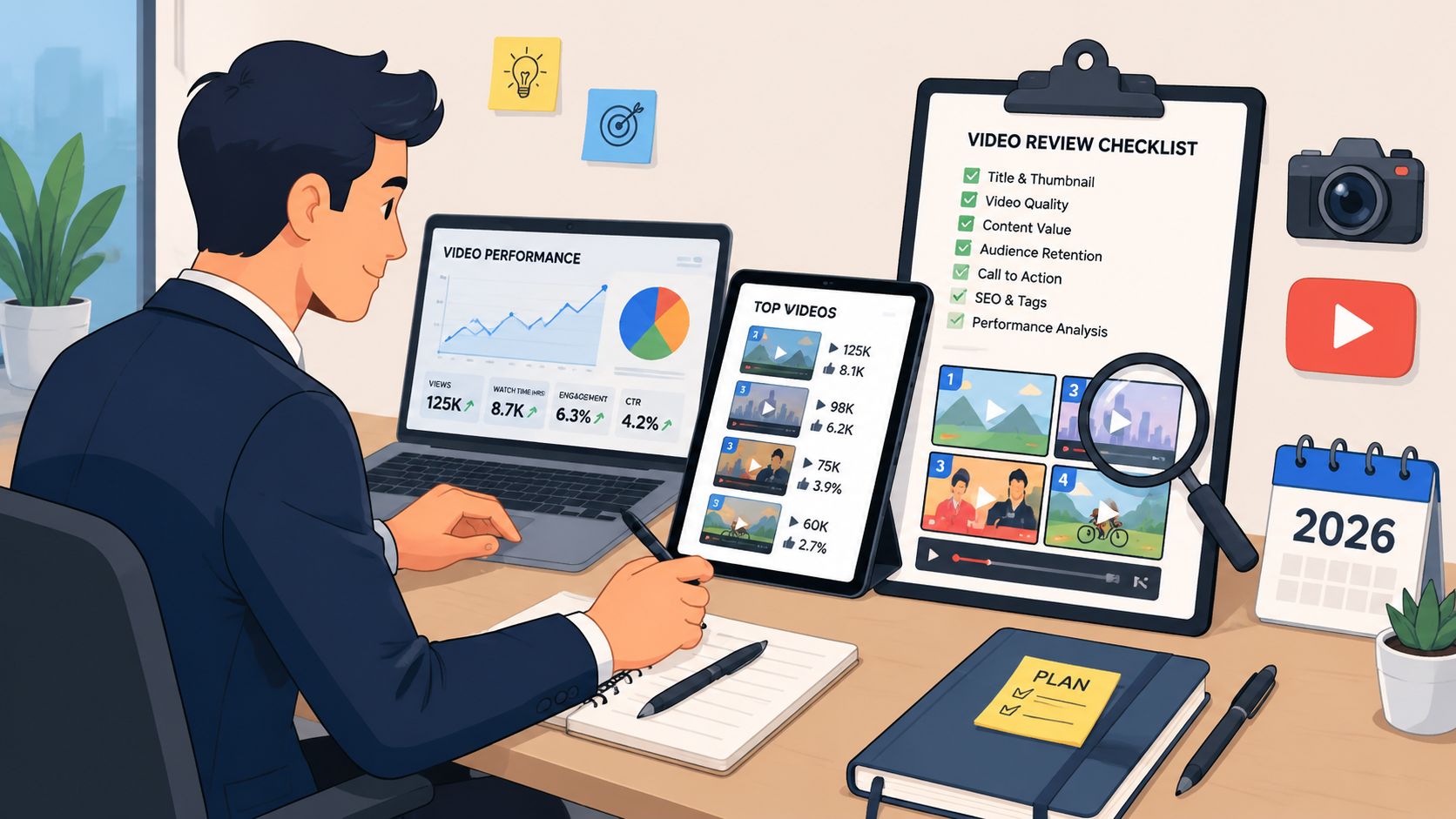
Choosing a video marketing agency comes down to one decision made in the right order: pick the operating model that matches your workload first (production shop, specialist, full-service partner, or embedded creative team), then test the people, process, scope, and commercial terms behind it.
I run Moonb, a creative studio, and a large share of the teams that reach us arrive after a bad pick rather than before their first one. A consumer brand I worked with had hired a shop off a gorgeous showreel and received exactly what the showreel promised: one gorgeous ninety-second film. Nobody had scoped the vertical cutdowns their paid team needed, so the film sat on the homepage for a quarter while the ad account ran static images. The vendor was fine. The model was wrong for the work.
Almost nobody debates whether to make video anymore; in HubSpot’s State of Marketing research, 93% of marketers say video is an important part of their strategy. The open question is operational. You need recurring social cuts, product explainers, paid creative, brand films, and campaign edits, but you may not need the same operating model for all of them.
So choose the partner type first. The rest of this guide runs in that order: models, interview questions, pricing, evaluation, and the first ninety days.
What a video marketing agency actually does
A video marketing partner connects strategy, scripting, production or animation, editing, versioning, and sometimes distribution and reporting. The work should begin with a business objective, then move through audience, message, format, channel, and measurement. A production team may shoot or animate the asset. A marketing-led partner may also place it, cut channel versions, and review performance. For the animated side of the calendar, our motion graphics services page shows what a dedicated team covers.
The phrase itself covers several very different operating models. A full-service shop may take responsibility from strategy through media distribution. A production shop usually creates the finished files and expects your team to own the brief and the launch. A specialist focuses on one lane, such as animation, social content, paid ads, or YouTube. An embedded creative team works alongside your marketing team on an ongoing basis, producing video, motion graphics, design, and related brand content at a set monthly cost.
Start with the three lanes
Strategy covers positioning, messaging, audience, channel fit, and the action you want viewers to take. When these decisions are fuzzy, a polished video can still solve the wrong problem; I have watched a well-produced product film flop because the script answered a question the audience had stopped asking a year earlier.
Wistia’s own summary of its 2025 State of Video report is a useful ninety seconds on what companies are actually doing with video, worth watching before you decide who should make yours.
Production includes live-action filming, editing, animation, motion graphics, voiceover, sound, finishing, and delivery. The right production model depends on whether you need a single hero film, a stream of social cuts, product demos, or several formats from one campaign idea.
Distribution includes placement, versioning, publishing support, paid media coordination, and performance readouts. Some partners handle these tasks. Others hand over files and stop there, which can be the right choice if your team already owns channel operations. Either way, decide early how video activity will connect to site behavior and pipeline in your analytics, because a partner who reports views alone is reporting almost nothing.
A team with a clear brief and strong internal distribution may only need a production specialist. A team facing constant demand across brand, product, social, and paid channels may need deeper integration. This comparison of full-service marketing models separates strategic ownership from execution in more detail.
The four partner types and how they compare
The four models below sit behind most searches for a video marketing agency. They overlap, but their responsibilities and trade-offs differ.
| Partner type | How you pay | What you get | Main weakness |
|---|---|---|---|
| Full-service shop | Per-project quote or monthly retainer | Strategy, scripting, production, editing, versioning, distribution support, sometimes reporting or media buying | Highest cost and operating complexity, and senior people may sell work that junior staff deliver |
| Production shop | Per-project quote, day rate, or defined project fee | Live action, animation, editing, finishing, and delivery of agreed files | You bring the strategy, channel plan, and measurement approach yourself |
| Specialized boutique | Per-project quote, retainer, or per-deliverable credits | Deep expertise in one lane, such as animation, paid video, social cuts, or YouTube | Limited breadth once the brief expands into other formats |
| Embedded creative team | Set monthly cost | A dedicated team that learns your brand, manages recurring requests, and covers video plus adjacent creative work | Less variety of directorial style, and capacity sits idle during quiet periods |
A full-service shop makes sense when you want one party accountable for the complete marketing motion. It also demands careful staffing questions: who leads strategy, who writes the scripts, who attends reviews, and who owns distribution after delivery.
A production shop is often the cleanest option for a defined launch. You provide the brief, message, audience, and approval path; the shop concentrates on craft. That division works well when your internal team can make decisions quickly.
A boutique earns its place when the problem is narrow and important. An animation specialist can beat a generalist on a complex product explainer. A paid-video specialist may be stronger when the work depends on testing hooks, cut lengths, captions, and calls to action across placements.
An embedded team sits closer to your operating rhythm. It can extend an existing creative department or serve as an alternative to hiring, but it still needs an internal owner who can brief and approve work. The in-house versus outside partner comparison helps if your decision is really about capacity, management, and continuity rather than video alone.
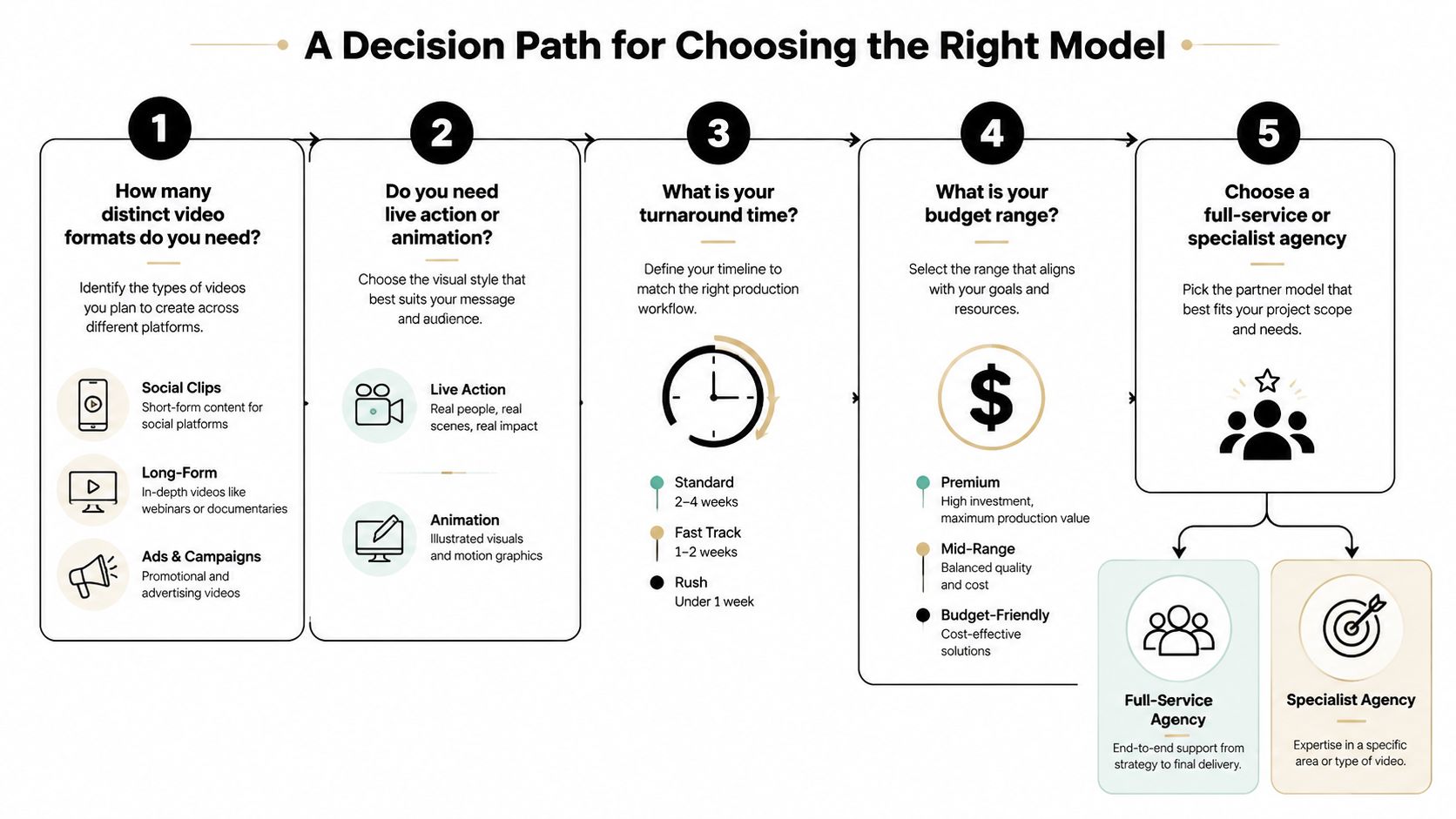
A decision path for choosing the right model
Answer these questions in order, and resist picking a partner off a single impressive film.
-
How many formats will you need? List the actual work: social cuts, product demos, paid ads, brand films, explainers, internal videos, YouTube edits. One defined format points toward a production shop or specialist. Several formats point toward a full-service or embedded team with broader production and design skills.
-
Which disciplines sit beside video? If the same campaign needs motion graphics, presentation design, landing-page assets, ad variants, and brand-system support, a video-only partner may create handoff problems. Broader creative coverage reduces the number of teams your marketers have to coordinate.
-
Is distribution and media buying in scope? If your team owns publishing and paid media, focus the partner on creative. If you need YouTube strategy, paid placement, testing, and reporting, look for a partner that explicitly owns those responsibilities rather than one promising to “support distribution.”
-
How much briefing and approval capacity do you have? Someone on your side must write a clear brief, consolidate feedback, and make decisions. If that person does not exist, a strategy-led partner may be necessary. If you can approve quickly, a production-focused model is usually more efficient.
-
How much timeline pressure is real? A campaign with a fixed launch date needs a partner that can prove staffing, review control, and delivery discipline. A recurring program needs a dependable queue and a team that keeps learning your brand across the work.
For paid-heavy programs I would add a sixth question: whether the partner should support campaign scaling, since paid creative lives or dies on versions and structured testing. Sovran’s overview of how video ads teams approach scaling is a useful outside read on that operating question.
The answers work together. A narrow format, clear internal strategy, owned media buying, and a fixed launch usually favor a production shop or specialist. Broad recurring demand, limited internal capacity, and a need for brand continuity point toward a full-service or embedded model. This explanation of creative as a service is another lens on ongoing creative capacity.
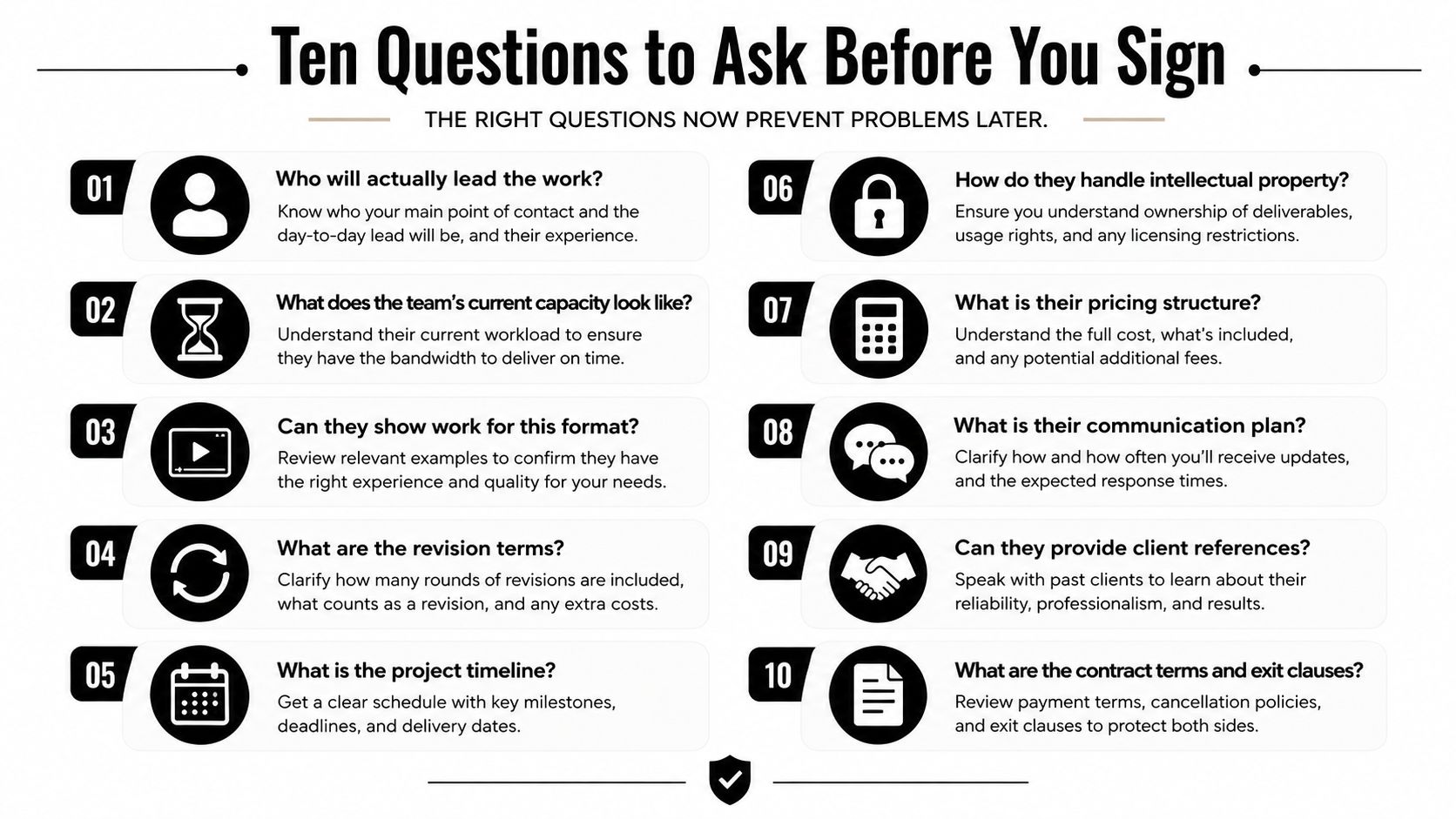
Ten questions to ask before you sign
A good interview shows you how the team works when the brief gets difficult. Ask every contender the same questions and judge the specificity of the answers. Strong answers name people, numbers, and documents; weak ones stay abstract.
-
Who will lead the work? You want names: the Creative Director, producer, writer, editor, and day-to-day contact, plus who steps in when someone is out. If the conversation keeps drifting back to the founders or the pitch team, the delivery team is being hidden from you.
-
What does current capacity look like? A serious answer shows the active workload, explains how new requests enter the queue, and admits where the production constraint sits. “We can handle anything” is a sales reflex, not an answer.
-
Can you show complete work for this format, audience, and channel? Complete pieces with the brief behind them beat a highlight reel. If everything shown is adjacent work, keep asking.
-
How do you turn a business objective into a creative plan? Listen for a line that runs from objective to audience insight, message, format, distribution, and a measurable action. Awards, aesthetic references, and promises to “go viral” are the weak version.
-
What is included, and what triggers extra cost? Get scripting, production, editing, versioning, voiceover, music, usage rights, travel, revisions, and delivery formats separated. A headline figure with open deliverables becomes a dispute later, so use our map of what video production services include as the checklist.
-
Who owns the strategy, footage, edits, source files, and ad spend? Ownership and access belong in writing before production begins. “It is standard” means nothing until someone defines what actually transfers.
-
How are deadlines, review rounds, and approvals managed? The good version uses one written brief, one review location, a named approver, and a documented revision process. This guide to writing a creative brief helps your side prepare before the interview. Scattered messages with no priority order are how two review rounds become seven.
-
What reporting will we receive, and what decisions should the data change? Reporting should match the format: completion for awareness, click-through and cost per result for paid creative, demo requests for product video. Raw views with no next step is a report nobody reads twice.
-
What would you stop, simplify, or refuse after reviewing our sample brief? This is the question I never skip. A partner willing to cut deliverables, challenge assumptions, or flag a channel mismatch will protect your money later. One that accepts every request immediately is quoting, not thinking.
-
How does your specialist work fit this brief? For motion-heavy work, ask for the motion designer’s reel specifically. For performance work, ask how creative testing and versioning actually run. For regulated or broadcast work, ask about compliance and finishing experience. One general showreel is not proof of every capability.
Then ask for three complete pieces from one client and the brief behind each. A reel shows selected seconds. It does not show the approval process, the difficult middle, or whether the team can repeat the quality.
How video marketing partners charge
Video pricing follows operating complexity more than a logo. Partners commonly charge through per-project quotes, monthly retainers, per-deliverable credits, production-day rates, or embedded team arrangements. A retainer fits recurring output. Project pricing fits a defined launch. An embedded model fits a queue of changing creative requests.
For scale, HubSpot’s video budget research found that 41% of companies spent under $20,000 on video promotion and advertising in 2025, while 28% spent over $20,000. Treat that split as a planning reference, not a rate card; it covers promotion and advertising, not the production quote for your specific work.
The variables behind the number
A simple talking-head edit has a different cost structure from a campaign film with locations, talent, crew, travel, reshoots, and post-production. Animation adds its own variables: concept development, illustration, character work, motion design, voiceover, sound, and finishing.
Deliverable count matters just as much, and in the quotes I see it is the variable teams underestimate most. One master file is simpler than a package of vertical social edits, square placements, paid ad variants, landing-page versions, CTV assets, and broadcast files. Usage rights, music licensing, talent rights, source-file ownership, revision rounds, and turnaround pressure all move the number too.
Control the variables you own:
- Reduce ambiguity: define the audience, action, message, channels, formats, deadline, and exclusions.
- Limit combinations: decide which versions matter before production begins.
- Consolidate feedback: give the partner one clear review from one accountable owner.
- Organize assets: supply approved logos, footage, product screens, guidelines, and references.
- Compare scope: review staffing, revisions, usage, licensing, and delivery, not only the headline amount.
Technical delivery belongs in the scope too. The IAB digital video ad format guidelines call for 16:9 when possible, with HD delivery at 1920x1080 or 1280x720 and source-file bitrate options of 50Mbps VBR or 15 to 30 CBR. The IAB video ad format standards add a frame-rate minimum of at least 15 frames per second, key frames every second, and codecs including MPEG2, WMV, and H.264/AAC. Both are older reference documents, so let your media owner or platform specifications control the final delivery list; the point is to confirm that list before production, not after.
Our breakdown of what video production costs helps you lay out scope variables before asking partners to quote.
What video marketing services should include
Whatever the model, the services layer breaks into the same five parts, and a quote that skips one of them is where scope disputes start. Strategy covers the audience, the message, channel fit and the action you want, written down before anyone opens a camera. Production covers scripting, the shoot or the animation build, editing, motion graphics, voiceover and sound. Versioning covers the vertical, square and horizontal cuts, the six and fifteen second edits, captions, and the platform specs for each placement. Distribution support covers publishing, paid coordination and the hand-off to whoever owns the media. Reporting covers what changed after the video ran, matched to the format it was made for.
A production shop usually sells the middle two. A full-service shop sells all five. An embedded team covers the first three while your marketers keep the last two, which is the split most teams I work with actually want. When you compare quotes, mark which of the five parts each one includes and price the gaps yourself, because you will pay for them either way.
Run the evaluation in three steps
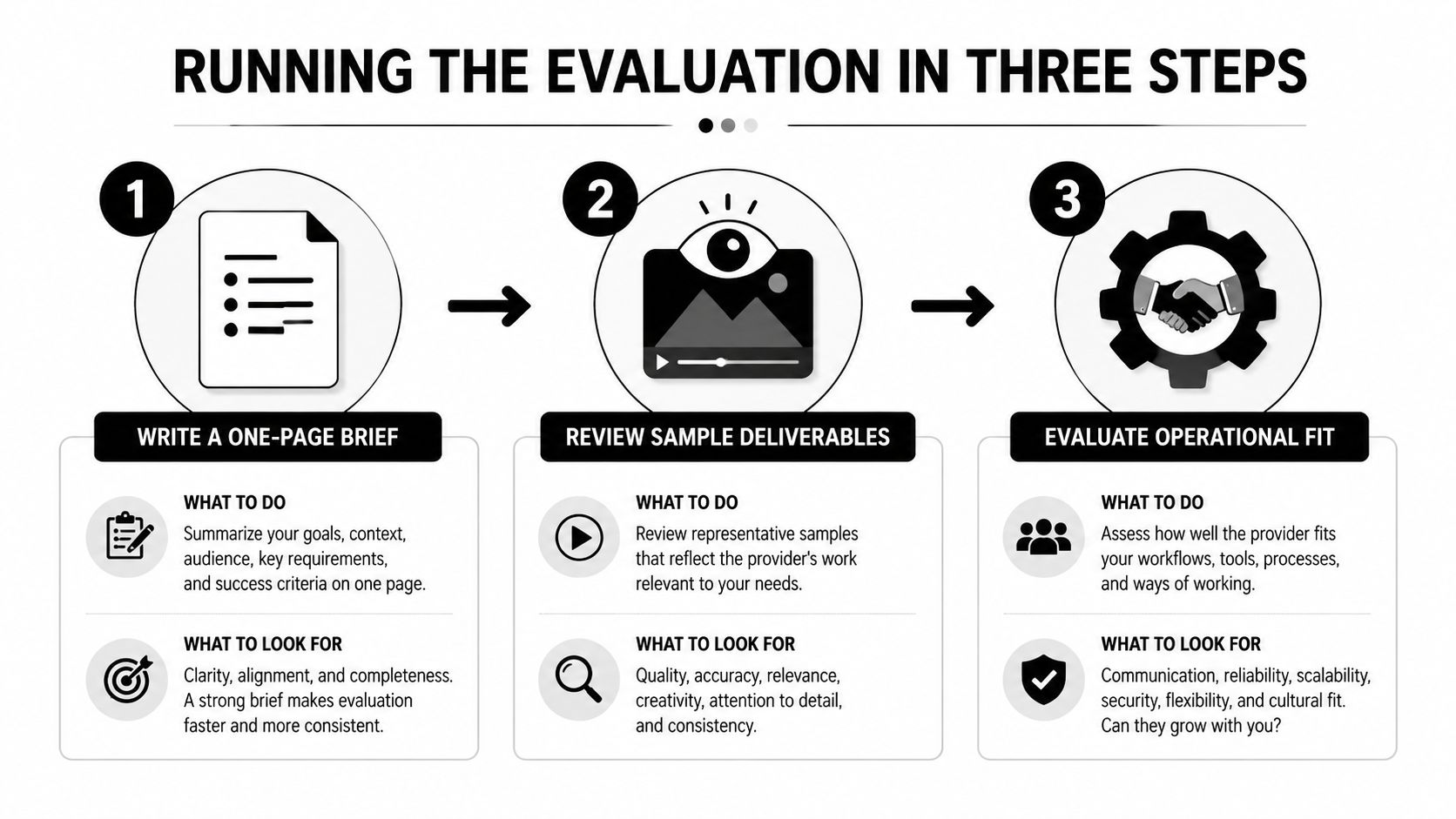
Skip the long list of contenders. Build three small artifacts that make the decision easier to defend.
One framing point before the artifacts. The work you are buying has to earn attention in feeds that ignore most of what brands publish, so judge contenders on whether their work is worth noticing, not merely whether it is competent. Seth Godin’s TED talk on why safe ideas go unseen is still the sharpest ten minutes on that bar.
One page that makes the problem clear
Your brief should state the business problem, audience, intended action, distribution channels, core message, required formats, deadline, decision-makers, spending range, success measures, and key requirements. Add what is not in scope.
This document keeps every contender solving the same problem. It also exposes whether a partner can improve the brief, rather than inventing strategy after the agreement is signed.
A paid test that resembles the work
Use a representative brief and pay for a small piece. Keep the assignment identical across contenders, then assess more than the final cut: strategic interpretation, concept quality, collaboration, schedule control, and how useful the revisions are. I have sat on the vendor side of enough of these to say the paid test is where the decision actually gets made; the pitch meeting rarely survives contact with a real brief.
A test piece should be deliberately specific. If your recurring need is social and paid creative, do not test a large brand film. If you need animation-heavy product education, ask for the motion approach your real audience will see.
A five-line scorecard
Score each contender on strategic fit, creative quality, execution capability, commercial clarity, and partnership quality. Assign the weighting before reviewing the work, put evidence beside every score, and set a minimum passing standard. The brief tests fit. The paid piece tests execution. The scorecard forces a clear decision memo that records the trade-offs.
Red flags and the first 90 days
The first month tells you more than the pitch deck. Week one should include a kickoff where the partner reviews your brand guidelines, existing footage, asset library, tone references, and marketing calendar, and both sides agree on one place to brief and one place to review.
In week two, the first small deliverables should ship. Social cuts or a repurposed edit are useful because they carry low production risk and reveal whether the team understands your style. Weeks three and four should move a larger brand or campaign piece through script, storyboard, production, and two review rounds.
Day-one polish matters less than the trend line. Watch how much the second round of feedback shrinks compared with the first.
The red-flag checklist
- Vague success metrics: kickoff language about visibility with no defined action. Write the metric into the brief and the agreement.
- One contact with no backup: every question waits on one person. Ask for a named backup and direct access to the production lead.
- Scope creep without a change order: new deliverables appear informally. Require a written scope update before work continues.
- Slow first revision: feedback sits with no explanation. Agree on review ownership, response expectations, and escalation.
- No shared asset library: files arrive with inconsistent names and versions. Establish a folder structure, naming convention, and source-file policy.
- Senior people only on the pitch: the people doing the work were never introduced. Meet them before signing.
- No raw files or performance data: ownership or reporting stays vague. Define file access, data access, licensing, and transfer terms in the agreement.
- A showreel as the only proof: ask for complete pieces, original briefs, and an explanation of what the team handled.
- Slack as the brief: scattered messages create avoidable revisions. Move requests into a written brief with a single approval owner.
- Views as the only measure: raw view counts depend heavily on distribution spend. Separate creative performance from distribution and review format-specific measures instead.
I watched an enterprise SaaS team brief three separate vendors, one for a brand film, one for social cuts, one for paid ad variants. Each launch shipped with mismatched typography, pacing, and voice, and every review became a repair job. Moving the recurring work to a single team under one Creative Director put the campaign film, the cutdowns, the LinkedIn versions, and the ad variants through one process, and brand consistency stopped being something caught at review stage. Fragmentation costs more than any single rate card shows.
What to measure by day 90
Agree on a two-layer scorecard before signing.
The operational layer tracks on-time delivery rate, average review rounds per piece, days from brief to first cut, and how often a piece needed a re-brief because the partner misunderstood the request.
The performance layer matches the metric to the format: view-through and completion for awareness pieces, click-through and cost per result for paid creative, assisted conversions or demo requests for product and landing-page video. This guide to video marketing ROI covers the measurement method in more detail. For measurement planning, a practical reference is video marketing with Google Analytics, especially when you need to connect video activity with site behavior rather than treating views as the end of the story.
No partner can promise performance numbers before the work exists. Judge whether the team is building a reliable learning loop, not whether the pitch predicted a result.
Recurring brand and campaign video
Recurring work changes the hiring decision. A single production can be judged as a contained project. Weekly social cuts, product demos, paid variants, and campaign films need a team that remembers your brand and can move between formats without restarting the relationship each time.
An embedded creative team fits when demand is steady and extends beyond video into motion graphics, design, animation, and brand content. It works alongside your existing marketing team, so your internal owner keeps priorities, approvals, and business context. It is not the right model for every company.
The first month as a practical benchmark
The month-one sequence above applies here with one addition: calibration. Week one sets the operating system, week two uses low-risk work to test tone, pacing, captions, and file delivery, and weeks three and four push a larger piece through script, storyboard, production, and two review rounds. On a recurring program you are also watching whether the queue itself works: how requests get sized, how the backlog is ordered, and whether output holds steady when your briefs arrive late. Judge any contender on a full month of mixed requests, not on their best single project.
There are real costs to the arrangement. You commit to a monthly amount whether or not you brief enough work, so quiet periods need planned backlog projects. You get a consistent team, but less variety of directorial style than hiring a new studio for every campaign. Large one-off productions, including multi-day shoots, big crews, remote locations, or unusual finishing requirements, may still need a separate quote.
Per-project studios carry the opposite cost. You get flexibility and fresh creative perspective, but each new engagement brings a brand-learning curve. Either model only works when someone on your side owns the queue and can approve work quickly.
The right partner is the one whose operating model matches the work you actually need. Write the one-page brief, run the paid test, score the trade-offs, and only then build a shortlist. Take your current video brief and turn it into that evaluation document this week: formats, channels, approval owner, review process, source-file terms, and the day-90 scorecard, then invite partners to complete the same paid test piece. The clearest process shows you who can produce strong work repeatedly, not just who presents it well.
Frequently asked questions
Yes, and plenty of teams do it well, usually one partner for recurring social and paid output and another for occasional large productions. The rule that keeps it sane: one internal owner routes every brief, and one brand system governs both. Trouble starts when each partner reports to a different stakeholder and the versions quietly drift apart.
Usage and licensing durations for music, talent, and stock footage; raw footage and project-file access; what happens to in-progress work if either side ends the engagement; and turnaround definitions in business days. Write renewal pricing in too. Most disputes I see trace back to one of these, not to creative quality.
For social cuts and repurposed edits, a week is usually workable once the team knows your brand. Campaign films need four to eight weeks for scripting, production, and reviews, and more when live shoots or talent are involved. Lead times vary by partner, so ask each contender for their standard by format and hold them to it.