What Is a Full Service Marketing Agency? a Complete Guide
A complete guide to choosing a full service marketing agency. Learn what they do, the pros and cons, pricing, and how to pick the right one for your business.

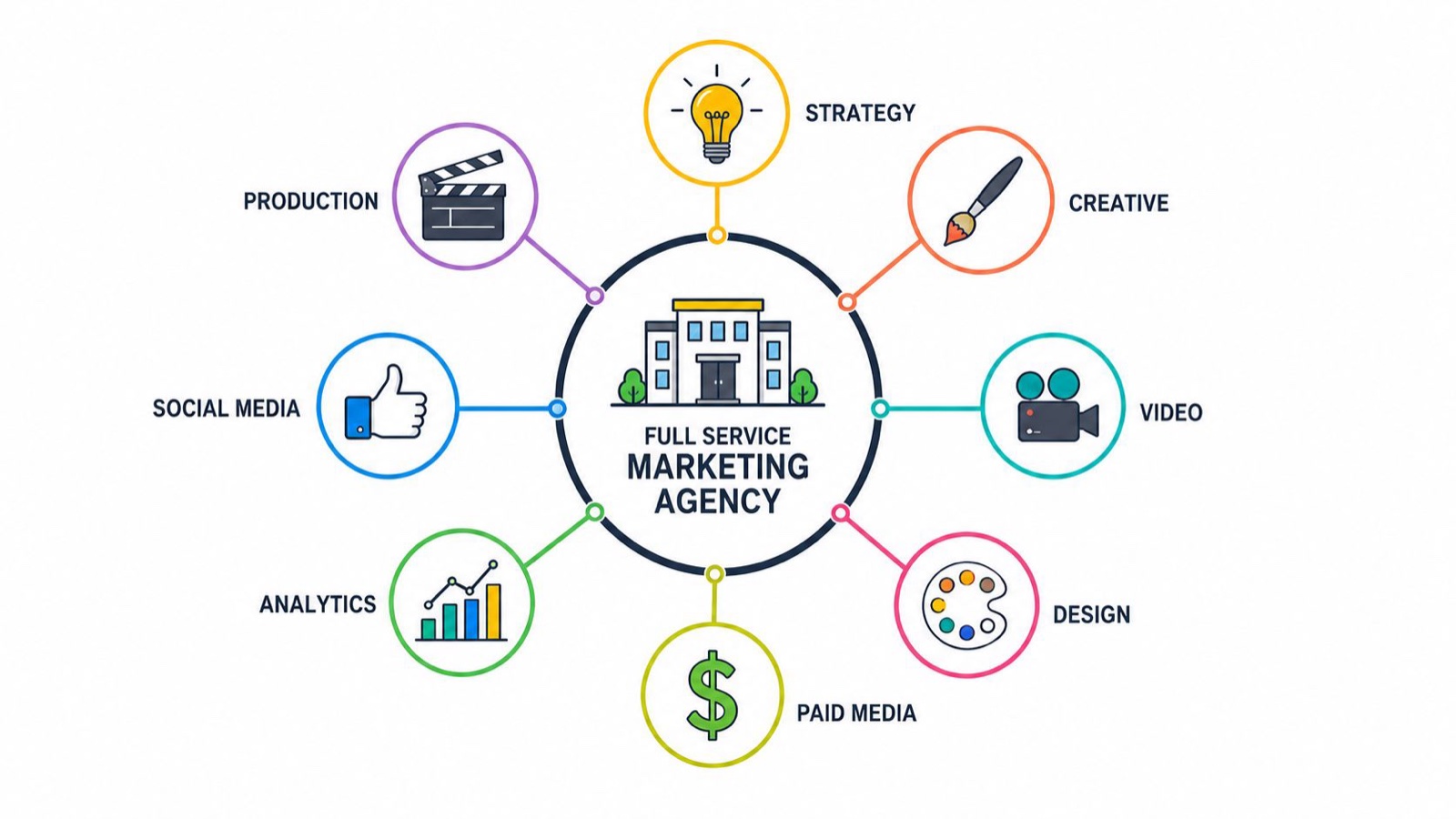
A full-service marketing agency runs your whole marketing program, from strategy through analytics. One team handles web design, social, video production, paid ads, and reporting, so you have a single point of contact instead of a stack of vendors to chase.
That sounds simple. In practice it solves a specific problem. Most teams I talk to aren’t short on ideas. They’re worn down because SEO, paid media, design, video, web, email, and reporting all run on different timelines and answer to different people.
I’ve watched this play out enough times to trust the pattern. When the work is split across too many vendors, you spend more hours aligning people than shipping campaigns. When one team owns the through-line, the work tends to come out cleaner and move faster.
The full-service marketing market is growing fast, at a CAGR above 9.2% through 2035, according to Research Nester.
What Exactly Is a Full-Service Marketing Agency
A full-service marketing agency is one partner that handles strategy, creative, execution, and measurement across your marketing program. Instead of hiring one shop for SEO, another for paid ads, a freelancer for design, and someone else for web updates, you bring in a single team to run the system together.
That distinction matters more than most buyers expect. Plenty of firms say they’re full service when they really mean they can refer work out. A real one owns the planning, the creative direction, the production, and the reporting under one contract, so you’re never left wondering who’s actually driving. That lines up with how Digilant describes end-to-end support across strategy, creative, execution, and measurement.

The appeal is obvious if you’ve ever tried to coordinate five specialists yourself. One team writes the campaign brief. The designer works from the same brief as the paid media manager. The landing page and the email go out with the same message. Analytics stop being an afterthought.
Practical rule: If an agency can’t tell you who owns strategy, who makes the final creative call, and who’s accountable for reporting, it isn’t really operating as one team.
I also think buyers should separate this model from pure creative support. Some companies need a full-service partner. Others already have strategy in-house and mainly need execution help from a dedicated creative team that can deliver on a steady weekly rhythm. Those are different needs. If you’re sorting through that line, this guide on creative design agencies is a useful companion read.
For teams trying to tighten attribution and reporting, the operational side matters as much as the service list. Tools that empower marketing agencies with data help because they connect channel work to real performance instead of leaving you with disconnected reports.
What Services Do They Actually Provide
A real full-service agency usually covers strategic planning, branding, creative services, digital channels like SEO and social, and web development, as inBeat lays out. That’s the broad list. What matters is how those pieces work together.
Early in a relationship, I look for whether the agency can connect business goals to actual deliverables. If they jump straight to “we’ll run ads” or “we’ll post on LinkedIn,” that’s usually a warning sign.
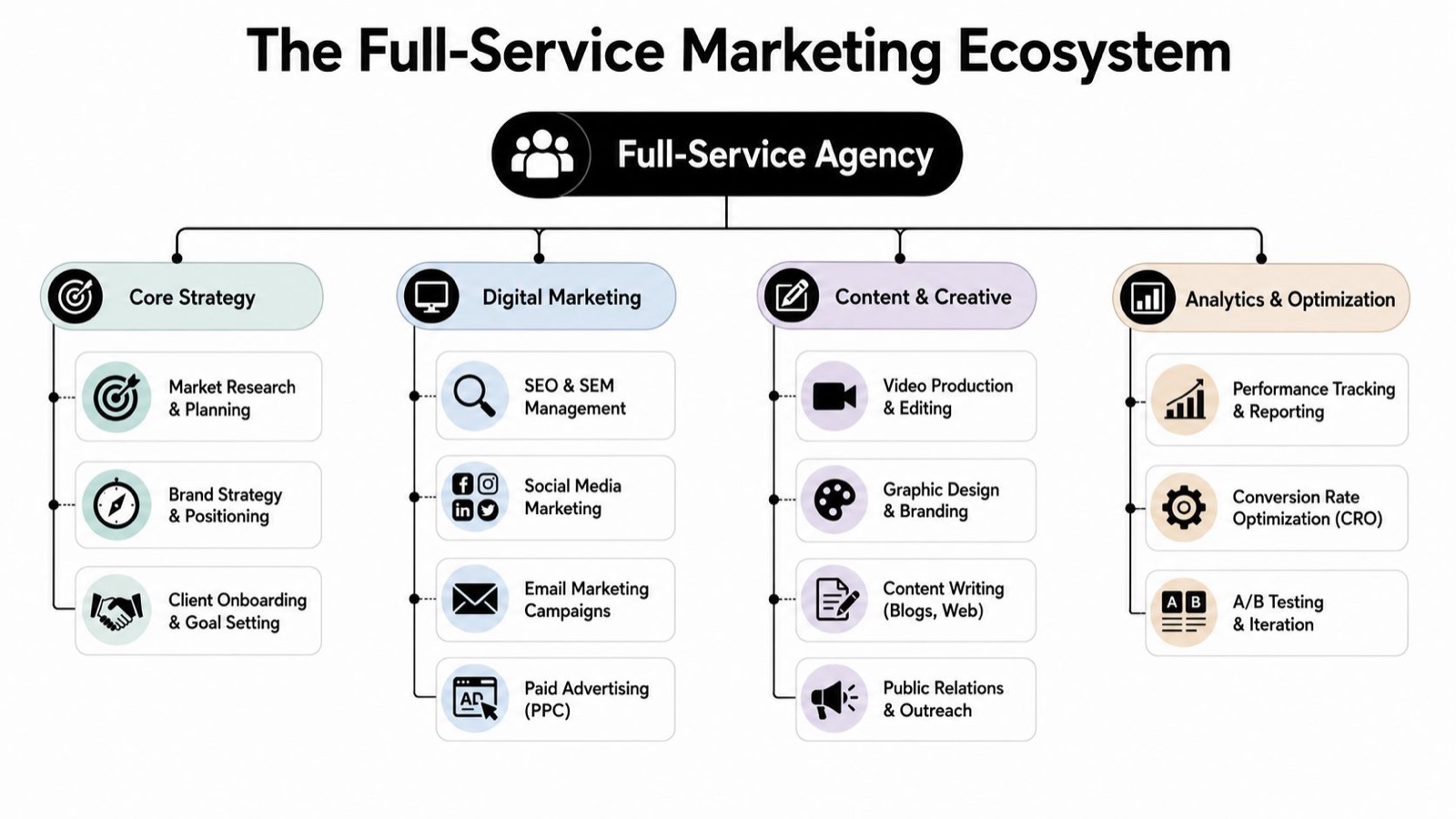
Strategy comes first
This is the part clients underbuy and later regret.
A strong full-service team starts with positioning, audience definition, message hierarchy, offer clarity, a competitor review, and channel priorities. If your buyer isn’t clear, the agency can still make good-looking assets, but they won’t map to the funnel.
Core strategic work often includes:
- Positioning and messaging: Clarifying what you sell, who it’s for, and why buyers should care.
- Market and competitor review: Looking at how others frame similar offers, where they’re weak, and where your brand can stand out.
- Campaign planning: Turning quarterly goals into channel-specific briefs, launch calendars, and creative priorities.
- Measurement design: Deciding what gets tracked and how success will be judged before any spend starts.
A go-to-market version of this model may also fold in lead generation, branding, web design, content, video production, graphic design, and revenue marketing as one coordinated package, as Pipeline Velocity outlines.
Creative and production are the visible layer
This is what most buyers think they’re paying for.
Creative work can include brand identity, ad creative, motion graphics, landing pages, product marketing assets, social content, email design, sales collateral, photography direction, and video. For a lot of companies the value shows up fast here, because these outputs are visible and easy to put to use.
The best agencies think past individual assets and build systems.
- Brand design systems keep social posts, decks, landing pages, and videos visually consistent.
- Content production creates campaign assets in several formats, not just one hero deliverable.
- Video and motion support launch films, demos, paid ads, social cutdowns, and internal communication.
If video is part of your mix, this look at YouTube video optimization services from Taja AI’s 2026 optimization guide is worth a read, because it shows how production and optimization need to connect once assets move past the first publish.
The service pages at Moonb are a good example of the narrower creative side of the market, where a team supports an existing brand function without trying to own the whole agency relationship.
One test I use. If an agency says it does video, ask what happens after the hero asset is approved. If they don’t immediately bring up cutdowns, aspect ratios, paid variations, subtitles, thumbnails, landing page placement, and social edits, they’re probably thinking in campaigns, not systems.
Channels and measurement do the scaling
A full-service agency usually manages a mix of:
- SEO
- Paid search and paid social
- Organic social media
- Email marketing
- Website design and development
- Analytics and reporting
Social carries a lot of weight here. Social media marketing is the top service offered by 75% of agencies, and 39% of global agency spend goes to social platforms, according to Revenue Memo. That’s one reason cross-channel coordination stopped being optional.
A few years ago, agencies could get away with handing analytics over at the end of the month. That doesn’t hold up now. The better teams use reporting to shape creative while the campaign is still running.
A short explainer helps if you want the broad picture from another angle:
How Does a Full-Service Agency Compare to Other Options
Most companies aren’t really asking, “Should I hire a full-service agency?” They’re asking, “What’s the least painful way to get good marketing done consistently?”
That’s a better question, because a full-service agency is only one of several workable models, and it isn’t automatically the best one.
Comparing 12 marketing resource options
The table below is the practical version I wish more buyers saw before they signed anything.
| Option | Best For | Typical Cost Structure | Main Advantage | Key Trade-off |
|---|---|---|---|---|
| Full-service agency on retainer | Companies that need strategy, execution, and accountability across channels | Ongoing retainer | One team owns the plan and execution | You need strong fit, because replacing the partner is disruptive |
| Full-service agency on project scope | Rebrands, launches, site rebuilds, or a fixed campaign | One-time project fee | Clear scope and timeline | Momentum often drops after delivery |
| In-house marketing department | Companies with steady volume and enough leadership to manage specialists | Salaries, benefits, software, recruiting | Deep brand immersion and direct access | Slow to build, harder to cover every specialty |
| Single senior marketing hire | Early-stage companies needing direction before team buildout | Salary plus tools and contractors | One owner inside the business | One person usually can’t execute every channel well |
| Specialized SEO agency | Search-heavy businesses with internal brand and paid support | Retainer or project | Deep channel expertise | SEO work can pull away from product and brand context |
| Specialized paid media agency | Teams spending heavily on ads and needing testing discipline | Retainer plus media management model | Focused performance management | Creative, landing pages, and CRM often sit elsewhere |
| Specialized social agency | Brands where community and platform-native content drive awareness | Retainer | Strong platform fluency | Social work can become disconnected from web and lifecycle marketing |
| Web design and development shop | Site redesigns, migrations, landing page builds | Project fee | Strong design and build capability | Campaign strategy and ongoing channel ops may be outside scope |
| Fractional CMO or consultant | Leadership teams needing senior guidance | Advisory retainer | High-level clarity and prioritization | They often don’t execute the work |
| Freelancer network managed in-house | Teams with strong internal direction and a producer to coordinate vendors | Per deliverable or hourly | Flexibility by skill | Coordination load sits on your team |
| Solo generalist freelancer | Small businesses with limited scope | Hourly, day rate, or project fee | Fast, simple, direct | Capacity and specialization are limited |
| Embedded creative team | Internal marketing teams that already own strategy but need output across video, design, and motion | Ongoing scoped engagement | Consistent production without building a department | It won’t replace broader channel strategy on its own |
If you’re weighing agency versus internal build, this guide on how to build an in-house creative team is useful, because it forces the staffing question into the open instead of pretending every model solves the same problem.
What the retainer model changes
One of the biggest trade-offs is how the relationship is structured. In my experience, ongoing retainers reduce the constant cost of rebuilding context, because the team already knows your brand, your history, and what you’ve already tried. Project work tends to create a handoff problem instead. Everyone is energized during kickoff. The site launches or the campaign goes live, and then nobody owns the iteration that follows.
The biggest hidden cost in marketing is the stop-start cycle of rebuilding context every time you swap partners. It rarely shows up on the invoice.
Retainers aren’t magic. A weak agency on retainer is still a weak agency. But if your marketing needs ongoing coordination across channels, the operating model matters as much as the credentials deck.
How Do I Choose the Right Agency for My Business
The first thing I look at isn’t the portfolio. It’s whether the agency knows how to start.
If the sales call ends with creative concepts before anyone has audited your positioning, customer profile, current funnel, and tracking, they’re guessing. Sometimes experienced teams guess well. It’s still guessing.
What the first 30 days should look like
A healthy first month usually has two parts.
Part one is discovery and audit. That means reviewing your positioning, ideal customer profile, existing brand assets, competitor environment, channel history, website performance, and data setup. The point isn’t paperwork. The point is to stop the team from making attractive work for the wrong buyer.
Part two is one quick win. Not ten things. One thing: a messaging foundation, a refreshed homepage hero, a launch video, or another visible asset that proves the team gets the brand and can ship.
That order matters. Agencies that skip the audit tend to produce polished work that doesn’t line up with the client’s real buyer or funnel.
A brand audit framework like the one in Moonb’s guide to brand audits is useful here, because it shows the kind of foundation work that should happen before production ramps up.
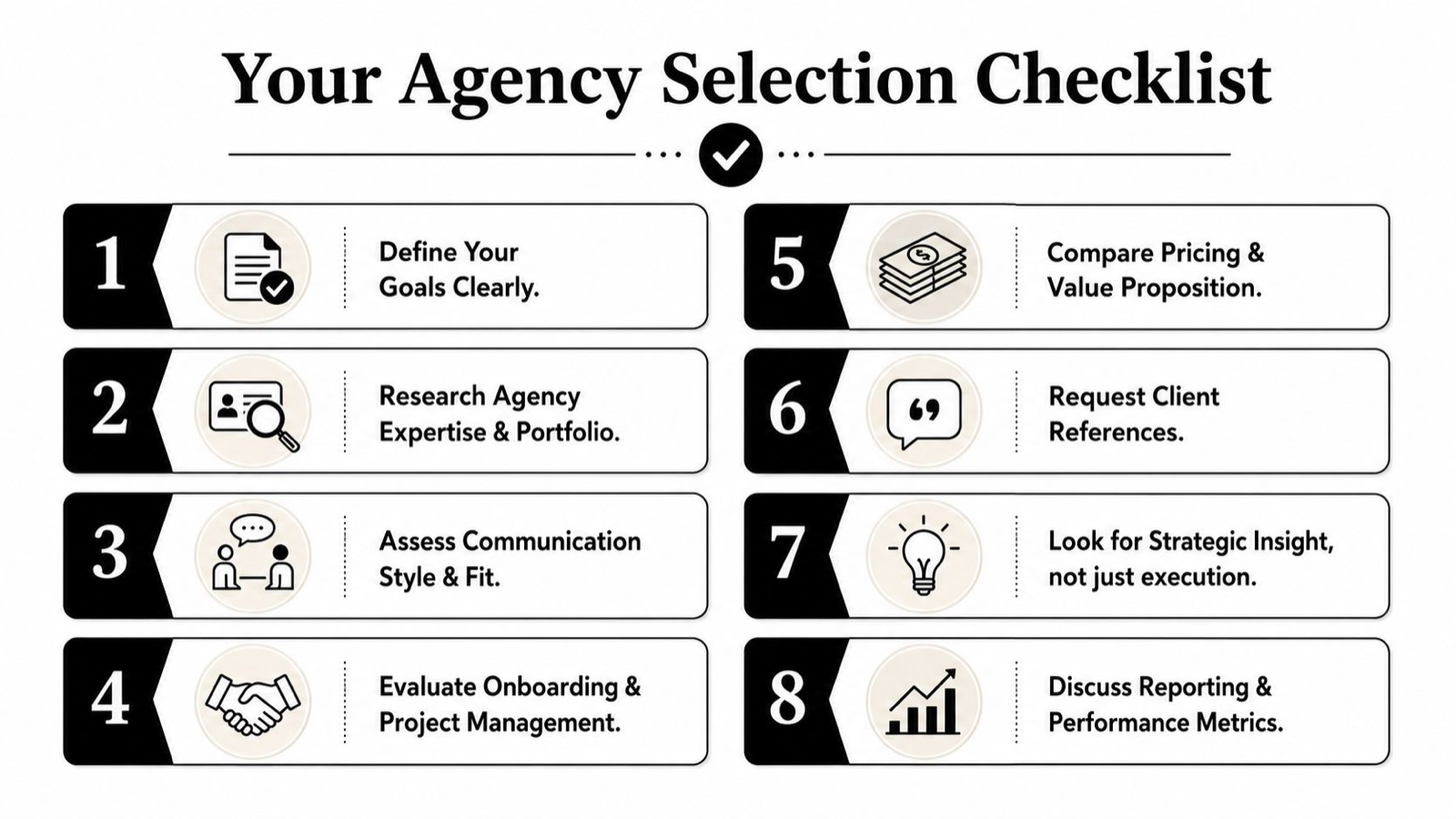
Questions I’d ask before signing
I’d ask questions that force the agency to talk about operations, not just taste.
- Who owns the strategy? If nobody clearly owns the plan, the work slips.
- Who gives creative direction? You want one person accountable for the through-line.
- What does the first month look like? Listen for audit first, then one trust-building deliverable.
- How do you handle feedback? Good agencies have a clear review process and documented rounds.
- How do you report performance? You want business-facing reporting, not vanity metrics dressed up as insight.
- What tools do you use to manage work? Asana, Trello, Notion, Frame.io, Slack, and shared asset libraries are all common. The tool matters less than whether everyone actually uses it.
- What happens when priorities change midweek? This tells you how rigid or resilient the team is.
I’d also ask about staffing health. You don’t need a utilization spreadsheet from them, but you do want to see that they run a disciplined operation and aren’t so overloaded that quality suffers.
Good sign: they can explain their workflow in plain English. Bad sign: they hide behind process language and still can’t tell you who will actually touch the work.
What Does Working with One Look Like Day to Day
The day-to-day should feel boring in the best way. Clear brief. Shared calendar. Fast feedback. One owner. Regular shipping.
When this breaks, it’s usually because too many people read the brief separately. The paid media manager wants performance. The designer wants polish. The social lead wants volume. The web team wants more time. Nobody is wrong. Nobody is aligned.
A weekly rhythm that actually works
The best cross-channel setups I’ve worked with follow a cadence like this:
- Monday priorities sync: One shared brief, one campaign calendar, one ranked list of deliverables.
- Tuesday to Thursday production: Video, design, web, email, and paid assets move in parallel against that same brief.
- Midweek async reviews: Comments happen in tools like Frame.io for video, Figma for design, and a board in Asana, Trello, or Notion, so feedback doesn’t wait for the next meeting.
- Friday QA and ship checkpoint: Final review, packaging, approvals, and launch readiness.
- Ongoing asset management: Approved files, captions, copy, thumbnails, and brand elements go into a shared library so the next project starts cleaner.
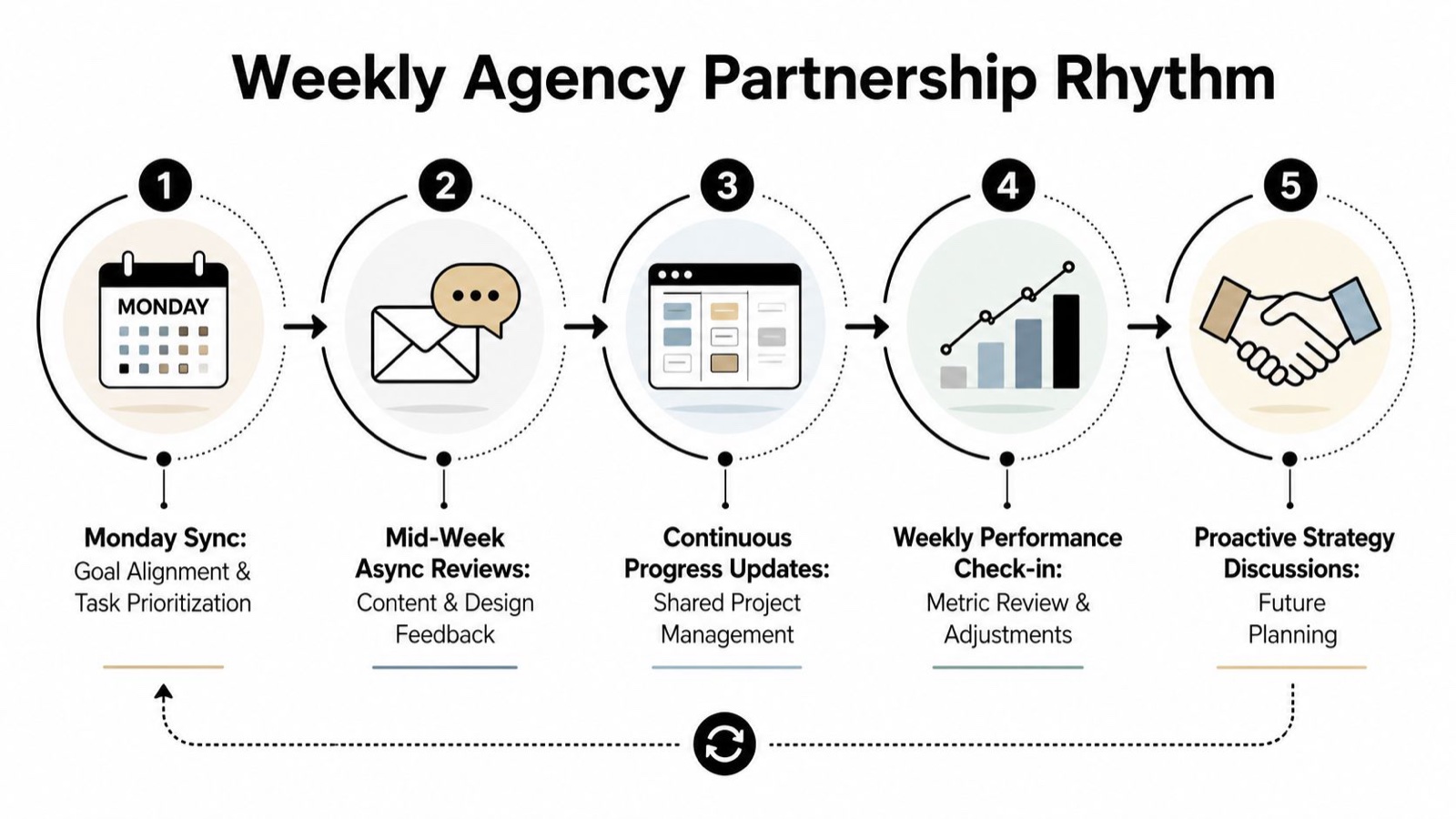
The real trick is the single creative owner, not the meeting schedule. One creative director, or an equivalent lead, has to hold the line so the landing page, ad set, email header, and social cut all carry the same message and visual logic.
Why video and design need to move together
Some of the strongest modern brand work comes from systems, not isolated deliverables.
Apple’s “Shot on iPhone” is a clean example. The films, social assets, outdoor placements, and design language all feel like one campaign because they were art directed as one system. Spotify Wrapped works for a similar reason. The design system is so recognizable that it extends into motion and sharing behavior every year.
That’s why I get nervous when buyers split video from design too early. One team can make a strong film. Another can make good static assets. If they weren’t built together, though, the campaign often feels stitched together.
This matters more because social now absorbs so much agency attention. As I mentioned earlier, social is the top service most agencies offer, and a large share of spend goes there. That puts pressure on the team to coordinate versions, not just concepts.
The most overlooked service in the mix
If I had to name one under-scoped service, it’s motion and video repurposing.
Clients plan for the shoot. They approve the hero edit. Then they realize they need vertical cuts, square cuts, short paid versions, silent-autoplay versions, subtitled versions, internal versions, landing page versions, and platform-native social edits.
Most teams need more than one video. They need a set of cuts that work everywhere the video will actually live.
This isn’t only a creative preference. In Wistia’s 2026 State of Video report, 81% of teams put video on LinkedIn and 76% on YouTube, according to Wistia. One hero asset can’t serve all of those places well, which is a good reason to plan for the repurposing layer, not just the shoot.
Is a Full-Service Agency the Right Move for You
A full-service agency is usually the right move when your core problem is coordination. You have enough marketing demand to justify ongoing work, but not enough internal capacity, or the management bandwidth, to run a fragmented vendor stack well.
It’s often a strong fit for a company that has product-market fit and needs one team to connect strategy, creative, web, paid, and reporting. It also works for larger teams that already have internal marketers but are overloaded and need one outside partner to own execution across several functions.
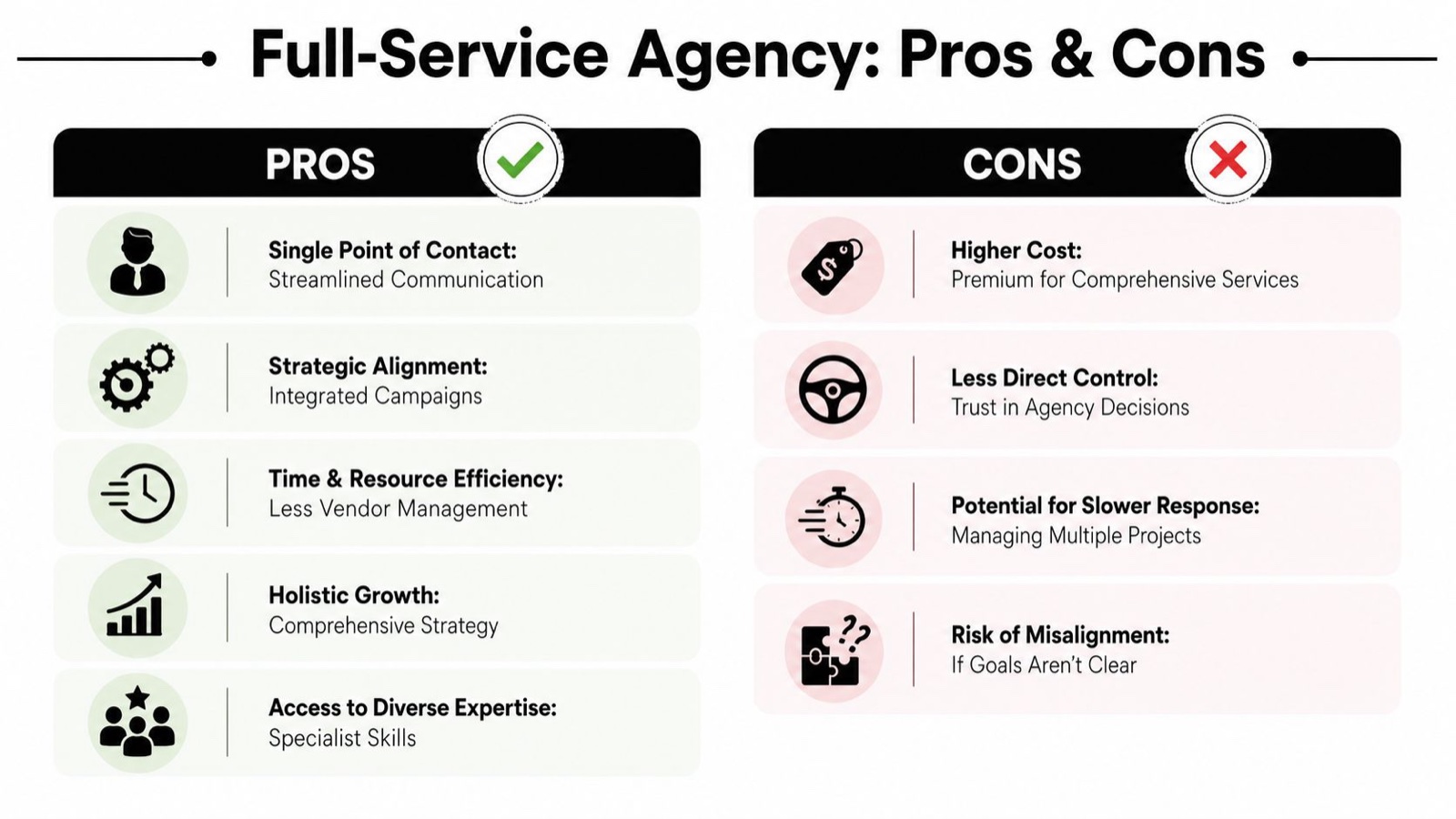
It may not be the best fit if your need is narrow. If you only need technical SEO, a site migration, or a one-time product film, a specialist can be the cleaner choice. If you already have a strong marketing leader and channel owners in-house, you may only need a dedicated creative team to extend output rather than a full agency relationship.
So the question is simple. Do you need one partner to own the whole machine, or do you already know how the machine should run and just need more hands to build the parts?
If it’s the second one, Moonb can slot in as a dedicated creative team that delivers strong work on a steady weekly rhythm, on brand and ready when you need it.
Frequently asked questions
The common structures are retainer, project-based, and sometimes advisory or value-based arrangements. A retainer makes sense when you need ongoing coordination across channels. Project pricing works better for fixed scopes like a rebrand, a website rebuild, or a launch campaign. In practice, the right model depends less on theory and more on whether the work is continuous or finite. I'd be careful with pricing conversations that stay vague too long. You should know what's included, who's on the team, how revisions work, what gets reported, and what falls outside scope. If an agency can't make that clear before kickoff, things usually get messy after it.
That depends on the channel and on what you mean by "results." You can usually judge the relationship itself early. In the first month, you should be able to tell whether the team gets your brand and communicates clearly. You'll also see whether they ship work in an organized way, or whether things pile up. Business results take longer and vary by mix. Paid media can show directional feedback quickly. SEO, brand positioning, and content systems ask for more patience. For video specifically, it helps to think in layers. The hero piece may launch first, but the repurposed edits often carry more day-to-day value across social and paid. If you're mapping out video scope, Moonb's FAQ page covers the kinds of production questions teams usually need to sort out early.
They hire for output before they hire for fit. That usually shows up in a few ways: Skipping the audit: They want campaigns immediately, before the agency understands the buyer, funnel, or message; Buying isolated deliverables: They ask for a homepage, a video, or ads without deciding who owns the broader strategy; Under-scoping repurposing: They fund the hero asset and forget the platform-native versions that make it useful; Letting reporting stay abstract: They accept "performance updates" that never connect back to business goals. The best first engagement is usually low on flash and high on trust. It gives both sides a working rhythm they can sustain.