Design Services: A Buyer's Guide to Making the Right Call
How to buy design services by request volume, consistency stakes, and direction needs: the four sourcing models compared, with the ownership and pricing traps.


Choose a design services model by request volume, brand-consistency stakes, and the amount of creative direction the work needs, not by portfolio alone. For low, irregular demand, use a freelancer or queue-based service. For sustained volume, hire in-house or use an embedded team. For a major identity or campaign, choose a studio that can lead the work.
I run Moonb, and I have sat on both sides of this purchase. The buyers who call us are usually deciding after another week of scattered requests: a paid social set needs new formats, sales wants a sharper deck, product needs a landing page, and the brand manager is correcting typography in every draft. The question is never who can make the asset. It’s which buying model keeps the work moving without creating more review, coordination, and brand management than it removes.
This guide covers design services for marketing and brand teams; it excludes architecture, engineering, and interior design. The category is bigger than most buyers assume: IBISWorld puts the global graphic design services market at $57.0 billion, and that is the narrow graphic-design slice, before you count web, product, motion, and multi-channel content work.
What design services cover and how to pick a model
Design services are outsourced or contracted creative work for a brand, marketing, product, or communications team. They can cover identity, campaign assets, landing pages, presentations, packaging, motion, illustration, and the systems that help other people apply the work correctly.
The buying rule is short: low volume favors flexible specialists, high volume favors stable capacity, and high consistency stakes with strategic work require creative direction. Those three filters change the answer quickly.
If you need a few presentation slides or a templated social asset from time to time, a freelancer can be the cleanest choice. You pay for a defined project and avoid carrying unused capacity.
If your team sends a steady stream of paid ads, decks, landing pages, and social variations, a queue-based service can absorb production. It works best when the briefs are clear and the work follows an established visual system.
If you’re launching a new category, rebuilding a brand, or asking design to shape the campaign idea, you need direction before production. A studio or embedded team fits better, because someone must make decisions across formats rather than execute tickets.
The supply side is enormously fragmented, dominated by solo freelancers and small shops, which gives buyers plenty of choice and makes the operating model matter as much as the work samples. Don’t start with “who has the nicest portfolio?” Start with “what did our last month of requests require?”
The disciplines that sit under design services
Design services are an umbrella. The disciplines below overlap constantly, especially when a campaign moves from identity into web, advertising, motion, and presentation design. If a brief involves unfamiliar users, pair the design work with structured discovery; the practical methods in this Formbricks user research guide are a good starting point.
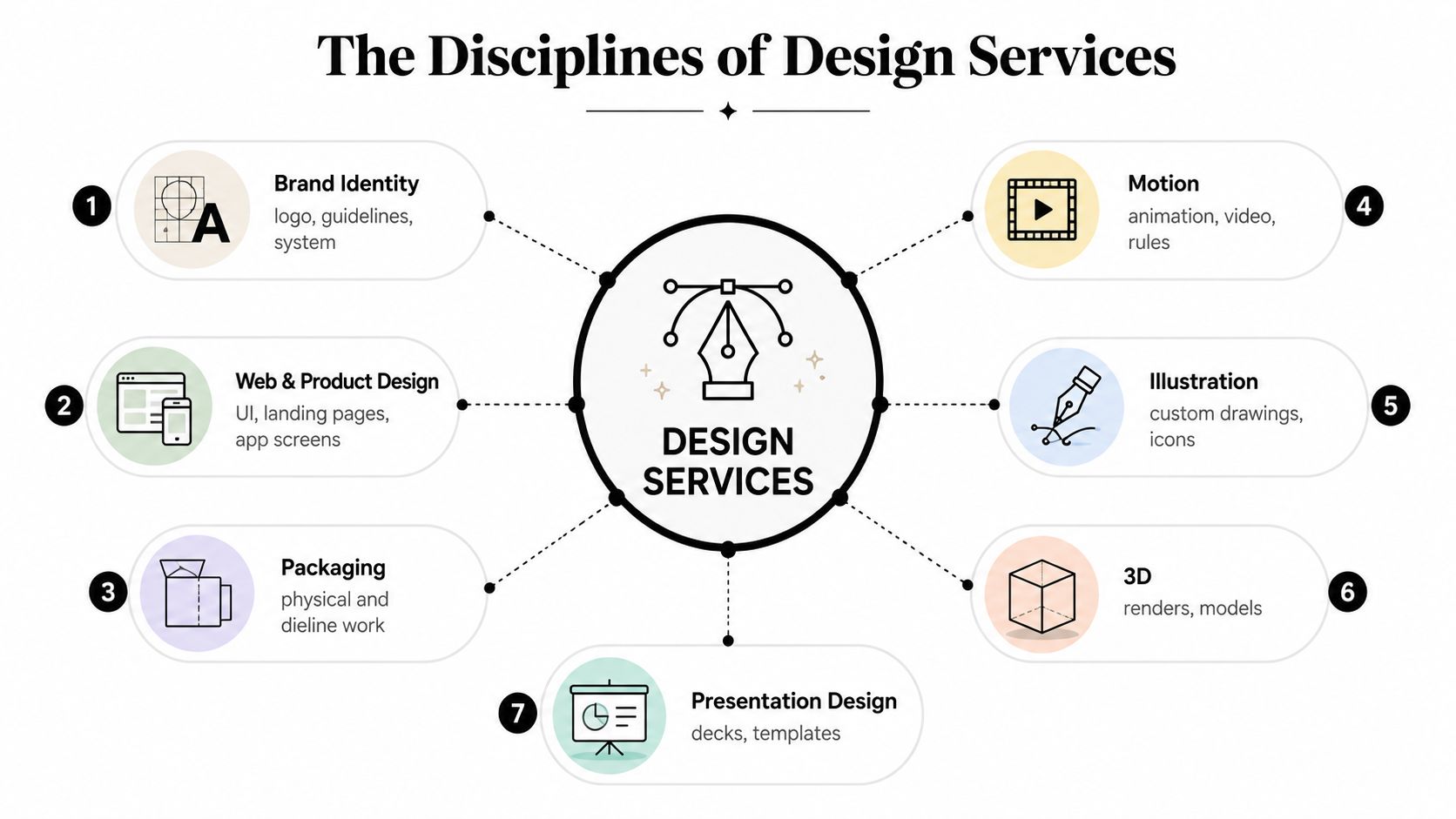
- Brand identity design: logos, type, color, layout rules, guidelines, templates, and the visual system that keeps later work coherent. This is the foundation; a logo file alone won’t keep a campaign, website, and sales deck aligned. Our map of brand identity design services covers what a system-level engagement should include.
- Web and product design: marketing sites, landing pages, interface patterns, app screens, wireframes, and responsive layouts. Web work depends on product, content, and development constraints.
- Packaging: physical packaging, labels, dielines, production artwork, and the visual decisions that must survive manufacturing.
- Motion and animation: social loops, animated type, product demonstrations, transitions, explainers, and motion rules. Motion turns static identity decisions into behavior.
- Illustration: custom drawings, icons, editorial visuals, and distinctive graphic elements that give campaigns a character stock imagery can’t provide.
- 3D: renders, models, product visualization, environments, and composited scenes. It’s specialist work; check the actual 3D capability rather than assuming a broad portfolio covers it.
- Presentation design: pitch decks, sales presentations, investor updates, reports, and reusable templates.
Brand identity carries the most downstream weight. A recent study in Frontiers in Psychology found that visually consistent product systems produced higher brand identification and reduced the cognitive resources viewers needed to process them. Treat identity as an operating system for the work, not a handoff of decorative files.
The four ways to buy design services
There are four common sourcing models. Each gives you a different thing, even when two providers appear to offer the same deliverables.
In-house hires
You employ the designer directly. The cost basis is salary plus benefits, software, recruiting, management, equipment, and the time required to keep the role productive. You get a person who builds daily context, attends internal meetings, understands stakeholder preferences, and protects the brand from inside. You also take on recruiting risk, leave, turnover, and idle capacity when the request pattern changes. Best for steady demand, proprietary product knowledge, and daily collaboration.
Freelancers
Freelancers charge hourly, daily, or per project. The person doing the work is usually the person you met, which keeps communication direct and makes the model quick to start. The trade-off is coverage: one freelancer may be excellent at identity but unavailable for motion, web, 3D, or urgent production. Hire several specialists and you become the coordinator, and often the de facto Creative Director. Best for defined projects, specialist work, and short bursts.
Studios and traditional agencies
A studio or agency charges through a scoped engagement or project arrangement. You buy a partner team, creative direction, project management, and access to several disciplines. You receive stronger campaign leadership and a broader bench; you also pay for more process, and the senior person who sold the work may not execute it. Ask who will be assigned, how the team is staffed, and who reviews the output. Best for brand identity, campaigns, complex launches, and work where concept and production must stay connected. A practical design service web partner guide can help structure that evaluation.
On-demand or queue-based design services
These services use a set monthly cost, a request queue, and one or two active requests at a time. A designer picks up the next available brief, returns a draft within the stated turnaround, and moves on after approval. The model handles repeatable production well. It has thinner strategic involvement, and the designer may rotate between requests, so context can reset from ticket to ticket, especially when the brand system isn’t documented. Best for templated, high-volume work with clear briefs; our explainer on recurring creative models covers how this category evolved.
The broader choice isn’t about finding a universally superior provider. A freelance specialist gives you direct creative ownership. A studio gives you direction and coverage. A queue gives you production throughput. An internal hire gives you context and control.
Comparing the sourcing models side by side
Use this table as a first filter, then verify the details in the contract. An “on-demand” label doesn’t tell you how many requests can be active, and a “studio” label doesn’t tell you whether a senior creative will review the work.
| Criterion | In-house | Freelance | Studio | On-demand / queue | Embedded team |
|---|---|---|---|---|---|
| Cost basis | Salary plus overhead | Hourly or project | Scoped engagement | Set monthly cost | Monthly team or scoped engagement |
| Turnaround | Internal priority dependent | Availability dependent | Project schedule | Stated queue turnaround | Planned weekly rhythm |
| Continuity | High | Person dependent | Team dependent | Variable designer continuity | Named team continuity |
| Creative direction | Internal lead | Usually limited | Built in | Usually limited | Creative Director led |
| Scaling | Slow to hire or reduce | Flexible, fragmented | Scales by scope | Adds request capacity within rules | Adds coordinated team capacity |
| File ownership | Employer controlled | Contract dependent | Contract dependent | Contract dependent | Contract dependent |
| Best operating mode | Daily context | Defined specialist task | Strategic project | Repeatable production | Recurring, integrated output |
Ownership deserves special attention. In the United States, the default rule is that the designer retains copyright in work they create unless the contract transfers ownership in writing or establishes a work-for-hire relationship. Payment alone doesn’t transfer copyright, and a client may end up holding only a limited license for project use while the designer keeps the underlying work. So no column in that table wins outright: the cheapest model often gives up continuity, the fastest model often gives up direction, and file rights depend on contract language rather than category. For the internal-versus-external structure question, use our in-house team comparison.
Choosing by request volume and work type
Don’t use a universal request threshold as a purchasing rule. Teams count requests differently, and one complex campaign can consume more direction than several templated assets.
Start with a request log for one month. Record each request type, the needed turnaround, and how many people touched it:
- Asset type: templated social post, campaign concept, presentation, landing page, or brand asset.
- Timing: when the first draft was needed and how quickly revisions had to return.
- Touch count: everyone who briefed, reviewed, revised, approved, or reformatted the work.
- Direction load: whether the brief was already decided or someone had to create the concept.
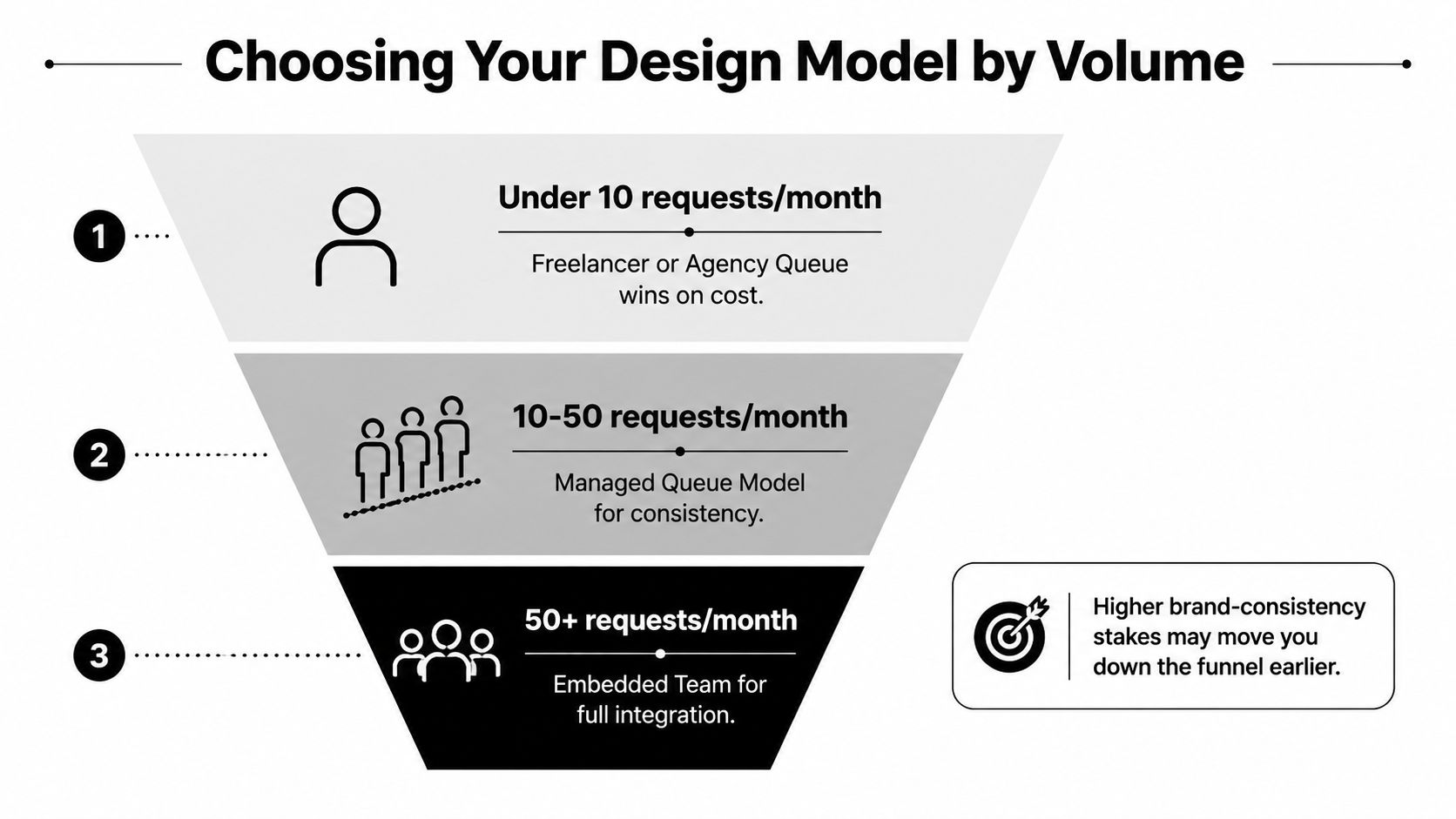
Then apply three tests. Keep internal the work that needs daily context and review authority; brand stewardship and product marketing visuals sit close to stakeholder decisions. Source out the spiky or specialist work; motion, illustration, 3D, campaign concepting, and a rebrand can justify external support without keeping a full-time specialist occupied. And match the operating model to the work mix: mostly templated requests suit a queue, concept-heavy work suits a studio or embedded team, and if demand stays above one person’s capacity, compare the fully loaded internal role with a stable external team.
For the internal calculation, anchor on the U.S. Bureau of Labor Statistics median wage for graphic designers, currently $62,960 per year in the Occupational Outlook Handbook. Apply your real benefits and overhead load; an illustrative 1.3 load takes that to roughly $81,800 before software, recruiting, equipment, and the share of a senior creative’s time spent supervising the role. Don’t hide those costs; they decide whether a salary comparison is honest. For how the recurring end of the market prices itself, compare on-demand design services, keeping your actual request mix as the source of truth.
Whichever model you land on, the quality of your briefs will cap the quality of the output. This short HubSpot walkthrough on writing creative briefs is the fastest fix I know for a team drowning in revision rounds.
From brief to delivery in a queue versus an embedded team
Take one brief: a paid social ad set and a landing-page hero. The output may look similar under either model. The path to it differs.
In a queue model, the marketing lead writes the brief and submits it through a portal. A producer triages the request, an available designer picks it up, and a first draft returns within the provider’s stated turnaround. Revisions follow. Once the asset is complete, the next request starts, and the buyer may need to restate the brand context because the same designer isn’t guaranteed. That sequence is efficient for repeatable work. It gets frustrating when the brief contains an unresolved concept, when several stakeholders need alignment, or when the asset must connect to a larger campaign.
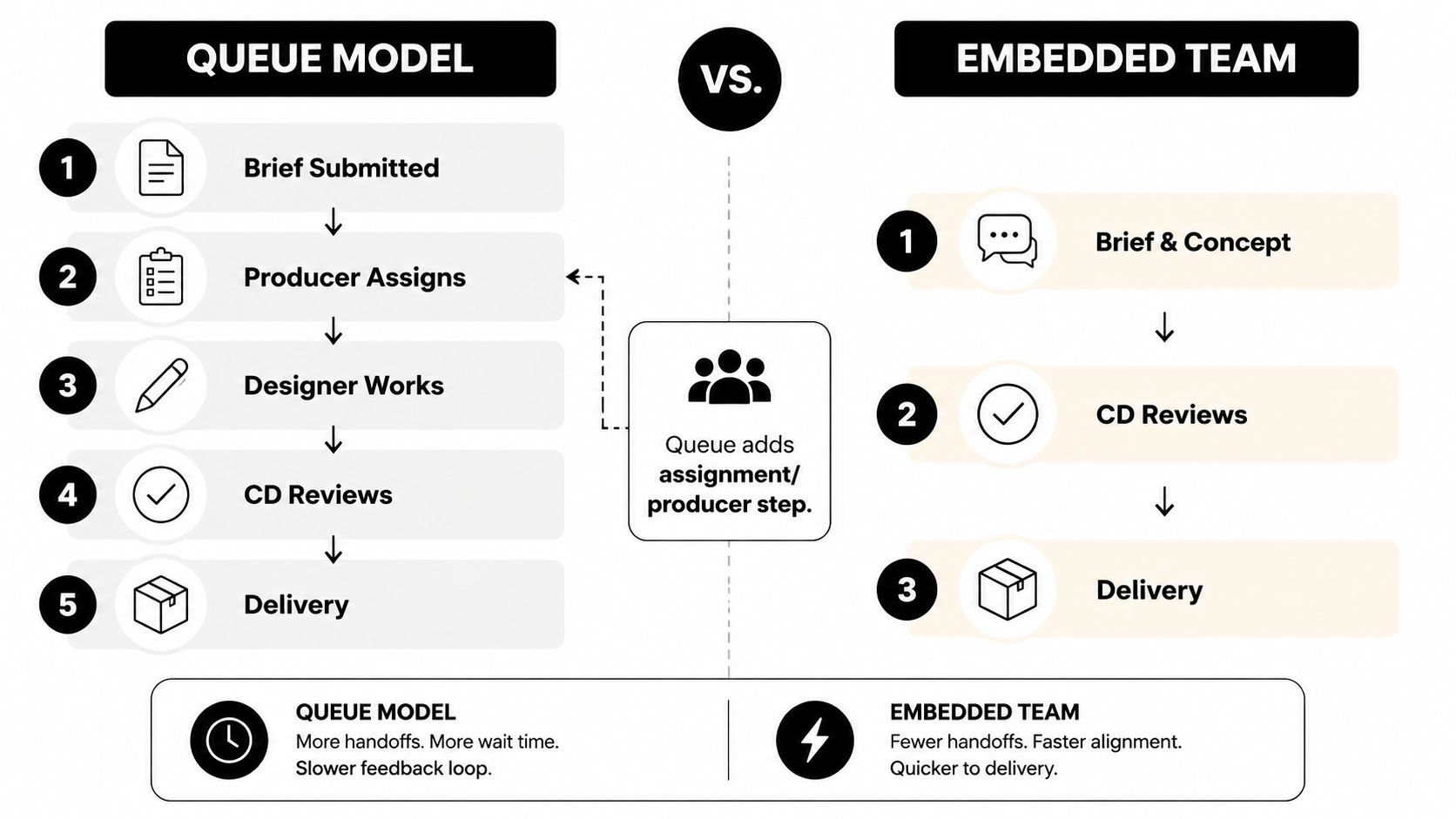
An embedded team starts with kickoff and brand immersion. A Creative Director leads a fixed group of designers, the team works in the buyer’s collaboration tools, and the backlog is planned on a weekly rhythm. New work gets concept direction before production, and the Creative Director reviews the asset before delivery. That structure builds continuity, but it requires participation: the buyer needs to share planning context and make decisions. The payoff is a team that can recognize the brand problem before turning it into a production ticket.
For a deeper look at production sequencing, this video production workflow guide is useful because the same principle applies to design: clear ownership at briefing and review prevents production from carrying unresolved strategy.
Moonb is one example of the embedded, Creative-Director-led model, delivering design, video, motion, animation, and brand content on a steady weekly rhythm. The choice is a fit question: do you need transactions completed, or a team that holds context while the work keeps moving? Our creative workflow process piece covers the operational details to examine.
Questions to ask any provider and mistakes to avoid
Run the same questions against a freelancer, studio, queue service, or embedded team. A polished portfolio doesn’t answer operational questions. Garry Tan’s design-for-startups talk makes the underlying point well: design quality is a function of decision quality, and that starts with who decides.
Continuity and capacity
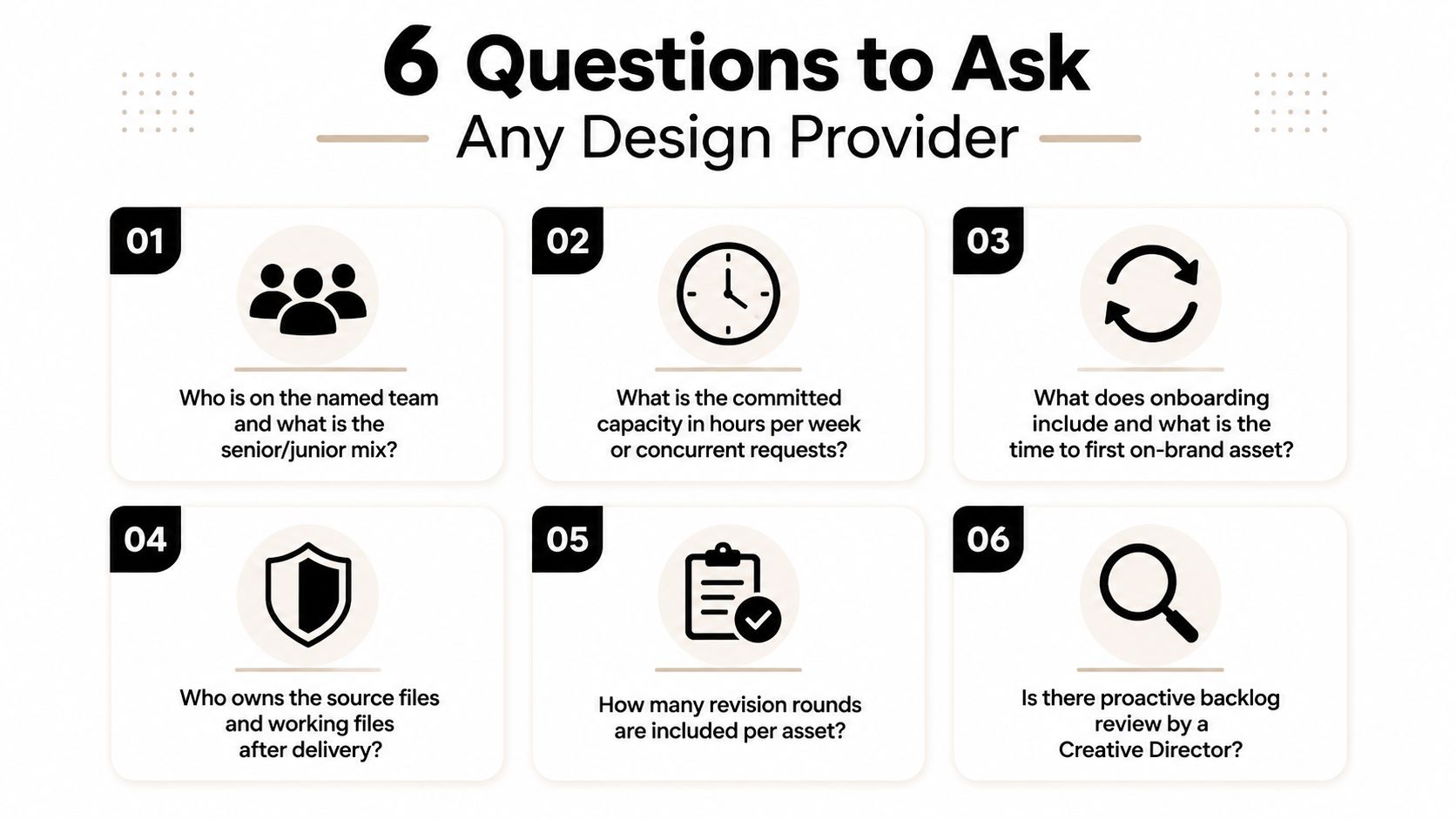
- Named team: who exactly will do the work, and what’s the senior and junior mix?
- Creative review: does a senior creative review every deliverable before it reaches us?
- Committed capacity: how many concurrent requests or hours per week are reserved?
- Coverage: can the team handle brand, web, motion, presentation, and ad creative, or will work move between vendors?
- Onboarding: what does brand immersion include, and when should we expect the first on-brand asset?
Process and measurement
Ask for turnaround by asset type, including first draft and each revision. Ask how many revision rounds are included and how many rounds similar clients typically need. Ask how blockers escalate and whether one person reviews the backlog proactively.
Then calculate cost per delivered asset from one real quarter of requests: divide the total paid by the number of completed assets that reached approval, not the number submitted. This exposes the gap between promised request access and actual output in queue models. The procurement version of the question: show us the delivery record for work like ours, including revisions, waiting time, and rejected requests.
Ownership and rights
Confirm who owns source files and working files after delivery. Check font, image, music, stock, and third-party asset licenses. Ask whether your team can modify the files later, whether reuse on another project is allowed, and what portfolio rights the provider keeps. Don’t assume payment settles ownership; the contract should state the transfer or license explicitly.
Mistakes that create expensive friction
- Buying on hourly rate instead of cost per delivered asset across a real quarter.
- Choosing only by portfolio instead of the named team who will do the work.
- Skipping brand onboarding, then wondering why the first month looks off-brand.
- Letting scope drift without asking when strategy work gets repriced.
- Ignoring IP terms for working files, source files, and licensed assets.
- Treating a queue like a planning partner when nobody reviews the backlog proactively.
- Skipping a paid pilot with defined deliverables, review rules, and approval criteria.
- Assuming studios can’t fail; they break through over-process and slow starts, so ask for the expected first-week process and decision owner.
For a broader procurement lens, compare these B2B creative provider questions with your own checklist. The provider should answer directly. If the response is vague, the contract probably will be too.
Design services are easier to buy once you separate volume, consistency, and direction. Log the work for a month, price the coordination burden, check ownership, and choose the model that fits how your team actually operates. That exercise gives your next decision a factual basis instead of another portfolio-driven guess.
Frequently asked questions
When demand stays high month after month, the brand work is tightly proprietary, and the designer needs daily collaboration with product and stakeholders. An internal hire also makes sense when someone must hold review authority every day. If the workload is spiky or specialist (motion one month, packaging the next), external sourcing avoids paying for idle capacity.
No, and assuming it is causes the most expensive surprises in this category. In the US, the designer owns the copyright by default unless a written contract transfers it or establishes work for hire; paying the invoice does not transfer ownership. If you need to edit, repurpose, or move work to another provider later, require source-file delivery and explicit license terms before signing.
Pay for it, keep it small, and define it precisely: three to five real deliverables from your actual backlog, named reviewers, agreed turnaround per asset, and written approval criteria. Then measure cost per approved asset and the number of revision rounds, not how nice the work looked. A provider who resists a defined paid pilot is telling you how the full engagement will run.