In-House vs Agency for Creative and Video Work
How to decide between an in-house creative team, an agency, or a hybrid for video, design, motion, and animation, based on the shape of the work rather than the label.


A marketing leader can feel the decision before they can explain it. The brief queue keeps growing, the in-house designer is covering video, a launch needs more motion work than the team can handle, and an agency invoice arrives at the same time as a hiring plan. The question sounds simple: should the company build in house or use an agency?
I run Moonb, an ongoing creative team that works alongside marketing departments, so I sit across this conversation every week. The useful answer rarely comes from choosing one side. It comes from matching the shape of the work to the shape of the team. Steady production, sensitive brand context, specialist skills, campaign spikes, and confidential projects can each belong in different places. That is why the strongest answer to in-house vs agency is often a deliberate mix.
One clarification before the framework: this guide is about the decision for creative production specifically, video, design, motion graphics, and animation, the work marketing teams most often weigh keeping in house versus sending out. The logic transfers to other functions, but the examples and the cost math here are all creative work.
Reframing the In House vs Agency Decision
A launch brief can expose the weakness of a simple choice. The company needs weekly product videos, a brand film, sales presentations, and specialist animation for a complex product. An internal team may understand the brand best, yet lack the capacity or production range to deliver everything on schedule. An agency may provide the missing expertise, while requiring more briefing, review, and coordination.
The useful question is which work belongs where.
Assess recurring volume, required skills, sensitivity, approval speed, and the cost of keeping capacity available. Ongoing brand content may justify a dedicated embedded team that builds context over time. A short campaign with unusual production demands may belong with an external specialist. Confidential product announcements may require tighter internal ownership.
Practical rule: Choose the operating model for the workflow, not for the label attached to the people doing it.
The market reflects this mixed approach. As summarized from Association of National Advertisers data in this industry overview of in-house and agency marketing data, 82% of member organizations had an in-house agency in 2023, compared with 78% in 2018 and 58% in 2013. At the same time, 92% still worked with external agencies. Organizations using both models handled an average of 61% of work in house in 2023, compared with 58% in 2018.
Those figures describe coexistence, not a clean replacement cycle. A dedicated embedded team often becomes the practical middle: external people assigned consistently to one business, with more continuity than a project agency and more flexibility than payroll expansion.
The decision is therefore about assigning each workflow to the team that can deliver the right balance of speed, quality, context, and capacity.
Which creative work usually stays in, and which goes out
The abstract answer is match the work to the team. Here is the concrete version for creative production, based on what marketing teams actually keep close and what they tend to send out.
Work that usually earns a place in house: the brand system and guidelines, fast turnaround social and lifecycle assets, anything tied to a confidential launch or roadmap, and the day to day requests that need someone who already sits in the product meetings. Proximity and speed matter more than raw craft here.
Work that usually goes out: hero films and commercials, specialist animation and 3D, launch campaigns that spike and then settle, and any format your team makes once or twice a year. Buying that capability full time is hard to justify, and the quality gap between an occasional in-house attempt and a dedicated team is widest on exactly this kind of work.
Work that sits in the middle, where an embedded team fits best: steady weekly video, motion, and design volume that is too much for one or two generalists but does not justify hiring a full department. This is the case most growing marketing teams actually face, and it is why the honest answer is usually a mix rather than a side.
What In House and Agency Actually Mean in Practice
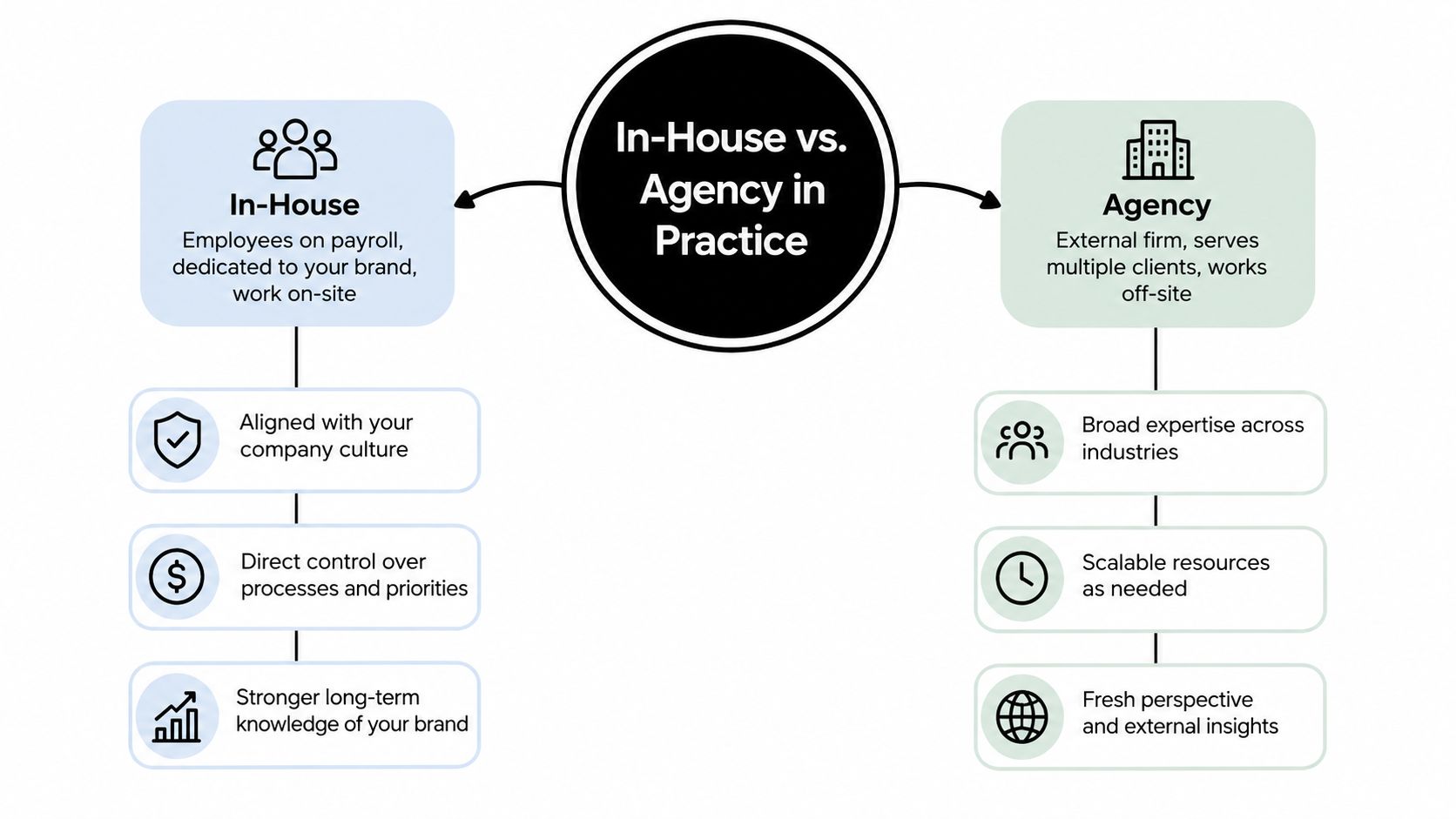
In house means employees on your payroll who work only on your brand and sit inside the company. They attend internal meetings, learn the product directly, understand stakeholder preferences, and build knowledge that stays with the business. The cost is largely fixed, including salaries, benefits, software, tools, and management, whether the workload is heavy or light.
An agency is an external firm serving multiple clients. You usually engage it through a retainer, a project fee, or a defined scope of work. The agency brings external capacity, a broader mix of skills, and experience from other briefs. In exchange, your team must provide context, manage the relationship, review work, and accept that the agency carries its own overhead and margin in the fee.
The difference isn’t just where the work happens. It’s the operating structure behind the work.
| Model | People | Main advantage | Main trade-off |
|---|---|---|---|
| In house | Employees dedicated to your brand | Deep context and direct control | Fixed capacity and narrower skill range |
| Agency | External team serving multiple clients | Flexible capacity and broad expertise | More onboarding and less embedded context |
| Embedded team | Dedicated external team working as an extension of your team | Continuity with added range | Requires clear ownership and working norms |
A dedicated external team sits between the two. It doesn’t become your payroll department, but it can work closely enough to retain brand knowledge and follow an ongoing production rhythm. Moonb is one example of this embedded model, alongside freelancers, fractional specialists, and traditional agencies.
For a second perspective on the practical differences, Keywordme’s in-house vs agency marketing guide is useful as a terminology reference. You can also compare the broader agency model with Moonb’s explanation of a full-service marketing agency. Our guide to choosing a video marketing agency covers the video side of that choice.
Ten Dimensions Where the Two Models Actually Differ
The table below gives the quick read. The details matter because neither model wins every row.
| Dimension | In House | Agency | Where It Tilts |
|---|---|---|---|
| Cost structure | Salaries, benefits, tools, and management are fixed | Retainers and project fees flex with demand | Steady volume favors in house, variable demand favors agency |
| Speed and turnaround | Fast when priorities and approvals are close | Can add production power, but needs briefing and coordination | In house for rapid iteration, agency for resourced pushes |
| Brand knowledge | Deep and accumulated through daily exposure | Builds over time through briefs and collaboration | In house initially, embedded partners over time |
| Skill range | Limited by the people hired | Broad access to disciplines and specialists | Agency for varied production needs |
| Scalability | Growth requires recruiting and onboarding | Capacity can expand or contract by project | Agency for spikes |
| Capacity | Dedicated, but finite | Shared across clients and dependent on availability | Depends on workload and resourcing |
| Quality consistency | Easier to maintain one internal standard | Can vary by team, process, and account continuity | Continuity matters more than model |
| Management overhead | Hiring, coaching, workload planning, and retention | Briefing, feedback, scope, and relationship management | Neither is overhead-free |
| Confidentiality | Direct access and internal controls | Requires contracts, access rules, and trusted workflows | Sensitive work often tilts in house |
| Continuity | Knowledge remains with employees, though people can leave | Knowledge can disappear when teams or agencies change | Stable relationships win |
In-house usually wins when a project needs quick decisions from people who already know the product. A designer who has sat in product meetings won’t need a long explanation of a feature or audience. That context can make iteration feel natural.
Agencies can bring more firepower when a launch requires video, design, copy, animation, and production management at once. The agency may solve a capacity problem quickly, but it still needs access to the right stakeholders and a useful brief.
The common shortcut is to say in house means faster and agency means better. Neither is reliable. An overloaded internal generalist may take longer than a properly staffed external team, while a long-running agency relationship may understand the brand better than a recently hired employee.
The real performance variable is whether the team has enough capacity, the right skills, and a clear path through approval.
Quality consistency also depends on continuity. Research from IPA and System1 describes consistent creative foundations through consistent brand positioning, a consistent creative idea, and a stable agency relationship, rather than visual repetition alone, as explained in their creative consistency guidance. Contagious likewise reported that brands staying with the same agency generally had higher creativity scores than brands working with two or more partners in its review of creative consistency and brand growth.
The practical work behind these differences is covered further in Moonb’s guide to creative operations management.
The Cost Structure Most Comparisons Get Wrong
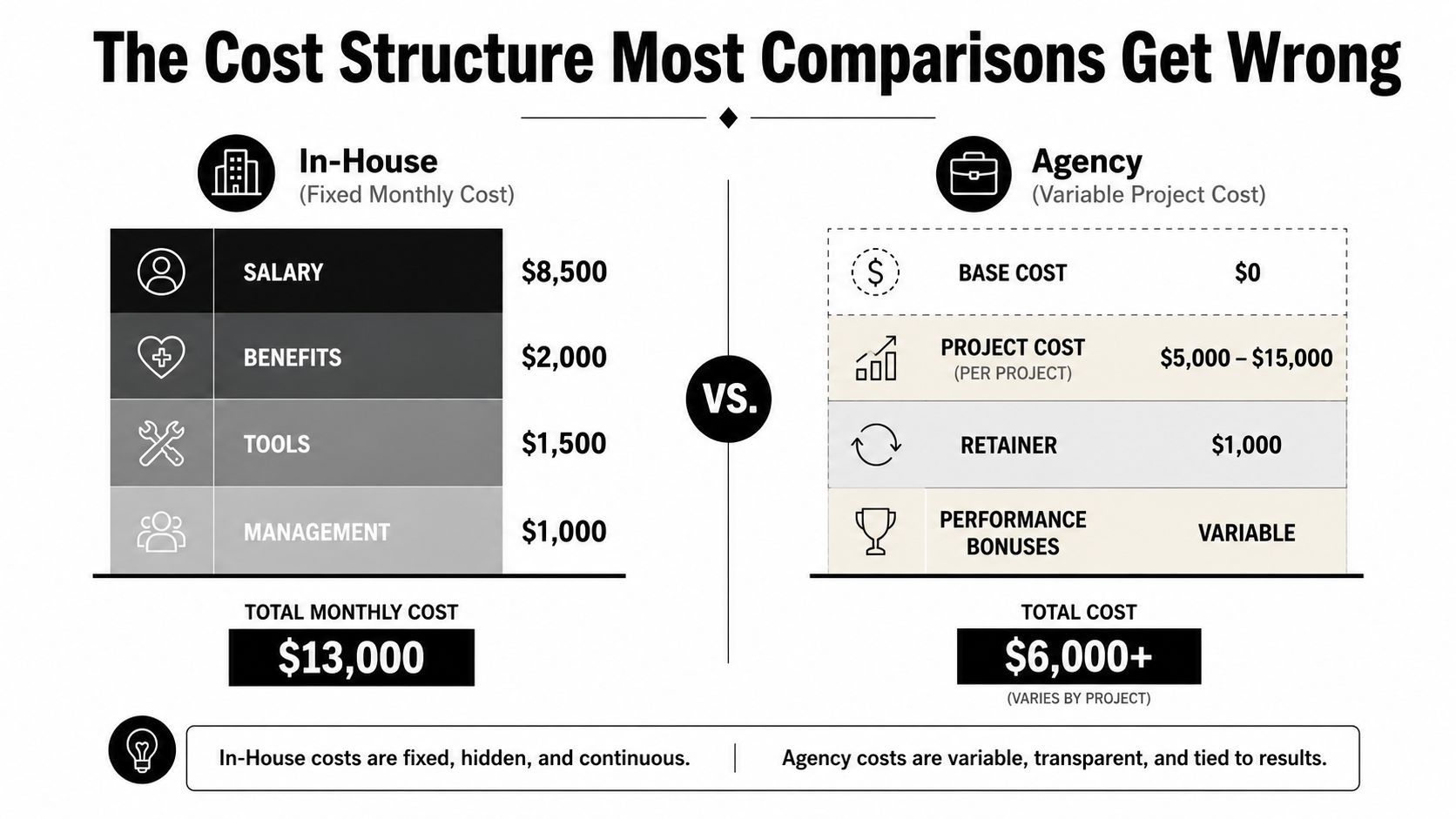
Cost discussions often compare an employee’s salary with an agency invoice and stop there. That misses the operating cost on both sides.
An internal team carries salary, benefits, tools, software, management, recruiting, onboarding, and unused capacity. Those costs remain during a quiet month. An agency converts more of the expense into a retainer or project fee. That gives the company more flexibility, but the fee includes the agency’s overhead and margin.
The break-even logic is straightforward. Steady, high-volume work can favor in-house economics because the company keeps using the same capacity. Variable or spiky demand can favor external support because the company doesn’t carry permanent headcount for temporary peaks.
Industry analysis reports that internal agencies take 25% less time on average to deliver the same assets and can produce 25% to 44% savings on lower-complexity assets or campaign deliverables. The same analysis says matching the internal resources with an external agency costs a brand about 60% more for the same team, as detailed in this comparison of agency and in-house creative costs. These figures describe specific production comparisons, not a universal promise. Your own result will depend on utilization, management, rework, and scope.
A useful model asks three questions:
- How often is the work needed? Weekly production supports a different cost structure from a launch that happens occasionally.
- How much idle capacity can the business carry? Fixed headcount becomes harder to justify when demand moves sharply.
- What does management consume? Both an employee and an agency need briefs, feedback, prioritization, and decisions.
For a separate explanation of external hiring costs and fee structures, see this agency fee breakdown from Underdog.io. For production planning, our breakdown of what video production costs can help teams frame the variables before they compare suppliers.
For the advertiser’s side of this debate, Bob Liodice, chief executive of the Association of National Advertisers, explains in this short BeetTV interview why in-house agencies grow as the business grows.
The Hybrid Middle Where Most Companies Actually Land
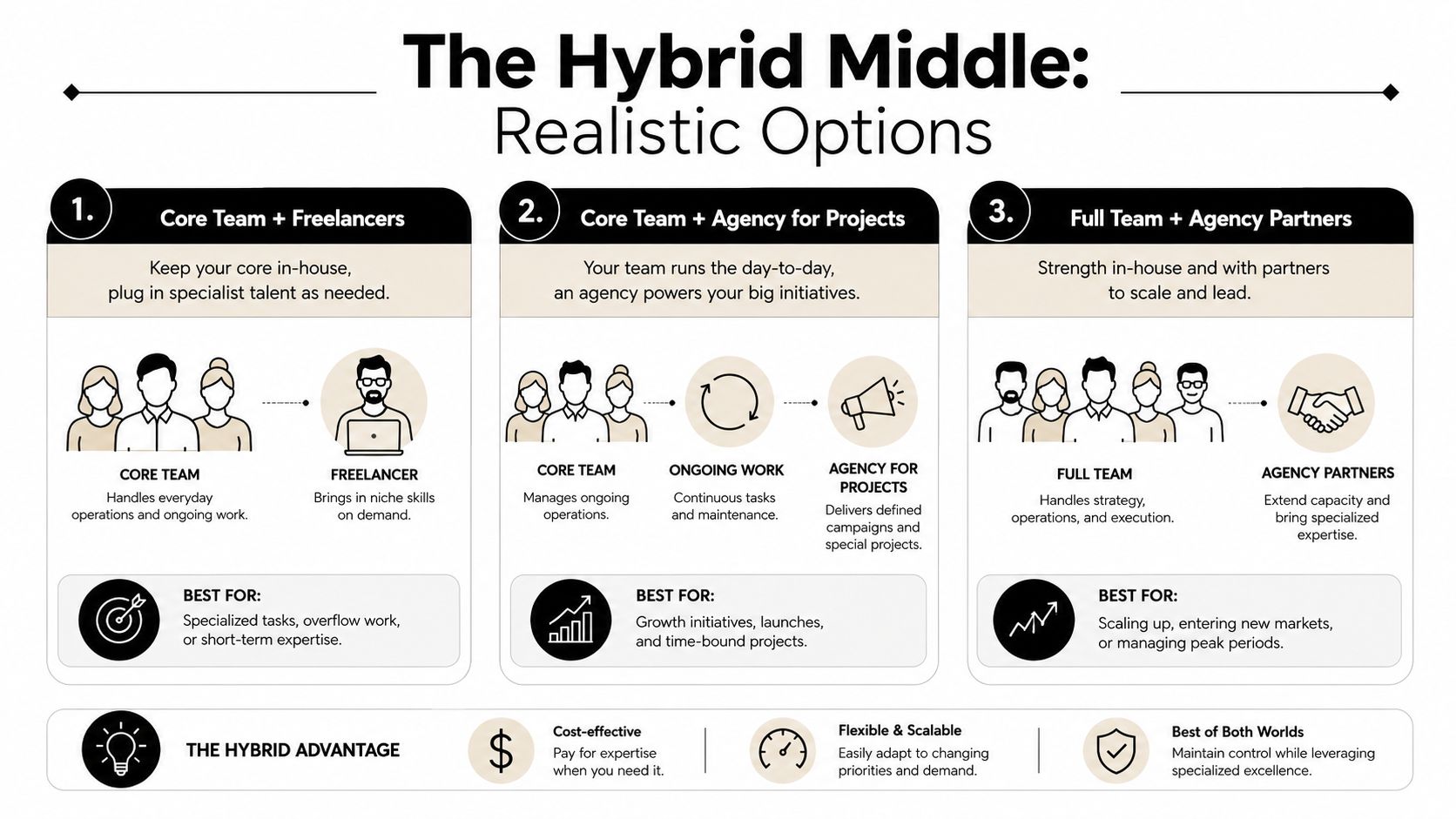
Pure in-house and pure agency are endpoints, not the only choices. The middle has several workable structures, and each solves a different constraint.
A small core team plus specialist agencies works when the company wants brand ownership close to home but needs outside expertise for launches, campaigns, or unusual formats. The internal team sets direction and protects consistency. Specialist partners add depth when the work exceeds internal range.
Freelancers and fractional talent suit defined gaps. A motion designer, editor, brand strategist, or creative director can add a specific capability without changing the whole org chart. This option can be efficient, but the company must manage availability, quality, files, and continuity across individuals.
An embedded or dedicated external team is designed for ongoing collaboration. The team remains external, but it learns the brand, follows shared processes, and delivers on a regular rhythm. It can provide more range than a small internal team without turning every request into a new vendor search.
The trade-off is control versus flexibility. A core internal team gives the company direct authority over priorities and people. Freelancers offer focused expertise but may be less predictable. Agencies provide broader production capacity, while embedded teams aim to preserve continuity as the relationship matures.
The structure only works when ownership is explicit. Decide who owns the brand system, who writes the brief, who gives final approval, where files live, and what happens when priorities conflict.
For another view of ongoing external support, see Moonb’s discussion of creative as a service. The important point is structural. A hybrid model should reduce coordination, not create another layer of it.
A Decision Framework Built on Five Questions
One piece of context before the questions: the Association of National Advertisers’ 2025 research on how long client-agency relationships last, and whether long relationships are shifting from a focus on cost to a focus on value, summed up in under four minutes.
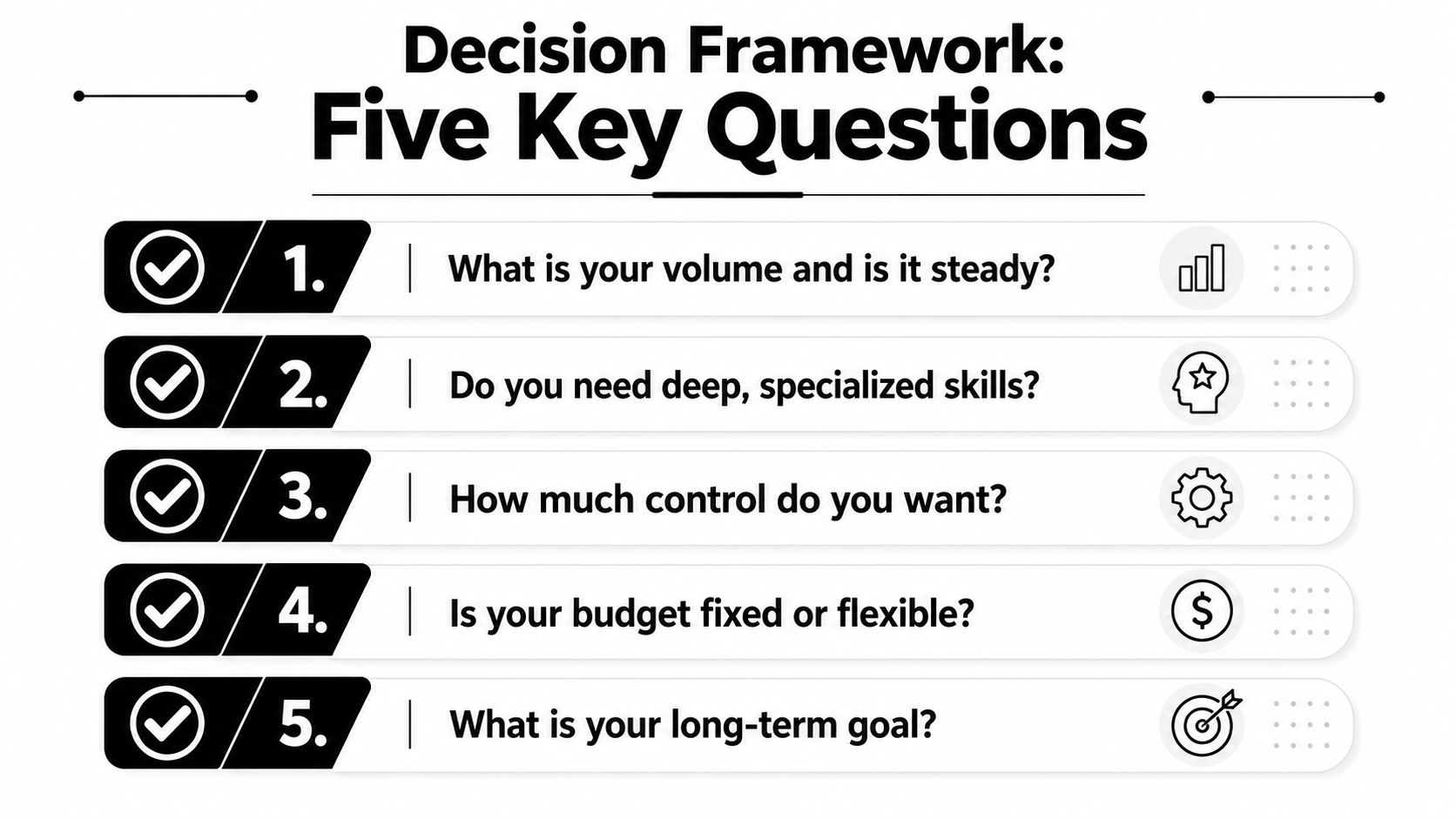
Use these questions before you choose a team model. Answer them with the work you have, not the team you wish you had.
-
How much volume is there, and is it steady or spiky? A weekly stream of product, social, and brand content points toward dedicated capacity. A major launch or occasional film points toward external specialists.
-
How varied are the skills? One discipline can often sit comfortably inside. Video, motion, design, animation, copy, and production management may require a broader mix than one hire can provide.
-
How core is the work to the business? Work that shapes the company’s positioning, product story, or sensitive roadmap may deserve internal ownership. Execution can still move outside when the right controls are in place.
-
How predictable must the budget be? Fixed headcount provides more stable staffing cost but carries the risk of unused capacity. Project work flexes more easily but can make future spend harder to forecast.
-
How quickly must capacity change? If demand can rise sharply for a launch and then fall, external capacity is useful. If demand stays high, recruiting may create stronger long-term ownership.
The answers usually point to a mix. A company with high volume, narrow skill needs, and strong confidentiality may build in house. A company with irregular demand and varied formats may use an agency or specialist pool. A team with steady output but limited internal range may choose an embedded partner.
Three situations in practice
An early startup may have a founder handling marketing and a contractor producing occasional assets. The priority is usually to create a reliable baseline without hiring a full department. A focused external partner can provide structure while the founder retains strategic control.
A scaling company may have outgrown founder-led production. It might hire an internal owner for brand and priorities, then add freelancers or a dedicated external team for video, motion, and design volume.
An enterprise often has existing specialists, procurement rules, brand governance, and several business units. The question may be which work to centralize, which to keep inside each unit, and where embedded partners can absorb recurring demand without weakening standards.
Teams building internal capability can also use Moonb’s guide to building an in-house creative team to pressure-test roles, scope, and operating needs.
Common Mistakes When Choosing Between In House and Agency
The first mistake is hiring one internal generalist and expecting agency-level range across video, design, motion, animation, and production. One talented person can cover a lot, but the role still has a limit. When every request depends on the same person, urgent work displaces important work and quality becomes uneven.
The second mistake is treating an agency as a sequence of transactions. If the partner receives isolated briefs, sees different stakeholders every time, and gets no access to brand context, it won’t build useful institutional knowledge. The company then blames the agency for work that the operating model made difficult.
A third mistake is changing agencies too often. New partners may bring fresh ideas, but each switch resets the learning curve. Brand consistency suffers when teams don’t share the same positioning, creative idea, or working history. Continuity matters wherever the team sits.
Hidden hybrid costs
Hybrid models fail when nobody owns the system. An internal team may approve strategy, one agency may produce campaigns, freelancers may create social assets, and another specialist may handle motion. Each contributor can do good work while the combined workflow becomes slow.
Set the rules before adding partners:
- Assign brand ownership: Name the person responsible for guidelines, templates, and final consistency.
- Define approval rights: Keep the review chain short and give each stakeholder a clear decision area.
- Create one source of truth: Store briefs, working files, final assets, and feedback in an agreed workspace.
- Set partner boundaries: Decide which team handles recurring work, launches, overflow, and specialist assignments.
- Review the model: Reassess capacity when demand changes, rather than defending the original structure.
The fourth mistake is adding permanent headcount for a temporary spike. A launch can justify extra production without justifying a lasting team expansion. External capacity often makes more sense for work that has a clear beginning and end.
The strongest setup follows the demand. Mature internal teams rarely try to do everything themselves. They keep the work where context and control matter most, then bring in the right outside capacity for specialist needs, peaks, and sustained production that the internal team can’t absorb.
If your creative queue keeps growing, map the work before choosing the team. List the recurring deliverables, specialist gaps, approval bottlenecks, and demand spikes, then decide what belongs inside and what needs external capacity. Moonb can help if an ongoing dedicated creative team fits that gap, delivering video, motion graphics, design, animation, and brand content on a steady weekly rhythm, on brand and ready when needed.
Frequently asked questions
Yes, but only if one person owns the brand system. Give the internal team the final call on brand consistency and priorities, and give the external partner a clear lane, like specialist production or a launch push. The mix breaks when both sides think they are steering, or when neither side is.
For a small team, a strong freelancer with a defined scope is usually the leanest starting point, because you buy the specialist hours without paying for a management layer. The trade-off is continuity: if the freelancer is booked out or moves on, you restart. When the volume gets steady enough to justify it, a dedicated external team costs more but stops the restart problem.
When the same category of work happens every week, and the internal briefing itself has become the bottleneck. If a marketer is spending half their week writing briefs and reviewing rounds for the same external team, a full-time hire will usually pay back. If work is spiky and specialist, keep it outside.