What a Brand Storytelling Agency Does (and How to Choose One)
What a brand storytelling agency delivers, the provider types, real studios worth shortlisting, and how to choose and price the right partner.


A brand storytelling agency builds the narrative system that keeps a company saying the same thing across its website, sales deck, product pages, video, social, onboarding, and packaging. The point is the story logic underneath, the part that makes every channel read as the same brand instead of a fresh coat of paint on each one.
I work at Moonb, a creative studio that operates as an embedded team for marketing departments, so I spend most weeks inside this exact problem. A company signs off on a beautiful hero film, posts it once, and still cannot answer a basic question about what it stands for, because the website, the sales deck, and the product page each sound like a different company wrote them. Closing that gap is what a storytelling partner is hired to do. If you are weighing outside help, the real question is not whether you need more content, but whether your team needs a better narrative system to hang the content on.
Story earns that investment because people remember a narrative far more readily than a list of features. Jennifer Aaker, a marketing professor at Stanford Graduate School of Business, has spent years documenting how a well-built story gets recalled and acted on much more than the same information delivered as data alone. You do not need a precise multiplier to feel this in your own buying: the brands you can describe to a friend are the ones that told you a story, not the ones that recited specs.
What brand storytelling really means
A weak brand story shows up in plain sight. The company runs a polished campaign, maybe even a strong film, and yet the website says one thing while the sales team says another and the product page reads like it belongs to someone else. That is rarely a shortage of creativity. More often the story system was never actually built, so every team fills the gap with its own version.
Brand storytelling is the consistent expression of who the brand is, what it believes, and why any of it matters to the buyer. In practice that throughline has to survive contact with ads, packaging, onboarding, social, product, and support. Apple keeps its line visible inside the product experience, not only in the marketing, and Nike carries the same idea through campaigns, retail, and the box the shoes come in. The story holds its shape even when the channel changes.
This is also where a storytelling partner starts earlier than a general marketing or advertising shop. Broader agencies often lead with media buying, performance, or campaign execution. A storytelling partner begins with the narrative logic that makes all of that coherent in the first place. Walker Sands describes a discovery process that reviews existing materials, interviews executives and subject-matter experts, then translates the findings into messaging pillars, proof points, and angles a reporter would actually use. When the story changes every time a new team touches it, the thing that is broken is the narrative architecture, not the copywriting.
Not every brand needs a deeper story. Some need better distribution, clearer positioning, or a steadier operating model around the story they already have. If the team already knows what the brand stands for but nobody executes it consistently, the problem is operational rather than conceptual, and rebuilding the brand from scratch would be the wrong fix. This is why some companies extend an existing creative function instead. For a sense of how one story can travel across formats without collapsing into one-off content, Moonb’s brand story examples work as a reference library. The cleanest brand stories barely feel like campaigns. They read like one voice showing up everywhere.
Every strong brand story has four parts
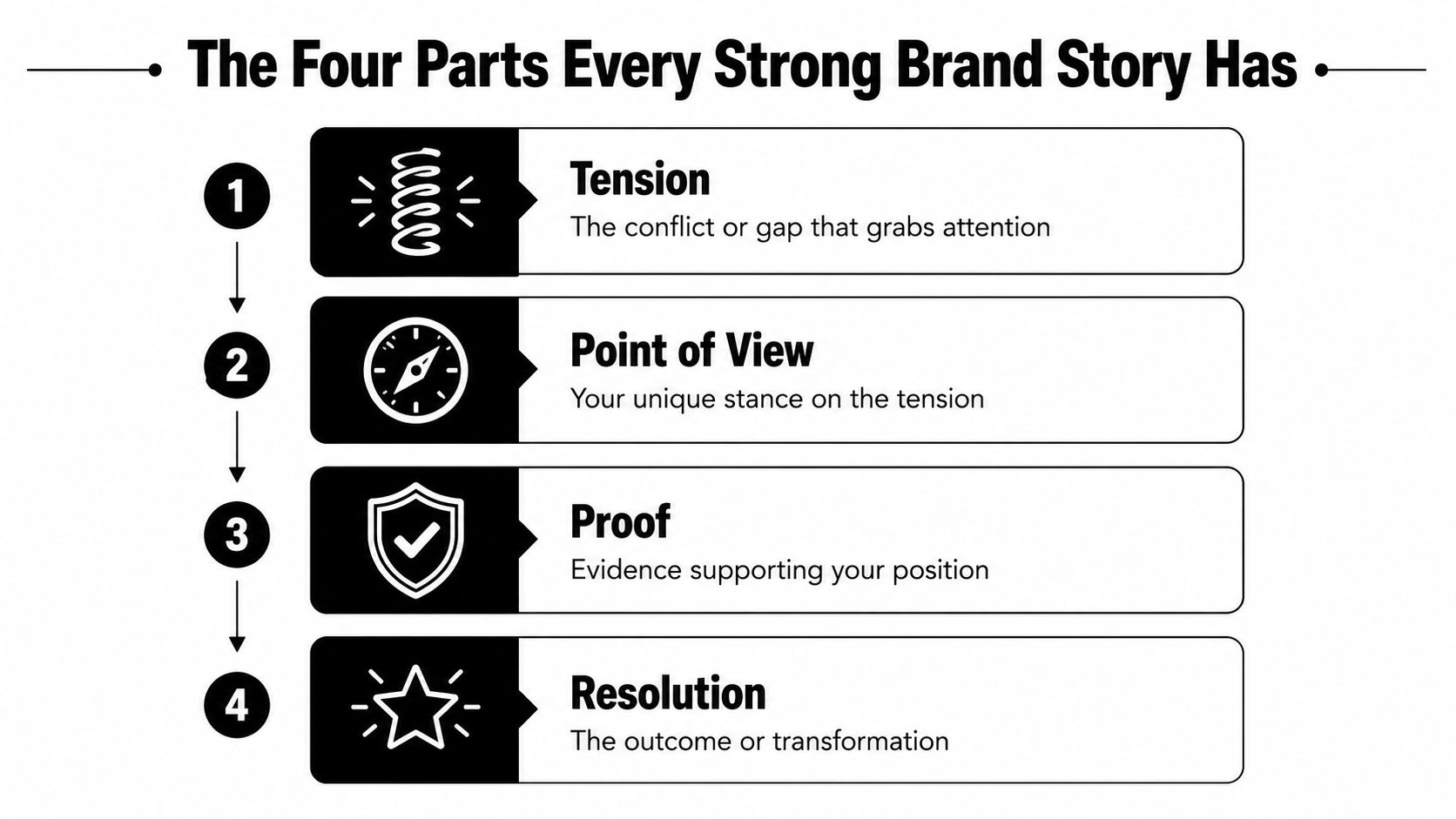
A strong brand story works because of its internal logic, not because it sounds polished. HubSpot frames that logic as a protagonist, a context, a belief-driven purpose, and a plot that moves from status quo to conflict to resolution in its brand story framework. Shadow makes a complementary point: the story needs proof that can be checked, whether that is named customers, quantified outcomes, third-party validation, or a clearly stated difference in its brand storytelling guidance. Strip out the proof and the story reads like marketing copy. If a brand leans on archetypes, they should sharpen the point of view rather than stand in for it, which is where Moonb’s guide to brand archetypes is useful.
The check I run on any draft story has four parts. It starts with tension, the problem, gap, or friction the audience already feels. Tension is what gives a story a reason to exist, and without it there is no urgency for anyone to keep reading. Next is the point of view, the brand’s actual belief about that tension. This is a stance, not a slogan, and it should be specific enough to force a choice. A good point of view says the market is handling the problem the wrong way and explains why. Archetypes can help sharpen it, as long as they do not turn the story into a personality exercise with no commercial edge.
Then comes proof, which is where vague storytelling usually falls apart. Proof can be named customer examples, results a buyer can verify, product capabilities, or outside validation. Hootsuite is explicit that data used in a story should be true, unaltered, and ideally from a trusted third party in its guidance on storytelling with data. When the proof feels soft, the audience assumes everything else is soft too. The last part is resolution, what changes for the customer once they believe the brand. Keep it practical rather than poetic, so the buyer can see the distance between where they are now and where the brand claims to take them.
A plain B2B example makes the structure easy to judge. A cybersecurity company can say companies need protection, but that line is generic. Turn it into tension and it becomes security teams buried in alerts. The point of view becomes manual triage wasting the wrong kind of time. Proof comes from customer examples, technical differentiation, or validated results. Resolution is the calmer, faster workflow the buyer actually wants. Run a draft through those four and the ones with mood but no tension, opinion but no proof, or aspiration but no resolution show themselves quickly.
What a brand storytelling agency actually delivers
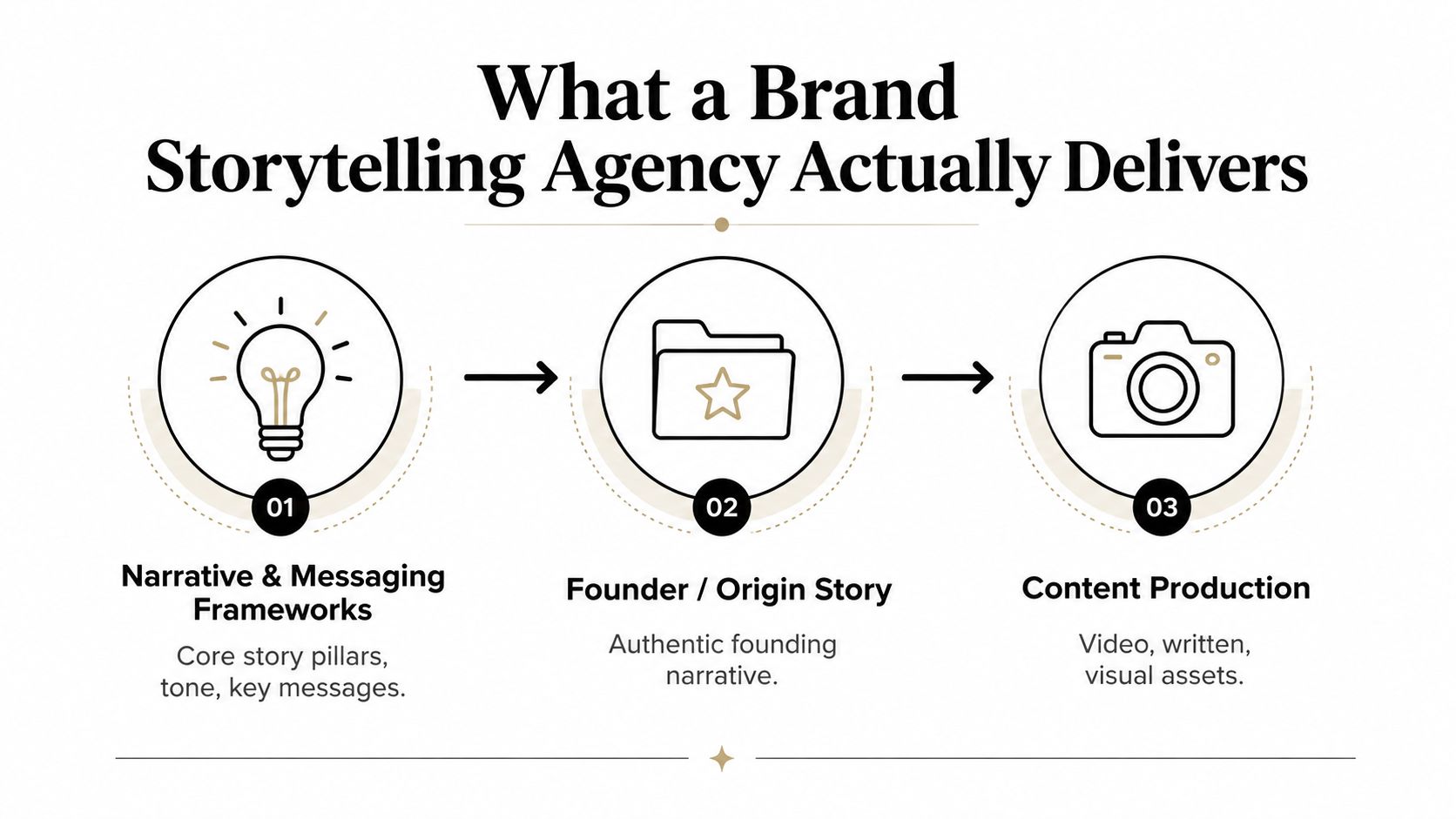
A serious partner hands over more than a manifesto deck. The output has to work inside real teams, which means it needs to be practical, reusable, and clear enough that marketing, product, sales, and leadership can all use it without constant reinterpretation. Good studios turn discovery, interviews, and source material into assets that keep moving through the organization rather than living inside one presentation.
The first deliverable is usually a brand narrative and messaging framework. It sets the core story, the message hierarchy, the tone, and the supporting proof, and it gives every team the same language to work from when they are shipping content at different speeds. Close behind is founder or origin story work, which helps early-stage companies as long as the details hold up under scrutiny. An over-polished founding story is easy to spot, so the stronger versions stay concrete, keep the claims traceable, and resist the urge to turn the origin into mythology.
Customer story development is the next piece, the case studies, testimonials, and use cases that connect the narrative to actual buyers. In complex categories, that proof often has to do more work than the copy around it, and the bar stays simple: named customers, verifiable outcomes, and a story that survives a buyer asking for specifics. When the story needs movement rather than words, a strong partner also produces video and motion, which usually means scripts, edits, cutdowns, and versioning that hold together across social, paid media, and sales use. If you are assessing that lane, Moonb’s branded video production shows how one story can become repeatable creative without drifting off-brand.
For regulated categories like fintech or healthcare, audience profiling, segmentation, and cross-channel consistency tend to get folded into the work. Bulleit Group lays out that fuller mix, from behavioral analytics and predictive insights to executive thought leadership, video, newsletters, and social listening in its agency approach. That matters when a story has to clear compliance review and still sound like it was written for people rather than policy. The best proposals are clear about which parts live in a slide deck and which parts actually ship in market, because those are not the same thing.
Six provider types you will meet
Once you start shopping for help, the category gets confusing fast. Some teams lead with positioning, some lead with production, and a few do both. A Series A startup and a Fortune 500 usually need different mixes of strategy, speed, and internal support, so the right answer depends on where the brand sits and how much the in-house team can carry. The table below maps the main types before I get into where each one fits.
| Provider type | Model | Best for | Trade-off |
|---|---|---|---|
| Full-service brand agency | Strategy plus execution across channels | Larger teams, rebrands, multi-market rollouts | Breadth can hide thin execution when the team is stretched |
| Boutique narrative or strategy shop | Positioning, messaging, and story architecture | Brands that need clarity before production | Usually hands off before the assets get made |
| Video-first production team | Film, motion, and campaign assets | Teams with the story set who need assets fast | Weaker when the narrative itself is still unresolved |
| Content studio | Ongoing brand content across formats | Brands with a steady publishing cadence | Less suited to a one-off strategic reset |
| Freelancer collective | Flexible specialist skills, assembled per project | Smaller or variable scopes, quick-turn work | You supply the direction and the glue |
| In-house team | Direct control and institutional knowledge | Brands with enough volume to justify staffing | Upfront hiring cost, and quality drifts without senior oversight |
A full-service brand agency is strongest when the problem is broad, since it can handle positioning, identity, and rollout in one place, though that same breadth can hide weak execution if the team is spread too thin. A boutique narrative shop is sharper when the issue is the story itself and the brand needs language, structure, and proof points before anything gets designed or filmed. Video-first teams fit better once the narrative is already set and the work simply needs to be produced well and on schedule.
Content studios sit between strategy and output, which helps when a brand needs a repeatable cadence instead of a single campaign. Many of them now operate like creative-as-a-service teams, running a standing queue of requests with versioning and production support that keeps the content engine moving. Freelancer collectives can be smart for targeted work, particularly when someone internal is already steering the narrative. Building in-house makes sense when volume is high enough to justify it and the brand needs daily control, though the trade-off is real: you gain closer access and faster feedback, but you also need enough senior talent and editorial judgment to keep the work from wandering. That last lane, a dedicated team that plugs into an existing marketing department and delivers on a steady weekly rhythm, is the one my own studio works in.
Fourteen studios and teams worth knowing
These names are worth a look when you are building a shortlist. None should be picked on reputation alone, and none is a permanent fit, so treat this as a research starting point and verify current availability, pricing, and category focus directly before you reach out.
- Wieden+Kennedy, known for culturally visible brand campaigns with a strong creative point of view.
- Ogilvy, known for broad brand work that connects strategy, advertising, and communication systems.
- Droga5, known for sharp, high-concept brand storytelling and campaign thinking.
- Mother, known for brand work with a distinct voice and strong creative personality.
- Anomaly, known for strategy-led creative that bridges brand building and business goals.
- Pentagram, known for identity, design systems, and visual storytelling with serious craft.
- Wolff Olins, known for brand transformation, identity systems, and strategic repositioning.
- Instrument, known for digital-first brand experiences and product-adjacent storytelling.
- Buck, known for motion, animation, and visually rich storytelling systems.
- Stink Studios, known for film, digital experiences, and polished branded storytelling.
- Sandwich, known for crisp, editorial-style brand storytelling and content systems.
- Column Five, known for content strategy, data visualization, and narrative-led brand content.
- Media.Monks, known for large-scale content production across formats and channels.
- Superside, known for embedded creative support that can cover ongoing brand content needs.
For disclosure, the studio I work at, Moonb, sits in the same embedded-team category as the last couple of names here, delivering ongoing creative on a weekly rhythm for teams that want an extension of their in-house function rather than a one-off project.
The useful question is not which of these is most famous but which one matches the kind of story you need and the way your team actually works. A studio with beautiful visual craft can still be the wrong choice if your real problem is narrative clarity, and a strategy-heavy shop can be the wrong choice if what you need is a lot of production support. Fit has to be practical, not aspirational.
How to choose and how engagements are priced
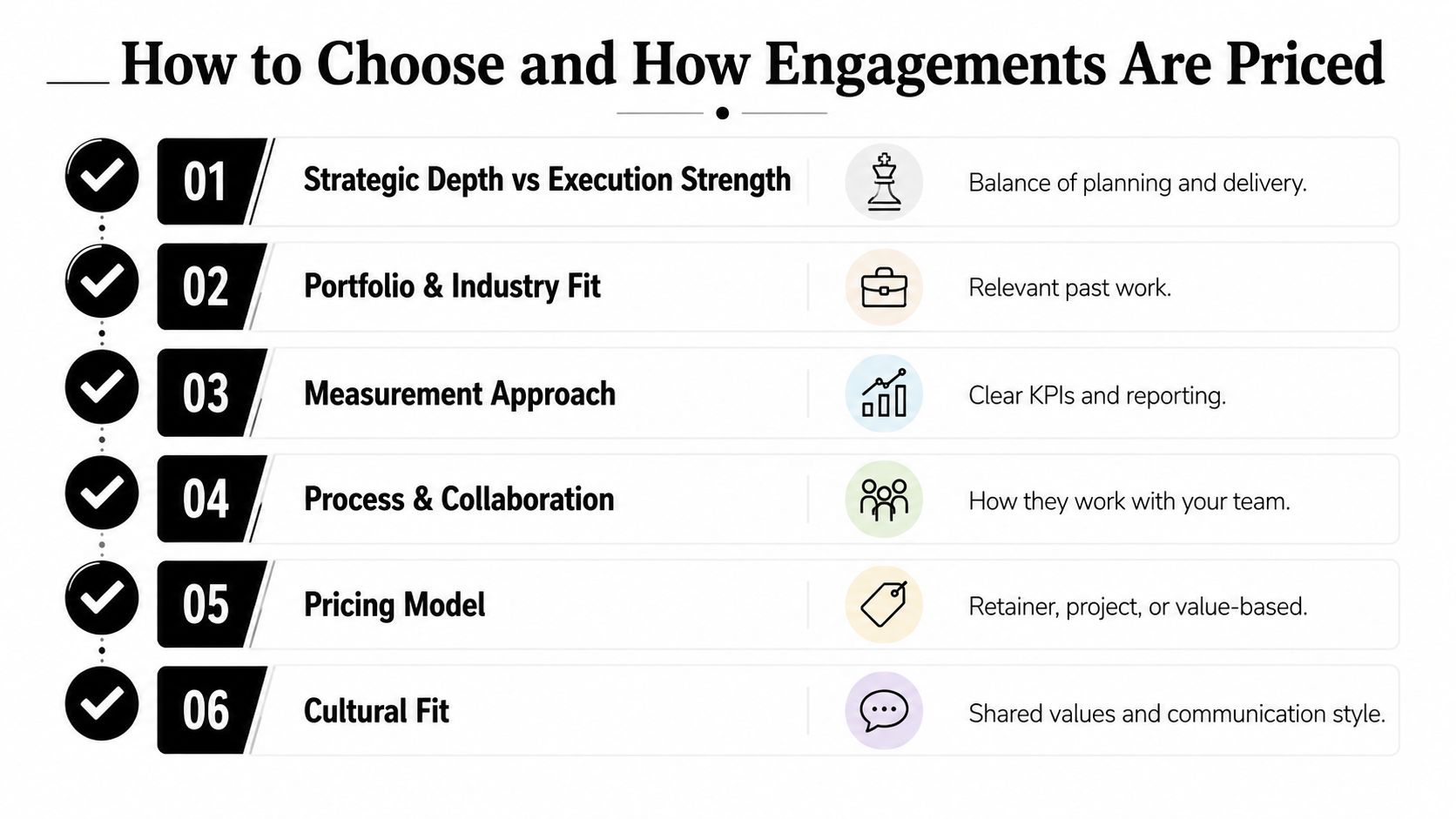
A brand storytelling engagement only pays off when the partner can turn narrative into an operating system for content rather than a single polished asset. A team strong on strategy but weak on delivery stalls right after the workshop, and a team strong on production but thin on story leaves you with attractive work that does not help the brand say anything clearer. So the first thing to weigh is strategic depth against execution strength: can the team shape the story and then turn it into assets your people can reuse across channels, formats, and future campaigns?
From there, check portfolio and industry fit. A strong reel proves taste, but it does not prove the team has handled a problem shaped like yours, with the same constraints and approval chains. Measurement belongs in the brief too, not as an afterthought, so ask how they define success, what they track after launch, and how they separate creative quality from business impact. A team that cannot answer that plainly may be selling inspiration with no way to tell whether the work helped. If the team wants a visual reference point before the brief is written, a library of branding inspiration can help clarify what strong work looks like.
Team seniority matters just as much, because you want to know who does the actual work, not only who showed up to pitch the account. Chemistry counts as well, since these projects run on interviews, revisions, and a lot of judgment calls, and a first meeting that feels evasive rarely improves once the work starts. The engagement model should match the need. Project-based work suits a defined deliverable like a narrative framework or a brand film. An ongoing partnership suits a brand that needs a steady stream of content and regular iteration. A blended strategy-plus-production model sits between the two and works when you need both the thinking and the assets from the same team.
Pricing tends to scale with seniority, scope, and how much gets produced. A small studio or freelancer generally costs a lot less than a top network agency, and for an early-stage brand that difference can matter as much as creative quality. For a clearer sense of how scope and team size move the number, Moonb’s breakdown of branding cost is a useful adjacent read, since it explains how the structure shifts as work gets larger or more specialized. Whatever the range, I would build a shortlist of three, ask for a paid pilot or a small first project, and reference-check one past client whose scope looked like yours before committing to anything bigger.
Red flags and the questions worth asking
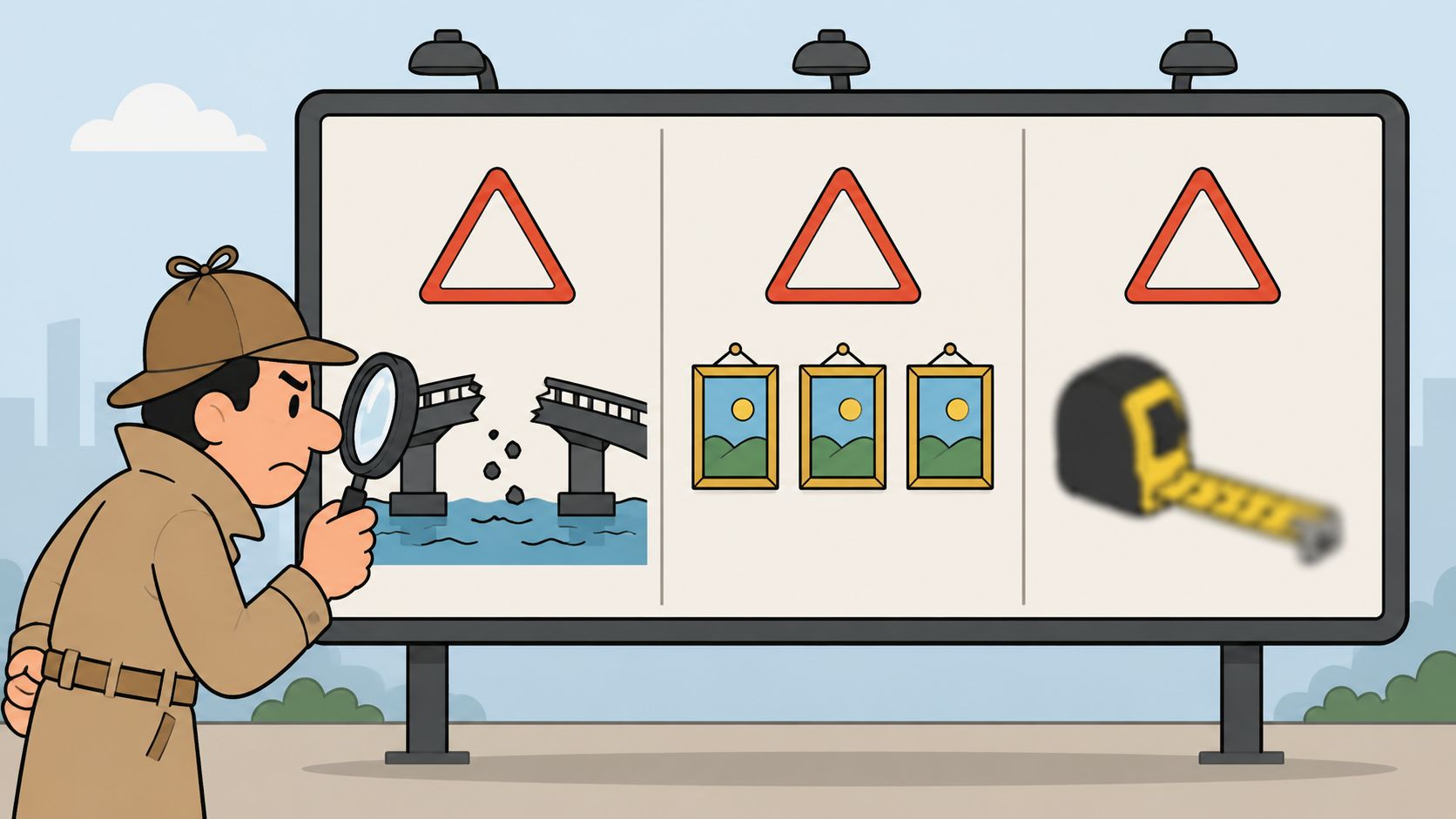
The fastest way to waste money here is to hire a team that sells narrative but cannot operationalize it. Strategy that never reaches execution is the common failure mode, closely followed by a portfolio full of look-alike work that proves style without proving judgment. Vague measurement language is another warning sign, because it usually means nobody has thought hard about what success would even look like.
A handful of questions separate clarity from spin. Ask who does the work day to day, and if a senior person is leading the pitch, find out how much of the actual project they will touch. Ask how success is defined and measured, and insist on the answer in plain language. Ask whether you can speak to a past client whose scope resembled yours. Then ask what happens when revisions run longer than expected, because that one question reveals a lot about process maturity, and a confident team will explain how it handles feedback, approvals, and scope changes instead of getting defensive.
Be wary of anyone who over-promises reach or virality. Brand storytelling is a system for making a brand easier to recognize and trust over time, not a shortcut to going viral, so treat big promises about reach as a warning rather than a selling point. The first engagement should teach you how the team works under a real deadline, not how it performs in a polished pitch meeting. If the answers feel evasive, walk away and keep looking. A good partner should leave the brand clearer and easier to manage, so when you are ready to evaluate options, start with one problem, one channel, and one measurable outcome, then ask for a small first project that shows how the team thinks, writes, and ships.
Frequently asked questions
A brand storytelling partner starts with the narrative, defining what the brand believes and why it matters, before any channel work happens. A general marketing or advertising agency usually starts with media buying, performance, or campaign execution. In practice you hire the first to build the story system and the second to distribute against a story you already have.
Pricing scales with seniority, scope, and how much actually gets produced, so a freelancer or small studio sits well below a top network agency for the same brief. Rather than chase a single number, define one deliverable (a narrative framework, a brand film, or an ongoing content cadence), ask two or three shops to quote against it, and compare what ships versus what stays in the deck.
If your team can already state clearly what the brand stands for but every channel expresses it differently, the problem is usually execution and consistency, not the story itself. If leadership, sales, and marketing each describe the brand differently when you ask them, the narrative needs work. Diagnose that first, because the two problems call for very different partners.