Video Production Services Explained: A Buyer's Map
What video production services actually include, which costs sit outside the quote, and how to choose between freelancers, studios, and embedded teams.

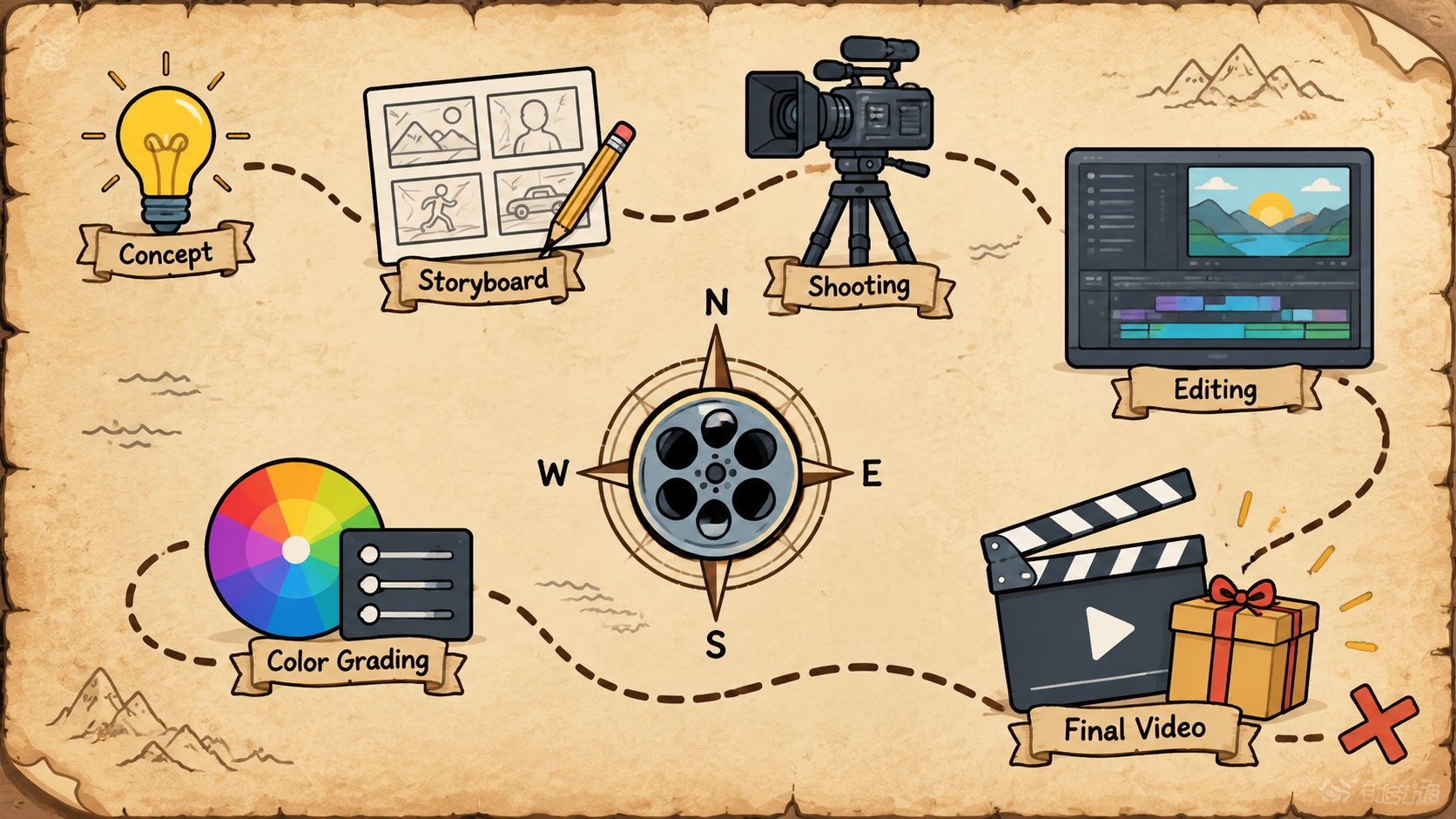
Video production services are the end-to-end work of planning, shooting or animating, editing, and delivering video, offered through models that range from solo freelancers to project studios to dedicated creative teams that work with you month after month. What you are actually buying is a deliverables list plus the rights that come with it.
I work at Moonb, and most of the scoping problems I see start before any camera gets booked. An enterprise SaaS client recently came in asking for one product video. By the time the launch plan was written, that one video had become a hero cut, four social edits, a captioned vertical version, and still frames for the landing page. The production itself was the easy part. Defining the scope was the actual work, and it is the part this guide is about.
One note on what this page is and is not. It is the map of what the services include, what sits inside a quote, and how the engagement models differ. Price ranges, vendor vetting, and corporate formats each get their own guide, and I link to them where they apply, because trying to cover all four jobs in one article is exactly the kind of scope creep this page warns you about.
What video production services actually cover
Video production services cover everything required to move from an idea to usable video files. That can mean recording an interview and editing it, producing a live-action brand film, building an animated explainer, or creating a library of versions for social, paid media, product, sales, and internal channels. The animated end of that list is on our motion graphics services page, with typical costs per piece.
The buying principle that matters most is simple: the deliverables list is the unit of scope, not the video file. A provider proposal should tell you what gets planned, created, reviewed, revised, licensed, and delivered. If it only says “one video,” you don’t yet know what you’re buying.
It wasn’t always this way. When recording was the hard part, you bought a finished tape and that was the whole service. Portable cameras, then desktop editing, then smartphones each pushed the value further downstream, and today most of the work sits in editing, motion graphics, versioning, and platform-specific delivery rather than in the shoot itself.
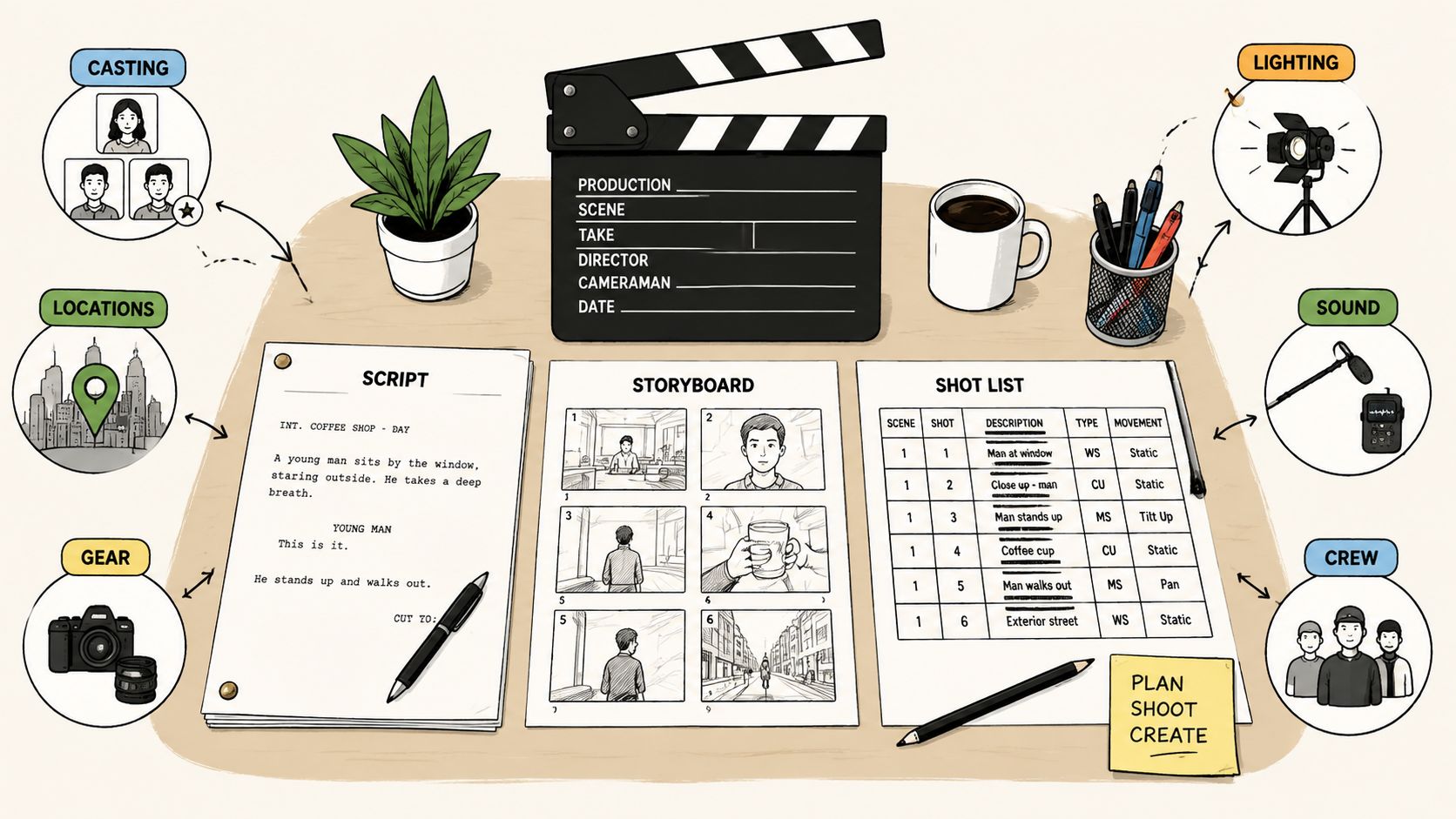
Read the proposal as an operating document
Ask whether the quote includes music licensing, paid talent, travel, extra revision rounds, and raw footage ownership. These items often sit outside the base scope, and each one can affect approvals, rights, delivery, or future reuse.
A clear proposal should also name the audience, channel, format, approval owner, revision process, and final files. If you are planning a broader content program, the proposal is where that intent either shows up or doesn’t; video that supports ongoing communication needs a different structure from a one-off production event. Teams planning a broader content program may find this guide to using video for organizational growth useful, because it treats video as part of ongoing communication rather than an isolated project.
For buyers who need a marketing brief turned into finished campaign content on a regular rhythm, a dedicated marketing video production team is one model. The wider market includes project-based specialists, in-house teams, full-service creative shops, and tools that handle selected production tasks.
How the end-to-end production process works
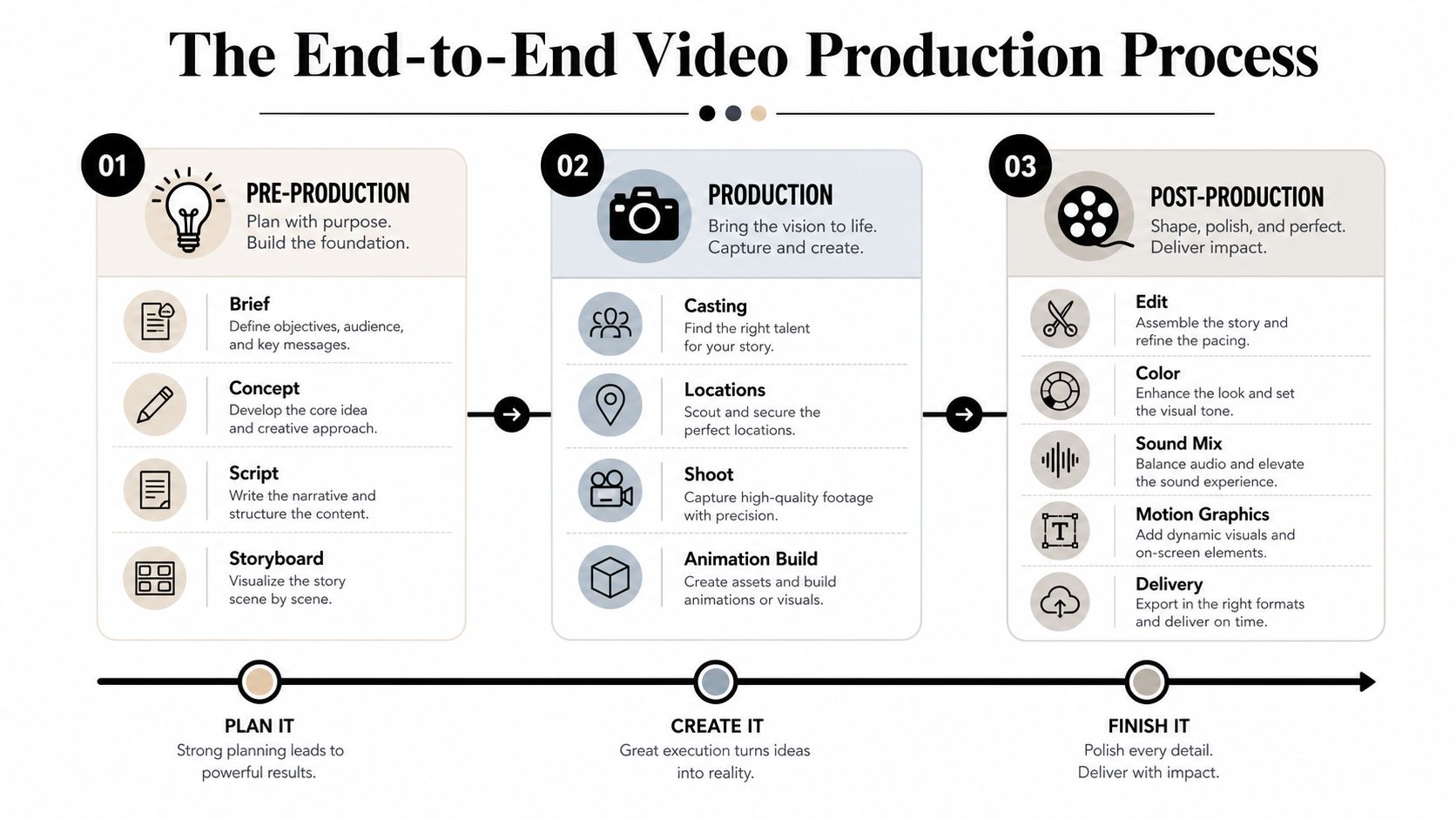
A full-service engagement usually moves through brief and kickoff, pre-production, production, and post-production. The camera or animation build is the visible part, but the decisions before and after it usually determine whether the work stays on track.
Before getting into the machinery, it helps to see how much of a shoot is decided on paper. StudioBinder’s step-by-step guide to building a shot list shows the level of planning a good crew expects before anyone books a camera, and it is a fair preview of what your provider should be doing in the first week.
Pre-production sets the boundaries
The provider should begin by confirming the goal, audience, channel, format, deadline, and approval owner. From there, the team develops the concept, script, storyboard or animatic, shot list, casting approach, locations, schedule, and written scope. If the piece is a scripted explainer, the script carries most of the creative weight, and it is worth understanding how an explainer video script gets built so you can judge the draft you are approving.
The scope should state how many review rounds are included, who owns usage rights, whether raw footage is transferred, and which versions will be delivered. If the project includes 3D or animated work, ask which rendering approach the team plans to use and why; this overview of rendering options for artists is a reasonable primer before that conversation.
Pre-production is where a vague request becomes a production plan. It’s also where you can catch a missing vertical cut, an unapproved music direction, or a rights issue before those problems reach the edit. I have watched a two-day shoot get repeated because nobody confirmed in writing that the talent release covered paid distribution; that is a pre-production failure, not a production one.
Production captures the planned material
Production may involve a live shoot, interviews, event coverage, remote recording, or an animation build. A producer keeps the schedule moving, coordinates crew and gear, manages locations, and checks that the team is capturing the material promised in the scope.
A well-run shoot doesn’t improvise every decision on set. The crew may adapt to weather, performance, or location constraints, but the creative team should already know what the finished piece needs.
Post-production turns footage into deliverables
Post begins with an assembly cut, followed by structured feedback and revisions. The later stages can include picture lock, color correction, sound mix, motion graphics, captions, platform-specific versions, and final delivery files.
A strong review workflow moves through upload and sharing, timestamped stakeholder review, consolidated feedback, revision, and approval or another cycle. Keeping notes against one version reduces conflicting instructions and mixed-up versions. Ask for a written timeline with named review points before signing; in my experience most delays trace back to slow or conflicting client feedback.
Technical delivery needs to be planned early too. A multi-platform brief may call for a 9:16 vertical master, a 16:9 cut for CTV, and a 1:1 version for display retargeting, each with its own resolution, loudness, and file-size requirements. Confirm the target platforms in the brief so the mix and the exports get built once instead of being reworked after picture lock.
Editing is also where the most invisible judgment lives, and it is worth understanding what you are paying for. Vox sat down with a trailer editor to show how a cut gets chosen, and it is the clearest twelve minutes I know on why two editors given the same footage hand back two different films.
For a deeper look at the workflow itself, see this guide to video production.
What is actually inside a quote
A production quote looks like one number, but underneath it is almost entirely people-days, plus gear, licensing, and margin. Once you can read the anatomy, you can compare two providers on substance instead of on the headline figure, and you can spot the quote that quietly left out half the work.
The labor floor under those day rates is public. In the O*NET wage data for producers and directors, which draws on federal Bureau of Labor Statistics figures, the 2025 median wage for producers and directors is 43.44 dollars an hour. Film and video editors sit at a 36.26 dollar median, and camera operators at 36.05. A freelance day rate lands well above the employed median because it has to carry gear, software, insurance, self-employment costs, and the days that don’t get booked. I am not quoting market day rates here because they swing by city and seniority; the point is that a crew line on your quote is a real labor market, not an arbitrary markup, and a quote dramatically below it is paying someone too little or skipping a role you need.
Here is the anatomy I tell clients to look for, line by line.
| Line item | What it actually pays for | What to check before signing |
|---|---|---|
| Creative development | Concept, script drafts, storyboard or animatic, references | How many concepts and script rounds are included |
| Producer and project management | Scheduling, crew booking, logistics, client communication | Whether PM time is inside the number or billed hourly on top |
| Shoot day | Director, camera, sound, lighting, and assistants at day rates, plus gear | Crew list by role; what triggers overtime or a second day |
| Locations and talent | Location fees, permits, casting, on-camera talent | Who books and pays; whether talent usage is time-limited |
| Edit days | Assembly, rough cut, fine cut, revisions | Review rounds included; the price of an extra round |
| Finishing | Color grade, sound mix, motion graphics, captions | Whether captions and graphics are line items or assumed |
| Licensing | Music, stock footage, fonts, talent usage rights | Term, territory, and media each license covers |
| Versioning and delivery | Aspect-ratio cuts, platform exports, file handoff | Which versions are included and which cost extra |
| Raw footage and archive | Storage, transfer, ownership of source material | Whether you can buy the raw files, and for how long they are kept |
Licensing deserves a slower read than any other line, because it is the one that follows you after delivery. A music license is defined on three axes: how long you can use the track, where in the world, and on which media. A track cleared for organic web use may not be cleared for paid advertising or broadcast, and talent releases work the same way, often with renewal fees when a campaign runs longer than the original term. None of this is a problem when it is written into the scope. All of it is a problem eighteen months later when legal asks why a paid ad is running on an expired license.
Versioning is the other line buyers underestimate. The shoot produces material once; the versions are what actually meet your channels. If the quote shows one deliverable and your media plan needs six, that gap amounts to a second scope. This page deliberately stays out of price ranges; when you are ready to put numbers against these line items, this guide to video production cost covers what productions actually cost and why.
How to pressure-test a quote in one call
When a client forwards me a proposal to sanity-check, I do not start with the total. I start with five questions, and the answers tell me more about the provider than any reel.
First, ask them to walk you through the crew list for the shoot day, role by role. A provider who planned the day can do this from memory: who directs, who operates, who handles sound, who is assisting. A provider who quoted a lump sum will get vague at the second role, and vague crew planning shows up later as a shoot that needed a person it did not have.
Second, ask what happens on revision round four when three are scoped. You are not negotiating; you are checking that an overage has a defined price and process. A high number is a fine answer; “we’ll figure it out” is the bad one, because that is a future argument you are signing up for.
Third, ask which licenses in the quote expire and when. If the answer is “none,” either everything really is bought out in perpetuity, which is worth confirming in writing, or the provider has not read their own music terms. Both are useful to know now.
Fourth, ask what you receive if the relationship ends the day after delivery. This question surfaces the raw footage and project file policy without the abstract contract language, and a provider’s comfort answering it is a decent proxy for how they handle endings generally.
Fifth, ask what they need from you, and by when. A good provider has a specific list: brand assets, product access, an approval owner, interview subjects, dates. A provider who says “nothing, we handle everything” is either padding the quote to cover the unknowns or planning to discover your requirements mid-production, at your expense either way.
None of these questions require production knowledge, and all of them are answerable in one call. The pattern you are testing for is specificity. Producers who have done the work a hundred times answer in details; the ones improvising answer in reassurances.
Types of video deliverables and common exclusions
Start with the job the video must perform. A brand film needs a different creative process from a product walkthrough, even when both result in polished video files. The service type also determines the number of deliverables, review points, and platform versions your team must manage. Corporate formats such as investor updates and internal comms tend to run on a calendar rather than a campaign and get scoped differently, which is why we treat corporate video production as its own service.
The scope checklist
| Phase | Usually included | Often excluded |
|---|---|---|
| Pre-production | Brief, concept, script, storyboard or animatic, shot list, casting, locations, schedule | Paid talent, travel, extensive research, additional concepts |
| Production | Crew, gear, direction, shoot, animation build, recorded footage | Location fees, specialist equipment, overtime, reshoots caused by changed requirements |
| Post-production | Edit, color, sound mix, motion graphics, captions, aspect-ratio versions, delivery specs | Extra revision rounds, music licensing, raw footage ownership, additional language versions |
Review exclusions before comparing quotes. A lower figure may reflect a narrower scope, with music, talent, travel, rights, captions, or alternate versions priced later. Those omissions also increase management work, because someone on the buyer’s side must identify, approve, and coordinate each add-on.
Service types by output
| Service type | Best for |
|---|---|
| Brand film | Communicating a company’s character, purpose, or point of view |
| Product or explainer video | Making a complex product, workflow, or technical idea easier to understand |
| Testimonial | Giving customer experience a human voice through interviews and supporting footage |
| Event video | Capturing talks, atmosphere, highlights, and reusable event content |
| Social and ad creative | Producing short, format-specific assets for paid and organic distribution; see this guide to types of video advertising when mapping formats to campaign goals |
| Training video | Teaching a process, product, policy, or safety requirement consistently |
| Animation | Showing systems, interfaces, data, or abstract ideas that are difficult to film |
Short-form work needs native framing rather than a late crop from a master. IAB’s vertical video guidance treats vertical as its own format, planned as 9:16 from the brief onward, which protects framing, text placement, and safe zones.
Platform specifications reinforce that requirement. Google recommends 1080 x 1920 HD delivery for vertical video ads and says SD is not recommended for optimal quality, per Google Ads video requirements. LinkedIn supports vertical 9:16 sponsored content from 360 x 640 up to 1080 x 1920, per LinkedIn’s video ad specifications. Amazon Ads lists 1080 x 1920 as the minimum vertical frame size for site-served online video, with a recommended 8 Mbps bitrate and a 500 MB cap on site-served files, in its online video ad specifications.
None of this is edge-case behavior anymore. In the State of Video research Wistia publishes with HubSpot, 76 percent of surveyed teams adjust aspect ratio depending on where a video will be posted. Brief these exports before the shoot or animation begins; otherwise versioning becomes a post-production change request rather than a planned output.
What a complete delivery package contains
“Final files” is doing a lot of work in most proposals, so I spell out what a finished handoff should physically contain. A complete package usually includes the graded and mixed master at the highest delivery resolution, every platform version named in the scope, caption files as separate sidecar files rather than only burned into the picture, a clean version without on-screen text if you ever expect to localize, poster frames or stills for thumbnails and landing pages, and a short written summary of what each music and talent license covers.
Two items sit outside the package unless you negotiate them: the raw footage and the editable project files. Providers vary on both, and neither position is wrong, but you need to know yours before delivery day. If the provider keeps the raw material, ask how long it is archived and what a re-edit costs; if you receive it, confirm your own team can actually store and read it. The cheapest moment to settle all of this is in the proposal. The most expensive moment is after the provider relationship has ended and you need a fifteen-second cutdown of a film whose project files no longer exist.
How the engagement models compare
There isn’t one correct way to buy video. The choice depends on how often you need content, how much direction your internal team can provide, and whether the format will repeat.
Wistia’s State of Video research has found, for the third year running, that company size and resources top the list of barriers to producing video, followed closely by cost. Management load is a real buying factor alongside the quoted price, which is why the table below tracks it separately.
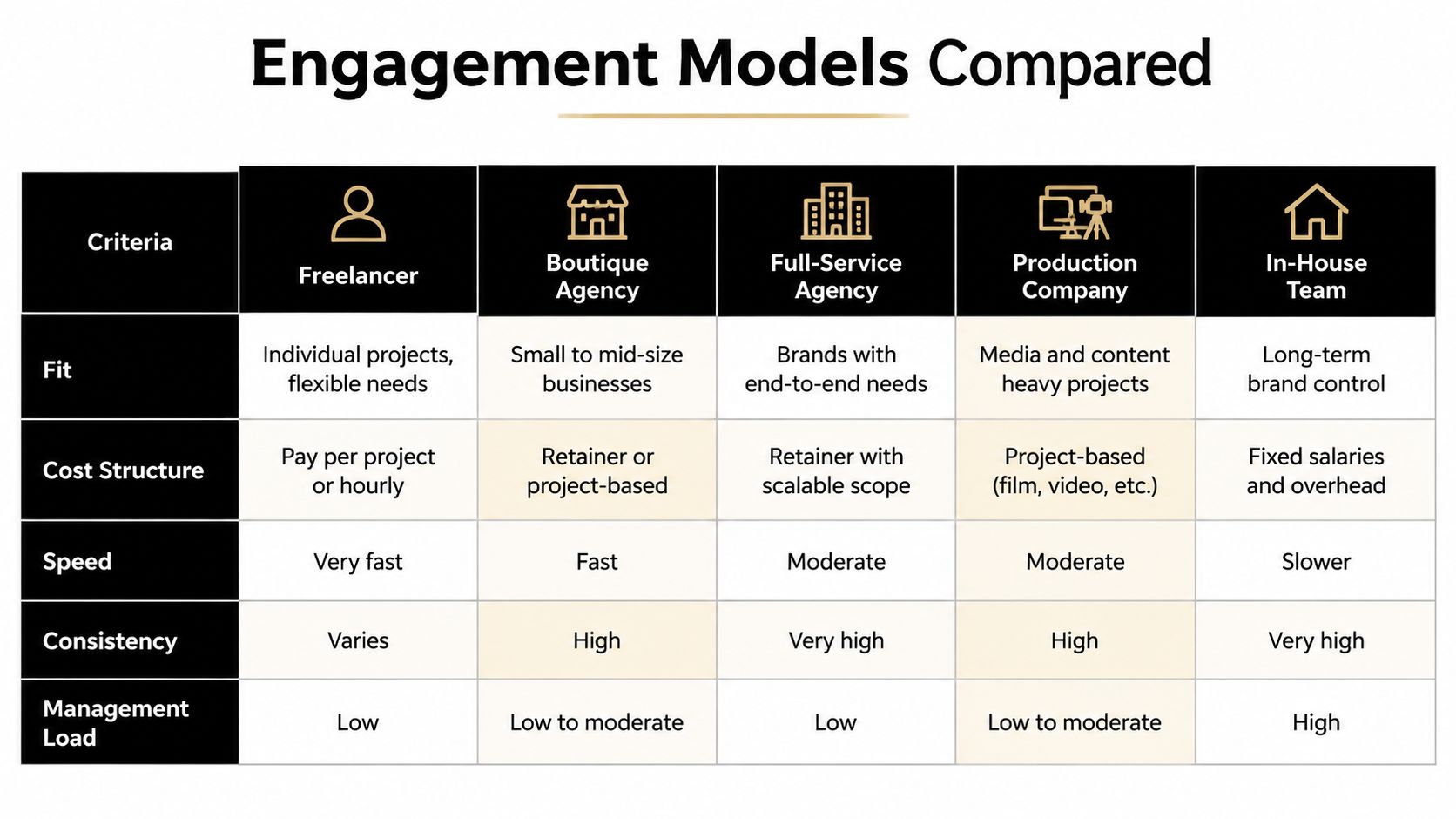
| Model | Typical use | How you pay | Speed | Consistency | Management load | Where it breaks |
|---|---|---|---|---|---|---|
| Freelancer or marketplace | One-off edits, simple shoots, specialist tasks | Per project or agreed deliverable | Can be fast when availability is good | Depends on the individual | High | The buyer often becomes the producer, and availability can be fragile |
| Boutique production company | Defined campaign, shoot, or film | Project quote | Deliberate and scope-led | Strong within the project | Medium | Less suited to frequent small requests |
| Full-service creative shop | Brand campaigns spanning several disciplines | Project quote or campaign scope | Varies by scope and approvals | Often strong across a campaign | Medium to high | Work may still be organized around separate projects |
| Embedded creative team | Recurring weekly video across channels | Set monthly cost | Built for repeat output | High once the brand system is established | Lower after onboarding | One-off buyers may pay for continuity they won’t use |
| In-house team | Ongoing control and close brand access | Salaries, tools, equipment, and production costs | Fast for familiar work | High when staffing is stable | Internal management remains high | Hiring, capacity, and specialist coverage limit scale |
| AI-assisted tools | Drafts, variations, transcription, selected production tasks | Tool or usage cost | Fast for defined tasks | Requires human review | Direction and rights checks remain with the buyer | Brand judgment, compliance, and final polish still need people |
An embedded team at a set monthly cost fits a company shipping video every week across social, ads, product, and sales enablement, because the same people carry the brand system from asset to asset without a fresh briefing cycle. Project quotes fit a single high-production shoot, a seasonal campaign, or a format you won’t repeat.
Since I sit on the embedded side, this is what that scope looks like in practice rather than in a table. A brief comes in on Monday for a customer story, a product walkthrough and four social cuts. The Creative Director scopes it the same day, a standard piece comes back in about two working days, revisions sit inside the monthly cost rather than in a change order, and the same people pick up the next brief without being onboarded again. The trade is that you need a steady queue to feed it, and a team like ours is the wrong buy for a single film a year.
To pick between them, ask how many finished assets you need, how many channels they serve, whether the same visual system recurs, who will manage freelancers, and how quickly approvals move. For a broader comparison of internal and external models, use this guide to in-house teams versus outside partners. The right choice is whichever one matches your actual workflow.
Match the model to your demand pattern
Most buying advice compares providers. In practice the decision is simpler if you start from your own demand pattern, because the cadence of your briefs is more stable than any vendor relationship. The market data backs this up: in the same Wistia research cited above, blended teams are becoming the norm, with in-house capability and outsourcing both growing year over year and outsourced production seeing the bigger jump at 7 percent. Around a quarter of companies outsource video creation to freelancers or external production partners even when they produce in-house, and the highest-volume producers, those making more than 250 videos a year, are 41 percent more likely than other groups to rely on an in-house team. The pattern is clear: companies match the model to the cadence, and mix models when the cadence is mixed.
Here is the mapping I use when a client asks which way to go.
| Demand pattern | What it looks like | Best-fit model | The trap to avoid |
|---|---|---|---|
| One-off | A launch film, an event recap, a single campaign asset | Freelancer for simple work; boutique studio when stakes or complexity rise | Signing a recurring engagement for a project-shaped need |
| Quarterly | Campaign cycles, seasonal pushes, a steady but slow calendar | Studio or full-service shop on repeat project quotes; keep the same one if quality holds | Re-briefing a new provider each quarter and paying the onboarding tax every time |
| Weekly | Always-on social, paid variations, product and sales content | Embedded team, in-house hire, or a mix of both | Feeding a weekly pipeline through project quotes, where every request becomes a negotiation |
A one-off buyer’s real risk is overbuying. If the need is genuinely a single film, a project quote with clear rights and a complete delivery package is the whole answer, and the vetting matters more than the model.
A quarterly buyer’s real risk is drift. Each cycle works, but nothing accumulates: the visual system resets a little with every new brief, and the knowledge of what performed stays in the provider’s head. If your calendar is quarterly and predictable, negotiate continuity into the relationship, meaning the same director or lead editor across cycles and a shared asset library, even while you keep paying per project. Corporate calendars are the clearest example of this rhythm, and this guide to corporate video production covers how those programs get structured.
A weekly buyer has crossed a threshold where video stops being a series of projects and becomes a channel with an operating cadence. At that point the question stops being which vendor and becomes who owns the pipeline: the brief intake, the prioritization, the brand system, the performance readout. That owner can sit in-house with production outsourced, or the whole function can sit with a dedicated external team, but someone has to hold it, and your video marketing strategy should name that owner explicitly before you sign anything.
If your demand pattern is about to change, buy for where you will be in two quarters instead of where you were last year. Switching models mid-stream is far more expensive than starting in the right one, because the costly part of switching is rebuilding the context, and no cancellation clause prices that in.
How to choose the right video partner
Look at the work before you look at the showreel. A polished reel can prove taste, but it can’t prove that the team understands your format, approval process, rights requirements, or publishing channels. If you want names to start from, our list of the best video production companies was checked against each company’s own site and Clutch profile.
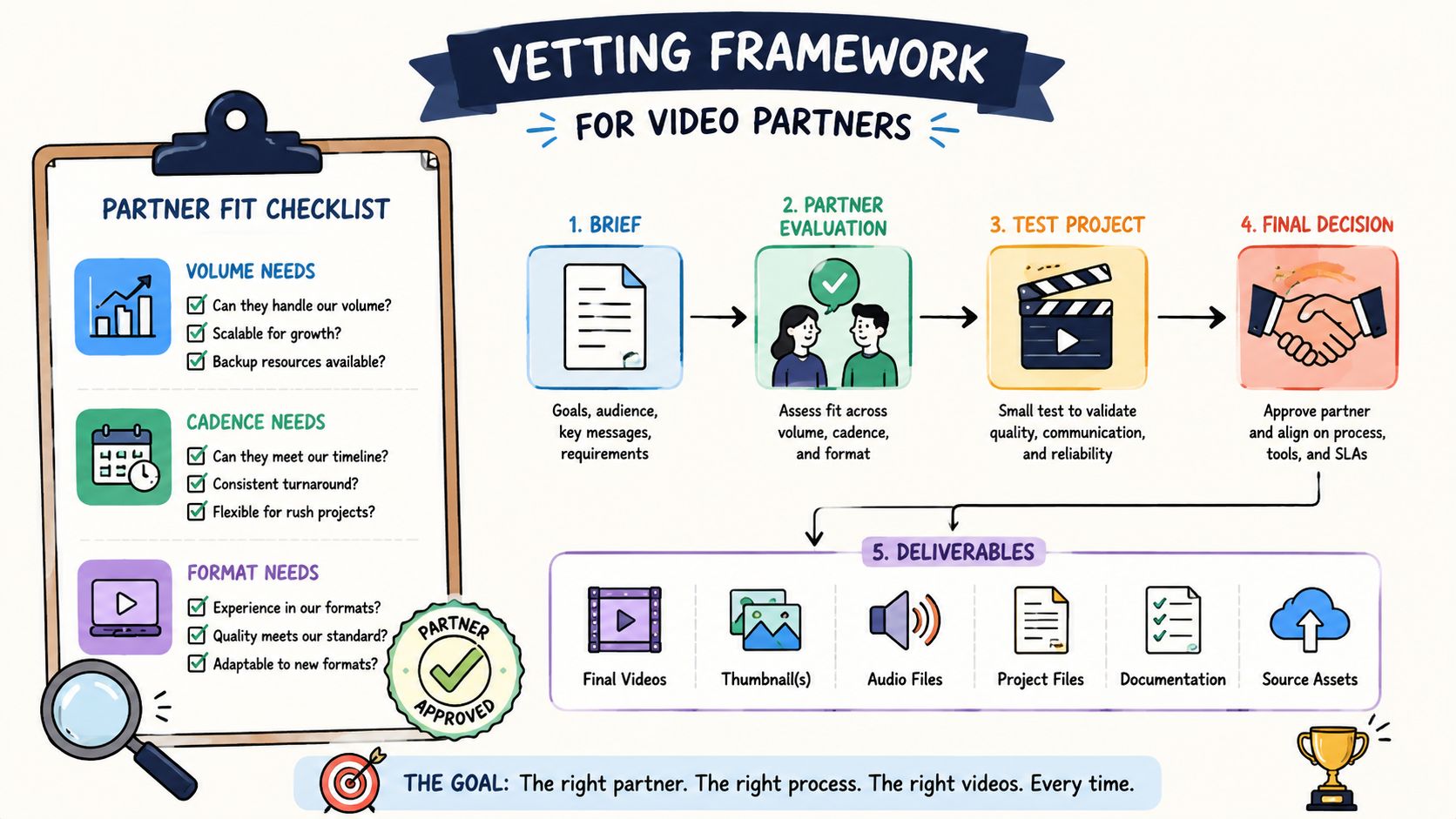
1. Define volume and cadence
List the finished assets you need over a normal cycle. Include hero edits, short cuts, captions, stills, aspect-ratio versions, and language variants.
If the answer is one film for a launch, a project-based partner may fit. If the answer is recurring content across several channels, compare the continuity and coordination of an embedded team.
2. Decide who owns strategy
Clarify whether you already have the audience, message, channel, and creative direction. If your team has the strategy but needs execution, you need a different partner from a team that must shape the concept, script, and distribution approach. Our guide to choosing a video marketing agency covers that second case.
Also decide who will manage the work. A freelancer can be effective, but the buyer may need to write the brief, source music and talent, chase versions, and check delivery specs.
3. Check portfolio fit
Ask to see work in the exact format you need. Review vertical social, paid ads, product explainers, training, event edits, animation, or CTV, rather than accepting a general reel as evidence.
Look for framing, pacing, sound, captions, motion systems, and clarity of message. A cinematic brand film doesn’t automatically show that a provider can produce a useful product demo.
4. Confirm revisions and rights
Get the revision process in writing. Confirm who approves, how feedback is consolidated, how many rounds are included, who owns the raw footage and final files, and where the music and talent can legally be used.
A proposal that leaves rights vague isn’t complete. Procurement should review usage terms before production starts.
5. Compare like-for-like scope and run a paid pilot
Build a comparison sheet with the same deliverables, formats, review rounds, licensing assumptions, travel, talent, and delivery requirements for every provider. Ask for a line-item quote rather than treating one headline figure as a complete comparison.
A paid pilot tests the working relationship without committing to a long engagement. Measure the quality of the brief response, first cut, feedback handling, file delivery, and communication.
Measure the service on two levels
The video’s outcome metric should match its job. Awareness work may use watch time and completion rate. Demand work may use click-through and assisted conversions. Product or training work may use activation or support-ticket deflection, while paid social may focus on hold rate in the first three seconds. Name the metric in the brief so the edit serves a clear purpose.
Then measure the provider operationally: on-time delivery rate, revision rounds used versus scoped, turnaround from brief to first cut, cost per finished asset once versions are counted, and the time your own team spends on each project. Be careful with benchmark numbers from vendor blogs; if you need an external reference, use a dated primary source and check the original context before it goes in a deck.
Red flags and common buying mistakes
The lowest quote can be the right choice for a tightly defined task. It becomes misleading when it excludes the work your team still has to manage.
A solo freelancer or marketplace hire may leave you responsible for briefing, music and talent sourcing, version control, spec checks, and rights paperwork. A single point of failure can also appear when availability changes. AI-assisted tools can reduce effort for drafts and variations, but they still need direction, brand judgment, human finishing, and rights checks. The low quote is real; the hidden hours are real too, and both belong in the comparison.
The buying mistakes I see repeat across companies of every size:
- Buying one hero video without a distribution plan, so the asset sits on a homepage with no useful versions for other channels. Define the cuts, crops, captions, and destinations before production begins.
- Comparing unlike quotes. One provider includes strategy, licensing, and three revision rounds; another includes none of them. Normalize every proposal against the same deliverables and assumptions.
- Choosing showreel polish over format fit. Ask for examples that match the exact audience, format, pace, and technical delivery you need.
- Skipping the written brief. If the audience appears for the first time in the edit, the team is already late. Write down the message, viewer action, channel, approval owner, and success metric.
- Leaving rights and licensing unsettled. Music, talent usage, raw footage, and ownership create problems after delivery unless they are settled in the scope and contract first.
- Approving by committee. Multiple reviewers produce conflicting notes and stalled decisions; name one decision maker who consolidates feedback.
- Treating video as a campaign event when demand is ongoing. Re-briefing a new provider every quarter creates repeated setup work and inconsistent brand execution; compare an operating model instead of another isolated quote.
Failure modes I keep seeing
Lists are tidy; failures are not. These four patterns come from real engagements, with the identifying details removed, because the shape of the failure is what teaches.
A mid-size software company bought a beautiful launch film with music licensed for organic web use only. Six months later the growth team put paid spend behind it, the license did not cover advertising, and the choice was re-licensing at campaign rates or re-scoring the film. The fix would have cost nothing at the proposal stage: one sentence confirming the license covered paid media.
A consumer brand ran its product line through three different providers in a single year, chasing availability and price on each brief. Each provider was competent. The library they left behind was not: three grades, three type treatments, three pacing styles, and a brand channel that looked like three companies. Nobody made a bad decision on any single project; the failure was that no one was accountable for the whole.
A services firm approved a hero film through a five-person committee. Every review round produced conflicting notes, the edit went six rounds against a scoped three, the overage charges roughly matched the cost of a second video, and the film shipped weeks after the event it was made for. The provider gets some blame for not forcing a single approver at kickoff, but the structural failure was on the buying side.
A hardware company took final delivery of a launch video and archived nothing. Two years later a request came in for a thirty-second cutdown; the provider had closed, the project files were gone, and the raw footage had never been transferred. The only remaining asset was the compressed final export, so the cutdown had to be rebuilt from scratch. Raw footage and archive terms feel like legal boilerplate at signing. They are the difference between a half-day edit and a new production.
Each of these failures traces back to a single unread or unwritten line in the scope. That is the argument of this whole page: the reading you do before signing is the highest-return hour in the entire engagement.
For cost questions, use this guide to video production cost as a starting point, then request a line-item quote for your actual scope.
Before you request quotes
Write the deliverables list, name the approval owner, and identify every channel the work must serve. Then compare providers against the same scope, run a paid pilot where the decision is close, and choose the model that matches your actual cadence. If you want a structured way to shortlist, this guide to choosing a video production company walks through the vetting questions in order.
Frequently asked questions
Plan on four to eight weeks for a straightforward brand or product video: one to two weeks of pre-production, a day or two of shooting or a few weeks of animation, then two to three weeks of post and reviews. Recurring social work moves much faster once a team knows your brand. The schedule slips most often at client review, so book your approvers before the shoot, not after.
Send one decision maker, even if only on a video call. Shoots surface small choices about wardrobe, line reads, and framing that someone must approve on the spot, and pulling in a committee mid-shoot burns paid crew time. Animation has no set, but the same person should join storyboard and animatic reviews, because changes are cheap there and expensive once rendering starts.
Bring the goal, the audience, the channels, a rough deadline, and any brand assets or past videos, including ones you disliked. A capable provider can scope accurately from that in one conversation. If you can also name the approval owner and the number of finished assets you expect, the quote that comes back will be closer to the real number and much easier to compare.