How to Choose the Right B2B Creative Agency
Learn what a B2B creative agency actually does, how it differs from B2C, and a practical checklist for choosing the right partner for your team.

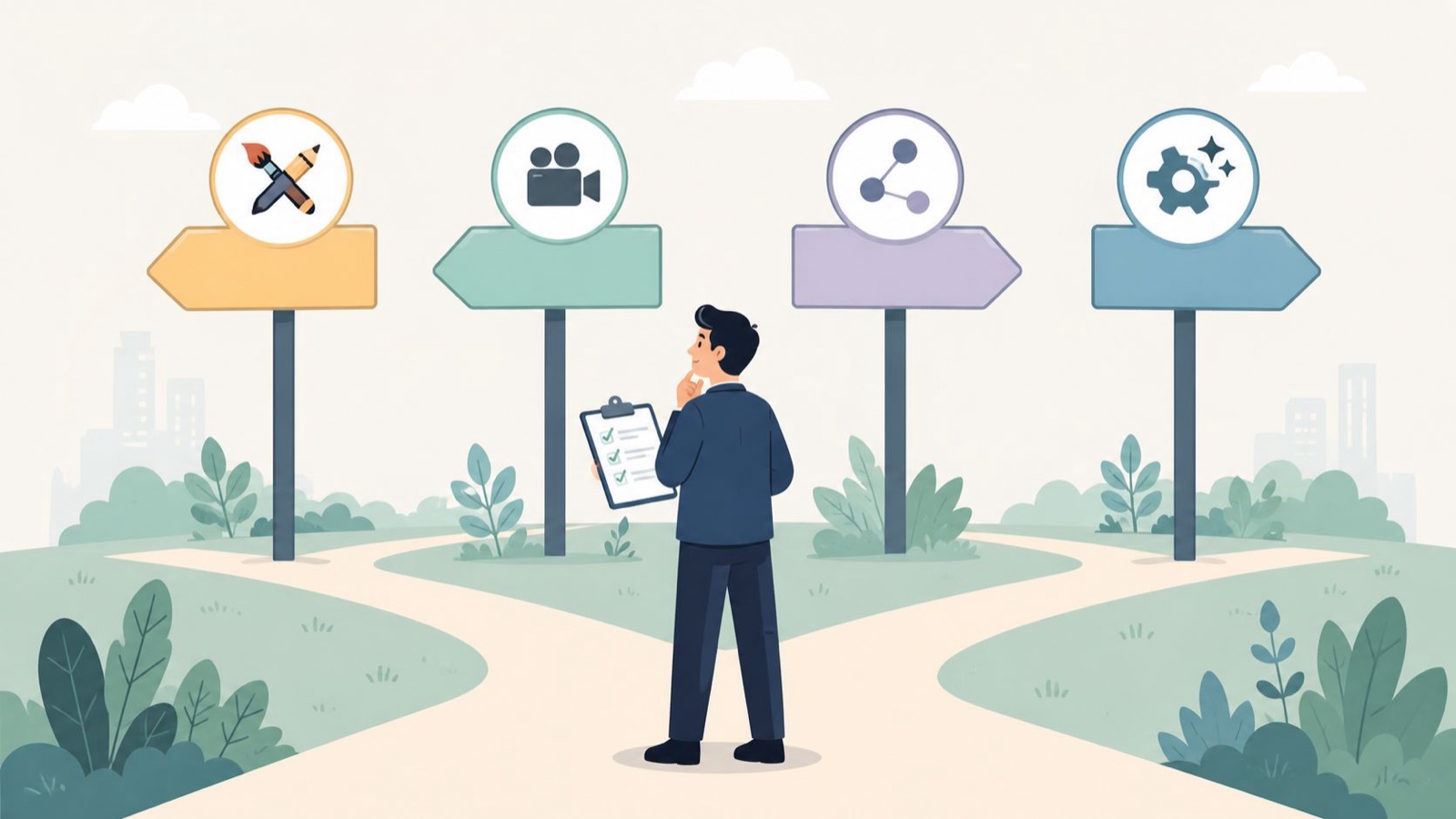
You already know the feeling. The launch deck is approved, the webinar date is set, sales wants a cleaner demo story, and the paid social team needs five new cuts by Friday. Your internal team is good, but it can’t carry every asset, every week, across every channel. That is the moment I usually get the call, when buyers start looking for a b2b creative agency, or a dedicated creative team that can keep pace without turning every request into a staffing crisis.
The partner I would trust is rarely the one with the flashiest reel. What I look for is a team that can turn complex offers into clear, useful creative, then keep shipping. In B2B, that matters because the market is big and the work never really stops, which keeps the pressure to produce more assets climbing. The U.S. marketing agencies market is large and still growing (Mordor Intelligence), which is the backdrop for the rising pressure on teams to produce more creative, more often. That doesn’t tell you which partner to hire, but it does tell you creative production sits inside a large, crowded services economy.
What a B2B Creative Agency Actually Does
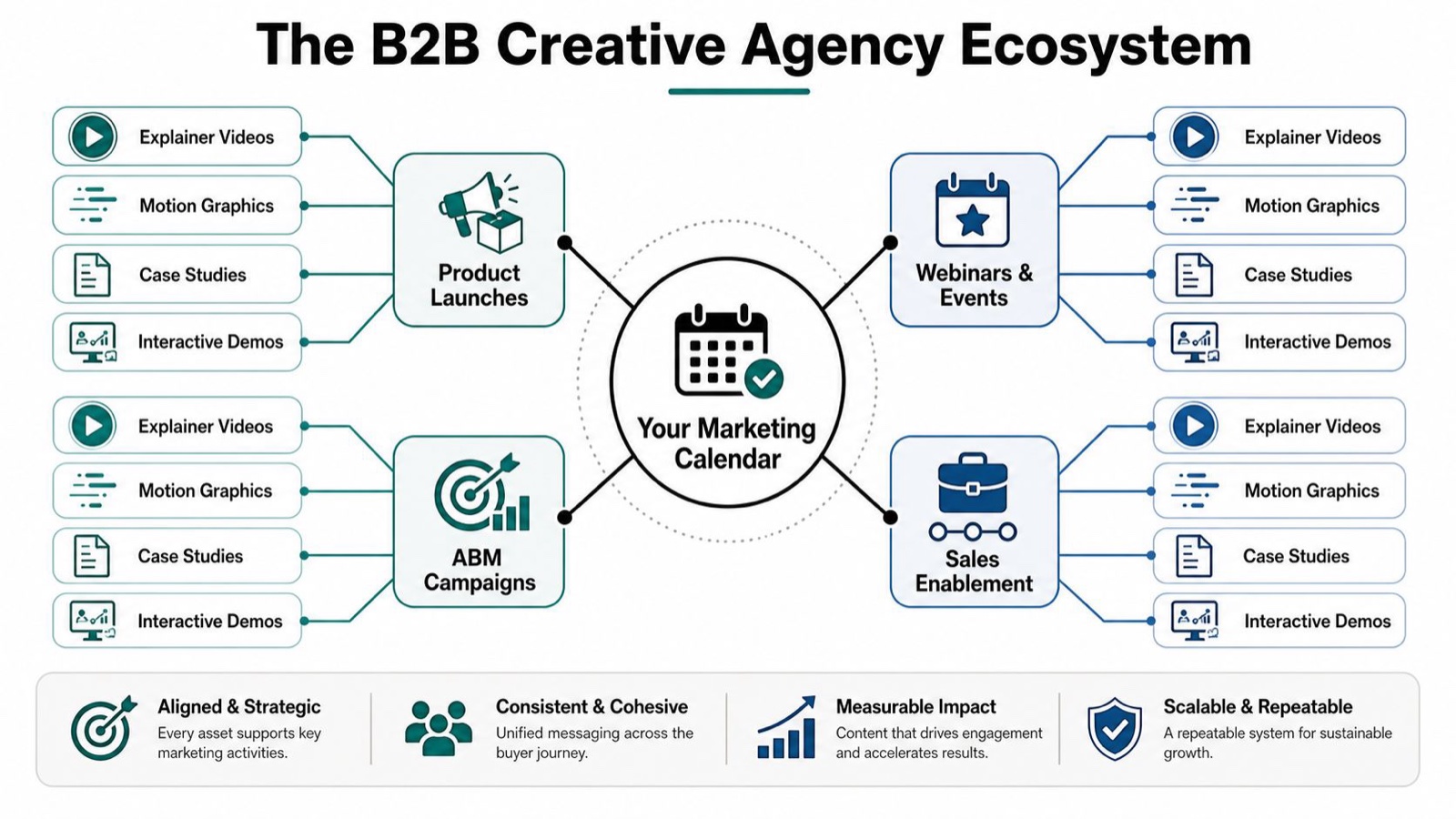
A good b2b creative agency handles the work that keeps your pipeline moving when your in-house team is stretched thin. In my experience that usually means brand identity and messaging, demand-gen ad creative, product and explainer video, sales enablement decks, website and landing pages, ABM assets, event graphics, and motion content for social. The job runs deeper than design polish. What we are really doing is turning a complicated offer into assets people can actually use.
The real job is production with a business purpose
B2B teams don’t need a pretty logo refresh and a folder of exports. They need creative that supports launches, demand generation, sales conversations, and consistency across channels. When a prospect asks me whether they need outside help, I tell them to look at their request list. If it includes videos, motion, decks, landing pages, ads, and campaign visuals, you are already in the zone where a dedicated creative partner can make sense.
The market is also pushing creative in a more video-heavy direction. HubSpot’s 2026 marketing data says short-form video is the top ROI-driving format for 49% of marketers, with long-form video at 29% and live-streaming video at 25% (HubSpot). I see that play out every week, and it is one reason many B2B teams now want a partner who can handle both static design and motion content without constant handoffs.
For a simple view of where this work sits inside the marketing calendar, the diagram above helps. If you want a deeper take on how creative services get scoped in practice, our overview of creative design services at Moonb is a useful companion read. For video-specific execution, studio-quality video insights from LunaBloom AI can also help you sanity-check what “good” looks like before you brief a team.
Practical rule: if the work has to show up every week, in multiple formats, and still stay on brand, you need a partner built for cadence, and concepting on its own will not carry it.
How B2B Creative Differs From B2C
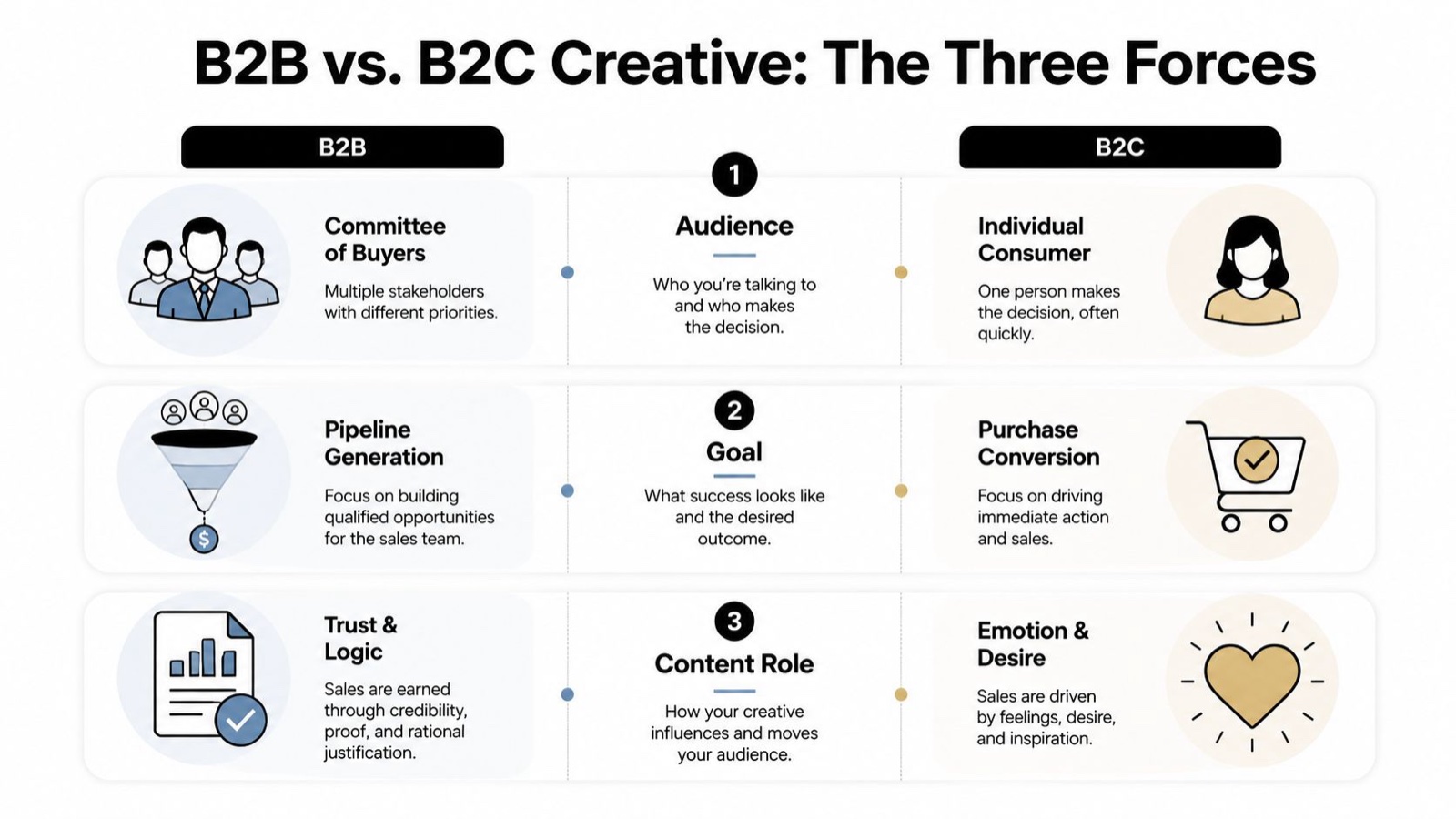
I have learned that B2B creative is a different animal. The audience is different, the sale is slower, and the work has to survive scrutiny from a buying committee. One stakeholder wants proof. Another wants risk reduction. Another just wants to know the thing won’t create more work.
Three forces change the work
First, B2B buys by committee. That means the creative has to speak to several people at once, not one consumer mood. Second, the cycle is long, so assets need to do more than grab attention. They need to support repeated conversations, from first touch to sales follow-up. Third, the product is often technical, which means a visually strong campaign still fails if it doesn’t explain the value clearly. I have watched beautiful campaigns stall on that last point.
That is why B2B creative has to carry both logic and emotion. Logic gets the reader to understand. Emotion gets them to care enough to keep going. I point clients to public brand work from companies like IBM and Salesforce, where the creative stays polished and confident while it holds onto a complex product story.
There is also a sales reality that B2C teams don’t face as often. Our B2B work gets screenshotted, forwarded, then argued over in procurement and internal review. So it has to stay legible once it is pulled out of context. In practice that means stronger messaging and cleaner visual systems, with fewer clever flourishes that will not survive a sales call.
Marketing Week reported research from LinkedIn B2B Institute and System1 that found the majority of B2B advertising is ineffective (Marketing Week). That tracks with what I hear from marketing teams. The problem I run into is rarely a shortage of assets. Far more often it is weak concepting, unclear messaging, or creative that nobody built for the buying process in the first place.
B2B work gets judged twice, once by the market and once by the sales team. If it can’t help either one, it’s decoration.
The Twelve Engagement Models Compared
There is no single buying model that fits every B2B creative team. The right choice depends on how much work you need, how senior the people need to be, how fast the team has to move, and how technical the category is. A founder-led SaaS company with one launch and a tight timeline should not buy the way a global team does when it needs ongoing campaign support, sales enablement, and web updates.
Buyers tend to ask whether they should hire out at all. I think the sharper question is what you actually need: strategy, execution, senior oversight, or steady production capacity. Hire for the wrong one and you end up paying for polished presentations when you needed message clarity, or you bring on a body shop when you needed someone who can shape the work and defend it in front of sales, product, and legal.
The options buyers actually run into
| Engagement Model | Best For |
|---|---|
| Large network agencies like Ogilvy or VMLY&R | Big launches, global coordination, and broader brand systems |
| Independent B2B specialists | Complex positioning, long sales cycles, and B2B-native thinking |
| Boutique studios | Focused campaigns, sharper creative taste, and smaller scopes |
| Embedded creative teams like Moonb | Steady weekly output alongside an existing marketing team |
| Full in-house teams | Deep product knowledge and constant availability |
| Freelance marketplaces | Ad hoc requests, one-off tasks, and quick sourcing |
| Project-based shops | A single campaign, rebrand, or launch sprint |
| Brand-strategy firms | Messaging, positioning, and narrative architecture |
| Motion and video specialists | Explainers, demos, campaign video, and social motion |
| Web and design-system studios | Site redesigns, component systems, and scalable UI consistency |
| Fractional creative directors | Senior creative leadership without hiring full time |
| Contract staffing firms | Temporary capacity when your team needs extra hands fast |
Large network agencies fit big launches and cross-market coordination. They usually bring process, senior brand thinkers, and enough bench strength to manage complicated stakeholder groups. The trade-off, in the deals I have seen, is cost and the risk that your work gets diluted across layers of account management.
Independent B2B specialists are the better bet when the audience is technical, the buying cycle is long, and the messaging has to hold up in sales reviews. Boutique studios work well when the brief is focused, the bar for taste is high, and you want a smaller team that moves fast without piling on process.
An embedded team like Moonb, which is how we are built, is a stronger fit when you need ongoing output rather than a one-time burst. We work like a standing creative function inside your marketing team, which helps when content, campaign assets, and web changes keep stacking up. For teams weighing recurring creative delivery against one-off project work, what is a creative subscription service walks through the difference.
Motion and video specialists are the right call when execution depth matters more than broad brand thinking. Web and design-system studios make sense when the problem is consistency across pages, templates, and product UI. Fractional creative directors give you senior judgment and sharper critique without adding a full-time headcount. Contract staffing firms fill capacity gaps quickly, though I rarely see them solve the bigger problem of how the work should be directed.
Full in-house teams give you the deepest product knowledge and the fastest internal coordination. Freelance marketplaces are useful for one-off tasks and short deadlines, especially when the brief is simple and the stakes are low. Project-based shops are built for a launch, a rebrand, or a specific campaign sprint, while brand-strategy firms are there to define messaging, positioning, and the narrative system before production starts.
The wrong model shows up fast. I see it when a team buys senior strategy but needs weekly asset output, or when it hires production help on price alone and then spends months cleaning up weak messaging. If contracts, approvals, and risk review are part of the buying process, the AI legal assistant for business owners can help your team pressure-test the agreement before anyone signs.
LinkedIn’s own marketing team had Les Binet and Peter Field lay out why B2B brand-building is not optional, which is the backdrop to every hiring decision in this piece.
How to Choose the Right Partner
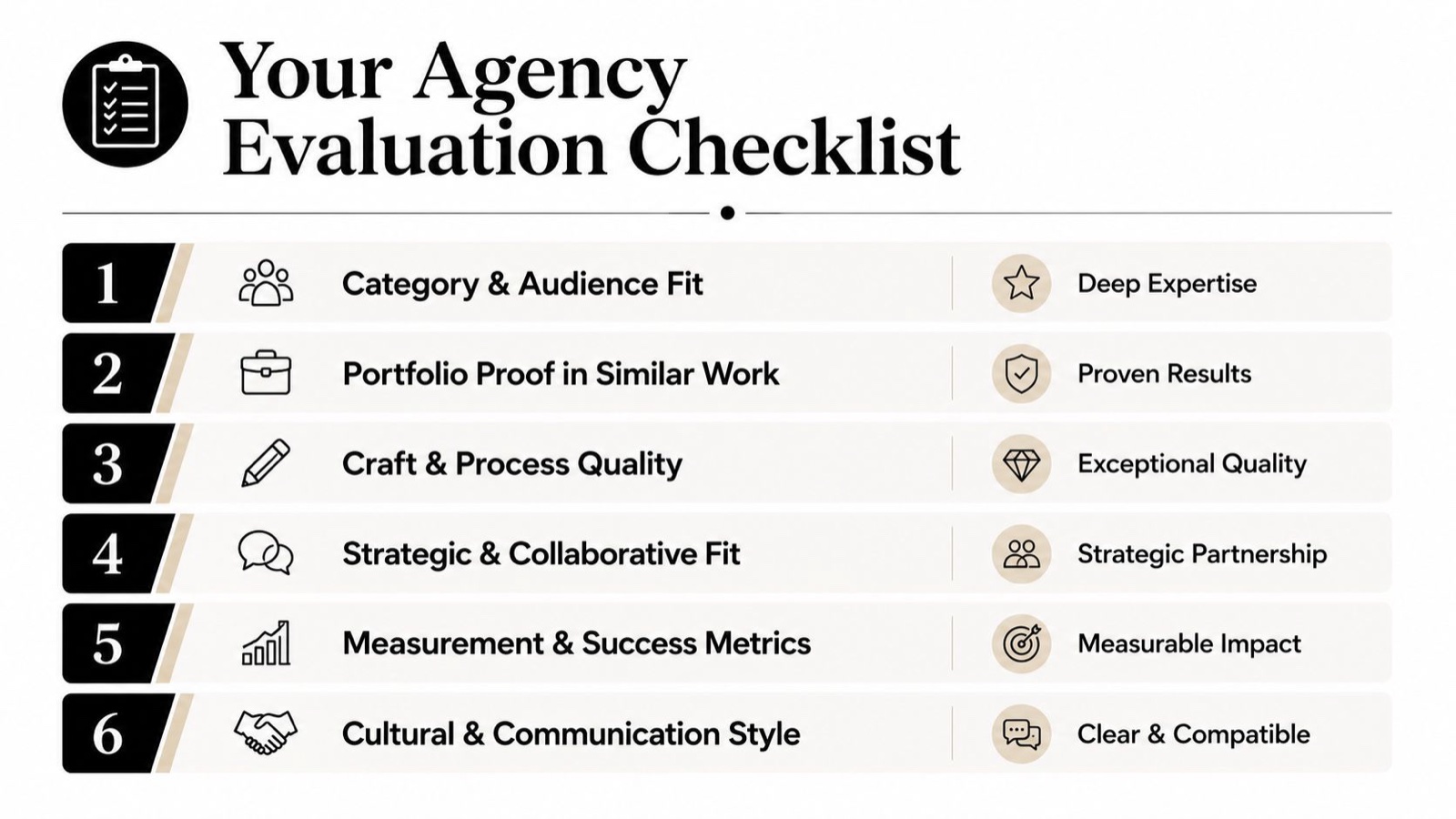
Start with fit, not polish. The nicest pitch deck in the room means nothing to me if the team has never worked on a similar audience, product, or sales motion. The wrong partner will hand you pretty work that misses the business problem.
Six things to check before you sign
-
Category and audience fit. Ask whether they have worked in your space or a close one. A team that understands SaaS buying committees can still struggle in healthcare or fintech if it has never handled compliance-heavy work.
-
Portfolio proof in similar complexity. Do not stop at pretty visuals. Look for work that explains hard things clearly, holds brand consistency, and shows range across ad creative, web, decks, or video.
-
Who does the work. Meet the people who will touch your account. Plenty of shops sell senior talent and then deliver junior execution, and that mismatch is one of the most common failure points I run into.
-
Working rhythm and turnaround. Ask how intake works, how fast they move, how review cycles are structured, and what happens when priorities shift. A strong partner should be able to describe the weekly rhythm without any hand-waving.
-
Alignment with sales and demand teams. If creative sits in a vacuum, it will not help pipeline. Ask how they connect messaging, campaigns, and sales enablement. Pedowitz Group’s guidance on vetting B2B tech creative agencies is clear that strong partners can tie creative output to revenue-marketing architecture, not just impressions or clicks (Pedowitz Group).
-
Brand consistency over time. One good deck is easy. Holding the line across dozens of assets is the hard part. Ask how they manage version control, asset libraries, and approvals.
Ask for a real working session with the people who will do the work. If the pitch team disappears after the sale, you already know where the pressure points will land.
Our guide at Moonb on how to choose a video production company is a good companion if video is a major part of your scope. The same logic applies here. You want the actual operators, not just the presenters.
How Pricing and Engagement Structures Work
Pricing in this space usually comes in four forms, and I always tell clients the model should match the work rather than the other way around. Project fees fit clear deliverables with a defined start and end. Monthly retainers fit recurring creative volume. Day rates make sense for advisory or overflow support. Value-based scopes work when the partner ties pricing to a defined business outcome or a tightly framed body of work.
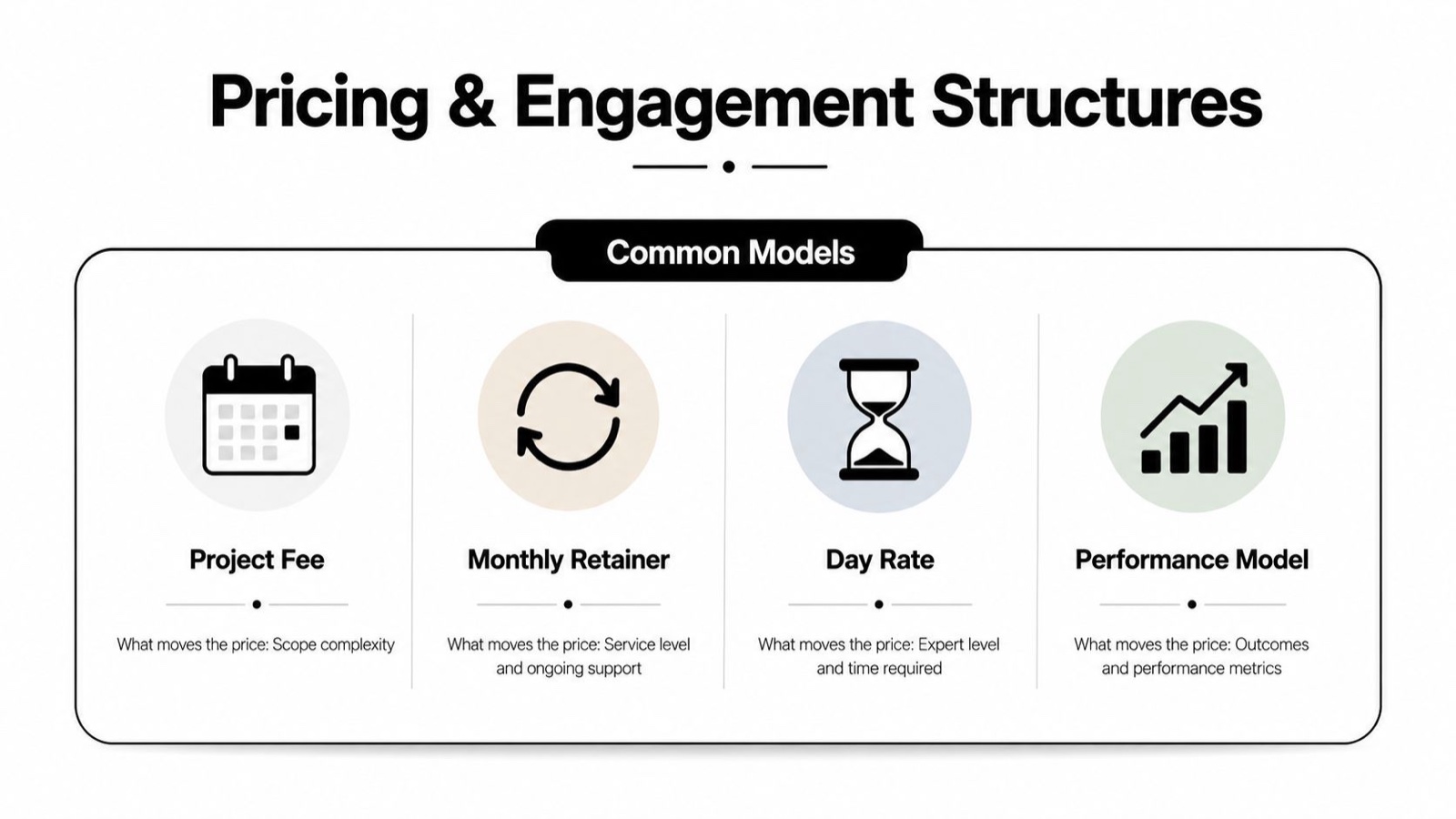
What moves the price
In my quotes, the biggest drivers are simple. Senior creative directors cost more than junior generalists. High-volume work costs more than one-off work because review, planning, and production all repeat. Strategy depth raises the scope. So does animation, motion, scripting, editing, or any other specialized production layer.
A one-page landing page and a multi-video launch kit are not the same kind of assignment. Neither are a brand refresh and a steady stream of weekly social motion. If a proposal hides those differences inside one lumped scope, push back. Ask what is included, what revision cycles look like, and what happens when the request list expands.
For a practical reference, our pricing page at Moonb shows how a dedicated creative team can organize scope and delivery around ongoing work. That kind of structure is easier to compare than vague promises. It also helps you see whether you are paying for real production capacity or just access to a generalist team juggling too many clients.
A strong proposal should also make clear where the work begins and ends. If the scope is fuzzy, the relationship gets fuzzy too. And if a partner bills for unused capacity or dodges defining revision limits, that is a sign the model was not built around your actual workflow.
What Good B2B Creative Looks Like
Good B2B creative makes a hard thing feel clear. Rather than hiding complexity, it organizes complexity so a buyer can move through it. That is why I judge it on four things, not one. Does it explain the product? Does it hold brand consistency? Does it support the next sales conversation? And does the craft feel strong enough to earn attention on its own?
Look at the output, then look at the system
I keep coming back to public work from Mailchimp, because the brand system stays recognizable and consistent across touchpoints. Slack has also shown how product storytelling can stay friendly without getting vague. Adobe campaigns often show how B2B creative can be visually strong while still serving a technical product story. Only cite examples that are public and easy to verify.
The deeper test is whether the work improves the business motion. If creative helps sales explain the offer faster, that matters. If it drives more demo requests or better-qualified conversations, that matters too. If it only looks nice in a portfolio, it is not enough.
I also like teams that improve over time. A partner that ships a predictable weekly cadence and keeps tightening the work often beats a one-off shop that wins on concept quality alone. Iteration compounds. That is especially true in B2B, where the message gets tested across campaigns, decks, landing pages, and video, then sharpened based on what buyers respond to.
Simple test: if you remove the logo, can the buyer still understand what the company does, why it matters, and what to do next?
Practical Next Steps and a Sample Weekly Workflow
Start with volume. Then decide whether you need deep category expertise, broad execution, or both. After that, pick the model that matches your pace and pressure points. Do not hire for the partner you wish you needed. Hire for the content load you actually have.
A realistic weekly workflow for an embedded creative team looks simple on paper, and it is close to how we run ours. Monday is intake and prioritization. Tuesday is concepting and rough drafting. Wednesday brings review and revisions. Thursday is production and final polish. Friday is delivery, handoff, and the next week’s planning. That rhythm is exactly why embedded teams can work well for B2B marketing groups that need ongoing output instead of occasional bursts.
If you want a deeper view of that operating model, our post at Moonb on creative workflow process is a useful reference. You can also compare it with your own setup using related reading on in-house versus agency models and creative team structure, which helps when you are deciding whether to build, buy, or blend.
The smartest move is usually the one that matches your real constraint. If you need speed and range, look outside. If you need deep product knowledge and constant availability, build internally. If you need both, run a hybrid model and make sure the team owns the rhythm, not just the deliverables.
If you are choosing a b2b creative agency right now, make the decision on fit, cadence, and who will actually do the work. Then ask for proof in work that looks like yours, not a prettier version of someone else’s problem. If you want help comparing models against your current backlog, line up your next three months of requests, and use that list to pressure-test every partner you speak with, us at Moonb included.
Frequently asked questions
When the demand is steady but spread across formats. If you need video, motion, decks, ads and landing pages most weeks, a single hire cannot cover all of it, and a dedicated team already has the range. If the need is one specialist skill full time, hire for that instead.
Ask to see the same client across several pieces, not one hero reel, and ask specifically for a sales deck template and a partner co-branding example. Consumer-style portfolios look great and often fall apart in a procurement portal or on a screen-shared call, which is where B2B creative actually lives.
A project agency scopes a campaign, delivers it and moves on. An embedded team works continuously alongside your marketing team, with the same people across months, so the fiftieth asset still matches the first. The embedded model fits ongoing production; the project model fits a defined one-off.