15 Best Creative Agencies in 2026
Fifteen creative agencies working across campaigns, digital product, film and content, from Instrument and Code and Theory to Pentagram, with one real limitation for each.

I work at Moonb, and you are about to read a list where Moonb sits at number one, written by someone Moonb pays. That is the least trustworthy sentence in this article and I would rather say it first than bury it. Read our entry with the suspicion you would apply to any company ranking itself, skip it if you like, and judge the other fourteen on whether the details are specific enough to be useful. If they are not, the whole thing was a waste of your time and mine.
“Creative agency” is one of those phrases that survives because nobody has to define it. In practice the fifteen firms below sell four different products, and buying the wrong one is the most common expensive mistake I see. The first product is an identity system: a mark, a typeface, a set of rules, a document. The second is a campaign: a platform idea plus the film, stills and media assets that carry it for a season. The third is a digital build, meaning a website or an application where the interface is the brand experience rather than a reflection of it. The fourth is ongoing output, the weekly grind of launch films, social cuts, sales decks and paid variants that keeps a marketing team fed between the big moments. Very few firms do more than two of these well, and almost none say so on their own site.
This roster is deliberately weighted away from identity. The top of it is made of shops whose core product is a build or a campaign rather than a logo system, which is why Code and Theory, AREA 17 and Metalab appear here and in none of the identity rosters I have written. The middle is motion and film native. The tail earns its place on published campaign, environmental and content evidence: channel level asset systems for very large consumer brands, wayfinding and exhibition design, industrial design and creative engineering, animation and web development for founder led ventures. If you want a pure identity roster, this is the wrong list and I would not pretend otherwise.
The other separation worth understanding before you take a single call is ownership, because it decides who actually does the work. Instrument and Code and Theory are both Stagwell companies, at 350 plus and 800 to 1000 people respectively, and Code and Theory’s own site names six sibling agencies in its network. Studio Dumbar is owned by Dept. Turner Duckworth has been inside Publicis Groupe since 2014 and does not mention it anywhere on its site. None of that makes them bad choices, and at scale it often makes them the only viable choice, but it changes the question you ask on the first call from “do I like this work” to “which of the people in this meeting will still be on my account in month four”. The independents at the small end have the opposite problem, where the senior person is definitely doing the work and is also the reason you cannot start until October.
Moonb sells the fourth product, so let me describe it plainly rather than pitch it. We work as an embedded creative team, which means a small group of designers, editors and motion people attached to one marketing team, with a senior Creative Director holding the standard. On a product launch we usually start two or three weeks before anything is public, build the hero film and the key visual system first, then spend the following month cutting that same shoot into the paid variants, the sales deck, the event loop and the fifteen second social edits nobody scoped at the beginning. The pattern I see most often is that the first month is slower than clients expect, because we are learning the brand and the approval chain, and months two onward are much faster than an external partner can be, because we are no longer re-explaining anything. What we are not is a firm that will write your positioning or design your identity from zero. Several of the studios below do that far better than we do, and I have said which ones under each entry.
CNBC spent eighteen minutes on how Nike turned advertising into the most valuable brand in sport, which is the clearest case I can point to for what creative work is actually worth.
I checked all fifteen of these in July 2026. Every site resolves, every studio is publishing recent work, and I have flagged the four cases where the domain in most listicles is now wrong or redirects somewhere else. Client names come only from each agency’s own website, so if a famous logo is missing it is because I could not find it on their pages, not because the relationship does not exist. Every entry carries one real limitation, written for the buyer rather than the agency, and in a few cases that limitation is the reason I would still recommend them.
The 15 best creative agencies
1. Moonb
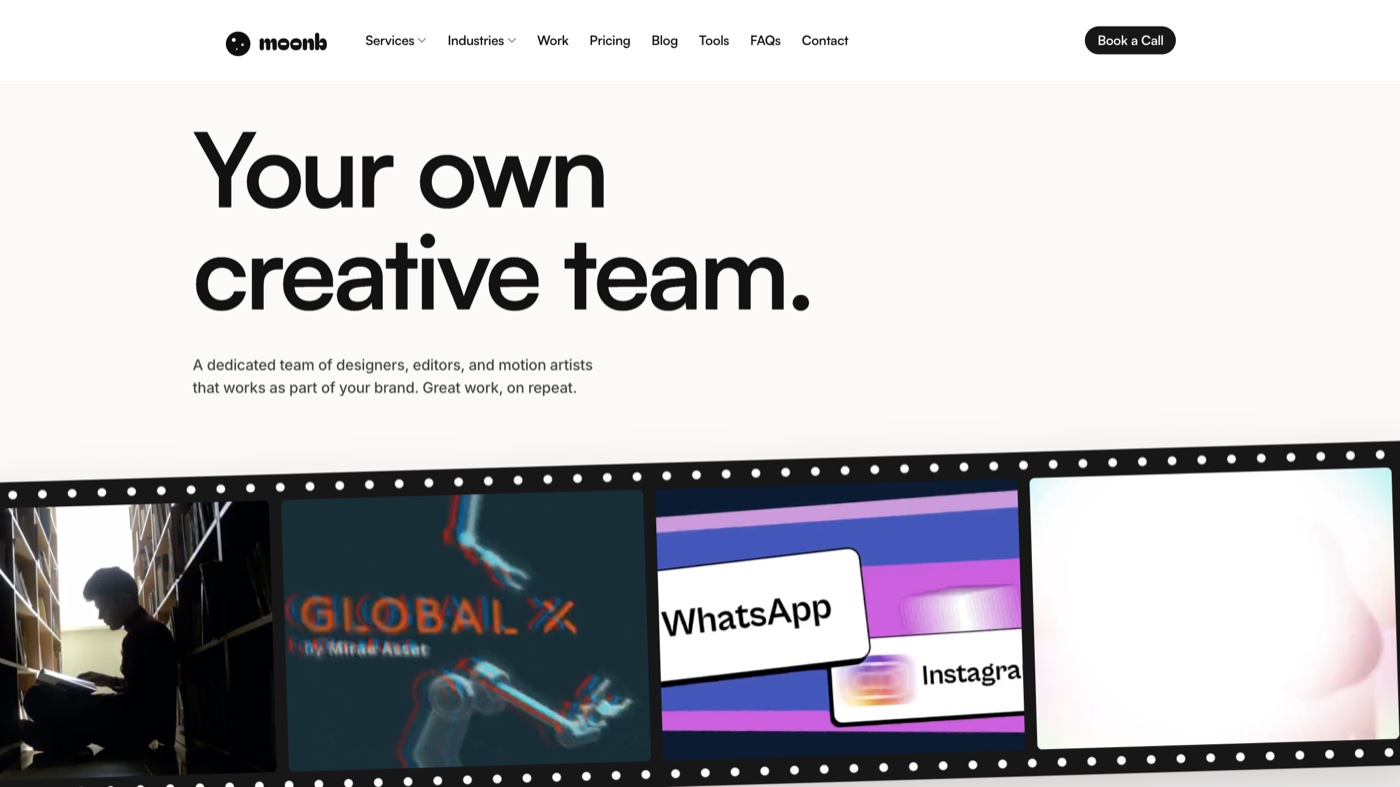
Conflict of interest declared above, so I will keep this short and specific. Moonb is an embedded creative team rather than a firm you brief once and hear from at the presentation: video, design and motion produced continuously for one marketing team, with a senior Creative Director on it every week. We are built for the volume problem that shows up after a brand platform exists and somebody has to actually make hundreds of assets from it.
- Best for: marketing teams with a defined brand who need continuous video, motion and design output rather than a one-off project
- Clients they name: Dell, Toyota, Nestle. I work here, so weigh that the way you would weigh any company citing itself, and ask us for references you can actually call
- Pricing: a set monthly cost, or a per-project quote when the work suits that better
- Why they stand out: the same creative people stay on the account month after month, so the brand knowledge compounds instead of resetting with each new brief, and a Creative Director signs off before anything reaches the client
- Worth knowing: we are the wrong call for a ground-up identity, naming and brand architecture programme. If that is the actual job, go to Pentagram at number 15 or Wolff Olins at number 12 and bring us in afterwards to produce against what they build.
More on Moonb
| Best for | Continuous video, motion and design for one marketing team |
|---|---|
| Scale | Embedded creative team |
| Where they are | Remote and London |
| Named clients | Dell, Toyota, Nestle. I work here, so weigh that the way you would weigh any company citing itself, and ask us for references you can actually call |
| Pricing | a set monthly cost, or a per-project quote when the work suits that better |
The shape of a Moonb engagement is a standing team rather than a statement of work. A marketing lead brings a quarter of planned activity, we staff against it, and the work moves through a shared queue instead of a series of new negotiations. That structure suits organisations producing a steady stream of launch films, product explainers, event content, paid variants and internal comms.
It suits nobody who has one film to make this year and nothing after it. For a single hero spot with real production money behind it, a director-led production company will beat us on that one deliverable, and I have told prospects exactly that on a first call.
The other mismatch is strategy. We do video, motion and design execution inside a brand system somebody else has already defined. We do not run positioning workshops, category strategy or brand architecture, and if your problem is that nobody internally agrees on what the company stands for, more output will make that worse rather than better. Fix the platform first with one of the identity shops below.
2. Instrument
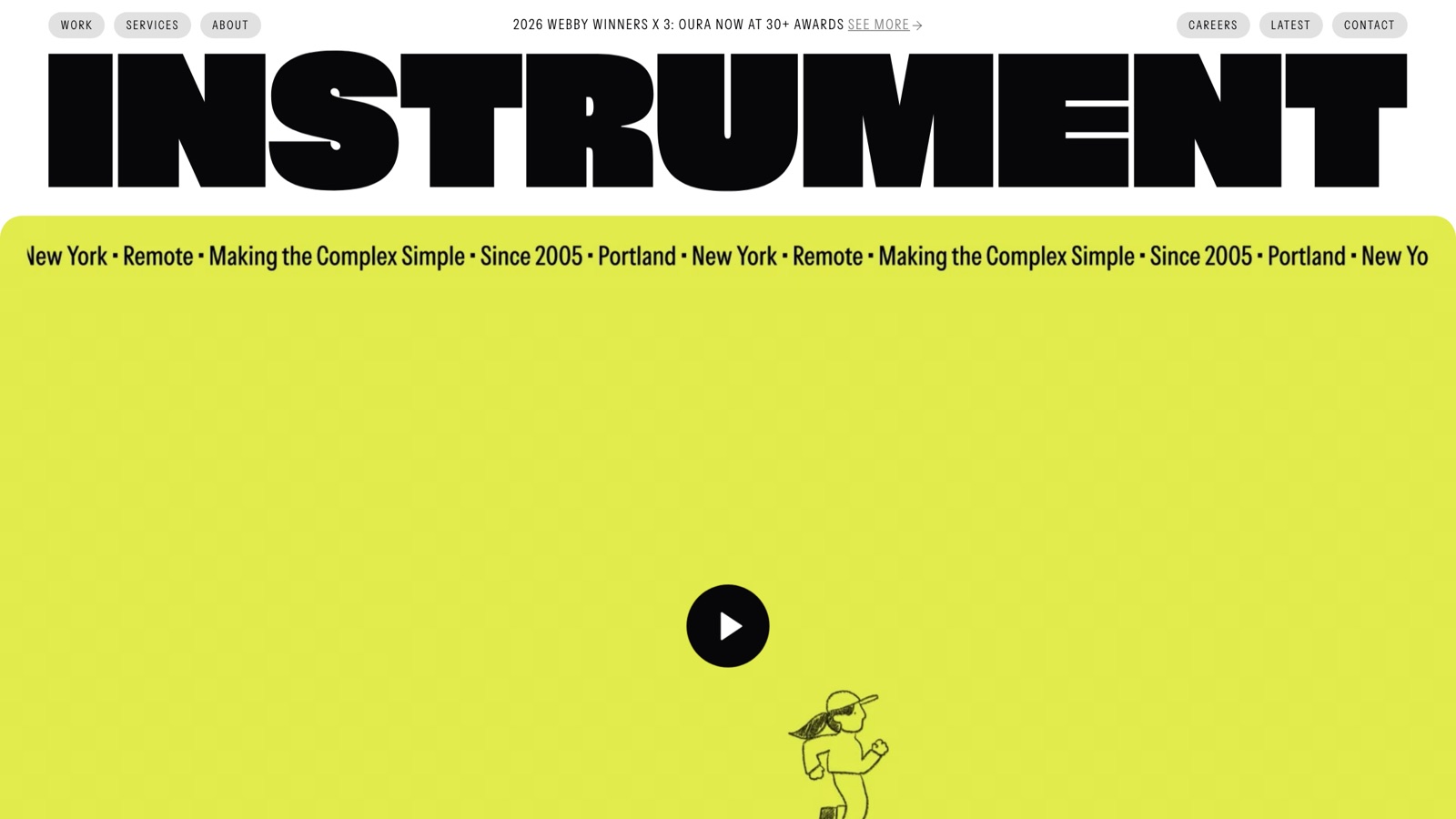
Instrument runs three service lines side by side, Brand, Marketing and Product, on a model its own site describes as designers who code and developers who design. The reason that matters commercially is that the campaign and the platform it runs on get built by the same organisation, which removes the handover where most launch timelines slip. Its own about page states more than fifteen years of operation, 350 plus employees and an all women C suite.
- Best for: technology platforms and national retail brands running a campaign and a digital build as one programme
- Clients they name: Nike, Google, Oura, ServiceNow, Electronic Arts, Netflix, Spotify, Pinterest, Microsoft, Patagonia, Uber, Marriott, Instagram, Sephora, Sonos, PayPal, Levi’s, NBA, Nordstrom, Stripe, Salesforce
- Pricing: per project, undisclosed
- Why they stand out: very few shops of this size still have engineering and creative reporting into the same room, and it shows in work where the interaction is the idea rather than a wrapper around one
- Worth knowing: Instrument is not independent. MDC Partners took 51% in 2018 and Stagwell bought the remaining 49% in January 2022, and the about page describes access to specialists across the Stagwell network. At 350 plus people inside a holding company, network staffing and network pricing apply, and there is no published minimum, so qualification happens on a call.
More on Instrument
| Best for | Campaign plus digital build as one programme |
|---|---|
| Scale | Network owned (Stagwell), 350+ |
| Where they are | Portland, New York, remote |
| Named clients | Nike, Google, Oura, ServiceNow, Electronic Arts, Netflix, Spotify, Pinterest, Microsoft, Patagonia, Uber, Marriott, Instagram, Sephora, Sonos, PayPal, Levi's, NBA, Nordstrom, Stripe, Salesforce |
| Pricing | per project, undisclosed |
Instrument’s centre of gravity is Portland with a New York office and a remote population, and the published roster skews hard toward large technology platforms. If your brief looks like a global product launch with a film component, a campaign site and a set of in-product moments, this is close to the ideal shape of partner.
The engagement pattern is a multi-month programme with a mixed team, not a small senior group. That is a strength for scope and a weakness for intimacy: the people who present in the pitch are unlikely to be the people in your weekly standup by month three, which is true of every firm at this headcount and worth naming explicitly in the contract.
Early stage companies should look further down this list. A brand only project without a build attached is also a poor use of what Instrument is good at, and I would send that brief to Mother Design or Studio Dumbar instead.
3. Code and Theory
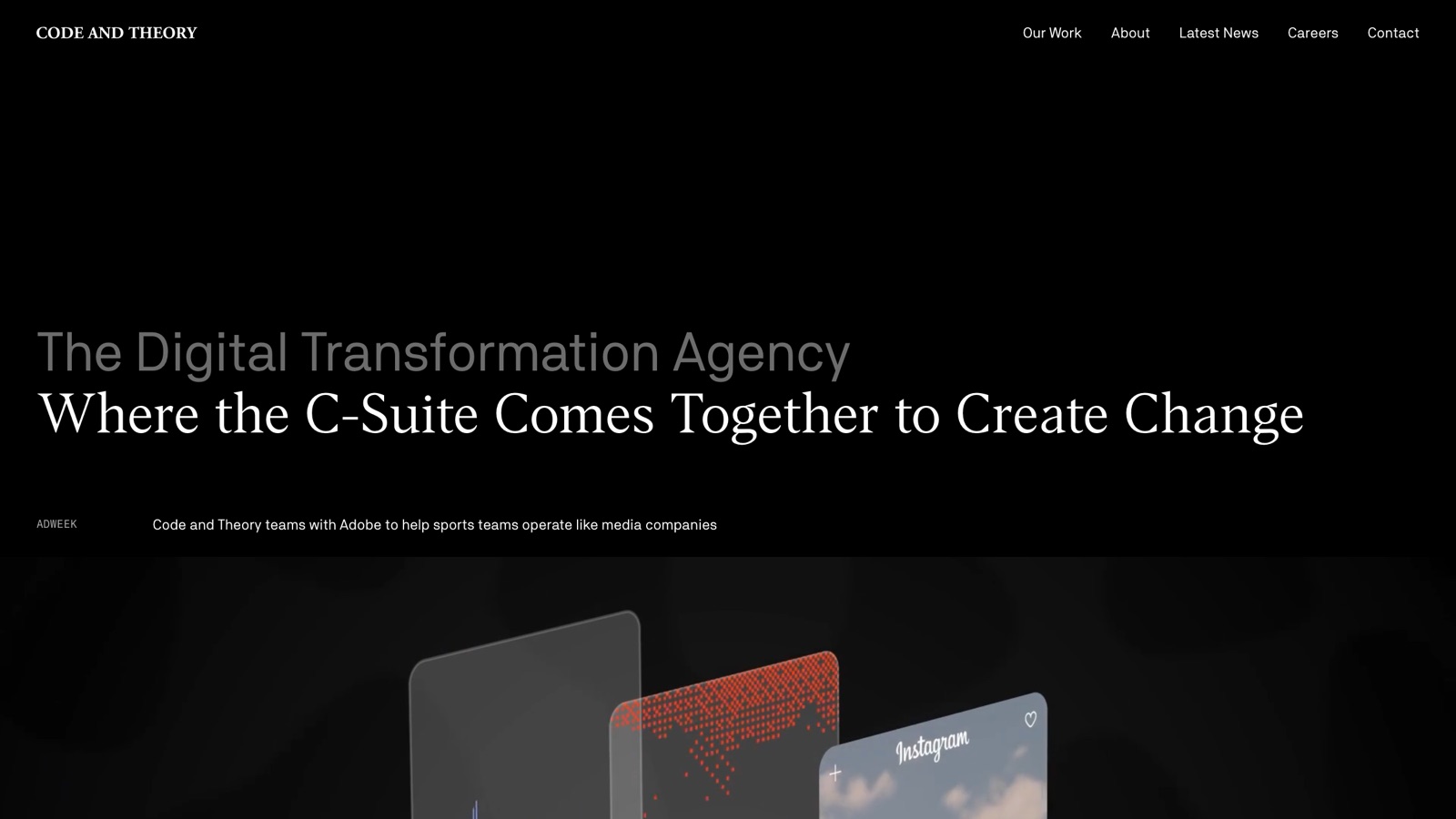
The site describes the group as 50% creativity and 50% engineering, and the client list reads accordingly: asset management firms and health systems next to the NFL and Manchester City. What you cannot guess from the name is that Code and Theory is the parent of a network, and its own structured data names Instrument, Left Field Labs, Kettle, Mediacurrent, Rhythm and Truelogic Software as sub-organisations under it, with Stagwell above all of them.
- Best for: enterprise replatforming, design systems and content operations where the engineering load is as heavy as the creative one
- Clients they name: Amazon Ads, Microsoft, Qualcomm, JPMorganChase, T. Rowe Price, TIAA, Apollo Global Management, NFL, MLB.TV, Manchester City, USTA, NBC, Marriott, Cartier, YETI, The Home Depot, Polestar, Volvo Trucks, Pfizer, Thomson Reuters
- Pricing: per project, undisclosed
- Why they stand out: genuine capability in regulated and financial categories, where most design-led shops have no comparable evidence at all
- Worth knowing: the site’s own data puts headcount at 800 to 1000 across New York, Manila and Bengaluru. Delivery is frequently offshored to Manila or Bengaluru, a brief can be routed to a sibling agency in the network, and a brand spending below enterprise level will struggle to hold senior attention.
More on Code and Theory
| Best for | Enterprise replatforming and design systems |
|---|---|
| Scale | Network owned (Stagwell), 800 to 1000 |
| Where they are | New York, Manila, Bengaluru |
| Named clients | Amazon Ads, Microsoft, Qualcomm, JPMorganChase, T. Rowe Price, TIAA, Apollo Global Management, NFL, MLB.TV, Manchester City, USTA, NBC, Marriott, Cartier, YETI, The Home Depot, Polestar, Volvo Trucks, Pfizer, Thomson Reuters |
| Pricing | per project, undisclosed |
This is the most engineering-weighted firm on the list. Capabilities published include CMS replatforming, design systems, product strategy, AI-enabled transformation and data and analytics alongside integrated marketing and branding, and the branding is real rather than decorative: the case studies include rebranding an NFL team twice.
The right buyer is a large organisation with a technology problem wearing a creative costume, or the reverse. A publisher rebuilding its content stack, a bank consolidating fragmented digital properties, a sports property unifying broadcast and product identity.
The wrong buyer is anyone who wants a small senior team on the tools. At this scale the account structure exists to manage risk across hundreds of people, and that structure costs money whether or not your project needs it. Ask directly, in writing, which office staffs which discipline.
4. AREA 17
AREA 17 treats identity and the digital thing that carries it as one engagement, with studios in Brooklyn and Paris and a client list that runs from Fondation Cartier and Saint Laurent to OpenAI and ElevenLabs. The detail I find most telling is that Pentagram appears on their own client list, which is not a name you see on many rosters.
- Best for: cultural institutions, luxury houses and well funded technology companies who need brand and platform designed together
- Clients they name: Fondation Cartier, Saint Laurent, Balenciaga, Estée Lauder, Accor, OpenAI, ElevenLabs, American Express, The New York Times, Harvard University Press, Getty, Consumer Technology Association, Pentagram, International Energy Agency, National Gallery of Canada, National Academies of Sciences, Engineering, and Medicine
- Pricing: per project, undisclosed
- Why they stand out: editorial and archive-heavy work at a level of structural care that very few brand studios can carry into a CMS
- Worth knowing: every case they publish couples identity to a website or product engagement, so a standalone identity brief with no digital delivery attached is not the shape of client they take. The roster also signals enterprise scope and timelines, and no pricing appears anywhere on the site.
More on AREA 17
| Best for | Brand and digital platform designed together |
|---|---|
| Scale | Large independent |
| Where they are | New York, Paris |
| Named clients | Fondation Cartier, Saint Laurent, Balenciaga, Estée Lauder, Accor, OpenAI, ElevenLabs, American Express, The New York Times, Harvard University Press, Getty, Consumer Technology Association, Pentagram, International Energy Agency, National Gallery of Canada, National Academies of Sciences, Engineering, and Medicine |
| Pricing | per project, undisclosed |
Two offices, New York and Paris, and a portfolio built on organisations with deep archives: museums, foundations, publishers, fashion houses. The work tends to be systems that have to hold thousands of items rather than a dozen hero pages, and that is a specific and rare skill.
Typical engagements run long because the content modelling is half the job. If you arrive with a defined library, a taxonomy problem and a launch date, this is a very strong fit. If you arrive with a logo and an idea, expect a discovery phase that will feel expensive before it feels useful.
The technology half of the offer is delivered in house rather than subcontracted, which is exactly why two things belong in the first call: who maintains the platform after launch, and how much of it your own team can operate without coming back to them.
5. Metalab
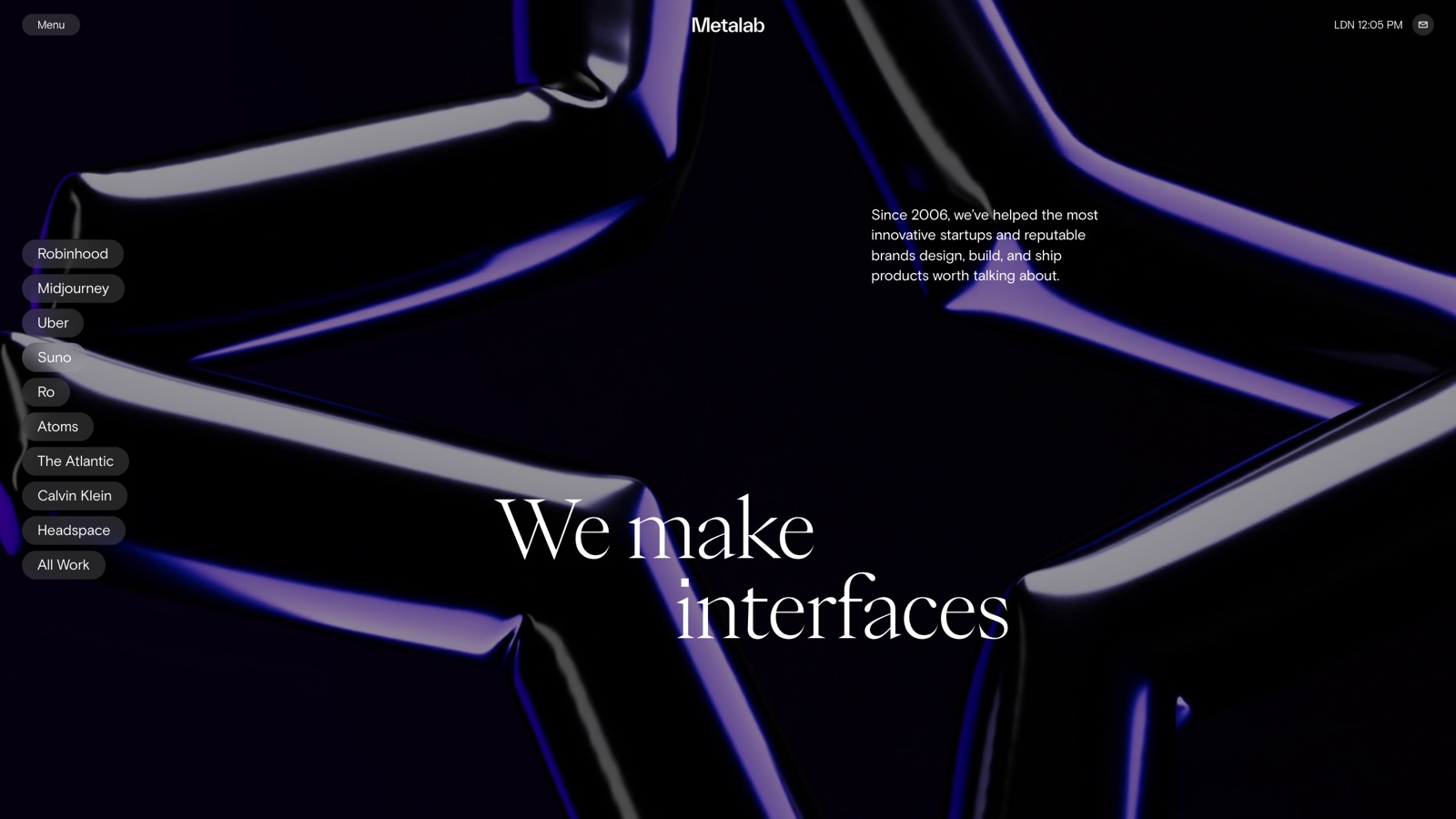
The positioning line on their own site is “We make interfaces”, and they have been doing it since 2006, which explains a client list carrying Slack, Loom, Coinbase, Midjourney, Suno and Neuralink. Two corrections before you research them: metalab.co now redirects to metalab.com, and the studio styles itself Metalab throughout its own site, so the camel-case spelling used in almost every listicle is wrong.
- Best for: software companies who need the product itself designed, from early stage through Fortune 500
- Clients they name: Midjourney, Nike, Loom, Instacart, Uber, Apple, Crusoe AI, Windsurf, Slack, Suno, Pika, Microsoft, Google, Meta, Threads, Coinbase, Robinhood, Nubank, Wealthsimple, Patreon, Webflow, Neuralink, Headspace, TED, National Geographic, Atlassian, Docusign, The Athletic, The Atlantic
- Pricing: per project, undisclosed
- Why they stand out: an unusually current AI-native client set, which means they are designing patterns for products that are only a few years old rather than restyling established ones
- Worth knowing: brand appears as a secondary capability here, reflected in open Brand Director roles rather than in a deep portfolio. A buyer who needs a full identity system, naming or print and packaging applications is shopping outside the core competence. The team is fully distributed with no client-facing studio address published anywhere, so there is no office to visit and no single timezone to plan around.
More on Metalab
| Best for | Digital product and interface design |
|---|---|
| Scale | Large independent, distributed |
| Where they are | No published offices |
| Named clients | Midjourney, Nike, Loom, Instacart, Uber, Apple, Crusoe AI, Windsurf, Slack, Suno, Pika, Microsoft, Google, Meta, Threads, Coinbase, Robinhood, Nubank, Wealthsimple, Patreon, Webflow, Neuralink, Headspace, TED, National Geographic, Atlassian, Docusign, The Athletic, The Atlantic |
| Pricing | per project, undisclosed |
Metalab is on this list because the broader definition of creative work has to include the firms building the interfaces people actually spend their day inside. For a software company, the product is a larger brand surface than any campaign will ever be.
The engagement shape is usually a defined product problem with a shipping deadline: an onboarding rebuild, a new surface, a redesign that has to survive migration. They are used to working alongside internal engineering rather than replacing it.
Do not hire them for the launch film, the packaging or the identity refresh. Metalab plus a brand studio is a common and effective pairing, and several firms lower down this list are built to be the other half of it.
6. Further
This is the studio formerly known as DesignStudio, and design.studio now redirects to further.group, so half the internet still credits their work to a name that no longer trades. The portfolio is unusually strong on live properties where the brand has to work under broadcast conditions: Wimbledon, UFC, EA Sports, HSBC SVNS, alongside the Airbnb, Deliveroo and Depop work the studio is better known for.
- Best for: consumer platforms and sports properties needing a rebrand plus the campaign and broadcast system that follows it
- Clients they name: Airbnb, Wimbledon, Eurostar, UFC, Deliveroo, Depop, Squarespace, Panasonic, EA Sports, HSBC SVNS
- Pricing: per project, undisclosed
- Why they stand out: they design for motion and broadcast from the start, so the identity survives contact with a stadium screen, a stream overlay and a phone
- Worth knowing: the rename means most of the third party evidence, awards coverage and case study writeups you will find sit under DesignStudio, which makes independent reference checking harder than it should be. The published work is also concentrated in sport and consumer platforms, so a regulated or industrial buyer will find little that resembles their own problem.
More on Further
| Best for | Consumer platform and sports rebrands with rollout |
|---|---|
| Scale | Independent |
| Where they are | London, New York, Dubai |
| Named clients | Airbnb, Wimbledon, Eurostar, UFC, Deliveroo, Depop, Squarespace, Panasonic, EA Sports, HSBC SVNS |
| Pricing | per project, undisclosed |
Three offices, London, New York and Dubai, and a body of work built on large public rebrands where the launch itself is an event. That is a specific discipline: the identity has to be defensible in the press, usable by a broadcast partner and rollable across a sponsorship estate within weeks.
The engagement usually runs as a full programme with strategy, identity and rollout in one contract, which is why it suits organisations with a fixed public moment to hit.
If you want an incremental refresh handled without drama, this is a mismatch of ambition and cost. They are set up for the version of the project that gets talked about.
7. Mother Design
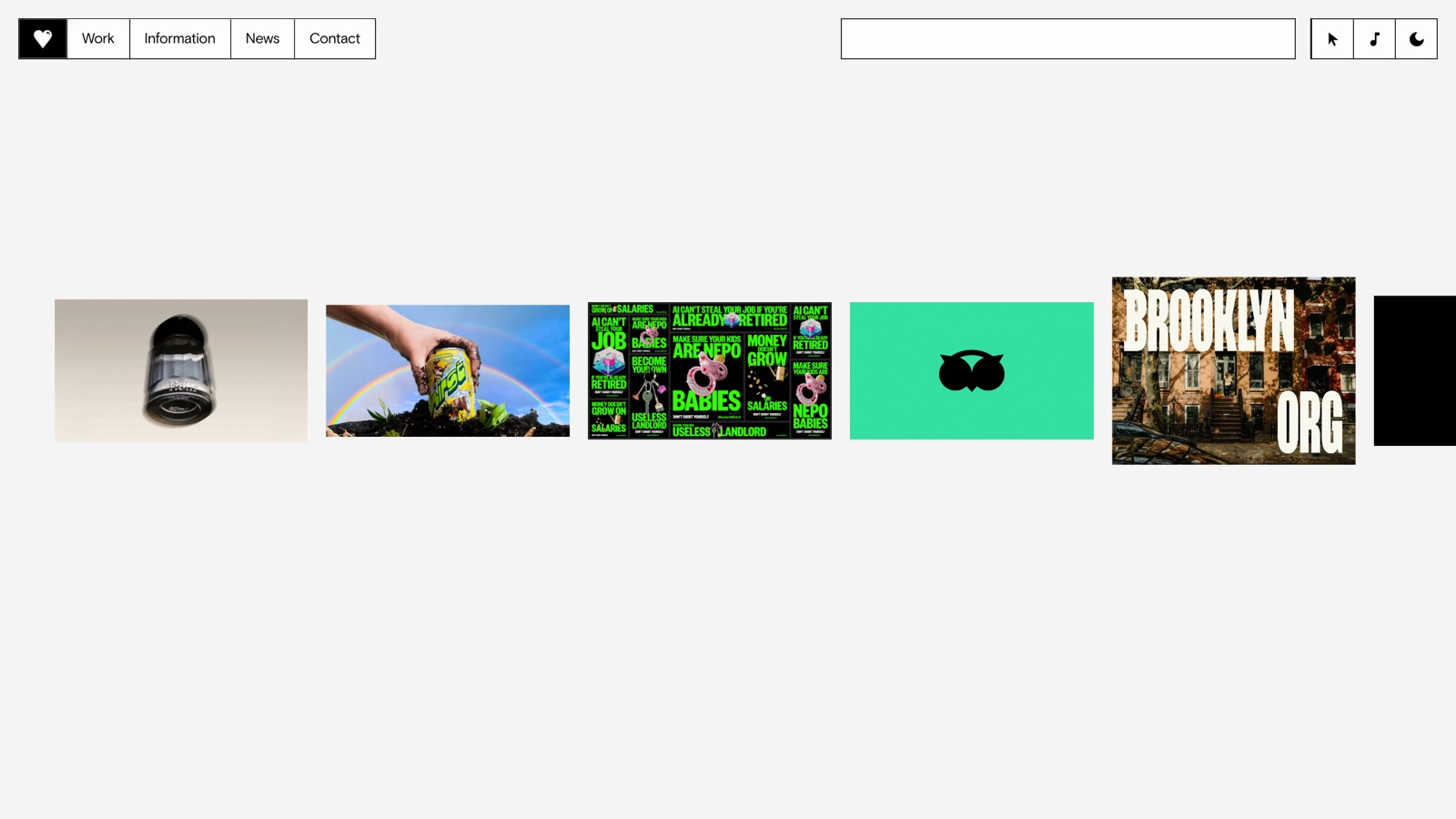
Mother Design builds complete brand worlds rather than identity documents, and the capability list includes sound design and packaging alongside campaigns and brand experience, which is what puts it in a campaign roster rather than an identity one. The information page calls the studio independent, but the footer links to Mother Family and the about copy describes the team as residing on a small island just off the coast of Mother, so it sits inside the Mother group.
- Best for: consumer and culture brands who need a full world built, from naming through packaging, sound and campaign
- Clients they name: Jägermeister, Selfridges, NBA, Hennessy, Cadillac, Facebook, Pepsi, Nike, Target, BBC, Tripadvisor, Wrangler, Zaha Hadid, Adobe, Barbican, Marriott Bonvoy, M&S, PizzaExpress, air up, Brooklyn Org
- Pricing: per project, undisclosed
- Why they stand out: verbal identity and sound are treated as first-class deliverables rather than afterthoughts, which is rare outside advertising and shows in how the brands sound in film
- Worth knowing: the published people list is heavily London weighted. Of roughly 23 named staff only around five are tagged New York and none are tagged Los Angeles, so the three office footprint oversells how much senior capacity sits outside London. A US buyer should ask by name who is on the account.
More on Mother Design
| Best for | Full brand worlds with sound and campaign |
|---|---|
| Scale | Independent studio in the Mother group |
| Where they are | London, New York, Los Angeles |
| Named clients | Jägermeister, Selfridges, NBA, Hennessy, Cadillac, Facebook, Pepsi, Nike, Target, BBC, Tripadvisor, Wrangler, Zaha Hadid, Adobe, Barbican, Marriott Bonvoy, M&S, PizzaExpress, air up, Brooklyn Org |
| Pricing | per project, undisclosed |
The lineage matters. Sitting alongside an advertising network gives Mother Design a campaign instinct most design studios do not have, and it shows in work that assumes a media plan exists rather than stopping at a guidelines PDF.
Typical engagements are full brand builds for consumer businesses at a moment of change: a relaunch, a category move, an expansion into a new market. Strategy, architecture, naming and identity in one programme, then the campaign expression that carries it.
Less suited to enterprise or B2B work, where the published evidence thins out considerably, and to organisations that want a neutral system rather than a point of view.
8. Studio Dumbar
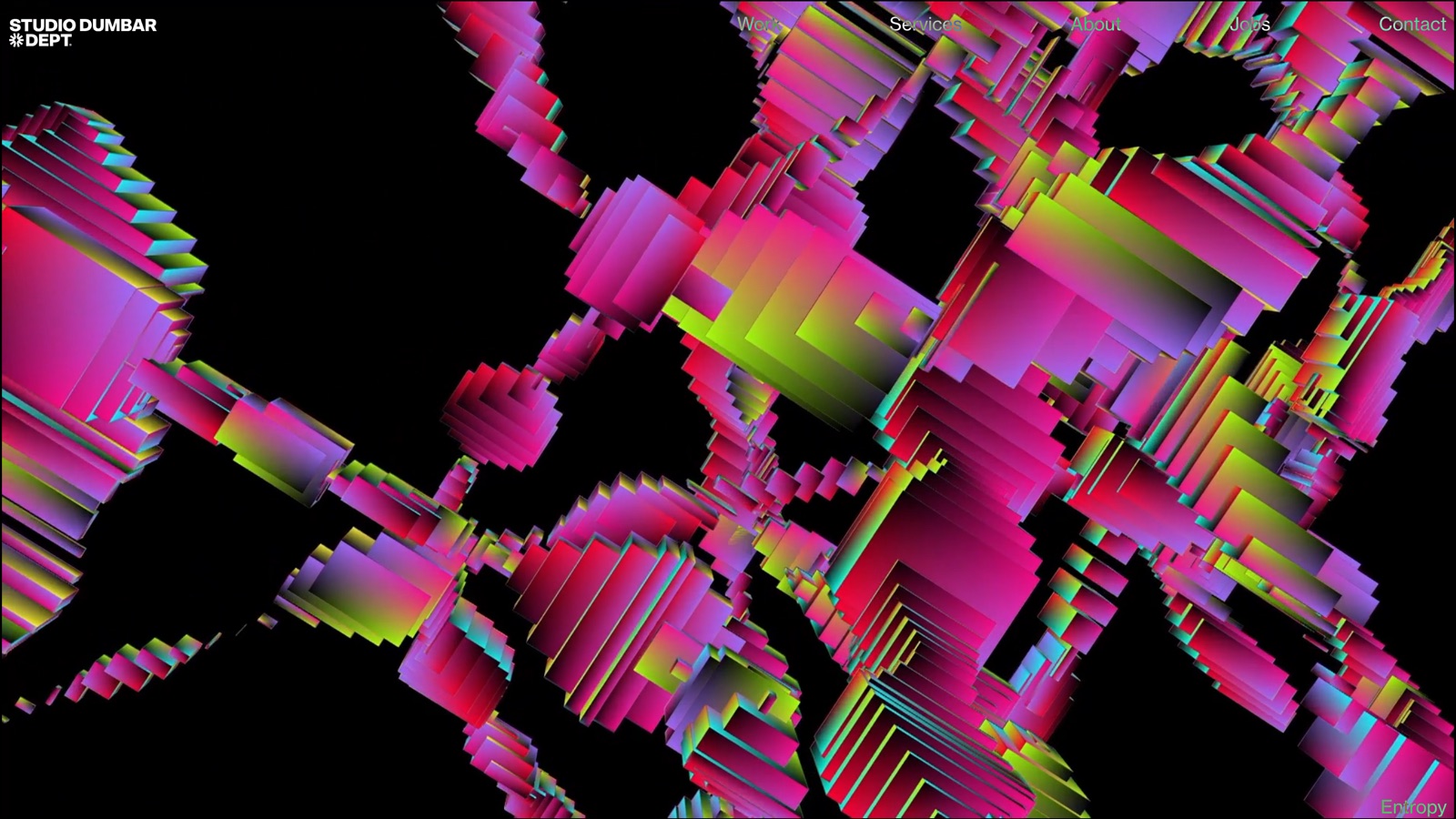
Motion is not a deliverable at Studio Dumbar, it is the medium the identity is designed in, with in-house motion, sound and creative coding capability and a client list running from OpenAI and Spotify to the Dutch national police and Feyenoord. The mix of technology platforms, sports clubs, museums and public institutions in a single portfolio is unusual and tells you something about how transferable their system thinking is.
- Best for: organisations who want an identity that exists primarily in motion, screens and sound
- Clients they name: OpenAI, Apple, Google, Meta, Instagram, Spotify, adidas, Comedy Central, MTV VMAs, Riot Games MSI, Utah Jazz, Feyenoord, Club Brugge, Transavia, PostNL, NS Dutch Railways, OutSystems, AVROTROS, Van Gogh Museum, Mauritshuis, NEMO Science Museum, Dutch national police, D&AD Creative Festival
- Pricing: per project, undisclosed
- Why they stand out: creative coding is in house, so generative and responsive identity systems get built and tested rather than storyboarded and hoped for
- Worth knowing: the studio is owned by Dept and its own about page states it is part of a company of 4,000 plus specialists across 30 plus locations, despite reading like an independent. The Rotterdam team is roughly 35 to 40 people, so heavy multi-market rollout or always-on production means leaning on the wider Dept organisation, which changes who does the work.
More on Studio Dumbar
| Best for | Motion-native identity and creative coding |
|---|---|
| Scale | Owned by Dept, 35 to 40 in studio |
| Where they are | Rotterdam |
| Named clients | OpenAI, Apple, Google, Meta, Instagram, Spotify, adidas, Comedy Central, MTV VMAs, Riot Games MSI, Utah Jazz, Feyenoord, Club Brugge, Transavia, PostNL, NS Dutch Railways, OutSystems, AVROTROS, Van Gogh Museum, Mauritshuis, NEMO Science Museum, Dutch national police, D&AD Creative Festival |
| Pricing | per project, undisclosed |
There is a recognisable Studio Dumbar look, kinetic, high contrast, typographically confident, and you are buying it deliberately. That is a feature if you want the brand to feel designed and a problem if you want a neutral execution partner who disappears behind your existing house style.
The single Rotterdam office keeps the work coherent and caps the throughput. Engagements are usually a defined identity programme with a motion system at the centre, delivered over months rather than continuously.
Anyone needing sustained weekly output after launch should pair them with an in-house or embedded team, because the rollout volume is where this shape of studio runs out of hours.
9. Ramotion
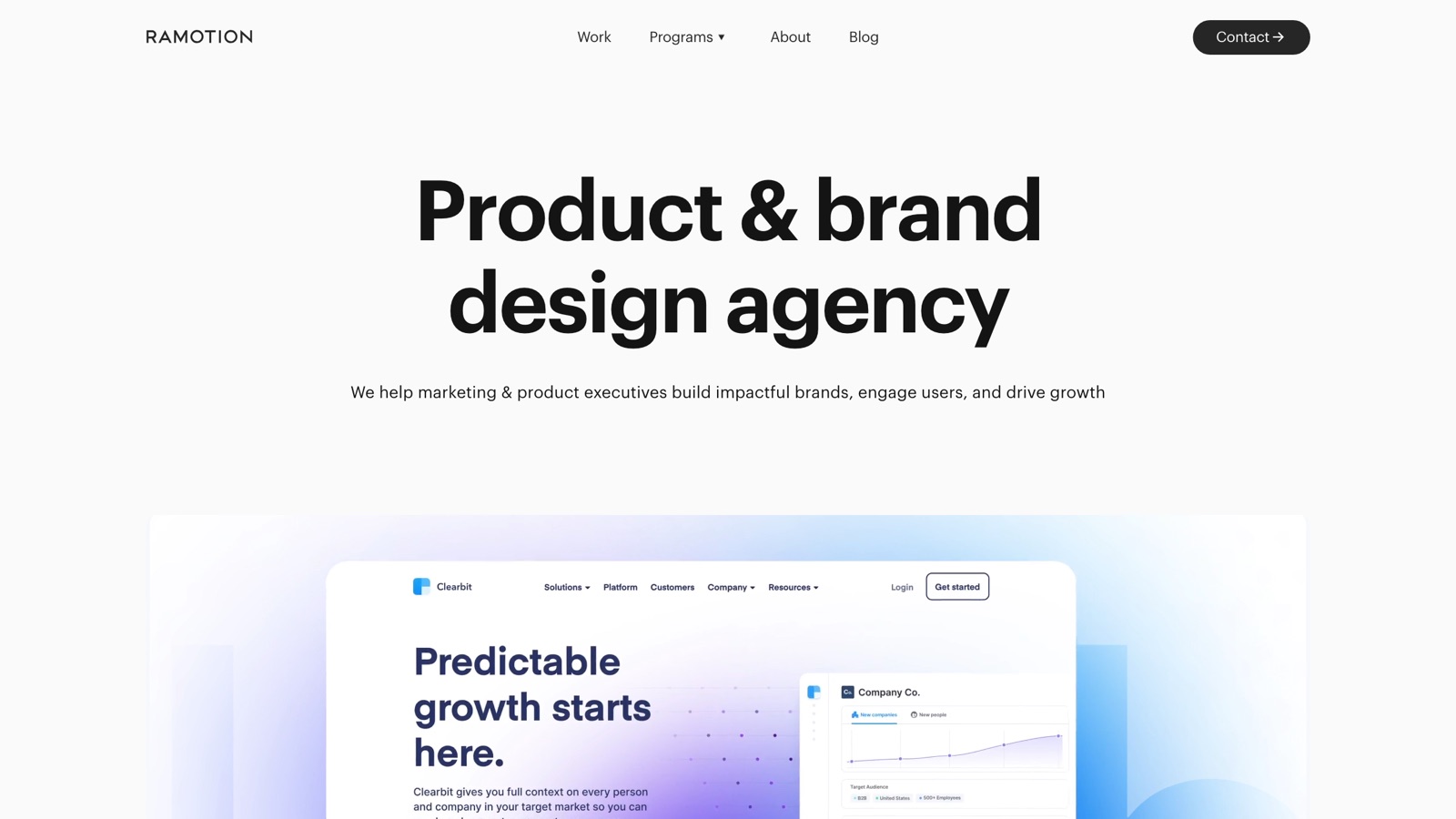
Ramotion sits in the narrow band between product design and brand design, working across identity, interface and marketing site for technology companies, with Netflix, Stripe, Adobe, Salesforce, Okta and Mozilla Firefox on the client list. The useful thing about that combination is that the same team designs the logo, the product UI and the page that sells it, which removes the usual argument about whose system wins.
- Best for: funded technology companies who need brand and product design from one team
- Clients they name: Netflix, Stripe, Adobe, Salesforce, Okta, Mozilla Firefox, NBCUniversal, Crunchbase, Xero, Descript
- Pricing: per project, undisclosed
- Why they stand out: identity work that is designed against real interface constraints, so the mark still functions at the size of an icon in a product nav
- Worth knowing: the published work is almost entirely software and technology. There is no packaging, retail environment or broadcast campaign evidence to judge, so a consumer goods or hospitality buyer has nothing comparable to assess and should treat any pitch outside software as unproven.
More on Ramotion
| Best for | Brand and product design for technology companies |
|---|---|
| Scale | Independent studio |
| Where they are | San Francisco, Los Angeles, New York |
| Named clients | Netflix, Stripe, Adobe, Salesforce, Okta, Mozilla Firefox, NBCUniversal, Crunchbase, Xero, Descript |
| Pricing | per project, undisclosed |
Offices in San Francisco, Los Angeles and New York, and a practice organised around technology categories rather than industries in general. That focus is the reason the work is consistent and also the reason the range is narrow.
Engagements tend to be defined and scoped: a rebrand, a design system, a marketing site rebuild, sometimes all three in sequence. They are comfortable working with internal product teams and handing over documented systems.
The buyer who does best here already has a product and needs the brand to catch up with it. The buyer who does worst is looking for a strategic point of view about what the company should stand for, which is a different purchase entirely.
10. DIA
Two things have changed about DIA that most directories have not caught up with. The old dia.tv address now redirects to dia.studio, and the about page states the studio is based in the French Alps, originally founded in 2009 in SoHo, so any listing calling it a New York studio is out of date. The work itself is kinetic identity, custom type and generative tooling, with an index that splits into Identity, Tools, Type, Experiential, Campaigns and Film.
- Best for: brands who need a motion and typographic system precise enough to run as a generative tool
- Clients they name: Coinbase, Mailchimp, Squarespace, Pinterest, Nike, Adidas, Johnnie Walker, IBM, Spotify, SSENSE, Maison Kitsuné, MoMA, Roblox, Verizon, Nissan, YouTube, SPACE10, MIT
- Pricing: per project, undisclosed
- Why they stand out: they build the tool as part of the deliverable, so the system keeps producing after the engagement ends instead of decaying into a PDF nobody opens
- Worth knowing: the about page names only two partners, Meg Donohoe and Mitch Paone, and publishes no wider team, so real delivery capacity is opaque and a large multi-market rollout would likely draw on freelancers. The base has moved from New York to Chamonix, which matters if you assumed US-hours coverage, and the offer is deliberately narrow, so it works best alongside a strategy partner rather than instead of one.
More on DIA
| Best for | Kinetic identity, custom type and generative tools |
|---|---|
| Scale | Small studio, two partners |
| Where they are | Chamonix, New York |
| Named clients | Coinbase, Mailchimp, Squarespace, Pinterest, Nike, Adidas, Johnnie Walker, IBM, Spotify, SSENSE, Maison Kitsuné, MoMA, Roblox, Verizon, Nissan, YouTube, SPACE10, MIT |
| Pricing | per project, undisclosed |
DIA is the most specialised studio in the top half of this list. Motion-native identity and custom typeface design, with an education and research strand that is visible in the work: creative director Mitch Paone teaches at ECAL, ZHdK, HEAD Genève and KABK, and the studio is a member of AGI.
The right engagement is a system with a technical core. A kinetic wordmark that has to behave consistently across a thousand outputs, a variable typeface that carries the brand’s personality, a generative tool an internal team can operate.
The wrong engagement is a full brand programme with positioning, architecture, packaging and campaign attached, or a project needing dozens of hands. Scope tightly and pair them with someone who covers the rest.
11. &Walsh
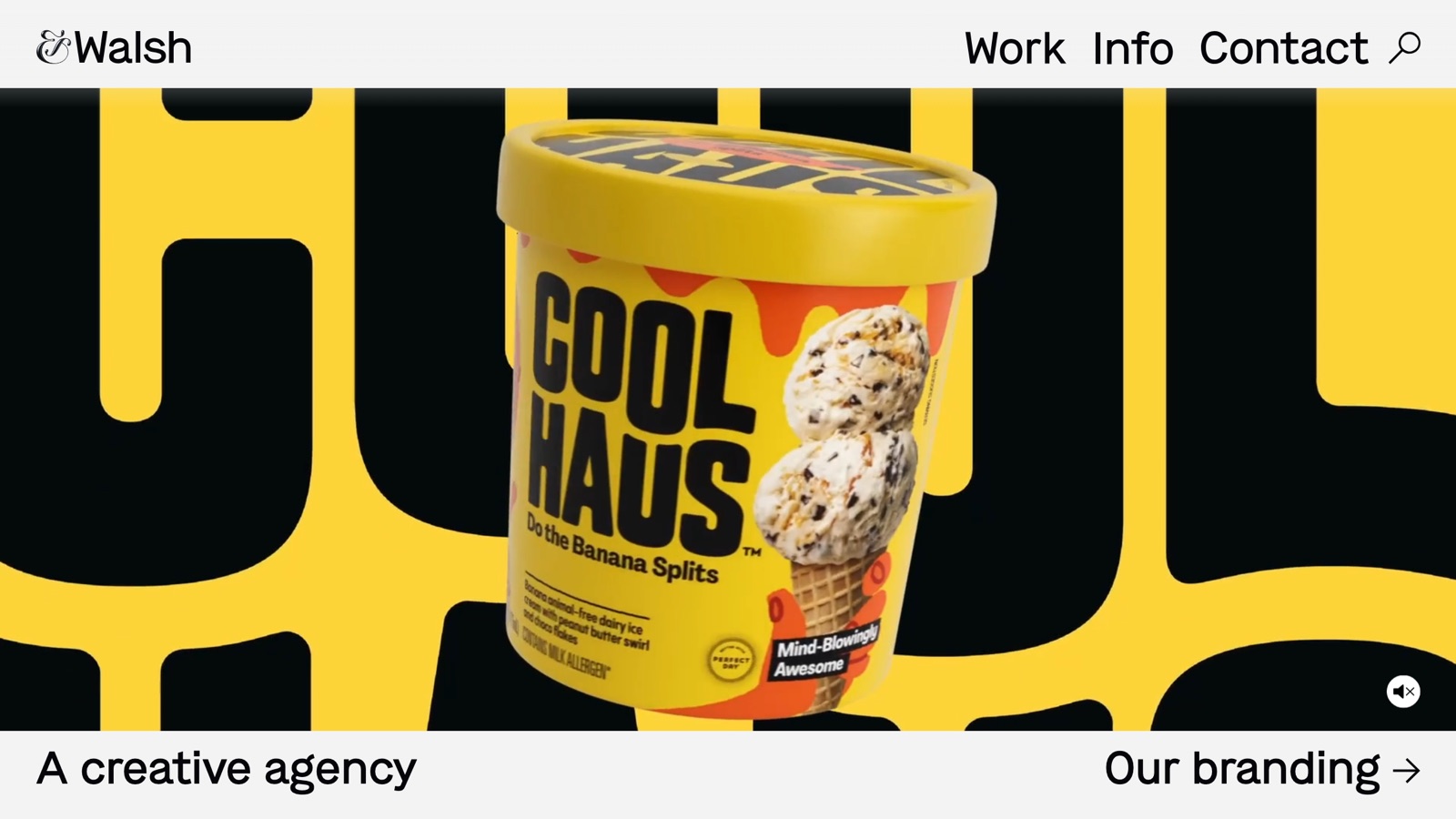
&Walsh is one of very few New York studios where the creative signature is the product being sold, and the work reflects it: art direction, photography and campaign expression that is closer to editorial than to corporate design. Bombas, Plenty, Pet Plate, Geltor and Parle Agro sit alongside the Google I/O 2023 identity, which is a wider range than the studio’s reputation for maximalist consumer work suggests.
- Best for: consumer brands who want an expressive, image-led campaign identity with strong art direction
- Clients they name: Bombas, Google I/O 2023, Plenty, Pet Plate, Geltor, Parle Agro
- Pricing: per project, undisclosed
- Why they stand out: photography and art direction are handled as core creative rather than sourced afterwards, so the campaign imagery is designed rather than licensed
- Worth knowing: the published client list is short and consumer-weighted, so a B2B, enterprise or regulated buyer has very little comparable proof to assess. The output also carries a strong founder-led aesthetic, so a conservative organisation that needs a restrained, neutral system will spend the whole engagement pulling against the studio’s instincts.
More on &Walsh
| Best for | Expressive consumer campaign identity and art direction |
|---|---|
| Scale | Independent studio |
| Where they are | New York |
| Named clients | Bombas, Google I/O 2023, Plenty, Pet Plate, Geltor, Parle Agro |
| Pricing | per project, undisclosed |
A single New York studio, founder-led, with a public profile that brings in a particular kind of client: consumer brands who want to be looked at. The work is loud in the good sense, built for attention in a feed rather than for quiet coherence across an enterprise estate.
Engagements are typically brand identity plus campaign expression for a launch or a relaunch, and the studio is comfortable owning the imagery as well as the design.
Availability and fit are the real qualifiers. Ask early whether the founder is directly involved in your project, because the answer shapes what you are actually buying.
12. Wolff Olins
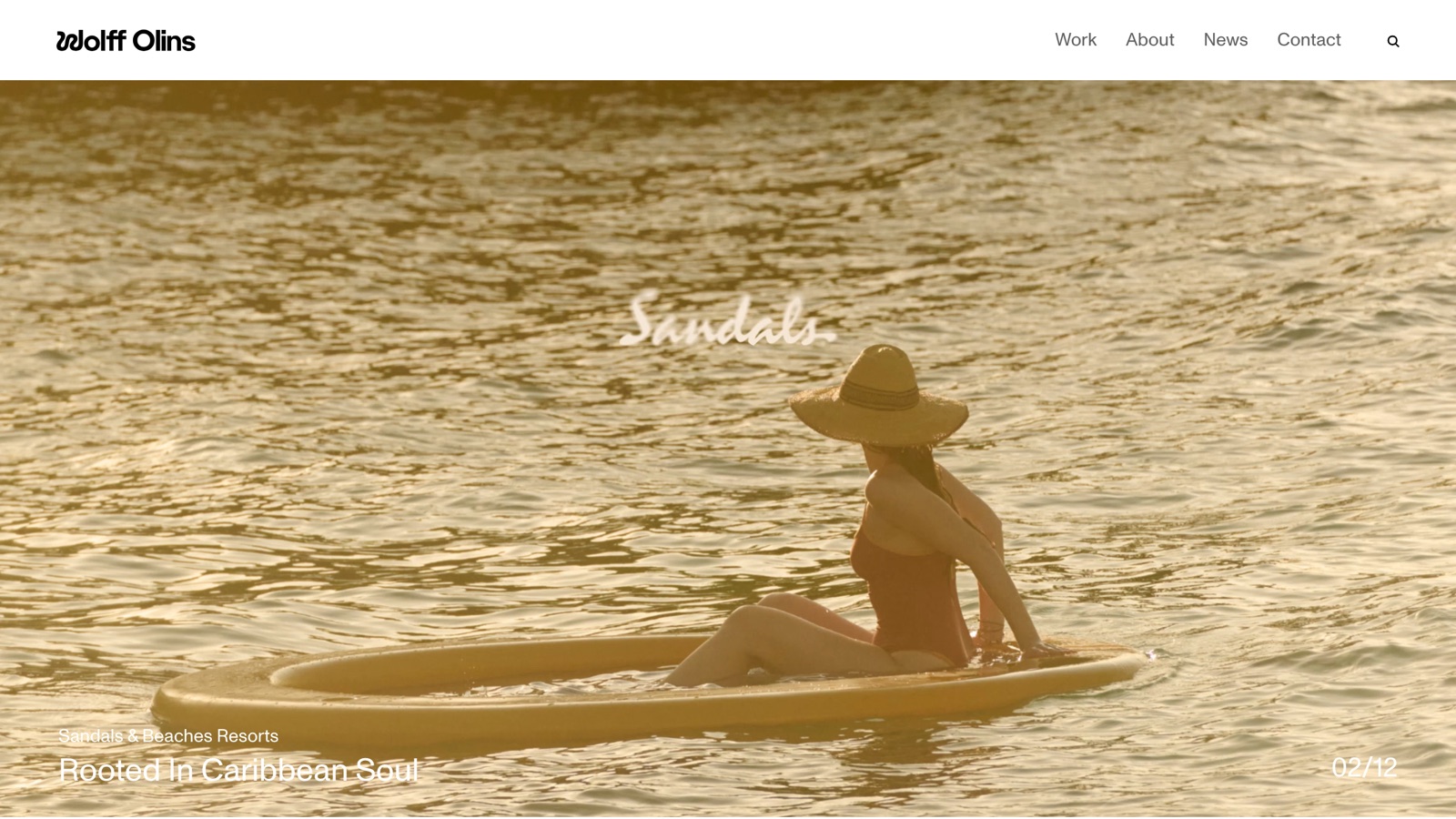
Wolff Olins takes on the version of the brief where the brand change is meant to signal a change in the organisation itself, which is why the client list runs from TikTok and Uber to McKinsey, GSK and The Met. The work is as much about giving leadership something to rally an organisation around as it is about the visual system, and the identities are usually launched as public statements.
- Best for: organisations making a strategic shift that needs to be legible to the market on day one
- Clients they name: TikTok, Uber, Instacart, Decathlon, Patreon, LG, GSK, McKinsey, The Economist, Kenvue, Mercedes-AMG Petronas F1, The Met
- Pricing: per project, undisclosed
- Why they stand out: they are comfortable in the room where the brand decision is actually a business decision, and the work is built to survive that level of scrutiny
- Worth knowing: the published work is dominated by wholesale repositioning at the largest scale, which means long stakeholder phases and a process built to carry a board rather than a founder. If your project is an evolution rather than a reset, you will be paying for a machine designed for a much bigger problem.
More on Wolff Olins
| Best for | Repositioning at organisation-changing scale |
|---|---|
| Scale | Large brand consultancy |
| Where they are | Not published in this check |
| Named clients | TikTok, Uber, Instacart, Decathlon, Patreon, LG, GSK, McKinsey, The Economist, Kenvue, Mercedes-AMG Petronas F1, The Met |
| Pricing | per project, undisclosed |
Very few firms get invited to rebrand a company at the moment it splits, merges or redefines its category. Wolff Olins is one of them, and the client list is evidence of that specific trust rather than of design range.
Engagements run in phases, with a heavy strategic front end, and the visual system arrives later than a design-led studio would deliver it. That sequencing is deliberate and is the reason the outcomes hold up internally.
Not the right partner for packaging, retail environments or continuous campaign output, and not the right partner if the decision maker cannot commit the time the process demands.
13. Moving Brands
Moving Brands works across brand, product, digital and campaign for technology-led and institutional organisations, and the client list mixes household names with a current crop of B2B software companies: Vanta, Asana, Gong, Eppo, Rula, Spring Health, Globalization Partners. That second group is the more informative one, because it shows what the studio is being hired for now rather than what made its reputation.
- Best for: technology and institutional brands needing identity extended into product and campaign by one team
- Clients they name: Google, Netflix, BBC, Facebook, Apple, Microsoft, United Nations, Hewlett Packard, AliPay, NYU Langone Health, Vanta, Asana, Rula, Metropolis, Nebula, Eppo, Globalization Partners, Mercedes-Benz, Stella McCartney, Virgin, Swisscom, Khan Academy, TikTok for Business, Cruise, Gong, Spring Health
- Pricing: per project, undisclosed
- Why they stand out: an early and consistent record of designing brands as systems in motion, long before that became standard practice
- Worth knowing: the site publishes no studio cities, no headcount and no engagement sizes, and the contact page routes everything through two regions only. The logo wall also mixes current work with identity projects well over a decade old, so from the site alone you cannot tell which team would staff your project or whether the famous work reflects who is there today. Ask for recent case studies with named leads.
More on Moving Brands
| Best for | Technology brands extended into product and campaign |
|---|---|
| Scale | Large independent |
| Where they are | Not published, two regions |
| Named clients | Google, Netflix, BBC, Facebook, Apple, Microsoft, United Nations, Hewlett Packard, AliPay, NYU Langone Health, Vanta, Asana, Rula, Metropolis, Nebula, Eppo, Globalization Partners, Mercedes-Benz, Stella McCartney, Virgin, Swisscom, Khan Academy, TikTok for Business, Cruise, Gong, Spring Health |
| Pricing | per project, undisclosed |
The gap between reputation and current evidence is the thing to resolve in your first two calls. The historic work is significant, and the recent B2B software roster suggests a practice that has adapted rather than coasted, but the site does not connect the two.
Engagements appear to run as identity programmes extended into digital and campaign, which suits a company at a funding or repositioning milestone that needs everything moving at once.
Because there is no published footprint, timezone coverage and team composition are contract questions rather than research questions. Get both in writing.
14. Turner Duckworth
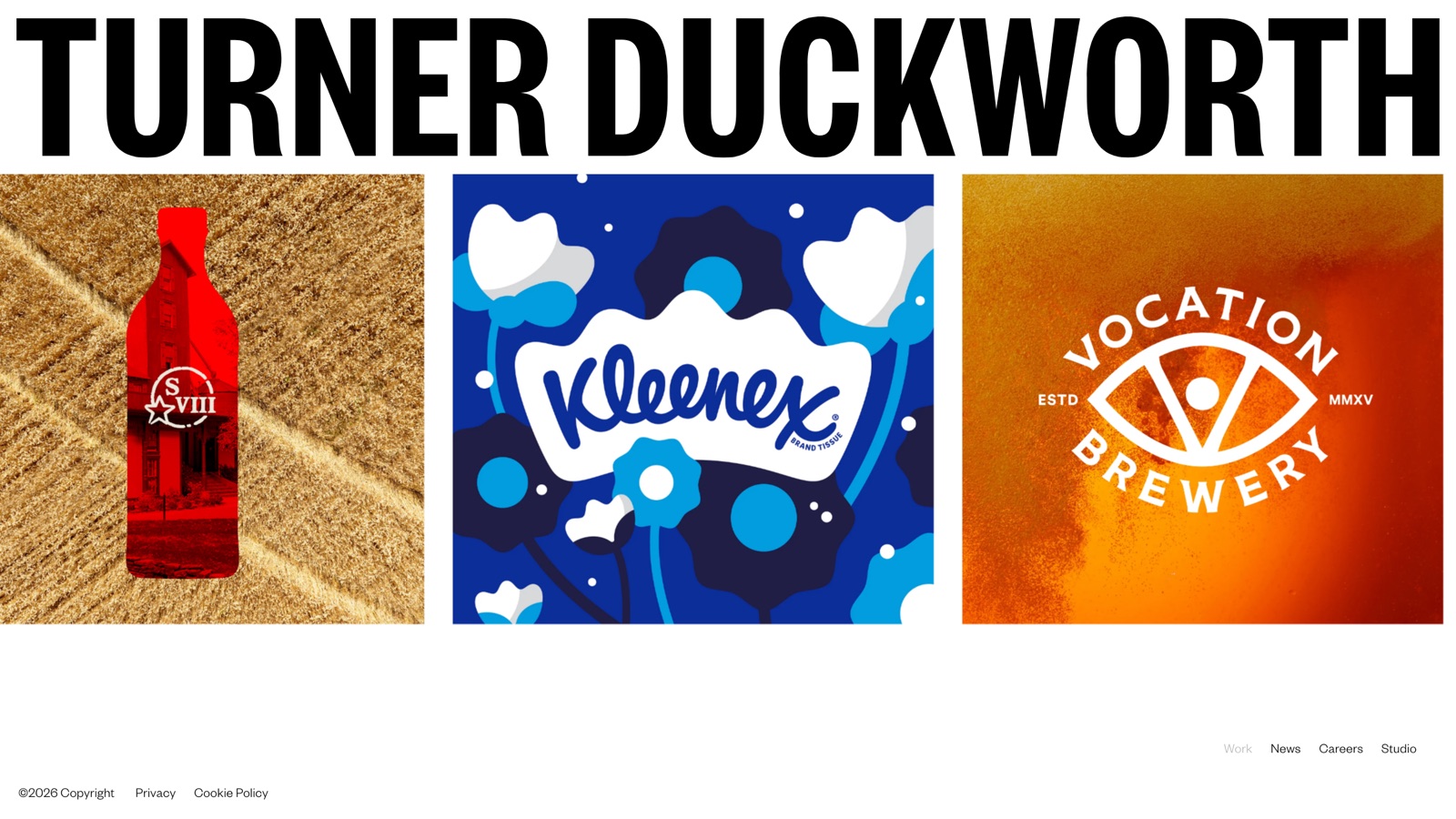
Turner Duckworth’s real product is the asset system that lets a very large consumer brand behave consistently in every channel and market, which is a different job from designing a logo and is why they belong in a campaign roster. The work for Coca-Cola, McDonald’s and Sprite is the clearest published evidence of it, alongside Amazon, Levi’s, Samsung, Metallica and a deep bench in food, drink and quick service restaurants.
- Best for: large consumer brands who need channel-level asset systems and packaging that hold across markets
- Clients they name: Coca-Cola, McDonald’s, Sprite, Amazon, Levi’s, Samsung, Metallica, Campbell’s, Kleenex, Subway, Little Caesars, Jim Beam, Newman’s Own, Blue Diamond, Icelandic Provisions, Crumbl, Vocation Brewery, Star Hill Farm Whisky, Khloud
- Pricing: per project, undisclosed
- Why they stand out: they design the distinctive assets that do the recognition work, so the brand still reads when the logo is cropped out of frame
- Worth knowing: the site presents an independent design studio and never mentions that Publicis Groupe acquired the firm in September 2014 and aligned it with the Leo Burnett network, where it was still listed inside Publicis Groupe UK as recently as 2024. Ask about ownership, network conflicts and who staffs your project before signing anything.
More on Turner Duckworth
| Best for | Channel-level asset systems and packaging |
|---|---|
| Scale | Owned by Publicis Groupe since 2014 |
| Where they are | Not published in this check |
| Named clients | Coca-Cola, McDonald's, Sprite, Amazon, Levi's, Samsung, Metallica, Campbell's, Kleenex, Subway, Little Caesars, Jim Beam, Newman's Own, Blue Diamond, Icelandic Provisions, Crumbl, Vocation Brewery, Star Hill Farm Whisky, Khloud |
| Pricing | per project, undisclosed |
The specialism is distinctive asset systems for brands with enormous distribution, where a small change in the shelf or the screen has measurable consequences. That is a high-stakes, slow-moving discipline and the firm is one of a handful trusted with it.
Engagements are typically identity, packaging and asset architecture for a brand already at scale, with long approval chains on the client side.
A smaller brand will find both the process and the commercial minimums built for someone else. The undisclosed holding company ownership is not a reason to walk away, but it is a reason to ask three specific questions before you do.
15. Pentagram
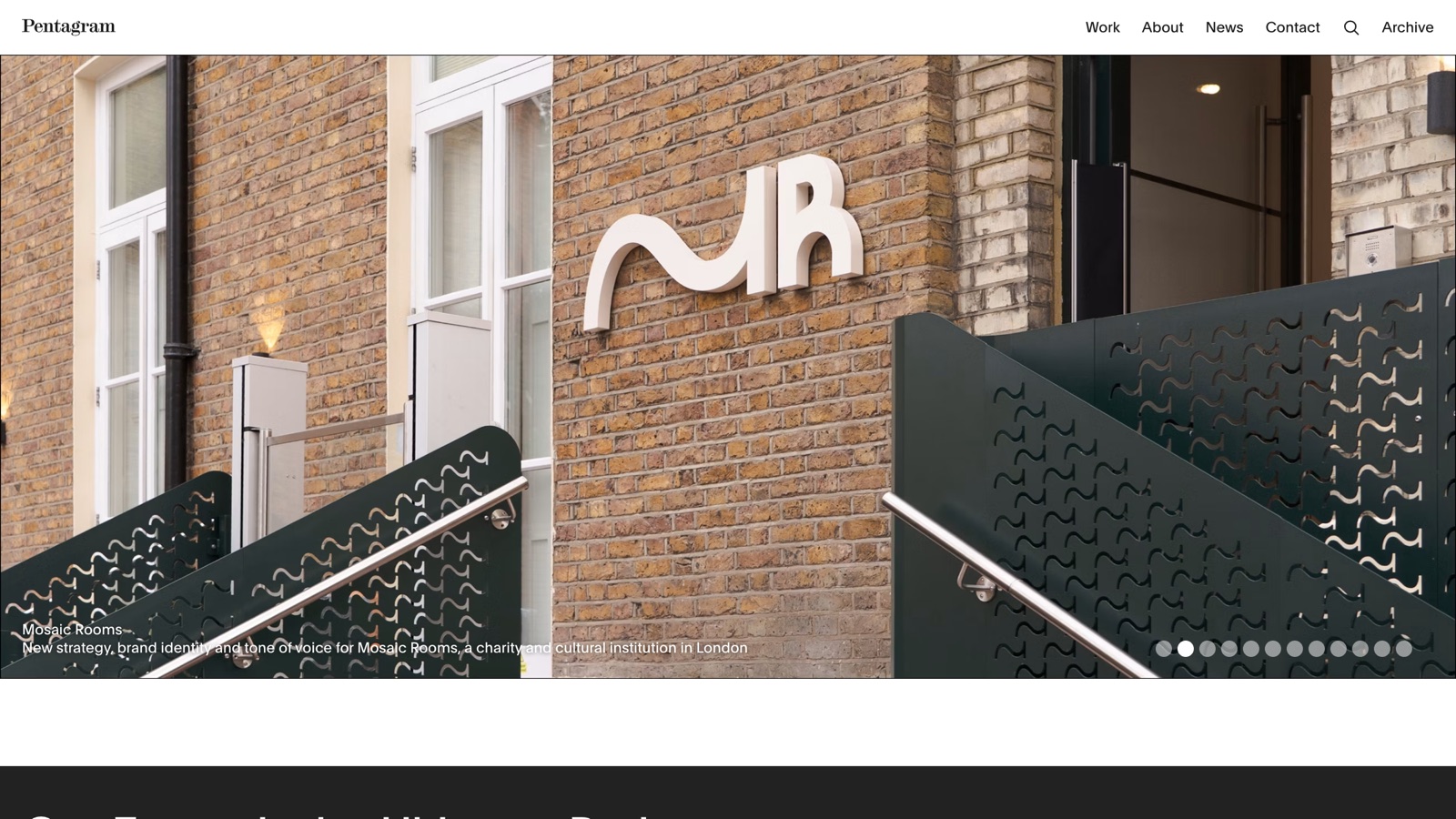
Pentagram is 23 partners who each run their own team and own their own client relationships under a shared roof, which is why the output ranges from the Obama Presidential Center to Poetry Magazine without a house style connecting them. You are not hiring Pentagram, you are hiring one partner, and picking the right one is most of the work.
- Best for: projects where you want a specific named designer’s point of view, across identity, environment, editorial and campaign
- Clients they name: Obama Presidential Center, Mozilla Foundation, St Paul’s Cathedral, Folger Shakespeare Library, Green-Wood Cemetery, Poetry Magazine
- Pricing: per project, undisclosed
- Why they stand out: partner ownership means the person whose work convinced you is the person doing your project, which is close to unique at this level of reputation
- Worth knowing: the same structure means availability rather than fee is usually the blocker, because a partner with a full slate cannot simply be reassigned. Two projects from two partners can also feel like they came from different firms, so consistency across a long programme depends entirely on staying with one team.
More on Pentagram
| Best for | Named partner authorship across many disciplines |
|---|---|
| Scale | Partnership, 23 partners |
| Where they are | London, New York, Austin, Berlin |
| Named clients | Obama Presidential Center, Mozilla Foundation, St Paul's Cathedral, Folger Shakespeare Library, Green-Wood Cemetery, Poetry Magazine |
| Pricing | per project, undisclosed |
Offices in London, New York, Austin and Berlin, with partners distributed across them. The practical research step is to look at the partner pages rather than the studio page, decide whose work matches your problem, and approach that team by name.
Engagement shapes vary as much as the work does, from a single identity to multi-year institutional programmes covering wayfinding, publishing and exhibitions.
The model does not suit continuous high-volume output or anything needing a large mixed team on standby. It suits a defined project where design authorship is the value you are paying for.
Every studio in one table
| Studio | Best for | Scale | Where they are |
|---|---|---|---|
| Moonb | Continuous video, motion and design for one marketing team | Embedded creative team | Remote |
| Instrument | Campaign plus digital build as one programme | Network owned (Stagwell), 350+ | Portland, New York, remote |
| Code and Theory | Enterprise replatforming and design systems | Network owned (Stagwell), 800 to 1000 | New York, Manila, Bengaluru |
| AREA 17 | Brand and digital platform designed together | Large independent | New York, Paris |
| Metalab | Digital product and interface design | Large independent, distributed | No published offices |
| Further | Consumer platform and sports rebrands with rollout | Independent | London, New York, Dubai |
| Mother Design | Full brand worlds with sound and campaign | Independent studio in the Mother group | London, New York, Los Angeles |
| Studio Dumbar | Motion-native identity and creative coding | Owned by Dept, 35 to 40 in studio | Rotterdam |
| Ramotion | Brand and product design for technology companies | Independent studio | San Francisco, Los Angeles, New York |
| DIA | Kinetic identity, custom type and generative tools | Small studio, two partners | Chamonix, New York |
| &Walsh | Expressive consumer campaign identity and art direction | Independent studio | New York |
| Wolff Olins | Repositioning at organisation-changing scale | Large brand consultancy | Not published in this check |
| Moving Brands | Technology brands extended into product and campaign | Large independent | Not published, two regions |
| Turner Duckworth | Channel-level asset systems and packaging | Owned by Publicis Groupe since 2014 | Not published in this check |
| Pentagram | Named partner authorship across many disciplines | Partnership, 23 partners | London, New York, Austin, Berlin |
How I would recommend choosing
Start by writing down the thing that has to exist on a specific date, and be brutally literal about it. If the work is really brand-building rather than campaigns, the best branding agencies list is the sharper tool. A film with a media plan behind it is a different purchase from a set of brand rules, which is a different purchase again from a working website with a content model underneath it. I have watched more projects go wrong from a fuzzy deliverable than from a bad agency, because a fuzzy deliverable lets both sides believe they agreed on something for about six weeks before anyone finds out they did not.
Then work out what happens the day after that thing exists. Most of the firms on this list produce a launch and then leave, which is correct and normal, but the volume of work that follows a launch is usually larger than the launch itself and almost nobody plans for it. If your organisation has an internal team that can carry it, hire the best possible specialist for the peak. If it does not, you are choosing between hiring, retaining a partner for ongoing output, or watching an expensive new system decay over two quarters into whatever people can make in a template.
For the shortlist itself, I would take three firms from different tiers rather than three that resemble each other, because the comparison teaches you more about your own brief than any internal workshop will. Put one network-scale option in there for coverage, one large independent for range, and one small principal-led studio for the version where you get the best individual designer available and accept the constraints that come with them. Ask each of them the same two questions: who is on my account in month four, and what have you delivered in the last twelve months that most resembles my problem. The answers separate the field faster than any portfolio review.
Two practical checks before you sign anything. Confirm ownership yourself rather than trusting the site, because several firms here read as independent and are not, and network ownership brings conflict rules, staffing pools and minimums that will affect you. Then ask which office or country actually performs each discipline, in writing, because offshored delivery is common at scale and is only a problem when it arrives as a surprise in month two.
Finally, take the reference calls seriously and ask for a client whose project went badly rather than one who loves them. Any firm on this list can produce a delighted reference. The useful conversation is the one where a marketing lead explains what got difficult, how the agency behaved when it did, and whether they would hire them again knowing that. Nothing on a website tells you what you learn in those fifteen minutes.
Frequently asked questions
A branding agency's core product is an identity system: positioning, naming, a mark, typography and rules. A creative agency sells a wider set of outputs, including campaigns, film, digital product and ongoing content. Many firms do both, but almost all lean one way. Check what they actually publish. If nine out of ten case studies end with a guidelines document, that is a branding shop regardless of what the homepage says.
Do not rely on the agency's own site, because several disclose nothing. Check the structured data in the page source, which sometimes names a parent organisation, then search for acquisition news by the agency name plus Publicis, WPP, Omnicom, Stagwell or Dept. Ownership matters because it brings conflict rules, shared staffing pools, account minimums and the possibility that your brief is routed to a sister company.
One partner is simpler when the brand and the digital build are the same problem, which is common for technology companies where the product carries the identity. Two specialists usually produce better work when the disciplines are far apart, for example an identity studio plus a production partner for ongoing output. The deciding factor is whether you have someone internally with the time and authority to manage the seam between them.