20 Best Branding Agencies in 2026
Twenty branding partners compared on named clients, real ownership and one limitation each, from Pentagram and Landor down to a 19 person Brooklyn studio.

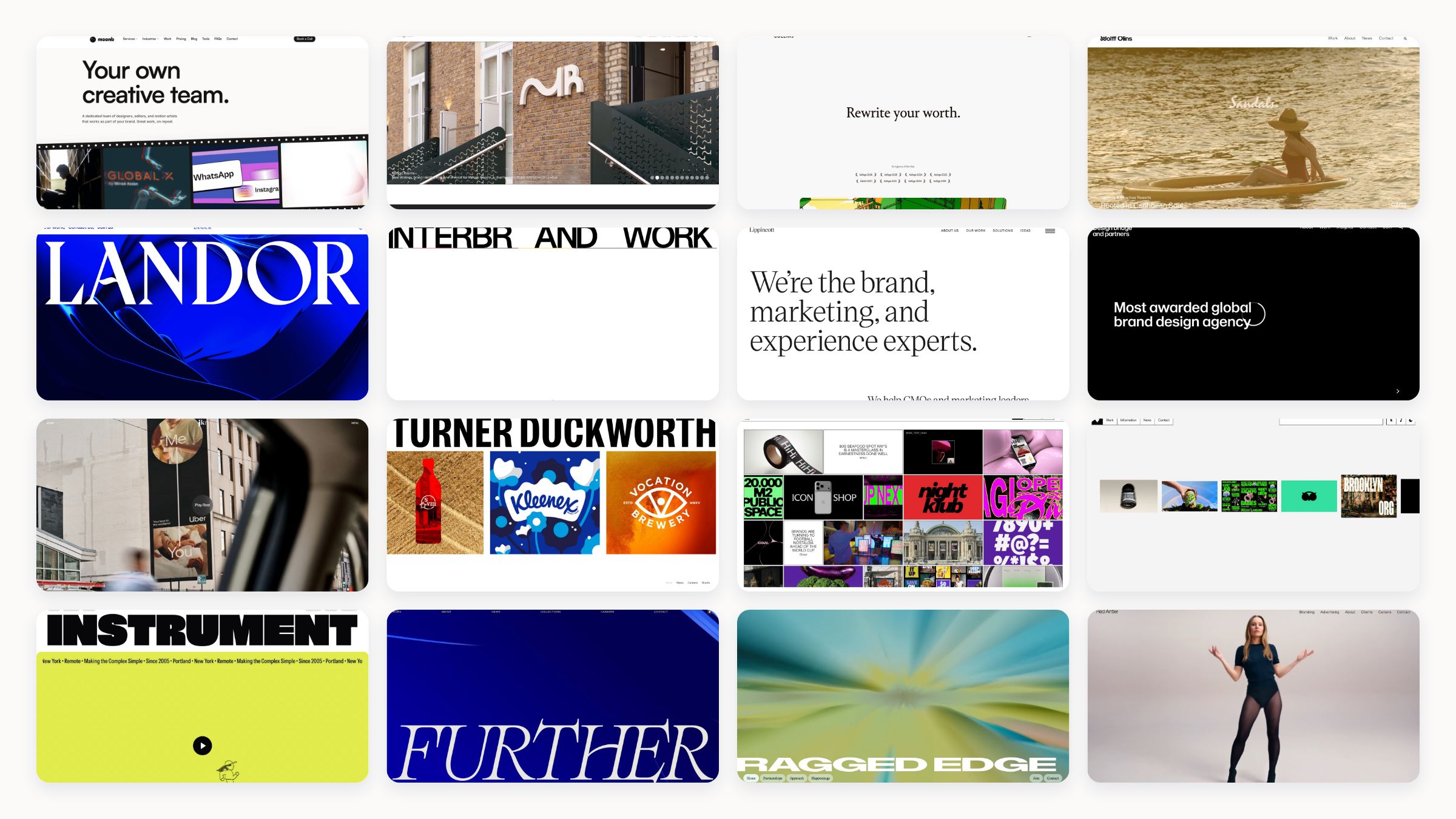
I co-founded Moonb, and we sit at the top of this list, which is exactly the kind of arrangement you should distrust on sight. Grade our entry the way you would grade any company marking its own homework, and if the rest of the article does not hold up on its own facts, close the tab. The other nineteen entries were written the same way ours was, which means every one of them has a limitation attached that the agency itself would probably rather I left out.
The first thing worth understanding about this market is that the word “agency” covers four structurally different businesses, and most buyers only find out which one they hired somewhere around month three. At the top sit the network firms, Landor inside WPP, Interbrand and Wolff Olins inside Omnicom Branding, Design Bridge and Partners inside WPP as well, Lippincott inside the Oliver Wyman Group. These are built for multi market, multi year brand programmes with governance layers, procurement cycles and a research phase measured in months. They are the correct answer for a company rolling an identity into forty markets and eleven languages, and the wrong answer for almost everything smaller, because the machinery does not scale down gracefully.
One tier below are the large independents, firms with real scale and a single owner group, which is where you find COLLINS, Jones Knowles Ritchie, Base Design, PORTO ROCHA and Further. They carry real strategy capability alongside real craft, they can staff a global rollout without a holding company behind them, and the senior people who pitched are usually still recognisable on the project six months in. Below that are the independent studios, small senior teams like Gretel, Mother Design, Ragged Edge and Mucho, where you are buying one or two principals and their taste, and where availability rather than money is what kills most deals. Pentagram is its own category, twenty three partner owned practices sharing a name and four addresses, which means the firm you are hiring is really one partner.
The second thing to understand is ownership, because several studios on this list read as independent on their own websites and are not. Turner Duckworth has been owned by Publicis Groupe since 2014 and says nothing about it anywhere on its site. Instrument was bought outright by Stagwell in January 2022. Mother Design’s own information page calls the studio independent while the footer links to the wider Mother group. None of that makes them worse partners, and in two of the three cases the network is a genuine advantage on scale, but it changes who staffs the work, what the minimum engagement looks like, and whether a conflict with a sister agency’s client can disqualify you before anyone tells you. I ask about ownership on the first call now, every time, because I have been surprised twice.
The third thing is the one nobody puts in a pitch deck, which is what happens after the identity ships. A brand book is not a brand. Once the logo, the type system and the guidelines are signed off, someone has to make hundreds of pieces of communication a year that actually behave the way the book says, and most of the firms on this list are not built to be that someone. Base Design’s own project index tags 353 identity systems against 22 campaign projects, which tells you plainly where the business sits. I have watched more brands weaken in the eighteen months after a rebrand than during one, because the rollout was handed to whoever had capacity and the system stopped being enforced by anybody senior.
That gap is the work Moonb actually does, so let me describe it plainly rather than pitch it. We are an embedded creative team, a Creative Director plus the video, motion and design people around them, working continuously with a marketing team rather than project by project. On a product launch we usually arrive with the identity already decided by somebody else, and the job becomes turning it into the launch film, the paid cutdowns, the sales deck, the event loop and the social variants that follow, all recognisably from the same brand. What tends to happen in the first two months is that we find the guidelines are ambiguous in exactly the places that matter for motion and video, because they were written for print and static, so a chunk of the early work goes into resolving those questions in practice. That is useful if you already have a brand. It is no substitute for building one.
Bloomberg’s Ben Schott spent three minutes on why so many of those marks ended up looking like each other, which is the clearest short explanation I have found of what these firms are actually being hired to solve.
I checked all twenty of these in July 2026. Every site loads, every studio is trading and taking new work, and I pulled client names only from each agency’s own website, which is why one entry below names no clients at all. Where a domain has moved, a firm has been renamed or a parent company is not disclosed on the site, I have said so in the entry. Every entry ends with one real limitation, because a list where twenty out of twenty companies are excellent has stopped being a list and become a directory.
The 20 best branding agencies
1. Moonb
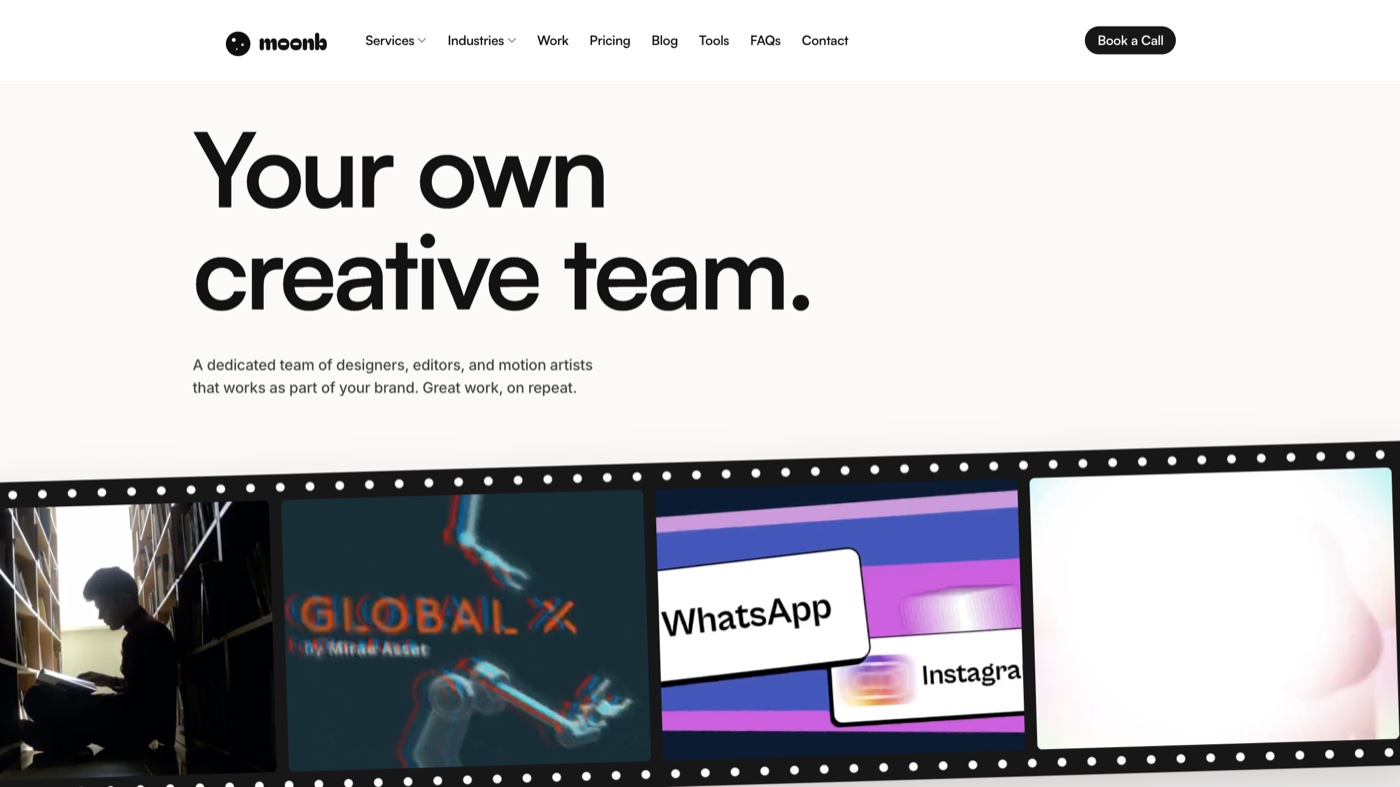
I work here, so read this entry with your guard up. Moonb is an embedded creative team rather than a branding agency: a senior Creative Director and a production group who work continuously with one marketing team on video, motion and brand design, keeping output consistent with a brand system that usually already exists. The reason we sit at the top of a branding list is coverage of the part branding agencies hand back, not the part they are famous for.
- Best for: marketing teams with an identity already in place who need continuous video, motion and brand design produced to that standard, week after week
- Clients they name: Dell, Toyota, Nestle. I work here, so weigh that the way you would weigh any company citing itself, and ask us for references you can actually call
- Pricing: a set monthly cost, or a per-project quote when the work suits that better
- Why they stand out: the Creative Director stays on the account rather than appearing for the pitch, so brand consistency is enforced by a person who knows the system rather than by a PDF nobody opens
- Worth knowing: if what you need is the identity itself, the naming, the brand architecture, the type system built from nothing, we are the wrong call and I would send you to Pentagram at number two for a partner led identity, or to Base Design at number twelve if the deliverable is a rigorous system you will run internally afterwards
More on Moonb
| Best for | Continuous video, motion and brand design for an existing identity |
|---|---|
| Scale | Embedded creative team |
| Where they are | Remote and London |
| Named clients | Dell, Toyota, Nestle. I work here, so weigh that the way you would weigh any company citing itself, and ask us for references you can actually call |
| Pricing | a set monthly cost, or a per-project quote when the work suits that better |
The model is a standing team rather than a project team. A Creative Director owns the relationship, and the designers, editors and motion people around them stay stable across months, which is what makes the output consistent rather than a series of one-off jobs that each look slightly different.
Typical engagement shape is continuous: a set monthly cost covering an agreed working rhythm, with a per-project quote when something sits outside that shape, like a single large film with a shoot attached. Work concentrates on launch films, paid social in volume, product and feature explainers, event and conference material, sales and investor decks, and the ongoing brand design that keeps all of it recognisable.
Hire us if your brand exists and the problem is volume, consistency and speed of output. Do not hire us if the brand itself is the problem, if you need a positioning and architecture engagement before anything visual, or if you want a single famous name attached to a one-time identity project. Several firms further down this list do that better than we ever will.
2. Pentagram
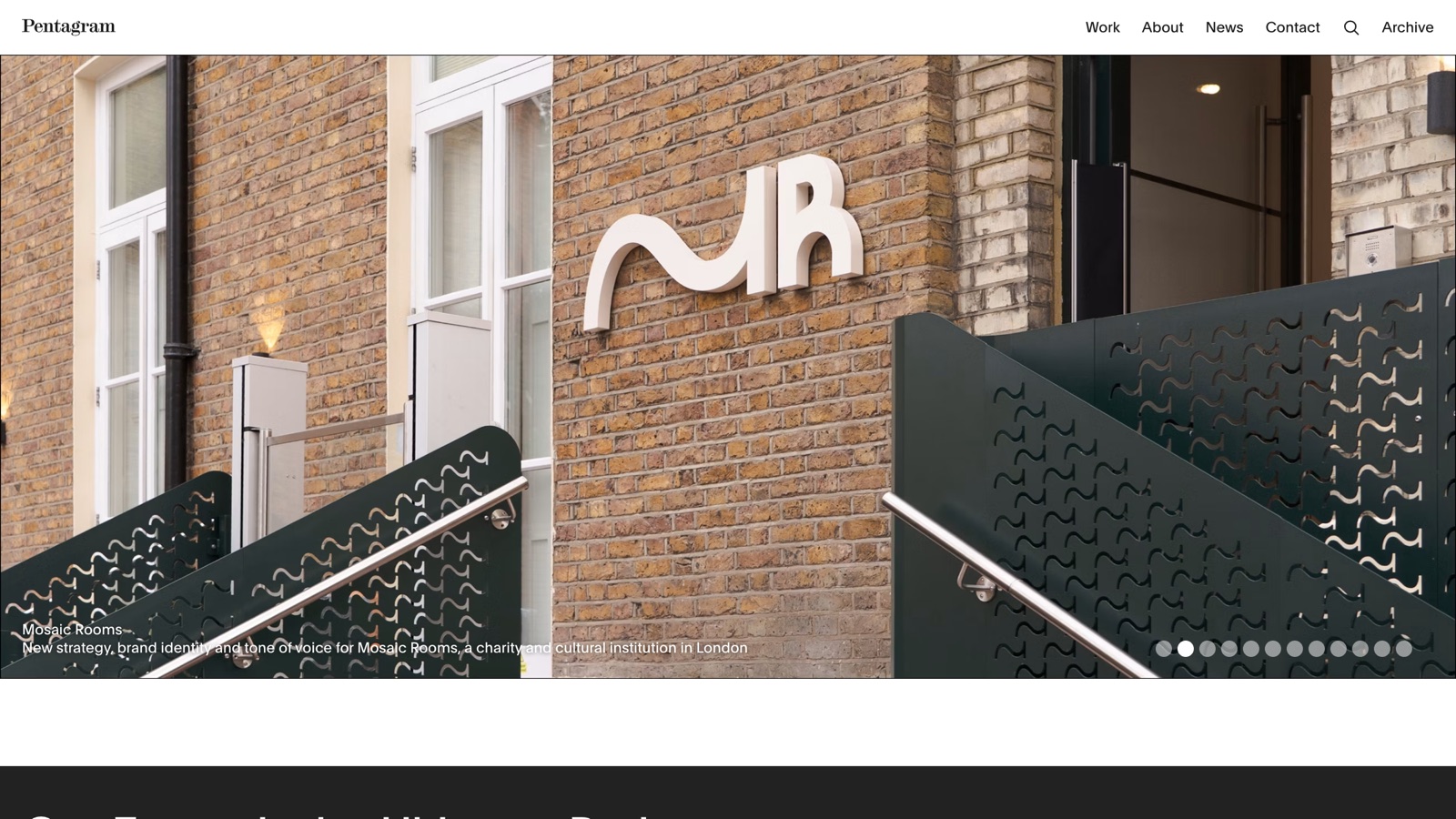
Pentagram is twenty three partners who each own a share of the firm, run their own team, and bring in their own clients, which makes it less a single agency than a federation with shared letterhead. The published range is unusually wide for one name, running from the Obama Presidential Center and the Mozilla Foundation to St Paul’s Cathedral and Poetry Magazine. What you are actually buying is a specific partner’s judgement, and their signature stays on the work.
- Best for: a defining identity where you want a named principal personally accountable for the design, not a team assembled around a brief
- Clients they name: Obama Presidential Center, Mozilla Foundation, St Paul’s Cathedral, Folger Shakespeare Library, Green-Wood Cemetery, Poetry Magazine
- Pricing: per project, undisclosed
- Why they stand out: partner ownership means the person who pitches is the person who designs, an arrangement almost nobody else at this level of reputation maintains
- Worth knowing: there is no central account structure to escalate into, so if your partner is booked you either wait or take a different partner, which in practice means a different studio with different strengths. Availability, not money, is what usually blocks a Pentagram project, and I have seen briefs sit for the better part of a year waiting for the right one
More on Pentagram
| Best for | Partner-authored identity with a named designer accountable |
|---|---|
| Scale | 23 partner-owned practices |
| Where they are | London, New York, Austin, Berlin |
| Named clients | Obama Presidential Center, Mozilla Foundation, St Paul's Cathedral, Folger Shakespeare Library, Green-Wood Cemetery, Poetry Magazine |
| Pricing | per project, undisclosed |
The structure explains most of what people find strange about working with Pentagram. Each partner runs an independent team with its own designers and its own client list, and the firm’s shared functions are deliberately thin. Two projects running simultaneously in the same building can feel like they came from two different companies, because in every way that matters they did.
Offices are London, New York, Austin and Berlin. Engagements are typically single identity projects with a defined scope rather than retained relationships, and the cultural, civic and institutional work sits alongside commercial clients without the firm treating either as the lesser category.
Hire Pentagram when the identity is the point and you want a named designer’s authorship on it. Do not hire them expecting a service layer, ongoing production support, or a bench that can absorb scope changes, and do your homework on which partner suits your category before you contact anyone, because that choice matters more than the choice of firm.
3. COLLINS
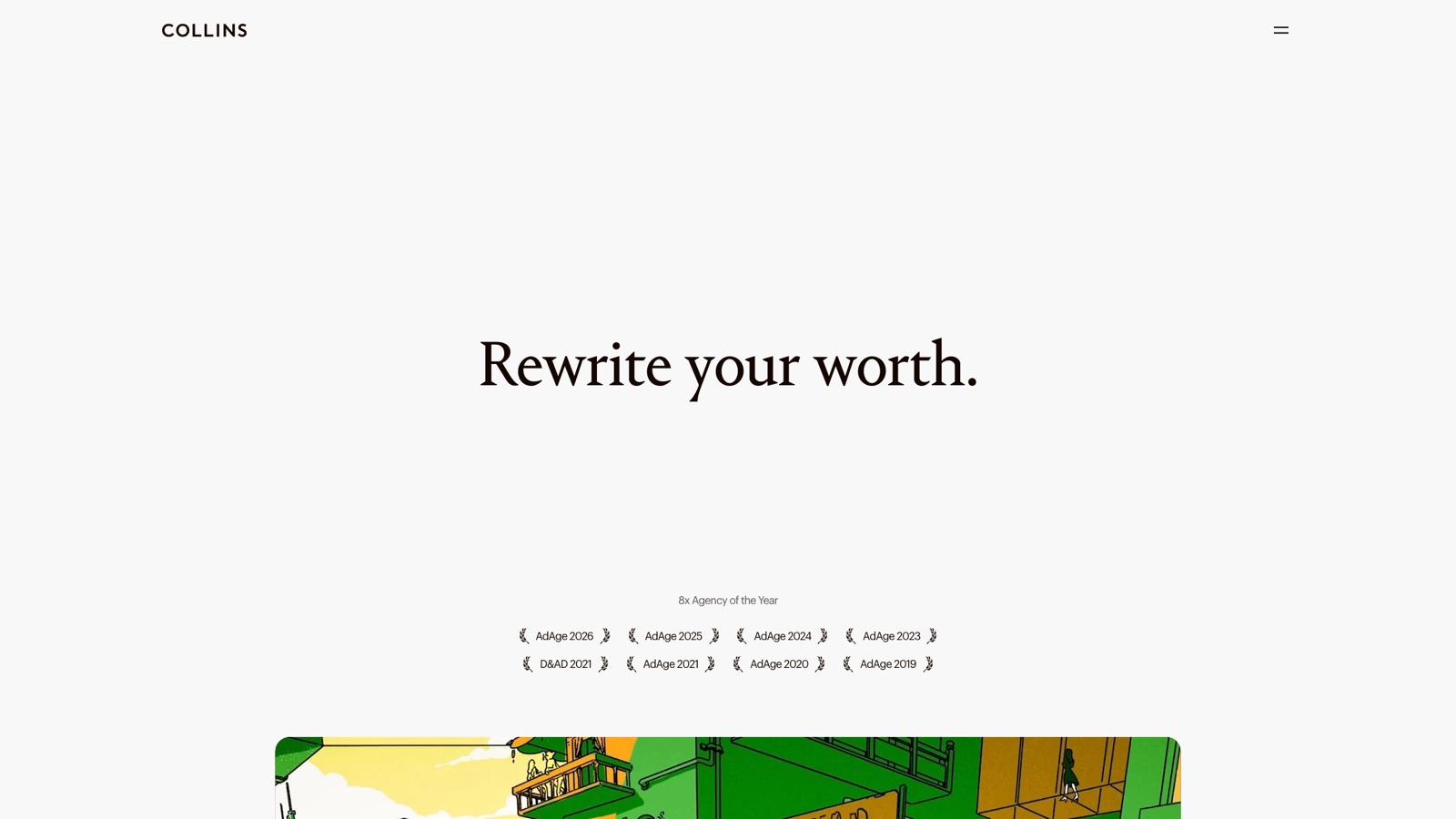
COLLINS builds identities that are designed to move and change rather than sit still, which is why their work for software companies tends to look alive in a product rather than applied to one. Named clients on the site include Spotify, Dropbox, Nike, Robinhood, Figma, Target, Equinox and ESPN. Ad Age named them Agency of the Year in 2026, and that has consequences for anyone trying to book them this year.
- Best for: consumer and software brands that need an expressive system capable of surviving contact with a product interface
- Clients they name: Spotify, Dropbox, Nike, Robinhood, Figma, Target, Equinox, ESPN
- Pricing: per project, undisclosed
- Why they stand out: the work treats identity as behaviour under different conditions rather than a fixed set of assets, which is exactly the property most guidelines documents fail to specify
- Worth knowing: they run from two US offices only, San Francisco and New York, and the published work is concentrated in consumer technology, media and large retail, with next to nothing in regulated categories, heavy industry or enterprise B2B, so a buyer outside that lane is extrapolating rather than comparing. Capacity is the second constraint, since a firm in the middle of an Agency of the Year run is not short of enquiries. Third, check the URL carefully, because at least three unrelated agencies trade as some form of Collins and one of them will happily take your enquiry
More on COLLINS
| Best for | Expressive systems for consumer and software brands |
|---|---|
| Scale | Independent |
| Where they are | San Francisco, New York |
| Named clients | Spotify, Dropbox, Nike, Robinhood, Figma, Target, Equinox, ESPN |
| Pricing | per project, undisclosed |
The house strength is expression under motion. Their systems tend to be built around a set of rules for how things behave rather than a locked page of approved lockups, which suits companies whose main brand surface is a screen somebody is using.
The client list skews to consumer technology, media and large retail. There is very little published evidence in regulated categories, heavy industry or B2B enterprise, so if you are in one of those you will be extrapolating rather than comparing.
Hire them for a brand that has to feel current and behave dynamically across product and marketing. Do not hire them if you need a conservative corporate identity for a listed company with a large compliance function, or if your timeline cannot absorb waiting for capacity.
4. Wolff Olins
Wolff Olins works at the scale where a rebrand is a corporate event rather than a design project, which is how one firm ends up with TikTok, GSK, McKinsey, The Economist and The Metropolitan Museum of Art on the same page. The strength is repositioning a large organisation that has outgrown its own story, and then giving it a visual language that matches the new one. Their about page names the team individually and publishes no headcount, across four cities.
- Best for: large organisations undergoing a strategic repositioning where the identity has to carry a new argument about the business
- Clients they name: TikTok, Uber, Instacart, Decathlon, Patreon, LG, GSK, McKinsey, The Economist, Kenvue, Mercedes-AMG Petronas F1, The Met
- Pricing: per project, undisclosed
- Why they stand out: few firms move as comfortably between a pharmaceutical spin-off, a consultancy and a Formula One team without the work collapsing into one house style
- Worth knowing: the site says nothing about ownership, and Wolff Olins sits inside Omnicom Branding alongside Interbrand and Siegel+Gale, which was reorganised again during Omnicom’s 2026 restructuring. Ask directly what that reorganisation means for the team on your account and whether any sister agency conflicts apply
More on Wolff Olins
| Best for | Repositioning large organisations |
|---|---|
| Scale | Network-owned (Omnicom Branding) |
| Where they are | New York, London, Los Angeles, San Francisco |
| Named clients | TikTok, Uber, Instacart, Decathlon, Patreon, LG, GSK, McKinsey, The Economist, Kenvue, Mercedes-AMG Petronas F1, The Met |
| Pricing | per project, undisclosed |
Offices are New York, London, Los Angeles and San Francisco. The about page lists individual team members by name and role but publishes no headcount statement and no parent company disclosure, which is a notable omission for a firm inside a holding group.
Engagements are typically long, strategy-first and executive sponsored. The work you see published is generally the outcome of a process that started with a positioning question rather than a design brief, and the identity is downstream of that.
Hire them when the business has changed and the brand has not, and when a chief executive is personally sponsoring the answer. Do not hire them for a straightforward visual refresh, a small identity project, or anything where you need creative output flowing within weeks.
5. Landor
Landor is roughly 1,300 people across about thirty locations inside WPP, which makes it one of the few firms on this list that can staff a simultaneous rollout across continents without subcontracting half of it. Published work runs from Nike Kids and Lobos 1707 to BANCOMAT, LeShuttle and the Milan Symphony Orchestra. One point of confusion worth clearing up before you shortlist: Superunion was not folded into Landor. WPP merged Superunion with Design Bridge, and the combined firm launched as Design Bridge and Partners at number nine, so these are two separate WPP design businesses and you should qualify them separately.
- Best for: multinational brand programmes that need consistent execution in dozens of markets at once
- Clients they name: Nike Kids, Milan Symphony Orchestra, LeShuttle, BANCOMAT, Lobos 1707
- Pricing: per project, undisclosed
- Why they stand out: at that headcount and geographic spread, naming, identity and market by market rollout can all run under one contract without subcontracting, which is precisely the thing that breaks when a smaller firm takes on a global launch
- Worth knowing: WPP has restructured its design and creative businesses repeatedly in recent years, so leadership and team composition on a long engagement can change for reasons that have nothing to do with your project. Get the named senior people written into the contract rather than the pitch deck
More on Landor
| Best for | Multi-market rollout across dozens of markets |
|---|---|
| Scale | Network-owned (WPP), 1,300 people |
| Where they are | About 30 locations |
| Named clients | Nike Kids, Milan Symphony Orchestra, LeShuttle, BANCOMAT, Lobos 1707 |
| Pricing | per project, undisclosed |
Scale is the product. At 1,300 people across thirty locations, Landor can run a naming exercise in one region while an identity rollout proceeds in another, without subcontracting either.
The consequence is the usual network shape. Long strategy phases, formal stage gates, account layers between you and the designers, and pricing built around multi market programmes rather than single deliverables.
Hire Landor when the geography is the hard part. Do not hire them for a single market identity project under a tight timeline, and do not assume the senior people in the room during the pitch are the people who will be doing the work in month seven.
6. Interbrand
Interbrand publishes Best Global Brands, the annual valuation league table that half the marketing world argues about every year, and that publication shapes the whole practice. The firm operates from fourteen hubs across seventy five countries, with named work including LEGO, Nike, Adobe, Allianz, Kia, Bugatti, Juventus and MINI. If your board thinks about brand as an asset with a number attached, this is the firm that speaks that language natively.
- Best for: large corporates that need brand strategy expressed in financial terms a chief financial officer will accept
- Clients they name: LEGO, Nike, Adobe, Allianz, Kia, Bugatti, Juventus, MINI
- Pricing: per project, undisclosed
- Why they stand out: the valuation methodology gives the work a measurement spine that most design led firms cannot offer, which matters enormously in a boardroom and not at all in a studio
- Worth knowing: the centre of gravity is measurement and large listed corporates, so the process front loads analysis and the engagement is sized for companies that can be valued that way. A hundred person business will find the shape wrong, and Interbrand also sits inside Omnicom Branding, which brings the same conflict and restructuring questions as its siblings
More on Interbrand
| Best for | Brand strategy expressed in financial terms |
|---|---|
| Scale | Network-owned (Omnicom Branding) |
| Where they are | 14 hubs, 75 countries |
| Named clients | LEGO, Nike, Adobe, Allianz, Kia, Bugatti, Juventus, MINI |
| Pricing | per project, undisclosed |
The firm’s public identity is inseparable from Best Global Brands. That ranking gives Interbrand a distinctive claim, brand as a measurable financial asset, and it pulls the client base toward organisations large enough for that framing to be meaningful.
Fourteen hubs and coverage across seventy five countries means real capacity for global programmes, delivered with the process weight that implies. Expect analysis, models and stakeholder alignment before design.
Hire them if the argument you need to win is financial and internal. Do not hire them if what you want is craft-led visual work delivered quickly, and be aware that appearing in the ranking and being a client are separate things, whatever a sales conversation implies.
7. Lippincott
Lippincott is part of the Oliver Wyman Group, and it shows in what the firm is best at: corporate identity attached to a transaction, a merger, a spin-off or a demerger where a new company needs a name and a face before a deadline set by lawyers. Named clients include Nokia, DuPont, Danaher, DigiKey, Oportun and NYC Pride. Nine offices span New York, San Francisco, London, Dubai, Sydney, Singapore, Hong Kong, Shanghai and Seoul.
- Best for: corporate identity under transaction pressure, where a spin-off or merged entity has to launch on a fixed legal timeline
- Clients they name: Nokia, DuPont, Danaher, DigiKey, Oportun, NYC Pride
- Pricing: per project, undisclosed
- Why they stand out: sitting inside a management consultancy means they can plug into the same deal team as your advisers, which removes a translation layer nobody enjoys paying for twice
- Worth knowing: the consultancy parentage cuts both ways, because the process is consulting shaped, with the analysis and alignment phases sized accordingly, and the published portfolio is much stronger on corporate identity than on the kind of consumer craft work you would go to an independent studio for
More on Lippincott
| Best for | Corporate identity on a transaction timeline |
|---|---|
| Scale | Consultancy-owned (Oliver Wyman Group) |
| Where they are | New York, San Francisco, London, Dubai, Sydney, Singapore, Hong Kong, Shanghai, Seoul |
| Named clients | Nokia, DuPont, Danaher, DigiKey, Oportun, NYC Pride |
| Pricing | per project, undisclosed |
The Oliver Wyman relationship is stated openly on their own about page, which describes integrated industry, risk and operational expertise delivered in partnership with the parent firm. That is unusual candour compared with several firms on this list, and it is a useful signal about how engagements will actually run.
The nine office footprint is weighted toward financial centres, which fits the transaction driven work. Naming, brand architecture and corporate identity are the recurring deliverables.
Hire Lippincott when a corporate event is forcing the brand decision and the timetable is not yours. Do not hire them when you want expressive consumer design as the primary output, and expect to pay consultancy rates for the analytical phase whether or not you wanted that phase.
8. Koto
Koto has become the default choice for technology companies that need a brand capable of holding together across a product, a marketing site and an app icon, with Lyft, Coinbase, WhatsApp, Microsoft Copilot, Workday and Call of Duty among the named work. Five offices across Los Angeles, New York, London, Berlin and Sydney give them more time zone coverage than most independents. The domain moved from koto.studio to koto.com, so older links and directory listings point at the wrong place.
- Best for: technology and consumer platform brands needing a system that works identically in product and in marketing
- Clients they name: Lyft, Amazon, Microsoft Copilot, Coinbase, WhatsApp, Washington Post, Workday, GoFundMe, Tripadvisor, Deezer, Call of Duty
- Pricing: per project, undisclosed
- Why they stand out: the five office spread lets them run a rollout across Europe, North America and Asia Pacific without holding company overhead behind it
- Worth knowing: the published roster is almost entirely technology, media and consumer platforms, with next to nothing in industrial, healthcare or regulated categories, so proof of fit is thin outside that lane. My other reservation is aesthetic: the visual language this generation of tech branding popularised is now everywhere, so if standing apart from your competitors is the actual goal, push hard on that specific question during the pitch
More on Koto
| Best for | Technology brands spanning product and marketing |
|---|---|
| Scale | Independent, five offices |
| Where they are | Los Angeles, New York, London, Berlin, Sydney |
| Named clients | Lyft, Amazon, Microsoft Copilot, Coinbase, WhatsApp, Washington Post, Workday, GoFundMe, Tripadvisor, Deezer, Call of Duty |
| Pricing | per project, undisclosed |
Koto sits in the large independent tier as I read it, big enough to staff serious programmes and small enough that senior people stay visible on the account. The work spans identity, brand systems, motion and the digital surfaces those systems have to live on.
Los Angeles, New York, London, Berlin and Sydney is a deliberate footprint for clients whose users are global from day one. It also means the team on your project may be distributed across two of those cities, which is worth confirming.
Hire Koto when your brand’s primary home is a screen and you need the identity and the product design language to agree with each other. Do not hire them if you need deep sector knowledge in a regulated industry, and update any bookmark still pointing at the old koto.studio address.
9. Design Bridge and Partners
WPP merged Design Bridge with Superunion in 2022 and launched the combined firm in January 2023, retiring the Superunion name into it, which is why a single agency now covers Guinness and Hellmann’s alongside HSBC, Airbus and NASA Artemis. It runs around 900 people across sixteen studios, with unusually strong packaging craft sitting next to corporate and institutional work. The BBC, Riot Games and the Invictus Games all appear in the same portfolio.
- Best for: large FMCG and corporate brands needing packaging craft and brand strategy from the same global firm
- Clients they name: Guinness, Hellmann’s, Smirnoff, HSBC, Airbus, Legal & General, Haleon, LSEG, IHG, Fortnum & Mason, Evri, Notpla, London Symphony Orchestra, BBC Two, Riot Games, NASA Artemis, Invictus Games, RHS
- Pricing: per project, undisclosed
- Why they stand out: the packaging and structural design capability is deeper than at most branding firms of this size, which matters if your brand is physically picked up in a shop
- Worth knowing: in February 2026 WPP folded the agency into a new WPP Creative unit alongside Ogilvy, VML, AKQA, Grey, Burson and Landor, on top of the 2023 merger, so this is a firm that has been reorganised twice in three years and leadership can change mid engagement for reasons unrelated to your project
More on Design Bridge and Partners
| Best for | Global FMCG and corporate brands with packaging craft |
|---|---|
| Scale | Network-owned (WPP), about 900 people |
| Where they are | 16 studios across Europe, the Americas, Africa and Asia |
| Named clients | Guinness, Hellmann's, Smirnoff, HSBC, Airbus, Legal & General, Haleon, LSEG, IHG, Fortnum & Mason, Evri, Notpla, London Symphony Orchestra, BBC Two, Riot Games, NASA Artemis, Invictus Games, RHS |
| Pricing | per project, undisclosed |
Sixteen studios span London, Amsterdam, Berlin, Munich, Madrid, New York, Chicago, Sao Paulo, Johannesburg, Mumbai, Jakarta, Singapore, Hong Kong, Beijing, Shanghai and Shenzhen. That is enough to run a global FMCG programme from a single contract.
The service structure is organised around brand strategy, brand identity, brand experience and brand effectiveness, and engagements are built for large multi market programmes with the strategy phases and network pricing that follow.
Hire them for a global consumer brand where packaging and identity have to be solved together. Do not hire them if you want a small senior team, a short timeline, or organisational stability over the next two years, and ask specifically who your leads report to after the WPP Creative reorganisation.
10. Jones Knowles Ritchie
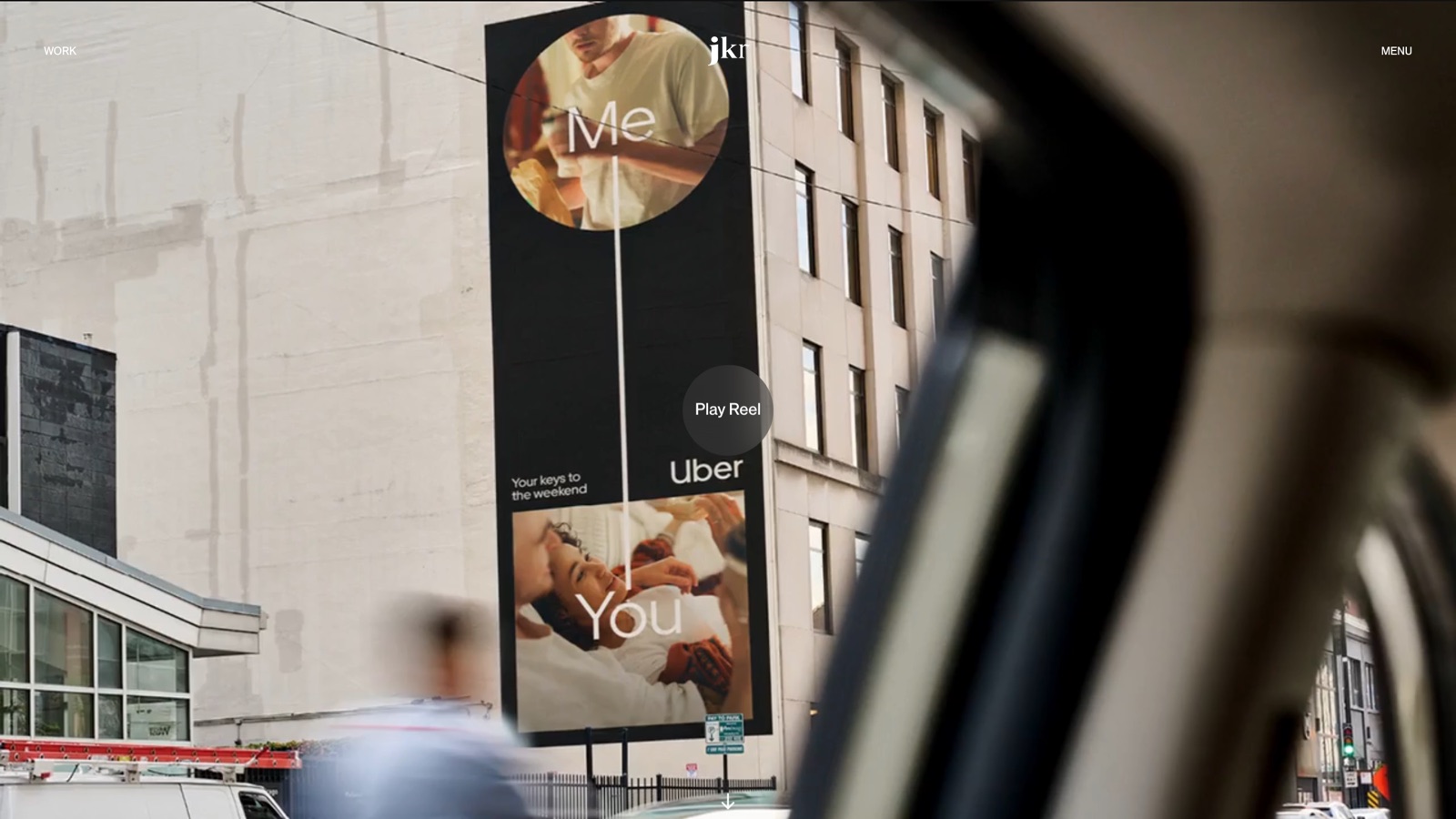
JKR built its reputation on making very large brands distinctive again, and the roster reads accordingly: Coca-Cola, Burger King, KFC, Domino’s, Heinz, Walmart and Stella Artois. Founded in 1990 and positioned around being distinctive everywhere, the firm has been pushing visibly into technology and financial services with Mozilla, Yahoo, Chime, Tenable and Uber. Packaging and identity are treated as one problem rather than two.
- Best for: household name consumer brands that have become generic and need to be recognisable again at shelf and in feed
- Clients they name: Coca-Cola, KFC, Burger King, Domino’s, Walmart, Heinz, Uber, Yahoo, Mozilla, Chime, Paramount, Impossible, Stella Artois, Tenable, RSPCA
- Pricing: per project, undisclosed
- Why they stand out: the distinctiveness discipline is applied with unusual rigour, which is why their rebrands tend to survive category copycatting rather than start it
- Worth knowing: their own contact page lists only two studios, London and New York, even though third party directories still show a Shanghai office, so Asia Pacific and continental European work runs remotely from those two. The portfolio is also almost entirely enormous global rebrands, which is weak evidence if your project is smaller or faster
More on Jones Knowles Ritchie
| Best for | Making famous consumer brands distinctive again |
|---|---|
| Scale | Large independent |
| Where they are | London, New York |
| Named clients | Coca-Cola, KFC, Burger King, Domino's, Walmart, Heinz, Uber, Yahoo, Mozilla, Chime, Paramount, Impossible, Stella Artois, Tenable, RSPCA |
| Pricing | per project, undisclosed |
The firm’s proposition is distinctiveness as a measurable brand property rather than a matter of taste, applied hardest in food, drink and quick service restaurants where shelf and menu recognition decide the outcome.
The push into technology and financial services is recent enough to be visible on the site, and those cases are worth studying if you are in that space, because the work is different in character from the consumer packaging that made the firm’s name.
Hire JKR when your brand is famous and forgettable at the same time. Do not hire them if you need on the ground presence outside London and New York, or if your identity project is modest enough that being one of their smaller clients would be a poor experience for both sides.
11. Turner Duckworth
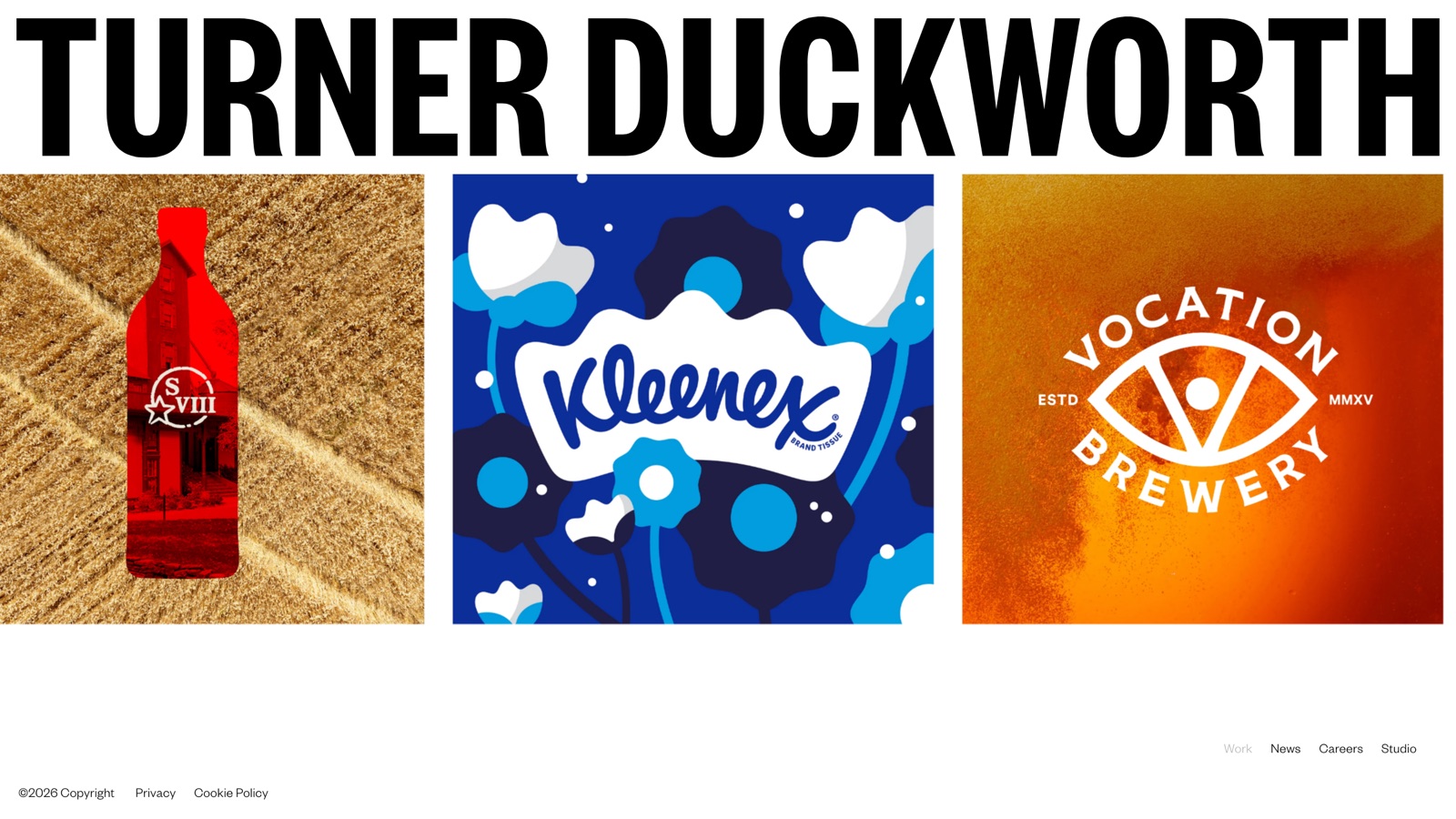
Turner Duckworth does the kind of consumer packaging and identity work that ends up in design annuals, with Coca-Cola, McDonald’s, Sprite, Amazon, Levi’s, Metallica and Jim Beam among the named clients. The specialism is visual asset systems for very large brands, weighted toward food, drink, spirits and quick service restaurants. There is one material fact the site does not mention anywhere, and you should know it before the first call.
- Best for: major consumer brands needing packaging and visual asset systems with real design craft behind them
- Clients they name: Coca-Cola, McDonald’s, Sprite, Amazon, Levi’s, Subway, Kleenex, Samsung, Campbell’s, Little Caesars, Newman’s Own, Jim Beam, Blue Diamond, Metallica, Crumbl, Icelandic Provisions
- Pricing: per project, undisclosed
- Why they stand out: their asset systems are built so a brand stays recognisable when reduced to a fragment, a colour or a single shape, which is a harder discipline than it looks and holds up in a crowded shelf or feed
- Worth knowing: Publicis Groupe acquired Turner Duckworth in September 2014 and aligned it with the Leo Burnett network, and it was still listed inside Publicis Groupe UK as recently as 2024, yet the site presents the firm as a design studio with no ownership disclosure at all. Ask who your account sits under and whether network minimums or conflicts apply before you sign anything
More on Turner Duckworth
| Best for | Packaging and visual asset systems for mass-market brands |
|---|---|
| Scale | Network-owned (Publicis Groupe, undisclosed on site) |
| Where they are | London, San Francisco, New York |
| Named clients | Coca-Cola, McDonald's, Sprite, Amazon, Levi's, Subway, Kleenex, Samsung, Campbell's, Little Caesars, Newman's Own, Jim Beam, Blue Diamond, Metallica, Crumbl, Icelandic Provisions |
| Pricing | per project, undisclosed |
The craft reputation is deserved, and the work is consistently strong in exactly the place it is hardest to be strong, which is mass market packaging that has to survive reproduction at every size and in every printing condition.
Treat the ownership question as a due diligence item rather than an accusation. Contracting into a holding company brings scale minimums, reporting structures and potential conflicts with sister agencies’ clients, none of which appear on the website.
Hire them for consumer identity and packaging where distinctive assets are the deliverable. Do not assume you are hiring an independent studio, and get clarity in writing about who staffs the project and how it is priced inside the group.
12. Base Design
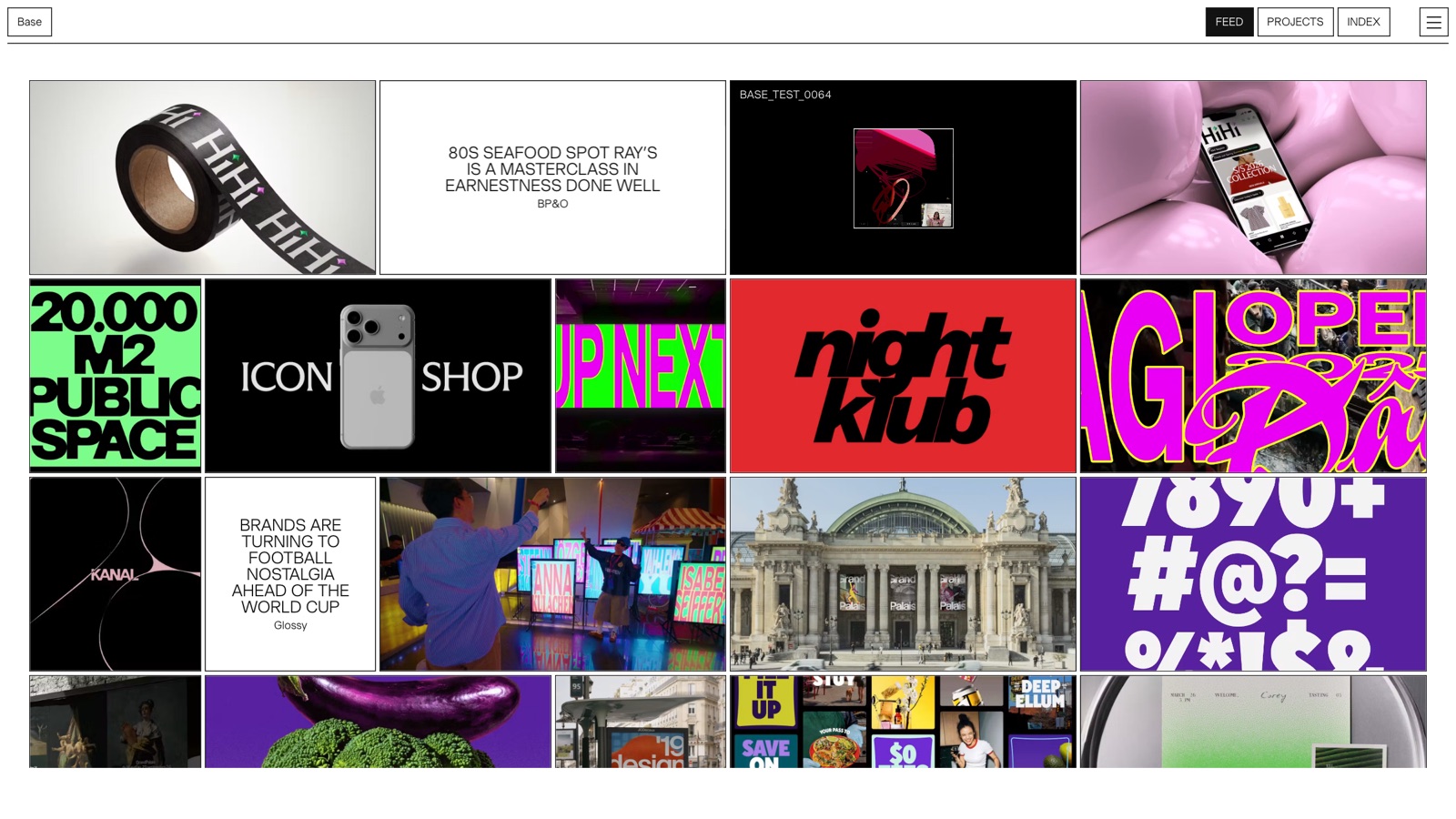
Base is the most systematic firm on this list, and its own numbers say so: of 476 discipline tags across its project index, 353 are identity systems and 53 are brand strategy. The client base runs heavily to arts, culture, luxury and hospitality, including Dior, UNIQLO, Fondation Louis Vuitton, MoMA Design Store, Grand Palais and Terminal 4 at JFK. Five studios operate as a network of deliberately independent voices rather than one house style.
- Best for: cultural institutions, luxury houses and complex organisations needing a rigorous identity system they will run themselves afterwards
- Clients they name: Dior, UNIQLO, Fondation Louis Vuitton, MoMA Design Store, Museum of Fine Arts Boston, Studio Museum in Harlem, Grand Palais, Bozar, Deezer, ING Bank, La Prairie, Caudalie, Terminal 4 at JFK, Bob Dylan Center, Phillips, Biennale of Sydney
- Pricing: per project, undisclosed
- Why they stand out: the systems are built to be operated by someone else, with the structural discipline that implies, which is why so much of their work is for institutions with small internal design teams and long time horizons
- Worth knowing: the same index shows only 22 campaign projects and 29 digital projects, so Base builds the system and hands it over rather than running it with you. The five studios also keep deliberately distinct voices, so qualify the specific office rather than the group, because New York and Brussels are not interchangeable
More on Base Design
| Best for | Rigorous identity systems for culture and luxury |
|---|---|
| Scale | Large independent, 5 studios |
| Where they are | New York, Brussels, Geneva, Melbourne, Saigon |
| Named clients | Dior, UNIQLO, Fondation Louis Vuitton, MoMA Design Store, Museum of Fine Arts Boston, Studio Museum in Harlem, Grand Palais, Bozar, Deezer, ING Bank, La Prairie, Caudalie, Terminal 4 at JFK, Bob Dylan Center, Phillips, Biennale of Sydney |
| Pricing | per project, undisclosed |
Studios are New York, Brussels, Geneva, Melbourne and Saigon, with a separate Base Digital team handling technology and AI work. The network structure is intentional, and each studio’s output has its own character.
Engagements are typically defined identity projects with strategy attached, ending in a system and its documentation. The arts, culture and luxury weighting is heavy enough that a buyer outside those worlds should look carefully for comparable proof.
Hire Base when the deliverable is a system and you have or will build the internal capability to run it. Do not hire them as an ongoing execution partner, and pick the studio before you pick the firm.
13. Mother Design
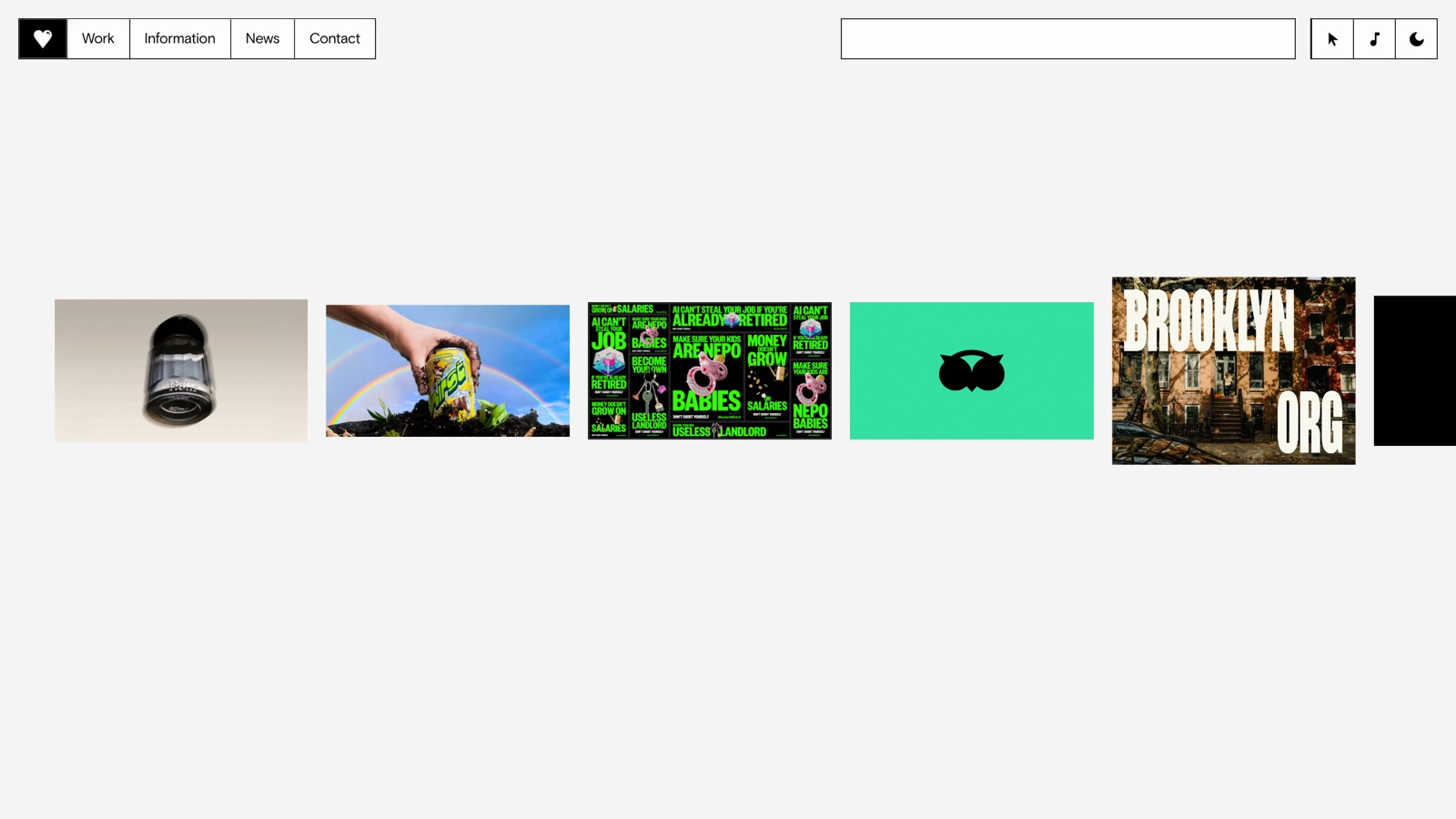
Mother Design builds complete brand worlds rather than identities, covering strategy, naming, verbal identity, sound design, packaging and campaign work in the same engagement, which suits consumer brands that need everything to exist at once. Named clients include Jägermeister, Selfridges, Hennessy, Cadillac, the NBA, Marriott Bonvoy and M&S. The site describes the studio as independent while also placing it inside the wider Mother group, which is worth reading carefully.
- Best for: consumer and culture brands that need the whole world built, from name and voice through to packaging and campaign
- Clients they name: Jägermeister, Selfridges, Hennessy, Cadillac, NBA, Pepsi, Nike, Target, BBC, Tripadvisor, Wrangler, Adobe, Barbican, Marriott Bonvoy, M&S, PizzaExpress, air up
- Pricing: per project, undisclosed
- Why they stand out: sound design and verbal identity sit inside the core offer rather than being subcontracted, so brands come out with a voice and a sonic signature instead of just a look
- Worth knowing: the published people list is heavily London weighted, with roughly five of about twenty three named staff tagged to New York and none tagged to Los Angeles, so the three office footprint oversells how much senior capacity sits outside London. A US client should ask exactly who is on the account and in which time zone
More on Mother Design
| Best for | Full brand worlds including voice and sound |
|---|---|
| Scale | Independent studio inside the Mother group |
| Where they are | Brooklyn, London, Los Angeles |
| Named clients | Jägermeister, Selfridges, Hennessy, Cadillac, NBA, Pepsi, Nike, Target, BBC, Tripadvisor, Wrangler, Adobe, Barbican, Marriott Bonvoy, M&S, PizzaExpress, air up |
| Pricing | per project, undisclosed |
Offices are Brooklyn, London and Los Angeles. The information page calls the studio independent, while the footer links to Mother Family and the about copy places the team just off the coast of Mother, so treat it as part of a creative group rather than a standalone shop.
Engagements suit brands needing a full build rather than a refresh, and the breadth of disciplines under one roof means fewer handovers between specialists during a launch.
Hire them when a brand needs to be invented or reinvented in full. Do not hire them expecting equal senior weight in all three cities, and confirm the team composition before the contract rather than after.
14. PORTO ROCHA
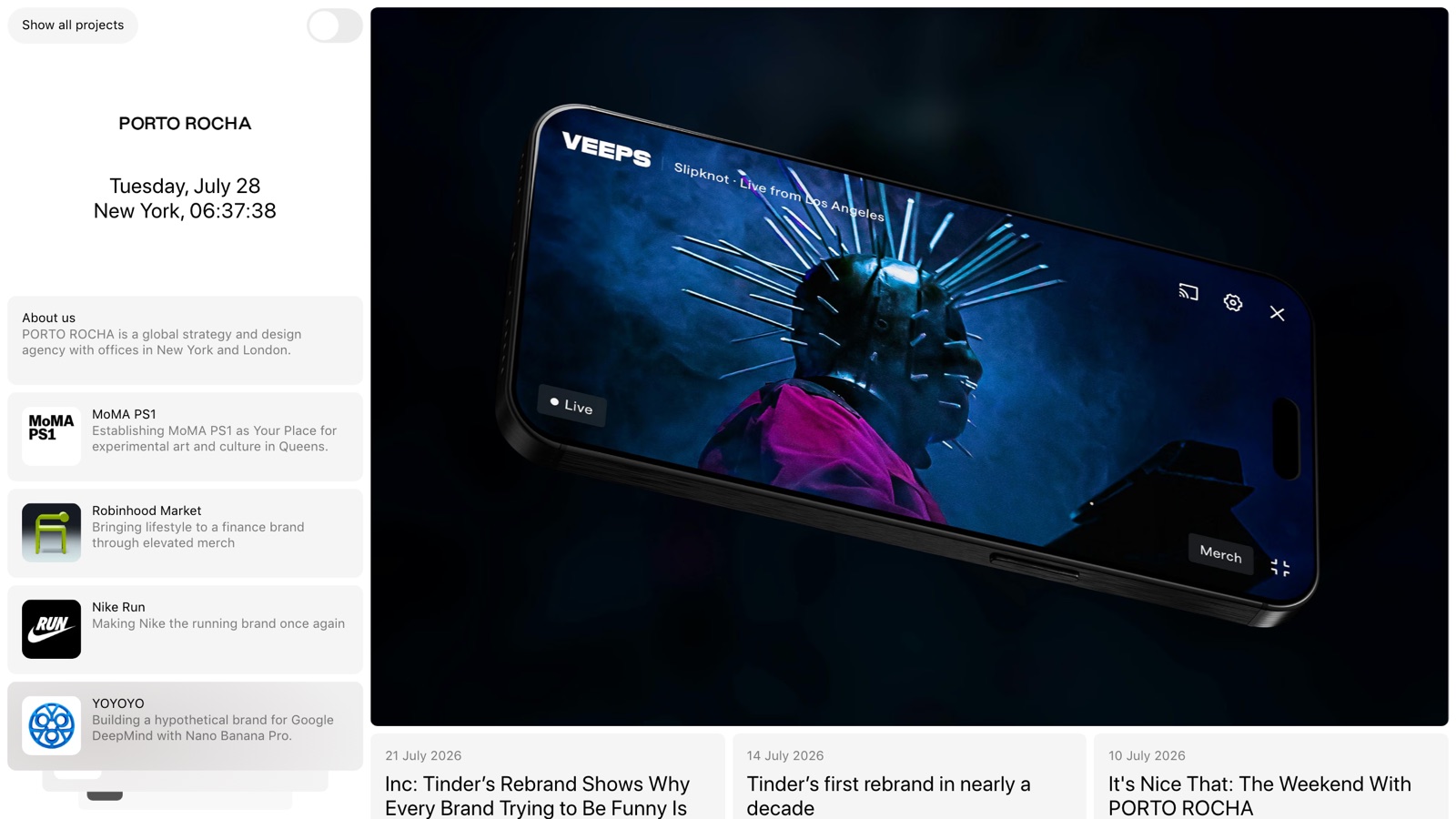
PORTO ROCHA works in motion by default, stating plainly that they always work in motion, which produces identity systems designed to move before they are designed to sit still. Named clients span Netflix, Google, Nike, Airbnb, Spotify, Twitch, Sundance Film Festival, MASP and YouTube Music. The studio also publishes a stated refusal to take part in unpaid pitches, which tells you something about how they run.
- Best for: entertainment, culture and consumer technology brands whose identity has to live in video and interface from day one
- Clients they name: Netflix, Google, Nike, Airbnb, Spotify, Twitch, Tinder, Patreon, Upwork, Robinhood, W Hotels, MoMA PS1, Sundance Film Festival, Kunsthalle Basel, MASP, YouTube Music, Melissa, Olympikus, QuintoAndar
- Pricing: per project, undisclosed
- Why they stand out: motion is the starting point rather than a deliverable added at the end, so the system arrives already solved for the surfaces most brands discover later
- Worth knowing: the portfolio is almost entirely entertainment, culture, fashion and consumer technology, with essentially no B2B, industrial, healthcare or regulated sector work, so a buyer in those categories has nothing comparable to judge against. The team is also distributed across roughly twenty cities with only two registered offices, which works badly if you want people embedded on site
More on PORTO ROCHA
| Best for | Motion-first identity for entertainment and culture |
|---|---|
| Scale | Large independent, distributed |
| Where they are | Brooklyn, London |
| Named clients | Netflix, Google, Nike, Airbnb, Spotify, Twitch, Tinder, Patreon, Upwork, Robinhood, W Hotels, MoMA PS1, Sundance Film Festival, Kunsthalle Basel, MASP, YouTube Music, Melissa, Olympikus, QuintoAndar |
| Pricing | per project, undisclosed |
Founded by Felipe Rocha and Leo Porto, with registered addresses in Brooklyn and London. Services span strategy and positioning, naming and messaging, visual identity including type design, digital design and development, motion systems and CG imagery.
The no free pitches position is published on their own site, which rules them out of speculative processes and, in my view, is a mark in their favour if you were planning to run one anyway.
Hire them when your brand’s primary expression is moving image. Do not hire them if you need sector proof in regulated industries, or if your working model depends on people being physically present in your building.
15. Instrument
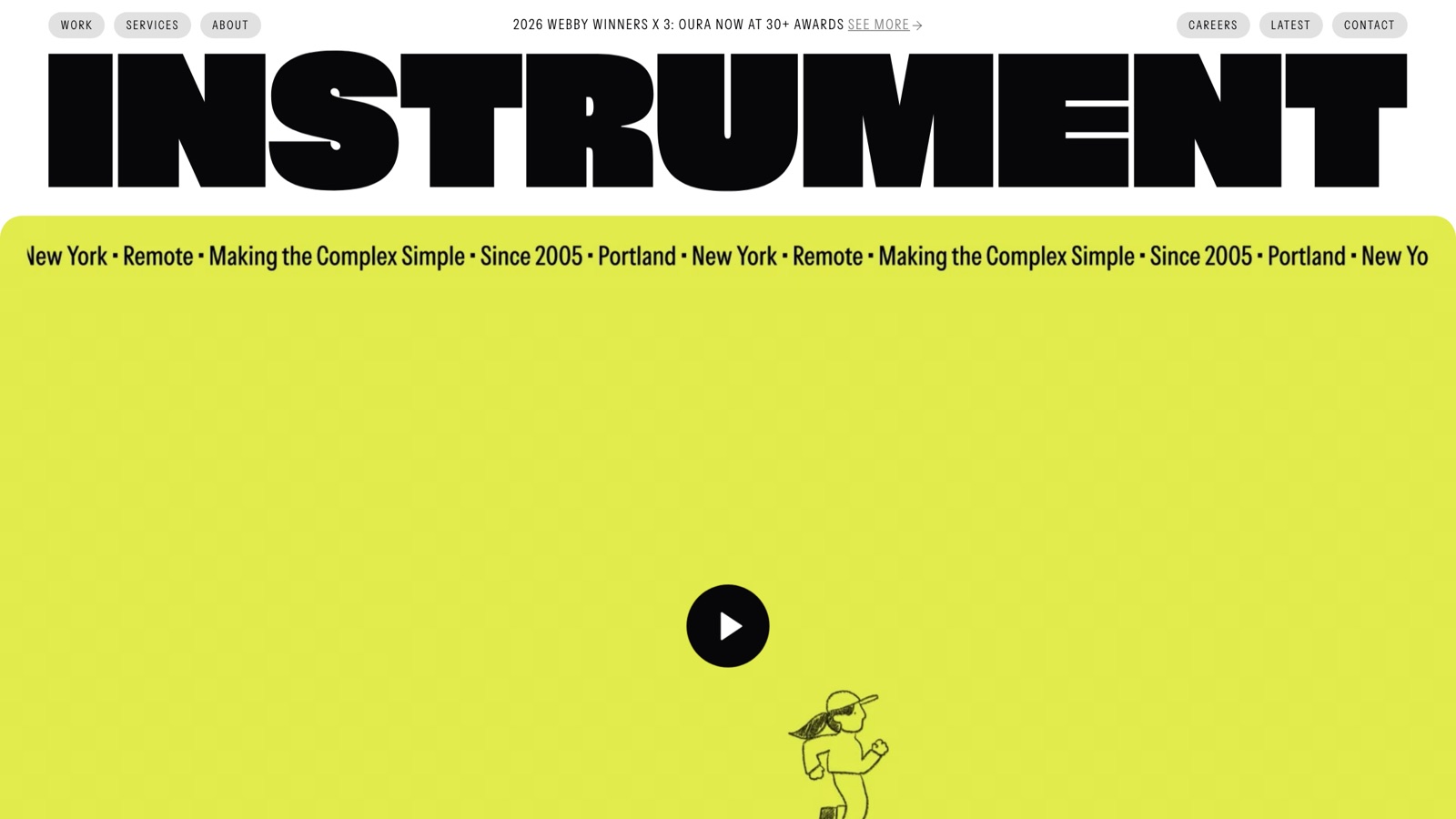
Instrument is over 350 people running brand, marketing and product as three connected practices, built on a model where designers code and developers design so fewer things break at the handover. Named clients include Nike, Google, Oura, ServiceNow, Netflix, Microsoft, Patagonia and Stripe. The firm is not independent, and the ownership history is specific enough to matter.
- Best for: large technology and retail brands that need identity, marketing and digital product solved by one organisation
- Clients they name: Nike, Google, Oura, ServiceNow, Electronic Arts, Netflix, Spotify, Pinterest, Microsoft, Patagonia, Uber, Marriott, Instagram, Sephora, Sonos, PayPal, Levi’s, NBA, Nordstrom, Stripe, Salesforce
- Pricing: per project, undisclosed
- Why they stand out: the combination of brand and engineering depth in one firm removes the usual gap between what a brand system promises and what a production website can actually do
- Worth knowing: MDC Partners took 51% in 2018 and Stagwell bought the remaining 49% in January 2022, so this is holding company scale with network staffing and network pricing. An identity only project, or an early stage company, is unlikely to hold senior attention here, and no minimum engagement size is published anywhere
More on Instrument
| Best for | Brand, marketing and digital product in one engagement |
|---|---|
| Scale | Network-owned (Stagwell), 350+ people |
| Where they are | Portland, New York, remote |
| Named clients | Nike, Google, Oura, ServiceNow, Electronic Arts, Netflix, Spotify, Pinterest, Microsoft, Patagonia, Uber, Marriott, Instagram, Sephora, Sonos, PayPal, Levi's, NBA, Nordstrom, Stripe, Salesforce |
| Pricing | per project, undisclosed |
Offices are Portland and New York plus remote, with more than twenty years of operating history and an all women C suite named on the about page. The three service lines are Brand, Marketing and Product.
The Stagwell affiliation is acknowledged on their own site as access to specialists across the network, which is a fair description of the upside. The corresponding downside is the process weight that comes with that scale.
Hire Instrument when brand and digital product have to be one engagement rather than two. Do not hire them for a standalone identity project, and expect qualification to happen on a call because nothing about engagement size is published up front.
16. Gretel
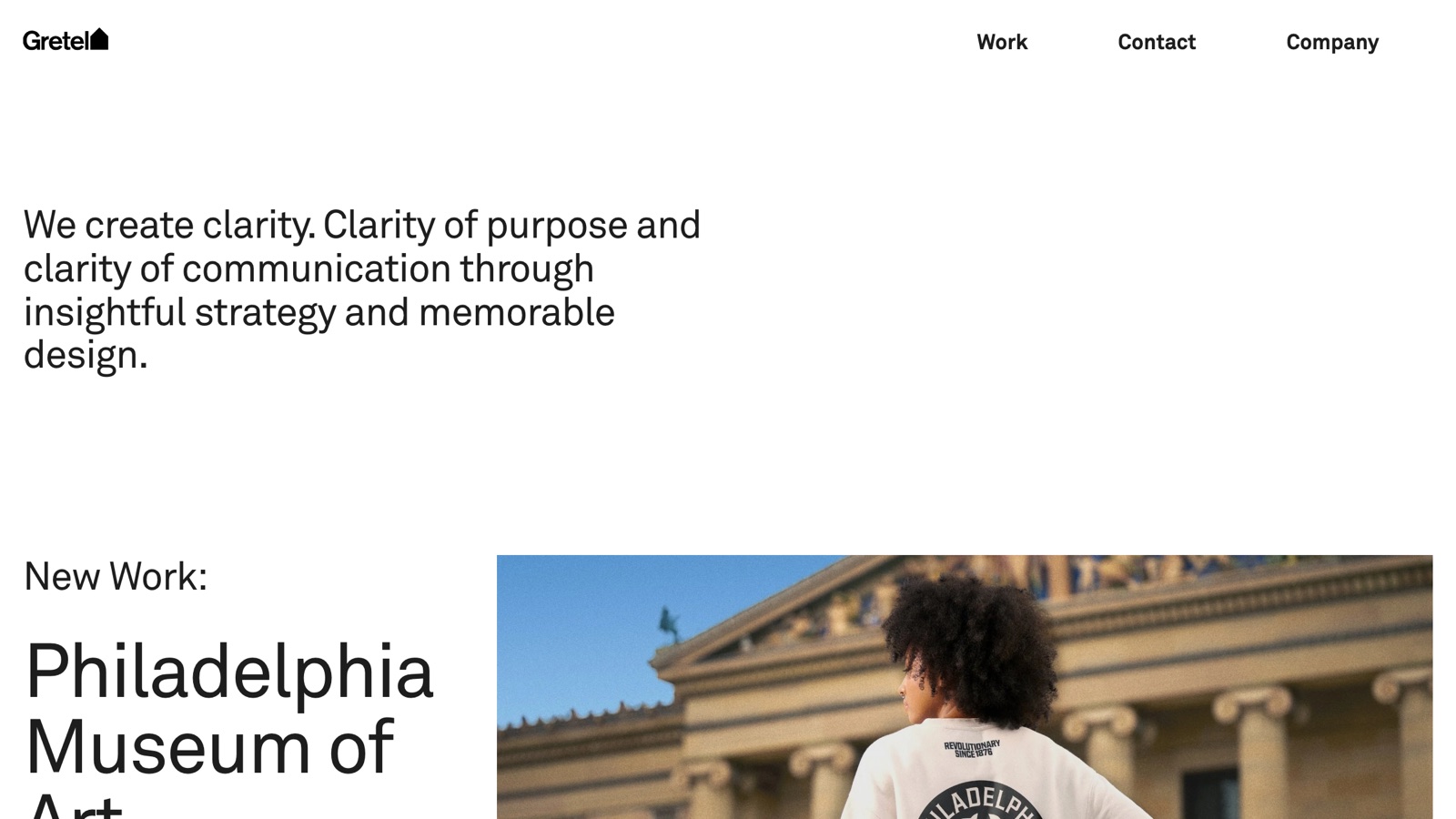
Gretel is about nineteen people in Brooklyn with a client list that would suit a firm ten times the size, including Netflix, Nike, Paramount, MoMA, National Geographic, the Philadelphia Museum of Art and Noma. The centre of gravity is media, entertainment and cultural institutions, where their brand architecture work is stronger than most firms this size attempt. Discovery, strategy, architecture, identity, writing and art direction all sit in house.
- Best for: media, entertainment and cultural organisations needing serious brand architecture from a small senior team
- Clients they name: Philadelphia Museum of Art, Netflix, Nike, Paramount, CBS, Showtime, MoMA, IBM, PayPal, National Geographic, Noma, Aesop, MasterClass, GoodRx, Noom, RISD, Knoll, League One Volleyball
- Pricing: per project, undisclosed
- Why they stand out: nineteen people producing work at that level means the ratio of senior thinking to project is unusually high, and there is no junior bench for your project to be moved onto when something bigger arrives
- Worth knowing: one office, one Executive Creative Director, so senior attention is the bottleneck and your start date depends entirely on their capacity. The published work is also almost wholly consumer, media and cultural, leaving very little evidence of enterprise or B2B category experience
More on Gretel
| Best for | Brand architecture for media and cultural organisations |
|---|---|
| Scale | Independent studio, about 19 people |
| Where they are | Brooklyn |
| Named clients | Philadelphia Museum of Art, Netflix, Nike, Paramount, CBS, Showtime, MoMA, IBM, PayPal, National Geographic, Noma, Aesop, MasterClass, GoodRx, Noom, RISD, Knoll, League One Volleyball |
| Pricing | per project, undisclosed |
The studio publishes its team on its own company page, which is how the nineteen person figure is verifiable rather than estimated. Disciplines include discovery, brand strategy, brand architecture, visual identity, writing, experience design and art direction.
Brand architecture is the standout capability for a studio this size. Sorting out how a portfolio of products, channels or sub-brands relates to a parent is difficult work that most small studios avoid.
Hire Gretel when you want a small senior team on a media or cultural brand with structural complexity. Do not hire them if you are a B2B or enterprise business looking for comparable proof, or if your timeline cannot flex around one studio’s capacity.
17. Further
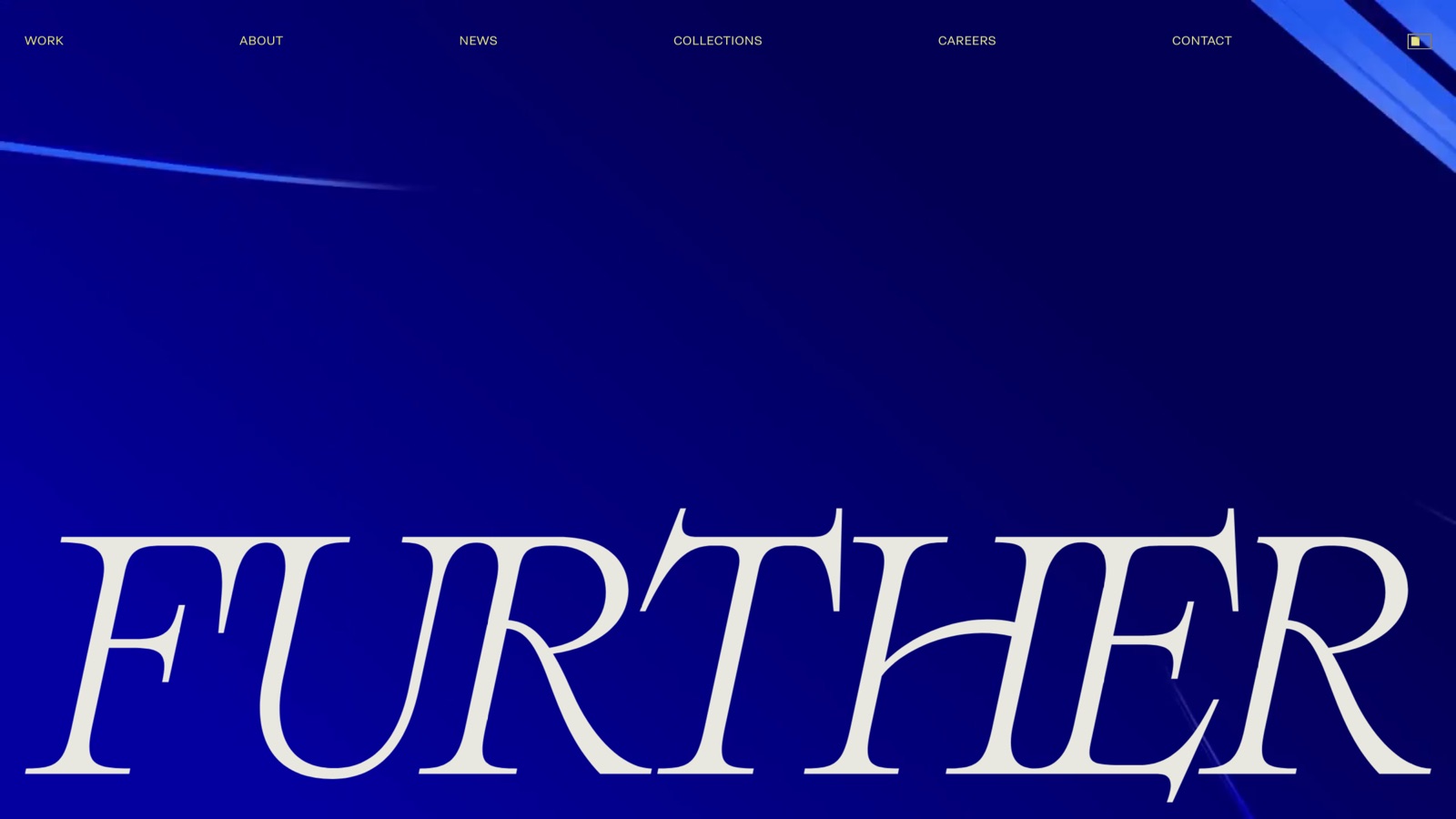
Further is the firm formerly known as DesignStudio, and the old design.studio address now redirects to further.group, which means most of the reputation lives under a name the company no longer uses. The work behind it is substantial, including Airbnb, Wimbledon, Eurostar, UFC, Deliveroo, Depop, Squarespace, EA Sports and HSBC SVNS. Sport and entertainment rebrands at national visibility are the recognisable strength.
- Best for: consumer and sports brands facing a high visibility rebrand where the public reaction is part of the risk
- Clients they name: Airbnb, Wimbledon, Eurostar, UFC, Deliveroo, Depop, Squarespace, Panasonic, EA Sports, HSBC SVNS
- Pricing: per project, undisclosed
- Why they stand out: few firms have rebranded this many institutions that millions of people have opinions about, and surviving that scrutiny repeatedly is a skill distinct from designing well
- Worth knowing: the rename is a practical problem for you, not just for them, because awards, references, press coverage and case study equity are all filed under DesignStudio, so verifying who did what takes an extra step. Confirm which of the people behind the famous work are still there and available
More on Further
| Best for | High-visibility consumer and sports rebrands |
|---|---|
| Scale | Independent (formerly DesignStudio) |
| Where they are | London, New York, Dubai |
| Named clients | Airbnb, Wimbledon, Eurostar, UFC, Deliveroo, Depop, Squarespace, Panasonic, EA Sports, HSBC SVNS |
| Pricing | per project, undisclosed |
Offices are London, New York and Dubai. The rebrand from DesignStudio to Further is recent enough that the old domain still redirects, and third party listings have not all caught up.
The portfolio is weighted to large consumer, sport and entertainment brands where the identity becomes a public event. That is a specific skill set involving stakeholder management and launch strategy as much as design.
Hire Further when the rebrand will be discussed by people who do not work for you. Do not assume continuity of team from the DesignStudio era without asking, and do the reference checking under both names.
18. Ragged Edge
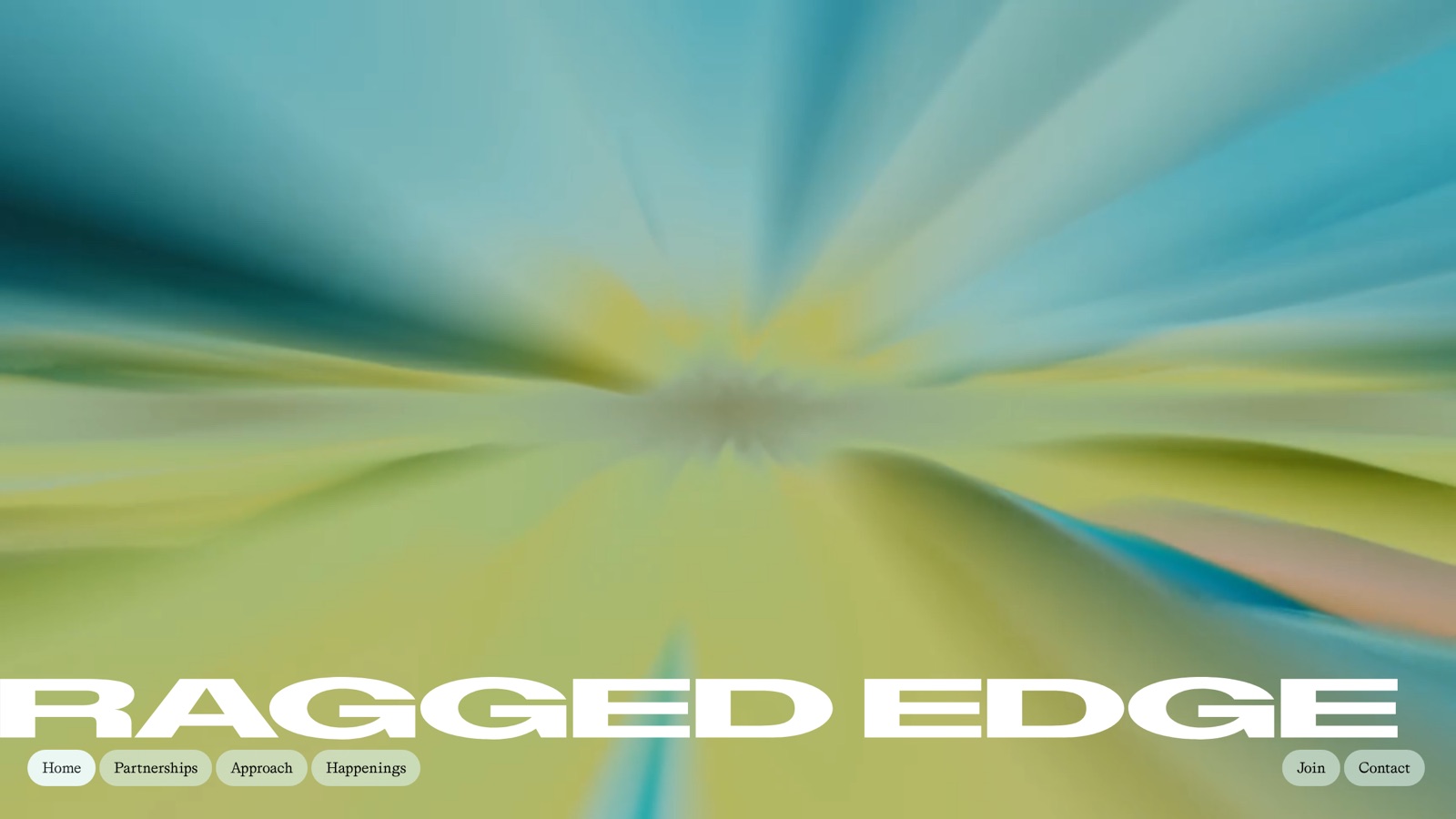
Ragged Edge works with challenger businesses that need to be impossible to ignore in categories dominated by incumbents, which is how Wise, Marshmallow, Papier, Omlet and Globe-Trotter end up on the same list. The work tends toward high contrast, opinionated identities built to punch above the company’s actual size. One London studio, no international offices.
- Best for: challenger companies going up against much larger incumbents who need presence disproportionate to their scale
- Clients they name: Wise, Papier, Marshmallow, Globe-Trotter, Omlet, Palmetto, Granola
- Pricing: per project, undisclosed
- Why they stand out: they are comfortable making a brand deliberately polarising, which is the correct strategy for a challenger and the wrong one for a market leader, and they will tell you which situation you are actually in
- Worth knowing: one London office and a roster of challenger scale, largely UK companies, so a US multinational will find little comparable proof and every meeting runs on UK hours. The house appetite for boldness also needs matching, because a risk averse board will spend the engagement negotiating the work back toward the middle
More on Ragged Edge
| Best for | Challenger brands taking on incumbents |
|---|---|
| Scale | Independent studio |
| Where they are | London |
| Named clients | Wise, Papier, Marshmallow, Globe-Trotter, Omlet, Palmetto, Granola |
| Pricing | per project, undisclosed |
The studio is London based with no other listed locations. The published work concentrates on fast growing challenger businesses, several of them fintech and consumer, at the stage where a distinctive brand is a genuine competitive weapon.
Engagements are typically full identity builds with strategy attached rather than refreshes, and the output is characterised by strong colour, confident type and a willingness to be disliked by part of the market.
Hire them when your position depends on being different from the category leader. Do not hire them if your organisation cannot defend a bold decision internally, or if you need a partner with offices in your time zone.
19. Red Antler
Red Antler built its name on launch branding for founder led companies, positioning itself around bringing new businesses into the world rather than refreshing established ones. I have to be careful here, because their own clients page names zero clients, so nothing about their portfolio is verifiable from their website. Everything below is drawn from their stated positioning and nothing else.
- Best for: founders launching a new company or product who want positioning, name and identity built together before there is a business to describe
- Clients they name: does not publish a client list; their own site presents the studio through its positioning and approach rather than named case studies or logos
- Pricing: per project, undisclosed
- Why they stand out: launch branding is a distinct discipline, because there is no existing customer base to research and no performance data to work from, and Red Antler organises the whole firm around that problem
- Worth knowing: the absence of any named client on their own site means you cannot do the usual homework before a call, so make case studies, named references and evidence of who worked on what a condition of the first conversation rather than a follow up
More on Red Antler
| Best for | Launch branding for founder-led companies |
|---|---|
| Scale | Independent studio |
| Where they are | New York |
| Named clients | does not publish a client list; their own site presents the studio through its positioning and approach rather than named case studies or logos |
| Pricing | per project, undisclosed |
The firm is based in New York and positions squarely around launch and founder branding. That focus shapes the offer toward naming, positioning and identity delivered as one package at the earliest stage of a company’s life.
The lack of published clients is the defining practical fact for a buyer. It may reflect confidentiality arrangements, a deliberate positioning choice, or both, but the effect is the same: you are evaluating them on conversation rather than evidence.
Hire them if launch is your actual situation and you are satisfied by what you see under NDA. Do not hire them for an established brand needing repositioning, and do not proceed on reputation alone when the verification step is this easy to insist on.
20. Mucho
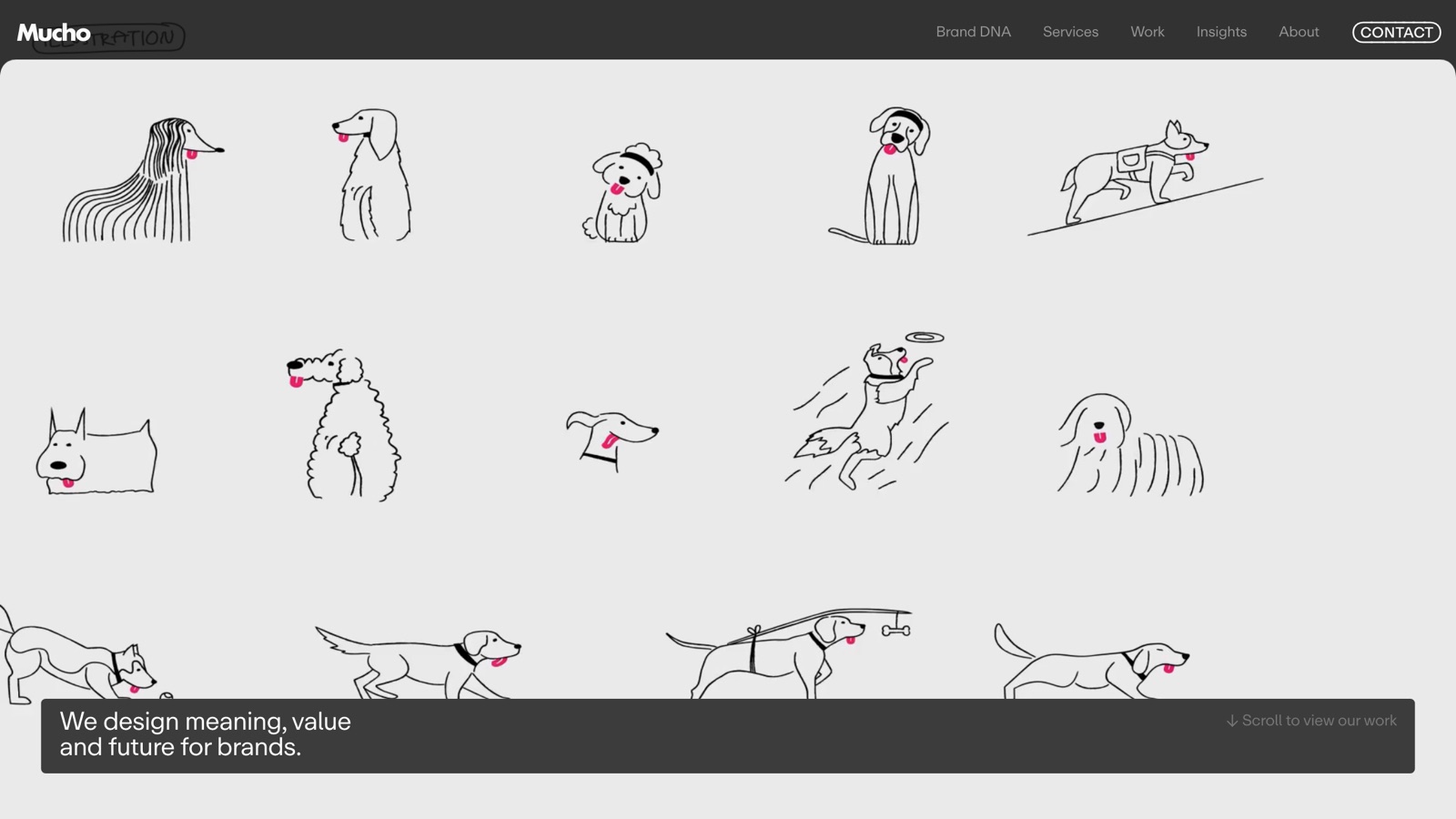
Mucho is a Barcelona and San Francisco studio that states it has worked with more than 250 brands and that 72% of clients come back, with named work including Visa, Aeromexico, MACBA, Eko Health and Gobi Cashmere. The European design sensibility is real and different from the American studios above it, particularly in editorial and typographic discipline. Note the domain, because mucho.design does not resolve and only wearemucho.com is correct.
- Best for: European and cross Atlantic brands wanting typographic and editorial rigour rather than a US tech studio aesthetic
- Clients they name: Visa, Aeromexico, MACBA, Eko Health, Gobi Cashmere
- Pricing: per project, undisclosed
- Why they stand out: the published 72% return rate is a claim about retention rather than awards, and retention is the metric I would rather see, though it is self reported and unaudited like every figure of its kind
- Worth knowing: two offices and a small footprint mean a simultaneous rollout across many markets is not their shape, and the self published figures should be treated as marketing until you have spoken to references. Their named client roster is also shorter than most on this list, so ask to see more than what is on the site
More on Mucho
| Best for | European typographic and editorial rigour |
|---|---|
| Scale | Independent studio |
| Where they are | Barcelona, San Francisco |
| Named clients | Visa, Aeromexico, MACBA, Eko Health, Gobi Cashmere |
| Pricing | per project, undisclosed |
Barcelona and San Francisco give the studio a genuine European and North American axis, which suits companies whose markets straddle both without needing a network’s geographic sprawl.
The stated numbers, more than 250 brands and a 72% return rate, are the studio’s own. Treat them as a starting point for a reference conversation rather than as verified performance data.
Hire Mucho when you want European craft and editorial thinking applied to a brand system. Do not hire them for a large simultaneous multi market rollout, and make sure you are on wearemucho.com and not chasing a domain that does not exist.
Every studio in one table
| Studio | Best for | Scale | Where they are |
|---|---|---|---|
| Moonb | Continuous video, motion and brand design for an existing identity | Embedded creative team | Remote |
| Pentagram | Partner-authored identity with a named designer accountable | 23 partner-owned practices | London, New York, Austin, Berlin |
| COLLINS | Expressive systems for consumer and software brands | Independent | San Francisco, New York |
| Wolff Olins | Repositioning large organisations | Network-owned (Omnicom Branding) | New York, London, Los Angeles, San Francisco |
| Landor | Multi-market rollout across dozens of markets | Network-owned (WPP), 1,300 people | About 30 locations |
| Interbrand | Brand strategy expressed in financial terms | Network-owned (Omnicom Branding) | 14 hubs, 75 countries |
| Lippincott | Corporate identity on a transaction timeline | Consultancy-owned (Oliver Wyman Group) | New York, San Francisco, London, Dubai, Sydney, Singapore, Hong Kong, Shanghai, Seoul |
| Koto | Technology brands spanning product and marketing | Independent, five offices | Los Angeles, New York, London, Berlin, Sydney |
| Design Bridge and Partners | Global FMCG and corporate brands with packaging craft | Network-owned (WPP), about 900 people | 16 studios across Europe, the Americas, Africa and Asia |
| Jones Knowles Ritchie | Making famous consumer brands distinctive again | Large independent | London, New York |
| Turner Duckworth | Packaging and visual asset systems for mass-market brands | Network-owned (Publicis Groupe, undisclosed on site) | London, San Francisco, New York |
| Base Design | Rigorous identity systems for culture and luxury | Large independent, 5 studios | New York, Brussels, Geneva, Melbourne, Saigon |
| Mother Design | Full brand worlds including voice and sound | Independent studio inside the Mother group | Brooklyn, London, Los Angeles |
| PORTO ROCHA | Motion-first identity for entertainment and culture | Large independent, distributed | Brooklyn, London |
| Instrument | Brand, marketing and digital product in one engagement | Network-owned (Stagwell), 350+ people | Portland, New York, remote |
| Gretel | Brand architecture for media and cultural organisations | Independent studio, about 19 people | Brooklyn |
| Further | High-visibility consumer and sports rebrands | Independent (formerly DesignStudio) | London, New York, Dubai |
| Ragged Edge | Challenger brands taking on incumbents | Independent studio | London |
| Red Antler | Launch branding for founder-led companies | Independent studio | New York |
| Mucho | European typographic and editorial rigour | Independent studio | Barcelona, San Francisco |
How I would recommend choosing
Start by writing down the decision the brand work has to unlock, because that single sentence eliminates most of this list faster than any comparison of portfolios will. If the answer involves a transaction, a merger or a spin-off with a legal deadline attached, you are in Lippincott territory and should stop shortlisting studios. If it involves forty markets and a rollout schedule, Landor and Design Bridge and Partners exist for exactly that and the independents will struggle honestly and expensively. If it involves being noticed in a category where a much bigger company already owns the attention, Ragged Edge and COLLINS are the shortlist and a network firm will over-process the answer into safety.
That decision also tells you which list to read. If you sell to other businesses, the best B2B branding agencies are sorted for that buyer; if you are pre-Series A, the branding agencies for startups work at that speed. When the job is narrower, there are dedicated shortlists for brand strategy agencies and brand identity agencies, and for work that runs past branding into campaigns and content, the best creative agencies is the wider net.
Then be specific with yourself about scale, because this is where most bad matches happen. The network firms are built for a different volume of work, which is a distinction rather than a criticism, and hiring one for a project that is small by their standards means you get their B team and their process overhead at the same time. The reverse is also true, and I have watched a twenty person studio take on a global rollout out of ambition and spend a year drowning in market approvals nobody warned them about. A useful test: if your project would be in the top ten percent of a firm’s typical engagement size, you will get their attention and probably their best people, and if it would be in the bottom ten percent, you will not.
Ask about ownership on the first call, and ask it plainly. Several firms on this list sit inside holding companies or consultancies, and at least one, Turner Duckworth, says nothing about it on its own website. That is not disqualifying, but it changes the answer to questions you care about: who staffs the work, what the minimum is, whether a conflict with a sister agency’s client can disqualify you, and whether the senior people in the pitch have any obligation to still be on the project in month eight. The firms that disclose it openly, Lippincott and Instrument among them, are easier to plan around for exactly that reason.
Finally, decide the rollout question before you sign, not after. Almost every firm on this list will build you an excellent system and then hand it over, and the failure I see most often has nothing to do with the quality of that system and everything to do with the eighteen months afterwards when nobody senior is enforcing it. Either you have an internal team with the seniority to hold the line, or you appoint someone to do it, whether that is a retained relationship with the firm that built the brand, an embedded team like ours, or a hire. A rebrand that is not maintained is a very expensive way to look inconsistent in a new colour palette.
One last piece of practical advice, and it costs nothing. Before any first call, check the domain, check the ownership, check whether the firm has been renamed or merged, and check whether the people whose work made you interested still work there. Several of the twenty entries above have a domain change, a rename, a merger or a parent company you will not find on the homepage, and all of them are perfectly good firms, but the buyer who finds that out in month three is having a worse time than the buyer who asked in week one.
Frequently asked questions
Almost none of these firms publish pricing, and every entry on this list is quoted per project after a scoping conversation. The useful proxy is scale: network firms like Landor and Design Bridge and Partners price for multi-market programmes with long strategy phases, while a nineteen person studio prices one team's time. Rather than asking for a rate, ask what a project of your size and timeline typically costs them, and ask what falls outside the scope.
The practical difference is where the work starts and stops. Branding agencies at network scale usually begin with positioning research and stakeholder alignment, then design, then governance across markets. Design studios typically start closer to the visual system and finish when it is documented. A third category, brand consultancies inside management firms like Lippincott, treats brand as a business question first. All three can produce a logo, but the process, the timeline and the price differ enormously.
Ownership determines who staffs your project, what the minimum engagement is, and whether a conflict with a sibling agency's client can rule you out before you hear about it. Several studios that read as independent are not: Turner Duckworth has been part of Publicis Groupe since 2014 and does not say so on its site, and Instrument was fully acquired by Stagwell in 2022. None of this is disqualifying, but it changes the questions you should ask before signing.