18 Best Brand Strategy Agencies in 2026
Eighteen strategy-first brand firms reviewed in July 2026, from Prophet and Interbrand to Motto and Ragged Edge, with clients named from their own sites and one real limitation each.

Before you read a word of the ranking: I work at Moonb, and Moonb is sitting at number one on a list Moonb wrote, which is the least believable seat in any roundup ever published. Read our entry with the suspicion you would apply to a student marking their own exam, and notice that we are not a brand strategy firm at all, which is why our entry says so in the second sentence and sends you elsewhere for the thing this article is actually about.
The phrase “brand strategy” is doing three different jobs in the market, and most of the bad buying decisions I have watched come from not knowing which one is being sold. The first job is management consulting with a brand lens, where the output is a positioning, a portfolio and architecture decision, a segmentation, and a business case that a CFO can argue with. The second job is the strategy-led design consultancy, where research and positioning are the front half of an engagement whose back half is an identity system, a verbal system and a rollout. The third job is a strategy sprint sold as the on-ramp to a design project, which is often good work but is scoped in weeks rather than quarters and is not designed to survive a boardroom. Those three cost different amounts, take different lengths of time, and produce documents that look superficially similar and function completely differently.
The test I give people is to ask who has to sign the thing off. If the answer involves a CEO, a CFO or a board, you need a firm whose published product is research, architecture, valuation and internal activation, because you are going to be asked to defend the recommendation in revenue terms and a design rationale will not hold that weight. If the answer is a CMO or a founder, a strategy-led studio will get you further faster and cost less doing it. The second question is what your brand problem actually is. Repositioning a category leader that has stopped growing is a different discipline from naming an architecture after three acquisitions, which is different again from launching something nobody has a mental model for. Very few firms are excellent at more than one of those, and the ones that claim all three usually have one they can prove and two they can describe.
The thing I look for before signing anything is a documented method I can inspect in advance. Prophet publishes five named service lines. Siegel+Gale has built the whole practice on a simplicity position it will apply to your brand whether you want it there or not. Kurppa Hosk runs a six-part model from Insight through Strategy, Identity, Experience, Activation and Governance. Motto has trademarked its central idea. Monigle sells research and employee activation as a practice rather than a phase. A published method is not proof of quality, but it tells you what you are buying and gives you something to hold them to at the halfway review. Where there is no method, you are buying the judgement of specific named people, which can be the better deal, as long as you have confirmed those specific people will be on your account and not just in the pitch.
The failure mode I see most often has nothing to do with the strategy being wrong. It is that the strategy is right and nobody was hired to build anything with it, so a well-argued positioning document sits in a shared drive while the marketing team keeps producing work in the old voice because the new one was never translated into anything makeable. Firms at the consultancy end of this list will tell you plainly that they do not execute. Believe them, and cost the second partner into the same approval, not the next one.
For context on where I sit relative to all of this: Moonb is an embedded creative team, so the work I know is the part that happens after the positioning is signed off. On a product launch we usually inherit a strategy someone else wrote, and the first fortnight goes into turning it into things that can be made, which means a film treatment, a motion system and a layout logic that survives both a social crop and a trade show wall. What tends to happen next is that the positioning holds up fine and the messaging hierarchy does not survive a fifteen second edit, so we come back with questions the strategy document never anticipated, and a Creative Director on our side keeps the answers consistent across every asset instead of letting each one solve it locally. That is the shape of my experience, and it is entirely downstream of what the firms below sell.
Big Think condensed ten thousand years of branding into six minutes, which is the fastest way I know to see that strategy, not decoration, is the older half of this discipline.
I checked all eighteen of these in July 2026. Every domain resolves and every firm is trading. Every client name below was taken from that firm’s own website rather than from a directory or a press release, and where a firm publishes no client names at all, as Red Antler does not, the entry says so instead of borrowing names from somewhere else. I also wrote one real limitation for every entry, including ours, because a list where nobody has a weakness is a list nobody bothered to check.
The 18 best brand strategy agencies
1. Moonb
We put ourselves first on our own list, so weigh that accordingly. More usefully: Moonb is not a brand strategy firm and should not be shortlisted as one, because what we run is an embedded creative team that produces video, motion and design continuously for a marketing department with a senior Creative Director holding the line on brand. We belong in this conversation only as the answer to the question every firm below leaves open, which is who makes the work once the strategy exists.
- Best for: marketing teams that already have a positioning and need the video, motion and design that carries it produced week after week rather than in isolated projects
- Clients they name: Dell, Toyota, Nestle. I work here, so weigh that the way you would weigh any company citing itself, and ask us for references you can actually call
- Pricing: a set monthly cost, or a per-project quote when the work suits that better
- Why they stand out: the output is continuous rather than campaign-shaped, and the same Creative Director stays across every asset, so the brand does not reset each time a new supplier picks up a brief
- Worth knowing: we do not do brand positioning, architecture or naming, and you should not hire us for it. If you need the strategy itself built and defended at board level, start with Prophet at number two or Lippincott at number three. If you want strategy and identity from one team, Kurppa Hosk at number eight is the better call, and Motto at number nine if you are a founder-led technology company.
More on Moonb
| Best for | Embedded video, motion and design production after the strategy exists |
|---|---|
| Scale | Senior embedded team |
| Where they are | Remote and London |
| Named clients | Dell, Toyota, Nestle. I work here, so weigh that the way you would weigh any company citing itself, and ask us for references you can actually call |
| Pricing | a set monthly cost, or a per-project quote when the work suits that better |
Moonb operates as an extension of an in-house team rather than as an outside supplier with a pitch process. The working shape is a standing team, a shared queue and a Creative Director who knows the brand well enough to answer questions without escalating them, which is what makes continuous output possible without the brand degrading.
The work itself is brand design, video, motion and design production. That covers launch films, product and social video, motion systems, campaign layouts, presentation and event assets, and the day-to-day volume most marketing teams under-resource. HQ is remote, and the team is built around senior people rather than a large junior bench.
Hire us if your bottleneck is production capacity and consistency, and if you have already decided what the brand stands for. Do not hire us if the strategic question is unresolved, if you need a naming architecture across acquired businesses, or if you want a firm that will run stakeholder research and hand a board a recommendation. Those are all real jobs and there are seventeen better answers to them below.
2. Prophet
Prophet is a management consultancy that happens to work through brand, which is why it opens this ranking rather than a studio with a prettier portfolio. Its five published service lines cover Brand Building, Marketing Excellence, Business Strategy, Experience and Innovation, and Organization and Culture, and that last one is the tell: this is a firm that expects to change how a company operates, not just how it presents itself.
- Best for: large enterprises where the brand question is really a growth question and the recommendation has to survive a board
- Clients they name: UBS, Invesco, Showmax, Save the Children, AEG, Kalmar, Institutional Investor, Amova Asset Management, Beazely
- Pricing: per project, undisclosed
- Why they stand out: the published product is a business argument with brand as the mechanism, and the organisation and culture line means the recommendation comes with an internal adoption plan rather than a handover
- Worth knowing: Prophet does not build. There is no fast-turnaround creative execution capability here, so anyone who needs identity design produced and campaign assets made will be running a second procurement to get it, and the sensible move is to scope both partners at the same time rather than discovering the gap in month four.
More on Prophet
| Best for | Enterprise brand-led growth and transformation |
|---|---|
| Scale | Large independent consultancy |
| Where they are | 16 offices, US, Europe, Middle East, Asia |
| Named clients | UBS, Invesco, Showmax, Save the Children, AEG, Kalmar, Institutional Investor, Amova Asset Management, Beazely |
| Pricing | per project, undisclosed |
Prophet runs across sixteen offices including San Francisco, New York, Chicago, Atlanta, Austin, Richmond, London, Berlin, Hamburg, Munich, Zurich, Dubai, Riyadh, Hong Kong, Shanghai and Singapore, which matters if your programme has to land in more than one region with local research behind it.
A typical engagement looks like a consulting engagement: a diagnostic phase, a research phase, a set of strategic options with commercial modelling behind them, and then a recommendation with an implementation roadmap. Timelines run in quarters, and the people in the room are consultants rather than designers.
Hire Prophet when the brand decision is entangled with a portfolio decision, a market entry, or a business model change, and when the person who has to be convinced sits on the executive committee. Do not hire Prophet for a visual refresh, a naming sprint, or anything with a deadline measured in weeks, and do not hire them at all unless you have already worked out who is going to make the things afterwards.
3. Lippincott
Lippincott has built a specific and unusual muscle around corporate transitions, which is to say mergers, spin-offs, demergers and the moments when a company has to become a different legal and commercial entity in public. The client list reflects it: Nokia, DuPont and Danaher are all companies that have had to explain a structural change to the market.
- Best for: corporate rebrands attached to a merger, a separation, a listing or a major portfolio restructure
- Clients they name: Nokia, DuPont, Danaher, DigiKey, Oportun, NYC Pride
- Pricing: per project, undisclosed
- Why they stand out: transition work has its own choreography around disclosure timing, employee comms and investor narrative, and Lippincott has run enough of it that the sequencing is a competence rather than an improvisation
- Worth knowing: the practice is built for corporate events, and the pricing and pace come with it. If your brand problem is ordinary growth rather than a structural change, you will be paying for machinery you do not need, and we found no published proprietary method on the site to inspect before you sign, so ask in the first meeting what the actual process is and who runs it.
More on Lippincott
| Best for | Mergers, spin-offs and corporate transitions |
|---|---|
| Scale | Global consultancy |
| Where they are | 9 offices, cities not published |
| Named clients | Nokia, DuPont, Danaher, DigiKey, Oportun, NYC Pride |
| Pricing | per project, undisclosed |
Nine offices. The firm does not make the city list easy to find, which is worth pinning down early, because on transition work a rebrand often has to go live simultaneously across regulatory regimes and you need to know which offices are actually covering yours.
Engagements tend to be long, multi-workstream and heavily stakeholder-managed, with research, positioning, naming, architecture and identity all running under one programme and a comms plan wrapped around it. Expect a lot of executive interviews.
Hire Lippincott if you are about to become a different company on paper and need the brand to explain that credibly to investors, employees and customers in the same week. Do not hire them if you are a mid-size business looking for a sharper story and a new look, because the engagement shape is heavier than that problem requires.
4. Interbrand
Interbrand publishes the Best Global Brands study every year, and once you know that, everything else about the firm makes sense. Brand valuation and brand economics are the centre of gravity here: this is a firm that will attach a number to brand strength and then argue from it.
- Best for: established brands that need to justify brand investment in financial terms to a sceptical finance function
- Clients they name: LEGO, Nike, Adobe, Allianz, Kia, Bugatti, Juventus, MINI
- Pricing: per project, undisclosed
- Why they stand out: brand valuation is a proprietary asset here rather than borrowed language, and no other firm on this list publishes an annual study of its own methodology that you can read before the first meeting
- Worth knowing: a valuation frame rewards brands that already have measurable equity to model. If you are creating a category or launching something with no history to value, the analytical apparatus has less to work with and you may get a rigorous answer to a question you were not asking. The network also runs across 75 countries with fourteen hubs, so which hub takes your brief materially changes the team, and that is a question to settle before signing rather than after.
More on Interbrand
| Best for | Brand valuation and financially argued brand investment |
|---|---|
| Scale | Global network |
| Where they are | 14 hubs across 75 countries |
| Named clients | LEGO, Nike, Adobe, Allianz, Kia, Bugatti, Juventus, MINI |
| Pricing | per project, undisclosed |
The firm operates across 75 countries with fourteen major hubs, and the hubs are not interchangeable, so get the specific one named in writing.
Engagements typically start with a measurement or diagnostic phase, move into strategy and identity, and finish with a set of metrics you are expected to track afterwards. The annual Best Global Brands study functions as both marketing and methodology showcase, and it is worth reading before a first meeting because it tells you exactly how they think about brand value.
Hire Interbrand when your CFO is the person blocking the brand programme and you need an argument built in their language. Do not hire them for early-stage work, for anything where the answer is meant to be intuitive rather than modelled, or without pinning down which hub and which named leads are on the account.
5. Siegel+Gale
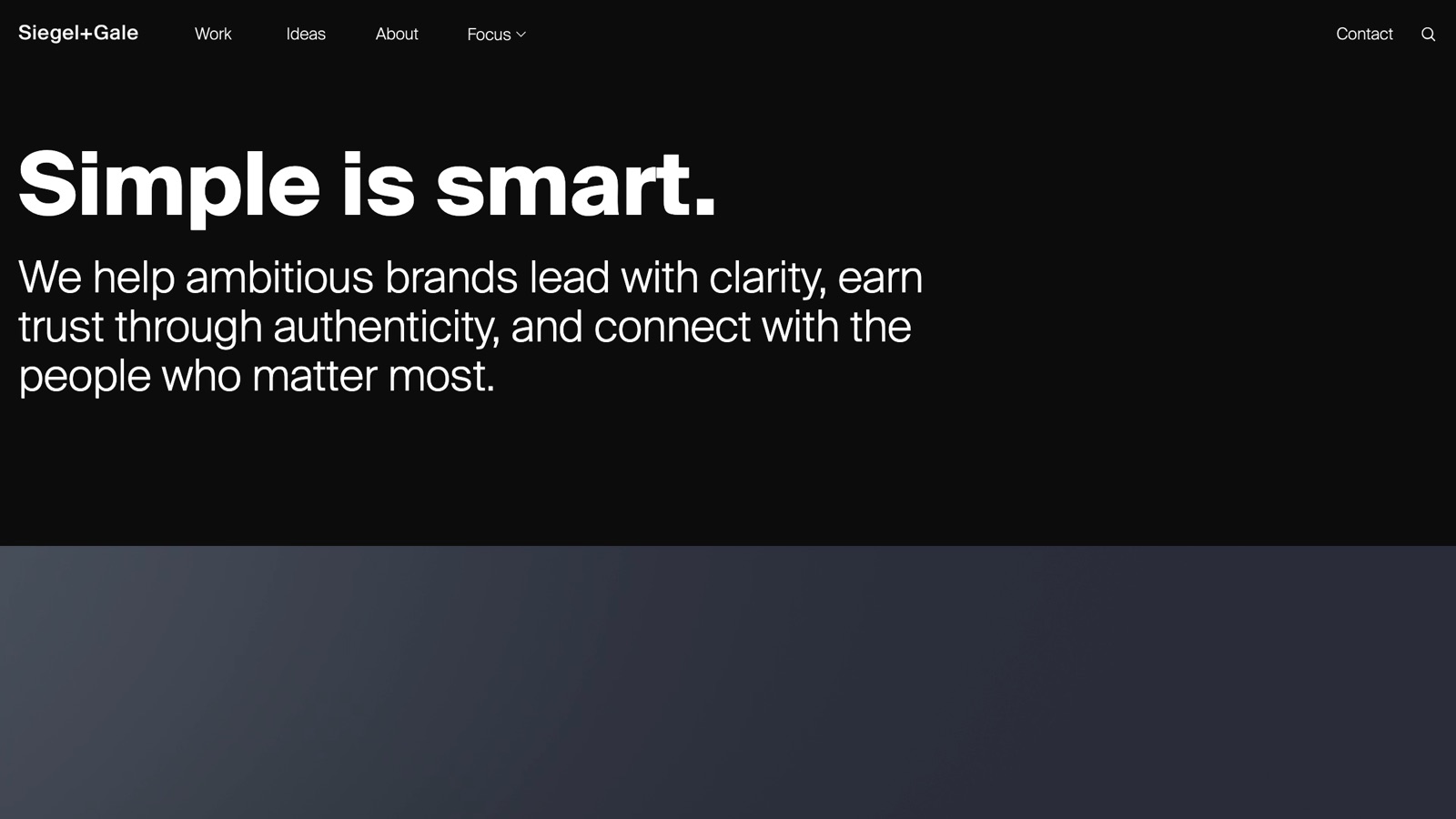
Siegel+Gale has built an entire practice on one idea, that simplicity wins, and it applies that lens to brand strategy, naming, activation and M&A work with a consistency that borders on stubborn. The published portfolio skews to complicated organisations, which is the point: healthcare, technology infrastructure and government are exactly the places where clarity is hardest and worth the most.
- Best for: complex or regulated organisations whose brand problem is that nobody outside can understand what they do
- Clients they name: CVS Health, Bristol Myers Squibb, HPE, Micron, U.S. Army, H&R Block
- Pricing: per project, undisclosed
- Why they stand out: the simplicity position is a real filter applied to language, naming and architecture, and the naming practice in particular is one of the strongest on this list for organisations with a tangled portfolio
- Worth knowing: that same position is a constraint you inherit. A brand whose advantage is richness, ornament, density or maximalist personality will spend the engagement arguing against the house view, and the work will pull towards restraint whether or not restraint is right for the category.
More on Siegel+Gale
| Best for | Simplifying complex and regulated organisations, naming |
|---|---|
| Scale | Global consultancy |
| Where they are | 7 offices, cities not published |
| Named clients | CVS Health, Bristol Myers Squibb, HPE, Micron, U.S. Army, H&R Block |
| Pricing | per project, undisclosed |
Seven offices, spread across multiple regions. As with the other network firms here, the office that takes your brief changes the team, so name it in the statement of work.
The engagement shape is research-led and language-heavy, with a lot of attention paid to nomenclature systems, hierarchy and how a brand explains itself in words before anyone talks about how it looks. For an organisation with dozens of sub-brands and no logic connecting them, this is the practice that untangles it.
Hire Siegel+Gale if your customers, your salespeople or your own employees cannot articulate what you sell. Do not hire them for a fashion, luxury or entertainment brand where the appeal is texture and complication, because the method is pointed the other way.
6. Vivaldi
Vivaldi sells brand strategy fused with business strategy, growth and innovation consulting, across five stated areas covering business transformation, brand and experience, business technology strategy including AI, marketing acceleration, and people and culture. The client roster is heavily multinational, with Mercedes-Benz, AB InBev, LEGO and Danone among the names on its own site, and the work is scoped for organisations of that size.
- Best for: multinationals treating brand as an input to a growth or transformation programme rather than a marketing project
- Clients they name: Mercedes-Benz, AB InBev, Samsung, LEGO, Coca-Cola, Birkenstock, Pfizer, Comcast, Ford, GE, Danone, Canon
- Pricing: per project, undisclosed
- Why they stand out: the technology and AI strategy line sits inside the same practice as brand, which is rare and useful if your brand promise depends on a product or platform change actually happening
- Worth knowing: this is a strategy consultancy with design downstream, and it front-loads research before anything visual appears. If you are expecting to see creative territories in week six, recalibrate, because you will be paying senior consultant rates through a long analytical phase first and the visual work is the tail of the engagement rather than the body of it.
More on Vivaldi
| Best for | Brand fused with business and technology strategy |
|---|---|
| Scale | Network consultancy |
| Where they are | 10 offices, New York HQ |
| Named clients | Mercedes-Benz, AB InBev, Samsung, LEGO, Coca-Cola, Birkenstock, Pfizer, Comcast, Ford, GE, Danone, Canon |
| Pricing | per project, undisclosed |
Ten offices, with New York as headquarters plus Los Angeles, Zurich, Munich, Hamburg, Dusseldorf, London, Singapore, Buenos Aires and Lima. The Latin American presence is unusual among firms at this tier and worth knowing about if that is a growth market for you.
Engagements are structured as consulting programmes with defined analytical phases, stakeholder workshops and frameworks, then strategic recommendations, then execution planning. Timelines run long by design.
Hire Vivaldi when the brand question cannot be separated from a business model or technology question and you want one firm holding both. Do not hire Vivaldi if creative craft is the deliverable you are actually buying, and do not hire them on a compressed timeline, because the process does not compress well.
7. Monigle
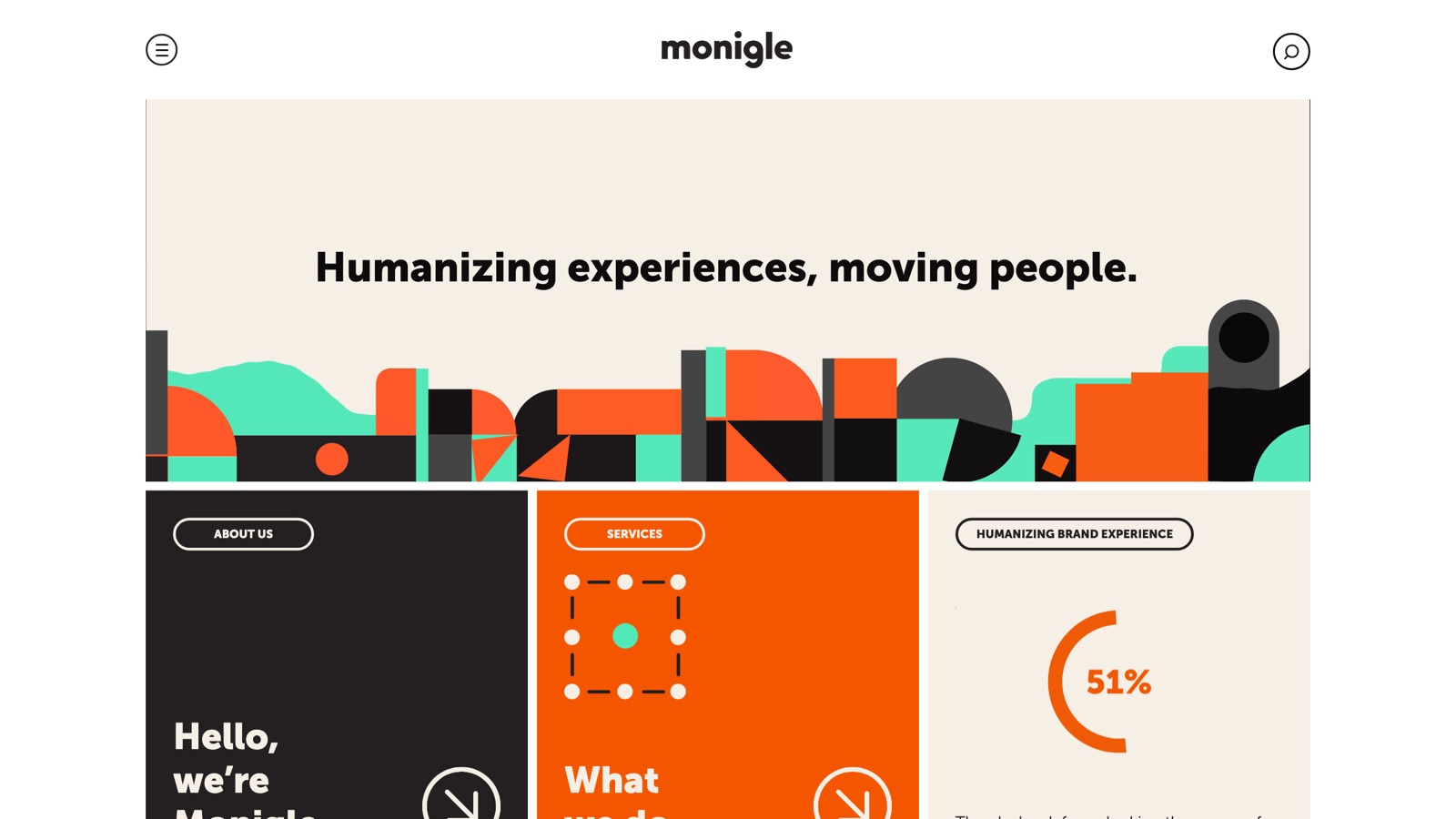
Founded in 1971 and describing itself as a brand experience agency, Monigle has built an uncommon specialism in the internal half of branding, meaning employee activation, brand management programmes and the research that supports both. The published work concentrates in US healthcare systems, insurance and place branding, which are three categories where the brand is delivered by thousands of employees rather than by a campaign.
- Best for: large employers, health systems and civic bodies where the brand only becomes real if staff adopt it
- Clients they name: Onvida Health, Resmed, Gifthealth, ProSight, Fairfax County, Town of Telluride
- Pricing: per project, undisclosed
- Why they stand out: research and internal activation are a standing practice rather than a phase bolted onto the end, and the brand management programmes mean somebody has thought about what happens in year two
- Worth knowing: the footprint is North America only, two offices in Denver and New York, so a European or Asian buyer runs the whole engagement remotely across time zones. The case studies also cluster tightly in US healthcare and public sector, which is thin evidence if you are a consumer, technology or fashion brand looking for comparable work.
More on Monigle
| Best for | Research and employee activation for large employers |
|---|---|
| Scale | Large independent |
| Where they are | Denver and New York |
| Named clients | Onvida Health, Resmed, Gifthealth, ProSight, Fairfax County, Town of Telluride |
| Pricing | per project, undisclosed |
Two offices, Denver and New York, and more than fifty years of trading history since its 1971 founding, which gives the firm an institutional memory of long-running brand programmes that newer studios cannot match.
Engagements often extend past launch into governance, training and internal measurement, which is where the employee activation practice earns its keep. If you have ever watched a rebrand die because nobody in the regions adopted it, this is the firm built for that failure mode.
Hire Monigle if your brand is delivered by people in uniforms, clinics, offices or counters, and if adoption is the risk. Do not hire them if you need a globally staffed team, if your category is fast-moving consumer or luxury, or if you want a bold external repositioning as the headline deliverable.
8. Kurppa Hosk
Kurppa Hosk publishes a six-part model running Insight, Strategy, Identity, Experience, Activation and Governance, and it is the most complete documented pipeline on this list, in the sense that it names both the research at the front and the governance at the back. The positioning language is Business Artistry, pairing quantitative analysis with design craft, and the portfolio backs it up across industrial, mobility, energy, fintech and retail repositioning.
- Best for: corporates that want research, strategy and identity from one team and expect the brand to be governed after launch
- Clients they name: Scania, Securitas, Telia, Tink, Heart Aerospace, Clas Ohlson, Nordiska Kompaniet, & Other Stories, Alleima, Intrum, Beatport, Dustin
- Pricing: per project, undisclosed
- Why they stand out: the six-part model is a rare thing, a published method that covers both ends of the problem, and the in-house KH Type foundry means proprietary typefaces are part of the offer rather than a licensing conversation
- Worth knowing: the site claims 200 plus staff across five offices, and the firm is part of the Eidra consultancy collective, so engagements are built as long multi-stage transformation programmes with account and governance layers on top. If you want one senior designer on the tools from brief to delivery, this is the wrong shape of company. The published roster is also heavily Nordic, so evidence of leading a US-first or Asia-first brand build is thinner than the office list suggests.
More on Kurppa Hosk
| Best for | Strategy through identity to governance for corporates |
|---|---|
| Scale | 200+ staff, part of Eidra |
| Where they are | Stockholm, Oslo, New York, Chicago, London |
| Named clients | Scania, Securitas, Telia, Tink, Heart Aerospace, Clas Ohlson, Nordiska Kompaniet, & Other Stories, Alleima, Intrum, Beatport, Dustin |
| Pricing | per project, undisclosed |
Offices in Stockholm, Oslo, New York, Chicago and London, with group ownership by Eidra. KH Type operates as a separate type foundry under the same roof.
The typical engagement runs as a staged programme, with insight and strategy phases producing a documented position, then identity and experience work, then activation and a governance framework that tells the client organisation how to run the brand afterwards. That last stage is what most firms skip and what most rebrands need.
Hire Kurppa Hosk when you are repositioning an industrial or corporate brand and want the analysis and the craft under one contract, with a plan for what happens in the two years after launch. Do not hire them for a short identity project, for a small company, or if your primary markets are outside Europe and you need proof of local fluency.
9. Motto
Motto has trademarked its central method, the Idea Worth Rallying Around, and organises everything around finding that single idea for technology and innovation companies before any design happens. The client list runs from Google and Klaviyo through Virgin Voyages and Goodnotes to a long tail of venture-backed companies, and the practice is strongest on positioning, category definition and founder-level brand strategy.
- Best for: founder-led and venture-backed technology companies that need a category position before they need a logo
- Clients they name: Google, Klaviyo, Virgin Voyages, Goodnotes, Cresta, Colliers, Brooklyn Brewery, CloudBees, Artnet, Minnesota Vikings, Earnest, Impel
- Pricing: per project, undisclosed
- Why they stand out: a trademarked and prescriptive method means you know exactly what process you are entering, and the founders will bring an outside point of view rather than facilitating you towards your own
- Worth knowing: roughly eighteen senior people, with two founders who are visibly the product, so availability rather than capability sets your start date. The method being prescriptive is a strength if you want a strong external opinion and a poor fit if you already have a brand framework you want executed inside. It is also remote-first with a meeting space in New York rather than a studio you can sit in, and wearemotto.com sits behind a bot challenge that makes automated tools report it as offline, so ignore any directory telling you the site is down. Note also that motto.agency is an unrelated parked domain listed for sale, not theirs.
More on Motto
| Best for | Category positioning for founder-led technology companies |
|---|---|
| Scale | Independent studio, ~20 people |
| Where they are | New York and London, remote-first |
| Named clients | Google, Klaviyo, Virgin Voyages, Goodnotes, Cresta, Colliers, Brooklyn Brewery, CloudBees, Artnet, Minnesota Vikings, Earnest, Impel |
| Pricing | per project, undisclosed |
Two locations listed, New York and London, with a remote-first team of around eighteen. The work is weighted to technology, with a visible sideline in sports and consumer brands.
Engagements start with the strategy work and the search for the central idea, then move into identity, messaging and launch assets built off it. Because the team is small and senior, you get principals in the room, which is the main argument for choosing them over a larger firm at a similar scope.
Hire Motto if you are defining or redefining a category and want a sharp, opinionated position that a founder can repeat on stage. Do not hire them if you need parallel workstreams running at once, if your timeline is fixed and immovable, or if your internal team has already set the strategic direction and wants an executor rather than an author.
10. Wolff Olins
Wolff Olins is still the firm most likely to talk a large organisation into a uncomfortable idea. The roster is unusually wide, from TikTok and Uber through GSK and McKinsey to The Economist and The Met, which tells you the practice is not limited to one sector’s grammar and that it gets hired by organisations with very different tolerances for risk.
- Best for: organisations that need to be seen differently and have the internal appetite to back a bold move
- Clients they name: TikTok, Uber, Instacart, Decathlon, Patreon, LG, GSK, McKinsey, The Economist, Kenvue, Mercedes-AMG Petronas F1, The Met
- Pricing: per project, undisclosed
- Why they stand out: the client set spans consumer platforms, pharmaceutical, professional services, publishing and cultural institutions, which is a rare spread and suggests the work is not a house style being reapplied
- Worth knowing: this is the least inspectable firm on the list before you sign. Our July 2026 check found no published office list, no headcount and no documented method anywhere on the site, so you cannot tell which studio or which people would staff the account, and there is no framework to hold them to at a mid-point review. Get the individuals, the location and the process written into the statement of work, because none of it is available to check in advance.
More on Wolff Olins
| Best for | Ambitious repositioning for organisations with executive cover |
|---|---|
| Scale | Not published |
| Where they are | Not published, ask before signing |
| Named clients | TikTok, Uber, Instacart, Decathlon, Patreon, LG, GSK, McKinsey, The Economist, Kenvue, Mercedes-AMG Petronas F1, The Met |
| Pricing | per project, undisclosed |
Engagements are usually full-scope repositionings covering strategy, architecture, verbal and visual identity. The firm is comfortable with organisations in the middle of an identity crisis and is frequently brought in when a business has outgrown or contradicted its existing brand.
The related risk is what happens after handover. I have watched work at this level stall in the twelve months following a launch because nobody internally had the authority to defend it, so before you engage, be clear about who owns the brand once the consultancy leaves.
Hire Wolff Olins when the answer needs to be brave and you have executive cover to see it through. Do not hire them if your governance is consensus-driven and slow, if what you actually want is a careful evolution of what already exists, or if your procurement process requires a documented method and a named delivery team before contract.
11. Landor
Landor is part of WPP and runs at 1300 people across 30 locations, which makes it one of the two largest operations on this list. It has absorbed the BAV brand asset valuator, retiring that name in the process, so the data heritage now sits inside the same entity as the design and rollout capability.
- Best for: global brand programmes needing strategy plus multi-market rollout under one roof
- Clients they name: Nike Kids, Milan Symphony Orchestra, LeShuttle, BANCOMAT, Lobos 1707
- Pricing: per project, undisclosed
- Why they stand out: strategy, brand analytics and multi-market design and implementation sit in a single entity at real scale, which very few competitors can match on breadth
- Worth knowing: the absorption is the risk as well as the strength. If you previously bought BAV’s data as a distinct product, it now arrives inside a different structure with different leadership, and at 1300 people the team that pitches is not reliably the team that delivers. Ask for named individuals with time commitments written into the statement of work.
More on Landor
| Best for | Global brand programmes with multi-market rollout |
|---|---|
| Scale | 1300 people, WPP |
| Where they are | 30 locations |
| Named clients | Nike Kids, Milan Symphony Orchestra, LeShuttle, BANCOMAT, Lobos 1707 |
| Pricing | per project, undisclosed |
Thirty locations, 1300 staff, and WPP ownership stated openly on the site.
Engagements are network-scale: multi-market, multi-workstream, with account management layers and the pricing structure a holding company implies. For a brand that has to go live in eighteen countries with local adaptation, that infrastructure is the product.
Hire Landor if your rollout is the hard part and you need one supplier who can cover strategy, design and implementation across regions. Do not hire them if you are a small or mid-size company, because you will be a small account inside a large system, and do not assume the analytics heritage transfers automatically to your project without asking for it by name.
12. Design Bridge and Partners
Formed when WPP merged Design Bridge with Superunion in 2022 and launched the combined firm in January 2023, this is a 900-person operation across sixteen studios, organised around brand strategy, brand identity, brand experience and brand effectiveness. The portfolio is one of the broadest here, running from Guinness and Hellmann’s through HSBC and Airbus to NASA Artemis and Riot Games. The Superunion name was retired into this entity, which is worth knowing if you are trying to trace an old case study.
- Best for: large FMCG, corporate and institutional brands needing strategy plus packaging and identity across many markets
- Clients they name: Guinness, Hellmann’s, Smirnoff, HSBC, Airbus, Legal & General, Haleon, Swiss Re, LSEG, IHG, Fortnum & Mason, NASA Artemis, Riot Games, London Symphony Orchestra, BBC Two
- Pricing: per project, undisclosed
- Why they stand out: the brand effectiveness line means the strategy is expected to be measured after the fact, and the combination of corporate positioning work and serious packaging craft in one firm is uncommon at this scale
- Worth knowing: it sits inside WPP and was folded into the new WPP Creative unit announced in February 2026, on top of the 2023 merger, so leadership, account structure and team composition can change mid-engagement for reasons unrelated to your project. Build a change-of-personnel clause into the contract and ask who your named leads report to today.
More on Design Bridge and Partners
| Best for | FMCG and corporate strategy plus packaging at scale |
|---|---|
| Scale | 900 people, WPP |
| Where they are | 16 studios worldwide |
| Named clients | Guinness, Hellmann's, Smirnoff, HSBC, Airbus, Legal & General, Haleon, Swiss Re, LSEG, IHG, Fortnum & Mason, NASA Artemis, Riot Games, London Symphony Orchestra, BBC Two |
| Pricing | per project, undisclosed |
Sixteen studios including London, Amsterdam, Berlin, Munich, Madrid, New York, Chicago, Sao Paulo, Johannesburg, Mumbai, Jakarta, Singapore, Hong Kong, Beijing, Shanghai and Shenzhen.
Engagements are built for large multi-market programmes, with long strategy phases and network-level pricing. The packaging capability in particular is deep, which matters if your brand lives on a shelf as well as on a screen.
Hire them if you have a global portfolio, real packaging complexity and the appetite for a long structured programme. Do not hire them for a compact identity project or if organisational stability at the supplier is a hard requirement for you, because WPP has been actively restructuring its creative businesses through 2026.
13. Ragged Edge
Ragged Edge works with challenger brands, and the portfolio backs the positioning with names like Wise, Marshmallow and Papier that came out of the work looking distinctly unlike their categories. The strategy is real and it is delivered as a strong point of view rather than as a research programme, which is the whole appeal and also the whole risk.
- Best for: challenger businesses in crowded categories that need a position sharp enough to be noticed without network-scale spending behind it
- Clients they name: Wise, Papier, Marshmallow, Globe-Trotter, Omlet, Palmetto, Granola
- Pricing: per project, undisclosed
- Why they stand out: the strategic output is opinionated rather than diplomatic, and at this size you are buying a specific point of view rather than a committee’s average
- Worth knowing: one studio in London, and no published proprietary method, so you cannot inspect the process before signing and there is no framework to hold them to at a mid-point review. The published portfolio is also weighted to consumer and fintech challengers, so a regulated enterprise buyer will not find directly comparable proof.
More on Ragged Edge
| Best for | Challenger positioning in crowded categories |
|---|---|
| Scale | Independent studio |
| Where they are | London |
| Named clients | Wise, Papier, Marshmallow, Globe-Trotter, Omlet, Palmetto, Granola |
| Pricing | per project, undisclosed |
A single London studio, working mostly with growth-stage and challenger businesses across financial services, consumer products and travel goods.
The engagement shape is a full brand build: strategy and positioning first, then identity, then the work that expresses it. Because the team is in one place, the collaboration is tight and the turnaround is faster than a network firm of comparable ambition.
Hire Ragged Edge if you are fighting incumbents and need a brand that behaves differently from the category norm. Do not hire them if you need a documented, auditable strategic method for internal governance reasons, if your programme spans multiple continents with local research requirements, or if your stakeholders need to be walked slowly towards a conclusion.
14. Red Antler
Red Antler is a New York branding agency built around launches and founder-led businesses, and that specific problem, naming a thing nobody has heard of and positioning it against an incumbent from a standing start, is a distinct discipline from repositioning an established company. It earns a place here on that specialism. It also comes with the largest verification gap on this list, so read the caveat before the case for it.
- Best for: launches and early-stage companies that need naming, positioning and a go-to-market brand from a standing start
- Clients they name: none. Their own clients page publishes no client names at all, so there is nothing here we can attribute to them, and we have deliberately left this bullet empty rather than sourcing names from a directory.
- Pricing: per project, undisclosed
- Why they stand out: launch strategy has different rules from repositioning, the decisions are made with no performance data to argue from, and a firm organised specifically around that starting condition is rare
- Worth knowing: this is the entry you should diligence hardest, because there is almost nothing on the site to diligence. No client roster, no team size and no office footprint beyond New York are published, which means every claim about who they have worked with and who would work on you has to be established in conversation and confirmed with references you source yourself. Ask for three named clients you may contact before you go further.
More on Red Antler
| Best for | Launch strategy, naming and go-to-market branding |
|---|---|
| Scale | Not published |
| Where they are | New York |
| Named clients | none. Their own clients page publishes no client names at all, so there is nothing here we can attribute to them, and we have deliberately left this bullet empty rather than sourcing names from a directory. |
| Pricing | per project, undisclosed |
Based in New York and identifying as a branding agency in the city.
Engagements in this shape typically cover naming, positioning, identity and launch communications, delivered on the compressed timelines that a launch imposes, but the site does not document a process, so confirm the phases and the deliverables in writing rather than assuming the standard sequence.
Hire Red Antler if you are bringing something new to market and want the story, the name and the look decided together, and if you are willing to do the reference-checking the site does not do for you. Do not hire them for a heritage brand with decades of equity to protect, or for an internal culture and activation problem, where Monigle at number seven is the better fit.
15. Base Design
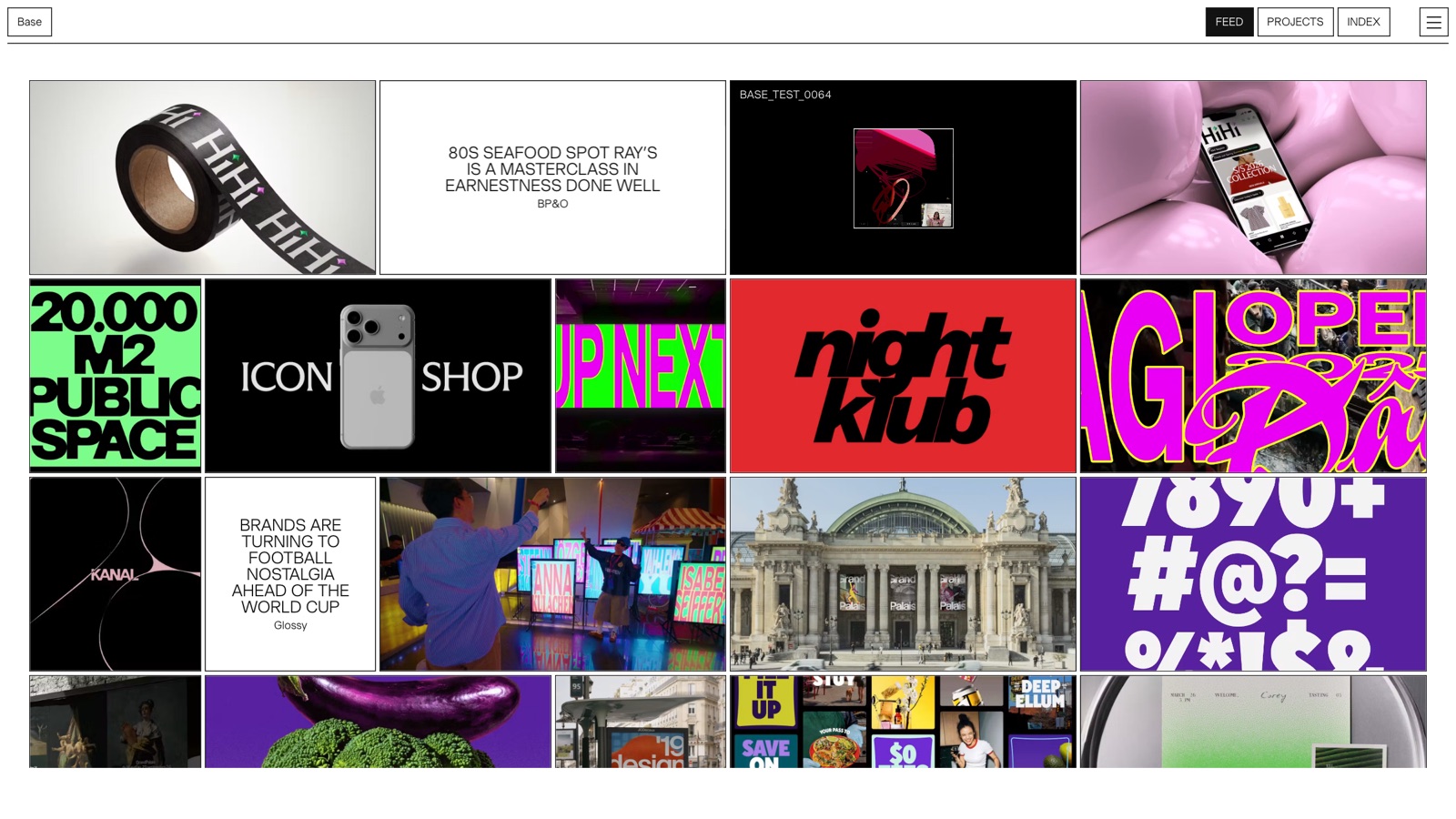
Base is on this list with an explicit caveat, because its own project index tags 353 of 476 disciplines as Identity System against 53 as Brand Strategy. This is the strategy-capable identity house rather than a strategy firm, and it earns the place on the quality of the systems thinking behind work for Dior, Fondation Louis Vuitton and the Grand Palais.
- Best for: cultural institutions, luxury and hospitality brands that need a rigorous identity system with strategy sufficient to justify it
- Clients they name: Dior, UNIQLO, Fondation Louis Vuitton, MoMA Design Store, Grand Palais, Bozar, Deezer, ING Bank, La Prairie, Phillips, Bob Dylan Center, Museum of Fine Arts Boston
- Pricing: per project, undisclosed
- Why they stand out: five studios across four continents produce a international body of cultural and luxury work, and the identity systems hold up across languages and formats in a way that most single-market studios never have to prove
- Worth knowing: the same index shows only 22 campaign projects and 29 digital projects, so Base builds the system and hands it over rather than running it with you. The five studios also operate with deliberately independent voices, so the office you engage changes the team and the output more than the shared name implies, and you should qualify the specific studio rather than the group.
More on Base Design
| Best for | Identity systems for culture, luxury and hospitality |
|---|---|
| Scale | Large independent network |
| Where they are | New York, Brussels, Geneva, Melbourne, Saigon |
| Named clients | Dior, UNIQLO, Fondation Louis Vuitton, MoMA Design Store, Grand Palais, Bozar, Deezer, ING Bank, La Prairie, Phillips, Bob Dylan Center, Museum of Fine Arts Boston |
| Pricing | per project, undisclosed |
Studios in New York, Brussels, Geneva, Melbourne and Saigon, with a separate Base Digital team handling AI and technology work.
Engagements centre on identity systems, with a strategy phase sized to support the design rather than to stand alone as a business recommendation. The cultural and museum work is the deepest seam, and the standard of typographic and editorial craft is high.
Hire Base if you have a cultural, luxury or institutional brand and need a system that behaves consistently across print, environment and screen in multiple markets. Do not hire Base if your primary need is the strategic argument itself, if you want an ongoing execution partner after launch, or if you assume the Brussels reputation guarantees the Melbourne output.
16. Bruce Mau Design
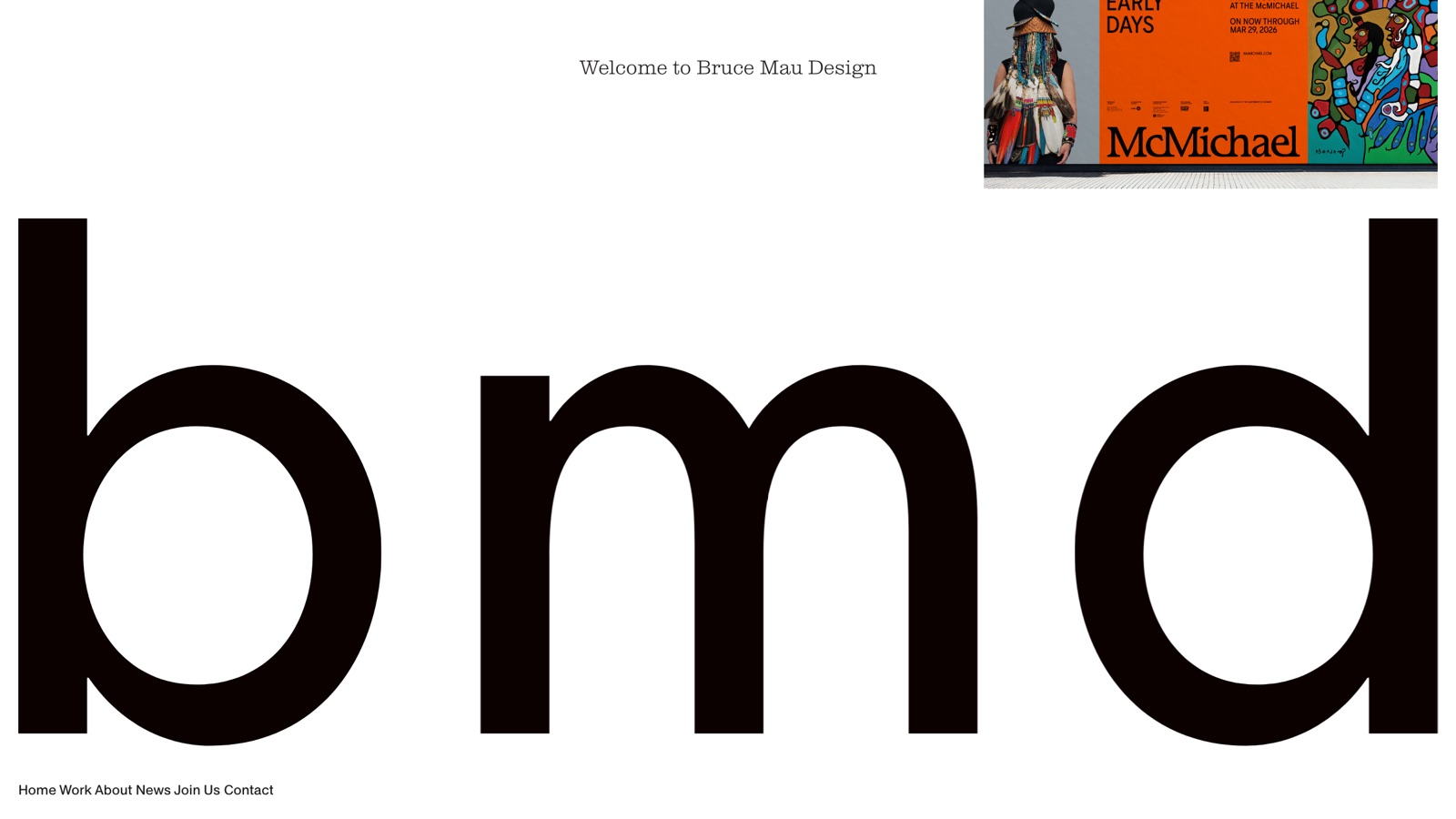
Bruce Mau Design earns a strategy listing on the strength of one specific and under-supplied capability, stakeholder visioning, which is the practice of getting a large institution with many competing constituencies to agree on what it is for before anyone designs anything. That sits alongside brand identity, wayfinding and environmental graphics, and editorial and book design, with a centre of gravity in museums, universities and civic infrastructure.
- Best for: cultural institutions, universities and civic bodies that need alignment among many stakeholders before a brand can exist
- Clients they name: Toronto Pearson Airport, The National Ballet of Canada, Zayed National Museum, Metrolinx, OCAD University, Art Gallery of Ontario, McMichael, Seattle Public Library, Pulitzer Arts Foundation
- Pricing: per project, undisclosed
- Why they stand out: visioning plus wayfinding plus editorial is exactly the combination a museum or a transit authority needs, and almost nobody else offers all three from one team
- Worth knowing: the name on the door is not in the building. Bruce Mau now runs a separate practice and is co-founder and CEO of Massive Change Network, so the founder equity you might assume you are buying is not part of the engagement. The marquee global consumer names on the clients page are also framed in the past tense as brands they have included, while recent case studies and news are almost entirely Canadian cultural and civic projects, so the live capability is narrower than the logo wall suggests.
More on Bruce Mau Design
| Best for | Stakeholder visioning, wayfinding and institutions |
|---|---|
| Scale | Independent studio |
| Where they are | Toronto |
| Named clients | Toronto Pearson Airport, The National Ballet of Canada, Zayed National Museum, Metrolinx, OCAD University, Art Gallery of Ontario, McMichael, Seattle Public Library, Pulitzer Arts Foundation |
| Pricing | per project, undisclosed |
One office in Toronto, founded there in 1985, with a current site that is actively maintained and publishing through 2026.
Engagements often begin with visioning workshops across boards, donors, staff and community groups, then move into identity, signage systems and publications. The wayfinding and environmental work is a real technical competence, not a decorative extension of the graphics.
Hire Bruce Mau Design if you run an institution, a campus or a piece of public infrastructure and the hardest part of the brand is getting your own constituencies to agree. Do not hire them expecting Bruce Mau personally, and do not hire them for fast-moving consumer marketing, where the recent evidence is thin.
17. Bond
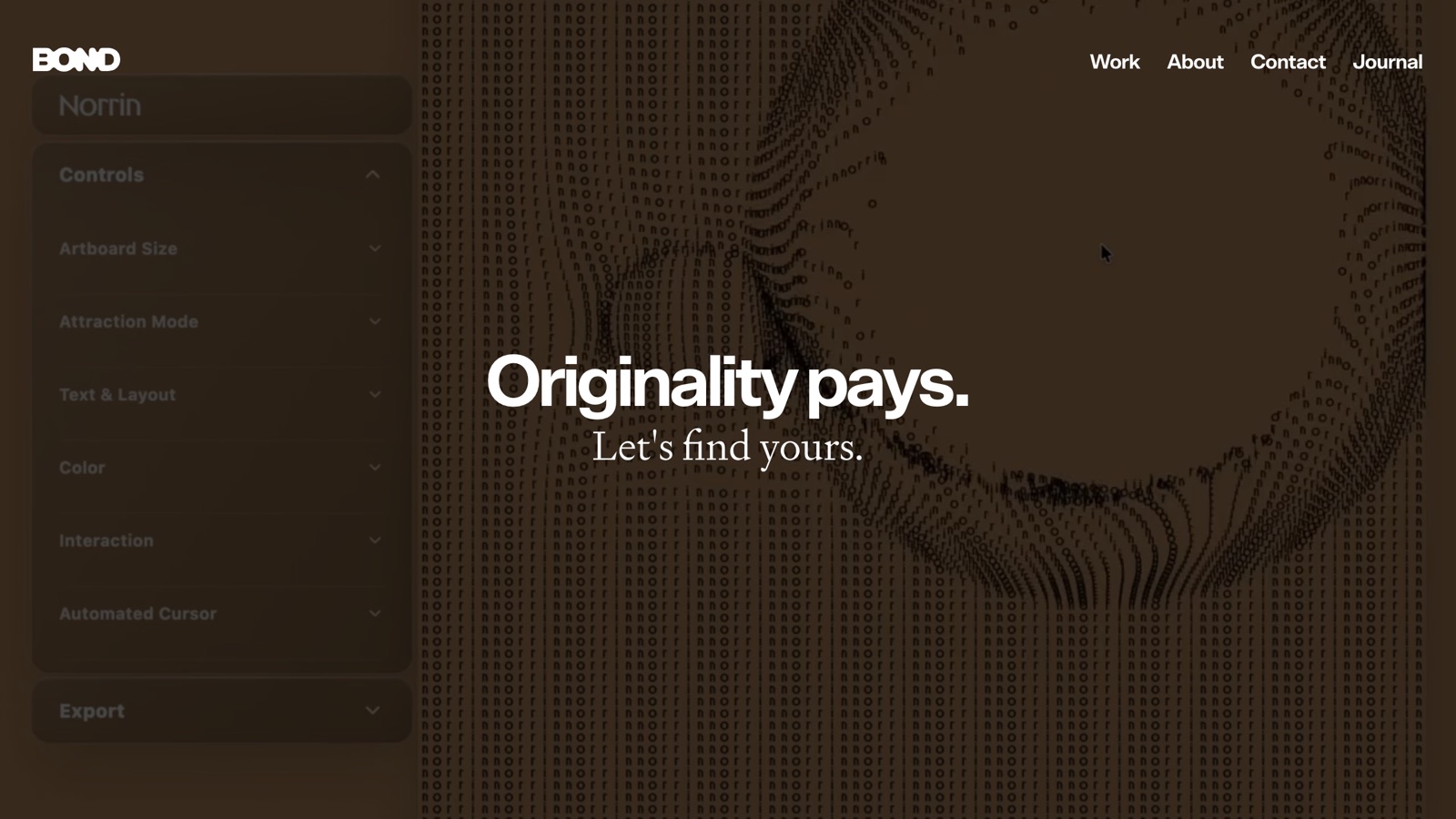
Bond has been independent since 2009, runs at forty people across fifteen nationalities, and describes what it does as creative engineering, which in practice means brand strategy and identity with an industrial design sensibility attached. The current positioning line is Originality pays, and the portfolio spans hospitality, food and drink, culture and Nordic corporates.
- Best for: hospitality, food and drink, and design-conscious corporates wanting strategy and identity from a small independent team
- Clients they name: Raffles Hotels, Fairmont Hotels, Outokumpu, Valio, Hartwall, Cloetta, Kalevala Jewelry, Helsinki Philharmonic Orchestra, Flow Festival, Aleph Farms, Visma, Loupedeck
- Pricing: per project, undisclosed
- Why they stand out: the industrial design leaning means brand thinking extends into objects and physical detail rather than stopping at applications, which is rare at forty people and valuable in hospitality
- Worth knowing: the published work is heavily Finnish and Nordic, with Valio, Hartwall, Kalevala and the Helsinki cultural institutions dominating the case study index, so the Dubai and New York offices carry far less demonstrated evidence than Helsinki does. At forty people total the non-Helsinki teams are small. Also note that bond-agency.com now redirects permanently, and thisisbond.com is the correct address if you are updating a shortlist.
More on Bond
| Best for | Hospitality, food and drink, and Nordic corporates |
|---|---|
| Scale | Independent, 40 people |
| Where they are | Helsinki, Dubai, New York |
| Named clients | Raffles Hotels, Fairmont Hotels, Outokumpu, Valio, Hartwall, Cloetta, Kalevala Jewelry, Helsinki Philharmonic Orchestra, Flow Festival, Aleph Farms, Visma, Loupedeck |
| Pricing | per project, undisclosed |
Three offices, Helsinki, Dubai and New York, independently owned since 2009.
Engagements run as full brand builds, with the strategy work sized to a studio rather than to a consultancy, so confirm the research scope in writing if a formal research phase matters to your stakeholders. The craft standard is high and consistent across the index.
Hire Bond if you want a small senior independent team, particularly for a hospitality, food or cultural brand, and if Nordic design sensibility suits the category. Do not hire them if you need deep US or Gulf market fluency proven by published work, or if you need capacity for a large simultaneous multi-market rollout.
18. Blok Design

Blok, founded by Vanessa Eckstein and based in Toronto, publishes an explicit strategic offer covering strategy and positioning, brand architecture, brand voice, naming and editorial direction, which is more than most studios of its size will commit to in writing. The portfolio runs deep in arts, culture, museums, hospitality, architecture and civic work, with print and editorial craft strong enough that the work has been exhibited at the Trapholt Museum in Copenhagen and the Royal Ontario Museum.
- Best for: cultural, civic and architecture-adjacent organisations wanting naming and architecture alongside a distinctive editorial sensibility
- Clients they name: Toronto International Film Festival, Museum of Contemporary Art Toronto, Pérez Art Museum Miami, Museo Jumex, Museo Tamayo, Bank of Canada, City of Toronto, Biblioteca Vasconcelos, The Broadview Hotel, Alberto Kalach TAX Architects
- Pricing: per project, undisclosed
- Why they stand out: brand architecture and naming are named services here rather than implied, and the editorial and print work is at a standard that gallery institutions actually exhibit
- Worth knowing: the clients page carries a Global Brands list including Adobe, Nike, Nestlé, Pepsi and Heineken, and none of those names have a matching case study anywhere in the project archive, so treat that list as unverifiable in scope and ask what the actual engagement was. The site also publishes no team size, no offices page and no engagement structure, with four email addresses and a phone number as the only route in.
More on Blok Design
| Best for | Naming, architecture and editorial for cultural and civic brands |
|---|---|
| Scale | Independent studio |
| Where they are | Toronto |
| Named clients | Toronto International Film Festival, Museum of Contemporary Art Toronto, Pérez Art Museum Miami, Museo Jumex, Museo Tamayo, Bank of Canada, City of Toronto, Biblioteca Vasconcelos, The Broadview Hotel, Alberto Kalach TAX Architects |
| Pricing | per project, undisclosed |
One studio in Toronto, actively publishing new work through 2025 and 2026. A disambiguation warning worth carrying into a search: blok.design is an unrelated placeholder page, and blokdesign.com is the correct address.
Engagements appear to run as full brand programmes including strategy, naming, identity, packaging and environmental work, though the absence of published process detail means you will have to establish the shape in conversation.
Hire Blok if you are a museum, a foundation, a hospitality group or a civic body and want work with real intellectual and material craft behind it. Do not hire Blok if your procurement needs documented process, published team structure and formal engagement terms before a first meeting, because none of that is on the site.
Every studio in one table
| Studio | Best for | Scale | Where they are |
|---|---|---|---|
| Moonb | Embedded video, motion and design production after the strategy exists | Senior embedded team | Remote |
| Prophet | Enterprise brand-led growth and transformation | Large independent consultancy | 16 offices, US, Europe, Middle East, Asia |
| Lippincott | Mergers, spin-offs and corporate transitions | Global consultancy | 9 offices, cities not published |
| Interbrand | Brand valuation and financially argued brand investment | Global network | 14 hubs across 75 countries |
| Siegel+Gale | Simplifying complex and regulated organisations, naming | Global consultancy | 7 offices, cities not published |
| Vivaldi | Brand fused with business and technology strategy | Network consultancy | 10 offices, New York HQ |
| Monigle | Research and employee activation for large employers | Large independent | Denver and New York |
| Kurppa Hosk | Strategy through identity to governance for corporates | 200+ staff, part of Eidra | Stockholm, Oslo, New York, Chicago, London |
| Motto | Category positioning for founder-led technology companies | Independent studio, ~20 people | New York and London, remote-first |
| Wolff Olins | Ambitious repositioning for organisations with executive cover | Not published | Not published, ask before signing |
| Landor | Global brand programmes with multi-market rollout | 1300 people, WPP | 30 locations |
| Design Bridge and Partners | FMCG and corporate strategy plus packaging at scale | 900 people, WPP | 16 studios worldwide |
| Ragged Edge | Challenger positioning in crowded categories | Independent studio | London |
| Red Antler | Launch strategy, naming and go-to-market branding | Not published | New York |
| Base Design | Identity systems for culture, luxury and hospitality | Large independent network | New York, Brussels, Geneva, Melbourne, Saigon |
| Bruce Mau Design | Stakeholder visioning, wayfinding and institutions | Independent studio | Toronto |
| Bond | Hospitality, food and drink, and Nordic corporates | Independent, 40 people | Helsinki, Dubai, New York |
| Blok Design | Naming, architecture and editorial for cultural and civic brands | Independent studio | Toronto |
How I would recommend choosing
Start by writing down the artefact you need at the end, in one sentence, before you contact anybody. For teams that need execution as well as strategy, the general branding agencies roundup is broader. If that sentence contains the words portfolio, architecture, valuation, merger or adoption, you are shopping in entries two through seven and the rest of the list will underserve you no matter how good the work looks. If the sentence is about being understood or being noticed in a category, the studios from Motto at number nine downward will get you there faster and for less money, because you do not need a research programme to answer a question you can already articulate.
The second filter is who has to be convinced. I have watched more brand programmes die in the approval stage than in the work stage, and the pattern is consistent: the brand team bought a partner who speaks brand, and then had to translate the recommendation for an executive who speaks margin. If your CFO is the veto, buy a firm whose method produces financial arguments, which is what Interbrand’s valuation practice and Prophet’s business strategy line exist to do. If your risk is that four thousand employees ignore the new brand, Monigle’s activation practice is a more relevant purchase than any amount of visual ambition.
Then insist on named people with committed time. The larger firms on this list have a structural gap between the pitch team and the delivery team, and that reflects how account-based businesses work rather than any dishonesty. The fix is boring and effective: get the individuals named in the statement of work with a percentage of their time attached, and a clause covering what happens if they leave or get moved. At the smaller studios the opposite risk applies, where the named people are certain but their availability is not, so ask when they can actually start rather than when they say they can.
A related and underrated filter is how much a firm lets you inspect before you sign. Some of the entries above publish a method, an office list and a headcount you can hold them to. Others publish almost nothing, and two of them, Wolff Olins and Red Antler, publish so little that everything has to be established in conversation and confirmed with references you source yourself. That is not automatically disqualifying, but it moves the diligence burden onto you, and you should price that in as time rather than ignore it.
Finally, decide who builds the work before you sign the strategy. This is the single most expensive gap in the market and the reason a great deal of good strategic thinking never reaches a customer. Firms like Prophet and Vivaldi will tell you upfront that execution is not what they sell, and the sensible response is to bring the production partner into the same conversation and the same approval, so the positioning is handed to someone with a plan for turning it into film, motion and layouts rather than to a shared drive. Whether that partner is an in-house team, a studio from lower down this list, or an embedded team like ours matters much less than the fact that somebody has the job before the strategy is finished.
One last thing, and it is the simplest piece of diligence available: ask each shortlisted firm what they would refuse to do for you. The ones with a real method will answer immediately, because a method is a set of things you have decided not to do, and the answer tells you more about the next six months than any case study will.
Frequently asked questions
A brand strategy firm sells thinking: research, positioning, portfolio and naming architecture, valuation and internal activation, with the output being a recommendation an executive team has to approve. A branding agency sells the identity system that expresses a position, usually with a shorter strategy phase attached at the front. Prophet, Vivaldi and Monigle sit clearly in the first group. Base Design and Bond sit in the second, with strategy sized to support the design work.
At consultancy level, plan for quarters rather than weeks. Firms like Prophet, Vivaldi and Kurppa Hosk run staged programmes with diagnostic, research and stakeholder phases before any recommendation, and multi-market work extends that further. A strategy-led studio such as Ragged Edge, Motto or Bond will usually move faster over the same territory, because the research is lighter and the decision-making group is smaller. Match the timeline to who has to approve the result, not to your launch date, and get the phases written down before you sign.
Some do and some refuse. Prophet openly does not execute creative work, so anyone hiring them needs a second partner for identity design and production. Kurppa Hosk, Design Bridge and Partners and Mother Design cover strategy through to design and rollout in one engagement. The most common and most expensive mistake is assuming the strategy firm will make the work, discovering it will not, and then running a fresh procurement while the positioning goes stale.