Fractional Creative Director: Costs and When You Actually Need One
What a fractional creative director does, what senior creative leadership really costs, and how to tell whether your gap is direction or production before you hire.


A fractional creative director is a senior creative leader you bring in part-time to own the direction of the work, without carrying a full-time executive salary. I run Moonb, so I hear the request often, and I have learned to answer it with a question: is your bottleneck direction, or is it production? That one distinction decides whether a fractional CD fixes your problem or just adds a layer on top of it.
Most teams arrive here the same way. The decks get made, the posts go out, the product video gets cut, and the brand still looks like four different companies depending on where you run into it. There are capable people doing the work. What is missing is the senior voice that can look at all of it, make the call, and hold the line week after week.
What a fractional creative director actually is
A fractional creative director is a senior creative leader engaged part-time or on a defined scope. They give creative direction, protect the brand, and lead the people making the work, without taking a permanent seat. The role sits inside the wider shift toward fractional leadership, where senior specialists work with a company a few days a month instead of joining full-time.
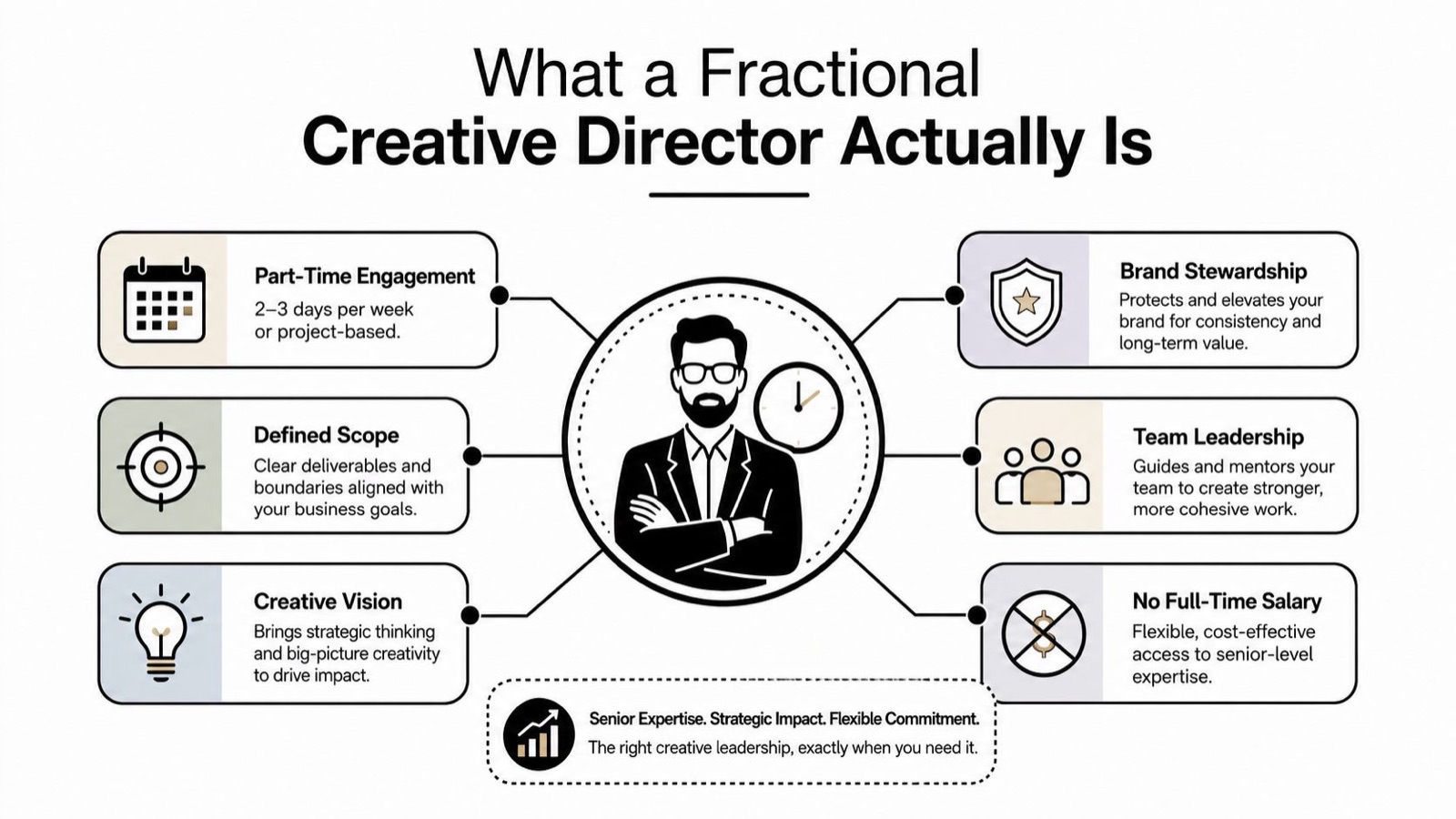
The part people miss is that the job is leadership, not output. A full-time CD is embedded day to day and owns the whole function. A fractional one owns the direction, the standard, and the decisions that keep the work coherent. They sit in the leadership meeting, set the bar for what good looks like, and keep your designers, writers, editors, and motion people pulling the same way, while the actual production stays with the team. For where that role stops and craft-level execution begins, our guide to the creative director and art director split draws the line cleanly.
The designer and technologist John Maeda has a short talk on how art, technology, and design shape the people who lead creative work. It is a good primer on the kind of judgment you are actually buying when you hire at this level.
What a fractional creative director does day to day
The day is mostly spent removing confusion before it turns into rework. The job is less about making every asset and more about making sure the team knows what good looks like, who decides, and how work gets reviewed.
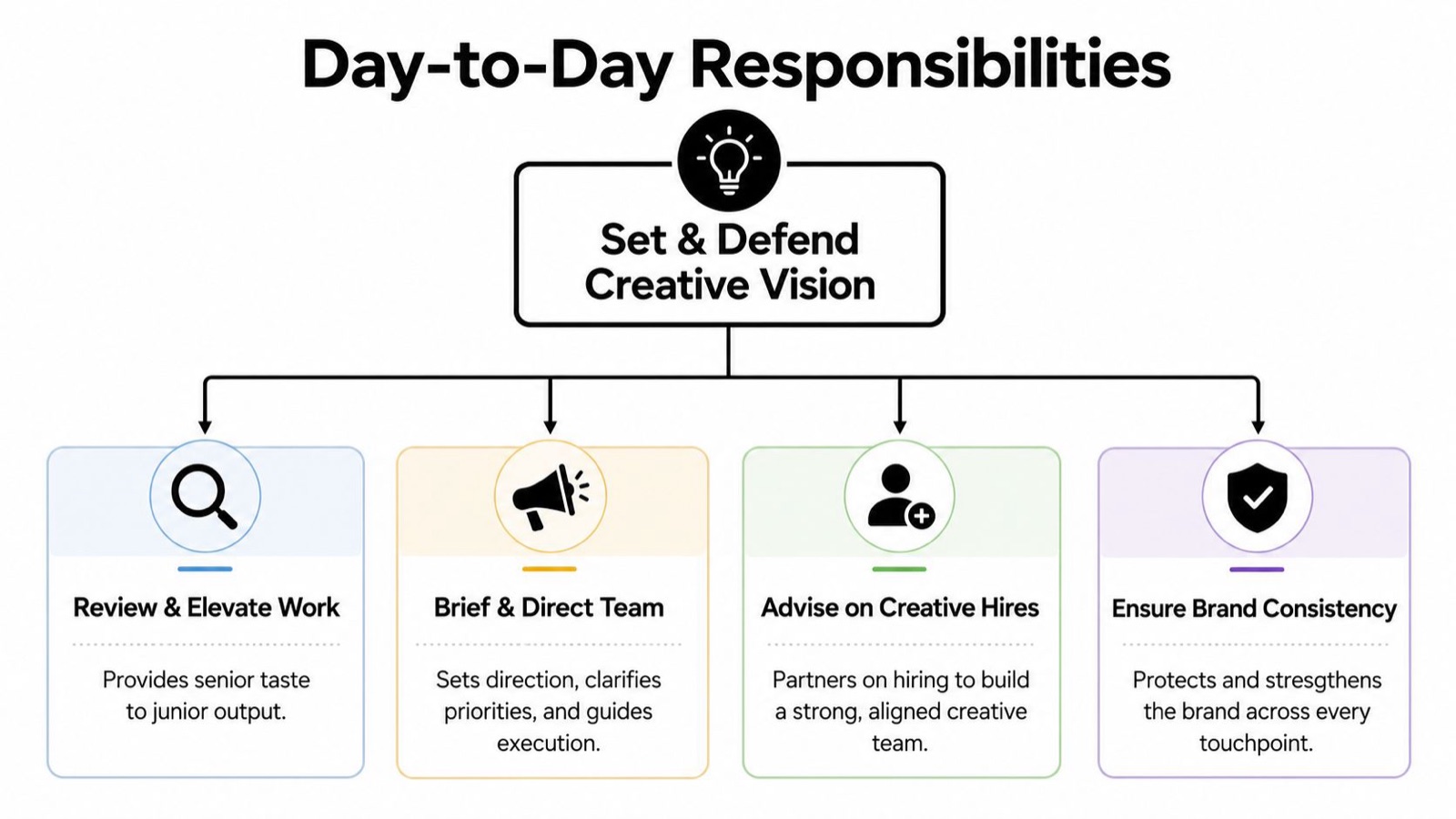
The strongest ones build what I think of as a creative operating system: briefing standards, a review cadence, version control, and a shared asset library, so decisions happen early and the team stops solving the same problem five different ways. That unglamorous scaffolding is what keeps output consistent across paid social, email, the site, and everything else.
In practice it starts with the brief. A good fractional CD sharpens the ask before anyone opens a file, checks the work while it is still easy to change, and keeps brand calls aligned across marketing, product, and design. They also weigh in on who you hire next, because once a senior creative is in the room it gets obvious whether you need a stronger designer, a sharper writer, or more motion support. If you are weighing whether to grow that muscle inside the company instead, how to build an in-house creative team is a useful planning read, and a clean approval flow keeps the reviews from becoming the bottleneck.
The situation I run into most is a Series A company with two junior designers and a marketing lead who is already stretched thin. Assets keep shipping, but the look and the message wander from channel to channel and nobody can say why. A fractional CD does not become the production engine here. Their week goes to setting the standard and tightening feedback so the team stops re-litigating the same creative decision on every project.
What a fractional CD cannot do is give you volume. The limit is hours, so most arrangements run a handful of hours a week or a few days a month, which is plenty for direction and nowhere near enough to clear a backlog. If your team is already underwater, the answer is another maker, not another layer of oversight.
Leading creative people well is its own skill, and Harvard Business School’s Linda Hill has spent years studying how the best creative teams actually run.
What it costs, and what drives the number
Start from what senior creative leadership costs full-time, because that is the number a fractional model gets measured against. The US Bureau of Labor Statistics puts the median for art directors, the closest government occupation, at $111,040 a year as of May 2024. For the creative director title specifically, Glassdoor puts the average base near $158,000, with the top quartile past $210,000. Add benefits, recruiting, tools, and the management time a senior hire needs, and a permanent seat costs well beyond the salary line.
Base pay only, before benefits, recruiting, tools, and management overhead. Sources: US Bureau of Labor Statistics, Occupational Outlook Handbook (art directors, May 2024); Glassdoor (creative director, 2026).
That gap is the case for the fractional model. You buy the senior judgment and the brand stewardship without taking on the full fixed cost of a permanent executive. Engagements usually take one of three shapes: a monthly retainer for a set number of days, a day rate for defined support, or a fixed scope for a launch, an audit, or a brand sprint. What moves the price is seniority, hours, category experience, and whether the director only sets direction or also owns deliverables. Market retainers vary widely by scope, so I tell teams to treat any single figure they find online as a starting point, not a quote. For drawing the line between what should live inside the company and what should sit outside, our creative design services overview helps separate direction from production, which is usually where the wrong hire happens.
How to know if you need one
The clearest signal is simple: your team is producing work, but no senior person is deciding what wins when the options are close.
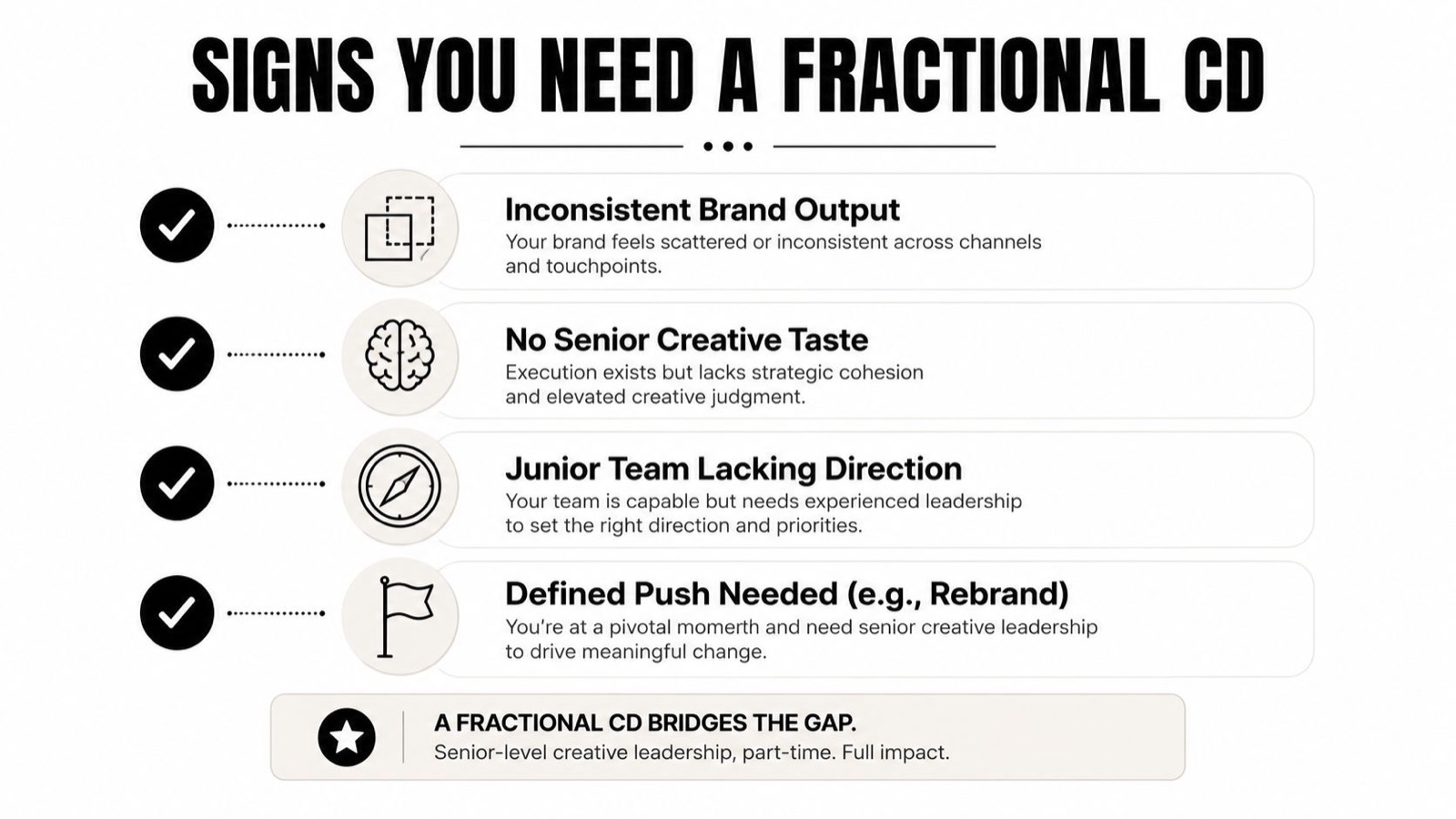
A few more tells point the same way. Your brand looks like a different company on each channel. The team keeps redoing work because the direction was fuzzy at the start. You have a rebrand or a launch coming that needs senior creative focus, but not enough steady volume to justify a permanent CD. A fractional CD is strongest when you have people who can make things but no senior taste in the room to steer them, and it is the wrong call when the real gap is throughput, because more direction will not create hours in the week. If you are not sure which problem you have, a brand audit is a good way to tell brand inconsistency apart from a deeper structural gap; once you can see whether the work is merely scattered or broken at the root, the fix is either a strategy problem or a staffing one.
Your options for senior creative leadership
There is more than one way to buy senior creative direction, and the right pick comes back to the same question: do you need direction, or more hands making the work? This is how the common routes compare.
| Option | Typical commitment | Best for | Key trade-off |
|---|---|---|---|
| Independent fractional CDs | Part-time, defined scope | Teams that need senior direction and brand guardianship | Limited hours, and the best people often juggle several clients |
| Fractional-exec networks and marketplaces | Variable, curated matches | Fast access to vetted senior talent | Quality varies by match, and fit matters a lot |
| Boutique studios with a CD-led team | Project or retained team | Brands that want leadership plus production | You may get a studio process, not a deeply embedded operator |
| Moonb, as a dedicated creative team | Steady weekly rhythm | Teams that need ongoing production across video, motion, design, and brand content | It supports the team, it does not replace in-house strategy ownership |
| Traditional agencies with an assigned CD | Campaign or retainer | Companies that want a broad agency bench | Direction can dilute if the CD is one layer inside a larger account |
| Freelance CDs via portfolio networks | Project-based | Specific launches or brand refreshes | Continuity thins out after the project ends |
| Staffing and contract firms | Interim or contract | Fast coverage for a vacancy | The hire is often about availability more than leadership depth |
| Full-time hire | Daily ownership | Companies with enough volume for a permanent seat | Highest fixed commitment, slowest to adjust if the fit is wrong |
| Promoting internally | Ongoing | Teams with strong internal talent and context | Great makers are not always ready to lead creatively |
| Brand consultancies | Strategy-led engagements | Repositioning, naming, or brand architecture | Usually light on day-to-day execution support |
| Design leadership advisories | Advisory cadence | Founders who need counsel, not management | Advice does not create output by itself |
| Interim or maternity-cover CDs | Temporary full ownership | Short-term leadership gaps | Short window, so systems may not fully mature |
| Product design leadership firms | Product and UX-heavy scope | Companies where creative and product overlap | May not cover broader brand and marketing needs |
Sort them by the kind of gap you have. Some teams need a senior eye to sharpen judgment and keep the work consistent; others need throughput, which means more people producing rather than more people reviewing. A fractional CD answers the first, not the second.
How to hire a good one
Start with where they come from, then check for leadership over portfolio polish. Strong candidates turn up in independent practitioner circles, fractional-exec networks, boutique studios that lead with a CD, embedded creative teams, and agencies with an assigned director. The best hires I have made and seen share a pattern: their portfolio fits your category and stage, their references speak to how they lead people rather than how their work looks, and they can explain exactly how they set briefs, run reviews, and hold the standard when other people do the making.
Watch for the big-name trap. A respected CD who mostly hands off to juniors can look strong on paper and still leave you without the senior judgment you thought you were paying for, so ask who joins the working sessions and who signs off on the final work. A short paid pilot with a clear brief and a shared definition of good is the cleanest way to learn whether their taste and their operating style fit your team, and our creative brief template is a decent companion for that first assignment.
Making the call
A fractional creative director makes sense when you need senior direction and brand consistency but the volume does not justify a full-time hire. If your real need is more production, build that capacity first. If it is leadership, sharper standards, and one person who owns the creative bar, the fractional model fits, and the best answer is the one that matches your stage and how much direction your team can actually use right now.
At Moonb we run closer to the dedicated-team end of that spectrum: a standing group that holds the brand memory and keeps producing across video, motion, design, and brand content, so nobody is re-explaining the brand every week. It supports your team rather than taking over your strategy, which for a lot of growing companies is exactly the piece that was missing.
Further reading: research summary, fractional cadence overview, improve AI search visibility, GTM 80/20 salary statistics.
Frequently asked questions
It comes down to who does the making. A fractional creative director gives you senior direction while your own people produce the work, so it fits teams that already have designers, writers, or editors but no senior taste steering them. An agency is the better call when you need the whole thing produced outside the building and do not have the internal hands to execute. If your makers are good but the output keeps wandering, buy direction; if there are no makers, buy production.
There is no fixed term. Many arrangements are rolling monthly and continue while the need is real, and others are scoped to a single window like a rebrand or a launch and end when it ships. I would start with a short paid pilot against a clear brief, then extend only if the taste and the working rhythm actually fit. Committing to a long engagement before you have seen how someone leads is the most common way this hire goes wrong.
Within limits. The real constraint is hours and the cost of context-switching, not talent. A single fractional CD can hold the direction across a couple of lines that share one brand system, because the standards carry over. Genuinely separate brands each need their own brand memory, so once you are asking one person to steer two unrelated identities on the same few hours a week, you need more direction time rather than the same time stretched thinner.