Content Creation Agency: How to Choose the Right Partner
The three kinds of content creation agency, how each one charges, the vendor-call questions that expose weak ones, and a starting shortlist organised by gap.


A content creation agency is an external partner that produces brand, marketing, or editorial content, and the label hides three very different businesses: SEO writing shops, social and creator agencies, and design and video production partners. The right one depends on the gap you need filled, not on whose portfolio looks best.
I work at Moonb, and I see the mismatch constantly: teams search “best content creation agency,” compare portfolios, and end up briefing weekly product video to a shop built for long-form SEO articles. A creator agency may produce strong short-form hooks but lack the design system your email and product teams need; a production partner may ship excellent motion work without owning search strategy. The narrower question wins every time: what gap must the partner fill, and how should the work run after kickoff?
Defining a content creation agency
A content creation agency is an external partner that produces finished content for a brand, marketing team, product group, or publisher. The quick decision rule: hire an SEO and long-form writing partner when search visibility and editorial volume are the constraint; choose a social or UGC agency for creator-style short video and paid social concepts; choose a design and video production partner, or an embedded creative team, for recurring branded video, motion, design, and campaign assets.
These options do not share the same production system. SEO firms start with search research, editorial planning, briefs, and written drafts. Social and creator firms develop platform-native concepts, source creators, produce UGC, and support social distribution. Design and video partners create visual work such as motion graphics, product demos, paid ads, presentations, and brand content.
The distinction affects both the buying decision and the working relationship. Don’t compare these firms by website polish or client logos. Start with the most expensive constraint in your workflow: if writers can’t keep up with search demand, assess the writing lane; if paid social needs a steady supply of creator concepts, assess social specialists; if your team loses time chasing briefs, revisions, files, and brand corrections across formats, assess a production partner with stronger creative operations.
For the narrative side of this choice, our guide to a brand storytelling agency is useful context. Keep the roles separate: a storytelling partner shapes the message, while a content creation partner turns that message into a repeatable stream of finished assets.
What a content creation agency does
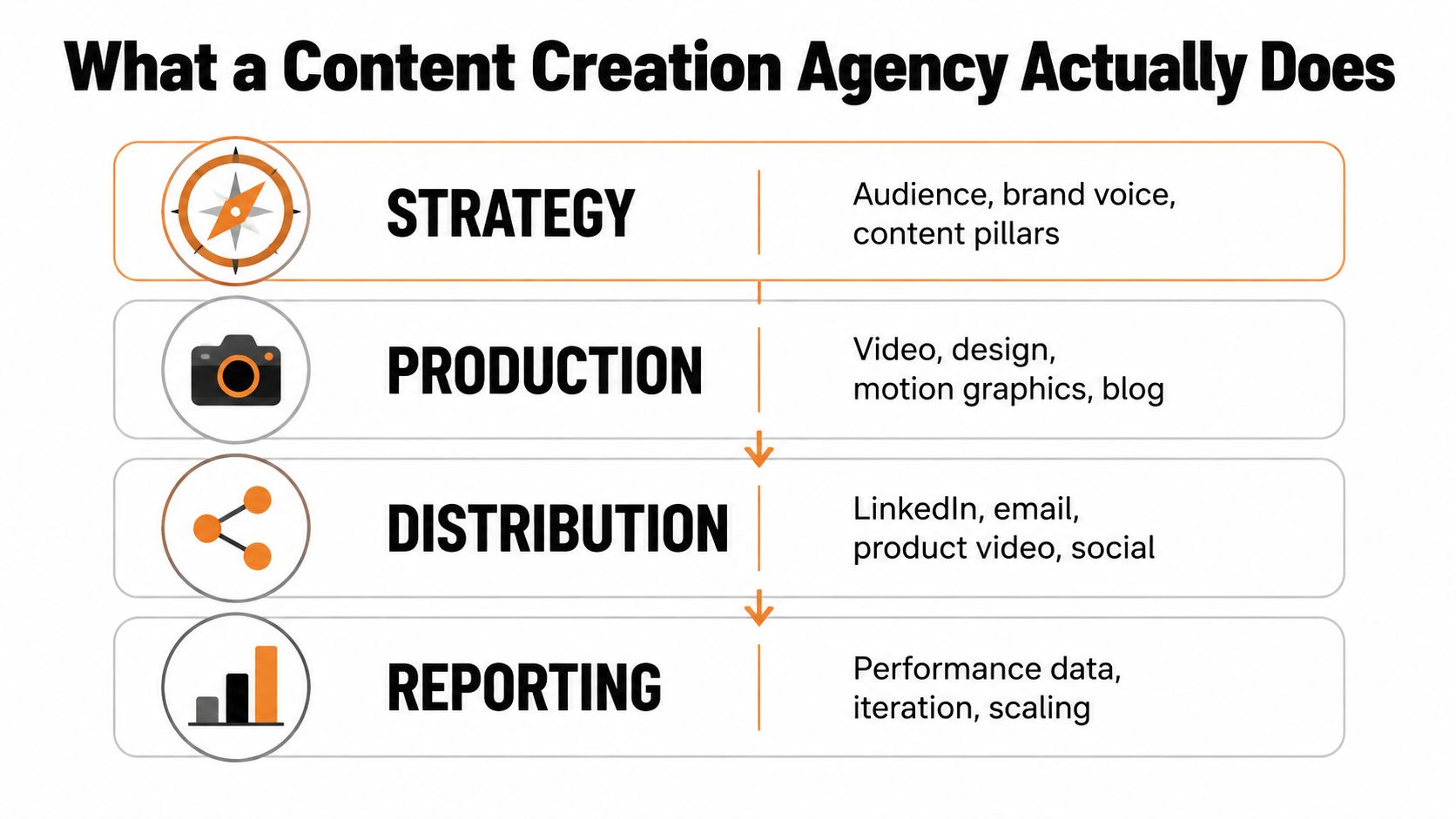
The word “agency” can describe very different scopes. One firm may own strategy, production, publishing, and reporting. Another may only produce assets after your team decides what to say, where it will appear, and how success will be measured. Clarify that boundary before comparing proposals.
Strategy sets the brief
Strategy may cover a channel audit, audience definition, content pillars, brand voice, campaign themes, and a shared calendar. An SEO programme adds keyword research and an editorial roadmap. For a product launch, the work determines which messages become a demo, social cutdown, email graphic, or sales asset.
Ask for named outputs whenever a proposal says “content strategy.” A useful deliverable gives your team something to apply: a calendar, brief template, prioritised topic list, or channel plan. If the message itself is the weak point, this HubSpot session on storytelling in marketing strategy is a good calibration for what the strategy layer should actually produce. Ecommerce teams considering automation in planning and drafting can review AI copywriting for eCommerce, while still checking brand rules, product facts, and customer intent themselves.
Production turns decisions into assets
Production is the most visible scope. It can include blog articles, social posts, short-form video, motion graphics, animation, illustrations, email visuals, product videos, landing page graphics, and presentation design.
Check whether the agency produces every format in-house. A firm may display video, design, and editorial work on one website, then subcontract one service after the contract is signed. That model can work, but the proposal should identify who owns quality, deadlines, feedback, and revisions.
Distribution and reporting need clear owners
Distribution may include uploading content, scheduling posts, managing email deployment, adapting assets for paid media, or handing final files to your internal team. Many production partners stop at delivery; that’s workable when your team owns publishing, provided the handoff is explicit.
Reporting should connect output to the channel’s goal. A writing partner reviews organic sessions and assisted pipeline. A video partner assesses watch time and completion. A social team examines engagement and saves. The reporting schedule matters less than whether the findings guide the next production decision. A content strategy scope can sit upstream of production, but buyers still need to confirm where planning ends and execution begins.
Ongoing pipeline versus project retainer
An ongoing pipeline starts with a kickoff covering channels, formats, brand rules, approvals, and existing assets. The client and agency share a calendar, then batch work weekly or biweekly; a batch might include social posts, a short video, and supporting graphics. One Creative Director signs off across the set, which helps the feed read as one brand. Agreed revision rounds and turnaround rules keep work moving.
A project-based arrangement works differently: each asset is briefed, quoted, and scheduled separately. It suits discrete campaigns and unusual deliverables, while recurring work loses time to repeated briefing and context-setting. Choose the model that matches your constraint, reliable throughput or flexible campaign production.
Three kinds of content creation agencies
The three lanes below are different buying decisions. Use the table to identify the primary gap before you compare names.
| Type | Typical deliverables | Engagement model | Best for |
|---|---|---|---|
| SEO and long-form writing agencies | Keyword research, editorial calendars, blog posts, landing pages, guides, technical SEO support | Project work, editorial programmes, or ongoing engagements | Teams that need search visibility, written volume, and a structured publishing plan |
| Social, UGC, and creator agencies | Creator sourcing, UGC briefs, short-form video, paid social concepts, platform-native posts, influencer campaigns | Campaigns, creator programmes, or ongoing social engagements | Brands that need creator-style content, social hooks, and paid media testing |
| Design and video production partners | Brand video, product demos, motion graphics, animation, ad creative, social design, presentations, campaign systems | Per-project production, retained production, or embedded team engagement | Marketing teams that need recurring visual output across video, motion, design, and email |
The decision path is straightforward. Start with the bottleneck that affects your next campaign, not the service list that looks largest. A writing-first agency fits a search-led problem. A creator agency fits a social or paid distribution problem. A production partner fits a cross-channel visual consistency and capacity problem.
Many teams need two of the three. Buy the primary gap first, then add the second lane once the workflow is stable. Combining partners too early creates another coordination problem, especially when each supplier has its own calendar, approval process, and interpretation of the brand. And before signing anything, ask who executes each format listed in the proposal; if the answer is unclear, ask which work is done by employees, which is assigned to freelancers, and who makes the final quality decision.
For a deeper look at the specialist end of the social lane, see our guide to a short-form video agency; when your main concern is ongoing production rather than a single campaign, the piece on creative as a service maps that category.
Agency vs freelancers vs in-house vs embedded team
The choice isn’t external versus internal. Most marketing teams are deciding how much coordination they can carry while keeping quality consistent, and in practice most in-house creative teams use external partners for overflow and specialist work rather than as a replacement; hybrid setups are the norm, not the exception.
| Model | Real benefit | Real cost | Best when |
|---|---|---|---|
| Agency engagement | Broad skill coverage and a fast start | Account-management layers, less brand immersion, switching costs at the end | You need several disciplines quickly or campaign work that changes over time |
| Freelancers | Specialist depth and direct access to the maker | Your team carries coordination, consistency, briefing, and backup coverage | You need a specific skill for a defined project |
| In-house team | Deepest brand knowledge and immediate availability | Slowest to build, fixed employment cost, specialist gaps in video or motion | Content is central to the business and demand is predictable |
| Embedded creative team | A standing crew, one Creative Director, a repeatable weekly rhythm | It remains external, so you still need an internal owner and agreed scope | You need recurring video, motion, and design without adding every role internally |
An agency engagement gives you breadth, but the account layer can separate the buyer from the people making the work. Freelancers can be excellent, but the client often becomes the producer, traffic manager, and continuity system. In-house teams know the brand best, though hiring a complete visual production function takes time and leaves gaps when demand spikes.
An embedded team sits between those models: it works inside the client’s workflow, learns the brand, and keeps a standing production rhythm. It doesn’t remove the need for direction; one internal marketing lead still owns priorities, messaging, and approvals. For a more detailed comparison, use the in-house versus agency guide.
How content creation agencies charge
The cheapest pricing model can become the most expensive once missing work, revisions, and coordination appear. Choose the model that matches how clearly you can define the work and how much production planning the partner will own.
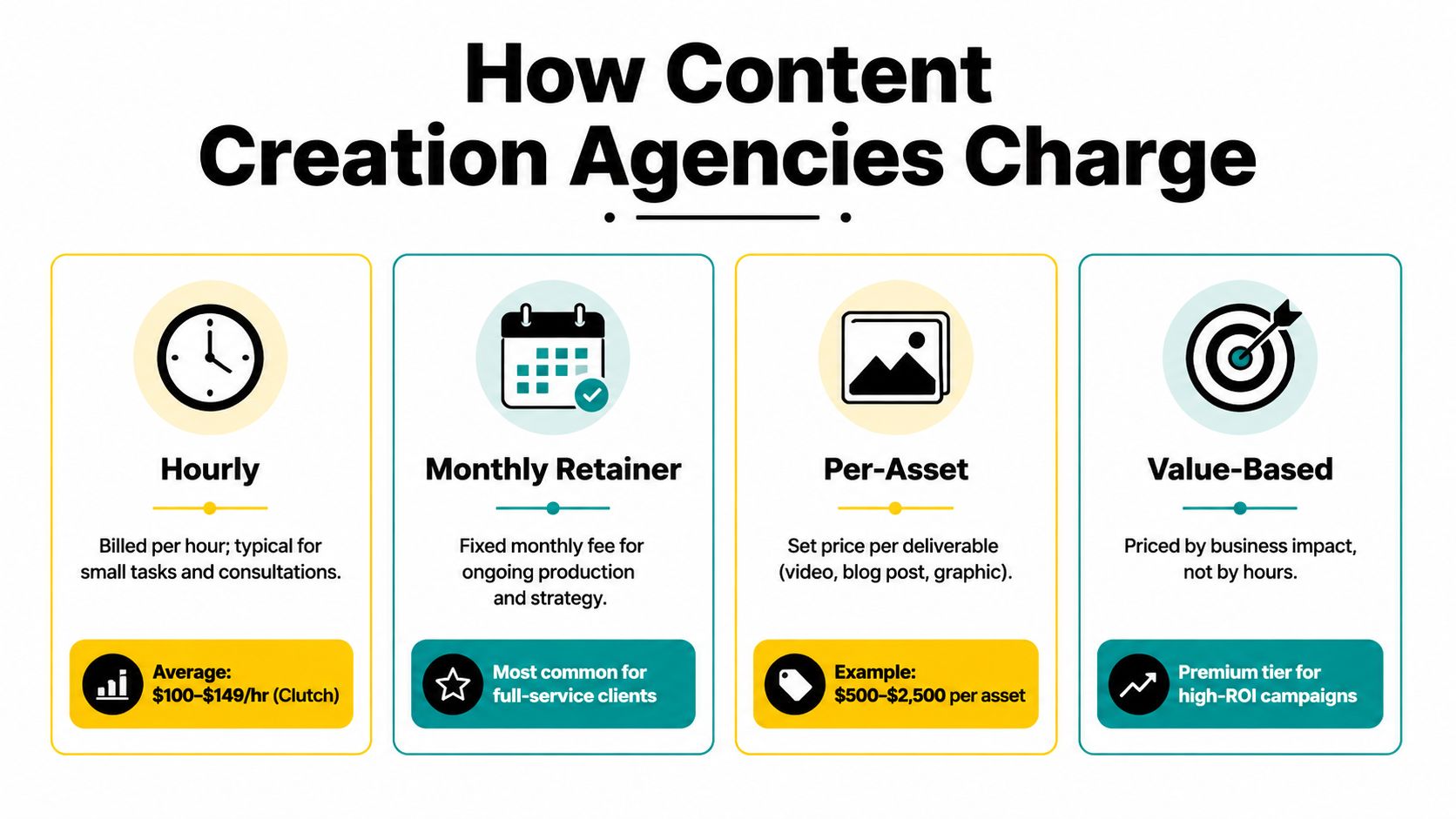
Hourly billing fits consultations, audits, small revisions, and specialist support. Directories like Clutch publish typical hourly bands for content marketing firms, and they’re worth a look as a reference, but open-ended briefs make hourly work hard to control. Ask what the estimate covers, who performs the work, how hours are tracked, and when the agency must warn you the plan is at risk.
A monthly arrangement reserves ongoing team access or a defined production scope. It suits recurring formats, regular campaigns, and teams that want a stable working rhythm. Compare more than the headline fee: review the included disciplines, seniority, asset definitions, revision rounds, meetings, strategy, distribution, reporting, and rules for unused capacity. A lower quote may leave out scripting, project management, adaptations, or approvals your team assumed were included.
Per-asset pricing makes a defined deliverable easier to assess: a product demo, an article, a campaign graphic set. The unit must be specified carefully. One supplier’s “video” includes research, scripting, storyboards, editing, captions, music, versioning, and final exports; another charges separately for each item. Put those inclusions in the scope before comparing quotes.
Value-based pricing ties the fee to the work’s commercial importance rather than time alone; agencies use it for launches, high-stakes campaigns, or assignments requiring senior strategic involvement. Whatever the model, request a scope breakdown before approving: the work before production, the review process, and the files delivered at the end. Compare operating assumptions, not just the final number.
How to choose and red flags to watch for
A vendor call should test the production system, not only the portfolio. Ask questions that reveal who will do the work, how feedback moves, and what happens when priorities change.
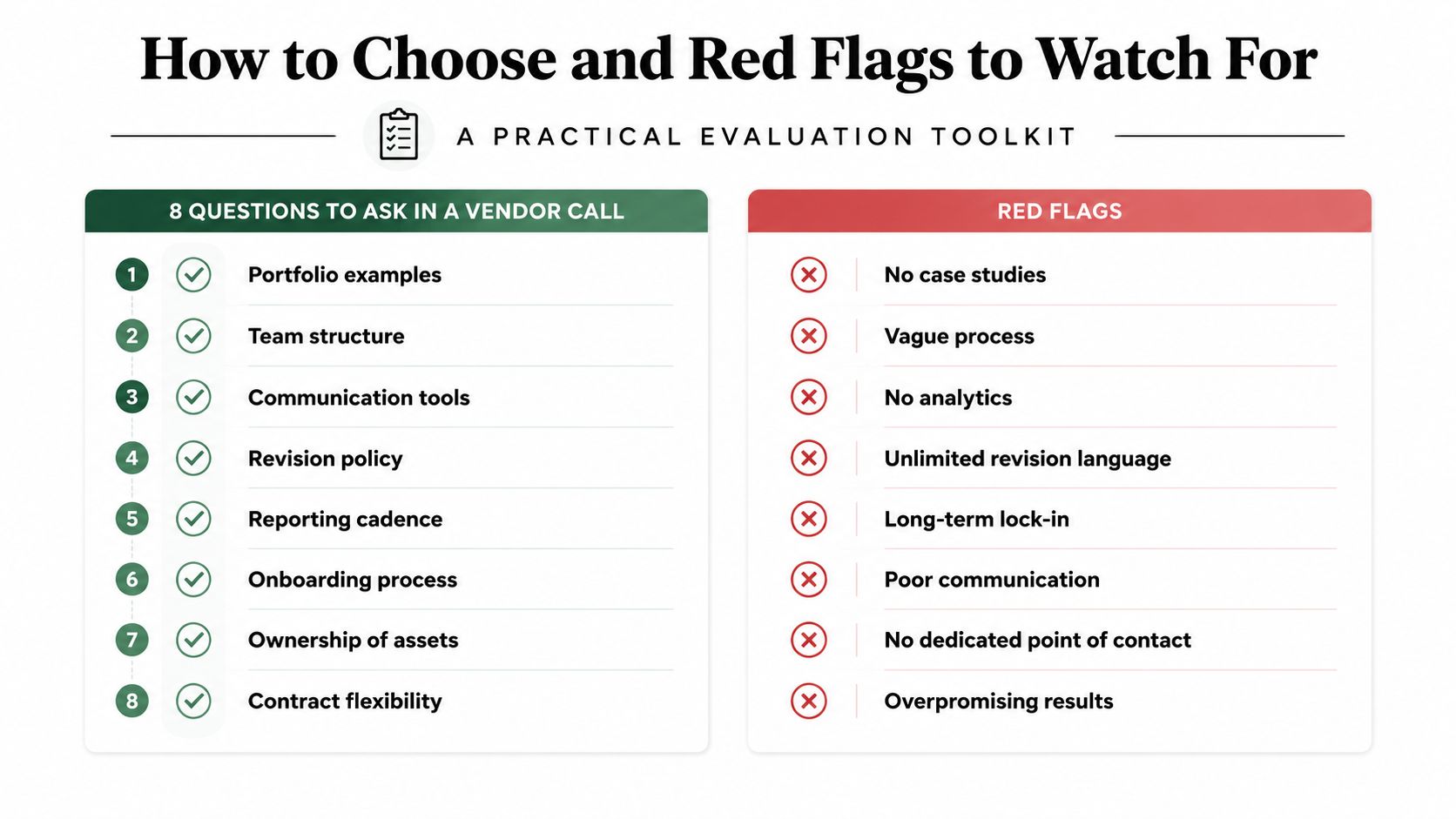
Eight questions to ask in a vendor call
- Who will do the work after the senior pitch? Ask for names, roles, and the person responsible for final quality.
- Can you show a real brief and revision thread? A portfolio shows taste; a revision history shows how the team handles ambiguity.
- Which formats do you execute directly? Confirm who handles video, motion, design, writing, animation, and adaptations.
- What does the revision policy say? Get the number of rounds, what counts as a new direction, and how late feedback affects the schedule, in writing.
- Who owns the content and source files? In the UK, the creator is usually the first legal owner of commissioned copyright unless ownership is agreed in writing; the US default is similar. Never assume payment settles it.
- What are the exit terms? Confirm notice, delivery of working files, access to project records, and the treatment of unfinished work.
- Who approves content on our side? Choose one internal owner before work starts. Five reviewers create conflicting direction.
- Which metric will guide iteration? Pick one primary measure for delivery, quality, and business performance before the engagement begins.
The reporting metric must match the partner. An SEO writing shop shouldn’t be judged on Instagram reach, and a social team shouldn’t be judged only on organic sessions. Choose the channel’s own business signal: engagement and saves for social, watch time and completion for video, organic sessions and assisted pipeline for SEO content. For the video side specifically, our guide to hiring a video editor covers the questions worth asking before you sign.
Red flags and the practical fix
- Buying volume without a goal: define the primary business metric before discussing asset counts.
- No internal owner: assign one approver who consolidates feedback.
- A portfolio without a process: request a brief, calendar, review example, and delivery checklist.
- A senior pitch with an unknown delivery team: name the working team in the agreement.
- Unclear ownership: put IP transfer, usage rights, source files, and exit terms in writing.
- Vague revisions: state rounds, feedback windows, and what triggers a rescope.
- Chasing every channel: start with two channels the team can support consistently.
- Promises without measurement: ask what the partner can control and how it will report progress.
A consumer fintech marketing team I worked with moved from asset-by-asset agency work to a standing creative team. Before the change, the marketing manager waited on quotes and briefed separate pieces for LinkedIn, product video, and email; different people touched each asset, so the visual system drifted. Afterward, one Creative Director guided a weekly rhythm and reused the same visual system across formats. The improvement was qualitative: fewer revision rounds, steadier posting, less internal coordination.
Whichever lane you buy, remember what the content is for. Kelly D. Parker’s TED talk on persuasive storytelling is a good reminder that the asset counts are the means, not the point.
A starting shortlist of 12 content creation agencies
This isn’t a ranking; it’s a starting shortlist organised by the gap each company may fit. Pricing is custom unless the company publishes a figure on its own site, and buyers should verify current scope directly.
SEO and long-form writing
- Siege Media: best for SEO-led content strategy, editorial production, and visual content connected to organic search.
- Brafton: best for teams looking for a broad content marketing programme spanning writing, strategy, and supporting formats.
- ClearVoice: best for organisations that need access to an editorial network and managed content workflows.
- Codeless: best for search-focused brands that need long-form editorial production and content operations.
Social, UGC, and creator work
- inBeat: best for creator-led paid social concepts and UGC programmes.
- LYFE Marketing: best for small and growing teams seeking social media management and content support.
- Viral Nation: best for larger creator, influencer, and social campaign programmes.
- iHatePosting: best for brands that want a social content system with platform-focused publishing support.
Design and video production
- Superside: best for companies seeking broad design and creative production support across formats.
- Design Pickle: best for teams that need recurring graphic design support across marketing requests.
- Column Five: best for data storytelling, editorial design, infographics, and visual content.
- Moonb: full disclosure, this is the studio I work with, so read it with that in mind. An embedded content creation team for marketing teams that need video, motion, and design shipped weekly under one Creative Director.
The shortlist is only useful if you apply the decision path. If search is the bottleneck, start with the first group. If creator-style social is the gap, start with the second. If the problem is recurring branded production across video, motion, design, and email, investigate the third; the guide to a video content agency adds context there. The strongest showreel still doesn’t answer the essential questions: who works on your account, how revisions run, and whether the partner can keep your brand consistent after the first project.
If you’re deciding this quarter, write down the single bottleneck you need to remove first. Then take that definition, the eight vendor questions, and the ownership requirements to your next three calls, and compare the actual delivery system rather than the most polished portfolio.
Frequently asked questions
An individual creator is one person responsible for their own specialist output; an agency or dedicated team coordinates writers, editors, designers, animators, producers, and creative direction under one roof. Choose by the number of formats you need, the continuity you expect, and how much coordination your team can carry. One brilliant freelancer plus a stretched marketing manager is often slower than a coordinated team.
Use three layers. Delivery covers on-time work, scheduled assets shipped, and revision rounds. Quality covers brand adherence, reuse across channels, and internal approval time. Business uses the channel's own measure: saves and engagement for social, watch time and completion for video, organic sessions and assisted pipeline for SEO. If a partner reports only impressions and follower growth, you're looking at context, not results.
When repeated briefing, quoting, and coordination take more effort than the creative work itself. That's the signal the overhead has outgrown the model. Start the transition with a shared calendar, a defined scope, one internal owner, and a single creative lead responsible for consistency; without those four things a standing team just recreates the same chaos on a monthly bill.