Your Brand Audit Playbook: A Step-by-Step Guide
A practical, step-by-step brand audit guide: how to set a benchmark, audit what your team actually publishes, turn findings into a gap analysis, and build a creative roadmap that sticks.

A brand audit should happen annually as a full review, with quarterly checks on key metrics like online presence and customer feedback, since a brand audit works best as a continuous exercise rather than a one-time event (Ainoa). In practice, it’s a systematic check-up on your brand’s health, comparing how you want to be seen with how you are seen, then turning the gaps into a plan to fix them.
Many teams don’t have a branding problem. They have a visibility problem inside their own company. Everyone is working fast, shipping assets, writing copy, updating decks, answering customers, and the brand slowly splits into versions of itself.
That’s why a brand audit matters. It’s not a naming exercise or a cosmetic review. It’s how you catch the gap between intended identity and public reality before that gap becomes your normal.
What Is a Brand Audit and Why Should You Care?
A brand audit is a structured review of your brand across strategy, messaging, visuals, and customer experience. It checks whether the brand you think you’re presenting is the same one people experience.
The most common surprise is not a bad logo or weak tagline. It’s the personality gap. A company says it’s premium and confident, then the Instagram voice is playful, the sales deck sounds stiff, and support emails read like apologies. The visual side usually tells the same story, logo variations, unofficial colors, random typography, old templates still circulating.
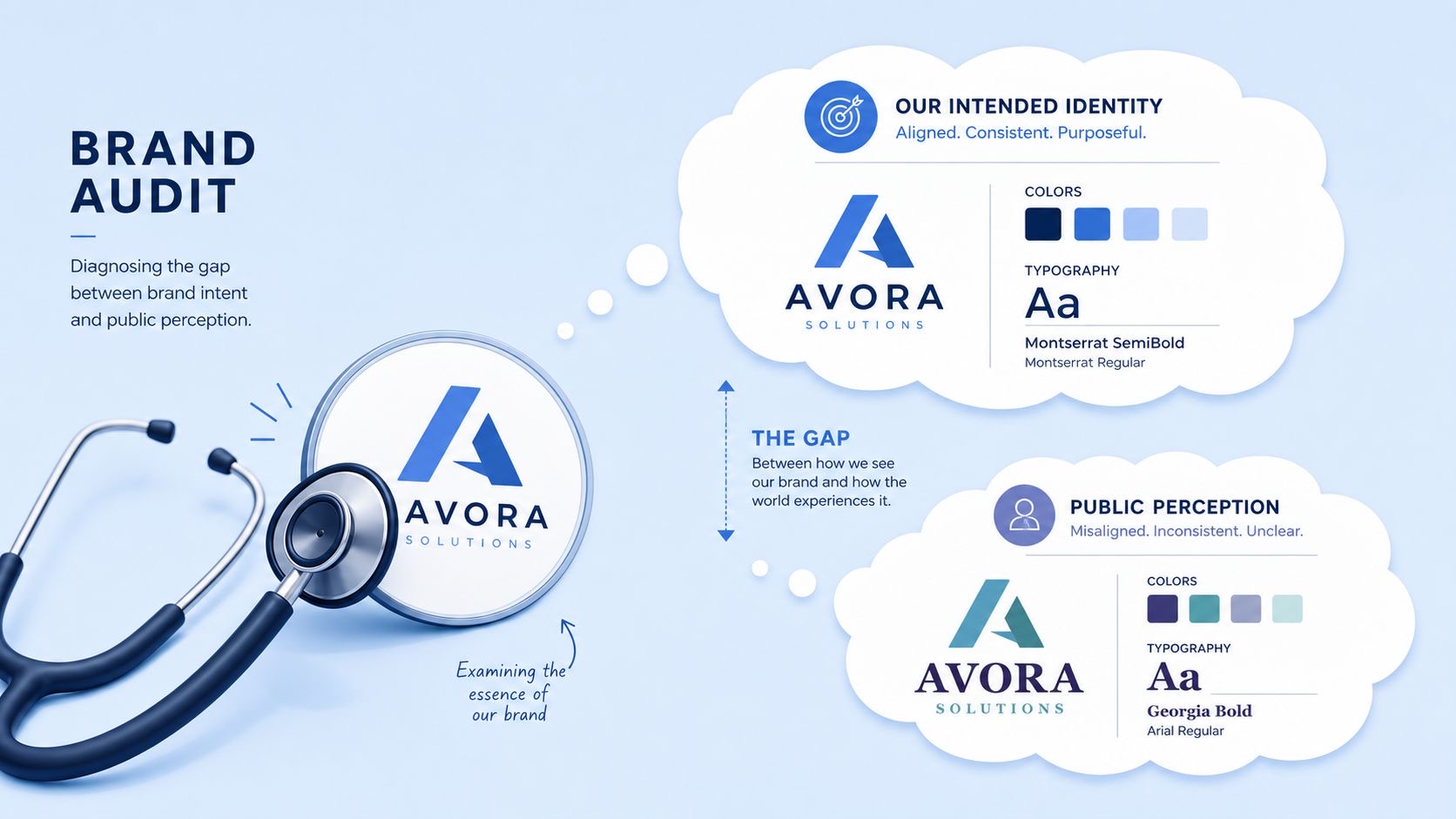
That’s why I treat a brand audit as a governance tool, not a creative exercise. You’re not just asking, “Does this look good?” You’re asking, “Can this brand stay coherent when five teams and three vendors touch it in the same month?”
If you’re already sorting through the difference between the core brand system and the outward execution, this breakdown of brand identity vs branding is a useful companion. If your bigger issue is operational drift across teams and channels, this outside guide on managing brand strategy across an organization gets into the management side rather than just the visuals.
A fragmented brand rarely comes from carelessness. It usually comes from speed, handoffs, and a missing system.
A strong audit gives you three things you can act on right away:
- A clear baseline, what the brand says it is today.
- A reality check, how that brand shows up across actual touchpoints.
- A fix list, what needs to change first, who owns it, and where it matters most.
How Do You Actually Conduct a Brand Audit?
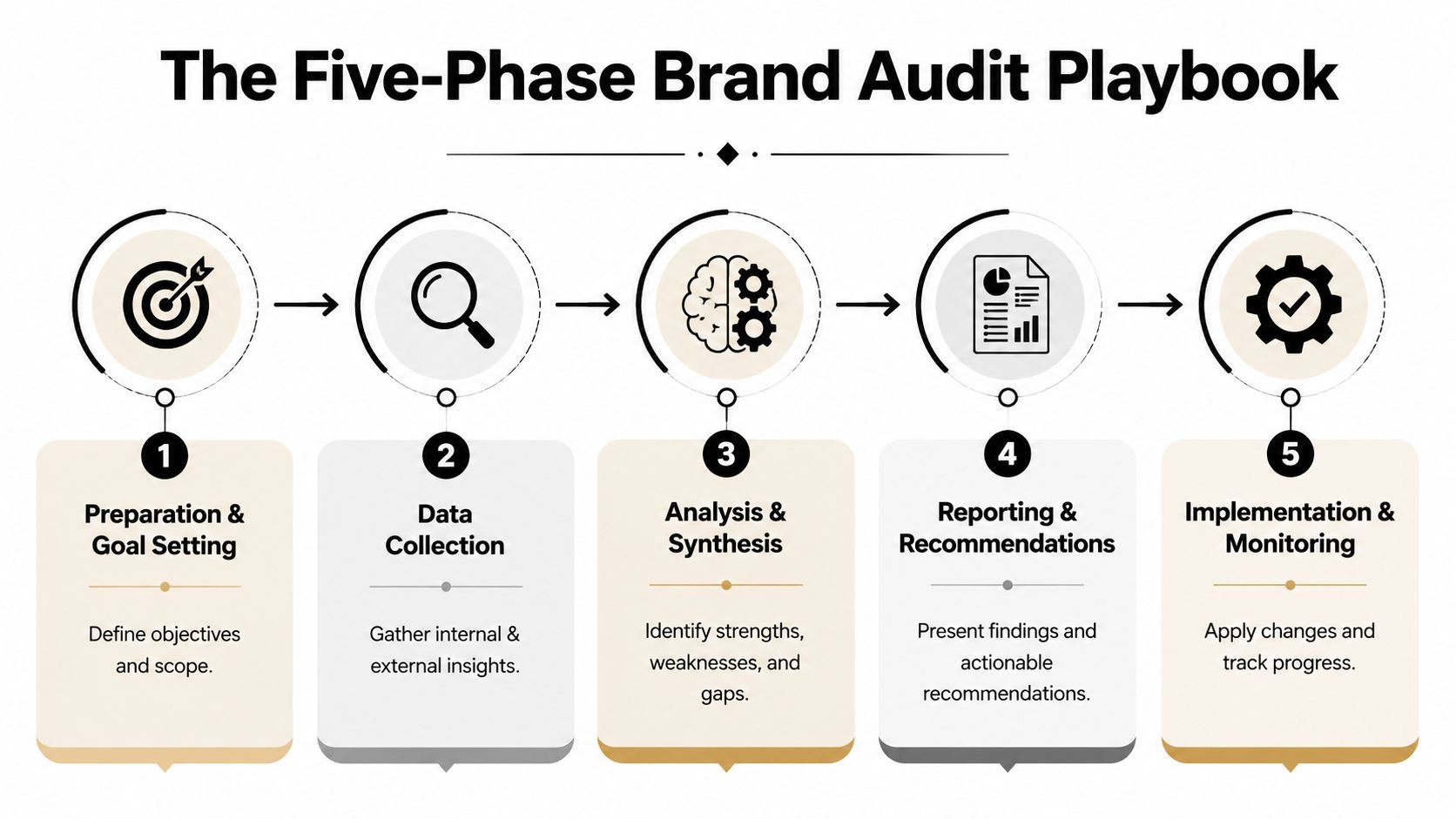
The best practice I trust is simple. Gather everything, compare intention against reality, then prioritize what matters most. A practical audit usually fits into a 4-week phased process: Week 1 defines benchmarks, Weeks 1 to 2 collect internal data, Weeks 2 to 3 gather external intelligence by mining customer reviews and interviewing 10 to 15 recent customers, Week 3 runs the competitive analysis, and Week 4 synthesizes everything into a gap analysis and prioritizes issues by business impact (Celerart).
Near the start, it helps to picture the whole flow before you dig into any one step.
How do you set the benchmark first
Start with what the company believes about itself. Pull the mission, positioning statement, value proposition, audience definition, messaging framework, tagline, brand guidelines, and recent strategy decks. If they conflict, don’t clean that up yet. The conflict is part of the finding.
I like one simple question here. If a new hire read these documents in one sitting, would they come away with one clear picture of the brand, or five partial ones?
Create a source-of-truth folder and log every foundational document. Then write a short benchmark summary in plain language. A few lines is enough if it’s sharp.
- Mission and value proposition, what promise the company is making.
- Audience and positioning, who the brand is for and how it wants to be known.
- Voice and visual intent, how the brand should sound and look when it’s working.
How do you audit what your team is actually publishing
This is the most time-consuming part, and the most revealing. Audit every real customer-facing touchpoint you can get your hands on. Website pages. Landing pages. Social posts. Sales decks. Lifecycle emails. Ads. Packaging. Event booths. Product UI. Support templates.
Catalog them in Airtable, Notion, or a spreadsheet. If your files are scattered, getting them under control is part of the audit. This guide to creative asset management is useful if your team already knows the brand has an organization problem.
Review each asset against a few fixed criteria:
- Visual consistency, logo use, color, type, imagery, spacing, and layout discipline.
- Verbal consistency, tone, confidence level, clarity, repeated claims, and message hierarchy.
- Strategic fit, whether the asset supports the current positioning or an outdated one.
- Operational reality, whether teams can realistically keep producing work in this style.
Practical rule: Don’t audit only the polished assets. Audit the rushed ones too. That’s where the real operating system shows up.
Later in the process, if you want stronger interview prompts or a cleaner way to structure audience input, these user research methods are a useful outside reference.
How do you audit customer and market perception
Internal intent only tells half the story. External perception tells you whether the market is receiving what you think you’re sending.
A more rigorous approach is to gather enough responses from each target market that you can treat the findings as more than anecdotes, pairing quantitative data with qualitative insights as part of the audit process (Neil Patel).
Use a mix of sources:
- Review mining, look at G2, Trustpilot, app stores, or category-specific review sites.
- Customer interviews, speak to recent customers, and include people who nearly bought but didn’t.
- Social and search visibility, check branded search results, social mentions, and how the brand appears in AI answers.
- Competitive comparison, map your brand against rivals on the few attributes customers care about.
I’m less interested in whether customers repeat your internal language. I care whether they describe you in a way that supports the business you’re trying to build.
How do you turn raw findings into a usable gap analysis
By this point, patterns usually become obvious. You’ll see drift between channels, conflict between teams, and old positioning still alive in surprising places.
Write the gap analysis in pairs. Intended brand on one side, perceived brand on the other.
| Intended brand | Observed reality |
|---|---|
| Premium and confident | Tone changes by channel, some copy feels casual or apologetic |
| Clear visual system | Multiple logo versions and inconsistent color use |
| One positioning story | Website, deck, and social lead with different messages |
Often, people overreact and call for a rebrand. Sometimes that’s right. Often it isn’t. Sometimes the brand system is fine and the governance is broken.
For a real example of a brand that let that gap widen and then reset its whole identity to close it, the Wall Street Journal’s rebrand series broke down why Burger King overhauled its logo and its look.
How do you write recommendations people will actually use
Weak recommendations sound like this, “improve brand consistency.” Nobody knows what to do with that. Strong recommendations are specific, owned, and tied to output.
For example:
- Consolidate messaging, replace competing value propositions with one approved framework.
- Retire old assets, archive outdated decks, templates, and logo files.
- Fix the highest-traffic touchpoints first, homepage, sales deck, email templates, and top-performing paid creatives.
- Create rules teams can follow, approved voice examples, design templates, and review checkpoints.
- Set a review rhythm, don’t let the audit die as a PDF.
The audit is only useful if the next week of work changes because of it.
What’s in Your Brand Audit Toolkit?
You don’t need a secret framework. You need a stack that helps you gather evidence, compare assets, and keep decisions visible. The core toolkit is usually boring in the best way. A database for findings, a design workspace for side-by-sides, research tools for search and competitor visibility, and listening tools for customer language.
I keep strategy frameworks in a separate mental drawer. They’re useful, but they’re lenses, not answers. A positioning statement template helps sharpen language. Kapferer’s Brand Identity Prism can expose imbalance. The Golden Circle is good for pressure-testing purpose against execution. Jungian archetypes can help a team discuss personality, but they shouldn’t become a costume.
If you’re reviewing visual consistency, even a practical reference like this color palette tool can help teams spot drift fast when unofficial shades have crept in.
I also keep a few external templates around for channel-specific audits. Narrareach’s social media audit template is handy when social is one of the places the brand has drifted.
Brand Audit Tool Comparison
| Category | Tool examples |
|---|---|
| Audit database | Airtable, Notion |
| Visual review | Figma, FigJam |
| Search visibility | Ahrefs, Semrush |
| Social listening | Brandwatch, Mention |
| Review mining | G2, Trustpilot |
| Market monitoring | Google Alerts |
| AI answer checks | ChatGPT, Perplexity |
| Internal interviews | Google Forms, Typeform |
| Customer interviews | Zoom, Google Meet |
| Survey analysis | Sheets, Airtable |
| Competitor mapping | FigJam, Miro |
| Documentation and rollout | Notion, Google Docs |
A few trade-offs matter here:
- Airtable vs Notion, Airtable is better when you need structured asset tracking, Notion is better for mixed notes and documentation.
- Ahrefs vs Semrush, both work, so pick the one your team already knows.
- Brandwatch vs native platform search, the dedicated tool is deeper, but native search is often enough for a first pass.
How Do You Measure Brand Health and Consistency?
Most leaders want a single score. I get the instinct, but brand health doesn’t compress neatly into one number. What does work is a mixed model, part qualitative scorecard, part channel and search signals.
Start with a simple internal rubric. Score each touchpoint on a 1 to 5 scale for logo use, color adherence, typography, imagery, message clarity, and tone of voice. Average those scores by channel, then track whether the average improves after changes. It’s not an industry standard. It is useful.
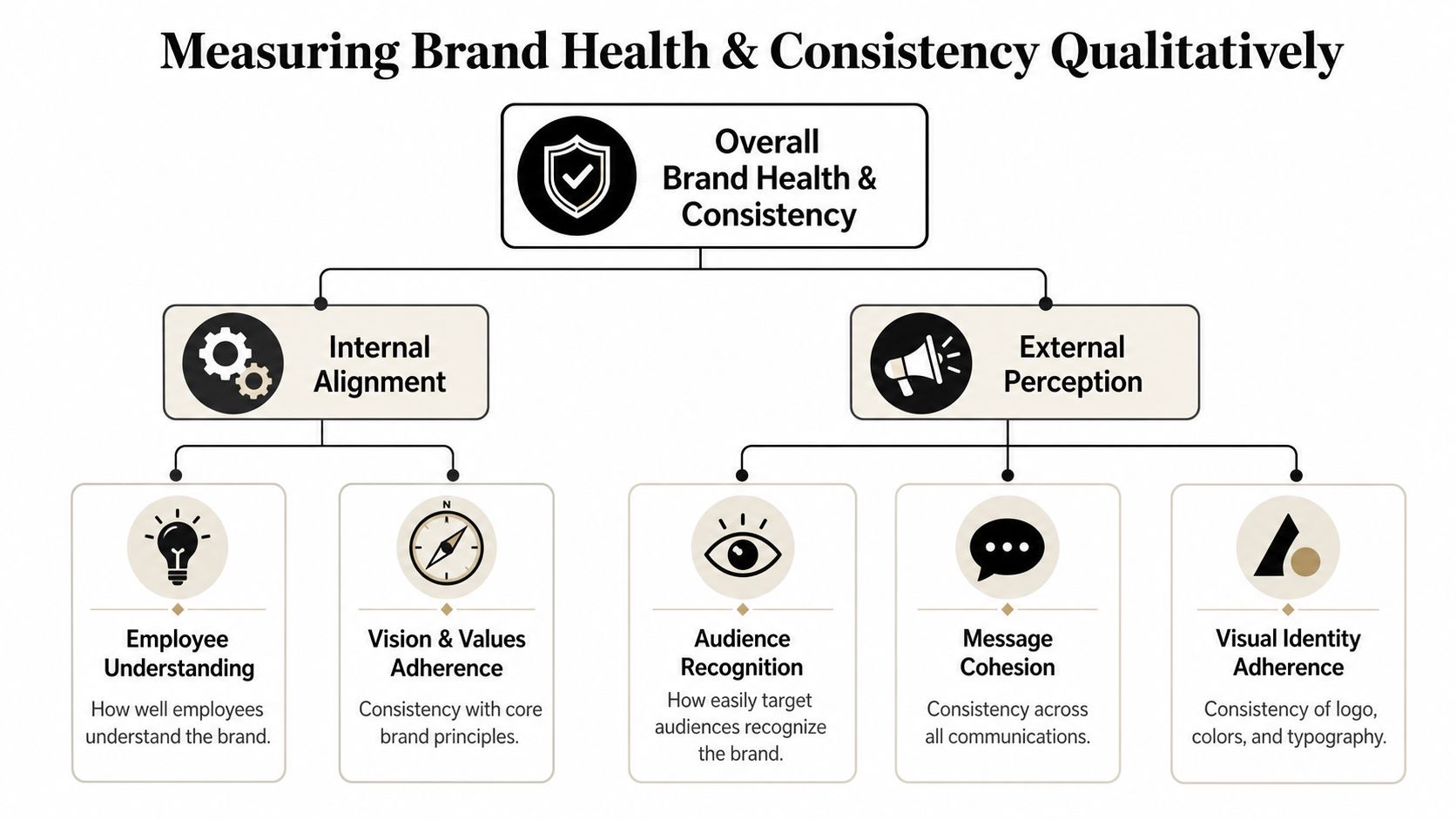
Then add a few harder signals. Track NPS by channel, since a wide gap between how one channel scores versus another usually points to an inconsistency worth fixing. Watch branded search too, because a steady slide in how often people look for you by name is an early sign that brand presence is fading, and Socialinsider walks through these signals in more depth. Neither number is a verdict on its own; they are prompts to go and look at the actual work.
What I wouldn’t do is promise a neat revenue number from consistency work alone. You can watch directionally useful inputs. You can build an internal scorecard. You can monitor search, sentiment, conversion path friction, and channel-level brand response. But brand measurement stays part operational discipline, part judgment.
Measure what changed in the work, not just what changed in the dashboard.
A useful scorecard often includes:
- Touchpoint adherence, your internal 1 to 5 ratings.
- Customer language, whether reviews and interviews reflect your intended positioning.
- Channel consistency, whether audiences get the same brand from website, social, email, and sales materials.
- Search signal movement, whether brand interest is holding or slipping.
How Do You Turn Audit Results Into a Creative Roadmap?
An audit that ends in a slide deck usually stalls. Its value shows up when findings turn into a weekly production plan. That means each issue becomes work with an owner, a format, and a deadline.
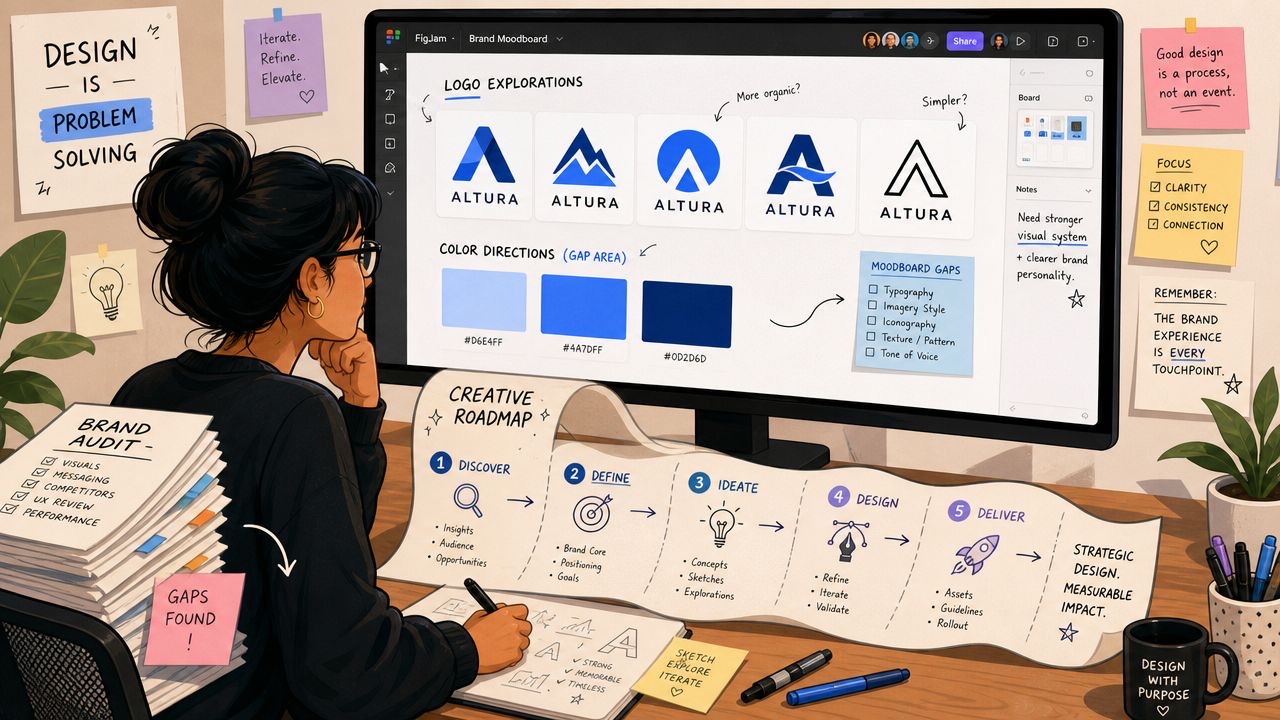
Here’s the shift that matters. Don’t leave recommendations at the level of “tighten the brand voice.” Convert them into output.
- If the homepage is off-positioning, rewrite the headline, subhead, and proof blocks.
- If sales materials drift, rebuild the core deck and lock the template.
- If social sounds like a different company, create post examples and an approval rule.
- If product marketing is improvising, give the team a brief template they can use, such as this creative brief template.
The operating problem behind many audits is fragmentation. When a dozen people and a few outside vendors all touch the brand without a shared system, execution drifts almost by default, a pattern Miller Media 7 digs into in their own brand-audit guide. That doesn’t mean one partner is always the answer. It means one system of ownership usually is.
A roadmap should separate work into three lanes.
What needs fixing now
These are the visible leaks. Homepage copy. Sales deck. Paid creative templates. Email signatures. Core social profile language.
What needs a new system
These are governance jobs. Updated brand guidelines. Asset naming. Template libraries. Approval paths. Retirement rules for outdated files.
What needs steady weekly execution
This is where brands either recover consistency or lose it again. Content calendars, campaign assets, launch creative, sales support design, motion, and brand content all need a regular rhythm. If a team can’t sustain that internally, a dedicated creative team can keep the work moving weekly and on brand without taking over internal leadership.
If you’re sorting out top-of-funnel visibility alongside brand health, this explainer on reach and impressions helps clarify what those metrics do and don’t tell you.
If your audit uncovers more work than your team can realistically execute each week, that’s where extra capacity matters. Moonb is a dedicated creative team that delivers great work on a steady weekly rhythm, on brand and ready when needed, across video, motion, design, animation, and brand content.
Frequently asked questions
An internal team knows the history and can pull every document quickly, which makes them strong on the benchmark and asset-gathering phases. The risk is that people inside the brand stop seeing the drift, so it helps to add a fresh reviewer for the perception and gap-analysis stages, where outsiders catch what insiders read straight past. If you keep it fully internal, assign one owner who will be blunt about findings instead of protective of past work.
A marketing audit asks whether your campaigns and channels are performing (traffic and conversions). A brand audit sits underneath that and asks whether the brand people actually experience matches the one you intend, across strategy, messaging, visuals, and customer support. You can pass the marketing audit on the numbers while failing the brand audit, because the channels convert but each one presents a slightly different company.
Yes, and it usually goes faster because you have fewer assets and fewer teams touching the brand. The value at that stage is catching drift before it hardens, since the gap the article describes forms exactly when you are shipping quickly with no shared system. You can run a compressed version in about a week: benchmark the intent, review your live touchpoints, then write a short gap list, and leave the heavier competitive and interview phases until you have more to compare.