17 Best Brand Identity Agencies in 2026
Seventeen identity studios compared on visual craft: Pentagram, COLLINS, Studio Dumbar, DIA, Order, Base Design and more, with real client names and one limitation each.

I work at Moonb, and we put ourselves at number one on our own list, which is exactly the sort of thing you should read with your arms folded. Nobody grades their own homework fairly. My defence is that our entry is the only one in this article that names four studios further down as a better call than us for the thing most people arrive here wanting, and if that disclosure is not enough for you, skip entry one and start at Pentagram.
Brand identity is a bundle of deliverables that gets sold under one word, and the first thing worth doing is unbundling it. A full identity system usually means a wordmark and a symbol, a typeface that is either licensed or drawn for you, a colour architecture that still passes contrast checks when it hits a form field, an approach to photography and illustration, a set of motion behaviours describing how the mark moves and how the system transitions, and a guidelines document that hundreds of people who will never meet the designer can follow. Almost nobody needs all of it at once. Working out which three or four of those you actually need is the single decision that determines which studio on this list is right for you, and it is the decision most companies skip before they start taking calls.
The studios in this article fall into four groups that behave very differently once you are inside a contract. There are partner-led practices where a named designer draws the thing personally and their calendar is the constraint, which covers Pentagram, Order, DIA and Blok Design. There are motion-native houses where the identity is designed as behaviour from the first week rather than animated afterwards by a different team, which is Studio Dumbar, PORTO ROCHA, DIA again and to a lesser extent Athletics. There are distinctive-asset and packaging specialists whose craft is aimed at a supermarket shelf and a two-second scroll, which is Turner Duckworth and JKR. Then there are the network groups built for multi-market rollouts, where the strategy phase is long and the pricing has a holding company behind it. A studio from the wrong group will still produce competent work, it will simply solve a problem you did not have.
The three questions I ask on every call, in this order. Who physically draws the identity, by name, and what else are they on that quarter. Can I see the guidelines document from a project you finished two years ago, not the case study film but the actual PDF or Figma library, because that document is the deliverable your team will live inside. And was motion designed alongside the mark or bolted on at the end, which you can usually tell within thirty seconds of watching the case study, because retrofitted motion always looks like a logo being politely rotated. Studios that answer all three without flinching are rare, and the ones that do tend to be the ones whose work you can recognise across a room, which is the ranking criterion I used here.
The gap that surprises people comes after the guidelines are signed off. A studio hands over a system, and then somebody has to build hundreds of things with it before the quarter ends. At Moonb we are the team on the other side of that handover. On a product launch we usually pick up a fresh identity from whichever studio built it, spend the opening weeks reading the guidelines properly and stress-testing where they break, then produce the launch film, the cutdowns for paid, the motion for the site header, the event graphics and the sales deck, with the same Creative Director staying on it month after month so the system does not degrade as the volume builds. It is not the glamorous part of a rebrand. It is the part where a good identity either survives contact with a marketing calendar or gets slowly flattened by whoever had capacity that week.
PBS Off Book made a short film on the craft of logo design that explains, better than I can in a paragraph, why a mark is the smallest part of an identity system.
I checked all seventeen of these in July 2026. Every one is live and actively publishing work, and where a domain has moved I have used the destination rather than the old address, which matters more than you would think in this category. Client names come only from each studio’s own website, so if a name is missing here it is because the studio does not publish it, not because the work did not happen. Every entry gets one real limitation written by me, and none of them say “they are premium”.
The 17 best brand identity agencies
1. Moonb
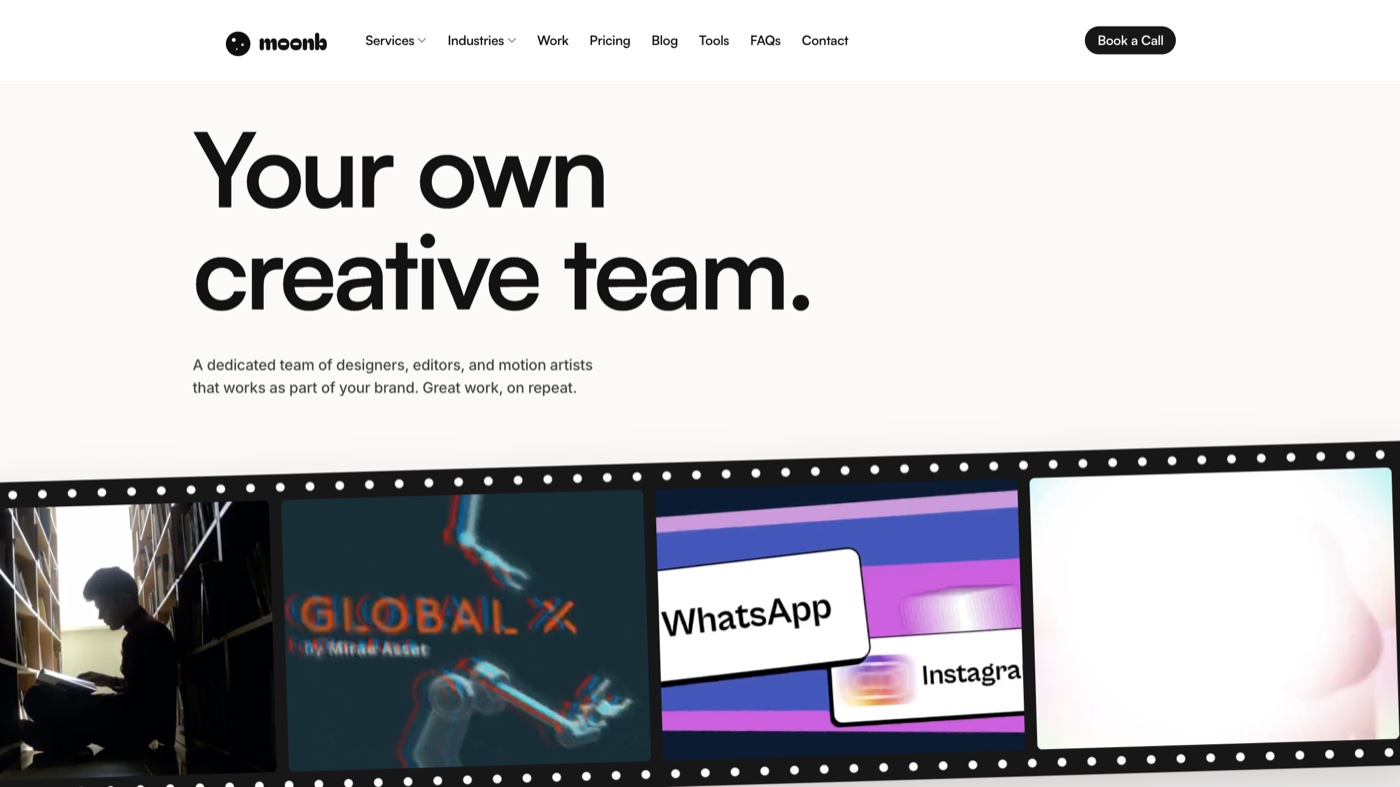
Conflict declared: this is our article and we are sitting at the top of it, which is a position we have not earned against the identity specialists below on their own terms. Moonb is an embedded creative team producing video, motion and design continuously for a marketing team, with a senior Creative Director holding the line on brand consistency. We are the people who take an identity system and make it exist across a year of campaigns, not the people who draw the mark in the first place.
- Best for: applying and extending an existing identity across video, motion and design at continuous volume
- Clients they name: Dell, Toyota, Nestle. I work here, so weigh that the way you would weigh any company citing itself, and ask us for references you can actually call
- Pricing: a set monthly cost, or a per-project quote when the work suits that better
- Why they stand out: the same Creative Director stays across every month of output, which is what stops a new identity from being diluted by a rotating cast of freelancers three months after launch
- Worth knowing: if what you need is a new identity system drawn from nothing, with custom type and a full guidelines document, we are the wrong first call, and four studios below are the right one. Order at number six runs its own type foundry. DIA at number five draws kinetic identity and custom type together. Base Design at number eight has tagged 353 of its 476 published disciplines as identity systems. Pentagram at number two gives you a named partner drawing it personally.
More on Moonb
| Best for | Applying and extending an identity across video, motion and design |
|---|---|
| Scale | Embedded creative team |
| Where they are | Remote and London |
| Named clients | Dell, Toyota, Nestle. I work here, so weigh that the way you would weigh any company citing itself, and ask us for references you can actually call |
| Pricing | a set monthly cost, or a per-project quote when the work suits that better |
Moonb works as an embedded creative team rather than a project shop. The model is a set monthly cost covering a continuous stream of video, motion and design work, with a per-project quote when a piece of work is better shaped that way, and a senior Creative Director who stays on the account rather than appearing at kickoff and vanishing.
The work is brand design, video and motion in service of a brand that already exists. Launch films and their cutdowns, motion for site and product, campaign design across paid and organic, event and sales material, and the ongoing maintenance of a visual system as it meets dozens of new briefs. HQ is Remote.
Hire us if you have an identity, or are about to have one, and the real problem is that nobody can produce enough on-brand work fast enough. Do not hire us to name your company, to design a typeface, or to run a strategy programme that ends in a positioning framework. The four studios named above do the first of those properly, and several firms on this list do the third far better than we would.
The tell that a company needs this rather than another rebrand is usually a marketing lead saying that the brand looked great in the guidelines deck and looks nothing like it in the ads.
2. Pentagram
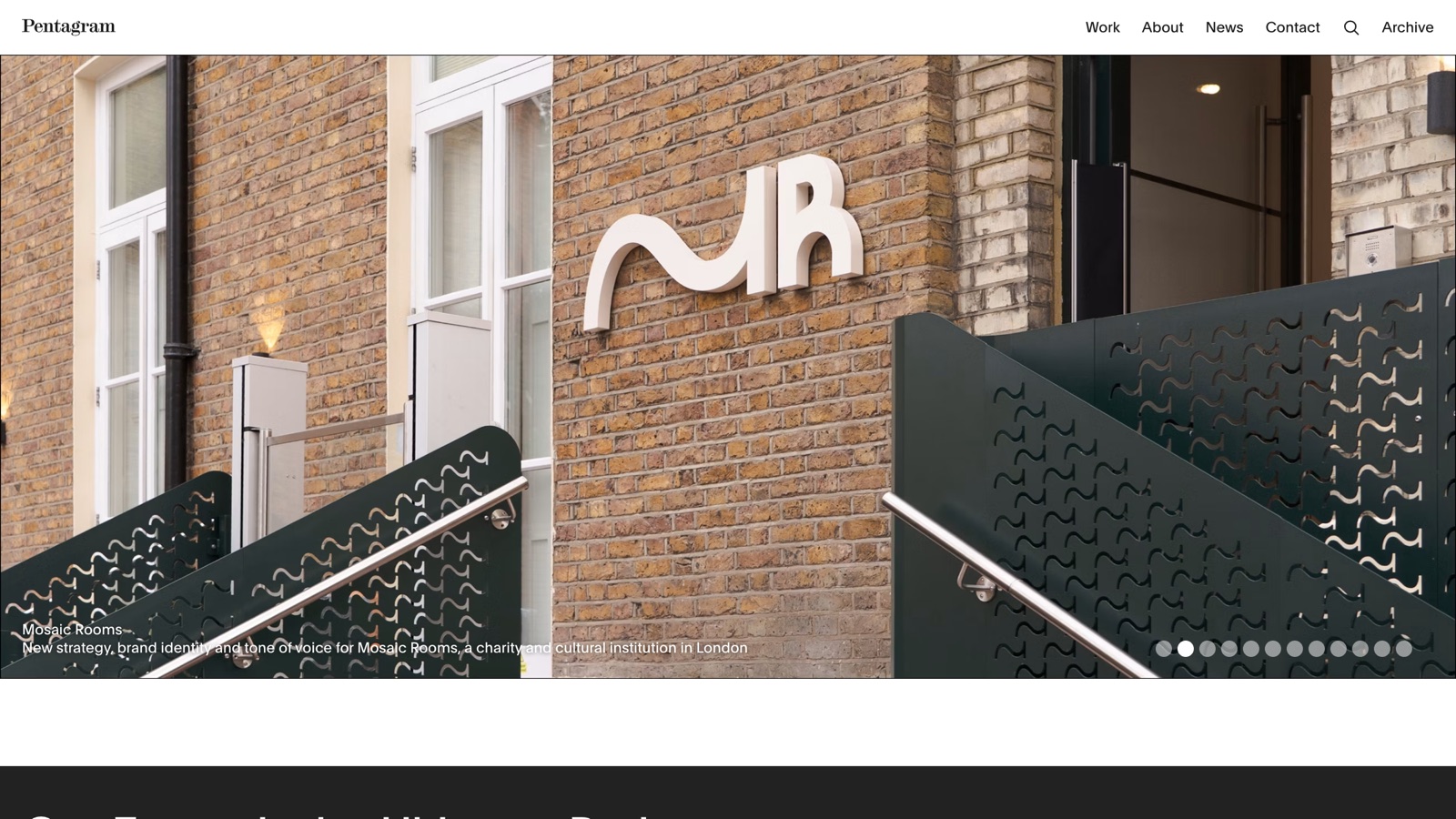
Pentagram is seventeen-three partners operating as seventeen-three small studios under one roof, each running their own team and their own work, which means the firm has no house style at all. Recent published work includes the Obama Presidential Center, the Mozilla Foundation, St Paul’s Cathedral, the Folger Shakespeare Library, Green-Wood Cemetery and Poetry Magazine, and those projects look nothing like each other by design. You are not hiring Pentagram, you are hiring one partner and their bench.
- Best for: landmark identity work for institutions, cultural bodies and companies that want a named designer’s authorship
- Clients they name: Obama Presidential Center, Mozilla Foundation, St Paul’s Cathedral, Folger Shakespeare Library, Green-Wood Cemetery, Poetry Magazine
- Pricing: per project, undisclosed
- Why they stand out: the partner model means the person whose portfolio convinced you is the person doing the work, which is not true almost anywhere else at this level
- Worth knowing: browsing the site tells you very little until you have chosen a partner, because the seventeen-three practices differ more from each other than they do from other studios on this list. Availability of the specific partner you want, rather than the size of the engagement, is usually the thing that decides whether the project happens this year.
More on Pentagram
| Best for | Landmark identity with named authorship |
|---|---|
| Scale | 23 partner studios |
| Where they are | London, New York, Austin, Berlin |
| Named clients | Obama Presidential Center, Mozilla Foundation, St Paul's Cathedral, Folger Shakespeare Library, Green-Wood Cemetery, Poetry Magazine |
| Pricing | per project, undisclosed |
The structure is unusual enough to matter. Partners own their work and their teams, share the overhead and the name, and are individually credited. That produces a portfolio with enormous range and makes any general statement about “Pentagram’s style” meaningless.
Offices are in London, New York, Austin and Berlin. Engagements tend to be identity systems for organisations where the mark will be in service for decades, which is why cultural institutions, universities, civic bodies and publishers appear so heavily in the published work.
Hire a Pentagram partner when the identity is a permanent asset and you want authorship you can point to. Do not hire them expecting a flexible rollout partner afterwards, and do not go in without having decided which partner you are pursuing, because the pitch process is effectively a conversation with one studio rather than a firm.
3. COLLINS
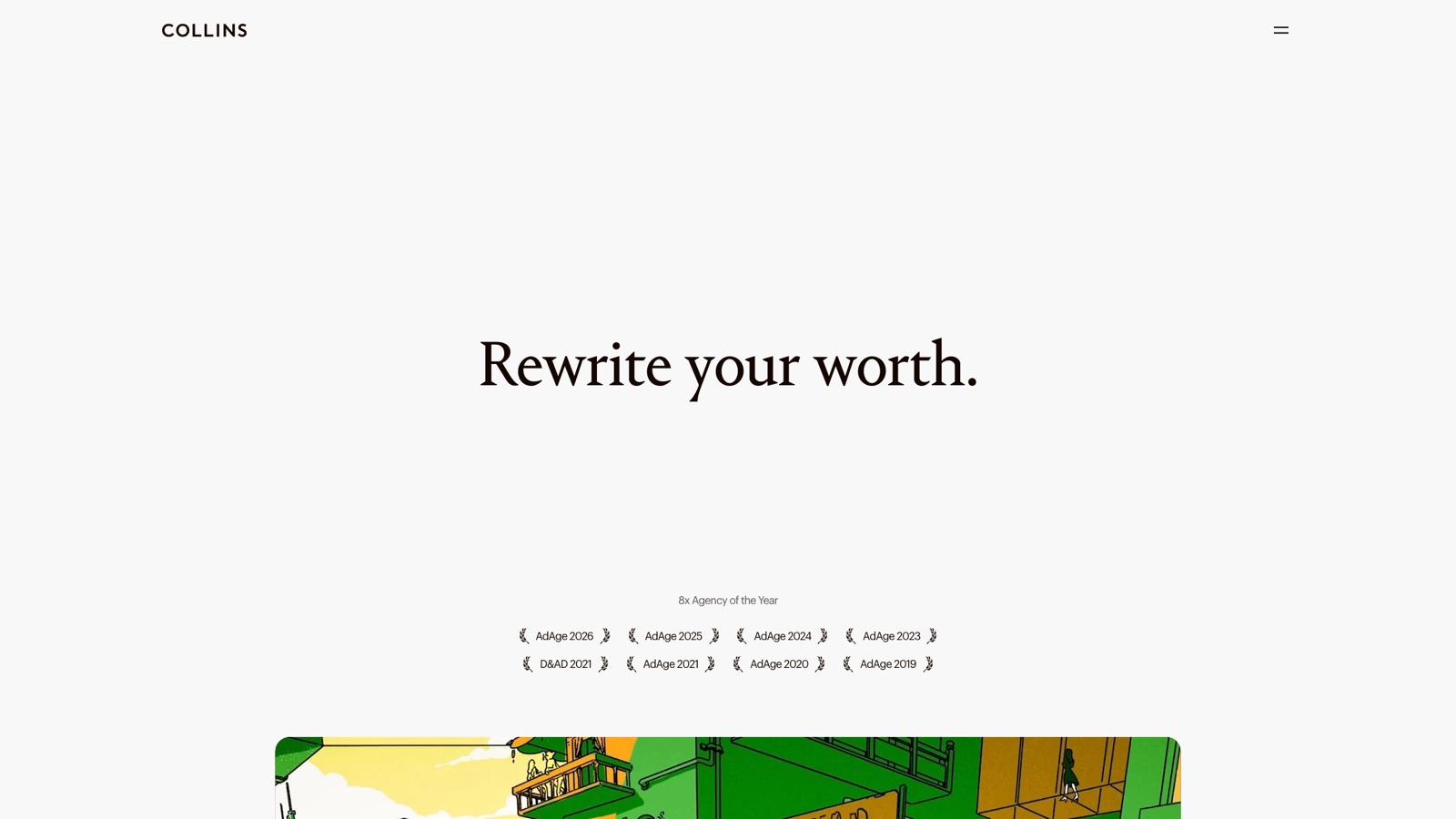
COLLINS was named Ad Age Agency of the Year in 2026 and its published work carries a recognisable appetite for saturated colour, expressive type and identity systems built to be performed rather than merely applied. The client list includes Spotify, Dropbox, Nike, Robinhood, Figma, Target, Equinox and ESPN, which is an unusually high concentration of brands whose identities are seen constantly and at enormous scale. They work from San Francisco and New York.
- Best for: expressive, high-visibility identity systems for consumer and technology brands with the nerve to be looked at
- Clients they name: Spotify, Dropbox, Nike, Robinhood, Figma, Target, Equinox, ESPN
- Pricing: per project, undisclosed
- Why they stand out: they design identity as something with a temperament rather than a set of correct usages, and the output is recognisable on sight without being formulaic across accounts
- Worth knowing: there are three unrelated design firms trading as some form of “Collins”, so confirm you are talking to wearecollins.com before you brief anyone. More substantively, this is a studio with a strong point of view that expects to change what you look like, which is the wrong shape of partner if your leadership team wants a refinement of what already exists.
More on COLLINS
| Best for | Expressive identity for consumer and technology brands |
|---|---|
| Scale | Two studios |
| Where they are | San Francisco, New York |
| Named clients | Spotify, Dropbox, Nike, Robinhood, Figma, Target, Equinox, ESPN |
| Pricing | per project, undisclosed |
COLLINS sits in the small group of studios whose work is used as a reference by other studios, which is both the reason to hire them and a reason to ask about availability in the first conversation rather than the fifth. The published portfolio skews to consumer technology, media and retail, where an identity has to work at enormous scale and still feel specific.
Two offices, San Francisco and New York. Engagements are typically full identity systems with strategy attached rather than isolated logo work.
Hire them when the brand needs to be transformed and the executive team is ready for that. Do not hire them for a conservative category where the brief is to look credible and blend in, and do not expect the process to end where you thought it would when you wrote the brief.
4. Studio Dumbar
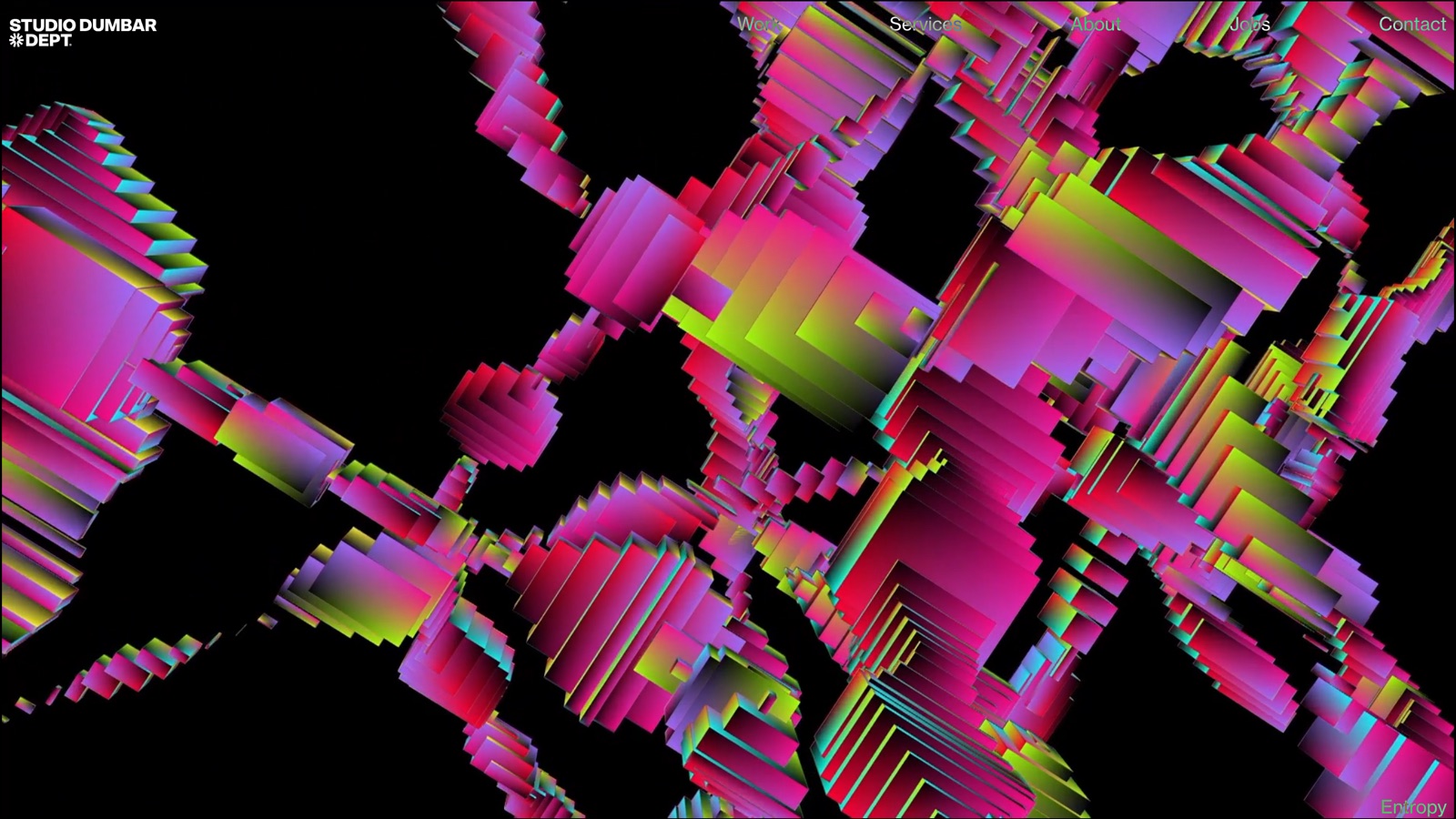
Studio Dumbar is the clearest example on this list of an identity house where motion and sound are made in the building rather than subcontracted, and the results show it, because their systems tend to be defined by how they behave rather than how they sit still. Published work covers OpenAI, Apple, Google, Meta, Instagram, Spotify, adidas, the Dutch national police, NS Dutch Railways, the Van Gogh Museum, Feyenoord and the MTV VMAs. The team is roughly thirty-five to forty people in a single Rotterdam office.
- Best for: identity systems where movement, sound and creative coding are part of the core design rather than a later deliverable
- Clients they name: OpenAI, Apple, Google, Meta, Instagram, Spotify, adidas, Comedy Central, MTV VMAs, Utah Jazz, Feyenoord, Transavia, PostNL, NS Dutch Railways, Van Gogh Museum, Rijksmuseum van Oudheden, Mauritshuis, Dutch national police
- Pricing: per project, undisclosed
- Why they stand out: in-house motion, sound and AI capability means the identity is designed in time as well as in space, and very few studios of this size can say that without outsourcing
- Worth knowing: the studio is owned by Dept and its own about page states it is part of that company, so the independent-studio impression the site gives is not accurate. With forty people in one city you are also buying a specific and very recognisable aesthetic, and any heavy multi-market rollout will pull in the wider Dept organisation, which changes who is actually on your project.
More on Studio Dumbar
| Best for | Motion and sound driven identity systems |
|---|---|
| Scale | 35 to 40 people, owned by Dept |
| Where they are | Rotterdam |
| Named clients | OpenAI, Apple, Google, Meta, Instagram, Spotify, adidas, Comedy Central, MTV VMAs, Utah Jazz, Feyenoord, Transavia, PostNL, NS Dutch Railways, Van Gogh Museum, Rijksmuseum van Oudheden, Mauritshuis, Dutch national police |
| Pricing | per project, undisclosed |
The Rotterdam studio has been producing identity work with a distinct visual temperature for decades, and the current output leans on kinetic behaviour, bold graphic systems and sound design. Public sector and cultural work in the Netherlands sits alongside global technology names, which is a rare combination.
Ownership by Dept, described on their own site as four thousand plus specialists across thirty plus locations, is the fact most buyers miss. It is not necessarily a problem, since it gives them production reach they would otherwise lack, but it should change the questions you ask about staffing.
Hire them when the identity will live mostly on screens and needs a motion language from day one. Do not hire them if you want a neutral execution partner who will subordinate their taste to yours, and do not assume the Rotterdam team can absorb an always-on production programme.
5. DIA
DIA describes itself as a design, research and innovation studio building kinetic identity systems, typographic systems and generative tools, and the published index backs that up, splitting the work into Identity, Tools, Type, Experiential, Campaigns, Film, Education and Studio. Clients named on the site include Coinbase, Mailchimp, Squarespace, Pinterest, Nike, Adidas, Johnnie Walker, IBM, Spotify, SSENSE, Maison Kitsuné, MoMA, Roblox and YouTube. The studio is a member of AGI, and creative director Mitch Paone teaches at ECAL, ZHdK, HEAD Genève and KABK.
- Best for: kinetic identity and custom typographic systems, especially where the type itself is the identity
- Clients they name: Coinbase, Mailchimp, Squarespace, Pinterest, Nike, Adidas, Johnnie Walker, IBM, Spotify, SSENSE, Maison Kitsuné, MoMA, Roblox, Verizon, Nissan, YouTube, SPACE10, Typotheque, MIT
- Pricing: per project, undisclosed
- Why they stand out: the motion and the type are drawn by the same people, so the letterforms are designed knowing how they will move, which is a level of integration almost nobody else on this list attempts
- Worth knowing: the about page names only two partners, Meg Donohoe and Mitch Paone, with no wider team published, so delivery capacity for a large multi-market rollout is opaque and would likely involve freelancers. The studio has also relocated its base from New York to Chamonix in the French Alps, which changes your timezone assumptions, and the offer is deliberately narrow, so DIA works best alongside a strategy partner rather than instead of one. Note the URL: dia.tv now redirects, and dia.studio is the address to use.
More on DIA
| Best for | Kinetic identity and custom typographic systems |
|---|---|
| Scale | Two named partners |
| Where they are | Chamonix, New York |
| Named clients | Coinbase, Mailchimp, Squarespace, Pinterest, Nike, Adidas, Johnnie Walker, IBM, Spotify, SSENSE, Maison Kitsuné, MoMA, Roblox, Verizon, Nissan, YouTube, SPACE10, Typotheque, MIT |
| Pricing | per project, undisclosed |
DIA is one of the few studios where the phrase “motion-native identity” is literally true rather than marketing. Their published tools and typefaces are treated as products in their own right, and the education work through ECAL and the other schools feeds the practice visibly.
Founded in SoHo in 2009 and now based in the French Alps, with New York still listed. Two named partners, no published headcount.
Hire them when the identity is fundamentally typographic and needs to move. Do not hire them to run positioning, naming or a campaign programme, and do not brief them as though you are engaging a mid-sized studio with a bench, because the evidence on their own site does not support that assumption.
6. Order
Order runs its own OTF type foundry and publishes the Standards Manual imprint, which reissues historical identity manuals, and that combination tells you more about the practice than any case study would. Their stated capabilities run from brand identity and type design through design systems, naming, guidelines, packaging, exhibitions and wayfinding. Clients named on the site include Google, Apple News, Apple Podcasts, Knoll, Herman Miller, MoMA, Adidas, Shake Shack, Kickstarter, MTV, the Washington Metropolitan Area Transit Authority and The Frick Collection.
- Best for: systematic, research-driven identity work with custom type and guidelines documentation that will actually be followed
- Clients they name: Google, Apple News, Apple Podcasts, Knoll, Herman Miller, MoMA, Adidas, Shake Shack, Kickstarter, MTV, NEA, The Frick Collection, Washington Metropolitan Area Transit Authority, Sensodyne, Justworks, Greenhouse, Floyd, Williams College, Bellingcat
- Pricing: per project, undisclosed
- Why they stand out: a studio that publishes historical standards manuals as a side business is a studio that takes documentation seriously, and the guidelines you receive reflect that discipline
- Worth knowing: this is a very small operation. The contact page names six people in Brooklyn, one of them on contract, plus a Miami office in Coconut Grove that is by appointment, and the two offices run independently under separate co-founders, so you are buying one principal’s team rather than a shared bench. A visible share of the portfolio is also self-initiated, the book reissues and their own typefaces, which makes availability the binding constraint on anything sizeable. One more thing: orderorder.com is not them and never was, the domain predates the studio by eighteen years and times out.
More on Order
| Best for | Systematic identity, type design and guidelines |
|---|---|
| Scale | Six named people |
| Where they are | Brooklyn, Miami by appointment |
| Named clients | Google, Apple News, Apple Podcasts, Knoll, Herman Miller, MoMA, Adidas, Shake Shack, Kickstarter, MTV, NEA, The Frick Collection, Washington Metropolitan Area Transit Authority, Sensodyne, Justworks, Greenhouse, Floyd, Williams College, Bellingcat |
| Pricing | per project, undisclosed |
Order was founded in 2017 and has built a practice around systems thinking, with type design as a first-class capability rather than an outsourced line item. Standards Manual, the publishing imprint, reissues historical identity manuals, which has given the studio an unusual public profile relative to its size.
Six named people in Brooklyn, a by-appointment Miami office, and two co-founders running the locations separately.
Hire them for an identity where the typeface and the documentation are the point, and where the scope is bounded enough that a six-person studio can own it end to end. Do not hire them for a simultaneous rollout across a dozen markets, and do not assume the Brooklyn and Miami teams are interchangeable.
7. PORTO ROCHA
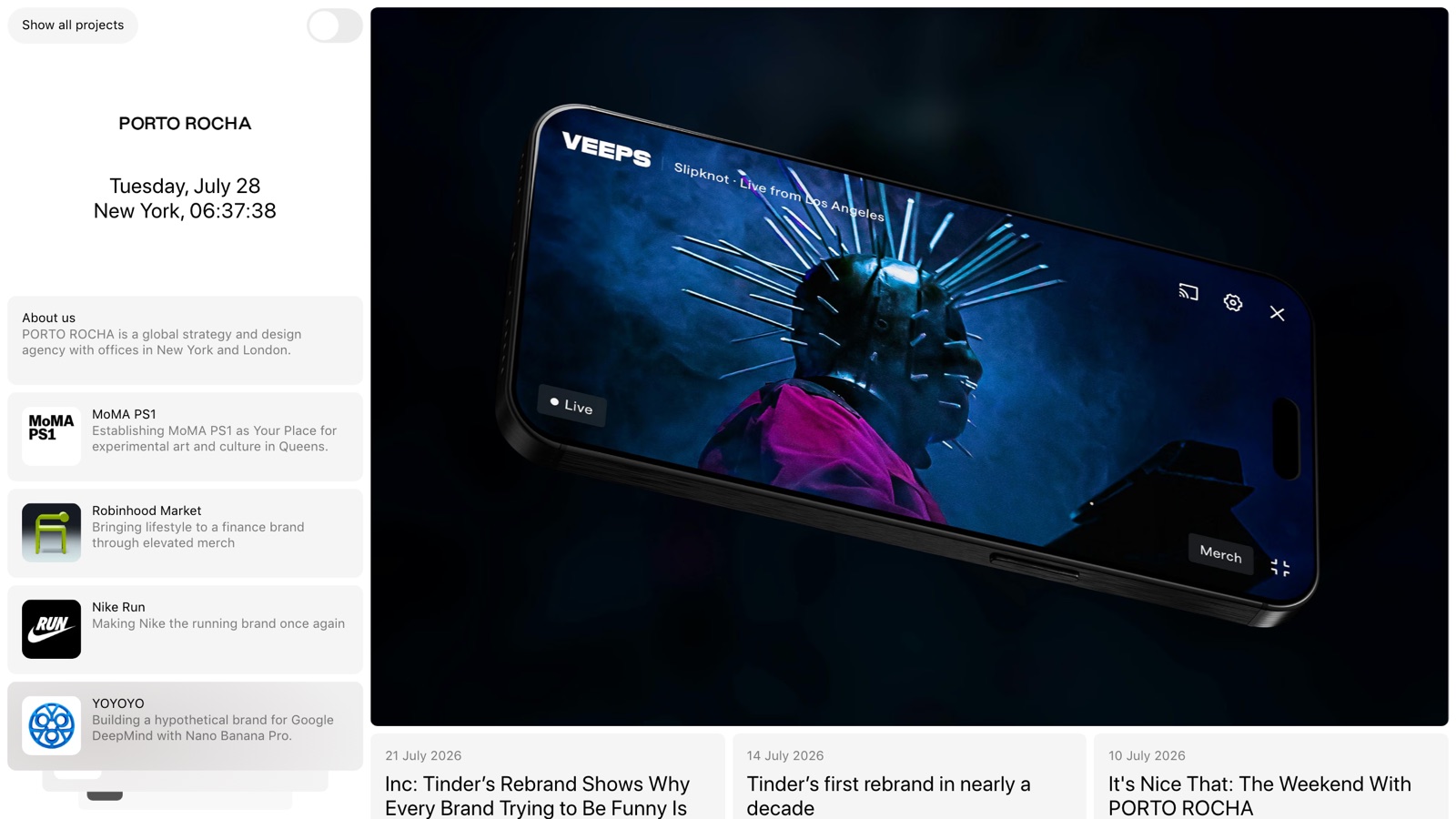
PORTO ROCHA states on its own site that it works in motion, always, and the portfolio bears that out with identity systems for Netflix, Google, Nike, Airbnb, Spotify, Twitch, Tinder, Patreon, W Hotels, MoMA PS1, Sundance Film Festival, Kunsthalle Basel and MASP. Their published capabilities cover strategy and positioning, verbal identity including naming, visual identity including logo and type design, digital design and development, motion systems, and CG imagery and VFX. They also publish a No Free Pitches position, meaning they will not take part in speculative pitch processes.
- Best for: motion-first identity systems for entertainment, culture, fashion and consumer technology brands
- Clients they name: Netflix, Google, Nike, Airbnb, Spotify, Twitch, Tinder, Patreon, Upwork, Robinhood, W Hotels, MoMA PS1, Sundance Film Festival, Kunsthalle Basel, MASP, Vevo, YouTube Music, Melissa, Olympikus, QuintoAndar, i-D
- Pricing: per project, undisclosed
- Why they stand out: motion is treated as the default state of the identity rather than an extension of it, and the CG and VFX capability in-house means the studio can build imagery most identity practices would have to commission
- Worth knowing: the published portfolio skews hard to entertainment, culture, fashion and consumer technology, with almost nothing in B2B, industrial, healthcare or regulated sectors, so a buyer in those categories has no comparable proof to judge against. The team is also distributed across roughly seventeen cities with only two registered offices, in Brooklyn and London, which suits senior async collaboration and is a poor match for anyone expecting an embedded on-site team. The refusal to pitch for free will also disqualify them from some procurement processes before you get a chance to argue.
More on PORTO ROCHA
| Best for | Motion-first identity for culture and consumer tech |
|---|---|
| Scale | Distributed, two offices |
| Where they are | Brooklyn, London |
| Named clients | Netflix, Google, Nike, Airbnb, Spotify, Twitch, Tinder, Patreon, Upwork, Robinhood, W Hotels, MoMA PS1, Sundance Film Festival, Kunsthalle Basel, MASP, Vevo, YouTube Music, Melissa, Olympikus, QuintoAndar, i-D |
| Pricing | per project, undisclosed |
Founded by Felipe Rocha and Leo Porto, the studio has built a reputation on identity systems that read as film-like rather than static, and the published roster carries a strong Brazilian strand, with MASP, Melissa, Olympikus and QuintoAndar sitting alongside the American platform clients.
Two registered offices, New York and London, with the wider team distributed. The no-free-pitch stance is published rather than implied, which is worth respecting rather than testing.
Hire them when the identity will be experienced primarily as moving image and the category rewards cultural fluency. Do not hire them for a regulated or industrial brand, and do not build a project plan that assumes a team sitting in one room with yours.
8. Base Design
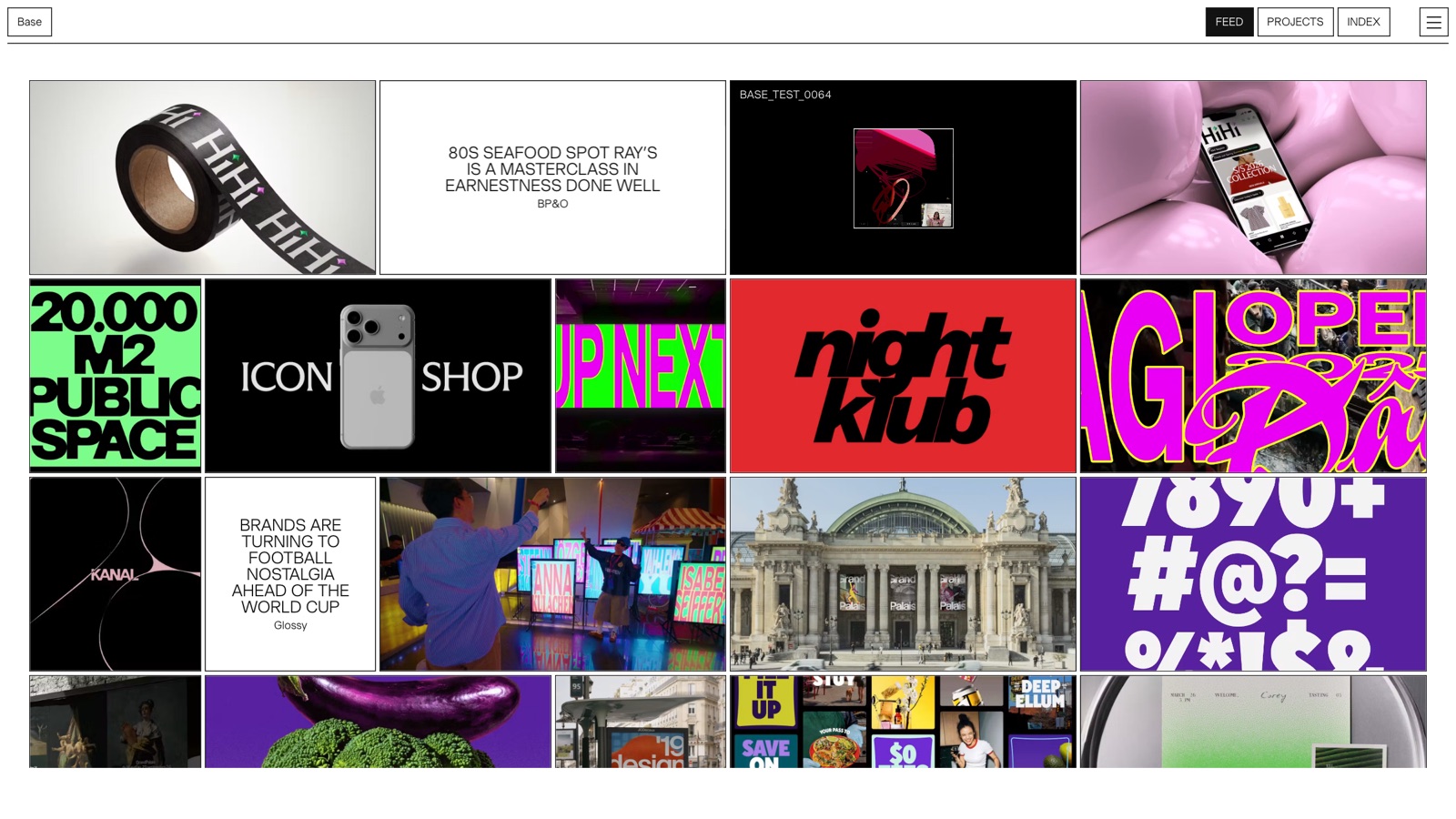
Base publishes a project index that tags its own disciplines, and 353 of the 476 tags are Identity System, against 53 for Brand Strategy, 29 for digital and 22 for campaigns. That ratio is the most useful number in this entire article, because it tells you exactly what the studio does when nobody is writing marketing copy. Clients include Dior, UNIQLO, Fondation Louis Vuitton, the Museum of Fine Arts Boston, the Studio Museum in Harlem, Grand Palais, Bozar, Deezer, ING Bank, the Bob Dylan Center and Terminal 4 at JFK.
- Best for: identity systems for arts, culture, luxury, hospitality and finance, across Europe, the US and Asia Pacific
- Clients they name: Dior, UNIQLO, Fondation Louis Vuitton, MoMA Design Store, Museum of Fine Arts Boston, Studio Museum in Harlem, Grand Palais, Kanal-Centre Pompidou, Bozar, La Monnaie Opera, Théâtre du Châtelet, Deezer, ING Bank, La Prairie, Caudalie, Terminal 4 at JFK, Prince Estate, Bob Dylan Center, Museum of Sex, Phillips, Mudam
- Pricing: per project, undisclosed
- Why they stand out: the discipline mix is a count on their own site rather than a positioning claim, and it makes Base the most identity-weighted studio in this roster by a wide margin
- Worth knowing: the same numbers that make Base attractive also tell you what it will not do, since 22 campaign projects against 353 identity systems means they build the system and hand it over rather than staying on as an execution partner. The five studios also operate as a network with deliberately independent voices, so the office you engage changes the team and the output more than the shared name suggests, and you should qualify the specific studio rather than the group.
More on Base Design
| Best for | Identity systems for arts, luxury and finance |
|---|---|
| Scale | Five-studio network |
| Where they are | New York, Brussels, Geneva, Melbourne, Saigon |
| Named clients | Dior, UNIQLO, Fondation Louis Vuitton, MoMA Design Store, Museum of Fine Arts Boston, Studio Museum in Harlem, Grand Palais, Kanal-Centre Pompidou, Bozar, La Monnaie Opera, Théâtre du Châtelet, Deezer, ING Bank, La Prairie, Caudalie, Terminal 4 at JFK, Prince Estate, Bob Dylan Center, Museum of Sex, Phillips, Mudam |
| Pricing | per project, undisclosed |
Base runs studios in New York, Brussels, Geneva, Melbourne and Saigon, with a separate Base Digital team handling AI and technology work. The cultural and luxury client base is deep and long-running, and the museum and institutional work in particular shows systems that have been in service for years.
The engagement shape is a defined identity programme with a start and an end, delivered by one of the five studios. Treat the group as five practices sharing a name and a standard.
Hire them for an identity system with real complexity, especially in culture or luxury, where you have your own team or another partner to carry the rollout. Do not hire them expecting always-on campaign production, and do not assume the Brussels team and the Melbourne team will give you the same thing.
9. &Walsh
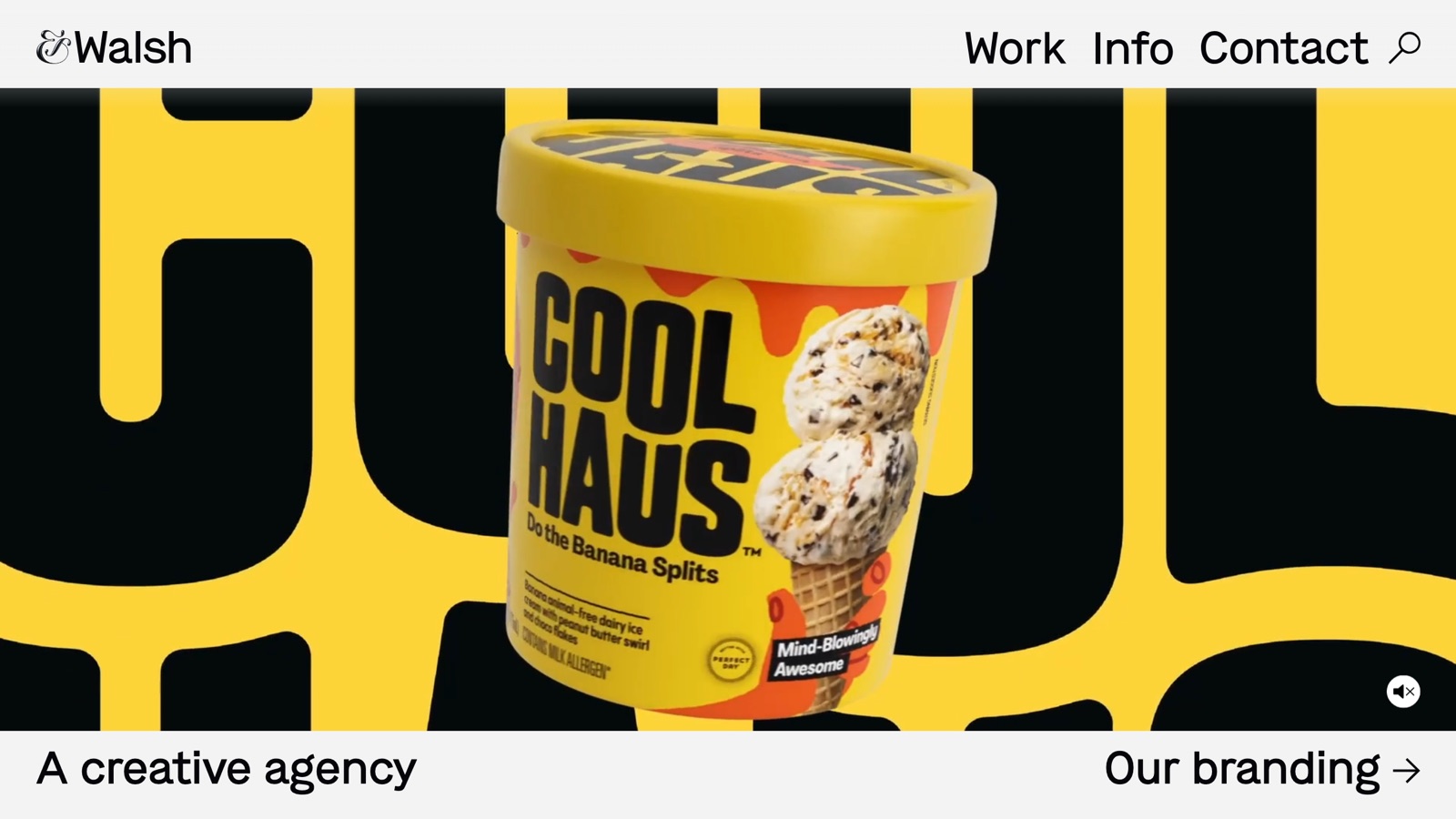
&Walsh is a New York studio with one of the most immediately identifiable visual signatures in commercial branding, built on colour, illustration and a willingness to be conspicuous. Published work includes Bombas, Google I/O 2023, Plenty, Pet Plate, Geltor and Parle Agro, a mix of consumer, food and technology brands that all came out looking louder than they went in. The studio’s own site is itself a piece of the portfolio.
- Best for: consumer and food brands that want to be the most visually distinctive thing in their category
- Clients they name: Bombas, Google I/O 2023, Plenty, Pet Plate, Geltor, Parle Agro
- Pricing: per project, undisclosed
- Why they stand out: you can identify their work without a credit line, which is rare and valuable if you want an identity that reads as authored rather than committee-approved
- Worth knowing: that signature is strong enough that it can overwhelm a brand rather than serve it, and in a conservative or regulated category the output will fight your buyers rather than persuade them. Because the studio carries a founder’s name, confirm in writing how much of the founder’s time the engagement actually includes, since expectation and reality diverge on founder-named studios more often than on any other kind.
More on &Walsh
| Named clients | Bombas, Google I/O 2023, Plenty, Pet Plate, Geltor, Parle Agro |
|---|---|
| Pricing | per project, undisclosed |
The studio operates from New York and works across identity, packaging, art direction and campaign design, with a portfolio weighted to consumer brands where visual distinctiveness converts directly into shelf and feed performance.
Engagements are typically full identity systems with heavy art direction attached, and the published work is expressive enough that judging fit is easier than average.
Hire them when the brief is to be unmistakable in a crowded consumer category. Do not hire them for enterprise software, financial services or anything where the primary job of the identity is to signal institutional stability.
10. Turner Duckworth
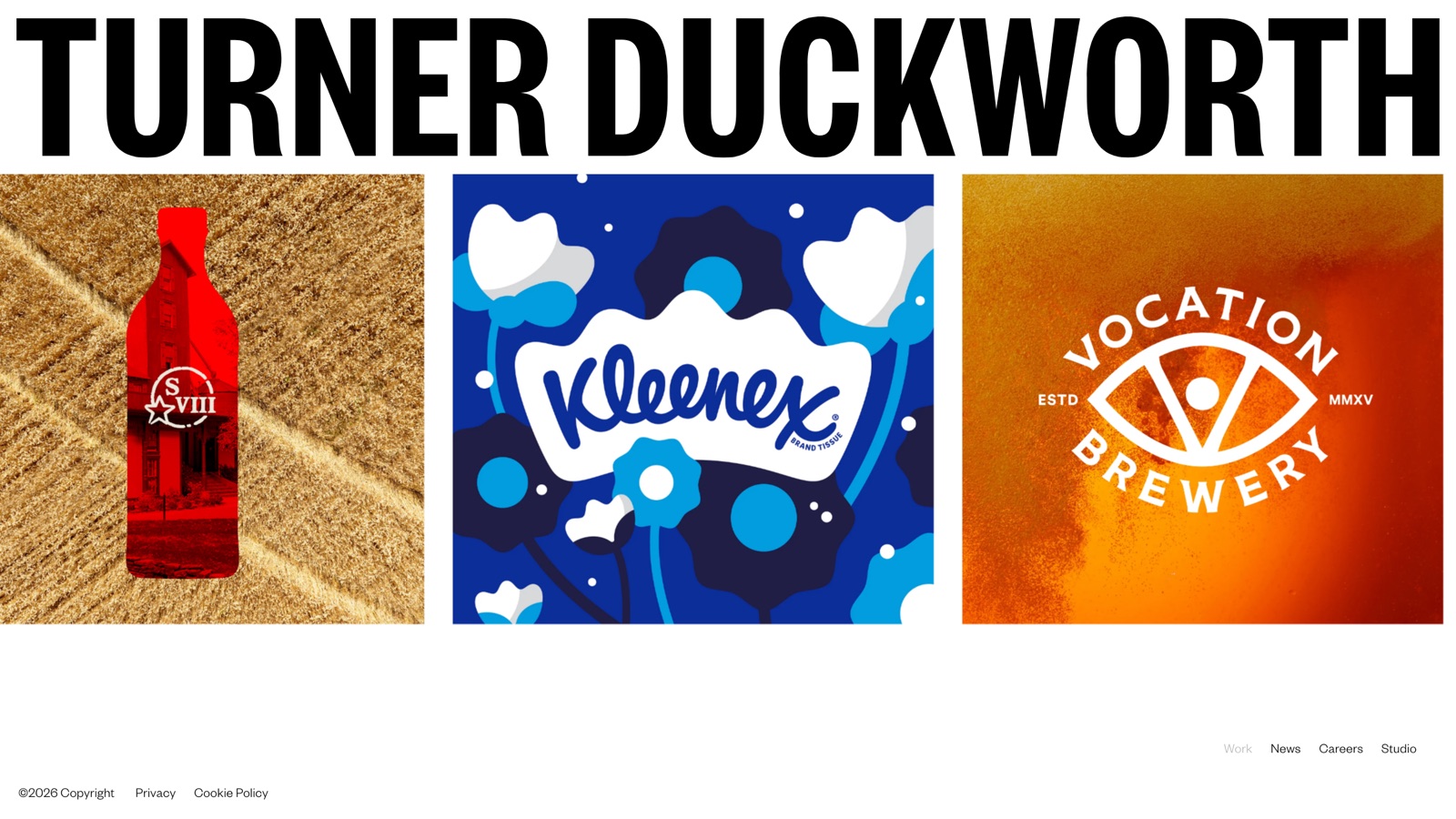
Turner Duckworth builds identity and packaging for brands whose marks are among the most reproduced objects on earth, including Coca-Cola, Amazon, Levi’s, McDonald’s, Samsung, Sprite, Subway and Metallica. The specialism is distinctive asset craft, meaning the parts of an identity that survive being shrunk, printed badly, seen sideways in a fridge and recognised in half a second. Food, drink, spirits and quick service restaurants dominate the portfolio.
- Best for: packaging-led identity and distinctive asset systems for large consumer brands
- Clients they name: Coca-Cola, Amazon, Levi’s, McDonald’s, Samsung, Sprite, Subway, Kleenex, Jim Beam, Little Caesars, Campbell’s, Newman’s Own, Blue Diamond, Crumbl, Icelandic Provisions, Vocation Brewery, Metallica
- Pricing: per project, undisclosed
- Why they stand out: they design for the physical object first, and the resulting marks hold up in conditions that break identities designed only on a screen
- Worth knowing: the site reads as an independent design studio and never mentions that Publicis Groupe acquired the firm in September 2014 and aligned it with the Leo Burnett network, where it was still listed inside Publicis Groupe UK as recently as 2024. You are contracting into a holding company, with the scale minimums, reporting lines and possible network conflicts that implies, so ask about ownership and about who staffs your project before you sign anything.
More on Turner Duckworth
| Best for | Packaging-led identity and distinctive assets |
|---|---|
| Scale | Owned by Publicis Groupe |
| Where they are | Not published in the sources checked |
| Named clients | Coca-Cola, Amazon, Levi's, McDonald's, Samsung, Sprite, Subway, Kleenex, Jim Beam, Little Caesars, Campbell's, Newman's Own, Blue Diamond, Crumbl, Icelandic Provisions, Vocation Brewery, Metallica |
| Pricing | per project, undisclosed |
The craft here is specific and hard to replicate: simplifying a mark until it is unmistakable at thumbnail size, and building a system of assets, colours and shapes that a consumer recognises before reading a word. The Coca-Cola and Amazon work is the reference point most buyers arrive with.
The engagement shape is a large consumer identity or packaging programme, priced and scoped accordingly.
Hire them when the brand lives on a shelf, a can or a shopfront and the goal is instant recognition. Do not hire them for a services brand with no physical presence, and do not assume you are engaging an independent studio, because you are not.
11. Jones Knowles Ritchie
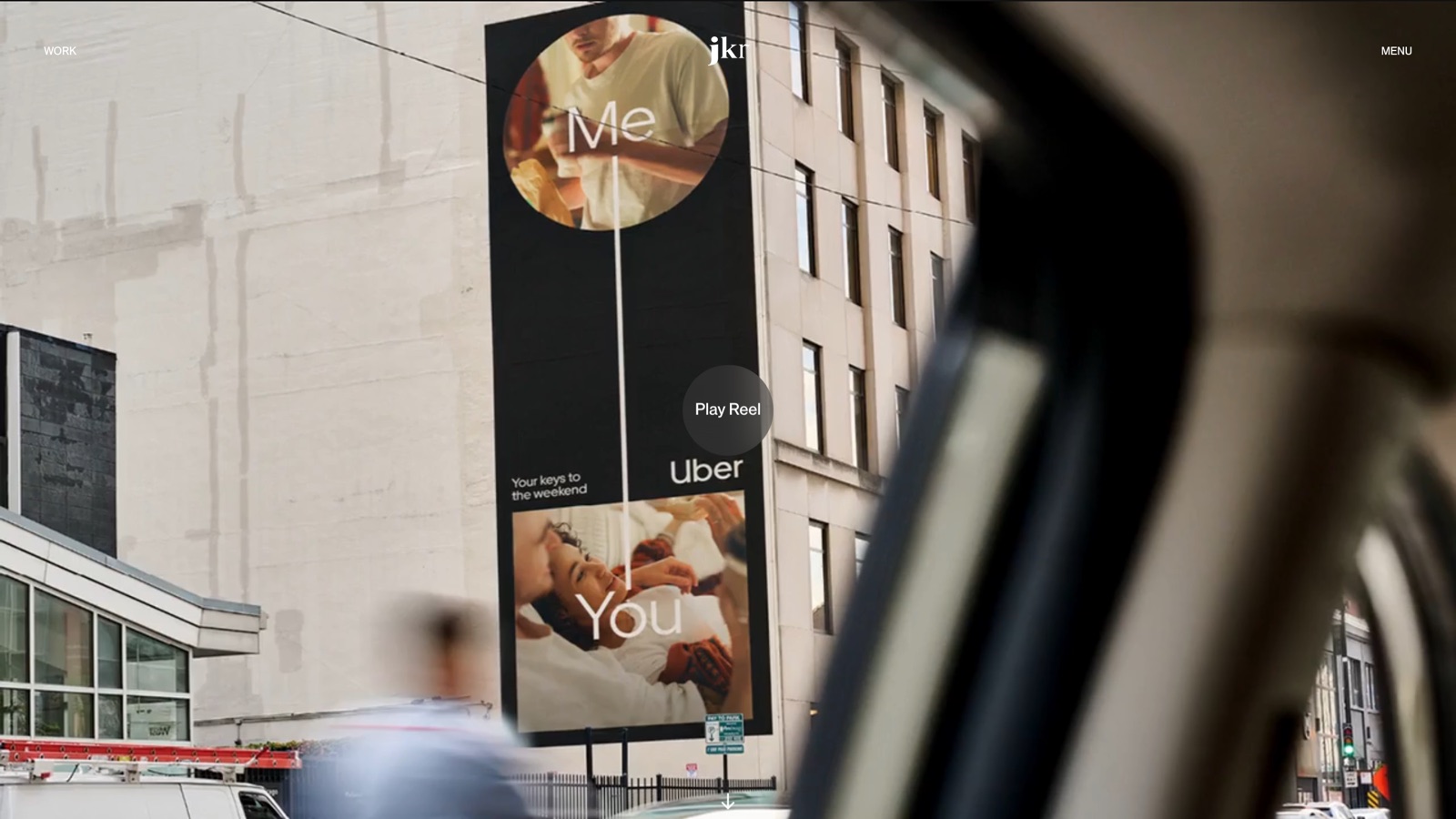
JKR trades under an explicit positioning of Be Distinctive Everywhere, founded in 1990, and its portfolio is a run of household rebrands: Coca-Cola, KFC, Burger King, Domino’s, Walmart, Heinz, Stella Artois and Paramount. The more interesting recent development is a visible push into technology and financial services, with Uber, Yahoo, Mozilla, Chime and Tenable now sitting alongside the food and drink work. Their own contact page lists two studios, London and New York.
- Best for: large-scale distinctive identity and packaging programmes, especially in food, drink and quick service restaurants
- Clients they name: Coca-Cola, KFC, Burger King, Domino’s, Walmart, Heinz, Uber, Yahoo, Mozilla, Chime, Paramount, Impossible, Stella Artois, Manischewitz, Tenable, CenterSquare, RSPCA
- Pricing: per project, undisclosed
- Why they stand out: distinctiveness is treated as a measurable design objective rather than a taste preference, which is why their rebrands tend to survive contact with marketing effectiveness teams
- Worth knowing: third party directories still list a Shanghai office, but JKR’s own contact page shows only London and New York, so work requiring real presence in Asia or continental Europe is run remotely from those two. The published portfolio is also almost entirely global rebrands for enormous brands, which is thin evidence that they are set up for a smaller identity project or a compressed timeline.
More on Jones Knowles Ritchie
| Best for | Large distinctive rebrands in food, drink and QSR |
|---|---|
| Scale | Large independent |
| Where they are | London, New York |
| Named clients | Coca-Cola, KFC, Burger King, Domino's, Walmart, Heinz, Uber, Yahoo, Mozilla, Chime, Paramount, Impossible, Stella Artois, Manischewitz, Tenable, CenterSquare, RSPCA |
| Pricing | per project, undisclosed |
Founded in 1990, JKR has become the reference studio for distinctive-asset thinking applied at global scale, and the technology and fintech work suggests a deliberate widening of the category base rather than a one-off.
Engagements are typically multi-market identity and packaging programmes with a substantial strategy component, run from London or New York.
Hire them when a very large brand needs to become more recognisable rather than more beautiful. Do not approach them with a modest scope and a tight deadline, and check which studio would hold the account before you build a timeline around it.
12. Gretel
Gretel is a Brooklyn studio of roughly sixteen people whose work sits at the intersection of media, entertainment and cultural institutions, with published disciplines running from discovery and brand architecture through visual identity, writing, experience design and art direction. Named clients include the Philadelphia Museum of Art, Crystal Bridges, Nike, Noma, PayPal, CBS, Knoll, National Geographic, Paramount, MoMA, IBM, Netflix, RISD, MasterClass and Aesop. The identity work has a particular strength in editorial systems and channel branding.
- Best for: identity for media, entertainment, cultural institutions and design-literate consumer brands
- Clients they name: Philadelphia Museum of Art, League One Volleyball, Crystal Bridges, Nike, Noma, PayPal, CBS, Knoll, IFC, National Geographic, Paramount, MoMA, IBM, Netflix, RISD, Showtime, WeWork, GoodRx, Noom, MasterClass, NYCFC, Aesop
- Pricing: per project, undisclosed
- Why they stand out: they design identities that have to hold up across a lot of content, which is a different problem from designing a mark, and their systems tend to survive being handled by an in-house team afterwards
- Worth knowing: one office and a single Executive Creative Director listed on their own company page, so senior attention is the bottleneck and your start date is set by their capacity rather than your urgency. The portfolio is also almost entirely consumer, media and cultural, with very little evidence of enterprise or B2B category experience, which matters if your buying committee is going to ask for comparable work.
More on Gretel
| Best for | Media, entertainment and cultural identity |
|---|---|
| Scale | Roughly 19 people |
| Where they are | Brooklyn |
| Named clients | Philadelphia Museum of Art, League One Volleyball, Crystal Bridges, Nike, Noma, PayPal, CBS, Knoll, IFC, National Geographic, Paramount, MoMA, IBM, Netflix, RISD, Showtime, WeWork, GoodRx, Noom, MasterClass, NYCFC, Aesop |
| Pricing | per project, undisclosed |
The published work leans heavily on television, streaming and cultural programming, with CBS, Showtime, IFC, Paramount and Netflix all on the client list, and the systems reflect that. They are built for volume across title sequences, channel packaging, editorial layouts and content ecosystems rather than for a single hero application.
Roughly sixteen people in Brooklyn. Engagements are full identity programmes with strategy and often naming attached.
Hire them when the brand produces a lot of content and the identity needs to organise it. Do not hire them for an industrial or enterprise category where they have nothing comparable to show, and plan around a single senior creative rather than a deep bench.
13. Mucho
Mucho works from Barcelona and San Francisco, states it has worked with more than 250 brands, and publishes a 72 percent return rate, which is a number very few studios are willing to put on a page. Named clients include Visa, Aeromexico, MACBA, Eko Health and Gobi Cashmere. The visual work carries a European graphic-design formality, with strong grid and typographic discipline, that reads differently from the American studios above it on this list.
- Best for: identity work with European graphic design rigour, spanning corporate, cultural and consumer categories
- Clients they name: Visa, Aeromexico, MACBA, Eko Health, Gobi Cashmere
- Pricing: per project, undisclosed
- Why they stand out: publishing a client return rate is a claim you can be held to, and it suggests the studio is optimising for repeat relationships rather than portfolio pieces
- Worth knowing: mucho.design does not resolve, so make sure any listing you found sends you to wearemucho.com. More usefully, the number of named clients published on the site is far smaller than the 250-plus figure implies, so you will need to ask for relevant case material directly rather than judging fit from the public work, and the centre of gravity is clearly Barcelona rather than San Francisco.
More on Mucho
| Best for | European typographic rigour across categories |
|---|---|
| Scale | Two studios |
| Where they are | Barcelona, San Francisco |
| Named clients | Visa, Aeromexico, MACBA, Eko Health, Gobi Cashmere |
| Pricing | per project, undisclosed |
Mucho positions itself as a design partner across identity, editorial and digital, with work spanning museums, financial services and consumer brands. The output has a consistency of craft rather than a signature colour or motif, which suits companies that want rigour without a loud house style.
Two offices, Barcelona and San Francisco.
Hire them for a well-made identity system with typographic discipline, particularly if you are a European brand or a US brand that wants a European sensibility. Do not judge them by the small public client list alone, and do not assume the San Francisco office carries the same depth as Barcelona.
14. Blok Design
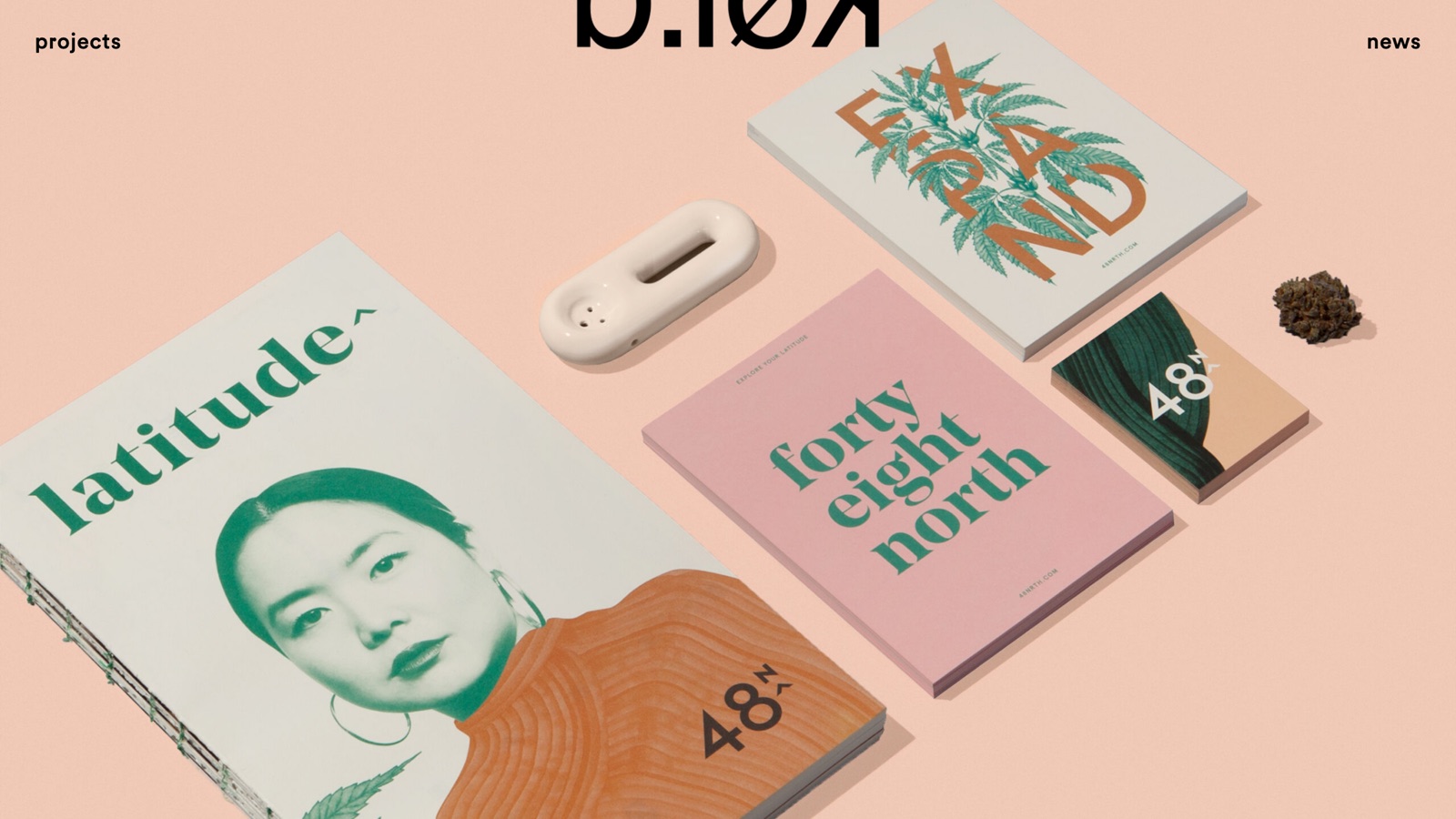
Blok, founded by Vanessa Eckstein and based in Toronto, has print, editorial and packaging craft of a kind that has become uncommon in a screen-first industry, and its work has been exhibited at the Trapholt Museum in Copenhagen, at Art Center in Los Angeles and at the Royal Ontario Museum. The published work concentrates on arts, culture, museums, hospitality, architecture and not-for-profit, including TIFF, MOCA Toronto, Pérez Art Museum Miami, Museo Jumex, Museo Tamayo, the Bank of Canada and the Biblioteca Vasconcelos.
- Best for: culture, hospitality, architecture and civic identity where print and material craft still matter
- Clients they name: Toronto International Film Festival, MOCA Toronto, Pérez Art Museum Miami, Museo Jumex, Museo Tamayo, Bank of Canada, City of Toronto, Biblioteca Vasconcelos, UNICEF, Environmental Defense Fund, The Broadview Hotel, Maximo Bistrot, Nienkämper, Trapholt Museum
- Pricing: per project, undisclosed
- Why they stand out: exhibition-level print and editorial craft from a commercial studio is rare, and it produces identities that feel made rather than assembled
- Worth knowing: the clients page carries a Global Brands list including Adobe, Nike, Nestlé, Pepsi and Heineken, but none of those names have a matching case study anywhere in the project archive, so a buyer cannot see what the scope was or how recent it is. Treat that list as unverifiable and judge the studio on the cultural and civic work, which is what is actually shown. The site also publishes no team size, no offices page and no engagement structure, with four email addresses and a phone number as the only route in. Note too that blok.design is an unrelated placeholder page, the correct domain is blokdesign.com.
More on Blok Design
| Best for | Culture, hospitality and civic identity with print craft |
|---|---|
| Scale | Independent studio |
| Where they are | Toronto |
| Named clients | Toronto International Film Festival, MOCA Toronto, Pérez Art Museum Miami, Museo Jumex, Museo Tamayo, Bank of Canada, City of Toronto, Biblioteca Vasconcelos, UNICEF, Environmental Defense Fund, The Broadview Hotel, Maximo Bistrot, Nienkämper, Trapholt Museum |
| Pricing | per project, undisclosed |
Blok has been operating from Toronto with a strong Mexican connection visible throughout the portfolio, and the studio’s reputation rests on identity work with a material and editorial sensibility. The exhibition history is unusual for a commercial practice and says something real about the standard of the output.
Engagements appear to be bespoke identity programmes rather than a standardised process, and the studio publishes very little about how it works.
Hire them for a cultural institution, a hospitality brand or a civic project where the identity will exist in print and in space as much as on a screen. Do not hire them on the strength of the global brands list, and expect to do your own diligence because the site will not do it for you.
15. How&How
How&How was founded in 2020 and has built a portfolio weighted toward technology and purpose-driven brands, including Hotjar, Big Cartel, Ideogram, Sauce Labs, Veriff, Pachama, Hometree and Chester Zoo. The studio works from London and Los Angeles, and the identity work has an illustrative, character-driven streak that separates it from the more austere European studios on this list. For a practice this young, the client quality is above what you would expect.
- Best for: technology, climate and consumer brands wanting an identity with warmth and illustrative character
- Clients they name: Hotjar, Big Cartel, Ideogram, Sauce Labs, Veriff, Pachama, Hometree, Chester Zoo
- Pricing: per project, undisclosed
- Why they stand out: they bring illustration and character design into identity systems in a way that gives software brands something to be liked for rather than just recognised by
- Worth knowing: founded in 2020, so there is very little evidence of how their identities have aged over five or ten years, which is the actual test of an identity system and one you cannot run on this studio yet. The published client list is also short relative to the older studios here, so ask for work in your category specifically. If you have an old listing, howandhow.co does not resolve, the studio is at how.studio.
More on How&How
| Named clients | Hotjar, Big Cartel, Ideogram, Sauce Labs, Veriff, Pachama, Hometree, Chester Zoo |
|---|---|
| Pricing | per project, undisclosed |
Studios in London and Los Angeles, with a portfolio that has grown quickly since 2020 across developer tools, climate technology and consumer brands.
The engagement shape appears to be full identity systems including illustration and motion, delivered by a small senior team.
Hire them when you want an identity with personality and you are comfortable being an early-ish client of a young studio. Do not hire them if your board will ask to see a long-running identity the studio built a decade ago, because a practice founded in 2020 cannot show you one.
16. Bond
Bond has been independent since 2009, states forty people and fifteen nationalities on its own site, and trades under the line Originality pays. The craft leaning is unusual, described on the site as creative engineering, with industrial design sitting closer to the identity work than it does at most branding studios. Published clients include Raffles Hotels and Fairmont Hotels through Accor, Outokumpu, Valio, Hartwall, Kalevala Jewelry, Eero Aarnio Originals, the Helsinki Philharmonic Orchestra, Flow Festival and Aleph Farms.
- Best for: hospitality, food and drink, culture and Nordic corporate identity with a physical craft dimension
- Clients they name: Raffles Hotels, Fairmont Hotels, Outokumpu, Valio, Hartwall, S Group, Cloetta, Elovena, Kalevala Jewelry, Eero Aarnio Originals, Helsinki Philharmonic Orchestra, University of the Arts Helsinki, Flow Festival, Allas Sea Pool, Veikkausliiga, Aleph Farms, Loupedeck
- Pricing: per project, undisclosed
- Why they stand out: the industrial design capability means identity decisions get tested against real objects and real materials, not just layouts, which shows up in the hospitality and packaging work
- Worth knowing: the published work is heavily Finnish and Nordic, with Valio, Hartwall, S Group, Veikkausliiga, Kalevala and the Helsinki cultural institutions dominating the case index, so the Dubai and New York offices carry far less demonstrated evidence than Helsinki does. At forty people total, those non-Helsinki teams are small, and if you need deep US or Gulf market fluency the portfolio does not yet prove it. Old listings pointing at bond-agency.com now redirect, the site is thisisbond.com.
More on Bond
| Best for | Hospitality, food and culture with industrial craft |
|---|---|
| Scale | 40 people, independent |
| Where they are | Helsinki, Dubai, New York |
| Named clients | Raffles Hotels, Fairmont Hotels, Outokumpu, Valio, Hartwall, S Group, Cloetta, Elovena, Kalevala Jewelry, Eero Aarnio Originals, Helsinki Philharmonic Orchestra, University of the Arts Helsinki, Flow Festival, Allas Sea Pool, Veikkausliiga, Aleph Farms, Loupedeck |
| Pricing | per project, undisclosed |
Bond runs from Helsinki with additional offices in Dubai and New York, and the Nordic design tradition is visible throughout, with restrained typography and a strong material sensibility.
Engagements cover brand strategy, identity, packaging and industrial design, often together, which is a combination few studios of this size can offer.
Hire them for a hospitality, food or cultural brand where the identity will be built into physical things. Do not hire them expecting a US-staffed team, and do not assume Gulf market experience just because there is a Dubai address.
17. Athletics
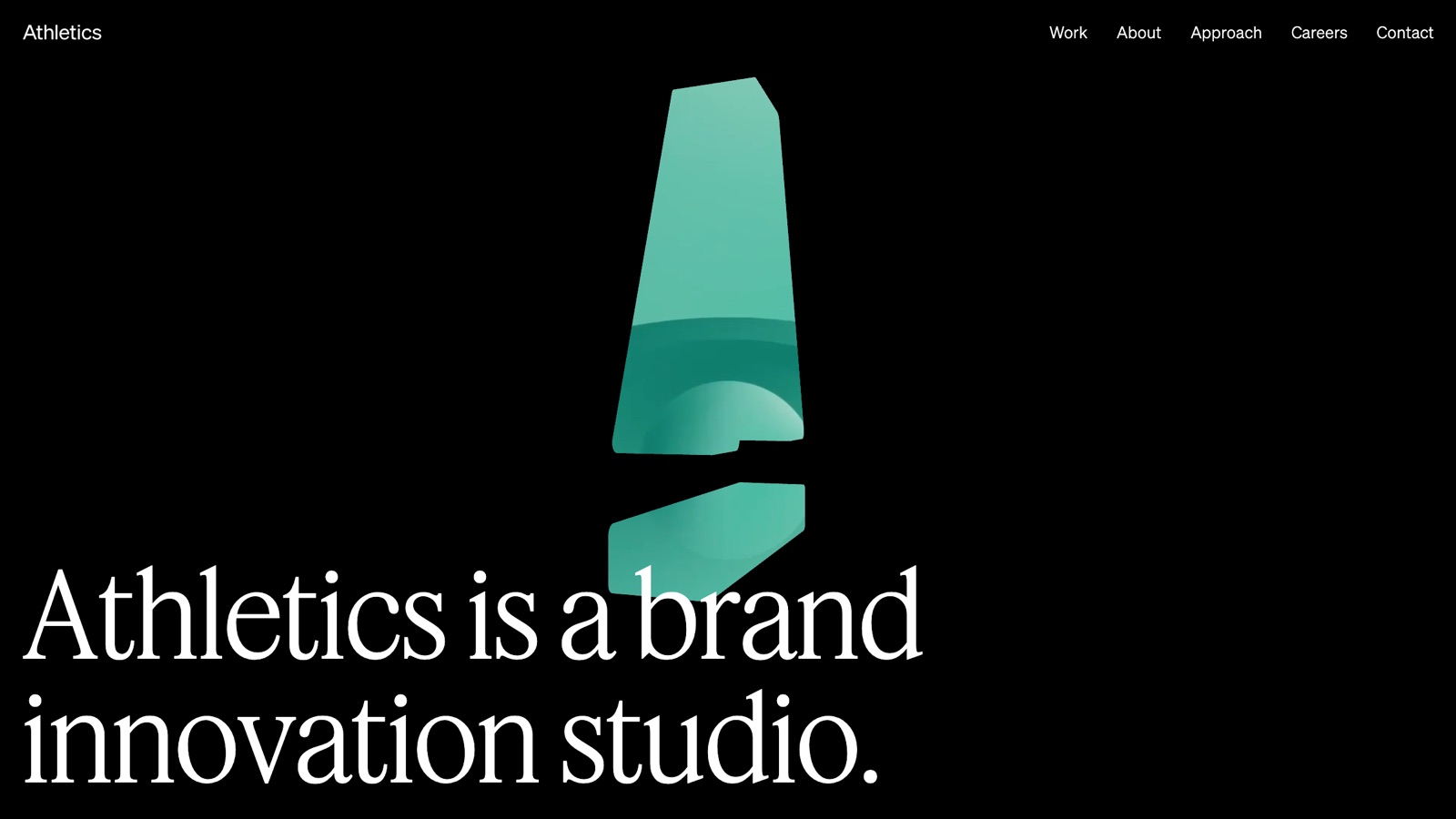
Athletics is a single Brooklyn studio that has built a specialism most identity houses avoid entirely: enterprise and B2B technology branding, done with actual craft. Published clients include Salesforce, IBM Cloud, IBM Consulting, IBM Watson, Google Chrome, Chromebook Plus, Google Beam, Amazon Design, Okta, Zapier and Citrix, sitting alongside sports and cultural work for MLS, Seattle Sounders FC, MoMA, the New Museum and the New York Review of Books. Their identity practice explicitly includes sonic and motion systems.
- Best for: enterprise and B2B technology identity, plus sports and cultural institutions
- Clients they name: Salesforce, IBM Cloud, IBM Consulting, IBM Watson, Google Chrome, Chromebook Plus, Google Beam, Amazon Design, Citrix, Okta, Zapier, Nike, MoMA, New Museum, The Nation, New York Review of Books, Major League Soccer, Seattle Sounders FC, Nashville Soccer Club, Pulitzer Arts Foundation, XQ Institute
- Pricing: per project, undisclosed
- Why they stand out: most studios with this level of visual craft will not touch enterprise software, and most enterprise-capable firms produce identities you could not pick out of a line-up, so the overlap Athletics occupies is thin
- Worth knowing: the portfolio is concentrated in US enterprise technology, sport and arts institutions, with very little consumer packaged goods, retail, fashion or hospitality work published, so a CPG or direct-to-consumer buyer will struggle to find directly comparable proof. It is also a single Brooklyn office with no other listed location, meaning non-US clients work entirely remote across time zones.
More on Athletics
| Best for | Enterprise and B2B technology identity, plus sport |
|---|---|
| Scale | Independent studio |
| Where they are | Brooklyn |
| Named clients | Salesforce, IBM Cloud, IBM Consulting, IBM Watson, Google Chrome, Chromebook Plus, Google Beam, Amazon Design, Citrix, Okta, Zapier, Nike, MoMA, New Museum, The Nation, New York Review of Books, Major League Soccer, Seattle Sounders FC, Nashville Soccer Club, Pulitzer Arts Foundation, XQ Institute |
| Pricing | per project, undisclosed |
Athletics has added a next-generation innovation practice covering AI enablement, futurecasting and product design alongside the identity work, which fits the enterprise client base. The sonic identity capability is worth noting since very few studios of this scale offer it in-house.
One office, in Brooklyn.
Hire them when a technology or enterprise brand needs an identity that a design-literate audience will respect. Do not hire them for a consumer packaged goods or fashion brief, and factor in the single-timezone constraint if your team sits in Europe or Asia.
Every studio in one table
| Studio | Best for | Scale | Where they are |
|---|---|---|---|
| Moonb | Applying and extending an identity across video, motion and design | Embedded creative team | Remote |
| Pentagram | Landmark identity with named authorship | 23 partner studios | London, New York, Austin, Berlin |
| COLLINS | Expressive identity for consumer and technology brands | Two studios | San Francisco, New York |
| Studio Dumbar | Motion and sound driven identity systems | 35 to 40 people, owned by Dept | Rotterdam |
| DIA | Kinetic identity and custom typographic systems | Two named partners | Chamonix, New York |
| Order | Systematic identity, type design and guidelines | Six named people | Brooklyn, Miami by appointment |
| PORTO ROCHA | Motion-first identity for culture and consumer tech | Distributed, two offices | Brooklyn, London |
| Base Design | Identity systems for arts, luxury and finance | Five-studio network | New York, Brussels, Geneva, Melbourne, Saigon |
| &Walsh | Visually distinctive consumer and food brands | Single studio | New York |
| Turner Duckworth | Packaging-led identity and distinctive assets | Owned by Publicis Groupe | Not published in the sources checked |
| Jones Knowles Ritchie | Large distinctive rebrands in food, drink and QSR | Large independent | London, New York |
| Gretel | Media, entertainment and cultural identity | Roughly 19 people | Brooklyn |
| Mucho | European typographic rigour across categories | Two studios | Barcelona, San Francisco |
| Blok Design | Culture, hospitality and civic identity with print craft | Independent studio | Toronto |
| How&How | Illustrative identity for tech and climate brands | Founded 2020 | London, Los Angeles |
| Bond | Hospitality, food and culture with industrial craft | 40 people, independent | Helsinki, Dubai, New York |
| Athletics | Enterprise and B2B technology identity, plus sport | Independent studio | Brooklyn |
How I would recommend choosing
Start by writing down what you will actually receive at the end, item by item, before you contact anyone. If identity is only part of a wider rebrand, the general branding agencies list is the better starting point. If the list includes a custom typeface, your shortlist collapses to the studios that draw type in-house, which in this roster means Order and DIA above everyone else. If the list includes motion behaviour that has to be designed rather than derived, you are looking at Studio Dumbar, PORTO ROCHA, DIA and Athletics. If the identity has to survive being printed on a can and recognised in a fridge from two metres away, Turner Duckworth and JKR have spent decades on that specific problem and the others have not. A brief that does not specify these things will produce four proposals that cannot be compared to each other, which is the most common way this process goes wrong.
Then take capacity seriously, because it is the constraint that kills more identity projects than money does. Order names six people. DIA names two partners. Gretel lists one Executive Creative Director across roughly sixteen staff. Those constraints are the reason the work is good rather than flaws, but they mean the studio’s calendar sets your timeline and not the other way round. If you have a hard launch date attached to a funding announcement or a product release, ask for the start date before you ask for the price, and be prepared to hear a number of months that does not suit you. The studios that can absorb a compressed multi-market programme are the network firms, and you will pay for that flexibility in process rather than in craft.
Ask who owns the studio, every time, without apology. Turner Duckworth has been part of Publicis Groupe since 2014 and does not say so on its site. Studio Dumbar is owned by Dept. None of that makes them bad choices, and in some cases the parent brings production reach you would otherwise have to buy separately, but it changes the minimum viable engagement, the conflict policy and who actually staffs the account. A studio that answers this question openly is telling you something useful about how the rest of the relationship will go.
Plan the rollout before you sign the identity contract, not after the guidelines are delivered. The most predictable failure I see is a company paying properly for a beautiful system, receiving a handover document, and then asking a skeleton in-house team to produce a year of campaigns from it while the studio has moved on to the next client. Base Design’s own numbers make the point plainly, since 353 identity systems against 22 campaign projects tells you exactly where their engagement ends. Decide early whether your in-house team can carry the applications, whether you need a separate production partner, or whether you should scope the identity smaller so you can afford both.
Finally, look at a studio’s work in the categories they have actually published rather than the categories they claim. PORTO ROCHA has almost no B2B or regulated work on the site. Gretel has almost no enterprise work. Athletics has almost no fashion or consumer packaged goods. Blok publishes a global brands list with no matching case studies behind it. This is not a criticism of any of them, since specialisation is what makes a signature possible in the first place, and the thing that makes a studio recognisable is the same thing that makes it wrong for someone. Your job is to find the one whose specialism is your problem, and then to accept the limitation that comes attached to it.
Frequently asked questions
An identity studio's deliverable is visual: a mark, a typeface, a colour architecture, motion behaviour and a guidelines document you can hand to a hundred people. A strategy consultancy's deliverable is a positioning framework, an architecture and a set of recommendations, with design commissioned downstream. Firms like Interbrand, Lippincott and Siegel+Gale sit in the second group. Many companies need both, but hiring one expecting the other is the most common and most expensive mismatch in this category.
You need one when licensing costs at your scale exceed the cost of drawing type, when your brand needs a voice that a licensed face cannot supply, or when the typography is doing the identity's main work. That is a small minority of projects. If a licensed family with good language coverage and a sensible web licence solves the problem, buy it and spend the saved money on rollout. Studios that draw type in-house, such as Order and DIA, will usually tell you honestly which situation you are in.
Because scope varies more than headcount does. A wordmark and a one-page usage note is a different object from a multi-brand architecture with custom type, motion, sonic identity and a fully documented system running across many markets. Studios also price partly on the value and permanence of the asset. Expect to give a range and a deadline on the first call, and expect the studio to shape scope around that rather than quote from a menu.