Superside vs Designity: Which One Fits Your Team in 2026?
Superside vs Designity compared on published pricing, contract terms, revisions, who runs your account, and review scores, with every number taken from their own pages.

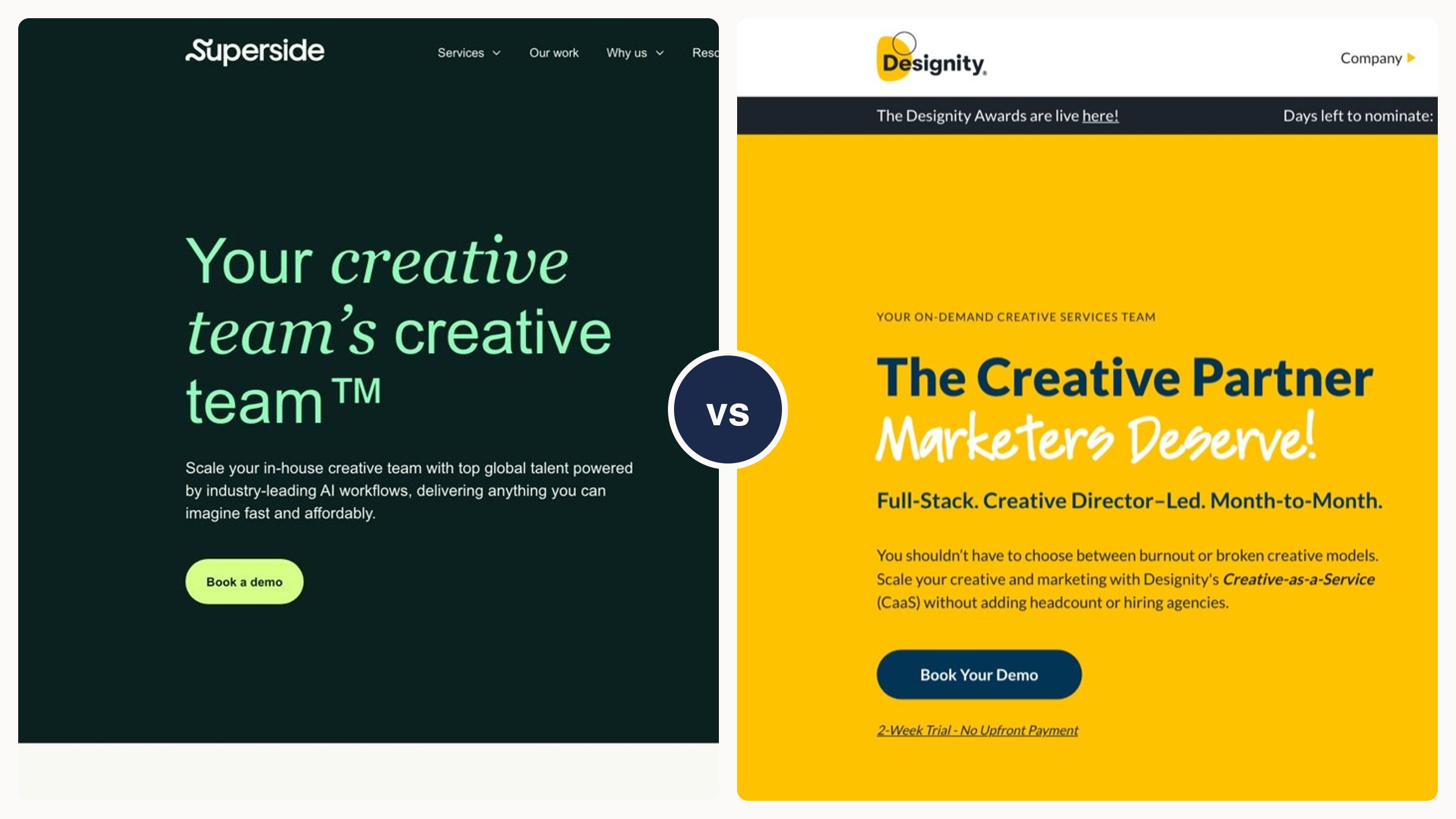
Superside starts at $15,000 a month on a twelve-month term, plus a $1,000 monthly software fee. Designity starts at $5,995 a month, month to month, with a two-week trial and a seven-day cancellation notice. That single line settles the question for most of the teams I talk to, because the two companies are not really competing for the same buyer. Superside is built for enterprises with a large and steady creative budget that want a global production machine. Designity is built for marketing teams that want a creative director leading a small team without signing a year away.
I co-founded Moonb, which competes with both of these companies, so read what follows as the view of an informed rival rather than a neutral judge. I have kept every claim tied to a source link you can click, mostly their own pricing and FAQ pages, and where something is not published I say so instead of guessing.
If you only want the numbers:
- Superside: from $15,000 a month, annual commitment, plus a $1,000 monthly software fee; Dedicated plans from $30,000 a month on a 12-month term
- Designity: Plus at $5,995 a month, Premium at $8,995 a month, month to month, two-week trial, cancel with seven days’ notice
- Revisions: Superside includes two rounds per project; Designity states unlimited revisions while you are an active client
- Your day-to-day contact: a Creative Project Manager at Superside, a dedicated Creative Director at Designity
- Reviews: Superside sits at 4.3 on Trustpilot and 2.9 on Clutch; Designity sits at 4.5 on Trustpilot and 4.8 on Clutch
What each company says it is
Superside describes itself as “your creative team’s creative team” on its homepage and as “an AI-first creative partner for enterprises” on its company overview page. The service list is wide: ad creative, social and digital content, video and motion, print and packaging, presentation design, copywriting, illustration, design systems, brand identity, and a growing menu of AI production services like custom image models and localization at scale. Its talent page reports a team of 800 or more people across 67 countries (its overview page says 70-plus), with video and photo production hubs in Bogota and Johannesburg.
Designity’s homepage leads with “Your ON-DEMAND CREATIVE SERVICES TEAM” and the three words that define its model: “Full-Stack. Creative Director-Led. Month-to-Month.” Its service list runs from social media and digital ads through email campaigns, account-based marketing, SEO and content, motion graphics and video, website and app design, branding, presentations, and packaging. The pitch is breadth with a single point of accountability, because every client is matched with a dedicated Creative Director who runs the work.
The difference in scale shows up in what they choose to brag about. Superside talks about 400-plus global brands on its customer stories page and shows logos like Colgate-Palmolive, Figma, Microsoft, Reddit and Amazon Pharmacy on its enterprise page. Designity talks about 850-plus high-growth teams and enterprises, and its logos are Calendly, Audible, Marriott, the Anaheim Ducks and the Memphis Zoo. One is selling to the Fortune 500 creative operation; the other is selling to the marketing director who needs a real team by next month.
Pricing and contract terms, in their own words
This is where the two companies split most clearly, and I have quoted their pricing pages directly because the wording matters.
Superside’s pricing page states that “Superside subscriptions start at a $15,000 monthly minimum on an annual term” and that “all Superside subscriptions run on an annual commitment.” The same page adds that “your Superside subscription includes a monthly budget and a $1,000 software fee,” which means the practical floor is $16,000 a month for twelve months. A Dedicated plan “is sold as a single monthly number starting at $30,000 a month, on a 12-month term.” Unused Flex budget “rolls over for up to three months.” There is no published trial. The “Quick Start” on the same page is “a $20,000, three-week engagement where our AI implementation specialists configure and tune your Brand Brain,” so it is an AI setup service sold alongside a plan, not a creative pilot. Project boosters start at a $15,000 minimum.
Designity’s pricing page is a conventional tier grid. Plus is “$5,995 /mo” for “120 hours dedicated /mo” with “2 active creatives/projects simultaneously” and “24-hour turnaround for minor requests.” Premium is “$8,995 /mo” for “180 hours dedicated /mo,” “3 active creatives/projects simultaneously” and “12-hour turnaround for minor requests.” A Custom plan runs “from $6k /mo.” Every plan comes with a “2-week trial with no upfront payment,” you can cancel “with a 7-day notice before your renewal date,” and you can pause for “$995” for “2 weeks per quarter.” Quarterly and yearly billing bring the monthly figure down, and the page shows the saving next to the toggle: “Save $1,500 /Qtr” and “Save $10,800 /Yr.” The same page says “unused hours don’t roll over.”
The commitment matters as much as the price. On Superside you are choosing a year at a minimum of roughly $192,000 all in, and the pricing page presents that as the entry point rather than the ceiling. On Designity you can leave with a week’s notice, which is why I see it chosen by teams that are still working out how much creative they actually need each month.
Two things to settle before you compare the numbers. Designity’s page says unused hours do not roll over, so get its hours estimate on your last three briefs, multiply by your monthly volume, and see whether that fits inside 120 or 180. Superside’s page says unused Flex budget rolls over for up to three months, so ask whether that survives the annual renewal.
| Term | Superside | Designity |
|---|---|---|
| Entry price | $15,000 a month plus $1,000 software fee | $5,995 a month (Plus) |
| Commitment | Annual, 12-month term | Month to month |
| Trial | Not publicly stated (the $20,000 Quick Start is an AI setup engagement, not a trial) | Two-week trial, no upfront payment |
| Cancellation | Not on the pricing page; the general terms page has a written-notice clause with the plan running to month end, so ask whether it applies to annual plans | Seven days' notice before renewal |
| Pause | Not publicly stated | $995 for two weeks per quarter |
Who runs your account, and how the work gets done
At Superside, the company FAQ says it “builds a creative team around your needs, led by a Creative Director and supported by Creative Project Managers who handle day-to-day coordination,” and that “your Creative Project Manager is your main point of contact.” Each project “includes two rounds of revisions,” production-focused work “can be turned around in just a few days,” and the globally distributed team “allows us to offer near-continuous coverage.” In my experience that structure suits a company running dozens of briefs at once, and it can frustrate a brand lead who wants to talk directly to the person holding the pen.
At Designity the structure is flatter. The FAQ says every client “is matched with a dedicated Creative Director who specializes in your industry” and that this Creative Director “acts as your main point of contact.” All plans “include unlimited revisions while you remain an active client,” and the same FAQ says that “every member of our creative and marketing community works within US time zones,” while the vetting page says its creatives “are located globally.” That last line is the one I would underline if your team is in the US and hates waiting overnight for a reply.
I have watched both models work and both models fail, and the failure mode is the same on each side: expecting one to behave like the other. Superside’s project-manager layer is the feature, because it is what lets them absorb enormous volume; treating it as a bug means you wanted Designity. Designity’s creative director is a real person with a real capacity, which is why the plans are sold in dedicated hours per month; asking that person to run a 40-market campaign launch means you wanted Superside.
What the review sites say
Review platforms are the closest thing to a neutral witness here, so I pulled the current numbers rather than repeating the testimonials on their sites. On Trustpilot, Superside holds a 4.3 TrustScore from 389 reviews. On Clutch, it sits at 2.9 out of 5 from 6 reviews, with the profile listing Palo Alto as headquarters. G2 shows 4.5 out of 5 from 115 reviews.
For Designity, Trustpilot shows a 4.5 TrustScore from 111 reviews, also claimed. Clutch shows 4.8 out of 5 from 28 reviews, a minimum project size of $5,000, and New York as headquarters. I could not find a Designity product page on G2, so there is no G2 figure to quote.
Superside has far more reviews in total, which reflects its size, and a small Clutch sample that skews low. Designity’s scores are higher but on smaller samples. Neither is a verdict; both are worth ten minutes of reading before you sign.
Superside, in more detail
More on Superside
Superside is the enterprise option in this comparison and it prices like one. The model is a monthly creative budget you draw down against, with a Creative Director shaping the work and Creative Project Managers running the queue. Its own overview page lists AI brand models, AI product photography at scale, and transcreation as services, and the company has been public about moving production toward AI-assisted workflows. Clients named on its enterprise page include Colgate-Palmolive, Grubhub, Figma, Microsoft, Reddit, Amazon Pharmacy and Pernod Ricard.
Not publicly stated: the Flex price above the minimum, per-project prices, service-level hours, cancellation terms for its plans, and any funding beyond the 2021 $30 million Series A it lists on its overview page.
Designity, in more detail
More on Designity
Designity sells a creative team led by one accountable person, sized in dedicated hours a month rather than a budget you draw down. Plus gives you 120 hours and two parallel projects; Premium gives you 180 hours and three. The company says it takes the top one percent of applicants and that its people work in US time zones. Every plan includes full copyright ownership of the work, and the two-week trial with no upfront payment is a real trial, not a paid pilot. Each plan also includes a brand-trained AI agent, one on Plus and two on Premium, which signals where it is headed.
Not publicly stated: Custom plan hours and prices, headcount, funding history, and launch dates for its AI features.
Choose Superside if
You run creative for a company with many brands, markets or campaigns in flight at once, you can commit to a year at $16,000 a month or more, you want production capacity in several time zones, and you are comfortable with a project manager as your main contact. If you are still deciding whether Superside’s price is right for you at all, my colleague’s breakdown of what Superside costs goes line by line through the plans.
Choose Designity if
You lead marketing at a growth-stage company or a single business unit, you want one Creative Director who knows your brand and answers your messages, you are not ready for an annual contract, and your monthly output fits inside 120 to 180 dedicated hours. If Designity is close but not quite right, the wider field is covered in our list of Superside alternatives and, at the other end of the price range, the Design Pickle alternatives guide.
Where Moonb sits, and why I would not pretend otherwise
Moonb is the third option, and since I run it you should weigh this paragraph accordingly. We give a marketing team one dedicated creative team, led by a Creative Director, for video, motion and design, on an ongoing monthly basis rather than per project. That puts us closer to Designity’s contact model with a video and motion depth that neither company leads with. I am not going to put a price next to that here, because we scope each team to the client, but if you want the full comparison of how the creative-as-a-service models differ, and when a fractional creative director is the smarter first hire, those two guides are where I would send a friend.
Every number in one table
| Factor | Superside | Designity |
|---|---|---|
| Entry price | $15,000 a month plus $1,000 software fee | $5,995 a month (Plus), $8,995 (Premium) |
| Commitment | 12-month term | Month to month, 7-day notice |
| Trial | None published (Quick Start is a $20,000 AI setup engagement) | Two weeks, no upfront payment |
| Main contact | Creative Project Manager | Dedicated Creative Director |
| Revisions | Two rounds per project | Unlimited while active (their wording) |
| Capacity model | Monthly budget drawn down | 120 or 180 dedicated hours a month |
| Talent footprint | 800-plus people, about 70 countries (its own pages) | Global talent working US time zones |
| Trustpilot | 4.3 from 389 reviews | 4.5 from 111 reviews |
| Clutch | 2.9 from 6 reviews | 4.8 from 28 reviews |
| G2 | 4.5 from 115 reviews | No product page found |
| Named clients | Colgate-Palmolive, Figma, Microsoft, Reddit | Calendly, Audible, Marriott, Anaheim Ducks |
| Headquarters | Palo Alto (own overview page; describes itself as fully remote) | New York (own site and Clutch) |
Two outside views worth watching
The ANA’s session on how PepsiCo’s in-house agency splits work with outside partners is the clearest picture I know of the hybrid model most enterprise teams end up running, whichever vendor they pick.
Think with Google’s 2026 research on what marketers now expect from agency partners, faster turnaround, embedded teams and cleaner economics, doubles as a checklist for the demo calls.
Frequently asked questions
Superside's published terms are annual, and whether you can leave early depends on the contract you signed, which its pricing page does not spell out. Designity is month to month, so the path most teams take is to run Designity's two-week trial during the final quarter of a Superside term, compare the output on the same briefs, and switch at renewal rather than mid-term.
Designity states full copyright ownership on every plan. Superside's terms page assigns the Work Product to you as a work made for hire. Still ask each of them for the master services agreement before you sign and confirm that rights transfer on payment, because a verbal reassurance is not the same as the clause.
Both list video and motion among their services, but neither leads with it. Superside has production hubs and a very large bench, so it can absorb volume. Designity sells dedicated hours per month, so a heavy video month uses capacity quickly. If video and motion make up most of your output, compare both against a video-first dedicated team before you decide.