AmpiFire Review (2026): What AmpCast Does and What It Costs
An AmpiFire review for 2026: what AmpCast does, the prices AmpiFire publishes, the 60-day guarantee, what users say, and who should and should not buy it.

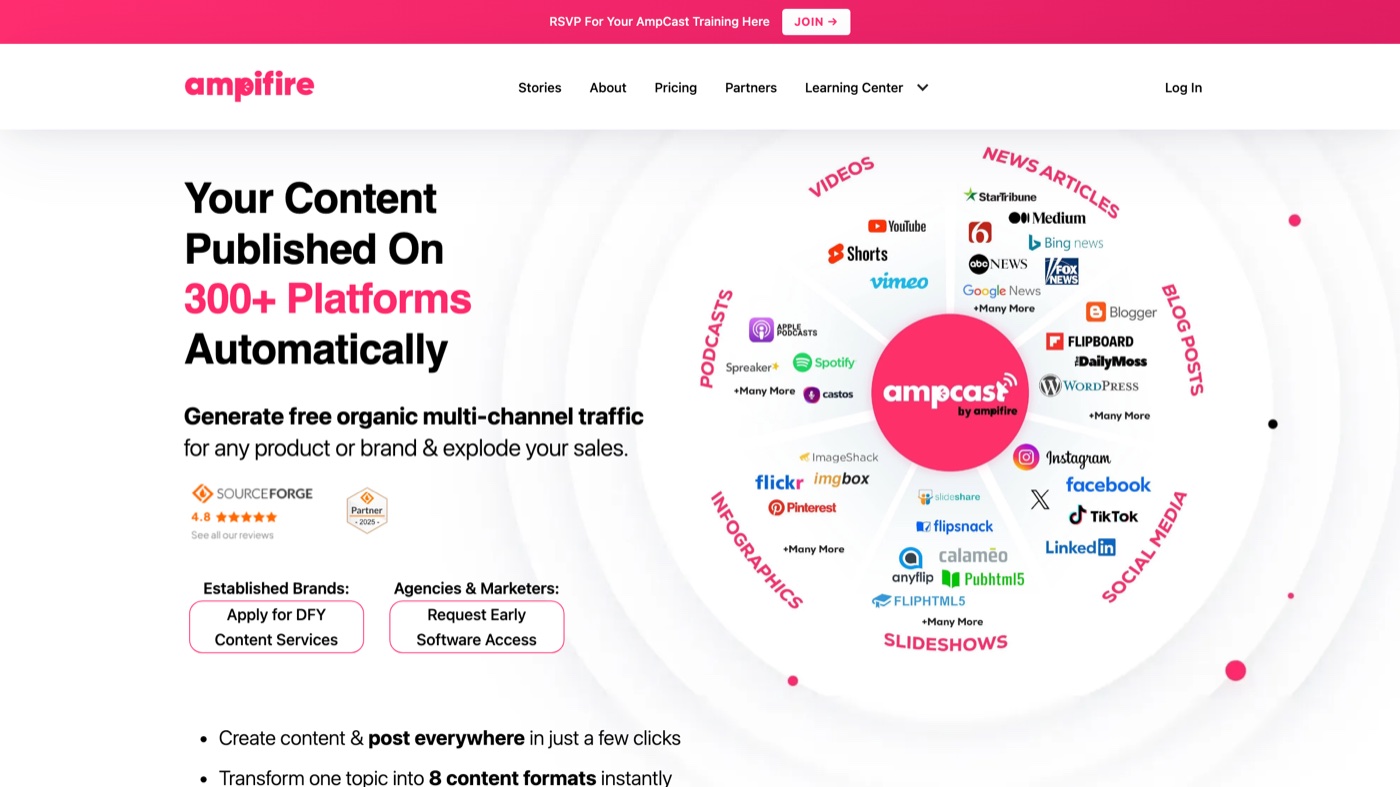
AmpiFire is a content distribution company, and its AmpCast platform takes one topic, turns it into eight formats and publishes them across what the company says are more than 300 sites, from Google News and YouTube to podcast directories and Pinterest. I think it deserves a serious look if you already know what you want to say and your problem is reach on the searches buyers run before they ever speak to sales. It suits you less well if you need results inside a quarter, or if the content itself has to carry a distinctive brand, because AmpCast is built for coverage far more than for craft.
Every price and claim below comes from AmpiFire’s own site or a public review platform, checked in October 2026.
What AmpiFire does, in plain terms
AmpiFire calls the idea MultiCasting. You start from a buyer question, a product page or any URL, and AmpCast builds a campaign around it in eight formats: a long video, a short, an interview-style podcast, a news article, a blog post, an infographic, a flipbook and a batch of social posts. It then publishes them to your own channels and out across its network, which on the homepage includes Google News, YouTube, Spotify, Apple Podcasts, Flipboard, Pinterest and several Fox affiliate news sites. The company says a full campaign takes about 20 minutes to build, against the weeks it would take a team to make the same set by hand.
The argument underneath is about the research stage of a purchase. AmpiFire’s FAQ makes the case that most people research online before they buy, more and more often by asking Google or ChatGPT, so a brand that appears across many sources gets found and, increasingly, recommended by AI assistants. I agree with that premise. Where I would push back is on what counts as appearing somewhere, and I come back to that further down.
On its about page, AmpiFire describes itself as bootstrapped and says it serves more than 5,000 customers with a remote team of over 100 people. If you want to see the product before booking a call, AmpiFire’s own 17-minute AmpCast video, posted on its YouTube channel in November 2025, walks through it:
AmpiFire pricing in 2026
AmpiFire publishes four price points on its homepage pricing table, and which one applies to you depends on how much of the work you want to hand over.
| Option | Price | What you get |
|---|---|---|
| Do-it-yourself AI creation | $97 a month | You build the campaigns yourself with AmpCast's AI tools |
| Syndication and distribution | $497 per campaign | Publishing one campaign across the 300+ platform network |
| Done-for-you creation | $297 per topic | AmpiFire's team turns one topic into the eight formats |
| Full done-for-you service | From $3,599 a month | AmpiFire runs the whole program, priced by volume |
The AmpCast software has not been released publicly yet, so agencies and marketers request early access, and the done-for-you services require an application because AmpiFire limits which brands it takes on. The real cost also depends on how often you publish. AmpiFire’s own advice is that weekly campaigns are the sweet spot for most businesses, with daily campaigns for competitive e-commerce, so at $297 a topic, weekly done-for-you creation alone comes to roughly $1,200 a month before any distribution. That figure is my arithmetic from their published price, and it is the one I would plan around, because a single topic will not tell you much.
The 60-day guarantee, next to AmpiFire’s own timeline
AmpiFire offers a 60-day guarantee: if you follow its process and see no measurable increase in organic traffic or reach within 60 days, it refunds what you paid. The conditions are worth reading closely, since the refund depends on following the process exactly, which the FAQ says includes turning up to scheduled calls and leaving the published content live.
The more useful number is the timeline the company itself gives. Its FAQ says clients typically see positive results within two to three months, with substantial growth between months three and twelve. Placed side by side, the guarantee covers the setup phase and the growth AmpiFire describes arrives later, which I have drawn out below from those two statements.
That is a normal shape for organic content, and AmpiFire is open about it, so I would budget for a full year of steady publishing before judging whether it worked. The headline case study on its homepage points the same way: a treadmill brand that, according to AmpiFire, went from zero to more than 60,000 monthly organic clicks over 15 months on a $5,000 monthly spend. I cannot verify that figure, so read it as the company’s own claim, but even taken at face value the big result arrives after a year of publishing.
What users say about AmpiFire
On Trustpilot, AmpiFire holds a 4.5 rating from 36 reviews as of 21 October 2026, on a profile the company has claimed. Many reviewers praise the support team, some of them by name. The critical notes are useful as well: a reviewer in September 2026 liked the people behind the product but found the platform hard to find their way around and the onboarding too close to a sales presentation. I would believe both, and expect a responsive team working with software that still has rough edges.
Where AmpiFire shines and where it falls short
AmpiFire is strong on speed and reach and weaker on control and predictability, and the panel below has the detail.
The full breakdown of AmpiFire
Not publicly stated: how many readers a typical campaign reaches on the network sites, and how monthly plans are cancelled.
If you want to stress-test it before committing, I would run a handful of campaigns on real buyer questions you already hear on sales calls, then compare search impressions and branded searches before and after. If you are short of questions to start from, our list of content marketing ideas is a decent place to mine them.
Who should use AmpiFire
AmpiFire makes the most sense for a business that sells something people research before they buy and wants organic reach that keeps working after the campaign is done. In practice that means three kinds of buyer:
- E-commerce and direct-to-consumer brands with many products and many buyer questions, tired of paying more each year for the same ad clicks.
- Local businesses that want to be found for specific services in specific places.
- Marketers and agencies who want to add content distribution to what they already sell to clients.
It is a poor fit if you need pipeline this quarter, since the company itself talks in months. I would also be careful in regulated categories such as health or finance, where every claim in every format needs checking, and I would not buy it expecting it to replace the core content work. It spreads what you give it, so the thinking about what to say still has to happen somewhere. Our content marketing plan template is a good way to set that out before you pay for any distribution.
What Google says about content at this scale
Google does not penalize content because AI helped make it, but it does act against content produced at scale mainly to move rankings, so the quality of each campaign decides which side of that line AmpCast ends up on. Google’s own guidance on AI-generated content says appropriate use of AI or automation is not against its guidelines, while using it to generate content primarily to manipulate rankings is. Its spam policies define scaled content abuse as many pages generated mainly to manipulate search rankings rather than help users, and they list generative AI used to churn out pages without adding value as one example.
Read against AmpiFire’s model, that cuts both ways. A campaign built around a real buyer question, with a useful answer in each format, is the kind of distribution Google says it is fine with. A daily schedule of thin topics, published mostly for the mentions and links, sits much closer to what the policy describes, and which side a campaign falls on comes down to the topics you choose and how carefully you edit them. John Mueller’s April 2026 episode of Google Search News, from the Google Search Central channel, includes Google’s latest guidance on AI-created websites and is worth eight minutes before you commit to any content engine:
Distribution multiplies whatever you feed it
The point I keep coming back to is that AmpCast multiplies a message, and the message still has to come from you. If the core idea is generic, 300 versions of it stay generic, and a buyer who meets your brand in eight formats will remember that too. That first step is the part my team spends its days on: working out the one thing a brand should say and making the video and design that carry it, which a distribution engine can then push much further. For video in particular, our video marketing strategy guide covers how to plan the core pieces, and the guide to short-form video shows how one idea becomes a repeatable pipeline of clips.
My overall view is that AmpiFire is a capable distribution engine for brands with clear messages and the patience for a year of steady publishing. If you go in with real buyer questions and review what goes out under your name, it can widen where you show up in a way few small teams could manage alone.
Frequently asked questions
Yes. AmpiFire is an established company that says it serves more than 5,000 customers, publishes its prices and offers a written 60-day guarantee, and its claimed Trustpilot profile showed a 4.5 rating from 36 reviews in October 2026. Whether it works for you depends far more on the topics you give it and how long you keep publishing than on whether the company is real.
AmpiFire's pricing table lists $97 a month for do-it-yourself AI creation, $497 per campaign for distribution across its network, $297 per topic for done-for-you creation, and from $3,599 a month for a fully managed service. At the weekly cadence the company recommends, done-for-you creation alone comes to roughly $1,200 a month before distribution.
Yes, as long as you sell in English. AmpiFire's FAQ says it works with businesses anywhere that uses English as its main language of commerce, so a UK or Australian company selling in English can use it, while campaigns in other languages are not something the company advertises.


