Video Marketing Strategy: A Practical Framework for 2026
A working video marketing strategy that ties every asset to a funnel stage, a channel, a metric, and a production cadence teams can actually keep.


Most video advice still starts with the wrong question. It asks what to film next, not how each video will earn its place in a system. I work at Moonb, a creative team that ships video, motion, design, and animation for marketing departments week after week, and the pattern I see most often is a team sitting on a pile of one-off assets, a few decent posts, and no repeatable way to turn any of it into pipeline, product adoption, or retention.
A real video marketing strategy connects each video to an audience, a funnel stage, a distribution channel, and a measurable objective. That is different from making a polished brand piece, posting it once, and hoping it travels. The market has already moved past that. Wyzowl’s long-running video marketing benchmark shows 91% of businesses use video as a marketing tool, up from 61% in 2016, and 93% of marketers call it a key part of their overall strategy, tracked year over year in Wyzowl’s video marketing statistics. Adjacent aggregators such as Siege Media’s roundup show the same direction of travel across newer datasets.
That shift matters because video is now a default layer across campaign, product, and lifecycle work, not a side project. The teams that get more from it plan for recurring production, reuse, and distribution from the start. The teams that do not usually spend all their energy on the shoot, then discover they have built nothing they can scale.
Why ad-hoc videos underperform
A one-off video can look successful and still do very little for the business. It might get comments, a few shares, and a brief spike in attention. Then it disappears because there is no follow-up asset, no funnel role, and no distribution plan to keep the work moving after launch.
A working video marketing strategy starts before production. It defines who the video is for, what stage of the journey it serves, where it will live, and what action it should drive. Adobe’s guidance on video marketing is clear on that structure, aligning content to awareness, consideration, conversion, and loyalty, then defining objectives first and measuring against clear KPIs.
Strategy beats isolated creativity
That is the difference between a polished brand film and a coordinated video system. The first can be expensive attention with no downstream value. The second compounds because the same core idea supports a landing page, a short social cut, a sales asset, and a retargeting angle.
Practical rule: if a video cannot be named against a funnel stage and a distribution plan, it is probably a creative asset, not a strategy asset.
In the reviews I run of B2B and SaaS teams, the most common gap is treating video as a format instead of an operating model, with no funnel assignment and no distribution plan. That makes short-form video strategy tips more useful than another inspiration board, because the core problem is not producing one good clip. It is building a repeatable system that keeps working after the first publish.
For brands that need the work to continue weekly, that distinction matters. A strategy gives each asset a job. Ad-hoc production gives you content with no assignment.
Mapping video types to the buyer journey
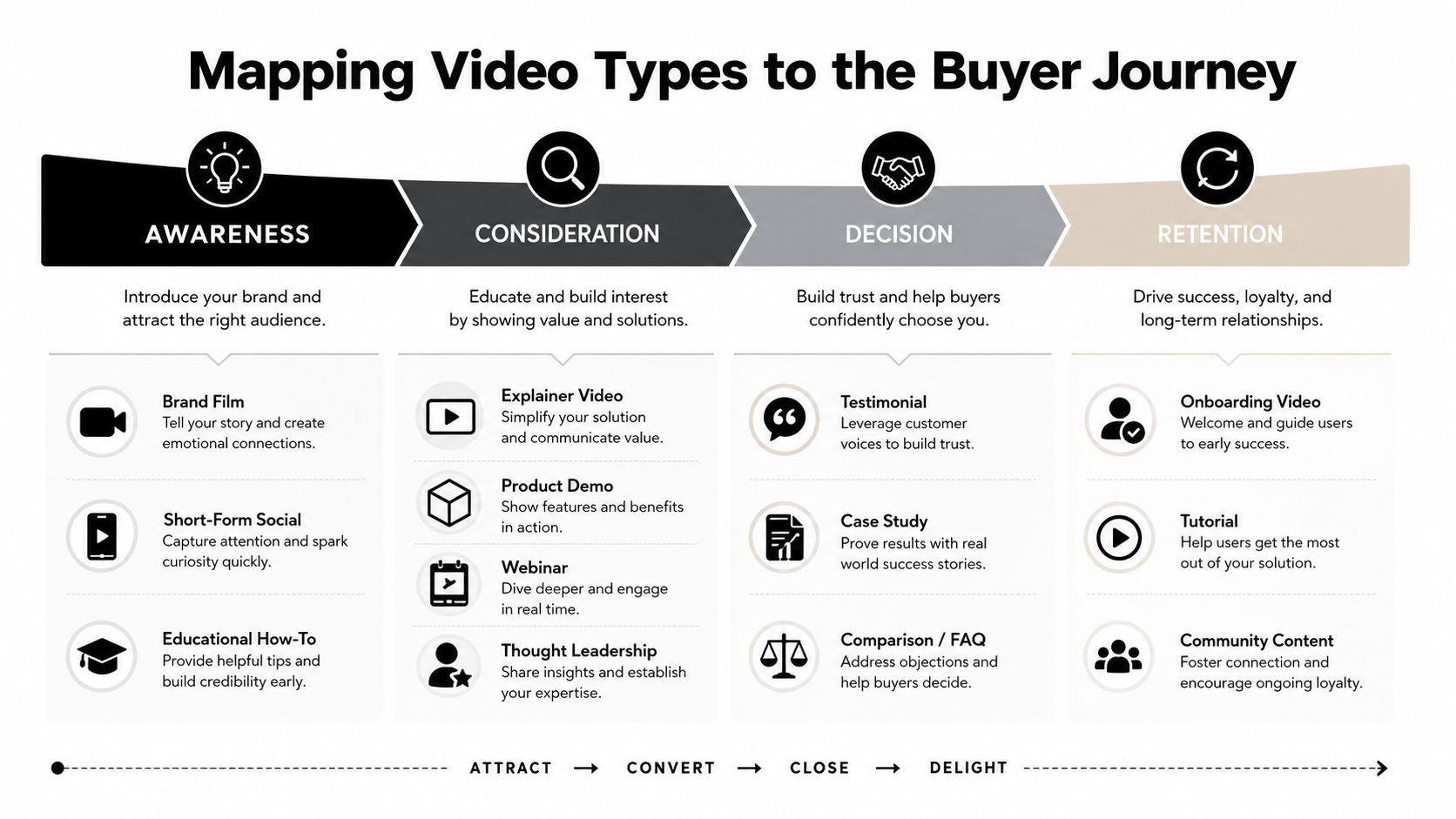
Good video strategy starts with the buyer journey, then assigns each asset a specific job. That keeps the work tied to awareness, consideration, conversion, and loyalty, instead of burying every message in one catch-all plan. The practical question is simple. What does this video need to do for the buyer at this stage?
Awareness and consideration need different signals
Awareness is the first contact point. Brand films, short-form social videos, educational how-to clips, founder intros, and expert interviews work well here because they are easy to absorb quickly and give people a reason to keep watching without asking for commitment too early.
Consideration asks for more detail. Explainer videos, product demos, webinars, thought-leadership videos, and comparison pieces do more of the heavy lifting because buyers are evaluating options and narrowing the field. Google’s video marketing research notes that more than half of shoppers use online video to help decide which specific brand or product to buy, which is why this stage deserves real planning (Google via Lemonlight’s video marketing stats roundup).
Decision and retention deserve as much attention
Decision content turns trust into action. Testimonials, case studies, comparison videos, FAQ videos, and sales enablement clips are the tools that answer objections before a buyer has to chase down proof elsewhere. If the buyer is ready, the content should remove friction, not create more of it.
Retention is where many teams go quiet. Onboarding videos, tutorials, community content, product update videos, and advanced how-to guides help customers get value after the sale and reduce the load on support and customer success. That work belongs in the same operating system as acquisition content, because the post-sale experience shapes repeat use and future expansion.
A useful internal reference for product-led teams is this video product marketing guide. It helps when content teams need to map demos, walkthroughs, and launch assets to buying moments without treating every video as a one-off.
The common failure mode is easy to spot. Teams publish polished top-of-funnel brand work and nothing that helps a ready buyer make a decision. That leaves revenue on the table and pushes sales to answer questions the content team should have handled earlier.
Building a repurposing system that multiplies output
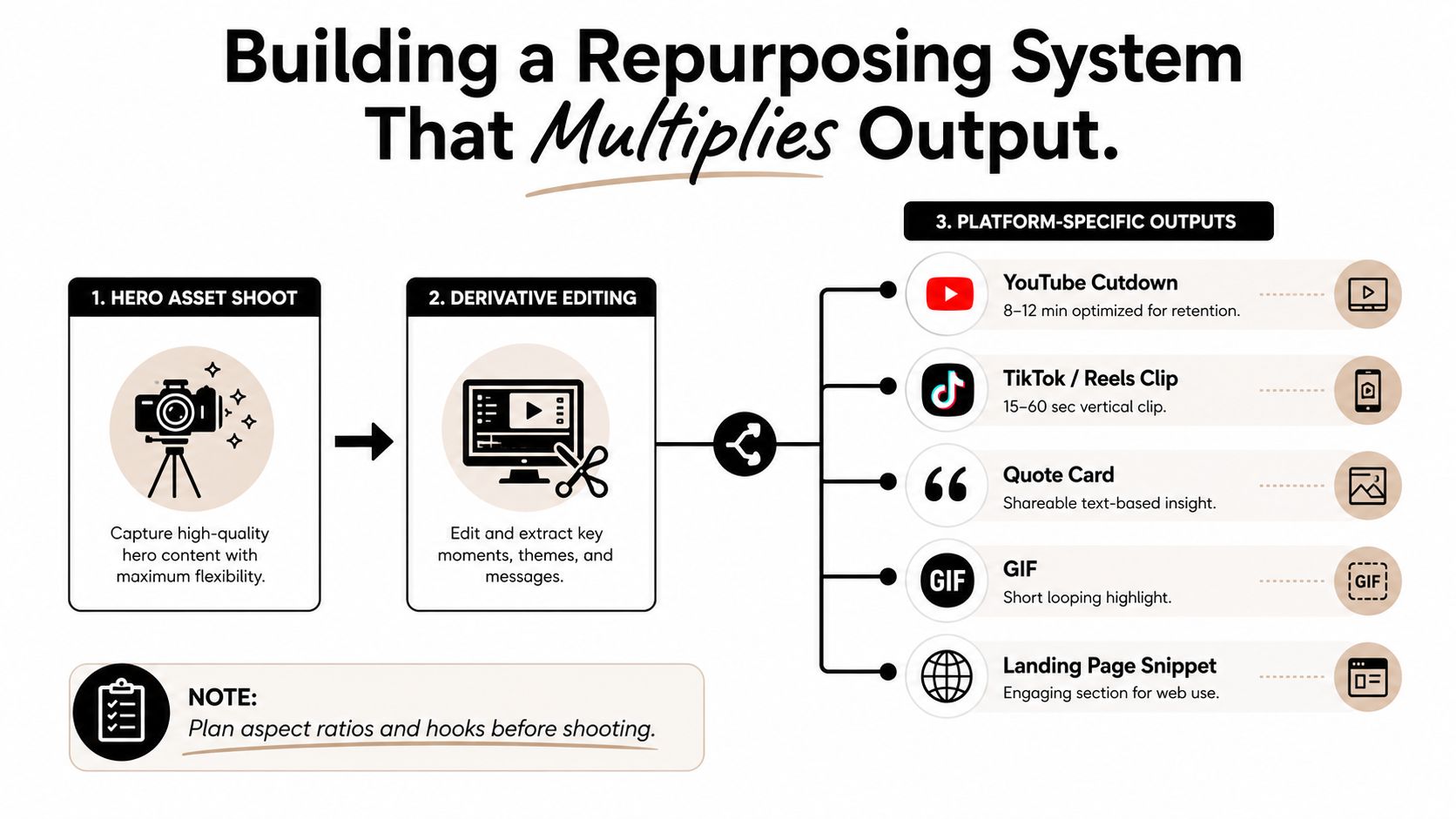
One shoot should produce more than one deliverable. The highest-impact part of video marketing is planning for reuse before anyone presses record. Buffer’s video marketing resource points in the same direction, with an emphasis on batch creation and regular analysis, which makes the operational gap pretty clear (Buffer’s video marketing resource).
Start with derivatives, not just the hero asset
A strong system starts with a hero concept, then defines the edits that should come out of it. That usually means short vertical clips, quote cards, GIFs, landing page snippets, email embeds, and platform-specific cutdowns planned in advance. If you only think about the master file, you will pay for it later in post-production.
One customer interview can become a case study video, three social shorts, and testimonial snippets for a landing page. That is a simple example, but it shows the logic. The value is not just in getting more files. It is in using the same story at different levels of attention and intent.
For teams managing asset libraries, this internal guide on creative asset management is worth keeping close. The process only works when the source footage, selects, and final cuts are organized enough to be reused without friction.
Plan aspect ratios and hooks before the shoot
This is the part teams often skip. If you know you need 9:16 vertical edits, 1:1 placements, and a longer 16:9 version, that framing has to shape the shoot itself. Retrofitting a horizontal interview into short native cuts is slower, and it usually looks retrofitted.
A practical repurposing workflow often looks like this:
- Capture the core message once. Film the strongest interview, demo, or walkthrough in a way that supports multiple edits.
- Design for cutdowns. Plan hook lines, CTA variants, and segment breaks before filming.
- Export by channel. Turn the source into social shorts, sales snippets, site embeds, and email-friendly versions.
For teams that want a broader refresher on format reuse, content repurposing for ministries is a useful example of the same principle in a different context. The specifics differ, but the operating model is familiar.
Choosing platforms and matching format expectations
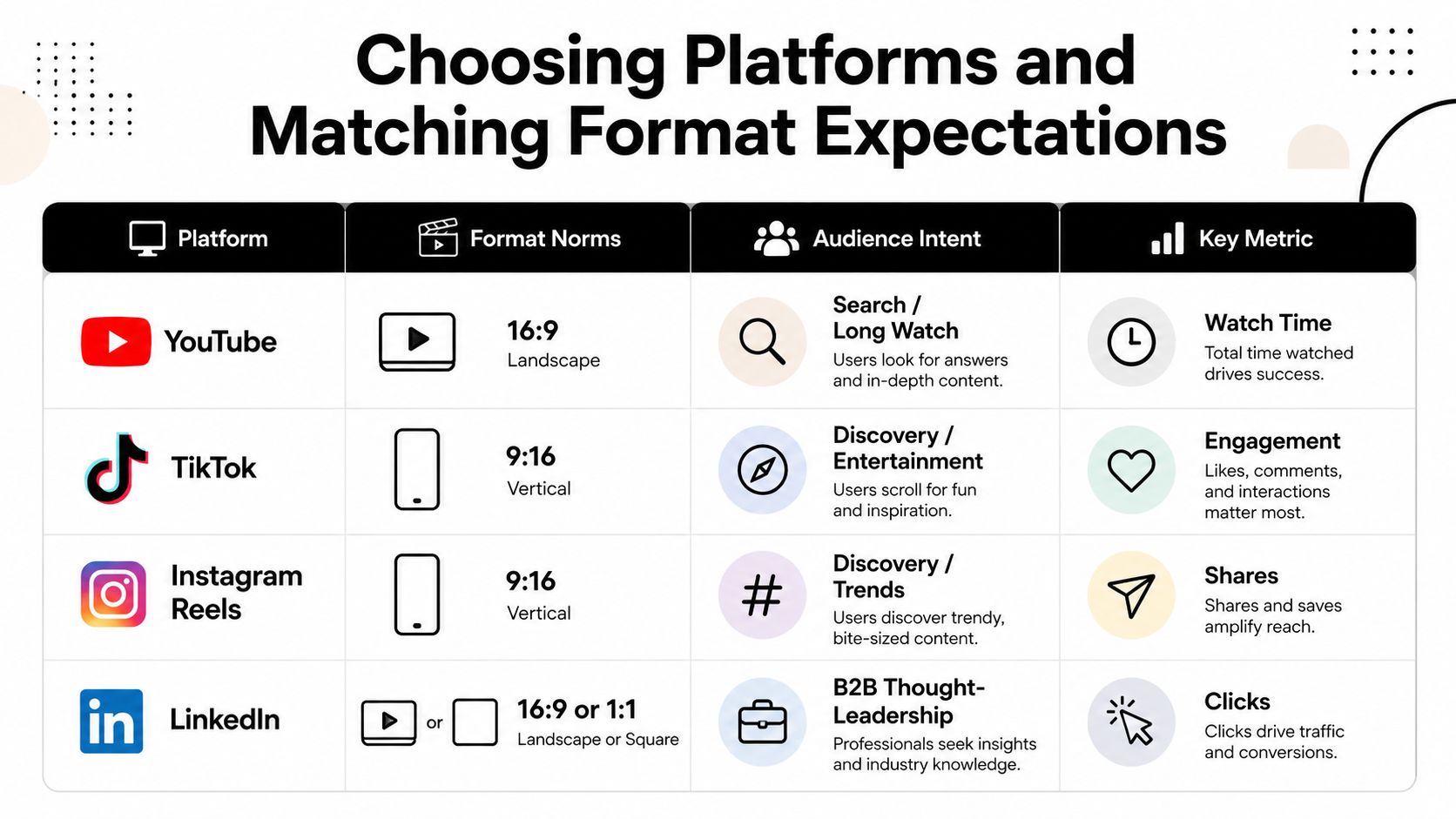
Platform choice should follow audience behavior, not brand preference. YouTube still fits search-driven discovery and longer watch sessions. TikTok and Instagram Reels are built for vertical short-form and fast discovery. LinkedIn supports B2B thought-leadership and proof-heavy content. Landing pages and email are where video often does its most direct conversion work.
Format norms matter more than cross-posting convenience
Each platform expects different lengths, hooks, captions, and pacing. The same cut can work in one place and fall flat in another if the format is wrong. Independent aggregators reporting on mobile video, such as Market.us, consistently show mobile-first framing driving both watch time and share rates, which is a strong reminder that captions, aspect ratio, and load speed decide reach at least as much as the creative does.
That is why reposting a horizontal YouTube cut to Reels unchanged usually underperforms. The viewer is not just seeing different dimensions. They are in a different environment, with different attention habits and different expectations for speed, subtitles, and hook structure.
For vertical execution details, this internal guide on vertical video dimensions is useful when teams are building a production checklist.
Match the platform to the job
YouTube is often strongest when the goal is education or search. TikTok and Reels are better when discovery and reach matter. LinkedIn works well when the audience wants credibility, perspective, or a practical point of view. Email and landing pages are where shorter, focused clips can support conversion.
A good distribution plan does not ask whether one video can fit everywhere. It asks what each platform rewards, then edits for that reality.
If you are comparing where to invest for a fundraising or campaign context, compare video fundraising platforms offers a different take on channel fit and audience intent. The lesson is the same across categories. The platform should serve the objective, not the other way around.
A worked example: one shoot, a month of content
Here is what the system looks like when it actually runs. Say you book a half day with one happy customer and one subject-matter expert from your own team. That is the entire production footprint. Two people, a few hours, one location or one clean remote setup.
Because you planned the edits before anyone showed up, that single session feeds the whole funnel. The customer conversation becomes a two minute case study for the decision stage, three vertical shorts pulled from the strongest thirty seconds, and a set of quote cards for social and the sales deck. The expert interview becomes a ninety second explainer for consideration, a longer how-to for YouTube and the help center, and a handful of captioned clips that answer the questions your sales team fields every week.
That is one shoot serving awareness, consideration, decision, and retention at the same time. The reason it works is not the camera. It is the plan. You decided the cutdowns, the hooks, and the aspect ratios in advance, so the editor is assembling known pieces instead of guessing what might be useful after the fact.
Now put it on a calendar. Run one session like this a month and you finish the year with twelve case studies, twelve explainers, and well over a hundred short clips, each tied to a stage and a metric. Compare that to the team that shoots a fresh brand film every quarter and keeps wondering why video never moves a number. Same budget, very different return, because one team built a system and the other bought a highlight reel.
The trap to avoid is treating the master file as the deliverable. If the only output is the polished long cut, you paid for a shoot and skipped the part that compounds. The derivatives are where most of the reach and most of the pipeline influence actually live, so they belong in the plan from the first creative conversation, not as an afterthought once the hero edit is locked.
Measuring what actually matters
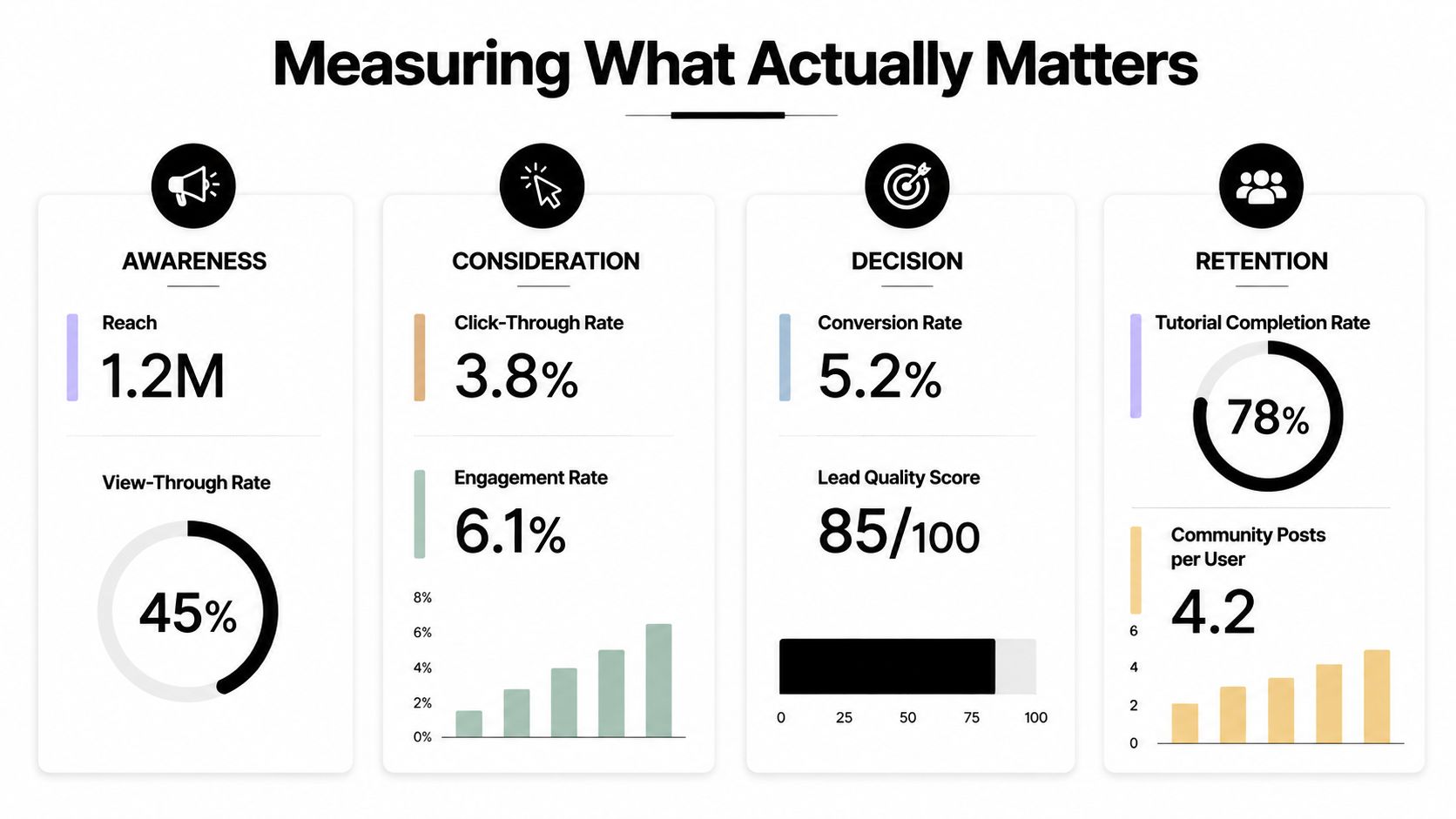
Views are the weakest headline metric in most video reporting. They tell you something, but rarely enough. The core question is whether the asset pushed the next action you wanted.
Set the KPI before you publish
Awareness videos should be judged by reach, view-through rate, and average watch time. Consideration assets should be tied to click-through, landing-page engagement, and lead capture. Decision videos should be assessed by assisted conversions, demo requests, and sales influence.
Watch time and retention curves are especially useful because they show where people drop off. If the first few seconds lose viewers, the hook needs work. If attention fades in the middle, pacing or structure is off. If viewers finish but do not click, the CTA is probably too vague or too easy to ignore.
The useful habit is simple. Define the objective first, then measure against it, then adjust the edit based on what happened. That is how reporting turns into optimization, especially when teams are trying to connect creative decisions to pipeline movement.
Use retention data to edit better
The strongest video teams do not treat analytics as a scoreboard. They use it as a creative diagnostic. A weak opening can be rewritten. A product walkthrough can be tightened. A testimonial can be recut around the sentence that holds attention longest.
For teams that need a practical toolset for this work, best tools for analyzing video is a useful companion piece. The point is the habit, not the dashboard. Set the metric before publishing, then let the result tell you what to change next.
If a video gets attention but does not move the next step in the journey, it is decorative, not strategic.
Resourcing your video production cadence
The right production model depends on cadence. Occasional campaigns can work with freelancers or a project studio. A steady weekly or monthly output needs more continuity, because brand memory, review speed, and handoff quality start to matter as much as raw creative skill.
Match the model to the volume
In-house teams give you control, fast internal context, and easier iteration. They also require hiring, management, and enough demand to keep the role full. Freelancers are flexible and useful for specific shoots or edits, but continuity can slip if you are constantly bringing new people into the brand.
Traditional studios can deliver polish and a clean process, especially for hero pieces, commercials, and launch videos. The trade-off is usually slower turnaround and less day-to-day brand familiarity. An ongoing creative team is another option when a brand needs recurring output without building the whole capability from scratch.
For disclosure, my own studio Moonb sits in that ongoing-creative-team category, delivering video, motion, design, animation, and brand content on a steady weekly rhythm for teams that want an extension of their in-house function. The point is not to replace the client’s team. It is to extend it with dependable production capacity. If the cadence angle is the interesting one, Moonb’s video production services shows what that looks like in practice.
Choose for consistency, not just cost
A good test is simple. If you need a few strong videos a quarter, a freelancer or studio can be enough. If you need repeatable output across launches, social, sales, and lifecycle content, the model has to support that rhythm without constant re-briefing.
For teams building that capability in-house, this guide on build an in-house creative team is a practical companion. The honest answer is that the resourcing decision should follow the cadence plan, not the other way around.
Consistency is usually the real constraint. Once that is clear, the right production model becomes easier to defend.
A lightweight working calendar
A simple monthly pattern can hold together well:
- Week 1. Script, interview, and shoot the core asset.
- Week 2. Cut the main video, plus shorts and landing-page snippets.
- Week 3. Publish, distribute, and test alternate hooks.
- Week 4. Review retention, update the edits, and prep the next concept.
That rhythm is often enough to turn video into a recurring business process instead of a scramble.
A useful video strategy does not start with a trend. It starts with a funnel stage, a platform, a repurposing plan, and a metric that means something. If your team is still making isolated videos and hoping they will carry the load, pick one core concept this month and map it across awareness, consideration, and decision before you shoot. Then turn the first production day into the next four weeks of distribution.
Frequently asked questions
A calendar answers what and when. A strategy answers why: which audience, which funnel stage, which channel, which metric. A calendar without a strategy just produces videos on a schedule and hopes something works. The strategy is what keeps a random Tuesday post from stealing attention from a launch you spent three weeks planning.
The number is a symptom, not a target. A team that ships four intentional pieces with clear roles usually beats a team that ships twenty aimless ones. Set the funnel-stage coverage first (awareness, consideration, decision, retention), then figure out the smallest run rate that keeps each stage fed. If you cannot keep up, cut a stage on purpose rather than skip one by accident.
Yes, but the point of short-form for B2B is rarely direct conversion. It compresses category authority, and it warms up buyers who otherwise take months to raise their hand. Treat it as top-of-funnel repetition that feeds the pipeline, not as a bottom-of-funnel closer. Use it to build a face and a point of view; use webinars, demos, and case studies to close.