How Much Does It Cost to Make a Commercial: 2026 Guide
Discover how much does it cost to make a commercial in 2026. Get clear cost drivers, typical budgets, sample breakdowns, and tips to reduce expenses for your

A basic local commercial can cost $1,500 to $5,000. Most professionally produced 30-second spots run $10,000 to $50,000, and national work climbs into six figures once the production gets more complex. The part many teams miss is that making the commercial and running the commercial are two different costs, and distribution can overtake production very fast.
That gap is where a lot of planning goes sideways. A team thinks it is asking “how much does it cost to make a commercial,” when what it really needs to know is whether the number covers scripting, crew, talent, edits, usage, versions, and media spend, or just the shoot itself.
I have watched smart marketers make good creative calls and still get caught by the wrong line item. Usually it comes down to talent usage or a distribution plan nobody costed on its own. A location count that crept up during planning is the other repeat offender. Get those in hand early and the rest of the number behaves.
How Much Does It Cost to Make a Commercial
A professionally made 30-second commercial in major markets typically costs $10,000 to $50,000 to produce, a figure Video Production Switzerland’s commercial cost breakdown traces to Simulmedia. National broadcast work runs far higher. The American Association of Advertising Agencies put the median for a professionally produced national spot at $342,000 in its 2025 Production Cost Survey. For what a dedicated team covers instead of a one-off quote, our commercial video production page lists the formats and the typical cost of each.
That spread is wide because “commercial” can mean very different things. A single-camera social ad with one location is not the same job as a union-talent broadcast shoot with custom art direction, motion graphics, a full sound mix, and a day of post.
Production cost is not campaign cost
This is the first distinction I make with any client. Production cost is what it takes to develop and deliver the asset. Campaign cost includes distribution, which could mean local TV, connected TV, streaming, or national broadcast buys.
It is also where most budgets tilt the wrong way. The benchmarks we gathered for our 2026 Brand Creative Report show creative and production taking about 32% of a typical advertising budget, even though a separate study credits the creative with close to half of an ad’s effect on sales.
If you want a second reference point, Adwave’s breakdown of TV ad costs is useful because it shows how quickly media buying changes the total once you leave the production side.
Practical rule: If a quote does not clearly separate production from airtime or media spend, assume you are looking at only part of the real number.
Airtime can be modest in smaller local markets and enormous in premium placements. That is not a reason to avoid commercials. It just means “how much does it cost to make a commercial” deserves a more precise answer than one headline figure.
What that means for a real plan
For most brands, I start by working out which of these lanes the project belongs in:
- Basic local or digital-first ad: simple setup, a lighter crew
- Professional regional or OTT spot: polished production with professional talent
- National brand campaign: larger crews, more approvals, higher finishing standards
If you are pressure-testing scopes early, our breakdown of what video production costs can help you weigh the moving pieces before you brief a producer.
What Factors Drive Commercial Production Costs
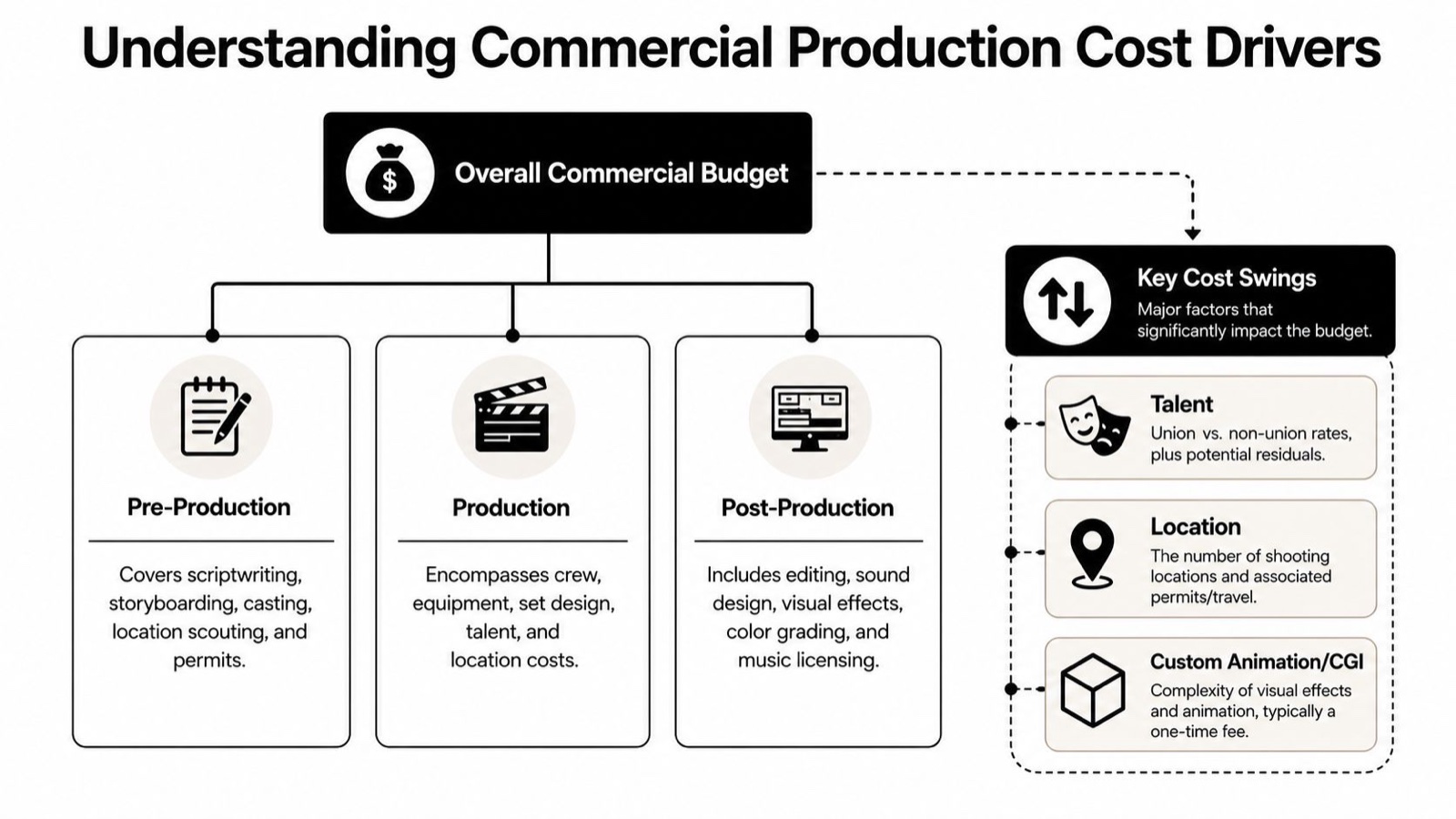
The total is built in stages, and each stage carries its own risk. Pre-production decides whether the shoot stays under control. What happens on the day sets how expensive that day becomes, and post is where the footage turns into something polished and reusable, or does not.
What pre-production really covers
Pre-production is often the least glamorous line item and the one that saves the most pain later. It covers scriptwriting, storyboarding, casting, location scouting and permits, and each of those lines is quoted separately by most production companies. Ask for them itemised: a quote that folds pre-production into one number is the one that moves later.
That money buys clarity. It tells everyone what is being shot, where, with whom, and for how long.
The teams that rush this part usually pay for it on set, and I have watched it happen more than once. They show up still deciding the script, or still unclear on who owns the usage rights. Then the shoot day slows down, and every extra hour starts costing real money.
For teams comparing line items in post, this companion piece on how much video editing costs is useful, because editing tends to grow when pre-production was vague.
What usually swings the total
Three things tend to swing the total the most.
- Talent: This is usually the biggest single factor. Fees are one piece of it. Usage rights can become the bigger issue later.
- Location count: One strong location is efficient. Multiple company moves create friction, setup time, travel, and permit complexity.
- Animation or CGI: Custom motion work can be expensive, but it is usually more predictable than talent because it does not carry the same residual uncertainty.
A few other drivers matter, too:
| Cost driver | Why it moves the total |
|---|---|
| Crew size | More complexity means more specialists on set |
| Production design | Custom sets, props, wardrobe, and styling raise the floor quickly |
| Equipment package | Specialty cameras, lighting, grip, and sound all stack up |
| Post-production finish | Color, sound design, motion graphics, and mastering add polish, and labor |
A commercial usually goes over plan because small decisions piled up, not because one line item was expensive.
What Different Commercial Types Cost
Not every commercial needs broadcast polish. In practice, the format, the channel, and the expected lifespan of the asset should decide the production level.
Cost ranges by commercial type
Pricing tends to split into two worlds. At the low end, a DIY or AI-assisted social ad runs from almost nothing to a few thousand dollars, made for speed and volume. Above that sits the polished tier: real crews and the finishing standards broadcast demands. The table below is the version of that range I keep in my head when a client asks where their project might sit.
| Commercial Type | Production Cost Range |
|---|---|
| DIY or AI-generated social ad | $0 to $5,000 |
| Basic local production | $1,500 to $5,000 |
| Entry-level social or digital-only ad | $1,500 to $10,000 |
| Mid-tier with professional talent | $5,000 to $15,000 |
| Professionally produced 30-second commercial | $10,000 to $50,000 |
| High-end brand film | $50,000 and up |
| National broadcast commercial | Six figures, with a $342,000 median in the 4A’s 2025 survey |
| High-end animation | $10,000 to $20,000 per minute |
For a closer comparison of format-specific pricing, this piece on how much a 30-second commercial costs is a helpful companion.
Twelve practical trade-offs between common options
At this point, the useful move is comparing specific choices, not averages. These are the trade-offs I walk clients through most.
-
Social-first vs regional TV Social can tolerate more rawness. Regional TV usually cannot.
-
One hero spot vs many variants One polished piece is simpler to produce. Multiple versions are often more useful in media.
-
Live action vs animation Live action brings shoot-day variables. Animation trades that for a longer post pipeline.
-
One location vs several One location protects the day. Several locations make the same idea more expensive very quickly.
-
Studio vs practical location Studios cost money, but they remove weather and access problems.
-
Non-union vs union talent The performance quality can be strong in both. The financial structure is very different.
-
Professional VO vs founder read Founder reads can feel authentic. Professional voice-over usually gives cleaner pacing and consistency.
-
Custom score vs licensed track Custom music gives a tighter fit. Licensed music is faster.
-
CGI-heavy vs product-in-hand CGI can explain what cameras cannot. Practical product shots are often faster to finish.
-
Broadcast finish vs digital finish Broadcast standards add technical steps. Digital-only delivery is often more forgiving.
-
Standalone campaign vs ongoing content system One-off work can look efficient at first. Ongoing output changes the economics.
-
Per-project quoting vs embedded weekly output Traditional production is bespoke and variable. A dedicated creative team working on a steady weekly rhythm suits brands producing continuously rather than making one hero commercial a year.
What Sample Commercial Costs Look Like
Ranges help, but a worked example is where people finally feel the trade-offs.
Sample one, a basic local social spot
Example total: $2,500
This is a lean production. Think one location, one performer, simple lighting, and an edit designed mainly for digital.
| Line item | Example approach |
|---|---|
| Script | Short concept and light revisions |
| Production planning | Simple shot list and schedule |
| Talent | One local non-union performer |
| Location | Existing office or controlled space |
| Crew and camera | Small crew with a light kit |
| Edit | One core cut plus a couple of social trims |
| Graphics and audio | Basic supers, light music, cleanup |
At this level, restraint is the whole trick. I tell clients not to fake a broadcast look. Make the idea fit the scope and a lean spot can still look sharp.
Sample two, a regional commercial with professional talent
Example total: $25,000
At this production tier, a lot of strong brand ads live. You can afford better casting, stronger art direction, more deliberate lighting, and a more refined finish.
The line items usually expand like this:
- Pre-production gets more serious: stronger script development, casting sessions, schedule control
- Production day gets fuller: director, producer, camera department, sound, lighting, HMU if needed
- Post gets more polished: edit rounds, color, sound mix, licensed music, motion graphics package
A lot of teams shopping in this range are also comparing vendors, so it helps to review how different commercial video production companies structure their scopes and handoffs.
A good mid-range commercial wins on clarity. It has one strong idea and enough time to execute it properly, with nothing bolted on for show.
Sample three, a high-end national brand film
Example total: $150,000
Now you are paying for scale and finish, and for the control that keeps a big shoot from wandering. The script may require custom locations or a studio build. The cast may need broader usage. Post might include advanced color, sound design, and heavier VFX.
Typical high-tier line items include:
- Creative development: more stakeholders, more revisions, tighter storyboard approval
- Talent and usage: larger fees, stricter contracts, more attention to terms
- Production design: wardrobe, props, styling, set dressing, or a custom build
- Larger crew footprint: more departments to keep quality high and timing tight
- Advanced finishing: heavier online, cleanup, delivery versions, platform specs
None of that is overkill when the distribution plan justifies it. It becomes overkill the moment a $150,000 film ends up living as a couple of paid social placements.
How Can You Reduce Commercial Production Costs
The best savings protect what the audience will actually notice and simplify everything they will not. Stripping the idea until it is weak saves money on paper and costs you the result.
A few of the most reliable levers are worth calling out.
What actually saves money without weakening the idea
Most teams miss the gap between production and campaign totals, and it is a wide one. That same 2025 survey from the American Association of Advertising Agencies put the median 30-second digital-first ad at $18,500, a fraction of the national broadcast median I mentioned earlier. Plan for the first number, forget that airtime drags you toward the second, and that is exactly where a plan comes apart.
The fixes are usually practical.
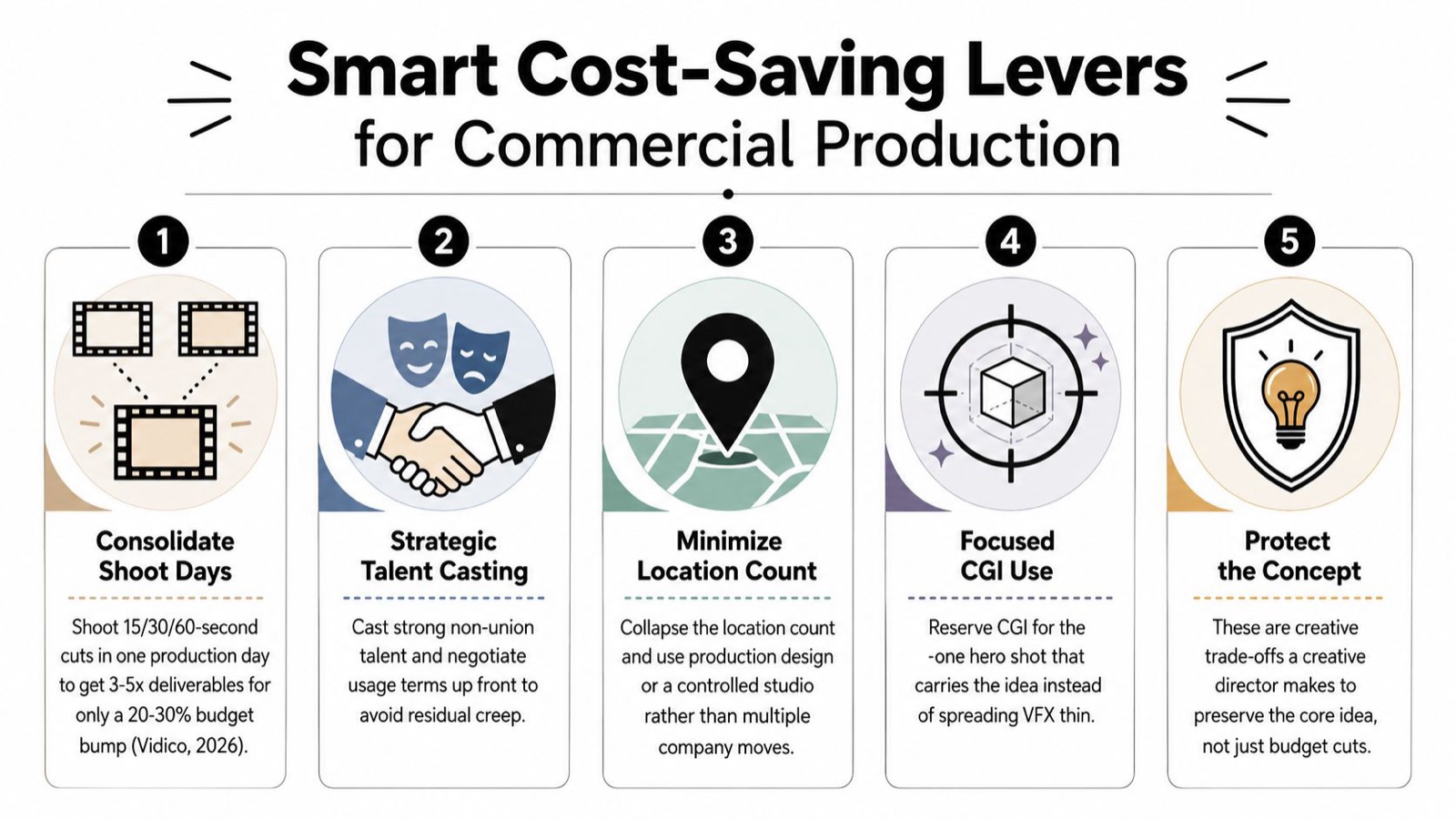
- Shoot multiple cutdowns in one day: The best version of this is planning 15, 30, and 60-second cuts together, instead of treating each as a separate production.
- Control talent usage early: Strong non-union casting and clear usage terms can keep the concept intact without inviting later surprises.
- Collapse locations: If production design can make one space play two ways, do that.
- Use CGI selectively: Put the visual effects into the one hero shot that carries the idea, not every frame.
- Match finish to channel: Social does not always need the same finish standard as broadcast.
If you are weighing synthetic footage or hybrid workflows, this guide to creating AI video ads is a useful reference for where AI can help and where human production still matters.
The same thinking works at film scale. StudioBinder’s short breakdown of how Wes Anderson budgeted The Grand Budapest Hotel shows it in practice: decide where the money shows on screen, then get creative everywhere else.
When ongoing output changes the math
This is the cost almost every single-project article skips. Plenty of the teams I talk to no longer need one ad. They need a system that keeps feeding paid social, streaming, lifecycle email, and sales enablement with fresh creative, week after week. Price each of those as a separate bespoke shoot and the quarterly total gets ugly fast.
If that sounds like your reality, it often makes more sense to work with a dedicated creative team that delivers on a steady weekly rhythm than to quote every asset as its own event. For teams weighing that model, this overview of an AI video production company is one place to compare production approaches.
The most expensive commercial is often the one you keep remaking, because you planned for a single version and the campaign needed twenty.
What Are the Key Takeaways for Pricing a Commercial
If you are trying to set a number you can trust, start with the distinction that trips up the most people. Production and distribution are separate costs. A digital-first ad and a national broadcast spot can sit an order of magnitude apart, and most of that gap is airtime, not craft.
From there, keep your attention on the swing factors.
- Talent first: usage rights and residual structures can reshape the total in ways that surprise you
- Location count second: every extra move adds friction and cost
- Pre-production matters more than people think: a tighter script and storyboard save money later
- Match the finish to the channel: do not build a national spot when you need a social ad
- Plan for versions: one asset is rarely enough anymore
If I had to put it in one line: the right cost is the one that protects the idea and matches the channel it will actually run on. The lowest quote almost never does both.
Frequently asked questions
Yes. They can matter as much as the shoot itself. A talent fee may look manageable at first, then become far more expensive once usage expands across channels or time periods.
Yes, especially when the product is hard to film, highly technical, or still changing. Animation can cost more upfront, but it removes location, weather, and some talent variables.
Yes, if the concept is simple and approvals are fast. Tight timelines usually fail because the team keeps changing the idea midstream, rarely because the schedule itself was short.
Trim complexity before you touch the concept. That usually means one less location and a simpler setup, with the core message left exactly as it was.