How Much Does Animation Cost? A Practical Breakdown
Real per-minute animation price ranges by style, a 60-second explainer costed out, and the hidden line items that move a quote.


A finished minute of animation usually costs somewhere between $1,000 and $25,000, and 3D or broadcast-grade work climbs well past that. Where your specific project lands depends on five things: the style, how complex the visuals are, how many revision rounds you buy, the sound design, and who actually does the work.
Most professional animation costs between $1,000 and $25,000 for a finished minute, with premium 3D and character work running higher, and the reason the range is that wide is that scope, not runtime, sets the price.
I work at Moonb, a creative studio, so I read animation quotes for a living. The thing I wish more buyers knew is that two 60-second videos with identical runtimes can come back priced ten times apart, and both quotes can be fair. One is a text-and-icon motion piece a single designer finishes in a week. The other has custom character design, a dozen illustrated scenes, a licensed track, and three rounds of client notes baked in. Same length, very different amount of work. So runtime tells you almost nothing about the price. Scope tells you most of it, which is why this guide takes the number apart the way I do when I sanity-check a quote: first by style, then by who makes it, then by the line items that move it the most.
Scope drives price more than runtime does
Studios quote animation by the finished minute, not by how long the clip runs on a timeline, and that distinction explains most of the confusion. Sixty seconds can be a plain explainer built from text and icons, or it can be a fully illustrated scene with characters that need to be designed, rigged, posed, and rendered. Both end at one minute. Only one of them is a week of work.
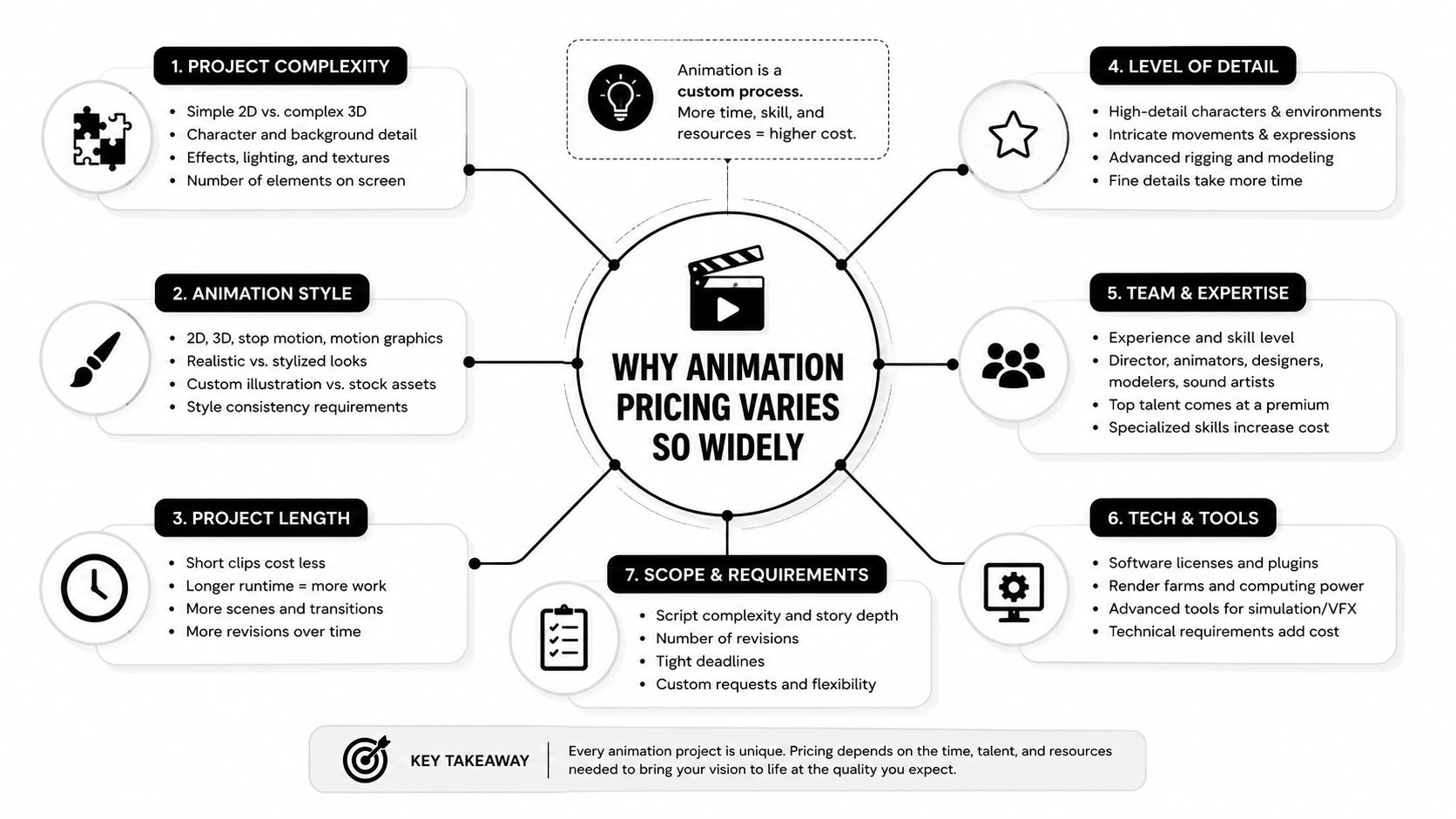
When I open a quote, the first thing I look at is how many decisions the studio has to make on my behalf. Style complexity sets how many assets get built from scratch. Script and storyboard work can be a quick pass or a month of structure. Voiceover, music licensing, sound design, extra revision rounds, and a compressed timeline each add either labor or an outside invoice. None of that shows up in the runtime, which is why the runtime is the least useful number in the whole conversation. A useful cross-check is to read the quote the way you would a formal pricing analysis: tie every line item back to a specific piece of scope, and treat anything that cannot be traced to work as a question worth asking.
It helps to remember that animation is skilled labor measured in hours. The U.S. Bureau of Labor Statistics tracks “special effects artists and animators” as its own occupation for exactly that reason, and a quote is mostly a bet on how many of those hours your project will take. If you want to see where the hours actually go, the animation process guide walks through how scope hardens as a project moves from idea to delivery.
What each animation style typically costs
The cleanest way to answer how much animation costs is to separate the styles, because a logo sting, a 3D product render, and a whiteboard explainer do not belong in the same bucket and should not be compared as if they did. The ranges below are the bands I actually see quoted, not a published rate card, so treat them as planning numbers rather than promises.
| Style | Typical range per finished minute | Biggest cost driver | Best for |
|---|---|---|---|
| Motion graphics | $1,000 to $5,000 | Design polish and animation density | Product and brand explainers |
| Whiteboard | $1,000 to $5,000 | Drawing complexity and pacing | Process and educational pieces |
| Kinetic typography | $1,000 to $5,000 | Type design and timing | Quote-led or punchy social spots |
| 2D explainer | $1,000 to $15,000+ | Illustration depth and scene count | Most product and SaaS launches |
| 2D character animation | $3,000 to $15,000+ | Rigs, poses, and revision rounds | Story-driven brand pieces |
| 3D animation | $5,000 to $50,000+ | Modeling, rendering, and realism | Product and broadcast work |
| Stop motion | $5,000 to $25,000+ | Physical build and shoot time | Tactile, craft-forward brand films |
A few formats do not fit a per-minute model at all. Logo animations, social micro-animations, and UI or product motion are usually priced per project or per scene set, because they rarely run a full sixty seconds. A logo animation leans on concept and brand precision, social micro-animations reward speed and output volume, and UI motion depends on how accurately it has to match a real product screen. At the very top of the market, broadcast and film-grade animation runs far beyond any of these bands, which is why studio feature work gets discussed in millions rather than thousands.
If you are still deciding which format you need, the explainer video types guide is a useful companion for choosing between a motion-led piece, a character-led story, or a simpler format that says the same thing for less.
Who makes it changes the price as much as what you make
The same brief can be priced very differently depending on who takes it on. A freelancer quote often looks lower on paper, but you usually carry more of the project management yourself. A studio quote tends to fold in coordination, consistency, and fewer handoffs, and the price reflects that. Here is how the common options compare in practice.
| Where you source it | What you typically get | Best for | Trade-off |
|---|---|---|---|
| Freelance marketplaces (Fiverr, Upwork) | Fast sourcing across a wide price spread | Simple, well-defined jobs | You manage selection, feedback, and quality control |
| Portfolio platforms (Behance, Dribbble, 99designs) | A discovery channel for strong visual taste | Matching a specific style or look | Discovery, not managed production; you still run the project |
| Individual specialist | Deep skill in one style | A single clear look done well | Limited capacity and turnaround |
| Boutique motion shop | Consistent art direction | Polished motion with less oversight | Small teams can bottleneck as volume grows |
| Full-service or brand studio | Coordination across the whole chain | Work that must match an existing brand system | Price rises as scope and expectations rise |
| Broadcast or post house | Heavy builds and high-stakes delivery | Large, complex productions | More overhead than most marketing videos need |
| Embedded creative team | A dedicated team on a steady weekly rhythm | Ongoing volume beside your marketing or product team | Built for continuity, less suited to a single one-off |
The embedded model is the one I work in day to day, so I am biased toward it for teams that ship video every week. For a single video, though, the lowest-priced option rarely has the cleanest handoff, and the smoothest option is not always the most expensive. It comes down to how much direction you can give and how many rounds of changes you realistically expect. The freelance animator guide is worth reading if you are weighing one freelancer against a studio for a specific project.
A 60-second explainer, costed out
A 60-second 2D explainer is a good worked example because it is common, useful, and easy to overcomplicate. For a mid-market piece I treat around $7,000 as a realistic planning number, with a practical band of roughly $5,000 to $10,000 depending on style, revisions, and voice talent. Here is roughly how that budget splits in a project like this:
- Script and storyboard: about 15 to 20 percent
- Illustration and design: about 25 to 30 percent
- Animation: about 35 to 40 percent
- Voiceover: about 5 to 10 percent
- Sound and music: about 5 to 10 percent
A clean, well-scoped 60-second piece can look effortless from the outside while carrying real production weight underneath. The lower end of that band uses fewer scenes, fewer characters, and fewer custom assets, and a template-led motion approach can bring it down further. The upper end adds more people, more distinct visual moments, premium voice talent, and more feedback loops, and each of those pushes the number up quickly. The explainer video cost guide is a helpful reference for sanity-checking a quote against the scope you actually asked for.
The hidden costs most buyers forget
The biggest surprise for first-time buyers is rarely the animation itself. It is the extras that sit around it, especially once the video has to live in more than one place. Licensed music and sound effects change the feel of a piece fast, but they are not always included in the base quote. Professional voiceover, mid-project script rewrites, source-file delivery in editable formats, social cutdowns, multiple aspect ratios, subtitles, and localization all add scope that a headline per-minute figure hides. As this guide to fixed costs for small businesses puts it in a different budgeting context, recurring obligations shape what a business can carry, and animation extras work the same way once a video has to live in several places.
The one that catches people most often is revision rounds, because every round after animation begins is genuine labor. When I scope a project, I make sure both sides agree on what counts as one round before anyone signs. One round can mean a single consolidated note from your team, or it can mean a messy chain of comments from five people who have not spoken to each other. Those are not the same amount of work, and a good quote will price the difference. Ask what is included, then ask what counts as a revision round, and you will have removed the two most common billing surprises before they happen.
How to cut cost without gutting quality
The safest lever is to lock the script and storyboard before animation begins. Changes are least expensive early and most expensive once scenes are already moving, and that is where a lot of budgets drift, not because the studio was careless but because the brief kept shifting after production started. Locking the storyboard is the single decision that saves the most money over the life of a project.
Style choice is the next lever. A clean motion system that fits the message usually beats a more elaborate look that needs heavy custom work, and reusing one visual language across several videos means the setup effort pays off across the series instead of being rebuilt each time. A few smaller habits help too:
- Consolidate feedback internally so revision cycles carry one clear voice from your team.
- Bundle related videos so shared setup lowers repeated production overhead.
- Match the format to the job, since a simpler motion piece can often say the same thing without forcing full character animation.
- Keep the storyboard step, because skipping it saves a little at the start and costs more later.
If speed is your main pressure, it is worth comparing your production plan against the best AI animation software, though the lowest bid with the biggest promises tends to become the most expensive path once rework starts.
Questions to ask before you sign a quote
Before you approve anything, ask what the price includes, how many revision rounds are covered, and who owns the source files at the end. Confirm the turnaround time and whether rush fees apply. Check that music and voiceover are licensed for the specific channels and regions you plan to use, and ask which cutdowns or aspect ratios are part of the deliverable, since those are often billed separately.
The goal with every one of those questions is the same: to make the scope visible before the work starts, because animation pricing is shaped by scope, not runtime. If a vendor gives you a range, confirm it against your exact style, revision plan, and delivery format, because a range only means something once you know what is inside it. Take your script, reference frames, target length, and delivery needs into one vendor conversation, ask for a line-item quote, and compare the answers against the style bands, the revision policy, and the hidden costs above before you commit.
Frequently asked questions
Most mid-market 60-second 2D explainers land between $5,000 and $10,000, with around $7,000 a realistic planning number. A template-led motion approach with few scenes sits lower, while custom characters, premium voice talent, and extra revision rounds push it higher.
3D adds modeling, rigging, texturing, lighting, and rendering on top of the design and animation work a 2D piece already needs, and each of those is skilled labor measured in hours. That is why 3D commonly starts around $5,000 per finished minute and broadcast-grade work runs far higher.
Extra revision rounds. Every round after animation begins is real labor, so confirm how many are included and what counts as one round. A single consolidated note from your team is very different from a scattered thread of comments from five people.