How Much Does an Explainer Video Cost?
A practitioner pricing guide to explainer videos: real ranges by production model, where the money goes stage by stage, and how to compare quotes without overpaying.

A custom 60 to 90 second explainer video usually costs between a few thousand dollars and the low five figures, and the size of that gap has little to do with how long the video runs. It comes down to scope. I work at Moonb, a creative studio, and I have watched a marketing lead collect three quotes for what looked like the same 75 second explainer and end up with numbers that sat almost 10x apart. One read as reasonable. Another looked suspiciously low. Before you compare any of them, stop reading the headline price and start reading what each one actually includes.
Treat a quote as a stack of decisions rather than a single figure. Two videos can both run 75 seconds and sit in completely different price bands, because one is a script led piece with custom design and original animation while the other is a template with a stock voice and light edits. That difference is the entire story of the price. So the useful question is simple. What am I actually asking this team to build?
What actually drives the cost
Scope drives the number, and scope breaks down into the message you need to get across and the way you choose to build it. Runtime barely moves the needle by comparison.
Start with the script
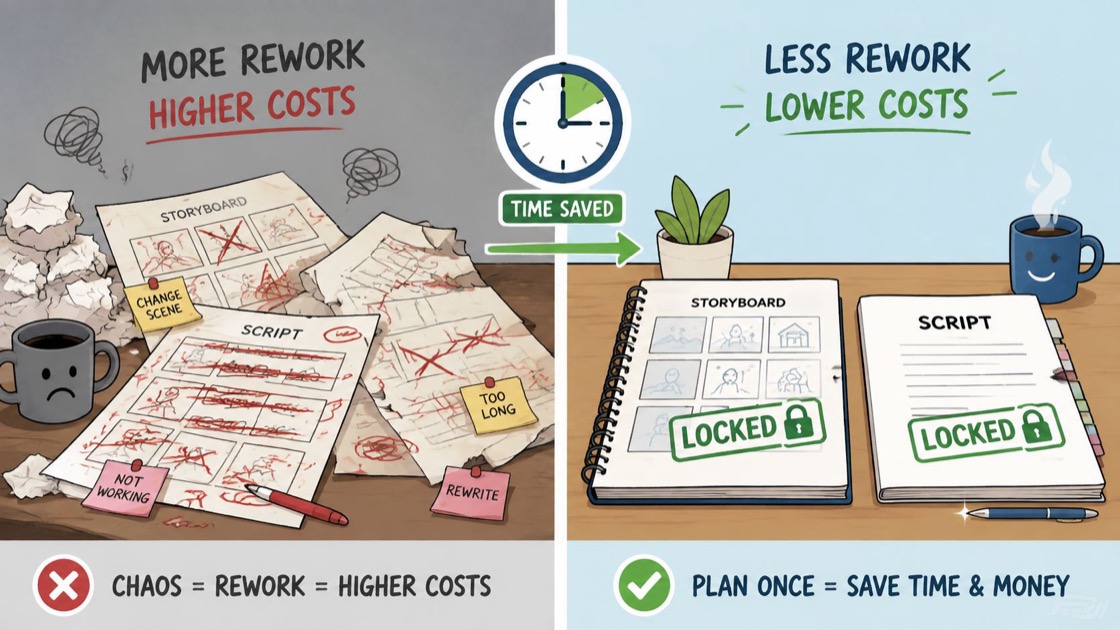
A strong script decides everything downstream, which is why I lock the message before anyone animates a single frame. Rework is where explainer projects bleed money, and most of it traces back to a script that was not finished before production began. If you want a tight process for that first stage, a proper creative brief controls cost better than any negotiation over the animation rate.
Story is the reason anyone watches an explainer to the end, which is why the script deserves more attention than the animation rate. This TEDx talk on the mechanics of storytelling is a useful watch before you brief one.
Then look at the visual ambition
Custom illustration and character design pull the number up, and full 3D pulls it up further. A simple product walkthrough in a clean motion style costs far less to stage than a layered narrative with multiple scenes and branded environments. This is the single biggest lever in most quotes.
Typical ranges by production model
The clearest way to read explainer pricing is by who makes it. I will give ranges here, but treat them as planning figures rather than quotes. They shift with region and scope, and they change year to year.
| Production model | Range I typically see (USD) | What you usually get |
|---|---|---|
| DIY and template tools | Hundreds to low thousands | Preset templates, stock scenes, a synthetic or stock voice, little custom work |
| Freelance motion designer | A few thousand | Custom motion, direct collaboration, lighter project management |
| Small studio or embedded creative team | Mid four figures to low five figures | Script support, custom design and animation, a structured revision process |
| Full service production company | High five figures and up | Strategy, senior creative, multiple review stages, broader deliverables |
DIY tools sit at the bottom because they trade originality for speed. Freelancers and small studios occupy the middle because you are paying for craft and collaboration. Full service companies sit at the top because they wrap strategy and senior creative around the production itself. If you are weighing an external team against building the capability yourself, I have written about the in-house creative team math separately.
Where the money actually goes
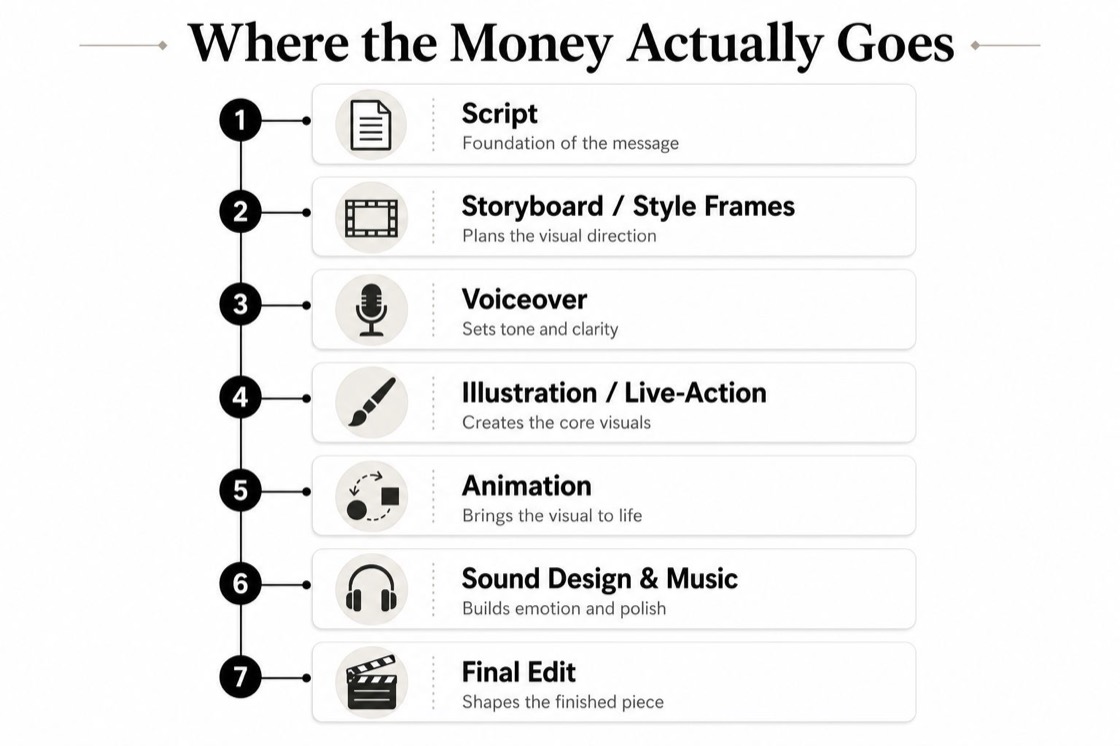
A finished explainer is built in layers. The script and storyboard come first and set up everything after them. The visual build and the voiceover take the largest share, and sound design plus revision rounds close things out. The most expensive assumption I see is that animation is the whole bill. In practice the early phases decide whether the later ones go smoothly or spiral, and a shaky script makes every downstream hour cost more.
Why skilled animation costs what it does
This is the part buyers underestimate. Custom animation is priced on skilled labor, and that labor is not a bargain input. The U.S. Bureau of Labor Statistics puts the median annual wage for special effects artists and animators at $99,800 as of May 2024, and the median for film and video editors at $70,980. When a quote covers original animation and a real edit, those wages are what you are paying for. It also explains why a template build comes in so much lower, since it skips the custom labor almost entirely.
Voiceover is the other real branch. A professional human voice adds performance that a synthetic read still cannot match, while a synthetic or stock voice lowers the production load when the script is carrying the weight. Whether you commission original illustration or reuse stock decides another chunk of the number. For work that leans on animated graphics rather than filmed footage, our motion graphics services overview walks through what changes the hours.
It is easy to underrate how much skilled hours cost. Business Insider’s look at why specialized work stays expensive is a good reminder of what sits behind a real production line item.
The rule I never break
Lock the script and storyboard before anyone animates. That sequence prevents the most expensive category of change, the redraw and the re-record, which costs far more than a note on a rough cut ever will.
Animation or live action
Animation usually skips the crew and the location, and it skips reshoots entirely. That makes it easier to control and less costly to update later. Live action can be the right call for a talking head or a simple product demo, but it climbs fast once you add a crew and multiple shoot days.
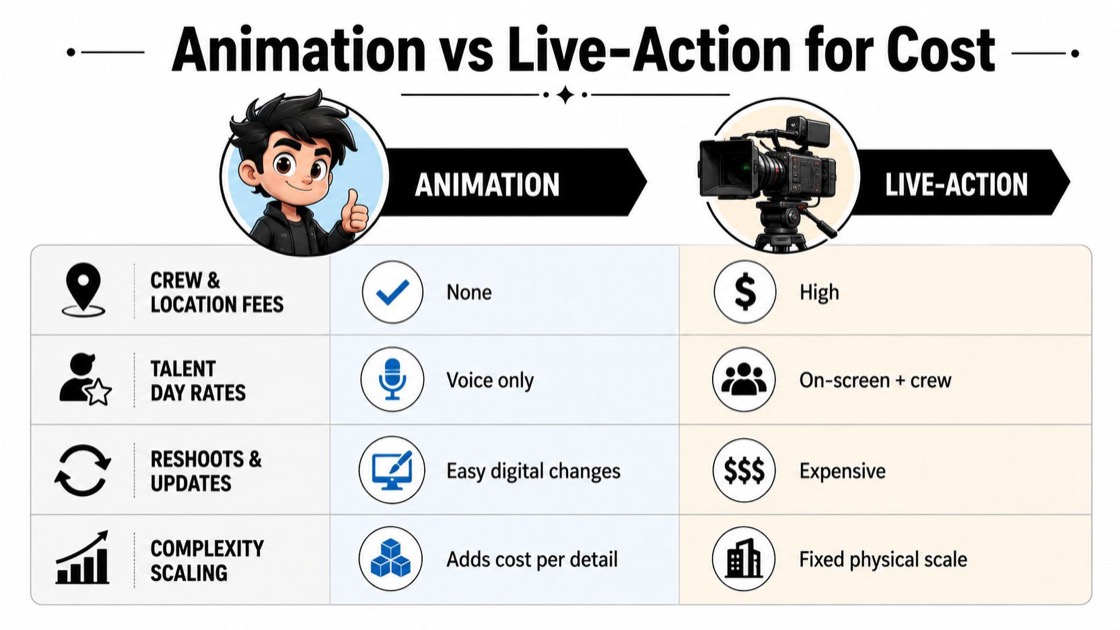
Do not assume animation is automatically the lower number. Highly custom 2D or full 3D can outprice a straightforward live action shoot. The real question is fit, so choose the format that explains the product best and let the number follow.
| Factor | Animation | Live action |
|---|---|---|
| Crew and location | None to minimal | Real cost, scales with days |
| Talent | Voice only | On camera talent plus crew |
| Reshoots and edits | Revised digitally | Harder and pricier to change |
| What pushes cost up | Visual detail and complexity | Physical production and shoot days |
What a suspiciously low quote leaves out
A rock bottom quote usually means something got left out. The provider may have dropped revision rounds and source files, then charges for them once the project is moving. Speed can hide the same trick, because rushed work tends to compress the parts that keep a project clean.
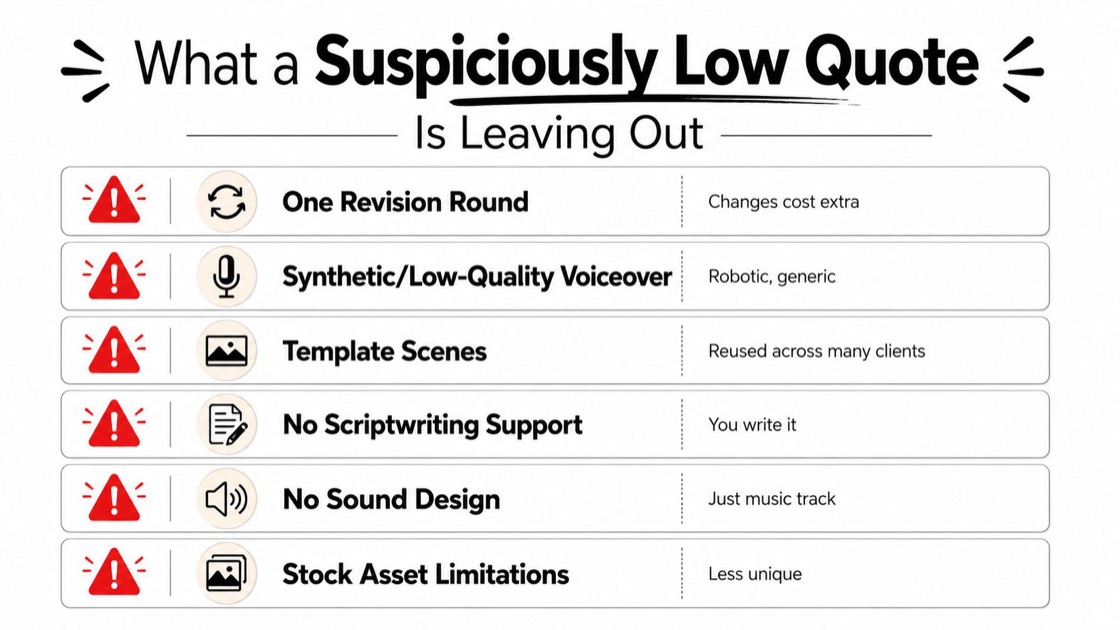
Ask every provider the same questions and the differences show up fast.
- How many revision rounds are included, and what does an extra round cost?
- Is the visual build custom or template based?
- Who writes the script, and who owns it at the end?
- What kind of voiceover is in the price?
- Do I get the source files?
- What is the realistic turnaround?
A very low number often turns into a generic result or a stack of change fees. Comparing deliverables line by line is the only way to catch it before you sign.
How to spend less without hurting the result
Lock the script and storyboard before animation starts. I keep repeating this because it saves more money than anything else on the list. Late changes ripple through every stage after them, so if the message is not stable, spend your time there first.
Keep the runtime tight. A 60 to 90 second cut is usually the sweet spot, and every extra block of time means more script and more animation to pay for. If money is tight, cut scope before you cut quality, because a shorter and sharper story beats a longer one that had to be rushed.
A few more levers you control:
- Choose a simpler visual style. Clean motion with fewer custom scenes costs less than dense illustration.
- Reuse a scene system across a series. Once the visual language exists, later videos move faster.
- Send one consolidated round of feedback instead of scattered notes over a week.
- Hand over your logo files and product screenshots up front to cut the back and forth.
Who should you actually hire
Match the maker to the job. A freelancer is a reasonable call for one straightforward video where you own the script and can direct it yourself. A production company makes sense for a one time flagship piece with a real production budget behind it. If you expect a steady stream of video and want the same script discipline and motion style across all of it, a dedicated creative team is the more sensible structure, since you are not rebuilding the process with every new vendor.
This is where a studio like Moonb fits. We work as an embedded creative team on a weekly rhythm, which keeps the motion style and review cycles consistent across a whole series instead of resetting each time. If you are comparing that model against other ways to buy creative, our overview of creative design services lays out how ongoing work gets scoped and priced. And if you are planning video alongside a larger brand investment, it helps to read it next to what branding costs so the full number makes sense.
Comparing quotes without getting fooled
Compare scope before you look at the sticker price. Send the same short brief to every provider, ask the same questions about revisions and ownership, then line the answers up side by side so the tradeoffs are visible.
The lowest total is rarely the lowest real cost, because the gaps come back later as change orders. Pick the quote with the clearest path to a strong final cut. That one was almost always priced with nothing hidden in the first place.
Further reading: event video production specialists London, AIMVG pricing guide, Sparkhouse pricing guide, video ads for e-commerce scaling, Gisteo explainer pricing survey.
Frequently asked questions
Runtime matters less than people expect. A 30 second cut and a 90 second cut in the same style are not priced in proportion, because the fixed setup work happens regardless of length. Going past about 90 seconds does add real cost, since you are adding scenes and voiceover, but shaving 15 seconds off a tight script rarely saves much. The bigger lever is complexity, not duration.
It depends on where the video runs and who it is for. For a sales or brand piece that a prospect watches while deciding whether to trust you, a professional human read still carries warmth and timing that synthetic voices approximate but do not equal. For internal training or high volume social cuts, a good synthetic voice is often fine and keeps production lighter. A useful middle path is to script for the voice you can afford, since a well written line covers a lot of ground either way.
Usually because they are not quoting the same thing, even when the brief looks identical. One team may include original illustration and two revision rounds while the other assumes template scenes and a single pass. Ownership of the source files and turnaround speed move the number too. Ask each team to itemize what sits in the price, and the gap almost always explains itself.