Creative brief template.
Eight fields that turn a vague request into work you can sign off. Type straight into the PDF, or use the Word file.
Free, no sign-up, no email.
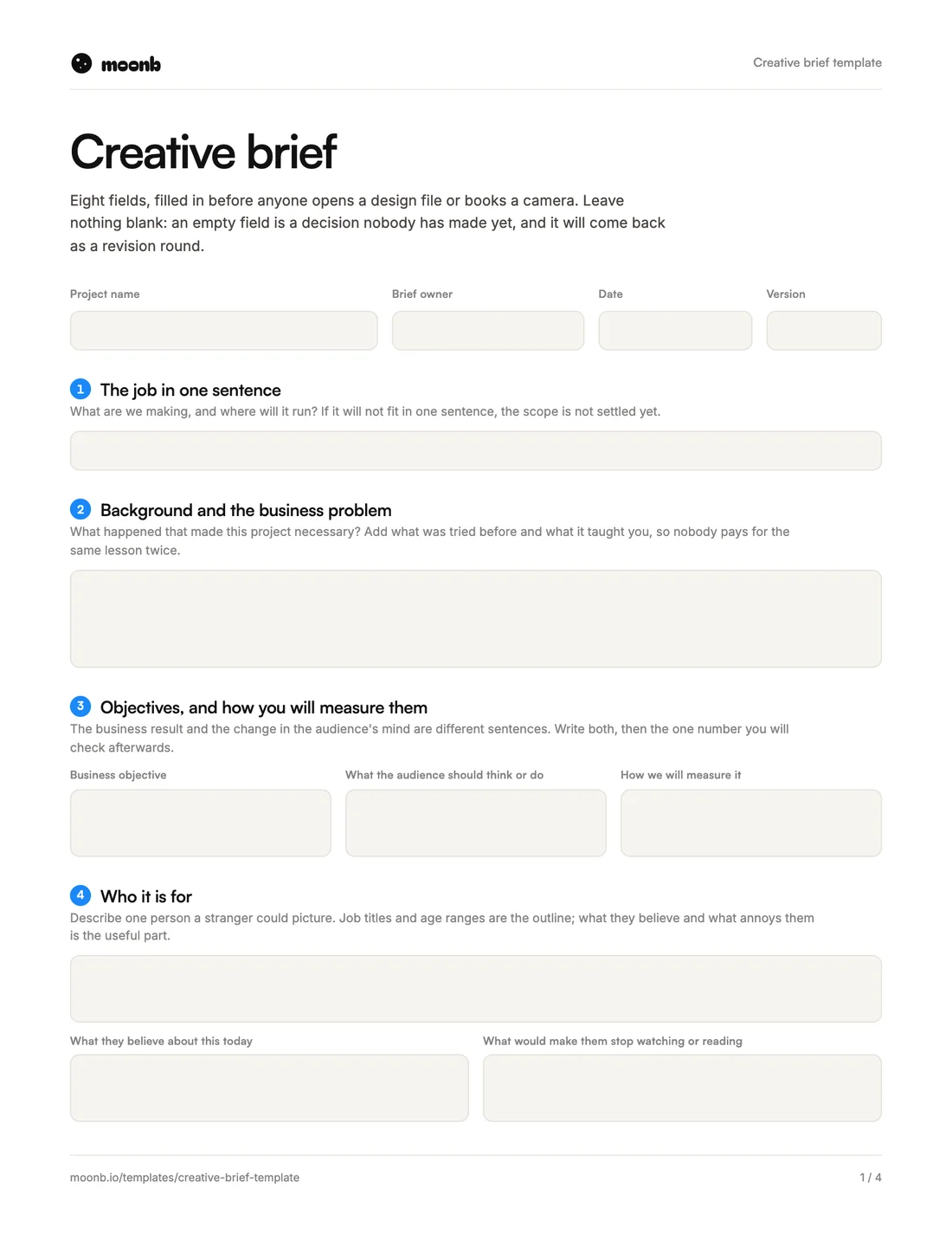
- Page 1
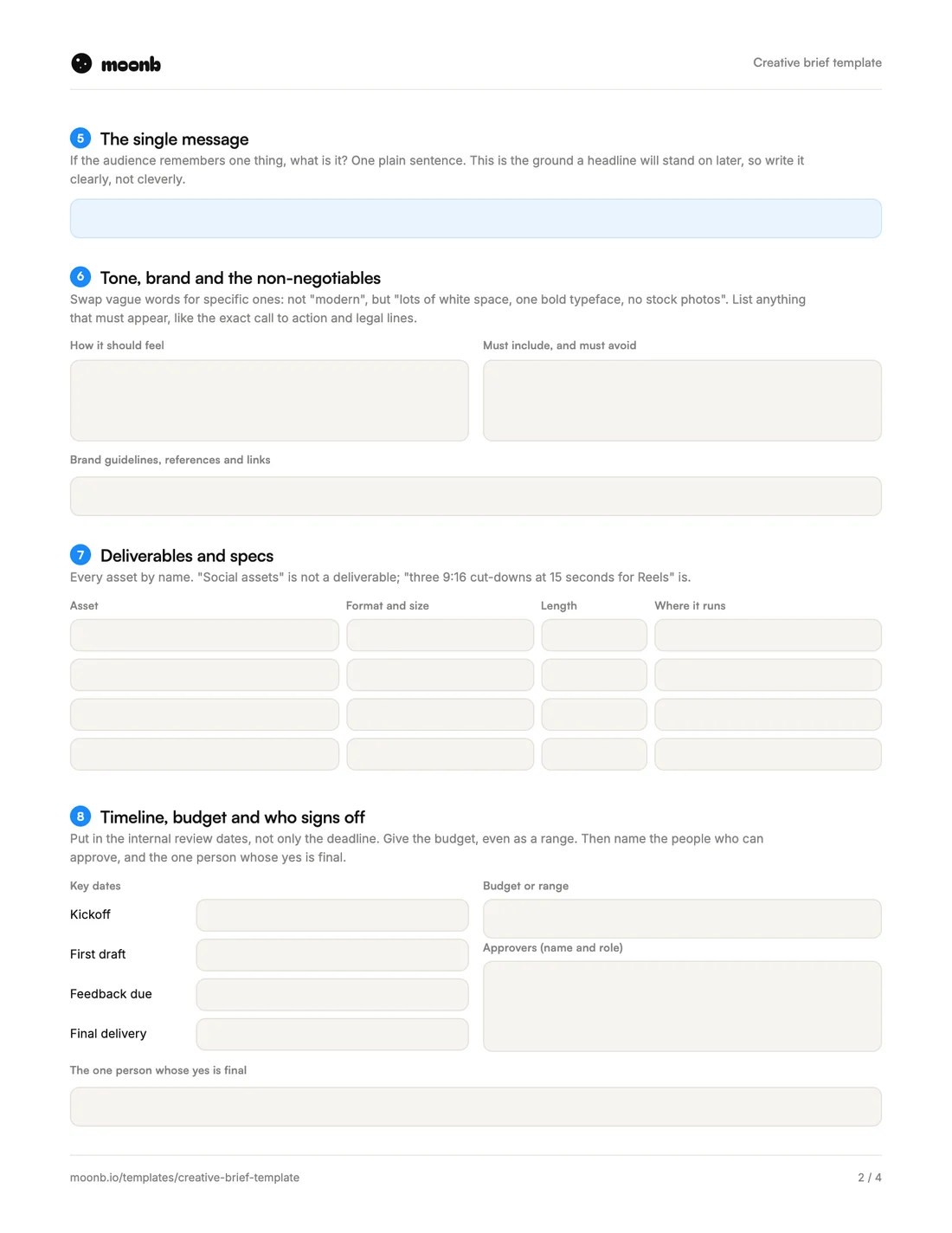 Page 2
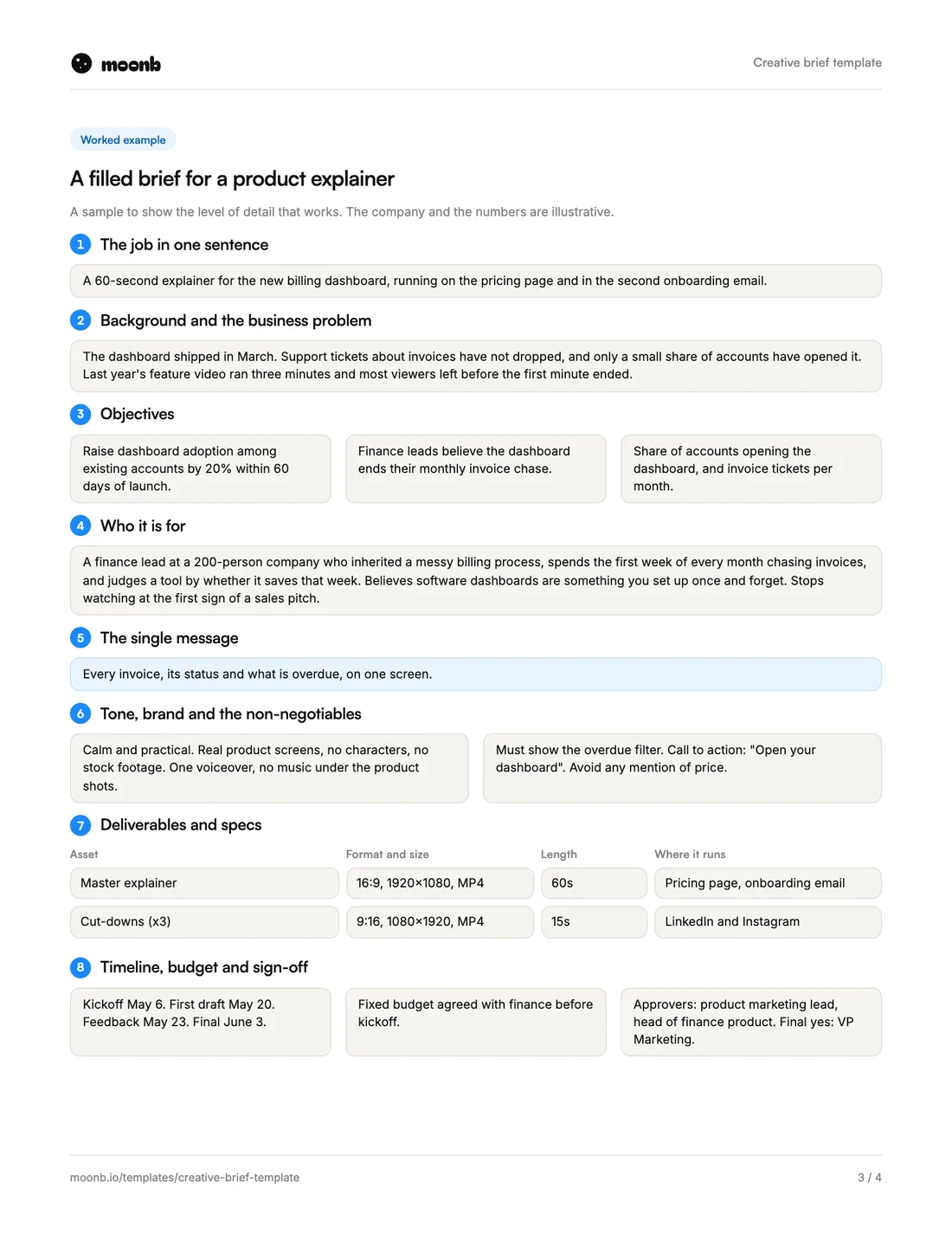 Page 3
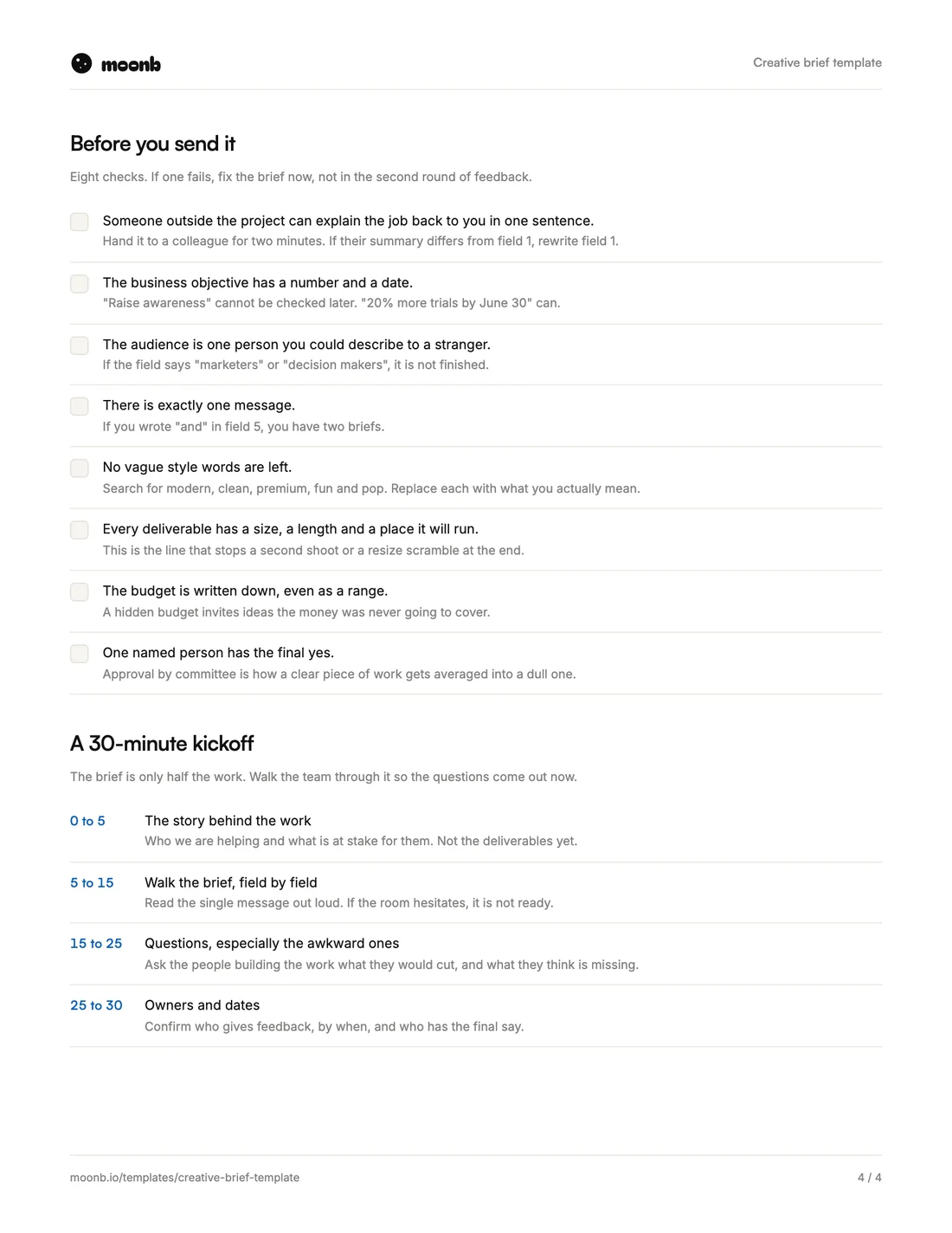 Page 4
A creative brief is the one or two pages you write before anyone opens a design file or picks up a camera. It says what you are making, who it is for, what it has to do, and who says yes at the end.
This template has eight fields for that, a filled-in example on page three, and a short checklist on page four. Leave a field blank and you will pay for it later, in the second round of feedback.
What is in it
| Field | What goes in it | The usual mistake |
|---|---|---|
| 1. The job in one sentence | What you are making and where it runs | Three ideas joined with “and” |
| 2. The business problem | What happened, and what you tried before | Describing the product, not the problem |
| 3. Objectives | The number, the change in people’s minds, how you will check | A goal nobody can measure |
| 4. Who it is for | One person you could describe to a stranger | “Decision makers, 30 to 55” |
| 5. The single message | The one thing they should remember | Two messages |
| 6. Tone and must-haves | How it feels, what has to appear | Words like modern, clean, premium |
| 7. Deliverables | Every asset with size, length and placement | “Social assets” |
| 8. Dates, budget, sign-off | Review dates, a budget range, one final approver | A deadline with no owner |
How to fill it in
- The job in one sentence. If you can’t say it in one sentence, the scope isn’t settled yet.
- The business problem. Why now? Add what you tried before, so nobody repeats it.
- Objectives. The business number and the change in the audience’s head are two different lines. Write both.
- Who it is for. Skip job titles. Write what this person believes today and what makes them switch off.
- The single message. One plain sentence. If you wrote “and”, you have two briefs.
- Tone and must-haves. Replace “modern” with what you mean. List the call to action and legal lines now, not at the end.
- Deliverables. Name every asset with its size and where it runs. “Social assets” is not a deliverable.
- Dates, budget, sign-off. Put the review dates in, give a range, and name the one person whose yes is final.
Why it is worth the half hour
Most briefs feel clearer to the person writing them than to the team reading them. In the Better Briefs Project, 80 percent of marketers said their briefs were clear. Only 10 percent of the agencies receiving them agreed.
Marketers rate their own briefs far higher than the teams who have to work from them.
The same research, published with the IPA, puts close to a third of marketing spend down to weak briefs and the rework they cause.
A three-minute masterclass
D&AD, the industry’s creative education body, recorded this short session with Kit Altin, who leads its course on briefing creative teams.
If you want the longer version of the process, our guide to writing a creative brief goes line by line. And if you would rather hand the brief to a team that already knows your brand, that is what we do at Moonb.
Frequently Asked Questions
One to two pages. If it runs longer, the thinking is not compressed enough yet; if it fits on an index card, something is missing. Aim for the shortest version that still lets a stranger execute the work without booking a follow-up call to ask what you meant.
Usually a project manager, strategist or marketing lead holds the pen, but the input is collaborative. The strongest briefs pull from the marketing lead and the senior creatives who will build the work, so the writer acts more like a journalist gathering facts than an author inventing them. A brief written by one person in isolation is a monologue, and monologues get argued with later.
A creative brief centres on the message and the audience, the strategic why behind the work. A content brief zooms into a single piece of content and its search intent, headings and keywords. On small projects many teams fold both into one document, but on a campaign with several deliverables it helps to keep the strategic brief separate from the per-asset content briefs.
More free templates
Briefs, plans and production sheets, built the way we use them.
The templates are free. The team isn't.
Need the video, design or motion actually made? Tell us what you're working on.