Brand messaging framework: what it is and how to build one
What a brand messaging framework must contain, how to know each component is actually done, which format fits your team, and a six step build process with a copy paste skeleton.


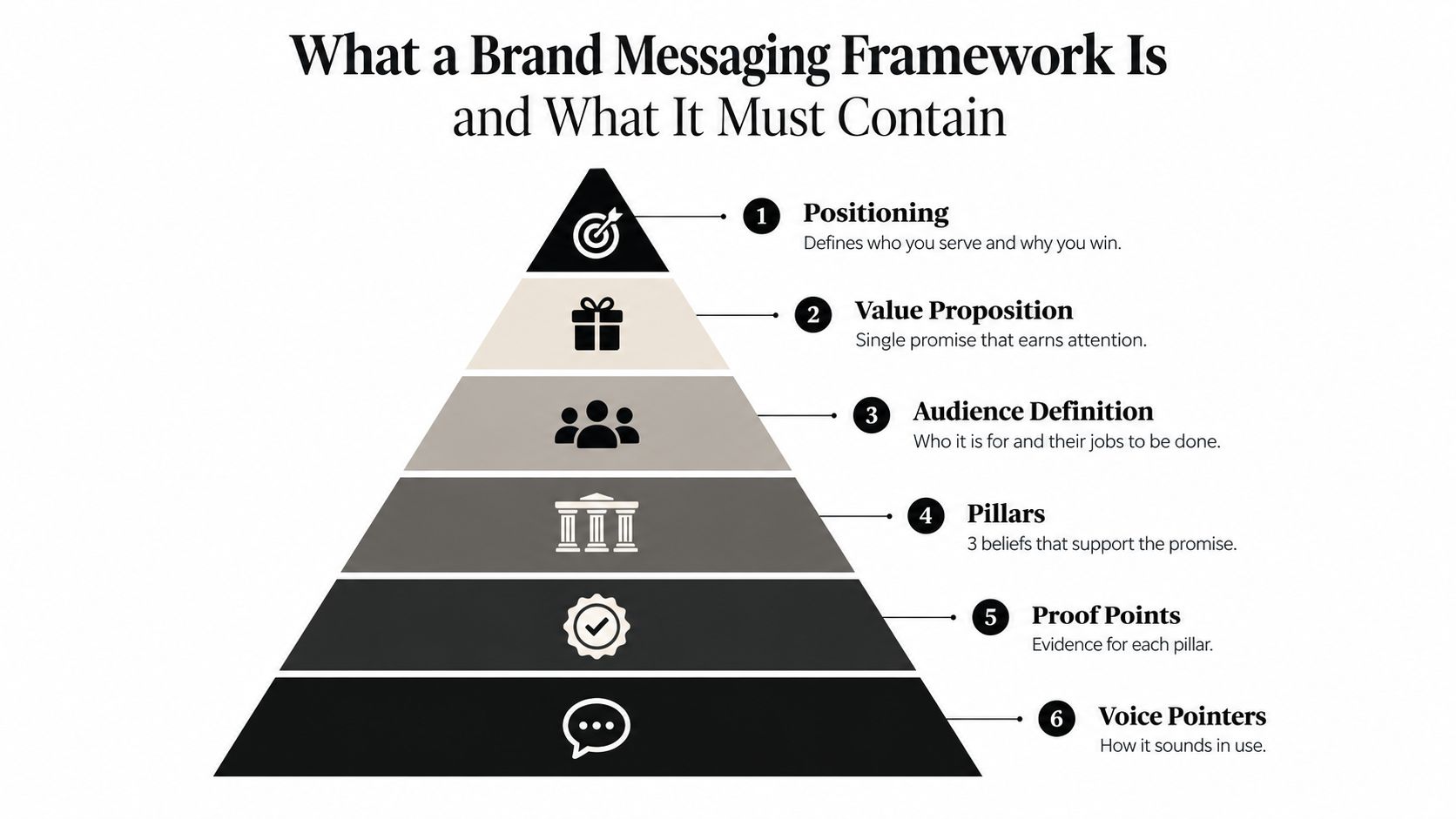
A brand messaging framework is the working document that decides what your brand says, in what order, and how each team adapts the story without changing its core. The document has six components: positioning, a value proposition, an audience definition, three to five messaging pillars, proof points under each pillar, and voice guidance. It ends in a set of ready-made lines, the one-liner, elevator pitch, boilerplate, and tagline that everyone actually pastes.
I read these documents for a living. Clients send them over alongside their briefs, and the state of the messaging document predicts the next quarter of work better than the brief does. When the framework is real, the copy reviews are short. When it is a workshop deck nobody opens, the homepage leads with one claim, the sales deck leads with another, and the next video script drifts toward whatever the loudest person in the review said.
What a brand messaging framework is and what it must contain
A messaging framework is not a copy deck, even though it usually gets filed next to one. It is closer to a decision system. It tells a writer which claim leads, tells a designer which idea the page has to support visually, and tells a video producer what angle the script opens on.
When none of that is documented, teams improvise, and improvisation is expensive in a specific way. Nobody is wrong. There is just no ranked story to be right about, so every asset relitigates the argument from scratch.
What belongs in the document
The list is short. The hard part is making each piece usable in production.
- Positioning, the internal statement of who you serve, what category you are in, and why you win.
- Value proposition, the single promise that earns attention.
- Audience definition, who it is for and what they are trying to get done.
- Messaging pillars, three to five beliefs that support the promise.
- Proof points, concrete evidence under each pillar.
- Voice guidance, the rules for how it all sounds.
The framework then ends in ready-made lines: a one-liner, an elevator pitch, a boilerplate paragraph, and a tagline. I treat those as outputs rather than a seventh component, because they only get sharp after the six above are settled.
If positioning still feels fuzzy, settle that first. This guide to brand positioning is the right precursor, because the rest of the framework will not hold if the strategic input is vague. The frameworks that survive real use read as a hierarchy: strategic foundation on top, an implementation layer underneath, reusable lines at the bottom.
My working test for the whole document is blunt. If a copywriter cannot turn it into a homepage hero, a designer cannot map it onto a layout, and a producer cannot write a thirty second script from it, it is not done, whatever the room thought of the workshop.
Teams writing landing pages, deck copy, ads, and video scripts should also study a few proven copywriting frameworks for conversions. A messaging framework does not replace them; it feeds them clean inputs.
How to know each component is done
A component is done when somebody downstream can use it without asking what you meant. That is the test, and it is stricter than it sounds.
| Component | What it is | Done test | Who uses it |
|---|---|---|---|
| Positioning | Who you serve, your category, and why you win | A strategist can explain the difference from your nearest rival in one clean sentence | Product marketing, founders, sales leadership |
| Value proposition | The single promise that earns attention | A homepage hero can be written from it without adding three extra claims | Web copywriters, campaign marketers, designers |
| Audience definition | The buyer or segment, their context, what they care about | Two different writers would emphasize the same problem and stakes | Content, paid, sales enablement |
| Messaging pillars | Three to five beliefs that support the promise | Each pillar can headline a page section or a slide without reading like a feature list | Writers, designers, producers, sales |
| Proof points | Concrete evidence tied to each pillar | Nobody has to re-argue a claim from scratch in any asset | Sales, product marketing, PR, scriptwriters |
| Voice guidance | The rules for how it sounds | A draft can be marked on-brand or off-brand without a debate about taste | Copywriters, social teams, video producers |
| Ready-made lines | One-liner, elevator pitch, boilerplate, tagline | The team pastes them into bios, intros, and decks with minor edits only | Everyone |
The component most teams get wrong
Pillars are where frameworks wobble. They should express beliefs or claims the brand wants to be known for, and a candidate claim has to pass four tests:
- True today. If it is still aspirational, it does not belong in the framework yet.
- Specific. If a rival could paste it onto their homepage unchanged, cut it.
- Provable. Every pillar needs something concrete under it.
- Worth repeating. If a customer would not say the idea back to a colleague, it is too weak.
The usual failure is additive. Someone proposes a sixth pillar, nobody has the nerve to cut it, and the framework stops ranking anything. Keep three to five and force the argument about order instead. Table stakes claims usually belong under proof points rather than as pillars; in many B2B categories, security, uptime, or compliance support the story unless buyers choose primarily on that axis.
Donald Miller’s TEDx talk makes the same case from the audience’s side: unclear messages get filtered out before they ever get evaluated.
Voice is not messaging
Voice is how it sounds. Messaging is what gets said, and in what order. Keep those separate in the document, because they get reviewed by different people for different reasons. When copy reviews keep turning into debates about adjectives, the problem is usually not voice at all; it is that nobody agreed on the lead claim.
Which format fits your team
Teams do not need a more elaborate framework. They need one they will actually open in briefs, reviews, and production.
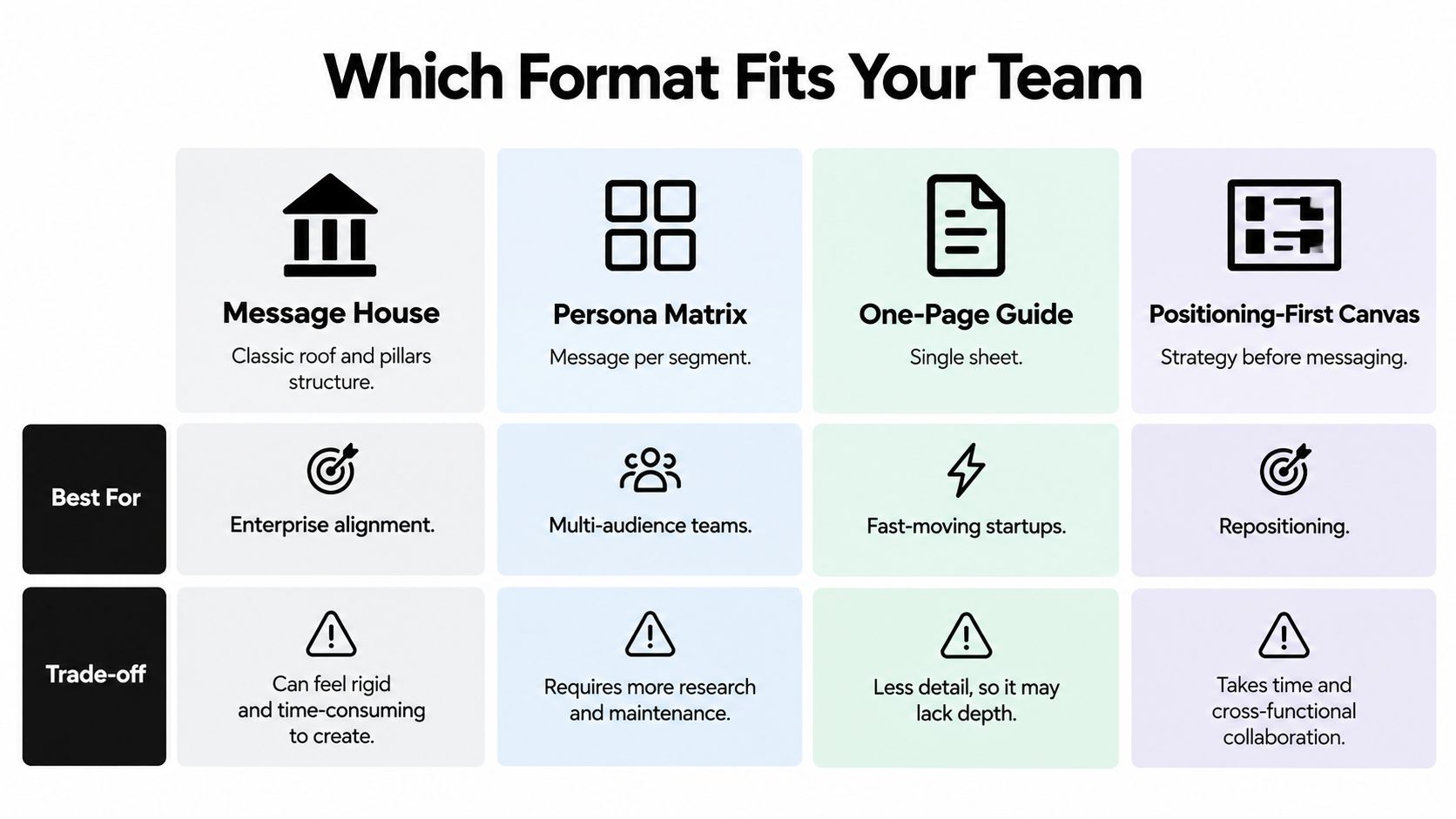
The message house is the default for a reason: one core message at the top, three or four supporting pillars underneath, proof points under each pillar. It is the layout cross-functional teams align on fastest. It is not the only option.
Four formats compared
| Format | Structure | Best for |
|---|---|---|
| Message house | Core message on top, pillars underneath, proof below each | Cross-functional alignment when many teams need one shared story |
| Persona or segment matrix | Rows by audience, message emphasis adjusted per segment | Teams selling to distinct buyers with different priorities |
| One-page messaging guide | A compressed sheet with positioning, promise, pillars, voice, and lines | Small teams that need speed and will not maintain a large document |
| Positioning-first canvas | Market, audience, category, alternatives, and differentiation before message outputs | Repositioning, or when strategy is not settled enough for final copy |
How to choose without overbuilding
Pick the lightest format that will survive real use.
- A message house, if marketing, sales, and product all need one ranked narrative.
- A segment matrix, if technical buyers and business buyers need different emphasis. Different buyers get different emphasis, not a different story; the proof stays tied to the claim.
- A one-pager, if the team is small and disciplined.
- A positioning-first canvas, if everyone keeps rewriting the basics because the strategy underneath is not settled.
The format also needs a home after sign-off. If the framework only lives in a workshop deck, it will disappear. It should sit inside the brand guidelines, the brief template, and the documents people open every week.
How to build a framework that survives production
The sequence matters. Skip steps and the framework gets approved faster and used worse.
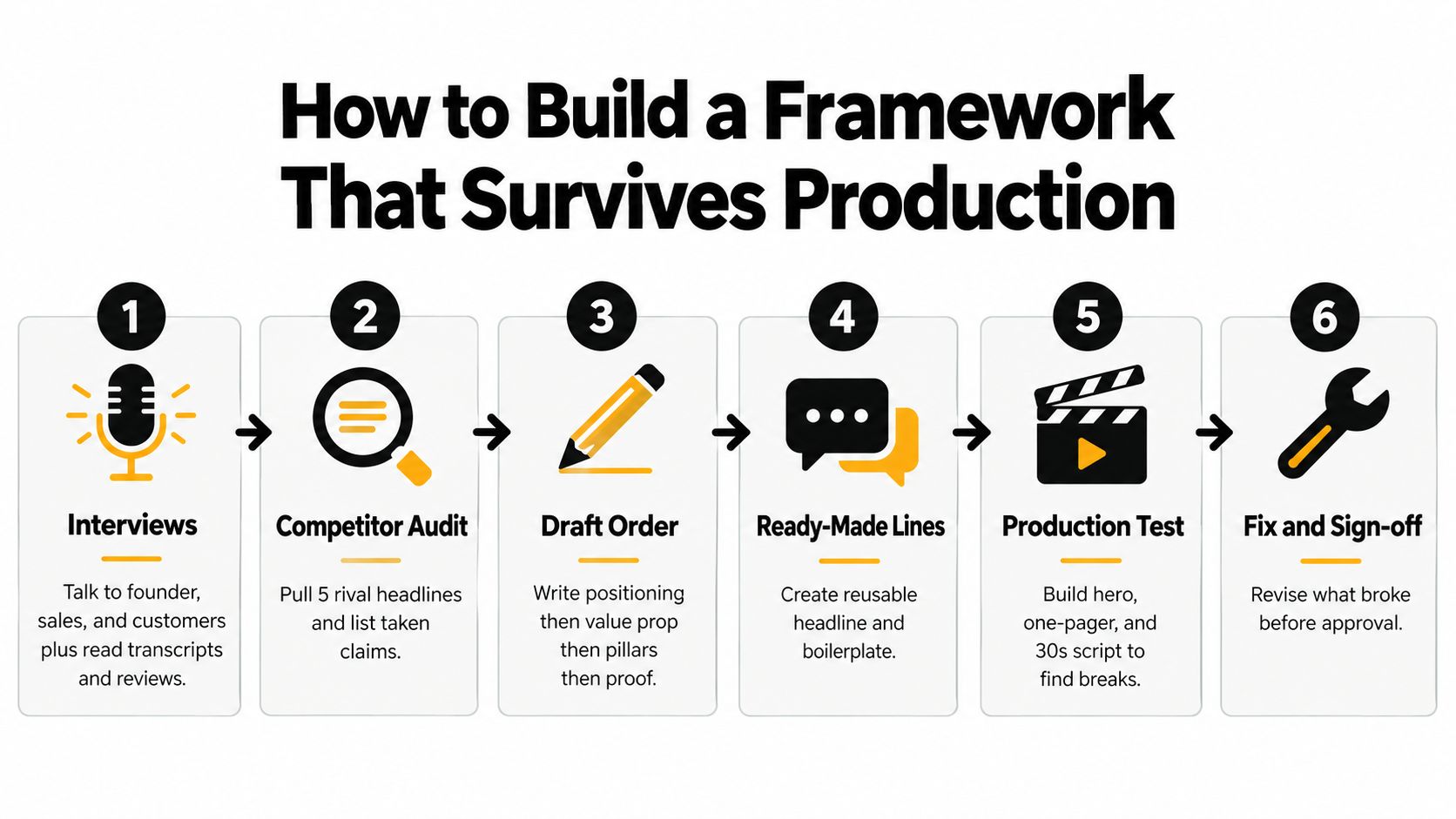
1. Start with interviews and raw language
Talk to the founder or exec sponsor, then two or three customer-facing people, then a handful of customers. Read call transcripts, reviews, and support tickets. You are collecting the exact words buyers use, the objections they raise, and what they think they are buying, which is often not what the team thinks it is selling.
2. Audit competitor language, not just positioning
Pull the homepage headlines of your five closest rivals and list every claim that is already taken. This is less about category conventions and more about avoiding borrowed language. If three competitors all say “simple,” that word has no strategic value left.
3. Draft in the order the logic flows
Write positioning first, then the value proposition, then pillars, then proof points. Do not start with the tagline because it feels concrete. Before you write anything, April Dunford’s interview on positioning is the best preparation I know.
4. Write the ready-made lines last
Only after the hierarchy is decided do the short lines get sharp. The one-liner, elevator pitch, and boilerplate are compressions of decisions already made; written first, they are guesses that harden into habits.
5. Run the production test before sign-off
This is the step most guides skip. Write two or three real assets from the draft before anyone approves it: a homepage hero, a sales one-pager, and a thirty second video script. If the hero needs extra claims to make sense, the value proposition is weak. If the one-pager cannot decide what comes first, the pillars are not ranked. If the script sounds generic, the proof points or voice guidance are too soft.
6. Fix what broke, then sign off and assign an owner
Whatever failed in the asset test gets fixed in the framework, and only then does it get signed off, versioned, and given an owner. Revisit it when positioning changes, when the product shifts meaningfully, or when the same weak spot keeps surfacing in production. Treat it as a governed document with an owner, never a one-time deliverable.
The whole build usually takes a few weeks, and the pace depends less on writing speed than on stakeholder availability, customer access, and how settled the positioning already was. When it works, the change is visible: people stop arguing about what to lead with and spend the time improving execution.
Copy paste skeleton and an example in use
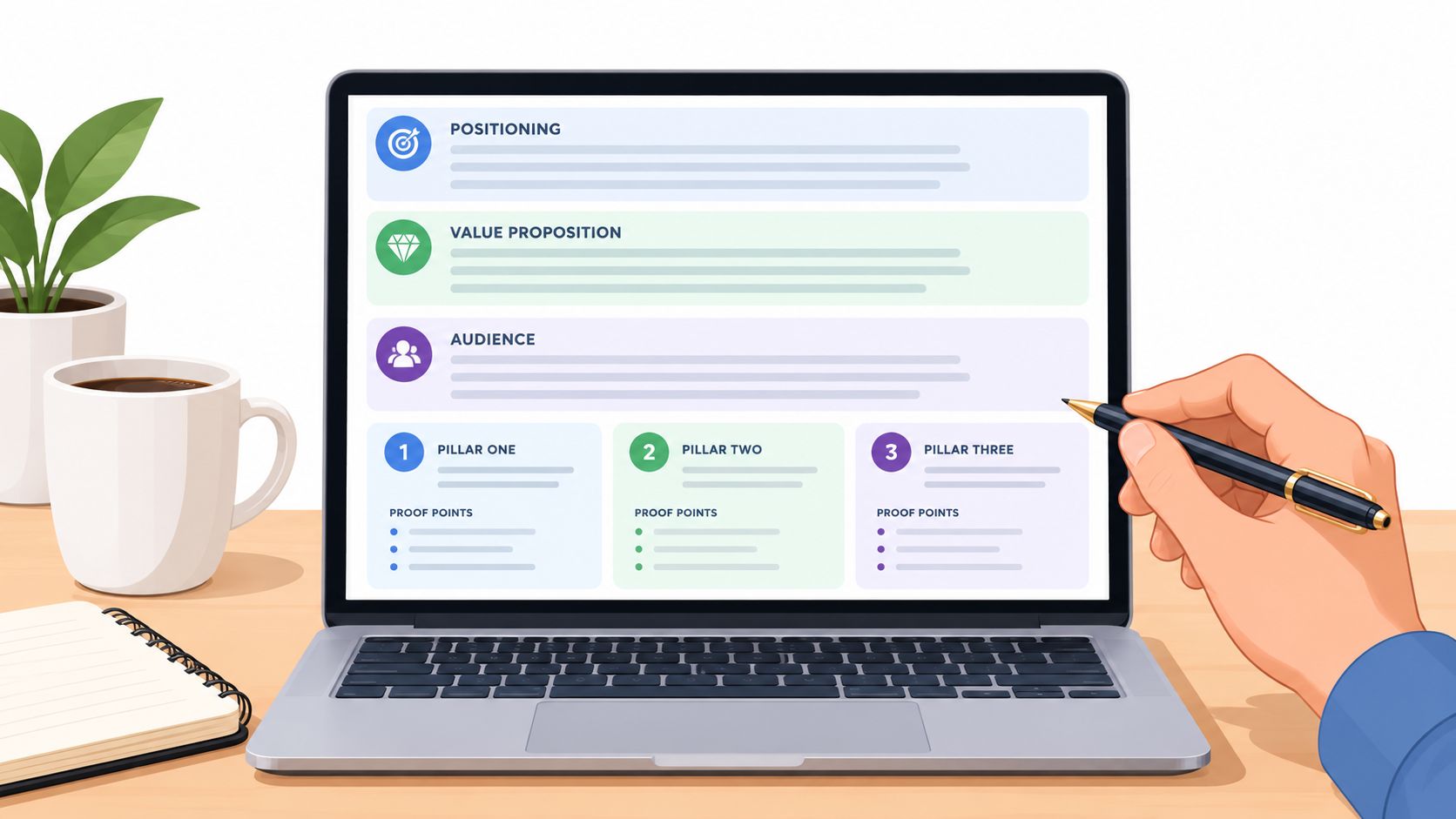
A template is useful only if a team can paste it into a doc and start filling blanks today. Keep it plain, and keep it short enough that people read it.
The skeleton
Positioning
For [audience], [brand] is the [category] that [primary differentiated outcome],
because [reason to believe].

Value proposition
We help [audience] achieve [important outcome] without [common friction or trade-off].

Audience definition
Primary audience:
What they are trying to get done:
What they care about first:
Common objections:
What they already believe about alternatives:

Pillar 1 / 2 / 3 (optional 4 and 5)
Claim:
Why it matters:
Proof points:

Voice pointers
We sound:
We avoid:
Sentence style:
Words we use often:
Words we avoid:

Ready-made lines
One-liner:
Elevator pitch:
Boilerplate:
Tagline:

Asset rules
Lead pillar by default:
When to reorder pillars:
Claims that must always carry proof:
Table-stakes points that stay under proof:
If you need the framework to show up in day-to-day asset planning, pair it with a solid creative brief template. That handoff is where usage succeeds or fails.
A hypothetical example
Take an enterprise SaaS brand. Before the framework, the website led with speed, the sales deck led with security, and paid ads led with price. All three claims were true, and the brand still had no ranked narrative.
After the framework, the lead idea became operational confidence. The pillars became fewer handoff failures, clearer oversight, and easier rollout across teams. Security moved under proof points unless the audience was specifically evaluating risk. The next three assets changed fast: the homepage hero opened on operational confidence, the sales deck opened on the same claim with oversight as the second reason, and the thirty second script opened on the same problem instead of pivoting to price.
Consumer work shifts differently. Brands there often have strong voice guidance but weak pillars, because the pillars are feature lists. When “made with X ingredient” gets rewritten as a belief about trust, ritual, or performance, the feature becomes the proof and the scripts improve almost immediately.
Who should build it and what each route trades off
There is no single right builder. There are four common routes, each with a failure mode, and the honest comparison looks a lot like the broader in-house versus external decision.
In-house product marketing
Often the best route when you already have a strong product marketer and a decisive founder. Internal teams know the product, category, history, and politics. The trade-off is time and proximity: uninterrupted weeks are rare, and people who have heard the same claims for years stop noticing the language problems in them. If the strategic input is the sticking point, start with a sharper brand positioning statement before drafting anything downstream.
Freelance strategist
A good freelancer moves quickly and brings independence, which helps in interviews; people say the obvious things out loud to an outsider. The weak spot is application. Many freelancers hand over a document, and the burden of turning it into pages, decks, and scripts lands right back on the team.
Brand consultancy
A consultancy brings rigor, research discipline, and strong facilitation, which matters when leadership alignment is the hardest part. The common failure is handoff: the deck lands, everyone claps, and the people who created it are not the ones making the assets it was supposed to guide. The framework needs a home in the guidelines system afterward, the kind you can see in these brand guidelines examples, or it starts drifting within a quarter.
Embedded creative team
This route works when the same people build the framework and then apply it in copy, design, and video, because drift shows up in the next asset instead of the next quarter. Moonb works this way, a dedicated creative team that writes the framework and then makes the work from it; the relevant page is brand strategy. And outside help is genuinely unnecessary when a strong product marketer and a decisive founder both have the time to do the interviews, make the cuts, and enforce the final ranking.
Common mistakes and how to fix them
Most bad frameworks do not fail because the team skipped a box. They fail because the claims are weak, unranked, or untested.
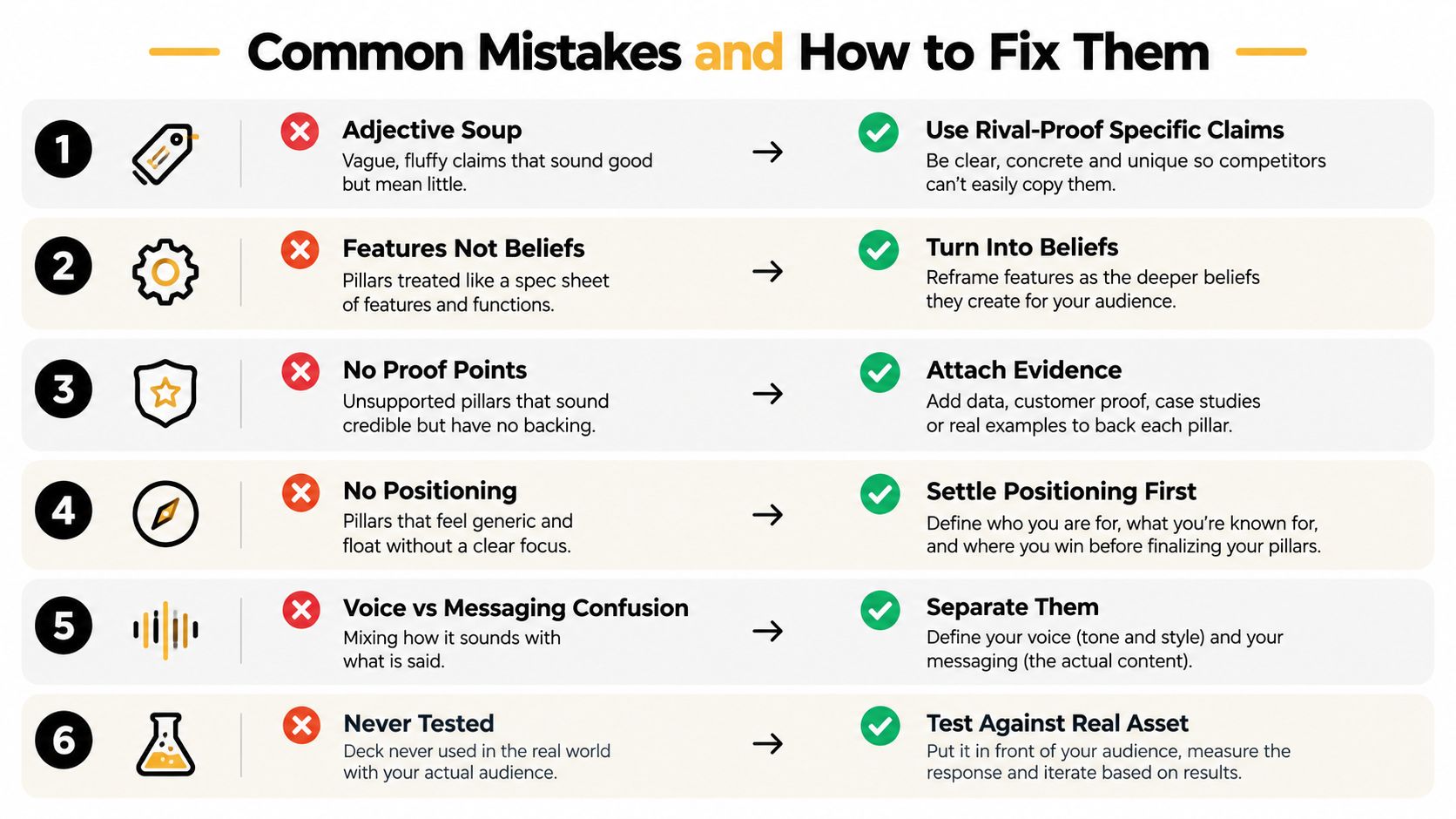
- Adjective soup. “Trusted,” “innovative,” and “world-class” do not help if rivals can say the same thing. Replace them with claims specific enough that a competitor could not paste them.
- Feature pillars. If the pillars read like a spec sheet, rewrite them as beliefs or outcomes, then attach the features as proof.
- No proof points. Unsupported pillars force every writer to rebuild the argument from scratch in every asset.
- Unsettled positioning. Pillars that float and feel generic usually point back to fuzzy strategy upstream. Settle positioning first, then finalize the pillars.
- Voice and messaging mixed together. Keep how it sounds separate from what gets said first. For the voice half, these brand voice examples show what usable guidance looks like.
- Never tested. A framework that has only lived in a workshop deck has never met a real audience. The production test exists for exactly this reason: put the draft into a hero, a one-pager, and a script, and see what breaks.
The fixes are consistent. Run every pillar through the four tests, keep one lead pillar and let personas reorder emphasis without changing the set, and give the document an owner and a version number so it lives in the brand guidelines and the brief template instead of an old deck. Consistency compounds quietly: when the same claim leads across the site, the deck, and the videos, buyers start repeating it back, and that is the whole point of the document.
Frequently asked questions
Three to five. Fewer than three usually means the value proposition is carrying the whole story alone; more than five means the team has stopped ranking claims, and the telling symptom is a sixth pillar nobody had the nerve to cut. Run every candidate through four tests: true today, specific, provable, and worth repeating. A claim that fails belongs under proof points or out of the document entirely.
Positioning is the strategic input, the messaging framework turns that strategy into ranked claims with proof, and brand guidelines are the home the framework lives in after sign-off. In practice the three fail together: fuzzy positioning produces floating pillars, and a framework that never gets folded into the guidelines and the brief template drifts within a quarter. Build them in that order and keep them in one system.
Watch production, not dashboards. Fewer copy revision rounds, faster briefs, less argument over the lead claim, consistent openings across live assets, and sales using the language unprompted are the signals that matter, because they show adoption. Audience tests on hero copy or ad variants can validate individual lines, but adoption across teams is what predicts everything else.