How to Write a Brand Positioning Statement That Works
Learn how to write a clear, effective brand positioning statement. Our guide covers the formula, components, real examples, and a step-by-step process.

A brand positioning statement is an internal strategic tool. It names your target audience, the category you compete in, the one benefit you own, and the reasons people should believe that benefit. The best versions stay simple. They use four core parts and hand your team one clear idea to build around instead of a pile of vague claims.
If you’re reading this, there’s a fair chance your brand looks fine on paper but goes blurry in practice. Sales pitches one story. The website tells a slightly different one. Product leads with features, and creative gets handed the job of making all of it feel like a single company. I’ve watched this play out inside a lot of teams, and a solid positioning statement fixes it upstream. It gives everyone the same answer to the same question: why should this brand exist in this customer’s mind at all?
What Is a Brand Positioning Statement Really
A brand positioning statement is not your slogan, homepage headline, or campaign line. It’s the internal sentence, or short set of sentences, that tells your team who the brand is for, what category it plays in, what benefit it owns, and why that claim holds up.
NielsenIQ calls brand positioning the cornerstone of a brand’s branding and marketing efforts, built to give the brand a specific place in the market relative to competitors, and notes that positioning needs to run through the whole organization, from sales messaging to the day-to-day work of employees, NielsenIQ. That’s the definition I trust, because it’s practical. It keeps the statement where it belongs, inside the business, shaping decisions.
I’ve found that teams get into trouble when they mix up identity, branding, and positioning. If you want a clean distinction, this guide on brand identity vs branding is a useful companion. Positioning sits underneath both. It tells you what lane you’re in before you pick the words, the visuals, and the campaigns.
A weak statement describes the company. A strong one tells the team what to lead with and what they have to be able to prove.
Why it matters in practice
When a positioning statement is doing its job, it helps people make faster calls across the business.
- Marketing gets focus: The team knows which promise to repeat and which angles to drop.
- Sales gets clarity: Reps can explain what makes the offer meaningfully different.
- Product gets a filter: New features can support the position instead of pulling it apart.
- Creative gets direction: Designers, writers, and producers know what idea every asset should reinforce.
That last point matters more than most people admit. If the people building the experience don’t share the same position, the market never will.
What Are the Essential Parts of the Statement
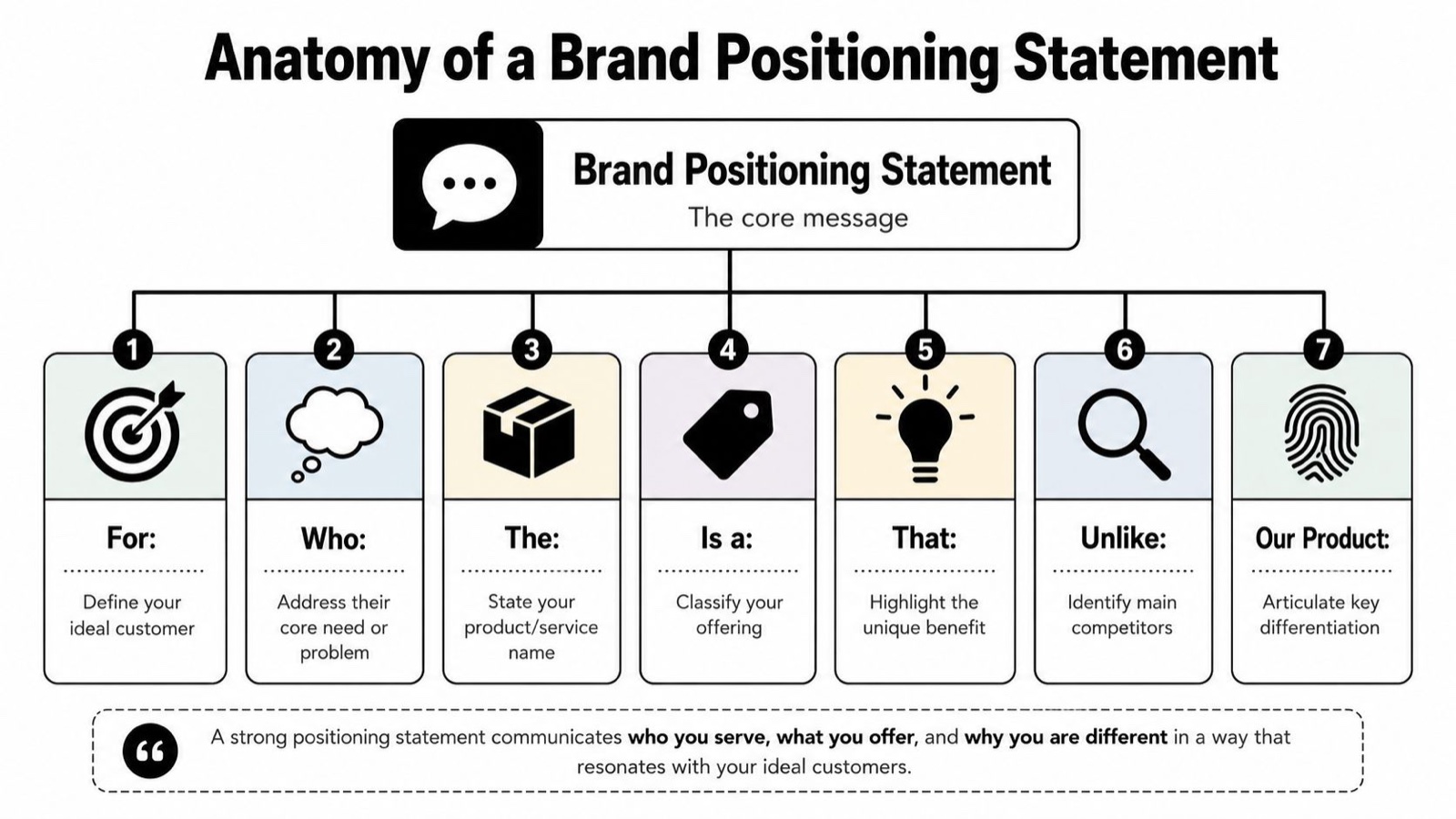
Most usable statements come down to a small set of decisions. A widely used template runs like this: “For [Target Audience], [Brand Name] is the [Market Category] that [Unique Benefit] because [Reason to Believe].” I like it because every blank forces a real choice. You can’t hide behind buzzwords when each slot asks you to commit to something specific.
The four-part structure you need
Here are the four essential parts I look for first.
| Part | What it answers | What good looks like | What weak looks like |
|---|---|---|---|
| Target audience | Who is this really for? | Specific buyer or user with a clear context | ”Businesses” or “everyone” |
| Frame of reference | What category are you in? | A category the buyer already understands | Invented language nobody uses |
| Point of differentiation | What do you do differently? | One sharp, defensible benefit | A list of nice-sounding traits |
| Reason to believe | Why should anyone trust the claim? | Two credible support points | Empty promises with no evidence |
If you’re documenting this inside your brand system, it helps to keep the final statement close to your rules for tone, messaging, and visual expression. This roundup of brand guidelines examples shows how teams turn strategy into something people can actually use day to day.
The Geoffrey Moore version I use most often
The formula I come back to most is the classic Geoffrey Moore version:
For [target customer] who [need or opportunity], [brand] is a [category] that [key benefit]. Unlike [primary competitor or alternative], [brand] [key differentiator].
I like it because it adds one thing many templates skip: the competitive contrast. That matters a lot in crowded markets.
Here’s the fill-in version:
- For [specific customer]
- Who [has this problem, need, or opportunity]
- [Brand] is a [category]
- That [delivers one key benefit]
- Unlike [main alternative]
- [Brand] [provides a distinct difference]
- Because [two reasons to believe]
Practical rule: If you can’t name the alternative you’re replacing, your positioning is probably still too abstract.
How Do You Write the Statement Step by Step
Good positioning isn’t a copywriting exercise. It’s a decision exercise, and the sentence comes last.
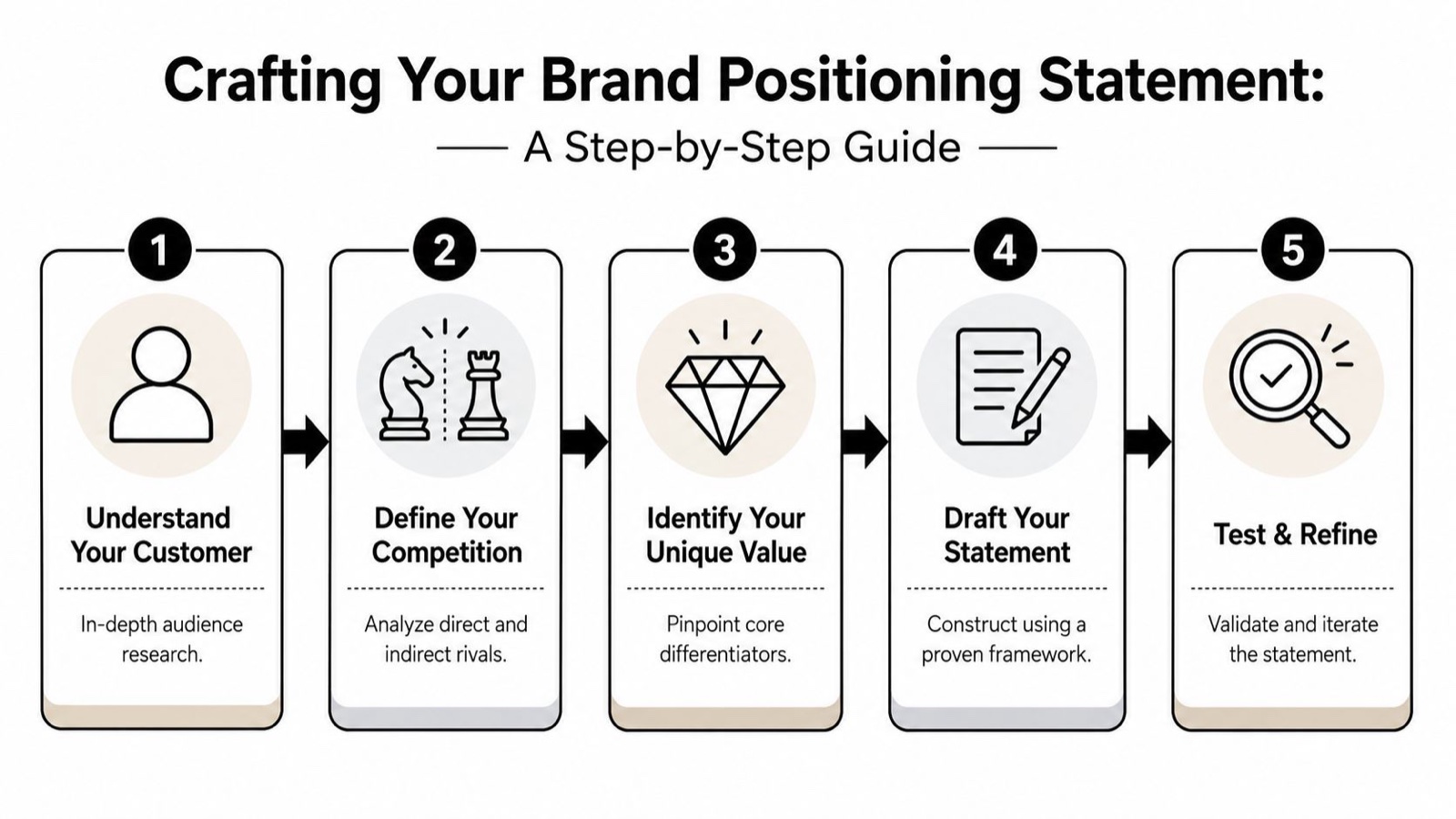
The process I use starts with a simple sequence: audit your current positioning, interview your best customers to pin down the problem you actually solve, name the strengths only you have, find where customer needs and market gaps overlap, then test and refine by trying the statement in real outreach. One useful gut check comes at the end. Can a prospect understand what you do in about ten seconds, and could your biggest competitor use the exact same statement? If the answer to that second question is yes, keep working.
Start with evidence, not wordsmithing
I usually work through the process in this order.
-
Audit the current story Write down the current elevator pitch, homepage headline, sales intro, and product description. Then compare them. If they point in different directions, that’s your first clue the position isn’t settled.
-
Listen to real customers Pull language from sales calls, customer interviews, win-loss notes, reviews, support tickets, and onboarding conversations. The most useful input is often the emotional job, not the feature request. People rarely buy “automation” or “analytics.” They buy relief, confidence, speed, control, or credibility.
-
Map the alternatives Don’t just list direct competitors. Include substitutes: in-house work, spreadsheets, consultants, agencies, email, old habits, doing nothing. A strong statement often changes once you realize the buyer isn’t comparing you to who you assumed.
-
Choose one benefit Teams usually wobble here. They want speed, quality, flexibility, expertise, simplicity, trust, and scale in one sentence. That never works. Pick the single benefit that matters most to your best-fit customer.
A good brief makes this easier. If your team struggles to capture inputs cleanly, use a simple structure like this guide to how to write a creative brief, then adapt it for positioning research.
Draft, then pressure-test
Once the inputs are solid, write several versions. I usually draft short, sharp options instead of polishing one sentence too early.
Here are the tests I use most:
- The substitution test: Could a competitor swap in its name and still sound credible?
- The proof test: Are you claiming something you can already support, not just hope to become?
- The trade-off test: What are you not trying to be?
- The ten-second test: Can a prospect understand what you do fast?
This video is a useful companion if you want another take on the process before you draft.
I also prefer one-on-one message testing over polished internal debate. Read the statement to real buyers. If they respond with “yes, exactly,” you’re close. If they nod politely and ask what you mean, keep working.
What Are Some Strong Brand Positioning Statement Examples
Most brands don’t fail because they’re short on words. They fail because the words could belong to any competitor in the category. The fastest way to see the difference is through examples.
Ten real examples, written as internal statements
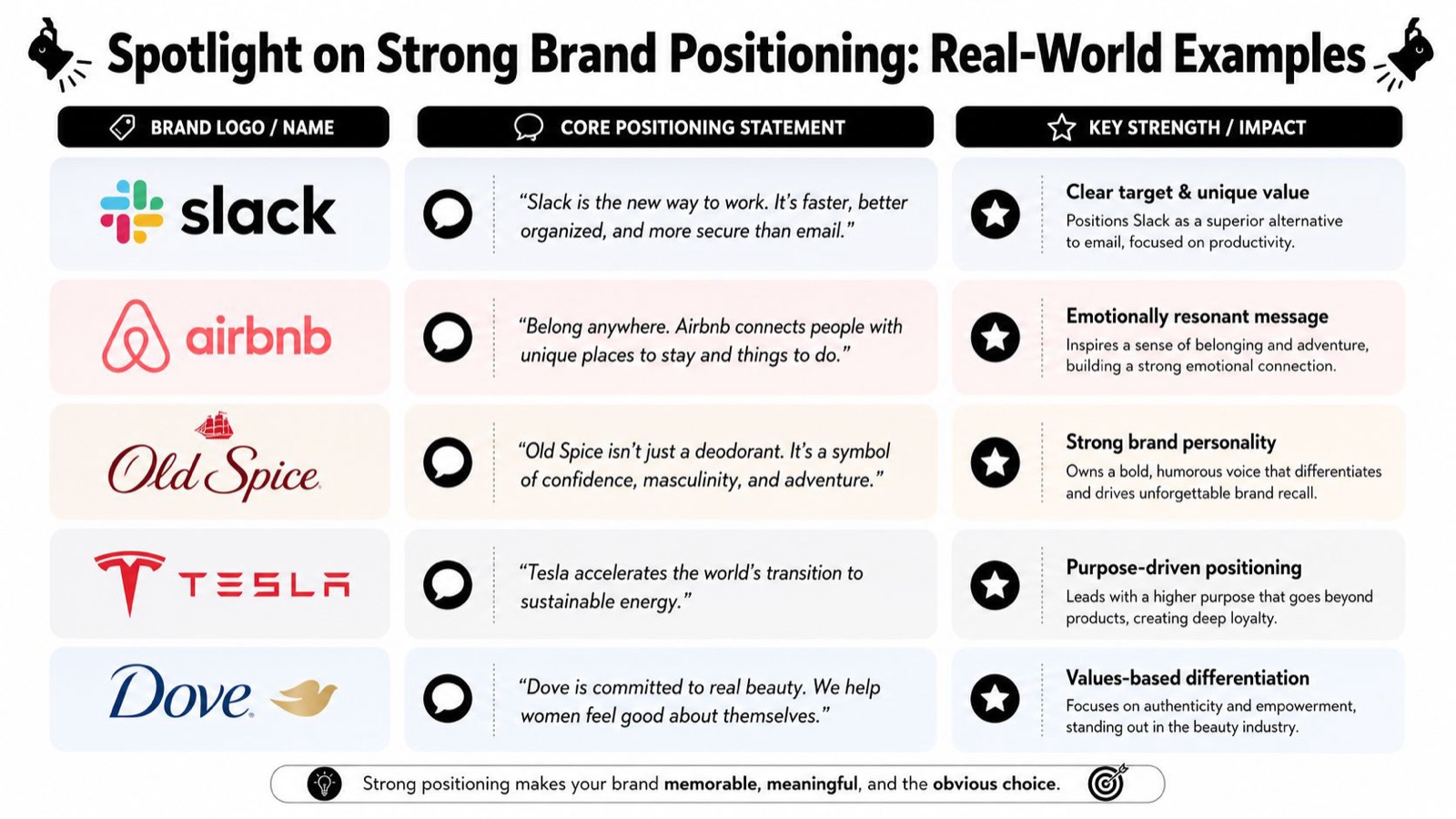
These are reverse-engineered internal statements, not official lines, based on widely recognized brand positions.
-
Slack Weak: For teams, Slack is a chat app that helps people communicate. Sharper: For working teams overwhelmed by internal email, Slack is a collaboration tool that helps people be less busy. Unlike email, Slack organizes communication in fast, shared channels.
-
Airbnb Weak: For travelers, Airbnb is a booking site with lower-cost places to stay. Sharper: For travelers who want a more personal stay, Airbnb is a hospitality marketplace that helps them feel they belong anywhere. Unlike hotels, Airbnb leans on local, lived-in experiences.
-
Old Spice Weak: For men, Old Spice is a grooming brand with deodorant and body wash. Sharper: For younger men who want grooming to feel confident and entertaining, Old Spice is a men’s grooming brand that makes personal care feel bold and funny. Unlike traditional aftershave brands, Old Spice runs on exaggerated humor and personality.
-
Mailchimp Weak: For small businesses, Mailchimp is an email tool. Sharper: For small businesses that need growth tools without enterprise complexity, Mailchimp is a marketing platform that helps them run and grow their marketing in one place. Unlike stand-alone email tools, Mailchimp widens the job beyond email.
-
Tesla Weak: For drivers, Tesla is an electric car company. Sharper: For drivers who want performance and a future-facing energy choice, Tesla is a sustainable energy brand that makes electric driving feel advanced and desirable. Unlike traditional automakers, Tesla ties the car to a larger energy transition.
-
Dove Weak: For women, Dove is a soap and skincare brand. Sharper: For people who want personal care without narrow beauty standards, Dove is a care brand that stands for real beauty and gentle care. Unlike brands built on idealized perfection, Dove centers realism and self-acceptance.
-
Nike Weak: For athletes, Nike is a sportswear company with quality gear. Sharper: For people who want to push their performance and identity through sport, Nike is an athletic brand that delivers inspiration and innovation. Unlike commodity sportswear brands, Nike turns performance into personal ambition.
-
Apple Weak: For consumers, Apple makes computers and phones with strong design. Sharper: For people who want technology to feel intuitive and premium, Apple is a consumer technology brand that makes powerful tools feel simple and desirable. Unlike fragmented tech ecosystems, Apple connects hardware and software into one experience.
-
IKEA Weak: For homeowners, IKEA sells furniture. Sharper: For people furnishing homes with practical limits on space and money, IKEA is a home furnishings brand that makes modern design attainable. Unlike traditional furniture retailers, IKEA combines function, style, and self-serve convenience.
-
Dyson Weak: For households, Dyson makes appliances. Sharper: For buyers frustrated by everyday tools that underperform, Dyson is an engineering-led home technology brand that solves overlooked problems better. Unlike appliance brands that compete mostly on price, Dyson leads with design and problem-solving.
What separates a sharp statement from a generic one
Here are the patterns those better examples share.
- They pick a real enemy: Email, hotels, old-school masculinity, fragmented tools, commodity design.
- They define the job clearly: Be less busy. Belong anywhere. Make grooming feel modern. Grow beyond email.
- They imply a trade-off: If you stand for one thing, you won’t stand for everything.
- They shape execution: You can see the ad tone, the product choices, and the creative direction from the statement alone.
If the statement only tells you what category the brand is in, it won’t help anyone make better decisions.
What Are the Most Common Mistakes to Avoid
The biggest mistakes are easy to miss. The sentence reads as polished, but it doesn’t actually help the team decide anything.
A lot of positioning advice still treats the statement like a document you write once and frame on the wall. That falls apart for fast-moving companies. When your product or your market shifts, the statement has to be something you can revisit without throwing the team into confusion.
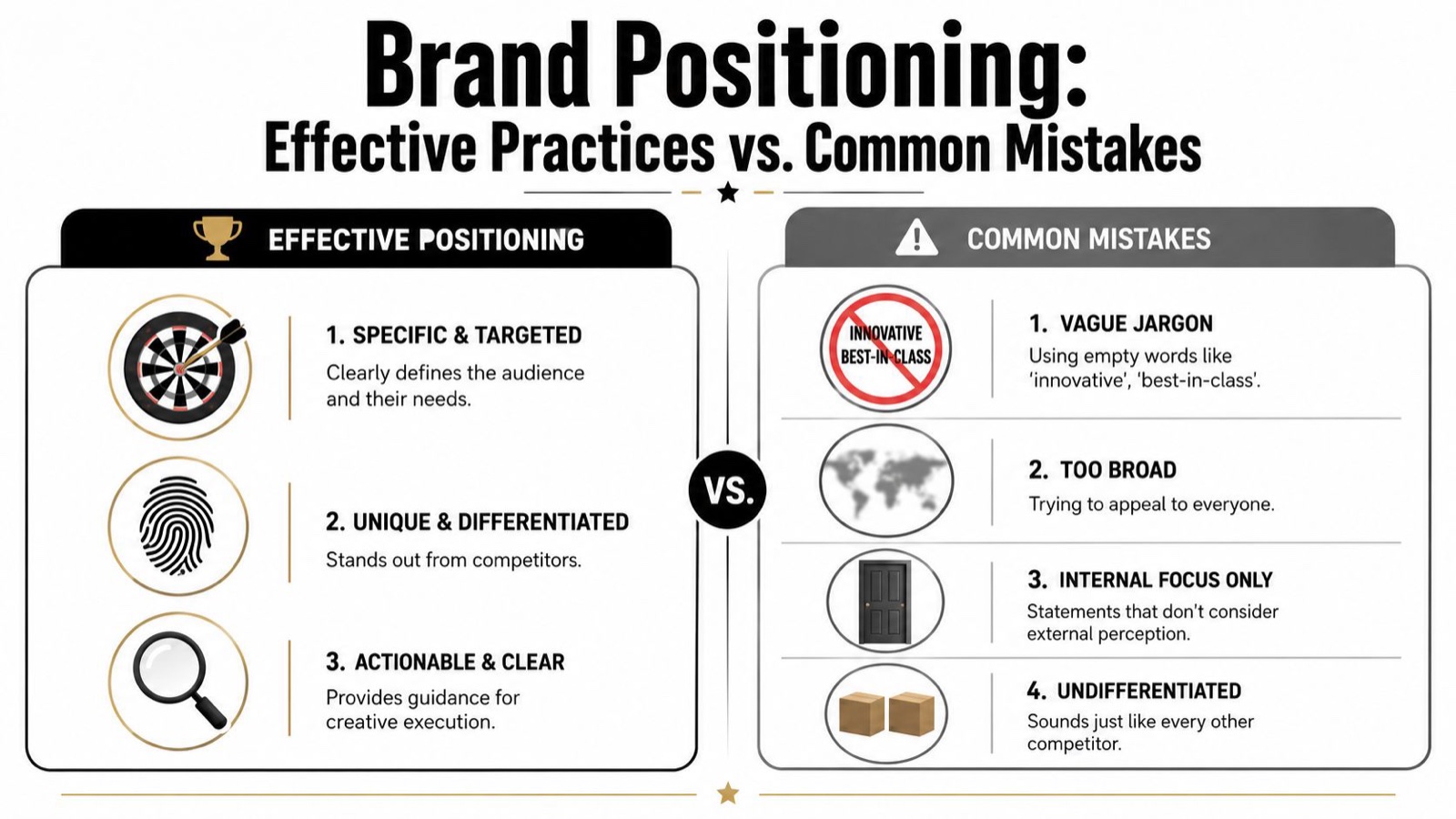
The traps I see most often
- Vague language: Words like cutting-edge, trusted, leading, and customer-centric usually say nothing unless you define and prove them.
- Audience sprawl: If the statement tries to serve everyone, it won’t move anyone.
- Feature stuffing: A positioning statement isn’t a product page. It needs one main benefit, not six.
- No proof: If you can’t support the claim with real reasons to believe, the line won’t survive contact with the market.
- Frozen thinking: When the offer changes, the statement needs a look. Not a rewrite every week, but a real check when the product, the customer, or the competitive set moves.
If you want a companion self-audit alongside this list, this roundup of common branding mistakes pairs well with positioning work, since a lot of execution problems trace back to fuzzy strategic language.
How Do You Turn the Statement into Great Creative
A positioning statement becomes valuable when it starts showing up in the work. It should guide the creative brief, the landing page angle, the ad hook, the explainer script, the sales deck, and even the product demo.
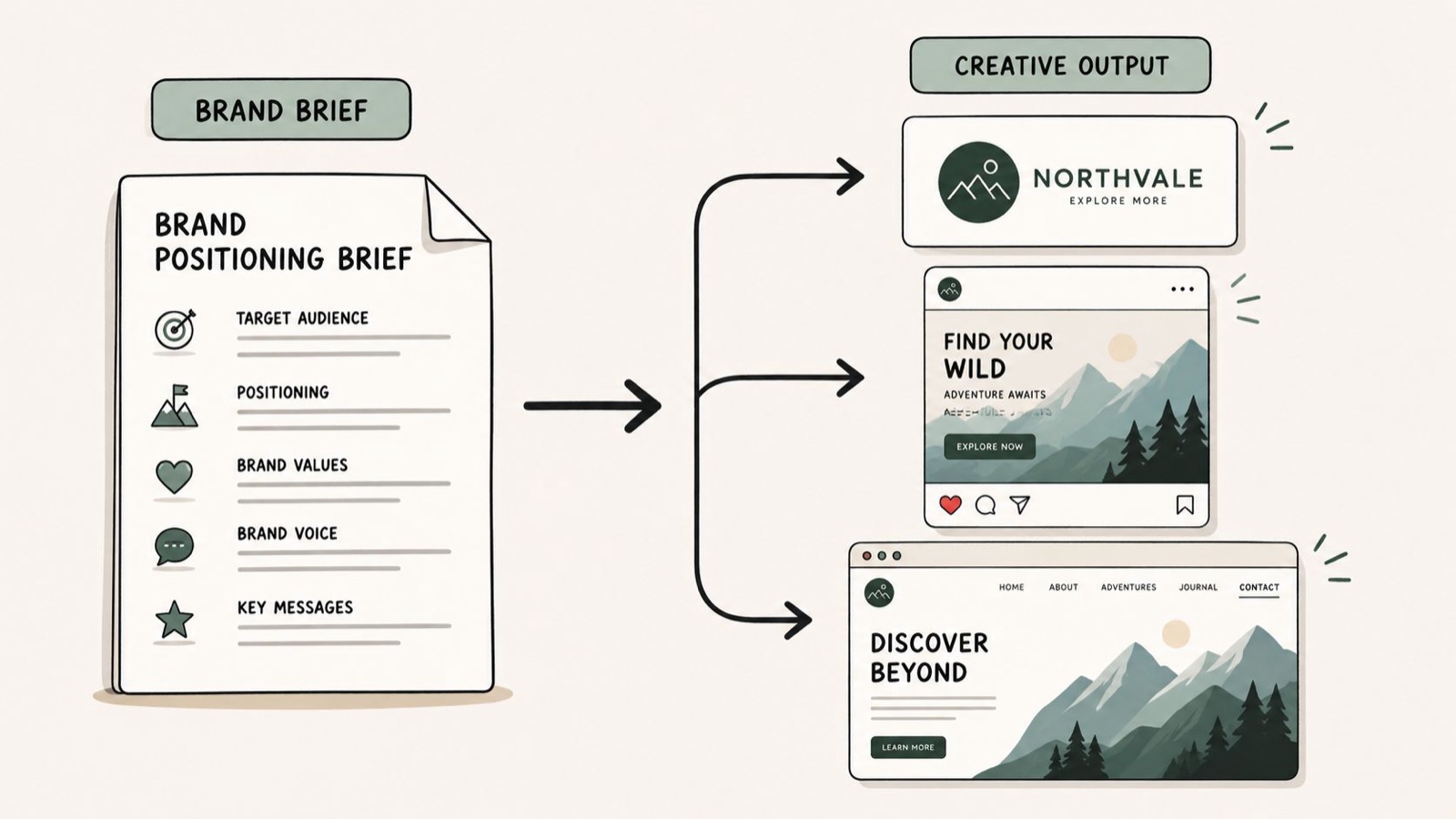
Use it like the master brief
If your position is “simple and reassuring,” the work shouldn’t look dense, technical, or noisy. If your position is “fast and decisive,” the videos shouldn’t open with slow scene-setting. The statement should create constraints.
I like turning it into one working page with these fields:
- Audience to prioritize
- Main tension or need
- Single benefit to dramatize
- Two reasons to believe
- Alternatives to position against
- Words, visuals, and tones to avoid
For teams writing that downstream expression, a practical guide to crafting your brand’s voice is useful, because tone tends to wander when the positioning is settled but the language rules aren’t.
Twelve practical decision criteria
When creative starts rolling, I use these twelve checks to keep it aligned.
| Criteria | Question to ask |
|---|---|
| Audience fit | Is this clearly for the target customer, not a general audience? |
| Need clarity | Does the work reflect the real problem or desire? |
| Category signal | Can people quickly tell what kind of offering this is? |
| Benefit focus | Is one core benefit obvious? |
| Differentiation | Would this still make sense if a competitor put its logo on it? |
| Proof | Do we show believable support for the claim? |
| Emotional match | Does the piece feel like the promise, not just describe it? |
| Message discipline | Are we resisting the urge to pile in extra claims? |
| Visual fit | Do design and motion choices reinforce the position? |
| Channel fit | Is the idea expressed in a way that suits the format? |
| Sales usefulness | Would a rep actually use this language in conversation? |
| Consistency over time | Can this hold across campaigns, not just one launch? |
When a team needs help turning that strategic page into finished work, that’s where a dedicated creative team earns its place. Moonb sits right there. It works as an ongoing creative team that delivers video, motion, design, animation, and brand content on a steady weekly rhythm, on brand and ready when you need it. The value isn’t raw volume by itself. It’s having one team that learns your position well enough to keep expressing it the same way across everything.
If your brand still sounds broad or interchangeable, the problem probably isn’t your tagline. It’s the sentence underneath it. Tighten the position first, then build everything else on top of it.
If you want a simple way to hand a clear position to whoever makes your creative, this creative brief template is a good place to start.
Frequently asked questions
No. A mission statement explains why the company exists. A brand positioning statement explains who the brand is for, what category it plays in, what benefit it owns, and why that claim is believable.
Usually, no. Keep it internal. Customers should feel its effect through messaging, design, product experience, and campaigns. They don't need to read the source document.
Revisit it when something material changes: your product, your best-fit customer, your competitive alternatives, or your proof. Don't rewrite it out of boredom.
Short enough to say in one breath. One sentence is ideal. Two can work if the second sentence carries the contrast.
Use this: For [target customer] who [need], [brand] is a [category] that [benefit]. Unlike [alternative], [brand] [differentiator].