Brand Positioning: A Practical Guide
What brand positioning is, why it decides your pricing and creative, how to write the statement, and 12 examples worth studying.


Brand positioning is the specific place your brand holds in a buyer’s mind against the alternatives, and it decides whether someone can explain why you are the right pick before they ever compare feature lists. I work at Moonb, a creative studio, and the failure I watch for most is the shrug. A buyer compares two companies and sees no real difference. So price decides, and price is a fight nobody enjoys. Gartner surveyed more than 1,100 B2B customers and found that 64% could not tell the difference between one supplier’s digital experience and another’s. That is the tax you pay for a fuzzy position.
Positioning answers three questions clearly enough that a stranger could repeat them back:
- Who is the brand for?
- What does it compete against?
- Why should someone pick it over that alternative?
The idea goes back to Al Ries and Jack Trout and their 1981 book Positioning: The Battle for Your Mind. It holds up because people rarely rank options by specifications. They rank by what they remember and who they trust.
Why positioning decides everything downstream
A clear position makes every later choice easier. Messaging gets shorter because you are not re-explaining the category on every page. Pricing gets firmer because the buyer sees a reason to pay. Design gets a real job to do instead of decorating a vague promise.
Positioning and differentiation are the same discipline seen from two angles. This lecture walks through how they fit together in classic marketing terms.
A weak position pushes that work back onto sales. The rep has to teach the category on every call, then cut the price to win the deal, because the buyer never had a crisp reason to prefer you. Before I touch a single visual, I want to know what the market already believes, which is why a brand audit is usually the first useful move before a launch or rebrand.
Here is the test I use on the spot. Ask someone why they should choose this brand. If the only answer is a feature list, the positioning is not finished. A real position hands the buyer a shortcut and removes the effort of figuring you out.
The five parts of a strong position
April Dunford’s Obviously Awesome (2019) treats positioning as a set of parts rather than one clever line, and that is the right way to work on it. Pull the pieces apart and pressure-test each one.
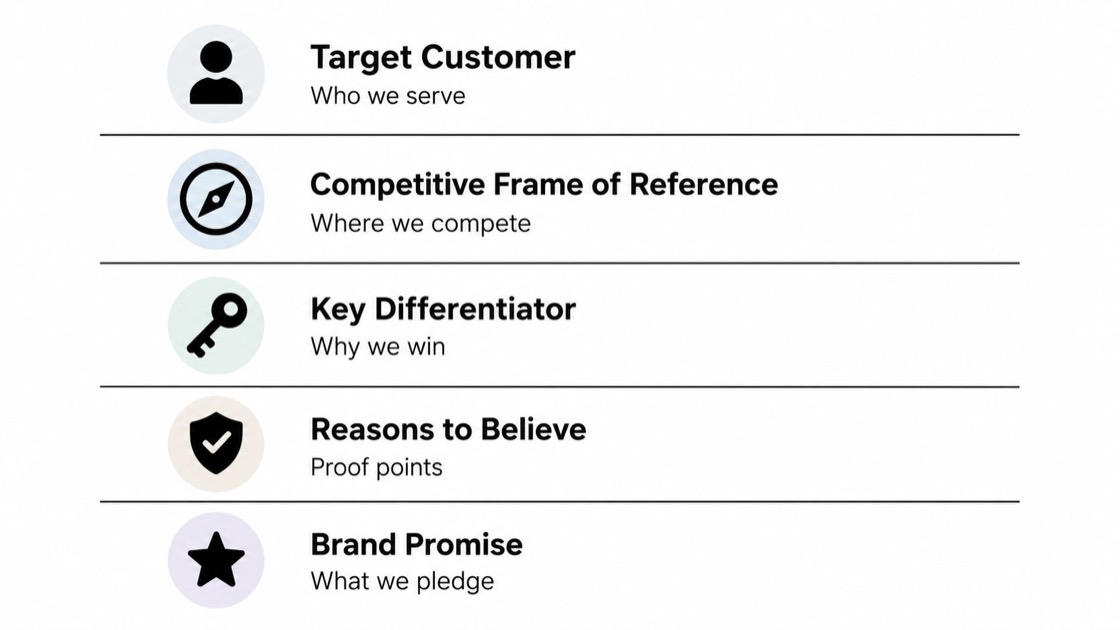
Target customer
Not “everyone who might buy.” The target is the group with the sharpest need and the clearest reason to care. If you cannot name that group with a straight face, the rest of the statement turns to mush.
Competitive frame of reference
This is the part most teams skip. You are always measured against something the buyer already understands, and often that something is a spreadsheet they already use or the decision to do nothing. Name it out loud, because that is the option you are actually being judged against.
One differentiator
Pick one thing the market can notice and you can defend. It might be speed, or a specific workflow advantage the others ignore. Owning one thing beats half-owning six.
Reasons to believe
These are the proof points that make the claim defensible, like a named customer outcome or a demo that shows the thing working. Without proof, a differentiator is just a boast, and buyers have learned to tune boasts out.
Brand promise
The promise is what the buyer should expect every time they deal with you. It has to be steady and tied to the differentiator. If the promise is broad enough to fit any competitor, tighten it until it only fits you.
How to write a positioning statement
A positioning statement is an internal decision tool, so keep it blunt and keep it out of your ads. Here is the template I use:
Positioning only works once you have chosen who you are for. This lecture on segmentation and targeting covers the step that comes right before the statement.
For [target audience] who [need], [brand] is the [category] that [differentiator], because [reason to believe].
Fill it with the words buyers actually use. “Marketing leaders at B2B software companies” gives the team more to work with than “modern businesses.” If buyers care about speed, write speed. If they care about fewer approvals, write that.
A worked example from my own world: for marketing leaders who need a steady weekly rhythm of video and design, Moonb is the embedded creative team that keeps output on-brand because the same people learn the brand and stay in step with the client’s calendar. That sentence never runs in an ad. It tells the writers and editors what to emphasize before they open a file.
There is a commercial reason to make the choice this clean. Harvard Business Review research on “decision simplicity” found that buyers who could gather trustworthy information and weigh their options easily were 86% more likely to buy and 115% more likely to recommend the brand. A sharp position is what makes a purchase feel simple, because it hands the buyer a shortcut instead of a research project.
One trap to avoid: do not stack edges that pull against each other. A brand that promises the highest quality and the lowest price in the same breath reads as a brand that has not chosen. If your proof only covers half the promise, shrink the promise rather than stretch the claim.
12 brands with a position you can name
The brands that stick made one sharp choice and stayed with it. None of them tried to own every benefit. Each picked a lane and reinforced it through product and creative until the market did the remembering for them.
| Brand | Position it owns | Why it works |
|---|---|---|
| Volvo | Safety | Decades of consistent messaging made one word do the selling. |
| Tesla | High-performance electric | Reframed EVs around performance instead of sacrifice. |
| Liquid Death | Edgy water | An ordinary product with a presentation nobody forgets. |
| Dollar Shave Club | Simple razors delivered | Plain benefit, no drugstore trip required. |
| Slack | Team messaging that replaces internal email | Named the enemy (email) so buyers knew where to file it. |
| Patagonia | Sustainability and repair | Product and values reinforce each other instead of competing. |
| Stripe | Developer-first payments | Speaks to builders before it speaks to buyers. |
| Airbnb | Belong anywhere | An emotional promise, not a transactional one. |
| Notion | All-in-one workspace | Sells the removal of five other tools. |
| Duolingo | Playful language learning | The experience itself is the differentiator. |
| Chipotle | Fresh fast food | A contrast simple enough to hold in one phrase. |
| Warby Parker | Designer eyewear online at a lower price | An easy comparison against the old optical-shop markup. |
Here is a useful gut check. If a competitor copied your visuals tomorrow, would the market still know it was you? A yes means you are positioned on something deeper than style. A no means the strategy is thin.
Positioning vs messaging vs branding vs tagline
These four get mixed up constantly, and the confusion leads to expensive mistakes, like rewriting a tagline when the actual problem is a weak position. The cleanest way to keep them straight is by level.
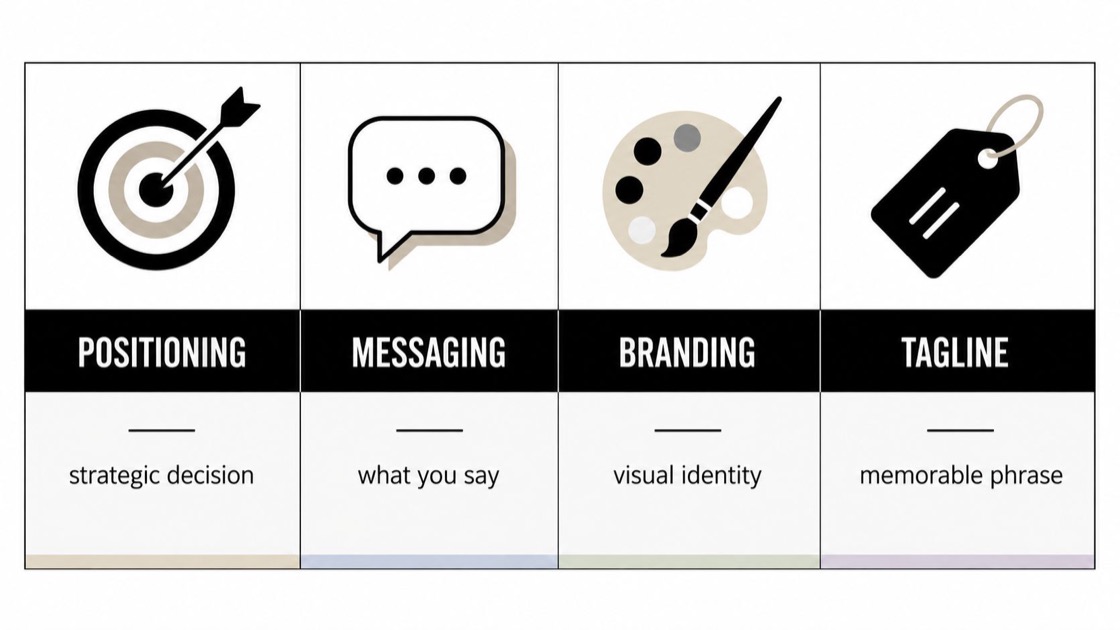
| Layer | What it decides | Where it lives | Example |
|---|---|---|---|
| Positioning | Where you compete and why you win | Internal strategy | Volvo chooses to own safety |
| Messaging | How you say it to buyers | Web copy, sales calls, campaigns | Headlines and talk tracks about safety |
| Branding | How it looks and sounds | Visual and verbal identity | Restrained design and a steady voice |
| Tagline | The short public line | Ads and lockups | A phrase that echoes the promise |
Branding is where personality shows up, in the look and the voice, and it only works when it expresses a position that already exists. If you want to go deeper on the expression layer, brand personality is a good next read. A clever tagline cannot rescue a fuzzy position. It just makes the confusion easier to remember.
Common mistakes I see again and again
Most bad positioning is not random. It comes from predictable shortcuts teams take to move faster.
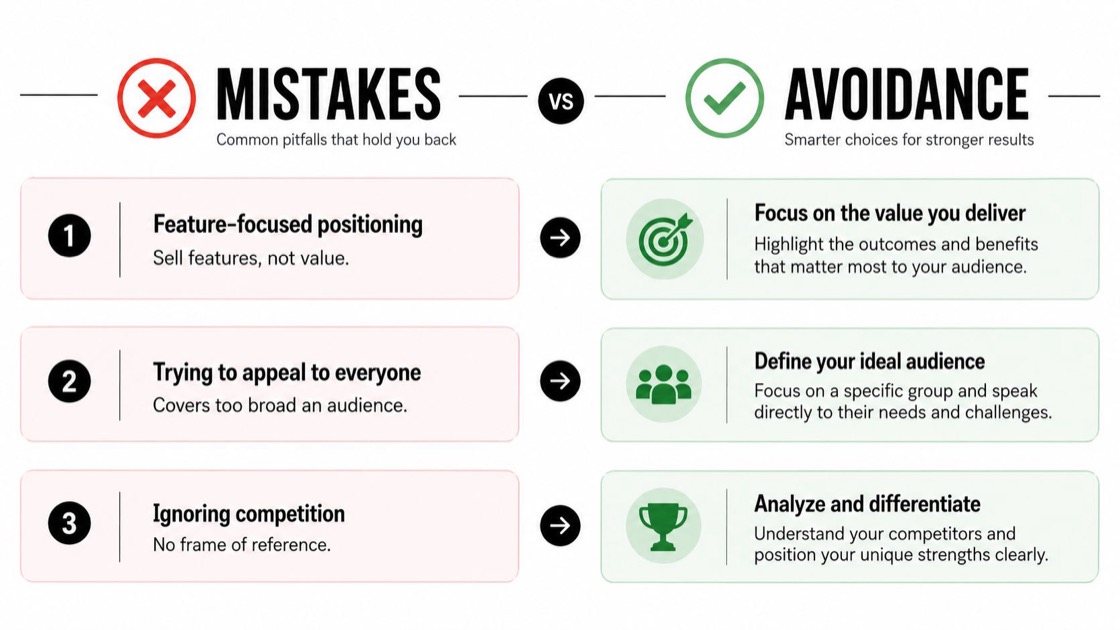
- Feature-first positioning. A feature is not a position. Translate it into the value a buyer actually feels.
- Trying to reach everyone. Narrow the audience until the message sounds specific enough to be useful.
- Ignoring the real alternative. Name what you are compared with, including the option to do nothing.
- Copying the category leader. Find the angle the leader cannot claim, then commit to it.
- Claiming a differentiator you cannot prove. Demand evidence before you build a campaign on it.
Positioning is not a one-time workshop either. Markets move and products change, so revisit the position when the buying pattern shifts. If the change is large, treat it as a rebrand with a real plan for sequence and timing, and keep the core recognizable so you do not confuse the people who already know you.
Turning a position into consistent creative
A position only earns its keep when people can see it in the work. Holding it steady across a launch video and a month of social posts is harder than writing it, because every new format is a chance for the story to wander into something else. Teams that hold the line rely on shared guardrails rather than taste.
Practical help ranges from a brand asset system that keeps files and approvals in order, to a simple rule that every script repeats the core promise in plain language before anything gets shot. Because proof has to travel well, the way you package and share video for buyers matters as much as the footage. And in a search world where an AI often writes the first answer a buyer reads, a consistent brand response keeps the position recognizable even when you are not the one telling the story.
On who carries this, you have options. A fractional creative director can set the position and the standard without a full-time hire. Some companies build the muscle inside and run creative design services style pipelines with their own people. Others bring in an embedded creative team like Moonb, where a fixed group learns the brand and produces the weekly output. The setup matters less than the rule underneath it. Settle the position first, because consistent output needs a consistent center.
If you are heading into a launch or a rebrand, block one hour this week and write the statement with your team using the template above. Then test it against real customer language and the objections your sales calls keep surfacing, and tighten it until the difference is obvious to someone who has never heard of you.
Further reading: brand positioning statistics, market positioning statistics, B2B brand positioning.
Frequently asked questions
Positioning is the market-level choice of who you serve and why you beat the obvious alternative. A value proposition is the specific benefit you promise one audience once that frame is set. Positioning is the strategy that decides the game; the value proposition is the sentence you say to a particular buyer inside it. Get the positioning wrong and every value proposition you write will fight the market instead of fitting it.
Not on a fixed calendar. Revisit it when the market shifts or when your sales team keeps hitting the same objection you cannot answer. The core should stay recognizable even as the messaging around it updates, because buyers need time and repetition to absorb a position. Changing it too often just resets that clock.
Yes, by narrowing rather than matching. Pick a use case the leader treats as an afterthought and own that comparison completely, then expand from strength later. Trying to beat a leader on their own broad ground is how small brands burn cash and stay invisible. The smaller you are, the sharper your position has to be.