Brand Design Agency: What It Is and How to Choose One
What a brand design agency actually delivers, how it differs from other providers, how the pricing works, and the ten questions that expose a weak one.

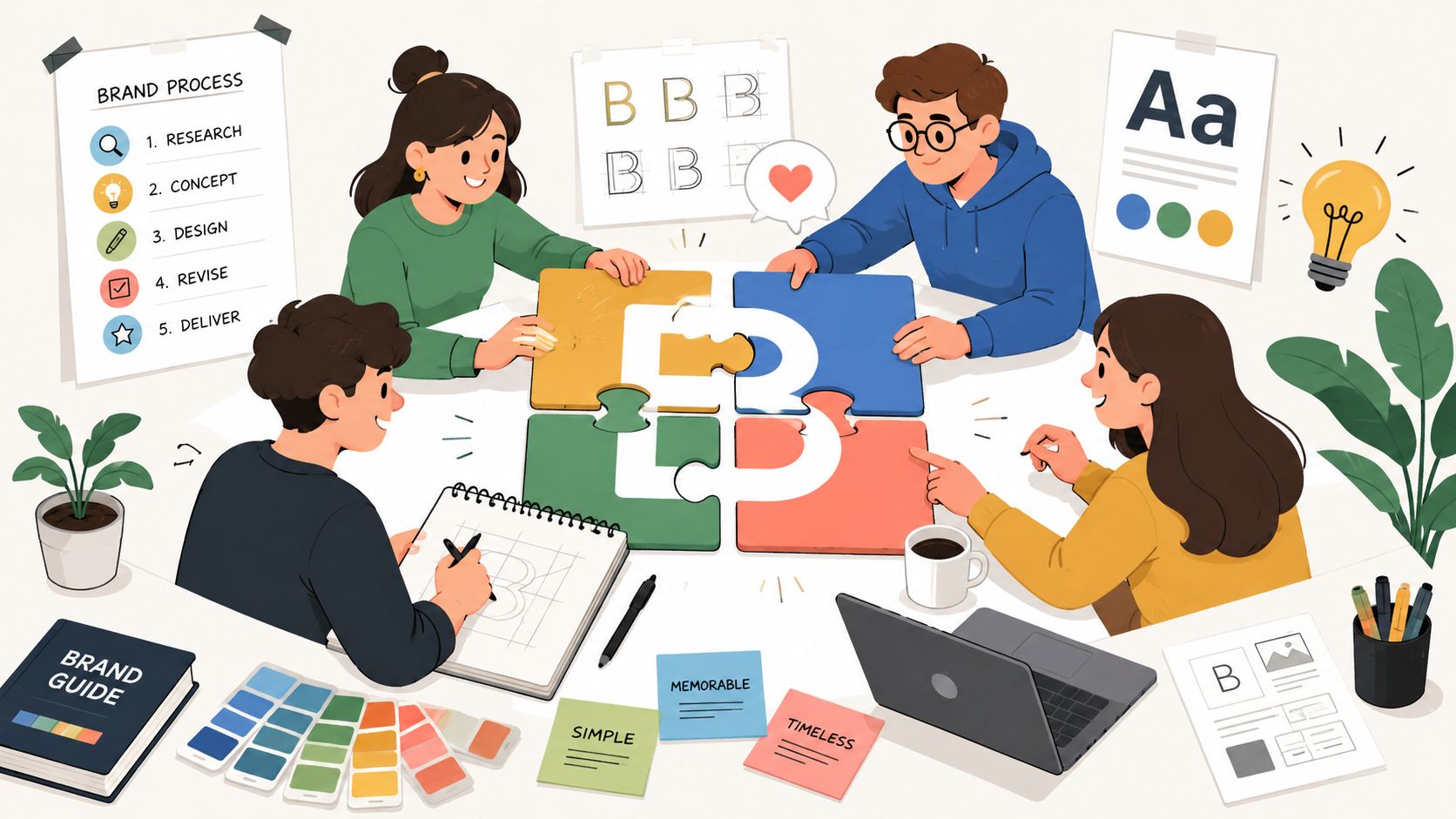
A brand design agency is a specialist team that turns positioning into a visual identity system: logo, type, color, layout rules, guidelines, and the applications that prove the system holds up in practice. Bring one in when you need a new brand, a rebrand, or a system that’s drifting across channels. If you mostly need positioning, start with strategy. If you need one logo and a few assets, a freelancer may be enough. If you need the brand to hold together everywhere, you need the system, not just the look.
I work at Moonb, and the buyers I talk to are rarely short of options; they’re short of a way to tell them apart. One homepage promises brand strategy, another studio shows beautiful logo work, and a freelancer’s portfolio looks terrific. The real question is who can turn your positioning into a system your team will actually use, without handing you a glossy PDF that dies in a folder. An enterprise SaaS client of ours arrived exactly there: a logo everyone liked, three shades of blue in circulation, and decks built by whoever was free that week. This guide is the filter I wish they’d had a year earlier.
What a brand design agency actually does
A brand design agency earns its keep by turning positioning into a system people can use. The work starts with the business problem, then becomes a visual language that holds up across websites, decks, social, product UI, packaging, and sales collateral. Anything less is a pretty presentation, and the test is simple: if the team cannot show how the system behaves on a landing page, in a deck, or inside product screens, the output is decoration. For a sense of how modern identity work gets judged at the craft level, these pro graphic design tips for 2026 are a useful reference point.
For founders and marketing leads, the split with adjacent work matters. Brand strategy defines what the company stands for and how it should be perceived. Marketing design makes campaigns work. Web design handles site structure and interaction. Product design handles interfaces. A brand design agency sits above those surfaces and sets the rules that keep them coherent.
Consistency is why this work keeps getting budget. Industry surveys of brand consistency keep finding the same two things: organizations credit consistent branding with a real share of their revenue growth, and only a minority have guidelines that anyone outside the design team actually uses. That gap between owning a brand book and living by one is the reason agencies get hired.
Marty Neumeier has spent a career on exactly that gap, and this interview is a better calibration for the buying decision than most agency pitch decks.
The buying question underneath it all: do you need a team to define the identity, or a team to operationalize it across the places your company ships work every week?
What a brand design agency delivers
A good engagement should leave you with more than a logo file and a polished deck. It should give you a system your team can reuse without inventing new rules every time a slide, landing page, or social post goes out. If the deliverables are thin, the process was thin.
| Phase | Key deliverables | What a thin version looks like |
|---|---|---|
| Discovery | Brand audit, stakeholder interviews, competitive visual scan, usage inventory | A quick kickoff call and a moodboard pulled from screenshots |
| Identity design | Logo suite, wordmark, color palette, typography, spacing rules, icon direction | One logo file and a few color swatches |
| System documentation | Brand guidelines, usage rules, do and do not examples, file structure | A polished PDF nobody opens twice |
| Rollout assets | Templates, pitch decks, social kit, internal comms assets, launch-ready files | A single brand book with no usable templates |
Discovery should inventory the assets already in play (site, decks, ads, product UI, social, packaging), then map where the system breaks and why. It should also tell you whether positioning already exists or needs to be created before design starts. A weak discovery phase skips that work and jumps straight to visuals.
The identity design phase should cover more than the logo. You want type, color, spacing, layout logic, and supporting marks that can scale across channels. Good agencies usually keep the logo if it still works, then build the system around it; reinventing a usable logo just to show creativity is vanity.
Documentation matters because teams don’t need more theory. They need rules people can follow under pressure. The best guidelines show real usage, edge cases, and what not to do. HubSpot’s walkthrough of building a style guide is a useful picture of the working document you should expect, as opposed to the coffee-table version.
A rollout package is where many agencies underdeliver. Templates, decks, social formats, and launch assets are what make the identity usable on Monday morning. If those pieces are missing, the system will drift fast. Teams that want a sharper reference point can compare against corporate identity design to separate a surface-level refresh from a full system.
A brand book is the handoff point. The work that matters starts when the team has to use it.
Brand design agency vs other provider types
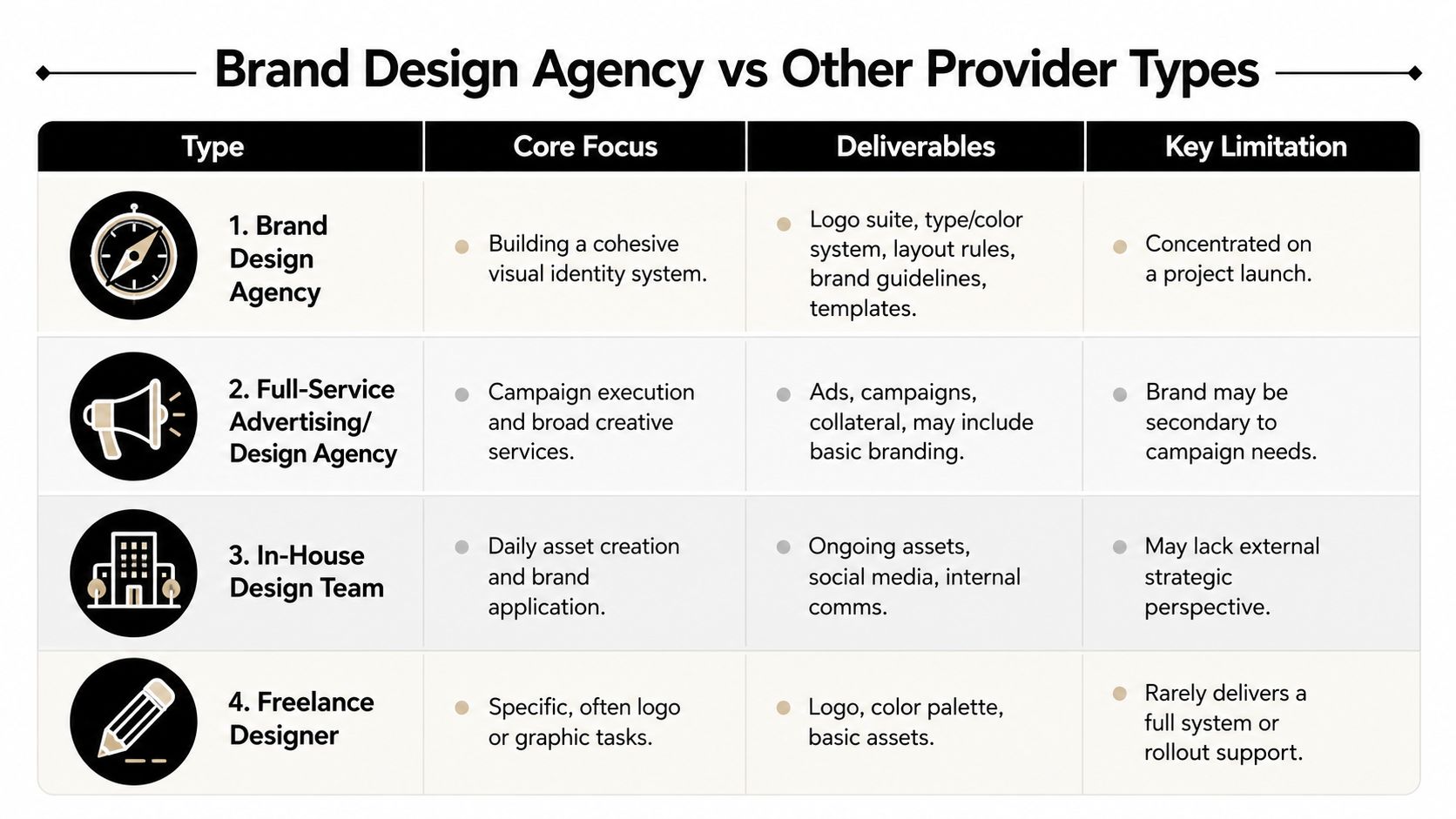
Buyers usually compare the wrong things. They compare portfolios first, when they should compare how each provider thinks, scopes, and hands work off. That’s where the differences show up.
| Type | What they lead with | Engagement shape | Where they fall short | Best for |
|---|---|---|---|---|
| Brand strategy consultancy | Positioning, messaging, market logic | Research-heavy, often upstream of design | Can leave you with sharp strategy and no visual system | Companies that need the brand clarified before design starts |
| Brand design agency or studio | Identity system, visual rules, rollout assets | Project-based, with defined phases and deliverables | Often focused on launch, less on ongoing application | Teams that need a usable identity across multiple touchpoints |
| Generalist creative agency | Campaigns, advertising, broad creative output | Mixed work across channels and formats | Brand depth can get secondary to campaign pressure | Brands that need identity and campaign execution together |
| Freelancer or embedded design team | Specific design tasks, fast execution, close collaboration | One person or a small working pod | Limited breadth, little redundancy, harder to scale | Smaller scopes, or teams that need ongoing production support |
A full-service agency can be useful if the campaign is the main event. But if the brand itself is the problem, a brand design agency usually brings better focus; the work is more disciplined because the brief is narrower. Modern brands rarely touch one channel, either. If you are also dealing with social and channel-specific reporting, an API for social media analytics is a useful reminder that the brand system has to survive measurement as well as design.
A freelancer can be the right call for a simple logo or a fast turnaround. The trade-off is obvious: you get flexibility and speed, but rarely the depth of system thinking that keeps a brand coherent after launch. For a fuller view of those trade-offs, in-house vs agency is worth reading, because the decision often comes down to where the work lives after the first round is done.
If your team needs a steady rhythm of design after launch, an embedded creative team can sit closer to the work than a project shop. Moonb fits that model as a dedicated creative team that keeps production moving on a weekly cadence; the brand identity services page shows how the launch work and the ongoing application connect. It’s an option for companies that want continuity without rebuilding the vendor relationship every quarter.
How a brand design engagement runs
A strong engagement feels controlled because the agency handles the ugly parts early. A weak one looks energetic at the start and messy by the end. The separator is whether the team turns the brief into a signed working agreement before anyone starts exploring visuals.
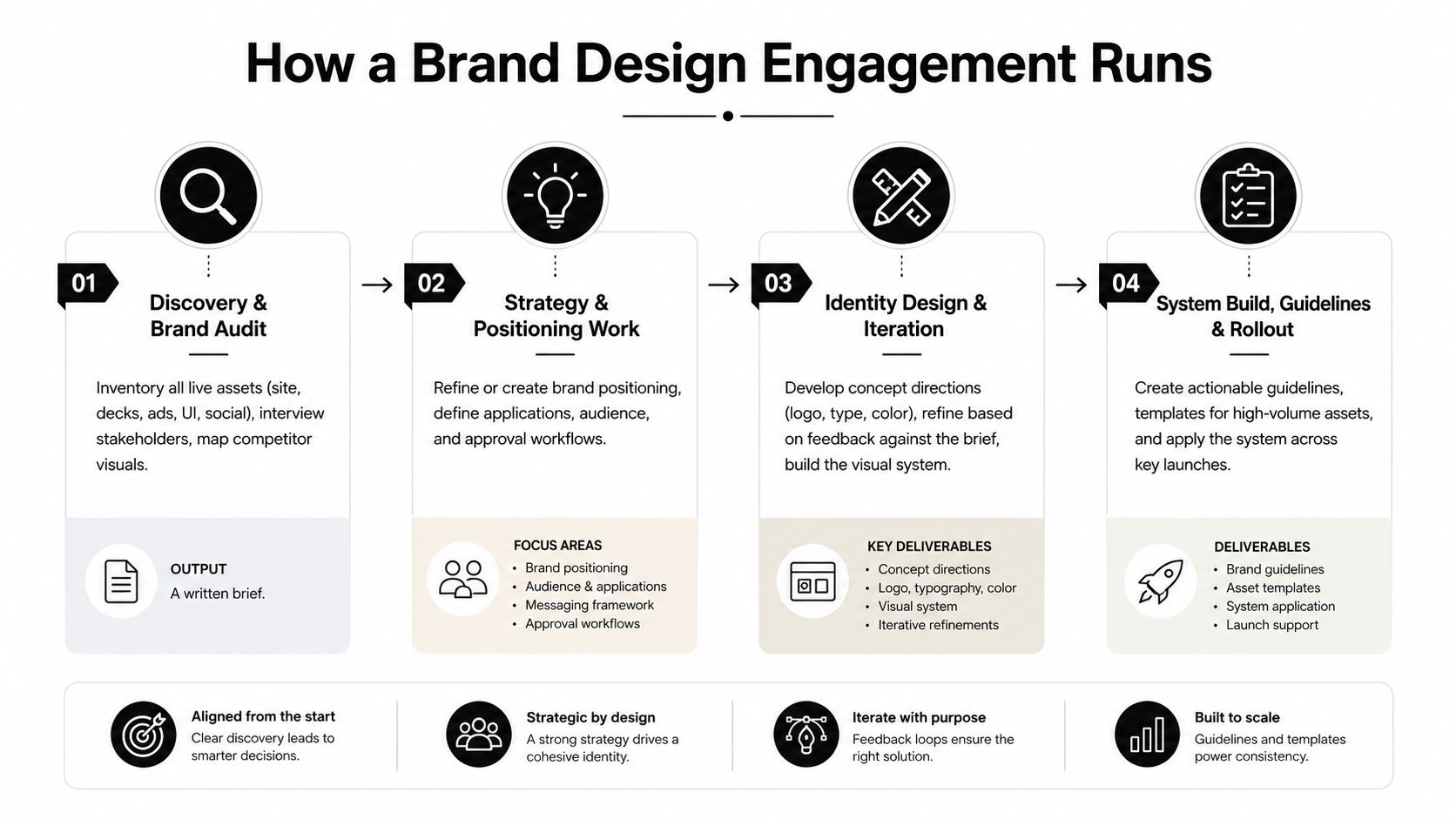
The first phase is audit and discovery. The agency inventories live assets, interviews the people shipping decks, pages, ads, and product screens, and maps the competitor visual field. The useful output is a written brief that says which applications the identity has to survive, who signs off at each step, and whether positioning already exists or needs to be defined.
A signed brief is not a formality. It is the reference point for scope, revisions, and approval. If the brief changes mid-project, good agencies don’t pretend that is free. They pause, reset assumptions, and show the client what changed in time, cost, or direction before the work keeps moving.
The second phase is positioning handoff. If strategy already exists, the agency translates it into design criteria. If it doesn’t, the team has to solve that first or the concepts will drift. Internal decision-makers matter here, because vague feedback from too many voices slows the work and weakens the system.
The third phase is concept directions and refinement. Strong agencies present a few distinct routes, then tighten them against the brief. Weak ones keep redrawing until the loudest person in the room wins. Tight feedback loops move faster and need fewer rounds.
The fourth phase is system build, guidelines, and rollout. The identity becomes usable: templates get built, rules get documented, launch assets get applied across the surfaces that matter.
That enterprise SaaS client I mentioned went through exactly this arc. The work kept the logo they liked, built the type, color, spacing, and layout rules around it, wrote guidelines people could follow, produced templates for the highest-volume assets, and applied the system across a product launch. The result was fewer one-off designs, fewer approval rounds, and a launch that looked like one company.
How brand design agencies price their work
Pricing in this category starts with scope control. A fixed project fee works best for identity work because the agency can define what’s in and what’s out. Ongoing arrangements fit rollout and application after launch. Hourly billing shows up when the scope is loose or the client wants flexibility. Value-based pricing exists too, but it’s less common in straightforward identity projects.
Quotes change for reasons buyers often miss. More applications mean more design time. More decision-makers mean more review cycles. More revision rounds mean more labor. If strategy is included, the scope gets bigger fast. Brand guidelines, internal templates, and post-launch refinement windows are easy to undercount, but they are part of the actual job.
For current market ranges, use how much branding costs as the numbers reference; this section is about structure. The key is understanding how the quote was built. A low proposal that leaves out rollout can cost more later because your team has to recreate the missing pieces. And the question I always tell buyers to ask: what does the fee cover after the logo is approved? That is exactly where many proposals go vague on purpose.
One more thing. Quotes often rise when the agency is asked to solve positioning and identity in the same engagement, especially if the starting point is fuzzy. A rising quote usually signals that the scope is larger than the buyer anticipated, not that the agency is inflating the price.
How to evaluate a brand design agency
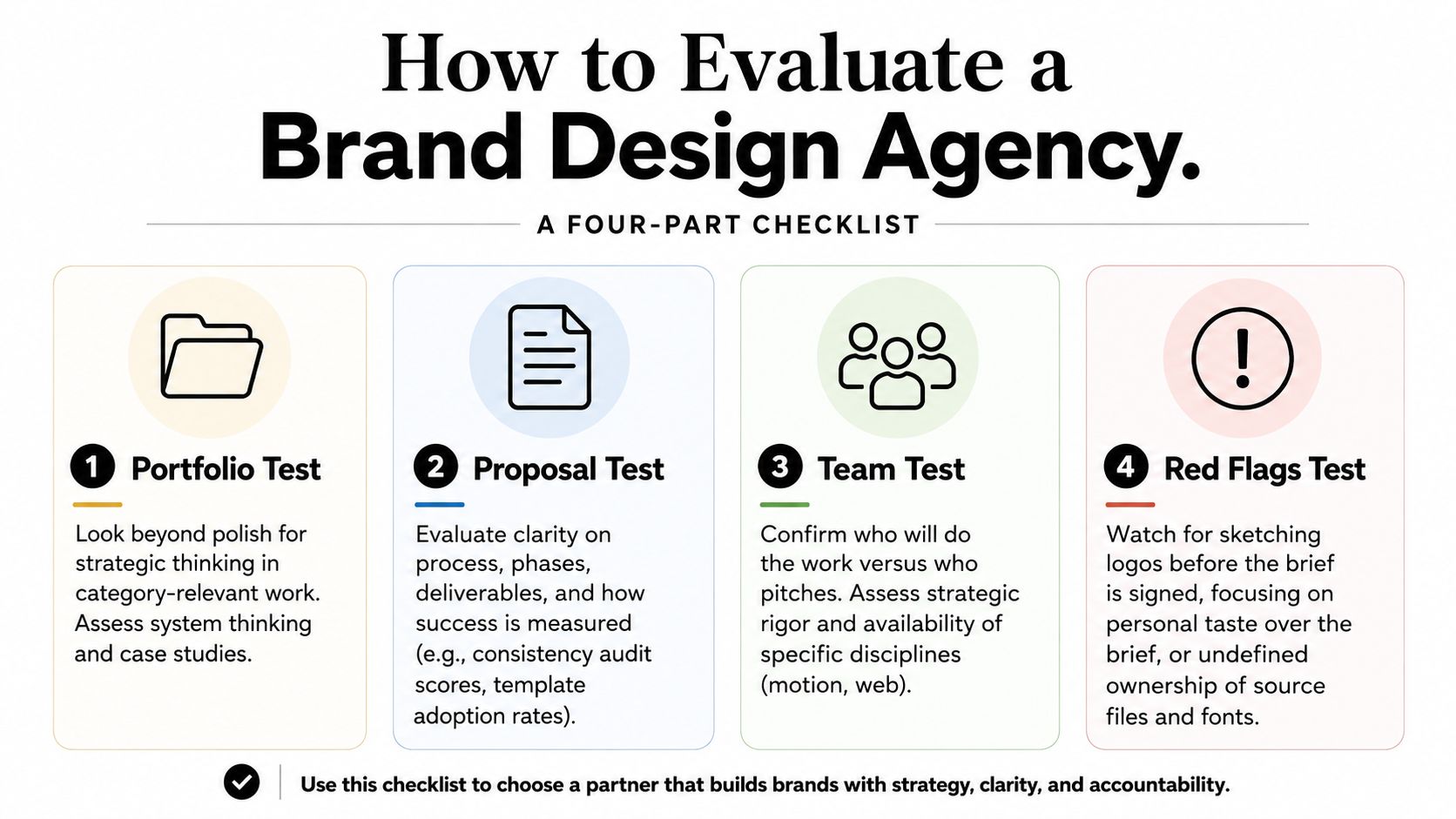
Portfolios can fool you. A pretty case study doesn’t tell you whether the team can think, scope, or hand off work in a way your team can use. You need to inspect the proposal, the people, and the failure modes.
Portfolio test
Look for before-and-after context, not just the final logo. Strong work shows the problem, the constraints, and how the system was used on real surfaces. If everything looks elegant but nothing shows application depth, the agency may be better at presentation than implementation. For a wider market view, best branding agencies is a useful cross-check, but don’t let lists do your thinking for you.
Proposal test
Read the scope for vagueness. If the proposal says “brand exploration” without naming deliverables, ask what that means in practice. If source files, font licenses, usage rights, or handoff rules aren’t explicit, that’s a problem. If success isn’t defined, the agency is setting itself up to declare victory on aesthetic taste alone.
Team test
Ask who does the work after the pitch. Seniority matters more than the name on the door. You want to know who is designing, who is approving, and whether the team covers the disciplines you need: motion, web, product, presentation design. A polished pitch deck can hide a thin delivery team.
Red flag test
Walk away if they want to sketch logos before the brief is signed. Walk away if they judge directions by personal taste instead of the brief. Walk away if ownership of working files is vague. Walk away if the timeline is so aggressive that strategy gets squeezed out. Our best brand identity agencies shortlist gives you a broader field to compare against, but the real filter is fit, not fame.
Ten questions to ask before signing
These questions surface failure modes before anyone signs a contract. A polished pitch can hide a weak operating model, and that’s where projects go sideways.
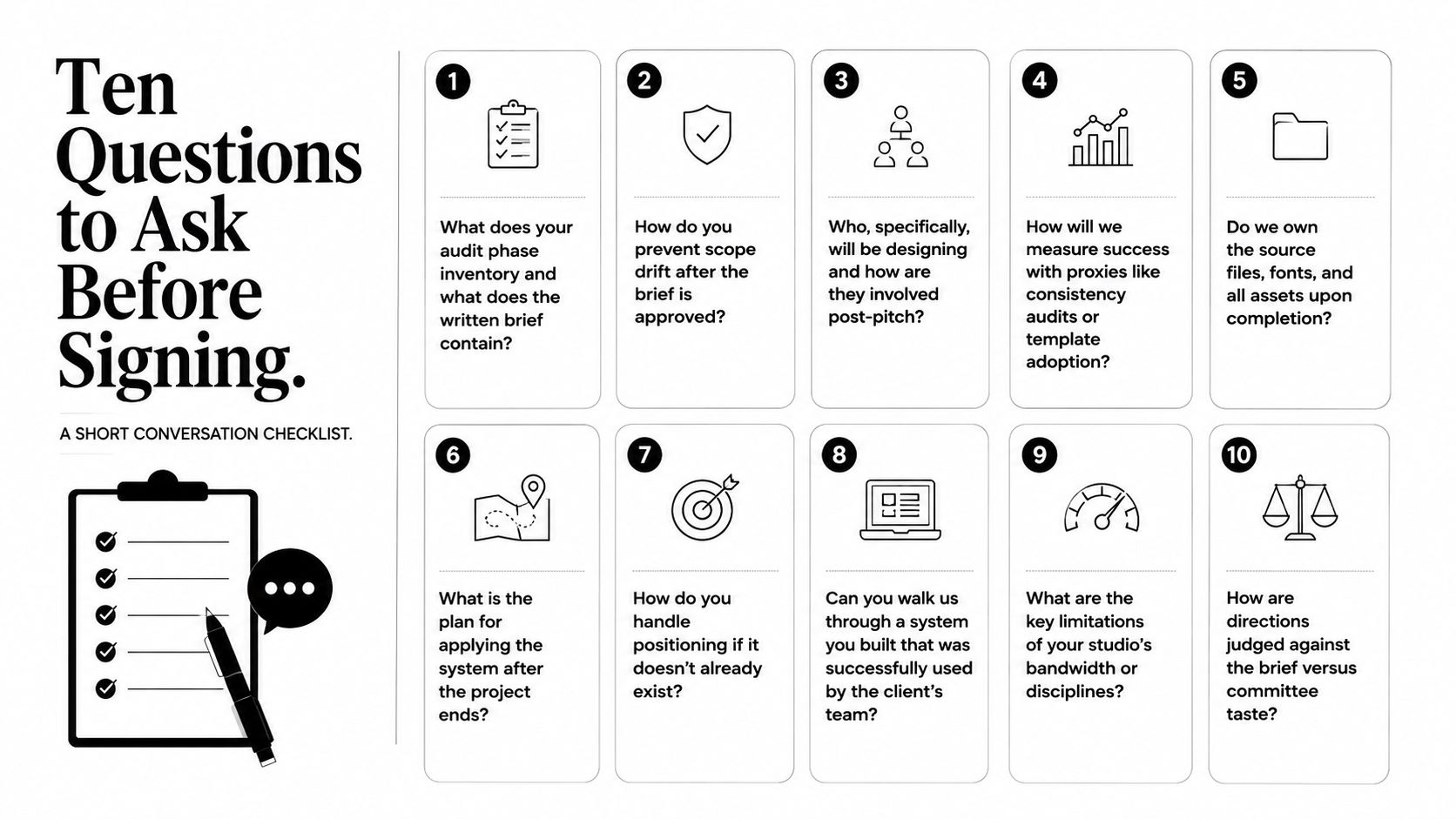
- What does your audit phase inventory, and what’s in the written brief? A weak answer sounds like “we’ll learn as we go.” A strong one names the live assets, stakeholders, applications, and approval rules.
- How do you prevent scope drift after the brief is approved? Weak answers stay fuzzy. Strong answers explain change control and how extra requests get handled.
- Who specifically will be designing, and how are they involved after the pitch? If the person pitching won’t touch the work, that matters. Ask for names, not titles.
- How will we measure success? A weak answer points to taste. A strong answer uses proxies like consistency audits, template adoption, or speed to produce on-brand assets.
- Do we own the source files, fonts, and all assets on completion? If they dodge this, stop there. Ownership should be clean and written.
- What happens after the project ends? A weak answer assumes your team will “pick it up.” A strong one explains rollout support, handoff files, and what ongoing application looks like.
- How do you handle positioning if it doesn’t already exist? If they skip that question, the design will absorb a strategy problem it can’t solve.
- Can you show a system your client’s team used? Ask for proof of adoption, not just polished mockups. A good answer shows living assets.
- What are the limits of your bandwidth or disciplines? Every shop has limits. Honest agencies say them out loud.
- How are directions judged, by the brief or by committee taste? If committee taste wins every time, the work will drift. That’s a process problem, not a design one.
The same clarity-first rule applies to the internal side of the sale. If you need to build pre-sell pages fast for stakeholder buy-in before the engagement is signed, keep those pages as plain as the brief: clarity beats cleverness there too.
Choosing well comes down to one habit: ask who will own the system after the logo is approved, then compare briefs, not just portfolios. If your team needs ongoing rollout as much as launch work, shortlist partners who can show a living system in a client’s hands, not just a pretty case study.
Frequently asked questions
Only if the brand is actually blocking something: sales conversations, fundraising, launch readiness. If investors keep misreading what you do, that's a brand problem worth paying for. If you mainly need a logo and some basic materials to look credible, keep the scope tight and upgrade to a full system once the positioning has settled, because early pivots invalidate expensive identity work fast.
A focused identity project typically runs six to twelve weeks; a full rebrand with strategy, system build, and rollout can run several months. The visible design work is the fast part. Discovery, stakeholder alignment, and rollout are the slow parts, and anyone promising a dramatic identity change in a tiny window is usually cutting one of those out.
Mostly focus and breadth. A branding studio concentrates on identity and system work, often with a strong authorial style. A creative agency is broader and may prioritize campaigns over system depth. A brand design agency should be strongest exactly where the identity has to hold up across many touchpoints. Read the deliverables list rather than the label; the same name covers very different operating models.