Design ops: what it is, who runs it, and when to hire for it
Design ops is the people, process, and tooling work that lets a design team ship consistent work at scale. Here is what it covers, who runs it, and how to choose between hiring, assigning, or embedding.

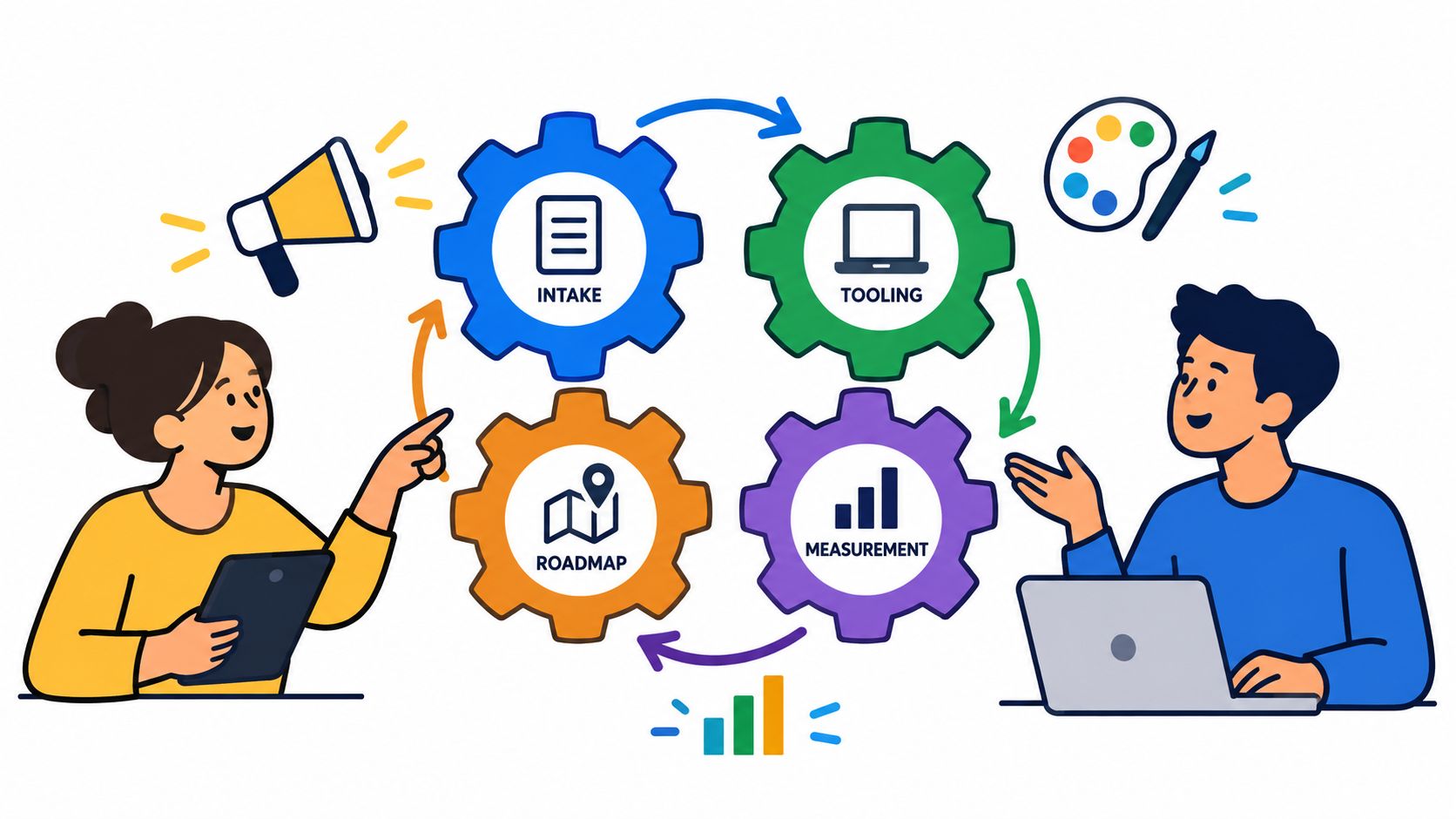
Design ops is the people, process, and tooling work that lets a design team ship consistent work at scale. It takes the idea behind DevOps, that the system around the makers deserves as much attention as the making, and applies it to design teams.
I co-founded a creative studio that works as a dedicated team inside marketing departments, so I spend a lot of time looking at how creative work actually moves through companies. The pattern that prompts a design ops conversation is always the same. Requests arrive through Slack messages, email, meetings, and hallway conversations. Designers rebuild the same components. Stakeholders review screenshots in scattered threads. Nobody has a reliable view of what is in progress. Creative demand has outgrown the team, and the next move is unclear. Should you hire a DesignOps manager, hand the work to a design lead, buy better tools, or bring in an external team that already runs on an intake and quality process?
This guide gives you a practical way to decide.
What design ops actually is
A team can produce good work and still operate badly. Requests land with whichever designer answers first. Three versions of the logo lockup circulate across campaigns. A reviewer comments on an old screenshot while the current file sits somewhere else. The team spends its days finding context instead of making decisions.
Design ops fixes the structure around the work. Nielsen Norman Group defines it as “the orchestration and optimization of people, processes, and craft in order to amplify design’s value and impact at scale” in its DesignOps 101 guide. In plain terms: it decides how requests enter the team, who sets priorities, which tools and files people use, how reusable components are governed, and how leaders know whether any of it is helping. The designers still do the craft. Design ops makes the conditions around that craft reliable.
The term comes from interaction designer Dave Malouf, who coined it and has spent years building the practice, borrowing the operational thinking that helped software teams coordinate development and release work.
Here is the test I use with clients: if your team cannot explain how a request moves from brief to approved asset, you have an operations problem before you have a tooling problem.
For a buyer, design ops is not a vague improvement program. It is a set of decisions about ownership and flow:
- Intake: where does a request go, and what information must arrive with it?
- Prioritization: who decides what gets done first when capacity is limited?
- Governance: which brand rules, components, templates, and file conventions are current?
- Quality: who reviews the work, at what stage, and against which standard?
- Measurement: which signals show less coordination drag, better consistency, or more predictable delivery?
The distinction matters because a project manager may track deadlines without governing design quality, while a design lead may protect the craft but lack time to maintain the system around it. A design ops function connects both needs.
For a marketing or brand team, the closest relative is creative operations management. The name changes by department, but the practical question stays the same: can the team absorb demand without losing control of the work?
The three areas design ops covers
Practitioners usually organize the work around three questions, and NN/g’s DesignOps menu groups activities the same way: how we work together, how we get our work done, and how our work creates impact. That structure keeps the function grounded. It stops design ops from turning into a collection of meetings or a tool administration role.
| Focus area | Concrete tasks |
|---|---|
| How we work together | Hiring, onboarding, team structure, role clarity, career paths, rituals, collaboration norms |
| How work gets done | Intake, briefing, prioritization, capacity planning, tooling, file governance, design system governance, review and handoff |
| How work creates impact | Cycle time, quality checks, stakeholder feedback, adoption, reuse, team health, reporting and improvement |
How we work together
People operations creates clarity around who owns what. A DesignOps lead may define team responsibilities, improve onboarding, maintain role expectations, and help leaders understand where the team needs capacity. In a small group, a design manager carries these duties alongside creative leadership.
This bucket also holds the less visible parts of team health. New designers need to know where files live, how reviews work, which components are approved, and who makes the final call. Without that context, each new hire learns the team through scattered conversations.
How work gets done
This is where most leaders first feel the need for design ops. The function turns scattered requests into a visible queue, creates a briefing standard, assigns decision rights, and maintains the systems people use every day.
Design systems are the strongest operational lever in this bucket. In Figma’s research on measuring design system value, designers who ran a task with access to a design system completed their objective 34% faster than they did without one. The benefit comes from reuse. Designers spend less time rebuilding components and rechecking decisions that were already made.
A design system still needs ownership. Teams need rules for contribution, review, versioning, documentation, and adoption. A practical guide to building a design system with tokens and tooling can carry the technical foundation, but the operating decision comes first: decide who maintains the system and how people know which version to use.
This talk from Figma’s own conference is a solid primer on what governance looks like once a system is live:
For marketing teams, the same logic applies to campaign templates, motion packages, brand assets, presentation layouts, and approved image treatments. A disciplined creative asset management process makes reuse easier and lowers the odds that an outdated file becomes the starting point for new work.
How work creates impact
Measurement should connect operations to outcomes leaders care about: delivery reliability, quality, brand consistency, team health, partner satisfaction. Nielsen Norman Group’s REACH framework groups DesignOps measures into Results, Efficiency, Ability, Clarity, and Health, and suggests concrete signals such as user satisfaction ratings, frequency of use, questionnaire scores, success and error rates, and design quality scores.
The point is not a dashboard for its own sake. It is finding out whether the team spends more time on meaningful creative work and less time resolving avoidable coordination problems.
Design ops vs creative ops vs marketing ops
The terminology creates unnecessary confusion during hiring. Design ops grew up in product UX, where designers work closely with product managers, researchers, engineers, sprint planning, and design system implementation.
Marketing teams usually call the same kind of work creative ops. The inputs differ, but the operating questions are familiar. A campaign team still needs a clear intake, priority rules, reusable assets, review stages, file governance, and quality control.
Marketing ops sits one level wider. It coordinates the systems, processes, reporting, and technology that support the entire marketing function, including campaign operations, lead management, analytics, automation, and planning.
| Function | Primary focus | Typical output |
|---|---|---|
| Design ops | Product design and UX delivery | Design workflows, system governance, team practices, research and engineering coordination |
| Creative ops | Brand and campaign production | Briefs, production schedules, review paths, asset libraries, brand QA |
| Marketing ops | Marketing systems and performance | Campaign processes, reporting, automation, data workflows, planning systems |
If you lead a product UX organization, search for DesignOps leads, DesignOps managers, producers, or program managers with experience working alongside engineering. If you lead a brand or campaign team, creative operations is probably the better job title and talent pool.
The distinction shapes the interview. A product DesignOps candidate may understand component governance but have limited experience managing a campaign calendar with video, paid media, social formats, presentations, and regional adaptations. A creative operations candidate may be strong at production flow but less familiar with product discovery or engineering handoff.
The same fork shows up in every operations discipline, which is why I find it useful to look sideways at how other functions solve it. This breakdown of customer success operations walks through the identical question in a different department: when the coordination work should sit with a dedicated hire and when it belongs to an existing functional leader.
Your wider marketing department structure should make the boundary explicit. Decide whether the function serves product experience, marketing production, or both. A single person can support both in a smaller organization, but the priorities and working rhythms still need to be spelled out.
Who does the work and when to hire
There is no magic headcount at which every organization needs a dedicated DesignOps manager. The stronger signal is coordination load.
A DesignOps lead owns the operating model. They define intake, clarify decision rights, improve team structure, govern tools and systems, and report on performance. A producer focuses on the movement of work: schedules, briefs, dependencies, reviews, delivery. A program manager handles larger cross-functional initiatives, such as a design system rollout, research operations, or a change to the design and engineering workflow.
In a small team, the design manager carries all three responsibilities on top of managing people and reviewing work. That can hold for a while. It becomes risky when coordination eats the time meant for creative direction, coaching, and quality decisions. In my experience the function stays small and senior; the pattern I see in practice is one or two experienced operators supporting a much larger design group, closer to an operating partner than an administrative department.
NN/g’s DesignOps FAQ makes the same point from the research side: not every organization needs dedicated DesignOps roles, but teams “experiencing substantial, rapid growth, those in a structure of widely embedded designers, or those within cultures of fast-paced timelines” tend to get high value from one.
Kate Kaplan from Nielsen Norman Group walks through the dedicated-role question in a few minutes here:
Triggers for a dedicated role
Look for these conditions:
- Coordination consumes leadership time. A design lead spends a substantial part of the week routing requests, chasing feedback, and resolving ownership questions.
- Intake has failed. Requests arrive through multiple side doors, and the team cannot explain what is currently committed.
- Demand comes from many directions. Several products, regions, or stakeholder groups compete for the same designers.
- Quality varies by channel. Brand rules get interpreted differently across web, social, video, presentations, and sales materials.
- The system needs maintenance. Components, templates, libraries, or documentation exist but nobody owns their evolution.
- Leadership needs evidence. You cannot explain where capacity goes or whether process changes improve delivery.
A dedicated hire makes the most sense when the coordination load is permanent and close to product development. Product UX work tied to engineering sprints, research programs, and release planning usually deserves an internal owner.
For teams still deciding how much structure to build, building an in-house creative team is the useful adjacent question, and comparing design services shows what the external version of that structure looks like. The answer may be a hire, a shared responsibility, or a deliberate external model. Choose based on the work pattern rather than the title.
Four ways to get design ops outcomes
Leaders have four practical choices. Each solves a different part of the problem, and none removes the need for clear ownership.
| Approach | Best for | Trade-offs |
|---|---|---|
| Hire a DesignOps manager | Permanent coordination across product UX teams | Strong institutional knowledge, but hiring takes time and the role can drift into administration |
| Assign ops to a design lead | Small teams with manageable demand | Fast to start, but craft leadership and people management may suffer |
| Buy tools | Teams with a defined process that needs support | Tools improve visibility, but they do not decide priorities or enforce behavior on their own |
| Embed an external team | Campaign creative where direction and production capacity are both needed | Faster operational coverage, but the client must retain approvals, priorities, and internal context |
Hire
Hire when coordination is a permanent product-side responsibility. The person builds relationships with engineering, research, product, and design leadership over time. The trade-off is the ramp. A new hire still needs to learn the organization, its product history, its decision culture, and its existing tools.
Assign
Assign the work to a design lead when the team is small and the main problems are visible. Protect time for it. If you stack operations on an already full leadership job, the result is reactive administration rather than a working system. A fractional creative director can be a middle path here, carrying direction and priority calls part-time while the internal lead keeps making.
Buy tools
Tools help once the process exists. A request form, project board, design library, review tool, and asset management system make work visible. They will not resolve a priority dispute between two senior stakeholders, and they will not produce a usable component library without governance.
Automation needs the same review rules as everything else in the system. If your team is looking at AI video editing features to scale content output, decide which outputs need human review, where source files live, and how approvals are recorded before the automation enters production.
Embed
An embedded team brings an operating layer along with production capacity. Moonb is a dedicated, Creative Director led team that arrives with its own intake, prioritization, and QA, delivering across video, motion graphics, design, and animation on a steady weekly rhythm; the creative strategy service is the piece that holds every asset to one concept, which is the embedded counterpart to the standardize, prioritize, and harmonize work described above.
Whoever you embed, make the operating model explicit. It should include one request channel, a brief template that asks for audience, goal, format, and deadline, and a single person who sequences work against capacity. That person maintains living brand rules and reusable components, runs a fixed review cadence with versioned files, and hands over assets using naming and folder conventions your DAM can absorb. The broader creative as a service model works the same way across providers, so use these mechanics as your evaluation checklist.
The boundary matters. The client still owns final approvals, spend decisions, and priority disputes between stakeholders. An embedded team covers the standardize, harmonize, and prioritize functions well. It does not cover hiring, career paths, or performance reviews.
The trade-off is institutional knowledge. Some context lives outside the company, and the arrangement needs an internal owner or it stalls. Product UX operations tied closely to sprints and engineering should generally stay in-house. Marketing creative is the better fit when the need is direction plus hands.
A starter plan and common mistakes
Teams without a dedicated role can begin with a small operating spine. Do not wait for a perfect system or a large tool investment.
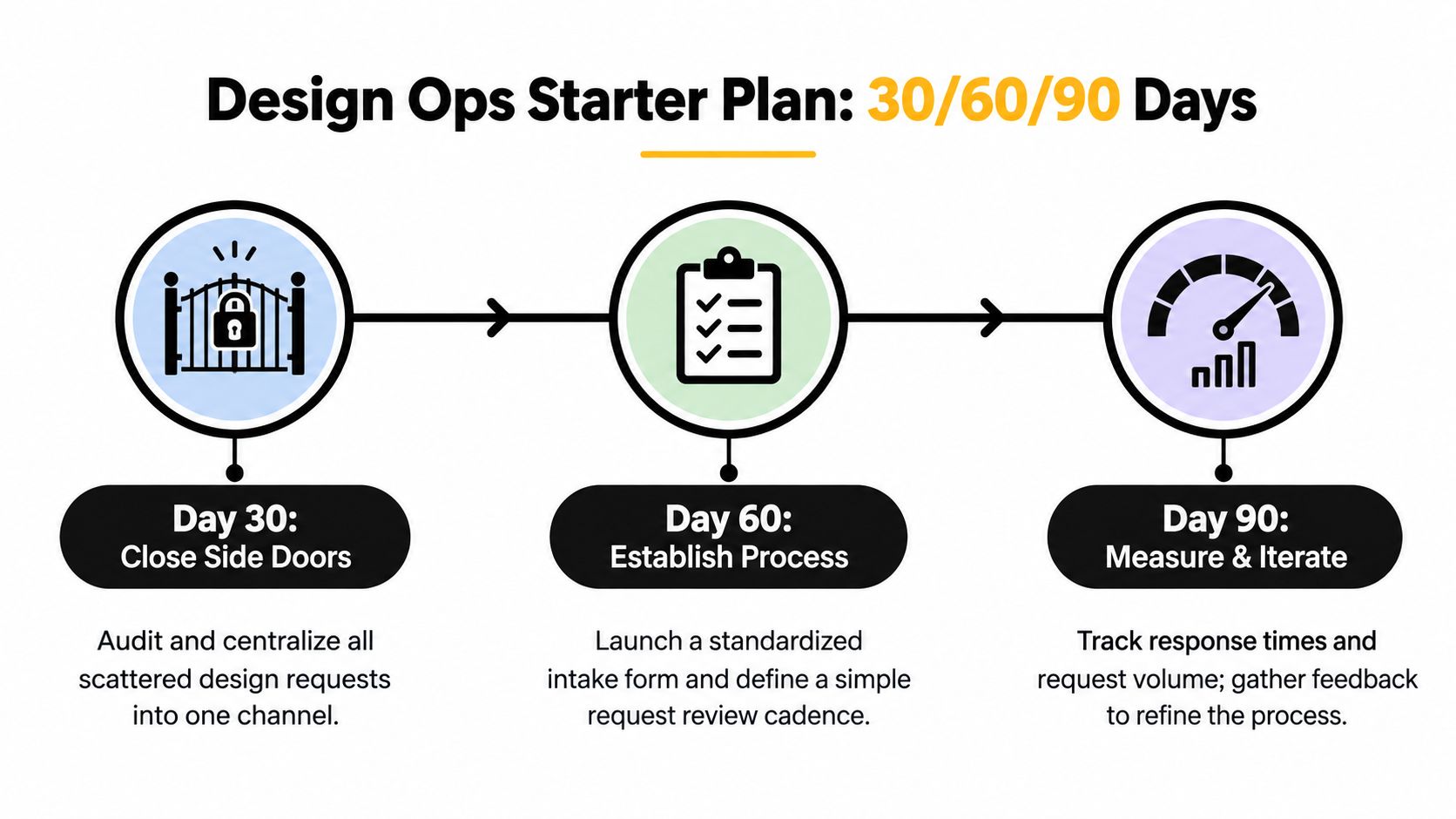
Days 1 to 30
Audit where requests currently arrive. Close the side doors, choose one intake channel, and create a short form that captures audience, goal, format, deadline, approver, and required inputs. Keep an exception path for urgent work, but make the exception visible.
Days 31 to 60
Start a weekly prioritization call owned by one person. Review incoming work, confirm capacity, resolve conflicts, and publish the current queue. Create a basic component or template library, even if it begins as a carefully organized set of approved files.
Days 61 to 90
Move reviews into versioned links. Set naming conventions, folder rules, and a handoff checklist. Begin tracking a small baseline of cycle time, revisions, intake compliance, and on-time delivery.
The process will fail if common mistakes go unaddressed:
- Buying tools first. Define the workflow before selecting software. The warning sign is a team debating features while requests still arrive everywhere.
- Calling project management design ops. Add design system governance, quality checks, and team practices. The warning sign is a clean task board with inconsistent assets.
- Leaving side doors open. Redirect Slack messages and email requests to the intake form. If the official queue looks empty while designers are busy, side doors are still active.
- Hiring too early or too junior. Confirm the recurring problem before adding a role. If the new hire only routes tickets, the scope is too narrow or the seniority is wrong.
- Making one person approve everything. Give decision rights to the people closest to the work. A queue that waits on one operator is becoming a bottleneck.
- Measuring volume. Track reliability and quality instead. If assets shipped rises while revisions and missed dates also rise, the headline metric is hiding damage.
- Applying product rituals to campaign work. Match the process to the work. A sprint ceremony can slow a campaign team that needs fast briefs and scheduled reviews.
- Keeping value invisible. Share a short operating report with leadership. If nobody can describe the problem the function solved, the role will look optional.
Metrics that prove the operation works
Start with a baseline. Without one, a team can claim improvement because the work changed or demand dropped.
Track these signals:
- Cycle time. Measure from approved brief to first draft. A high reading may point to unclear briefs, capacity limits, or slow feedback.
- Revision rounds. Count rounds per asset. A rising number can signal weak briefing, unclear decision rights, or inconsistent quality standards.
- Intake compliance. Compare requests through the official channel with requests arriving through side doors. A low share means the process is not trusted or leaders are not enforcing it.
- On-time delivery. Compare delivery against agreed dates. Misses may reflect poor prioritization, unrealistic deadlines, or late approvals.
- Asset reuse. Track how often the library supplies a starting component or approved template. Low reuse can mean the library is hard to find, outdated, or poorly governed.
- Craft versus coordination. Ask designers for a simple weekly self-report on time spent making work versus coordinating it. A high coordination share tells you where the operating model is still weak.
- Quality. Run a quarterly brand consistency review of shipped work. Look for outdated logos, inconsistent type, off-brand motion, accessibility gaps, and mismatched campaign treatments.
Do not make assets per month the headline number. Volume can rise while quality falls and rework grows.
Proving value is the part most operators find hardest, which is exactly why NN/g built REACH around a spread of signals covering results, efficiency, and team health rather than a single productivity score. A useful report combines speed, health, and downstream quality. For marketing leaders, the same discipline applies to video marketing ROI: establish what success means before production begins, then connect the operational measures to the business outcome the work supports.
Frequently asked questions
No. Small teams can use the same principles without creating a dedicated function. One intake channel, clear priorities, a small library of approved components, and a predictable review path remove real friction even when the design manager owns the process. The dedicated role becomes worth it when coordination starts eating the time meant for creative direction and quality decisions, which is a signal about workload, not company size.
It can cover a large share of the operating work: intake, prioritization, production coordination, QA, file governance, and reuse. It cannot replace internal ownership of final approvals, spend, stakeholder conflicts, hiring, or career development, and product UX operations tied to engineering sprints should stay in-house. The practical test is whether the arrangement has one internal owner; without that person, even a well-run external team stalls on decisions only the company can make.
After the team has agreed on a workflow, and not before. Tools fix visibility and repetition problems: a request form makes intake enforceable, a board makes the queue public, a component library makes reuse the easy default. They do not resolve unclear ownership, competing priorities, weak briefs, or inconsistent quality standards. A reliable warning sign is a team comparing software features while requests still arrive through five different channels.