Creative studio: what it is and how to pick one
What a creative studio is, how it differs from an agency, production company, freelancer, or in-house team, and the 10-point checklist for choosing one.

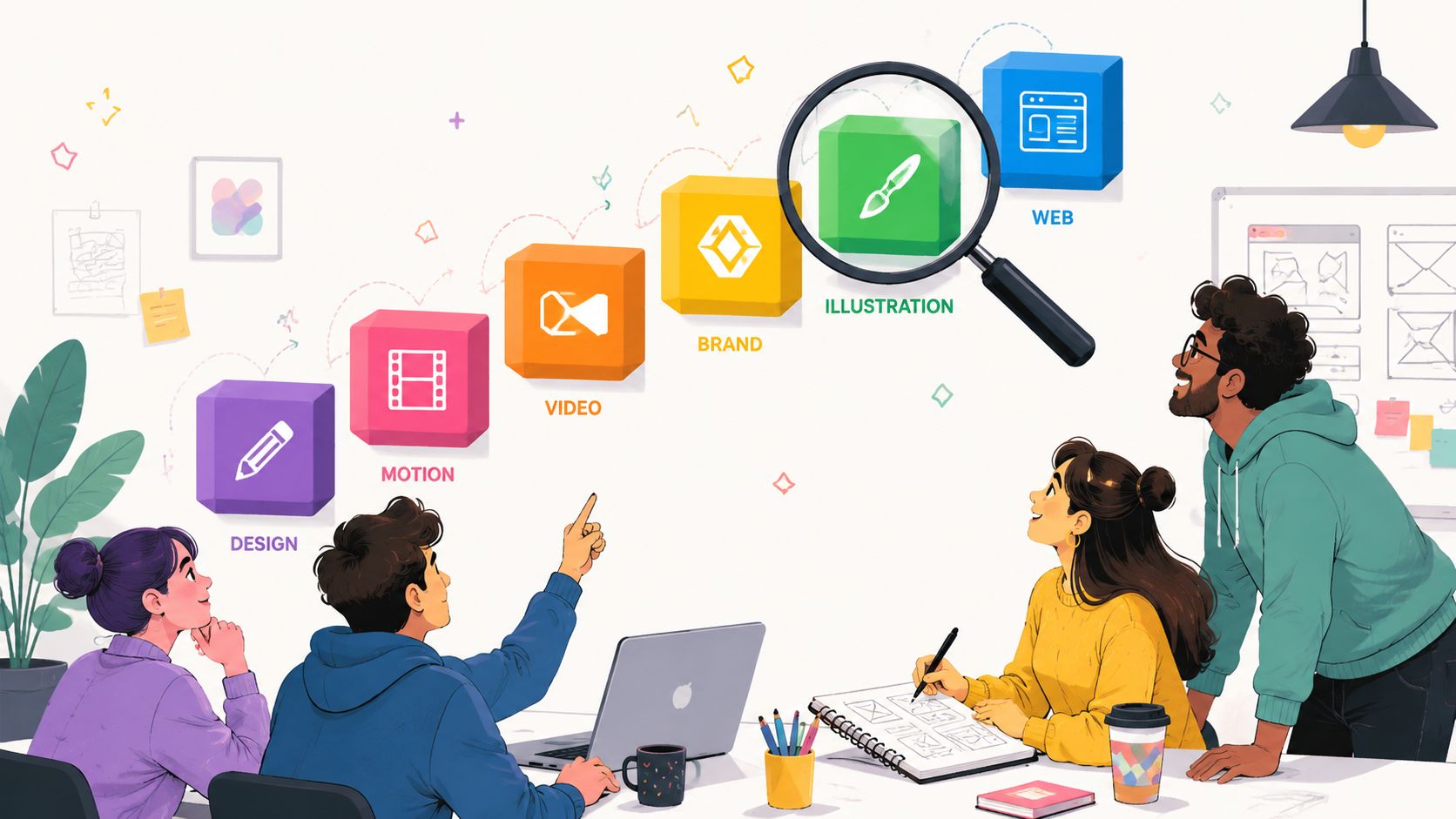
A creative studio is a small-to-mid multidisciplinary company you hire for craft-led work, design, video, motion, animation, where senior creatives make the work directly instead of managing it through account layers. An agency typically sells broader strategy, media, and integrated campaign management, then runs production through account teams, creative departments, and outside partners.
I work at a creative studio, so I read this category from the inside. Clients forward me the proposals they are trying to decode, and the pattern is always the same: the launch film, the motion cutdowns, the landing-page visuals, and the sales deck are split between freelancers, a production company, and whoever has spare time internally. The output is inconsistent, slow, and hard to manage, and now three vendors with three different labels are all promising to fix it. This guide is the vendor-evaluation doc I wish those buyers had before the calls started.
One disambiguation before anything else. Software products use the same name; Amazon Ads, TikTok, and several ad platforms all sell tools called Creative Studio. This article covers creative studios as companies you hire. If you are looking for a software product, its own documentation will serve you better.
The scale of the category surprises people. UNCTAD’s Creative Economy Outlook 2024 reports that cultural and creative industries generate almost $2.3 trillion in annual revenue and contribute 3.1 percent of global GDP, with 6.2 percent of global employment (figures the report cites from UNESCO).
What counts as a creative studio
The defining trait is proximity between the person you brief and the person who makes the work. A studio may be founder-led, creative-director-led, or built around a small group of senior practitioners. Its focus is the quality and usefulness of the work itself rather than media buying or the management of a large integrated campaign.
A studio can work on a defined project, a retainer, or an ongoing embedded arrangement. The brief might be a brand identity, a product film, a campaign system, a website, an animation package, or a recurring stream of social content. Strategy may be part of the engagement, but it usually exists to sharpen the creative work and guide production.
An agency normally has a broader commercial remit: brand strategy, campaign planning, media, account management, analytics, and production through several internal departments or external partners. That structure can be the right choice for a complex, multi-market campaign. It can also introduce more handoffs than a craft-led brief needs. If you are comparing creative design agencies, remember that the label alone tells you little; team structure and delivery model matter more.
So don’t choose the label. Choose the team that matches the disciplines, cadence, and decision-making your work requires. The useful question is who will make the work, who will approve it, and how much context survives between brief and delivery.
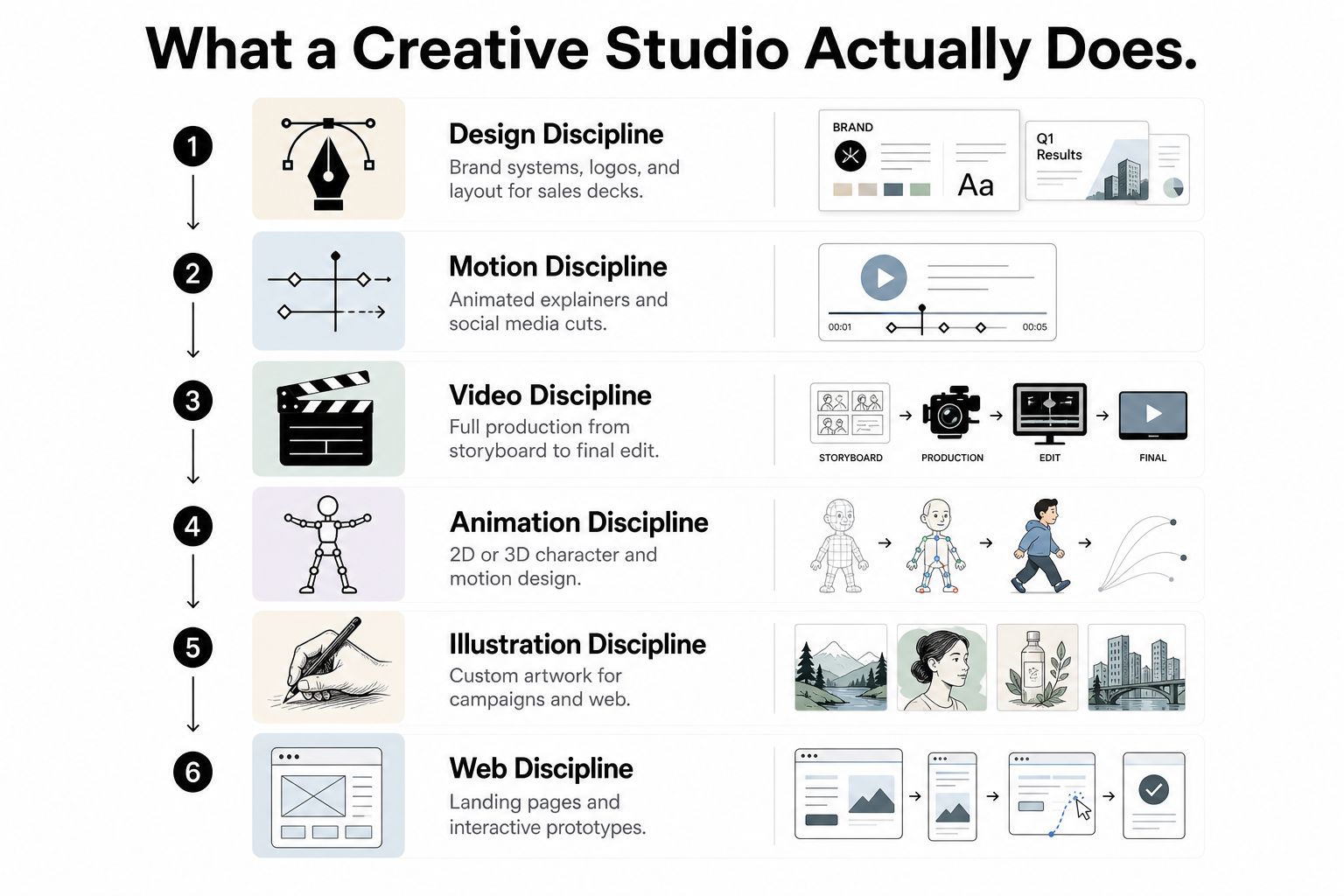
What a creative studio actually does
The output depends on the studio’s disciplines, but the strongest studios make those disciplines work as one system. Ask for finished deliverables, not broad promises about creativity. The worst proposal I have seen this year described “brand magic across every touchpoint” and, when pressed, turned out to mean two logo options and a mood board.
Design and brand
Design can include a visual identity, logo system, type hierarchy, presentation template, packaging range, editorial layout, or campaign toolkit. A finished engagement should leave you with editable files, brand assets, layout templates, and specifications for different channels.
Brand work goes further upstream: naming, positioning, verbal identity, messaging architecture, and a brand book. What you receive should be usable by internal teams, a structured identity system with examples for web, social, sales, and product touchpoints.
Motion, animation, and video
Motion design turns static brand elements into moving assets: a logo sting, an animated explainer sequence, a lower-third system, product interface animation, or a set of native social motion templates.
Animation may be 2D or 3D. It can produce character work, abstract visual sequences, product demonstrations, title design, or animated diagrams. Ask whether the studio handles storyboarding, design, animation, sound, and final exports itself, or whether those stages pass to other suppliers.
Video production covers campaign films, product demos, founder interviews, event capture, internal communications, commercials, and branded films. A studio may manage the process from script and storyboard through casting, filming, editing, sound, color, captions, and platform-specific exports.
Illustration and web
Illustration earns its keep when stock imagery cannot carry the idea: editorial artwork, spot illustrations, icon sets, diagrams, custom lettering, or a campaign illustration style that extends across a site and social feed.
Web work ranges from design systems and landing pages to microsites and front-end builds. A practical handover includes wireframes, responsive designs, component libraries, prototypes, and coded pages. Confirm whether development happens in-house or through a partner.
For strategy-led work, review how the studio turns business goals into a brief, audience, message, and creative direction; a creative strategy engagement is the concrete version of this. The test is whether strategy improves the making, rather than becoming a separate presentation exercise.
Most studios move through four broad phases: brief (goals, audience, channels, constraints, references, approval ownership), concept (routes, scripts, storyboards, visual direction), production (filming, design, animation, editing, development), and handover (final exports, specifications, editable files, usage information, archive structure). The senior people should stay involved through production. Ask directly whether the creative director reviews the final work or only appears during the pitch.
For a sense of how strong creative teams actually produce work together, this talk by Harvard’s Linda Hill, who spent a decade studying creative organizations, explains why the good ones look less like a genius with helpers and more like a system for collective problem-solving.
Creative studio versus agency, freelancer, and in-house team
The cleanest comparison is operational. Each model optimizes for a different constraint, and every model has a predictable weakness. If your requirement also includes growth planning, lifecycle marketing, or broader commercial coordination, a resource such as growth operations services may belong in the evaluation alongside the creative supplier.
| Model | Optimizes for | Typical team size | Who you talk to | How you engage | Best for | Watch out for |
|---|---|---|---|---|---|---|
| Creative studio | Craft quality and senior hands-on involvement | Small to mid-sized | Creative director or the makers | Project, retainer, or ongoing monthly | Brand-defining, visually demanding work | Less redundancy when a lead creative is unavailable |
| Creative or ad agency | Reach, media, and integrated campaigns | Mid-sized to large | Account lead, strategist, then creative team | Project, retainer, or campaign-based | Full-funnel campaigns with paid media | More account and production layers |
| Production company | Shoot execution and post-production | Small to large, project-dependent | Producer or production lead | Project or production package | Heavy shoot days, crews, locations, complex filming | May not own brand strategy or channel adaptation |
| Freelancer | Speed and a specific skill | One person | The practitioner directly | Project or day rate | Overflow, specialist work, one deliverable | Limited capacity and cover |
| In-house team | Institutional knowledge and access | Varies by company | Internal creative lead | Employment, with external support as needed | Continuous content at high volume | Hiring, retention, management, capacity limits |
An agency’s layers exist for a reason. An account manager coordinates stakeholders, a strategist connects the campaign to a wider plan, and a production partner handles specialist execution. That model is often right when a campaign spans markets, media, research, and many approval groups. It is excessive when a creative director and a designer could solve the brief together. I once counted the people between a client and the designer on an agency org chart in a pitch deck: five. Every one of them was billable.
At a studio, you usually speak to the creative director running the work or to the people making it. Briefs, feedback, and revisions move faster because fewer people sit between the decision and the craft. The trade-off is capacity. Ask who covers the relationship if the lead creative is away, and whether anyone else has enough context to continue.
A production company is built around execution. It is a strong fit for a substantial shoot, but you may need a separate partner for brand systems, messaging, or ongoing social adaptations. A freelancer is efficient for a focused task, but coordination becomes your job when several disciplines are involved. For a deeper look at the internal-versus-external question, see our in-house versus agency comparison.
If you want a feel for how much machinery a large agency really carries, this Bloomberg profile of the ad agency Mother is an entertaining look behind the curtain.
Main types of creative studios
The labels below help you shortlist. They are not strict categories, and many studios combine several of them.
Brand and design studios
These studios lead with typography, layout, art direction, and brand thinking. They fit best when the problem is how the company looks and sounds: identity systems, packaging, editorial design, campaign language, visual consistency across touchpoints. They may lack the production depth for regular video or complex animation.
Motion and animation studios
Built for explainers, product animation, title sequences, social cutdowns, and visual systems that need movement. They suit products that are hard to explain with static images. Check whether they can create the underlying visual language as well as animate it, and whether they deliver editable templates for future use. I have watched a team buy a beautiful explainer from a motion shop and then discover nobody could extend the style to a second video without rehiring them.
Video production studios
Their strength is production management and filmmaking: campaign films, interviews, commercials, event capture, and projects that need crews, equipment, locations, or complex post-production. Their limitation is often continuity after delivery, especially if you need a steady stream of design and motion assets between major shoots.
Digital and web studios
They combine interface design with development, or work closely with developers, on websites, landing pages, design systems, interactive prototypes, and front-end experiences. Confirm who owns the content, design system, code, and maintenance after launch.
Embedded ongoing studios
An embedded studio learns the brand and operates as an extension of the internal team, for buyers with continuous demand across video, motion, design, animation, and brand content. It provides continuity across channels, but it requires a real pipeline of work and clear priority-setting. Full disclosure on where I sit: I work at Moonb, which is built exactly this way, an embedded creative-director-led studio at a set monthly cost, so weigh this section knowing I live inside the model. Our guide to design services can help you work out whether your need is a discrete project or ongoing multidisciplinary support.
Many studios blur these boundaries. A motion studio may produce brand systems; a brand studio may direct a campaign film. Treat the category as a starting point for questions, not proof of capability.
How studios typically charge
Most reputable studios avoid quoting a meaningful price before they understand the scope. The final cost depends on the team involved, the creative complexity, the production requirements, the turnaround, licensing, usage rights, and how revisions are defined.
A project fee suits a defined deliverable with a clear beginning and end: a rebrand, a launch film, a website, a campaign toolkit. It rewards a clean brief and gives procurement a specific scope to approve. It punishes ambiguity. If you add deliverables, markets, formats, stakeholders, or review rounds, the original scope stops applying. A proposal should state what you receive, what is excluded, how feedback gets consolidated, and what happens when scope changes.
A monthly retainer reserves ongoing capacity for recurring work. It suits teams that need several disciplines across channels and want the studio to hold brand context between briefs. You need enough steady demand to use it properly. Ask how priorities are set, how unused capacity is treated, how urgent requests are handled, whether multiple brands are included, and how either side can pause or end the work. An embedded team at a set monthly cost follows the same basic logic, with more emphasis on continuity and integration.
Day rates are common for short advisory work, workshops, specialist support, or a burst of production. They are easy to understand, but they rarely describe the full cost of a deliverable. A few days of design may still require project management, licensing, editing, or technical delivery beyond the quoted time. If you are comparing software or service packages alongside creative suppliers, separate tools from labour; a structured resource such as compare pricing plans helps on the software side.
When reviewing proposals, use one consistent scope sheet across every vendor. The numbers I see go wrong are almost never the headline figures; they are the assumptions underneath, one round of revisions versus three, usage rights for one channel versus all of them. For the broader question of recurring creative support and how that end of the market structures itself, see our explainer on creative as a service.
A 10-point checklist for choosing a studio
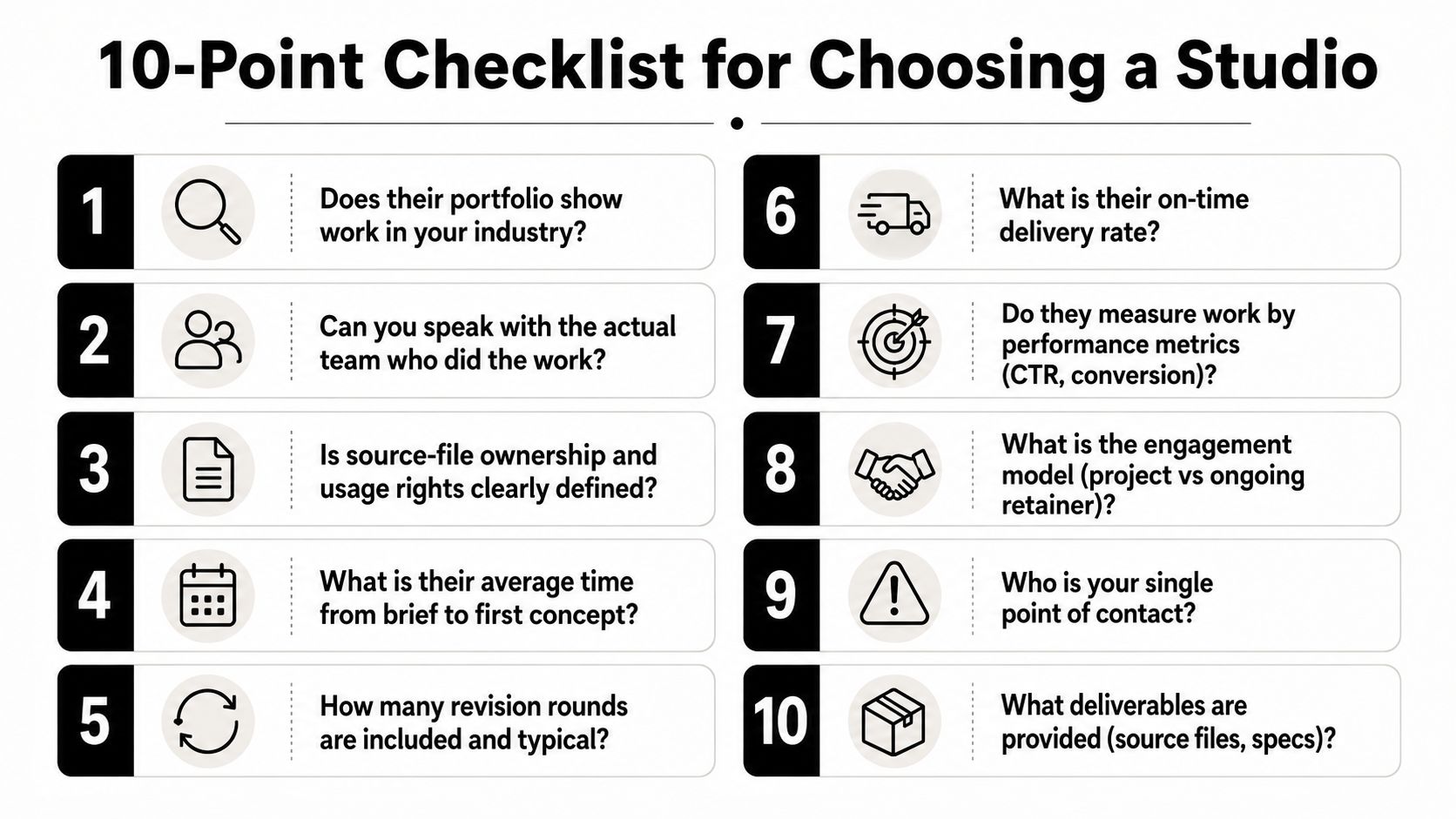
Use the checklist to remove uncertainty before you compare proposals. Don’t turn it into a superficial score; one serious gap in ownership, capacity, or decision-making can outweigh a polished portfolio.
-
Portfolio relevance. Does the portfolio show work with similar audiences, channels, technical constraints, or brand stakes? You don’t need identical industry experience, but you do need evidence the team can solve your kind of problem.
-
Actual project team. Who will do the work you are buying? Ask for names, roles, availability, and examples of work those people personally made.
-
Creative-director involvement. Will the creative director shape the brief, concept, and production, or only join the sales presentation? A strategy-led engagement should show how senior direction connects business goals to the making.
-
Process. Can the studio explain its path from kickoff and brief tightening through concept, production, review, and delivery? A process should make decisions visible instead of burying them in jargon.
-
Revision rules. How are revision rounds counted? Ask what qualifies as a revision, who consolidates feedback, and what happens when a new direction appears after approval.
-
Ownership and licensing. Who owns the source files, final assets, fonts, footage, music, code, and usage rights once the work is paid for? Get it in writing before production starts; in many jurisdictions the maker keeps rights the contract never transfers, and a shared design workspace or font license can quietly stay in the studio’s name. This is the single most common gap in the contracts clients forward me.
-
Capacity and timing. What is the studio’s current workload, and who covers when a lead creative is away? Smaller teams move quickly, but they have less redundancy.
-
Communication cadence. Who is your day-to-day contact? Decide where briefs, feedback, approvals, files, and urgent questions live.
-
References. Can you speak with current or recent clients about communication, scope control, revisions, and handover? Ask for references who bought a similar engagement; a famous logo on the client list answers a different question.
-
Exit terms. What happens when the relationship ends? Confirm final file delivery, archive access, usage rights, outstanding invoices, notice requirements, and support for transferring work internally.
If a studio cannot answer who does the work and who owns it, it is not ready for your shortlist.
Red flags and common hiring mistakes
A strong pitch does not prove strong delivery. Buyers often select for presentation quality, chemistry, and a few attractive images, then discover the operating model was never clear.
- Glossy reel, no project context. Ask for case studies that show the brief, process, final deliverables, and the studio’s specific contribution.
- Unnamed team. Request the actual roster, roles, and senior involvement. Don’t approve a team you have never met.
- Ownership hidden in the contract. Clarify source files, usage rights, licensing, and work-product ownership before signing.
- Pricing appears only after an NDA. Ask why the commercial scope cannot be described at a high level. Confidentiality should not prevent basic procurement clarity.
- Scope expands mid-project. Require a written change process, with additions approved before work starts.
- The same case studies appear everywhere. Ask when the work was delivered, who made it, and whether those people are still at the studio.
- The timeline sounds effortless. Ask how the team handles review delays, unavailable leads, and concurrent projects. A promise without a capacity explanation is weak evidence.
- No written brief. Create a one-page brief before requesting a quote, with the goal, audience, deliverables, channels, constraints, approvers, and required handover. Our guide to writing a creative brief covers the format.
- Internal review has no owner. Name one decision-maker who gathers feedback. A studio cannot resolve ten contradictory comments from ten stakeholders.
- Quotes are not comparable. Normalize deliverables, formats, usage, revision rules, production assumptions, and handover before comparing price.
- No paid pilot. Run one small, clearly scoped job before committing to a longer relationship. The pilot should test communication and delivery as much as visual taste.
- Vending-machine behavior. Don’t send isolated tasks with no context. Share goals, audiences, past work, performance learnings, and brand constraints.
A rushed decision at selection becomes an expensive renegotiation later. Put the awkward questions in the first conversation.
How to decide
Use a simple decision rule. Map the next six months of creative needs by discipline, then mark each need as project-based or ongoing. Add the expected cadence, the number of stakeholders, and the level of senior craft required.
Choose a creative studio when the work is craft-heavy, visually important, and spread across video, motion, design, or brand content. Choose an agency when you need media buying, market research, or one accountable partner across many disciplines and markets. Choose a freelancer for one small task with a clear end. Choose in-house when demand is constant enough to support hiring, management, and retention; an embedded team extends an existing team rather than replacing it when demand is continuous but hiring is not the answer.
The same discipline applies to any vendor decision that sits next to the creative one. If your project involves technical partners too, this guide on how to choose a software partner walks through ownership, process, scope, and handover for the development side.
If you are ready to shortlist suppliers, write the one-page brief first. Then ask each studio to name the actual team, define the handover, and explain how your feedback will move from kickoff to approved work. That process will tell you more than a polished reel.
Frequently asked questions
A project engagement runs until the defined deliverables are approved and handed over, usually a few weeks for a single asset and several months for a rebrand or campaign system. An ongoing arrangement continues while you have steady demand and both sides agree on scope, priorities, and exit terms; review it quarterly so unused capacity or scope drift surfaces early.
Some handle strategy and some start after the brief is set, so ask directly. The tell is whether the creative director shapes positioning, messaging, audience, and concept, or whether the studio only produces from supplied instructions. If your brief is still fuzzy, pick a studio that runs a discovery or brief-tightening phase; execution-only teams do their best work when the direction is already decided.
Usually a tightened brief, creative direction, concept routes, a script, a storyboard, or an initial design approach, depending on the engagement. Whatever it is, it should make the intended work easier to approve. If the first thing you receive is finished production with no checkpoint before it, the studio skipped the step where your feedback costs the least to act on.