Video production for attorneys: a practical guide
A practical guide to video production for attorneys: the formats that work, the bar advertising rules that shape every script, what drives cost, and how to film partners who hate the camera.

Video production for attorneys means making and publishing law firm video (attorney profiles, practice area explainers, testimonials and recruiting films) inside the advertising and confidentiality rules lawyers work under, with the compliance review done on the script, before anyone films a frame.
Law firm projects tend to look alike by the time they land on my desk at Moonb. There’s a pile of vendor decks, one pitching a cinematic brand film, another wanting to shoot everything like a documentary. And there’s a managing partner who only wants to know what the firm is allowed to say on camera. I’m not a lawyer, and none of this is legal advice. Your state bar’s version of the rules is the one that binds you, so read it before you publish.
Why law firm video is different
The rules change from state to state, which is annoying but manageable. Tone is harder. A line that sounds harmless in a brand meeting can sound like a promise of results once a lawyer says it to camera, and the people who have to approve it usually have the least time for a creative process.
So I tell marketing leads to treat legal video as regulated content from day one. A compliance pass bolted onto a finished brand project usually means a reshoot. If a phrase would need a footnote on a slide, it comes out of the script now; don’t count on the edit to soften it.
Compliance shapes the creative brief
Bar rules and client confidentiality shape the brief before the crew shows up, and so does the record of who approved what. I write the script with the disclaimer already in it and get every claim checked before filming. The approved version goes somewhere you’ll still find it three years from now.
Before any of that I ask what the video is for and how much risk it carries, because a practice area explainer, a testimonial, a recruiting film and a case result story are four different jobs. It also helps to treat video as one piece of a larger content system; my roundup of B2B video production companies shows how the better vendors set up that kind of ongoing work.
The video formats that work for firms
The easiest way to waste money here is making the wrong kind of video. A polished brand film won’t fix a weak practice page, and a testimonial won’t explain a complicated process.
| Format | Primary job | Runtime I’d aim for | Compliance review load |
|---|---|---|---|
| Attorney profile | Build trust around a named lawyer | 60 to 120 seconds | Moderate (watch skill and experience claims) |
| Practice area explainer | Answer first questions and reduce friction | 90 to 180 seconds | Moderate (every legal statement has to be accurate) |
| Client testimonial | Social proof where the rules allow it | 30 to 90 seconds | Heavy (state testimonial rules and disclaimers) |
| Case result story | Show how the firm works on concluded matters | 60 to 180 seconds | Heaviest (verifiable results plus client consent) |
| Recruiting and culture | Attract candidates and show the environment | 45 to 120 seconds | Light, unless it promotes the practice |
| CLE and training | Teach internal teams or referral partners | 10 to 45 minutes | Light to moderate |
| FAQ clip | Answer one narrow question fast | 20 to 60 seconds | Moderate (no advice that reads as a guarantee) |
| Short social cut | Extend reach on feeds and search | 15 to 45 seconds | Same as its parent video, plus the name and contact line |
| Process overview | Explain how a matter starts and what happens next | 60 to 120 seconds | Moderate |
If a firm can only make one, I’d push for the attorney profile. Clients hire a person, and a profile on the bio or practice page reaches visitors who already have intent. Explainers are less glamorous. They take some of the uncertainty out of the first call, on both sides.
Testimonials and case result stories can be the most persuasive formats you make, and they get the heaviest review. Recruiting and culture films are easier, since they aren’t selling legal services, at least until one ends with “call us about your case” and becomes advertising again. CLE and training content has a different audience, so it can look plainer and still do its job. For a whole library, our guide to video formats and aspect ratios helps you plan use cases and deliverables together.
Production workflow and realistic timelines
On a legal video, most of the delay happens before the shoot. Scripts sit waiting for sign-off and partners are hard to book, and if nobody has agreed who approves what, both get worse.
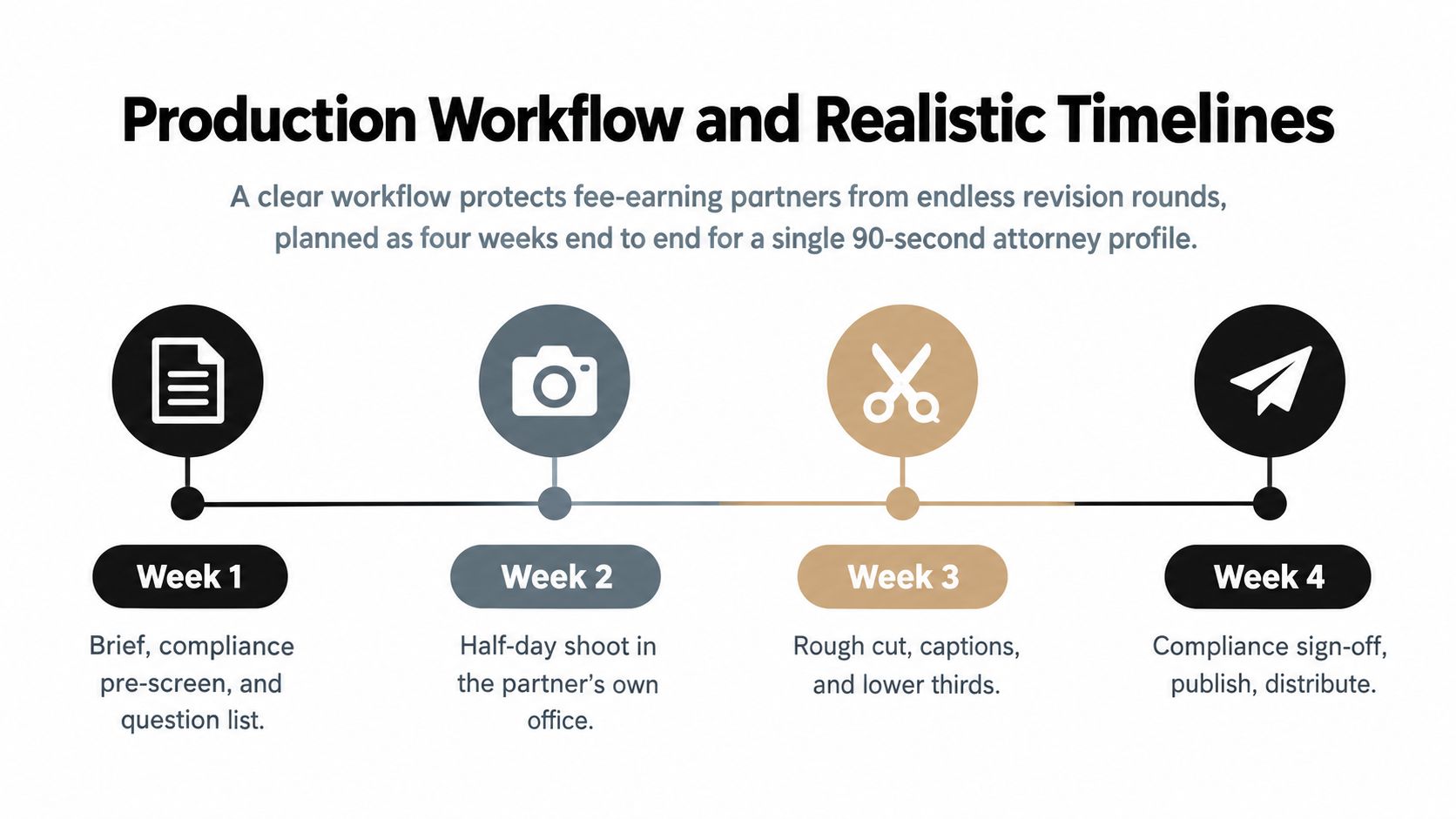
A four-week profile timeline
For a single 90-second attorney profile I plan four weeks, end to end. Week one covers the brief, the question list and a compliance pre-screen of the script. The shoot happens in week two, usually a half day with one attorney in one location. Week three is the rough cut with two revision passes, captions and lower thirds. In week four the final cut gets compliance sign-off, and I deliver horizontal, vertical and square versions plus a thumbnail.
There’s slack in that on purpose. A hearing or a client emergency will beat your edit deadline every time, and a schedule with no slack pays for it later in revision churn.
A small package, say three attorney profiles, two practice explainers and a handful of social cuts, runs two to three months in my experience. By then the bottleneck is scheduling and compliance review across several scripts. I give each package a one-page approval matrix with one named owner per asset, because if everybody approves everything, nobody approves anything.
The calendar pressure point
Legal teams tend to underestimate the waiting. A small wording change can sit in a partner’s inbox for days, and those days are where production gets expensive. So I keep the internal steps to a short list: brief, script, compliance gate, shoot, rough cut, final approval. Add more and you get more handoffs than a firm’s marketing team can carry. If you’re still deciding what kind of outside help to bring in, our explainer on how video production services are structured maps the options.
Directing partners who hate being on camera
Telling a nervous partner to “just be natural” and then handing them a teleprompter is the worst combination I know. Most people get tighter. Partners loosen up when they’re having a conversation, so that’s what I set up.
Make the room do some of the work
I film partners in their own office and keep the window narrow. Mornings early in the week have worked best for me, before the day’s emergencies stack up. Close the door and kill the phone. They sit where they normally sit.
Then I run the interview like a client meeting, with the questions they’ve answered a hundred times: how a matter usually starts, what they tell a worried client on day one, the mistake they see most often, what changed in their practice area recently. They don’t have to perform those answers. I let takes run long. The usable line often comes after the first few warm-up sentences. And if a partner freezes, I let the silence sit. Rushing them just gets you a fake smile.
Speaking coaches say much the same about nerves, and this TEDx talk from Jess Ekstrom is the one I’d send a reluctant partner the week before the shoot.
Frame for confidence
My setup is simple. The partner sits slightly off-axis, angled toward an interviewer beside the lens, under one large soft light so one side of the face falls gently into shadow. Tight frame, a little headroom. Plain charcoal or navy reads well on camera; fine stripes and small checks can shimmer, and logos pull the eye. Partners who worry about how they come across can read this guide to body language on camera, which covers posture, gestures and eye line in terms an executive will read.
For the first ten minutes I barely talk and let the room settle. The interview goes in one block, and the b-roll comes after it: hands, desk details, books, the view from the window. If your team is writing the question list from scratch, our guide on how to write a video script works for this kind of interview too.
What drives the cost of each format
There’s no price table here. A range tells a managing partner comparing bids very little until they know what sits inside each quote, so I’d rather show where the money goes.
Crew days come first. A single-camera interview in the partner’s office is one short day; a testimonial package with clients filmed in their own homes or businesses can take several. Each extra location adds setup time and travel, sometimes permits. Every person on camera multiplies all of it, because each attorney or client needs prep and a release, and has a calendar you have to work around. In the edit, motion graphics for a practice explainer, archival material for a case story and every extra revision round add editor time. Captions, transcripts and multiple aspect ratios are smaller line items. Put them in the first quote anyway, so nobody discovers them at delivery.
Costs also drift through scope creep. One more change after final approval reopens the timeline, so lock the script before filming and write the revision limit into the agreement in plain language. My breakdown of what video production costs has current ranges by format and how different vendor models price their work.
The compliance review before you publish
I run compliance twice, once on the script before the shoot and again on the final cut, because things change in the edit.
The rules that apply to almost every firm
The American Bar Association’s Model Rules of Professional Conduct are a model. Each state adopts its own rules, and your state’s text is what binds you. I still treat them as the baseline for what a video has to get right. These four matter most.
- ABA Model Rule 7.1 is the core rule, and it’s blunt: “A lawyer shall not make a false or misleading communication about the lawyer or the lawyer’s services.” It covers statements that are literally true but omit “a fact necessary to make the statement considered as a whole not materially misleading.”
- Rule 7.2 says a lawyer “may communicate information regarding the lawyer’s services through any media,” then adds the requirement every video end card has to meet: any such communication “must include the name and contact information of at least one lawyer or law firm responsible for its content.” The same rule bars implying that a lawyer is a certified specialist unless the certifying organization meets its conditions and is “clearly identified in the communication.”
- Rule 7.3 governs solicitation. It bars soliciting work “by live person-to-person contact” for pecuniary gain, with narrow exceptions. A video on your website isn’t live contact, but pushing it to specific people who need help with a specific matter can raise solicitation questions under your state’s version.
- Rule 1.6 says “A lawyer shall not reveal information relating to the representation of a client unless the client gives informed consent,” with limited exceptions, and requires “reasonable efforts to prevent the inadvertent or unauthorized disclosure” of that information. On a shoot, that means the case files, whiteboards and screens in the background.
Testimonials and case results
This is where firms overreach most. The ABA’s comment to Rule 7.1 warns that a truthful report of a lawyer’s achievements “may be misleading if presented so as to lead a reasonable person to form an unjustified expectation that the same results could be obtained for other clients in similar matters without reference to the specific factual and legal circumstances of each client’s case.” It also notes that “an appropriate disclaimer or qualifying language may preclude a finding” that a statement is misleading. Under the Model Rules, then, the question for results and testimonials is whether they mislead.
Some states go further, and Florida shows how far. Its guidelines for video sharing sites say videos “used to promote the lawyer or law firm’s practice are subject to the lawyer advertising rules,” including the prohibitions on “references to past results that are not objectively verifiable, predictions or guaranties of results, and testimonials that fail to comply with the requirements listed in Rule 4-7.13(b)(9).”
That rule, in the Rules Regulating The Florida Bar, treats a testimonial as inherently misleading if, among other things, it “has been written or drafted by the lawyer,” if the person “has been given something of value,” or if it “does not include the disclaimer that the prospective client may not obtain the same or similar results.” Florida’s comment also says a lawyer who wants to advertise past results “must have the affected client’s informed consent,” even when the information is in the public record.
Other states draw the lines elsewhere, so treat Florida as an illustration and check your own bar’s rules and ethics opinions for the jurisdiction where the video will run.
Whoever owns sign-off at your firm should watch this FSU College of Law webinar. The Florida Bar’s ethics counsel is on the panel, and the session walks through current ethics issues with lawyers’ online advertising and social media.
Build the one-page compliance card
Every script gets a one-page card before camera day. At the top go the jurisdiction and the rules that govern the ad. Under that, every claim that needs substantiation, and a note on whether the video has a testimonial, a past result, a dramatization or an actor in it. Then the disclaimers it needs and where each one appears (script, lower third, end card), plus the name and contact line. Any phrase that looks even slightly too broad gets rewritten before the shoot.
Records, filing and releases
Get written consent from everyone on camera before filming. A family member or staff person in the background needs a separate release. Keep the approved script, the final cut and the sign-off in one place.
Some states also require filing or retention. Florida requires advertisements to be filed with the Bar “at least 20 days prior to the lawyer’s first dissemination,” subject to listed exemptions. Its guidelines say videos posted solely on video sharing sites don’t need filing, while a banner ad on those sites must be filed unless an exemption applies. The lawyer also has to “retain a copy or recording for 3 years after its last dissemination along with a record of when and where it was used.” Your state’s numbers may differ, so put them on the card.
Choosing a production partner
In a vendor conversation, most of my questions are about control. Who writes the script, who approves the legal language, who owns the cutdowns, who keeps the raw footage. From what I’ve seen, the three common models compare like this on law firm work.
| Criterion | Freelance crew | Legal-focused studio | Full-service marketing firm |
|---|---|---|---|
| Familiarity with bar advertising rules | Varies by person | Usually stronger | Varies by account team |
| Script support | Limited or ad hoc | Structured | Broad, often slower |
| Raw footage ownership | Confirm in writing | Usually defined | Check the contract terms |
| Cutdowns for social | Basic, if requested | Common | Common |
| Best fit | One simple shoot | Repeatable legal content | Large cross-channel programs |
Whichever model you pick, two things end the conversation for me: a vendor with no experience of bar rules who won’t discuss disclaimers, and a contract that leaves the firm without clear rights to its own footage. I also like to ask who rewrites the script when a partner changes a line on the shoot day. Vendors who have done enough legal work answer that instantly.
Distribution, accessibility and what to measure
Plan distribution before the shoot. The aspect ratios, captions and transcript all change what gets delivered.
Put each video to work in more than one place
One master attorney profile should become a vertical social cut and an embed on the practice page, with a transcript on the page. On YouTube, release a batch at a steady rhythm over several weeks; this walkthrough on how to schedule YouTube videos covers the mechanics of queueing the uploads. Short or not, every cut still needs the firm name and contact line, plus any disclaimer the parent video carried.
Captions are an accessibility requirement
The W3C’s WCAG success criterion 1.2.2 calls for captions “for all prerecorded audio content in synchronized media,” and the Department of Justice’s web accessibility guidance on ADA.gov lists “No captions on videos” among its examples of website accessibility barriers, noting that “people with hearing disabilities may not be able to understand information communicated in a video if the video does not have captions.” If the firm runs several sites or microsites, make captions one standard across all of them. This accessibility compliance roadmap is a practical way to do that for a whole portfolio: audit every site, then fix the shared templates once so the fix reaches every page.
Confidentiality follows the video out the door too. Blur or replace any client document on screen and keep real case files out of the b-roll. Raw footage goes under firm-controlled access, because footage gets reused in ways nobody planned.
Measure what brings work in
View counts tell me very little. I watch form fills and calls from the page that hosts the video, watch time on practice area pages, and assisted conversions in the CRM, and I review them once a quarter, since legal content takes a while to show a pattern. When a video gets watched and nobody takes the next step, I stop making more like it. For a firm starting out, I’d make one attorney profile and one practice explainer, each with its own compliance card. Publish those two and plan the next round around what people watch and ask about.
Frequently asked questions
Usually, yes, if they promote the lawyer or the firm's practice. The Florida Bar's guidelines for video sharing sites say so directly, and the ABA Model Rules cover communications about a lawyer's services in any media. Florida does say a video used solely for purposes unrelated to the practice of law isn't advertising. A practice explainer, profile or testimonial is, so it gets the same compliance review as a print ad, firm name and contact information included.
Often, though the conditions depend on the state. Under the ABA Model Rules a testimonial is judged by whether it misleads, and a disclaimer can help. Some states are stricter. Florida, for example, bars testimonials the lawyer wrote, testimonials given in exchange for something of value, and testimonials without a disclaimer that results may differ. Either way, get the client's written consent, keep their words their own, and check your state's rule before filming.
A named attorney responsible for the content, plus whoever handles advertising compliance at the firm. Ideally they both see it twice, on the script before the shoot and again on the final cut. The ABA Model Rules require every ad to name at least one lawyer or firm responsible for it, so I'd make that person the final sign-off. Keep the approved script, the final file and the approval record together in case your state bar asks.