A Guide to the Best Video Advertising Companies in 2026
Find the right partner from our list of top video advertising companies. This guide covers how to vet, hire, and what questions to ask for great creative.

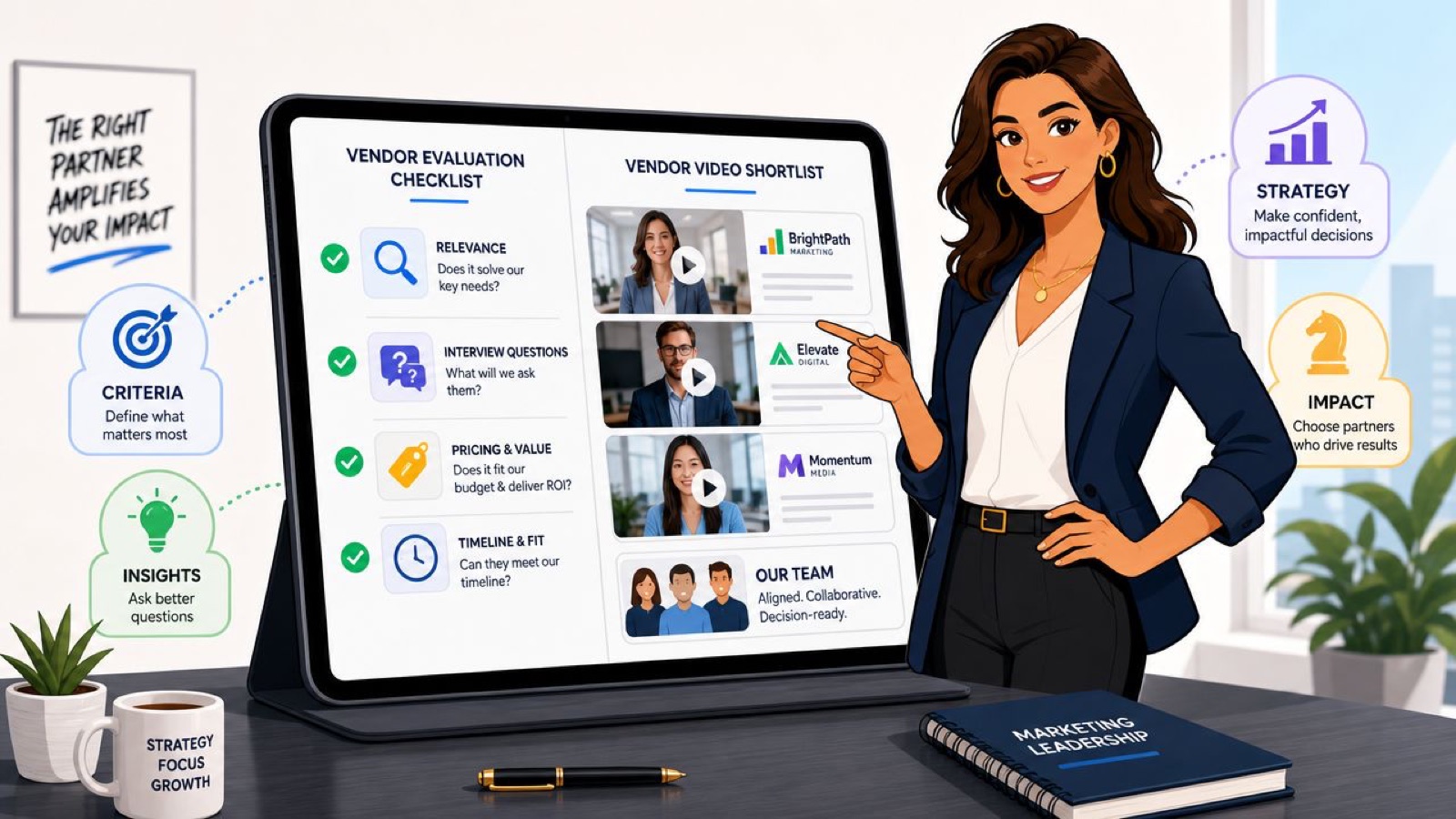
Finding a video partner can feel like a gamble. You want creative that performs and a team that reads your brand without a three-month ramp, and most marketing leaders I talk to are not short on options, they are short on clarity about which model actually fits how they work.
The wrong partner tends to fail in familiar ways. Some make good-looking work that was never built for paid distribution, some need so much hand-holding that you become their producer, and some vanish after the kickoff only to resurface with a big reveal that misses the brief. The one I see most often is the shop that nails a single launch film and then cannot keep up with the weekly asset flow your channels actually run on.
A partner that fits feels calmer than that. They learn your brand quickly, they know how to build for paid social and YouTube and landing pages and CTV, and their process is visible enough that you are not chasing status updates. The work helps your team move faster instead of becoming one more thing to manage.
I put this guide together for that decision. It gives you a practical way to compare video advertising companies, pressure-test how each one is built, and ask sharper questions before you sign anything.
1. Moonb
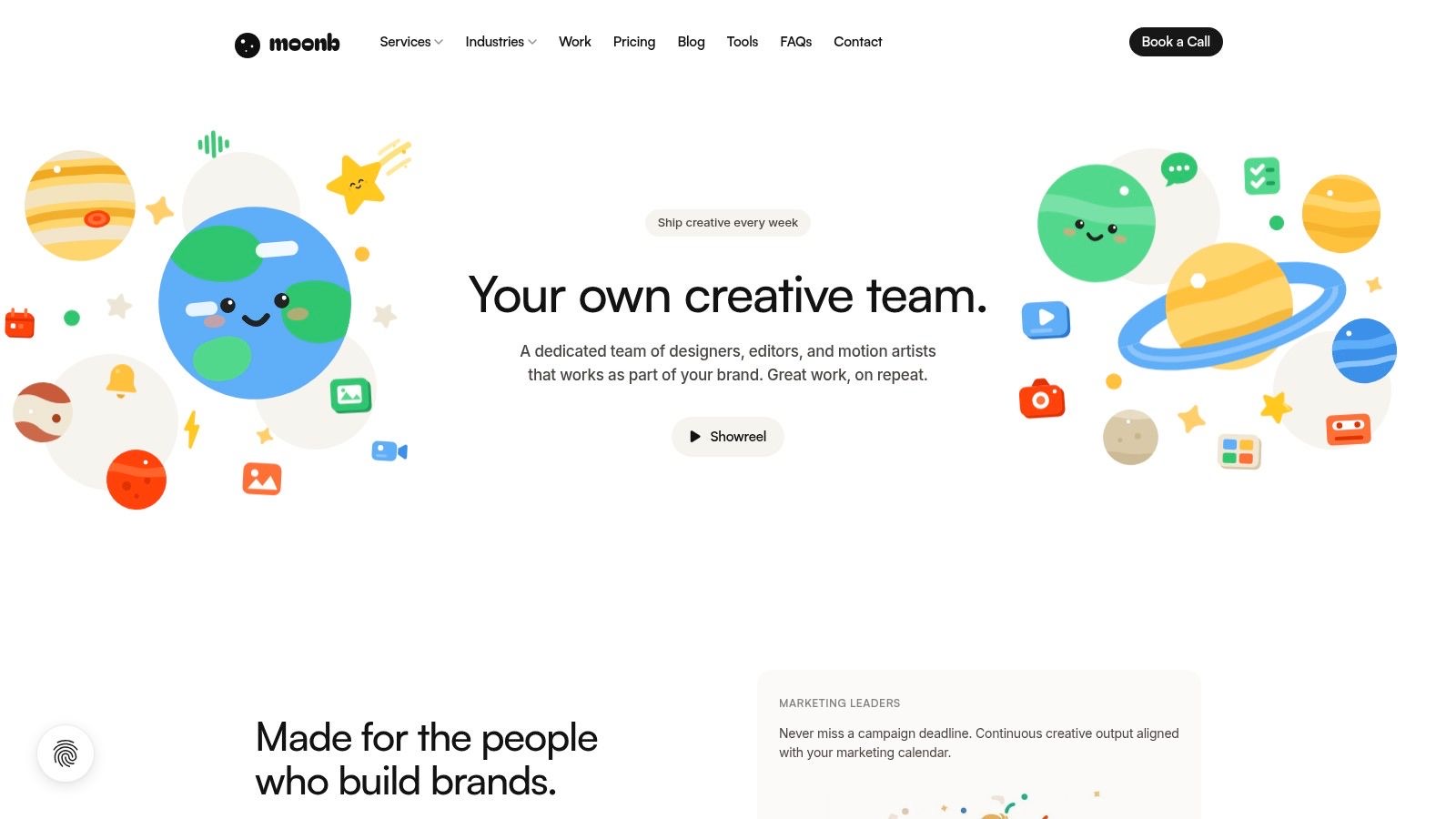
I work at Moonb, so read this first entry as an inside view and weigh it against the rest of the list accordingly.
Moonb is the strongest fit here for B2B marketing teams that need steady output, not one polished campaign every quarter. It runs as a video-first creative partner led by senior creative directors, producing video, motion design, and design for in-house teams that already have goals, calendars, launches, and deadlines to hit.
What I would point to is the operating model. Each client gets a dedicated creative team that learns the brand and delivers on a weekly rhythm, and that matters more than most buyers expect going in. Consistency tends to beat novelty once you are trying to scale paid creative, explain a complicated product, and hold a campaign on brand across channels at the same time.
The team also handles more than ad edits, producing motion graphics, design, animation, and brand content, which helps when your paid team, brand team, and product marketing team all need different assets cut from the same source material.
Why Moonb fits modern marketing teams
A lot of video advertising companies sit at one of two extremes. You either get a classic agency model with slower cycles and bigger campaign handoffs, or you get a loose bench of freelancers who may never really learn your brand. Moonb sits in a more useful middle for ongoing work: a stable team, direct collaboration, and output that keeps moving.
The pitch I would make on a call is repeatability. Marketing teams lose real time coordinating separate vendors for motion, design, paid social cuts, explainers, and campaign support, and pulling those into one creative team cuts the handoff friction and keeps the visual language tighter. There is no public price on the site, so comparing it against the others on this list means an actual conversation.
If your team needs new creative every week, hire for repeatability rather than for a one-time sizzle reel.
Where it is the wrong call: if you only need a single launch film and nothing after it, this model is more support than you need.
Pros and cons
- Best for ongoing output: Moonb is built for teams that need work shipped every week, across video, motion, animation, and design.
- Strong brand continuity: The same creative leads and artists stay close to the account, which usually produces more cohesive work over time.
- Good fit for technical categories: Compliance-ready workflows and explainer-heavy execution suit fintech, healthcare, SaaS, and other regulated or complex industries.
- Custom pricing: There is no public price on the site, so you will need a conversation to compare it against other options.
- Less ideal for one-off projects: If you only need a single launch film and nothing after that, this model may be more support than you need.
2. Harmon Brothers
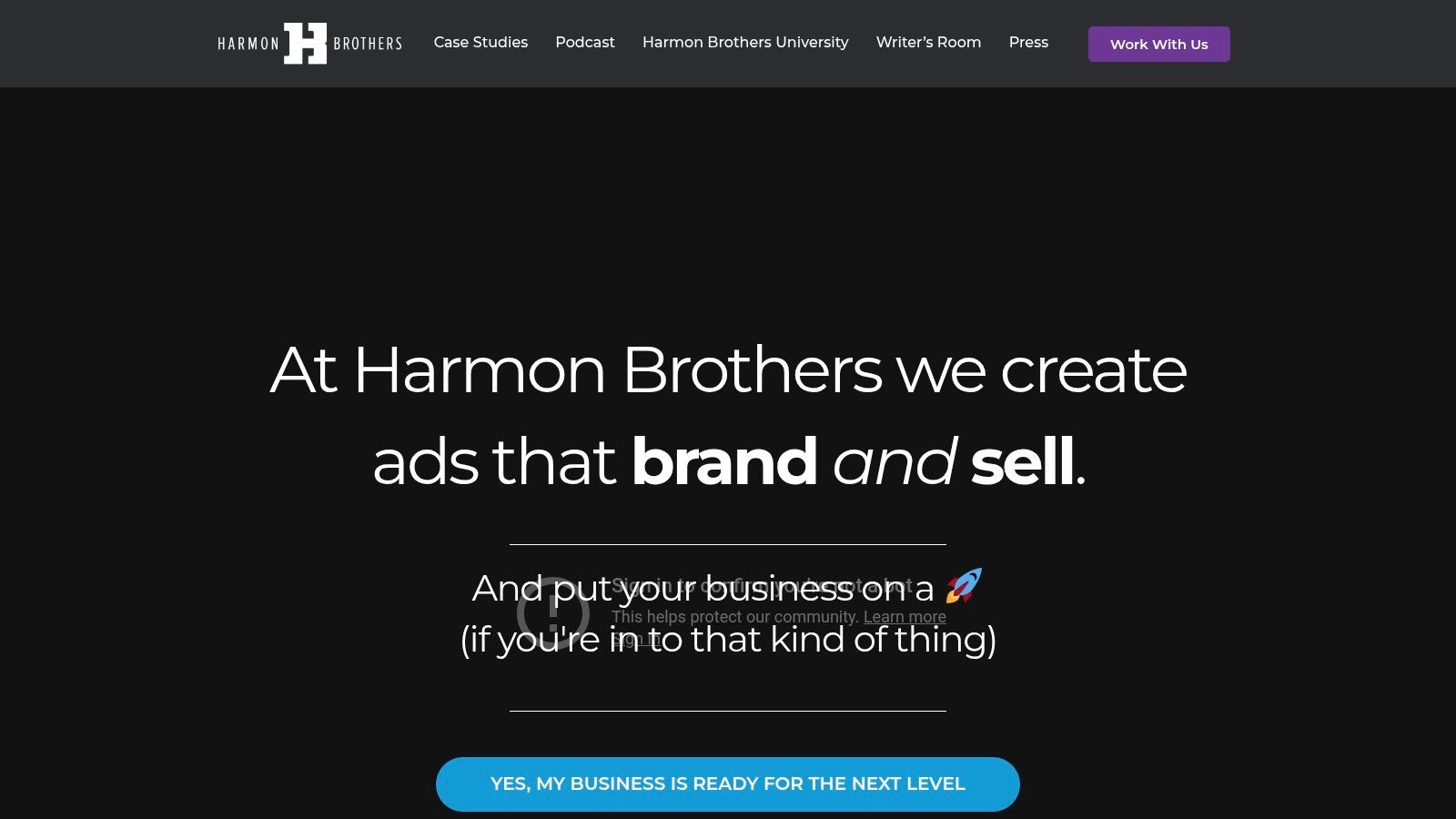
If your product is hard to explain and your category is crowded, Harmon Brothers is still one of the clearest reference points in performance-driven video advertising. They became well known for narrative-heavy commercials that entertain, simplify, and sell at the same time.
Their strength is the anchor ad, the lead creative idea that defines a campaign rather than the endless stream of minor variations around it. That is a good fit when you need one strong concept to shape paid social, YouTube, landing page video, and even TV or streaming cutdowns.
Where they shine
Harmon Brothers tends to work best for brands that need a memorable sales story. Their style is bold, consumer-friendly, and structured to make unfamiliar products feel easy to understand. That is useful when you are launching something new, entering a broad market, or trying to reset how people perceive an existing offer.
They also have a visible portfolio of direct-response style creative on the Harmon Brothers website. If you are vetting them, look past whether the videos are funny. Ask whether the concept carries the product argument clearly enough to survive multiple edits, placements, and audience segments.
Humor earns attention, but clarity is what closes the sale.
That is the trade-off with high-concept shops. A big idea can carry a campaign, but only if the message architecture stays disciplined underneath the entertainment.
Pros and cons
- Strong at flagship campaign creative: Good choice when you need a high-conviction ad concept with a clear sales angle.
- Good for broad audiences: Their storytelling style often makes complex products feel simple and mainstream.
- Likely a heavier lift: Expect custom scoping, longer timelines, and a bigger production process than a fast-turn creative partner.
- Not built for weekly volume: If your main need is constant ad refreshes, you will probably need another production layer after the hero spot.
- Pricing: Custom pricing.
3. Chamber Media
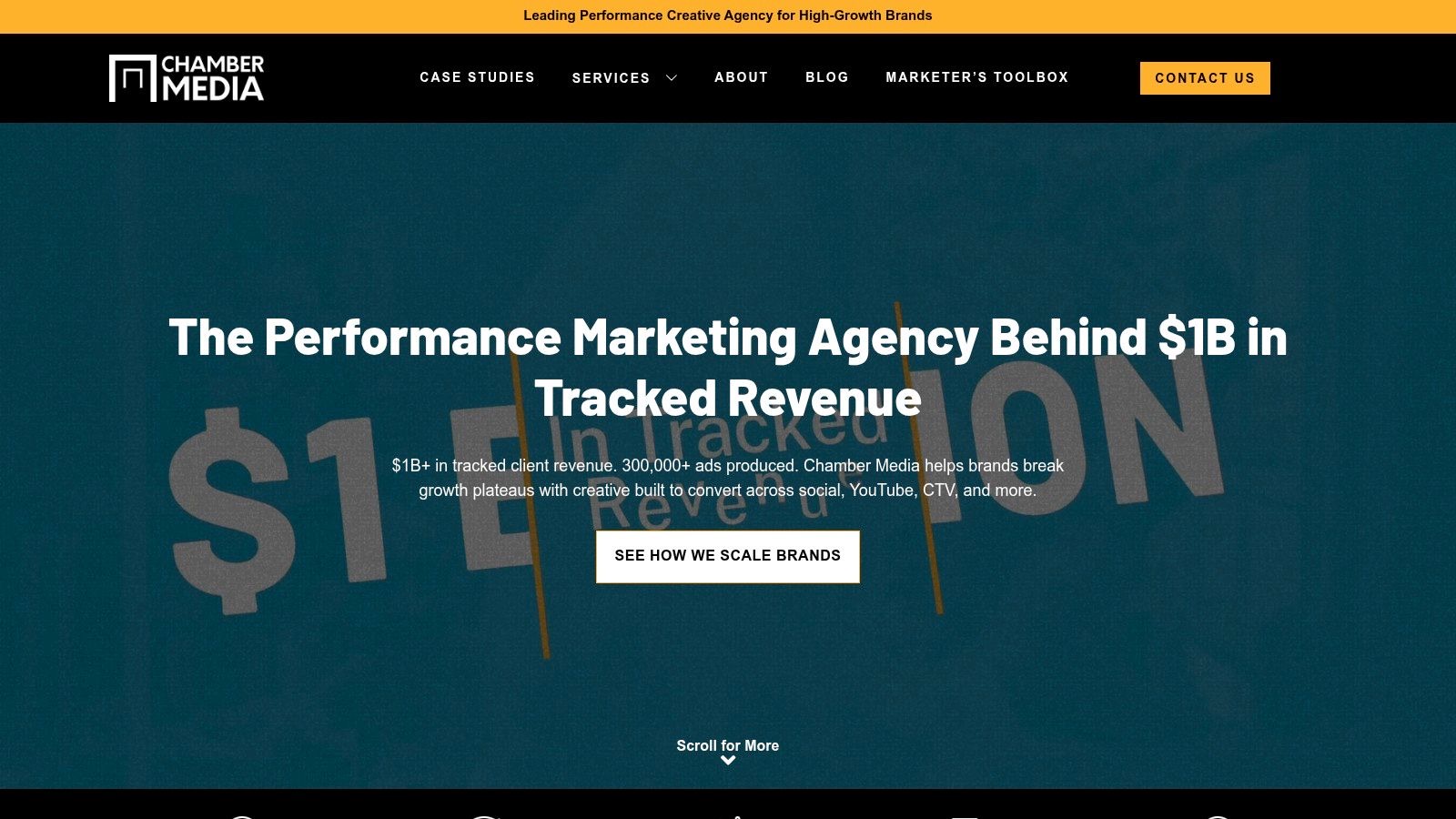
Chamber Media is a better fit when you do not want creative and media strategy split across different partners. Their pitch is closer to a performance marketing system than a production studio, which matters if your team is fighting creative fatigue and needs a constant flow of new ad creative tied to buying strategy.
This model usually works best for brands that already know paid media is the engine. The creative does not live on its own. It exists to test hooks, offers, audience angles, and formats at volume.
Best use case
Chamber Media is the kind of partner to consider when your question is not “Can you make a great ad?” but “Can you help us keep learning fast enough to scale?” Their work appears oriented around direct-response systems, recurring creative production, and cross-channel execution on the Chamber Media website.
That can be powerful, but it comes with a practical reality. The relationship works better when the same team has visibility into both creative decisions and media outcomes. If you only want one isolated video and your media buying sits elsewhere, you may lose part of the value.
On a first call with a shop like this, I would push on three things:
- How do you decide which new angle gets made next: Ask for the actual decision process, not just “we test a lot.”
- Who owns the learning loop: You need to know whether the creative team sees performance data directly or hears about it later.
- What happens when an ad underperforms: Good partners have a clear response, not vague optimism.
There is a strategic lesson buried in this model too. The part most teams underinvest in is the angle-finding itself, the discipline of hunting for a contrarian take and reviewing competitor creative for gaps rather than defaulting to the same hooks everyone else runs. Chamber-style relationships pay off when that process is explicit instead of left to instinct.
Pros and cons
- Useful when creative and media need to work together: Stronger fit for brands that want a connected performance system.
- Supports ongoing testing: Better than a one-off production shop if you are battling ad fatigue.
- May be overbuilt for standalone projects: Teams with a separate media function may not need the full model.
- Pricing isn’t published: Custom pricing.
4. Sandwich
Sandwich is the name I bring up when a product is advanced, the audience is smart, and the message still needs to feel effortless. They have a long track record making tech products look understandable without flattening them into generic startup language.
Not every brand needs that level of craft. But if you are launching a product, repositioning a company, or building a foundational explainer that will live everywhere, the quality bar matters. Sandwich is built for that job.
What makes Sandwich different
Some video advertising companies are optimized for high-volume testing. Sandwich is optimized for clarity and finish. Their strongest work tends to translate product complexity into stories people can follow, whether the format is live action, animation, a brand film, or an explainer on the Sandwich website.
This is especially useful in SaaS and product marketing. A weak explainer creates confusion at the exact moment a buyer needs confidence. A strong one makes the product feel obvious.
The best product video removes friction rather than adding more explanation.
Still, this is not the model for teams that need dozens of fresh variations every week. Sandwich is better as the shop that helps define the core story and the flagship asset library. You may still need another partner or in-house team to keep producing derivative paid versions at scale.
Pros and cons
- Excellent for launches and explainers: Strong fit for product storytelling, brand films, and core campaign assets.
- High creative bar: Good option when polish and narrative clarity matter.
- Less suited to rapid iteration: Not the first pick for fast ad testing cycles.
- Media buying isn’t the core offer: If you want creative plus distribution under one roof, look carefully at fit.
- Pricing: Custom pricing.
5. VaynerMedia
VaynerMedia is a scale play. If you need social-native creative tied to large media activation across TikTok, Meta, Google, and other major channels, they belong on the list. Their advantage is range. They can support brand, performance, platform nuance, and enterprise coordination in one system.
That does not make them the right fit for everyone. Big integrated shops tend to bring stronger platform relationships and more process. They also tend to ask more of your internal team in planning, approvals, and alignment.
When VaynerMedia makes sense
This is the kind of partner to consider when video is part of a broader cross-channel machine. If you are already spending significantly across social and need creative that maps tightly to platform behavior, VaynerMedia’s model has obvious appeal. Their VaynerMedia website highlights broad channel coverage and integrated execution.
The biggest upside is context. Short-form video does not succeed in isolation. It succeeds when the creative team understands the media environment, the audience signal, and the platform’s native behavior. That is where larger integrated firms can be useful.
The risk is speed. Enterprise-scale organizations often move slower than boutique teams. If your team wins by making quick decisions and shipping often, make sure their operating rhythm matches yours before you sign.
Pros and cons
- Strong for large cross-channel programs: Useful when your brand needs social, video, and media coordination at scale.
- Platform-savvy creative: Good fit for teams leaning heavily on TikTok, Meta, YouTube, and related channels.
- Heavier process: Expect more layers than you would get with a smaller specialist team.
- Usually better for larger spends: Smaller brands may find the model too broad for their immediate needs.
- Pricing: Custom pricing.
6. Tinuiti
Tinuiti is a strong option when your main challenge is less about making video and more about measuring it inside a larger performance mix. They sit closer to the media and attribution side than a pure creative studio, which can be a real advantage for teams spending across search, social, commerce media, and streaming.
Many buyers still struggle to evaluate video partners beyond surface metrics. That is one of the weakest areas in the category.
Best fit for measurement-heavy teams
If your leadership team asks how video affects pipeline, acquisition cost, or downstream conversion, Tinuiti’s integrated approach may be more useful than a pure production vendor. Their Tinuiti website points to capabilities across streaming, online video, and adjacent paid channels.
A practical warning here. Many video advertising companies talk about views, completion rates, and engagement, but stop short of connecting them to business outcomes. That gap shows up often in the market, and it is a real buying problem, as noted in this Atlassian Loom article on small business video marketing.
When you evaluate Tinuiti, or any media-led partner, ask how creative insights get fed back into future production. Measurement is only useful if it changes the next asset.
Pros and cons
- Strong for integrated media measurement: Good choice when video needs to connect with broader acquisition strategy.
- Useful for streaming and online video buying: Better fit than a pure creative vendor if media orchestration matters most.
- Creative may need reinforcement: Some brands will still want a separate dedicated creative team.
- Less ideal for teams seeking a close embedded creative relationship: The model skews toward performance operations.
- Pricing: Custom pricing.
7. MNTN
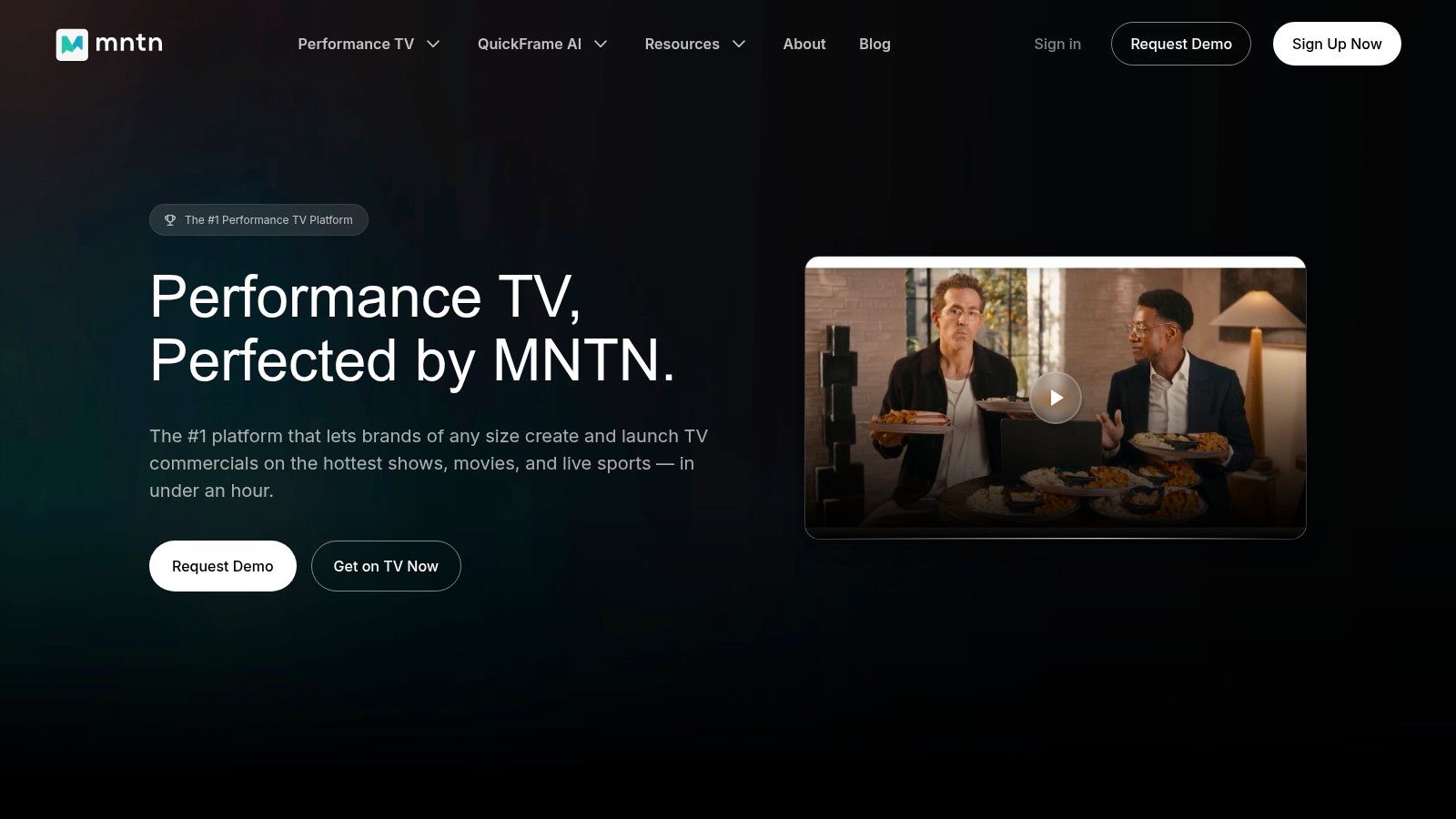
MNTN is different from the rest of this list because it is not really a classic service provider. It is a CTV buying platform with managed support options. That distinction matters. If you are comparing video advertising companies, MNTN belongs in the conversation because many teams now need distribution infrastructure as much as they need production.
For some brands, that is exactly the right move. If you already have creative or can source it elsewhere, MNTN can help you get onto streaming inventory faster than a traditional TV buying process.
Platform first, creative second
The appeal is straightforward. You can access premium streaming placements, manage campaigns in a more direct way, and avoid some of the friction that used to keep mid-market brands out of TV-style media. MNTN presents this model on the MNTN website.
Even so, do not confuse access with effectiveness. CTV does not rescue weak creative. In fact, poor creative gets more expensive when you push it into broader reach environments. MNTN is best when you already know your message works and need a cleaner route to distribution.
There is also a simpler reason CTV keeps coming up in these conversations: streaming has pulled a large share of viewing away from traditional TV, so more mid-market teams are testing it earlier than they used to instead of treating TV-style media as out of reach.
Pros and cons
- Good for fast entry into CTV: Strong option if you want streaming distribution without the old TV buying friction.
- Useful for brands with existing creative: Best when your message and assets are already in decent shape.
- Not a full creative partner: Clients often still need outside help with scripting, production, and iteration.
- Pricing is variable rather than a public package: The platform uses custom or variable media pricing structures rather than a single posted rate.
8. TubeScience
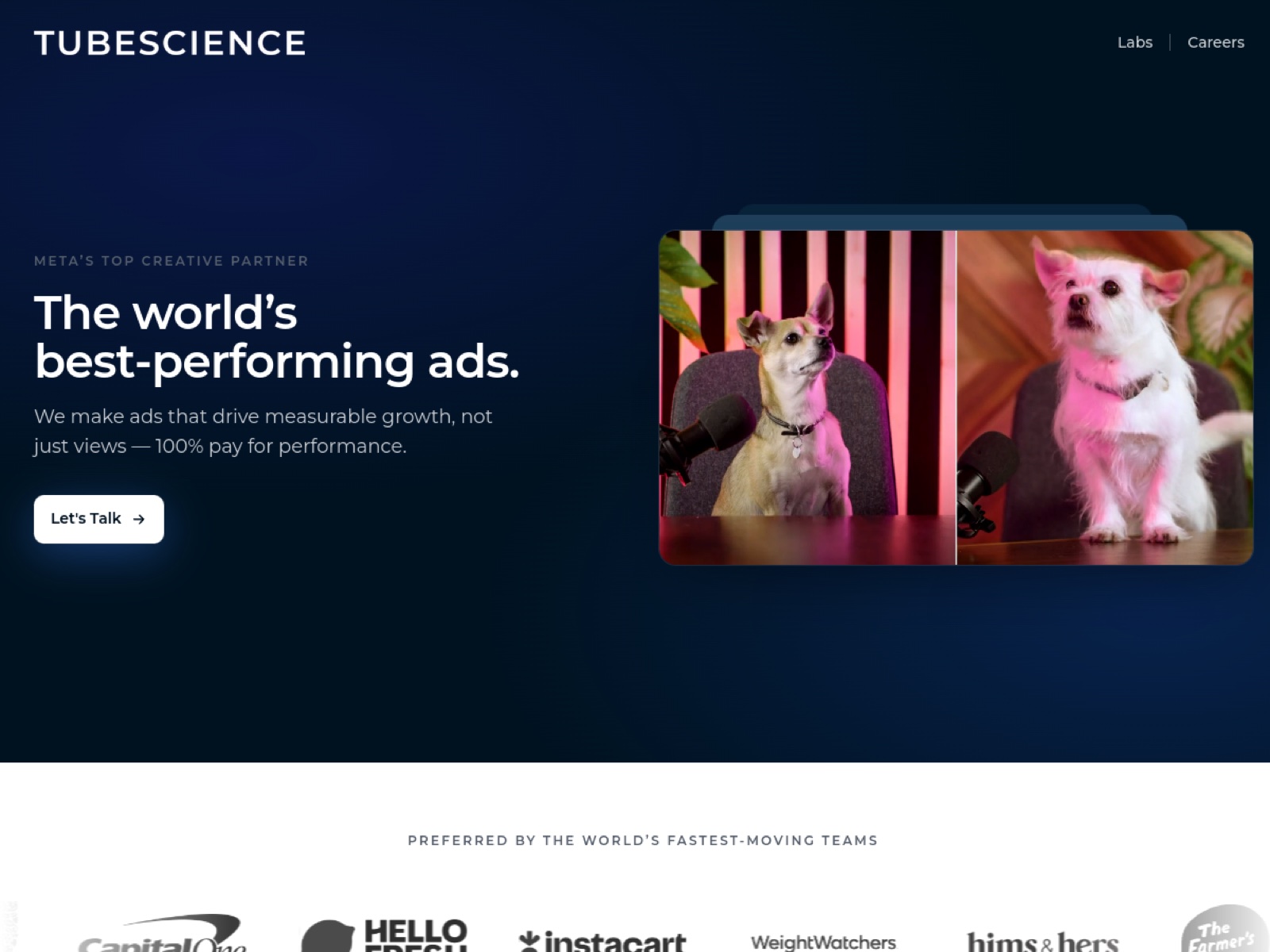
TubeScience is a creative production and media agency that builds high-volume performance video ads for Meta, TikTok, YouTube, Snapchat and CTV. They run an in-house video studio plus performance media buying and optimization, and offer a pay-for-performance model where clients pay for ads that meet predetermined targets rather than for views.
Best fit
Large DTC and performance advertisers that want high-volume video ad testing tied to measurable results.
Pros and cons
Strengths
- End-to-end offering: creative strategy, in-house video production, media buying, and measurement under one roof
- Built specifically for high-volume video testing across the major paid-social and video platforms
- Pay-for-performance model aligns their incentives with measurable ad results
Trade-offs
- Geared toward large performance advertisers and scaled ad spend, not small brands or brand-film work
- Volume-testing, direct-response approach is less suited to bespoke hero-brand storytelling
- Performance-based pricing typically means enterprise-level commitments
Website: TubeScience
9. MuteSix
MuteSix is a performance marketing agency (part of the Dentsu network) that pairs an in-house creative ‘Performance Studio’ with paid media across Meta, TikTok, YouTube, Google, and Amazon. Their studio produces video, photo, design, and copy purpose-built for ad performance, run alongside their media-buying teams for an integrated creative-plus-media approach.
Best fit
Growth-stage and enterprise brands wanting ad creative and paid media managed together.
Pros and cons
Strengths
- In-house Performance Studio produces video and photo ad creative alongside the media team
- Omnichannel coverage across Meta, TikTok, YouTube, Google, and Amazon
- Long-standing, established performance shop backed by the Dentsu network
Trade-offs
- Full-service media-plus-creative model is more than brands that only need video production
- As part of a large holding-company network, likely oriented to mid-market and enterprise spends
- Best suited to brands that want media buying bundled with creative, not creative alone
Website: MuteSix
10. inBeat Agency
inBeat is a creative growth agency that leads with a vetted creator network plus in-house production to make UGC-style video ads and performance creative for Meta, TikTok, Google, and Snapchat. Their model starts with creators and the content they naturally make, then scales the validated creative across paid channels with data-driven iteration.
Best fit
DTC and app brands that want creator-driven UGC video ads engineered for paid social.
Pros and cons
Strengths
- Combines a vetted creator network with in-house production for authentic UGC-style video ads
- Creative is built to be tested and scaled across paid social and CTV channels
- Strong fit for creator-authentic, short-form ad formats on TikTok and Meta
Trade-offs
- UGC and creator-led focus is less suited to high-production brand films or TV spots
- Oriented toward performance and DTC use cases rather than broad brand campaigns
- Best for brands comfortable centering their ads on creator content
Website: inBeat Agency
11. NewForm
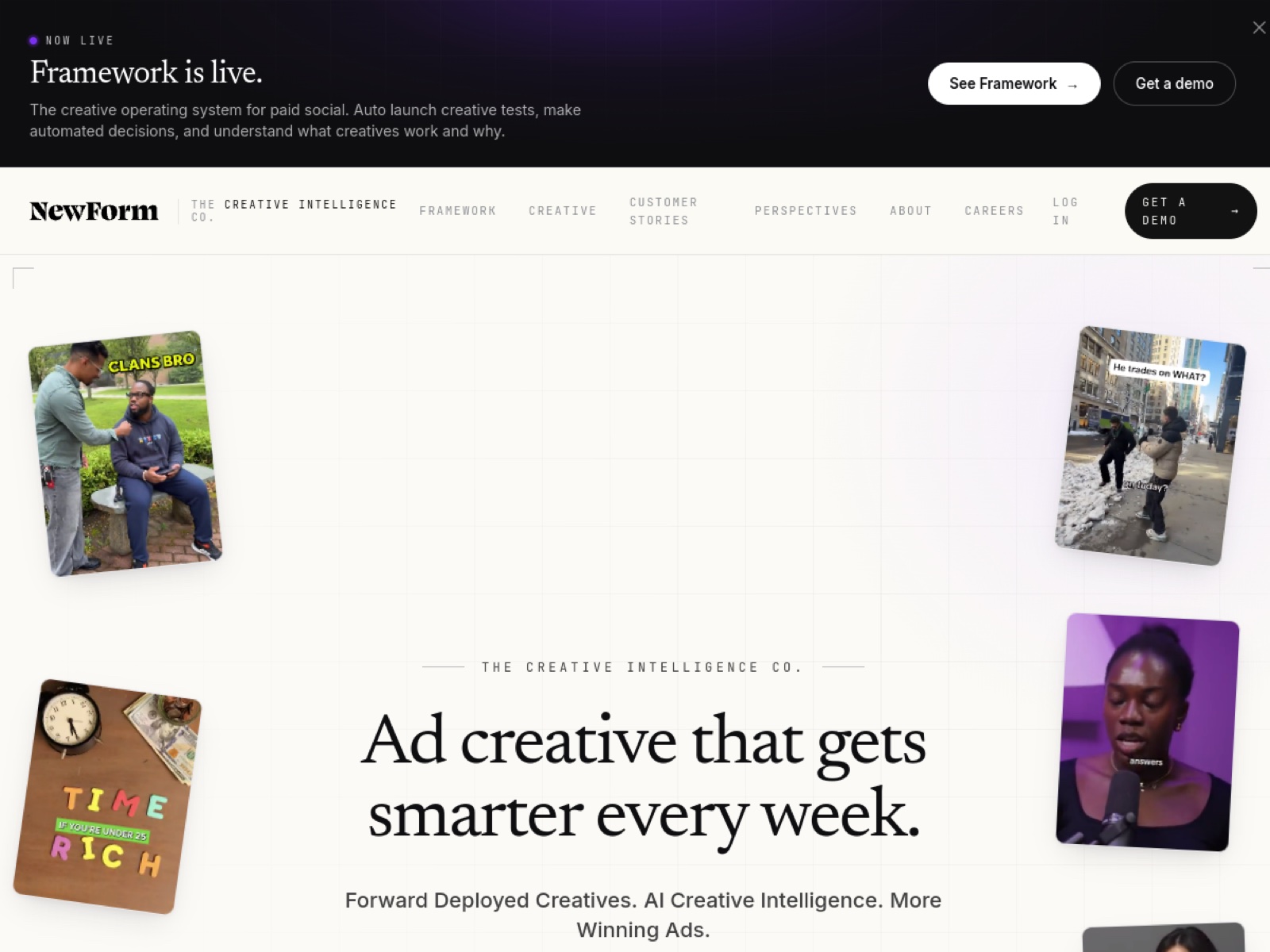
NewForm is a performance creative agency focused on Meta and TikTok that produces high volumes of ad creative for DTC and consumer-app brands. They run structured tests with many variants per brand each month, and their proprietary tool, Framework, runs statistical experiments to identify winning creative.
Best fit
Scaling DTC and app brands that want data-driven, high-volume creative testing on Meta and TikTok.
Pros and cons
Strengths
- Rigorous, statistics-driven testing approach (Framework) to find winning ad creative
- High-cadence variant production built for fast creative iteration
- Tightly specialized in the two highest-volume paid-social video platforms
Trade-offs
- Platform focus is concentrated on Meta and TikTok rather than the full channel mix
- Data-heavy, high-volume testing model fits scaling advertisers more than small brands
- A younger firm than some of the established shops on this list
Website: NewForm
12. Superside
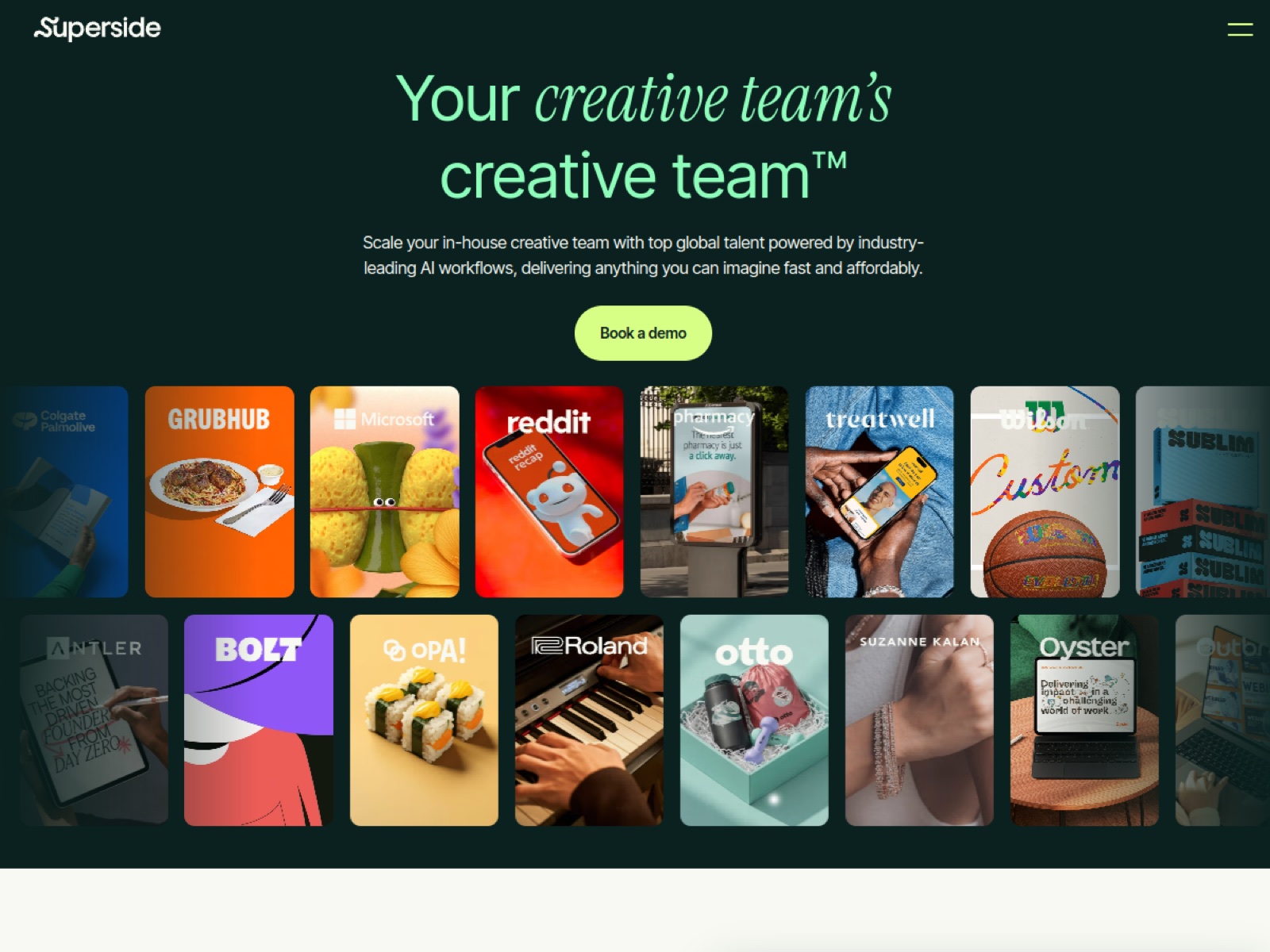
Superside is a creative services platform that extends in-house teams with vetted global talent and AI-assisted workflows to produce ad creative, video, motion, and other marketing assets. Brands sign on for ongoing creative output delivered quickly, spanning paid-ad creative, social assets, and video among a broad range of design services.
Best fit
In-house marketing teams that need scalable, on-demand ad and video creative across many formats.
Pros and cons
Strengths
- The recurring model gives predictable, ongoing access to ad and video creative production
- Broad creative capability beyond video (design, motion, social assets) under one recurring engagement
- Fast turnaround backed by a large global talent pool
Trade-offs
- Generalist creative platform, not a video-advertising specialist, so video is one of many services
- Less focused on paid-media strategy and buying than dedicated performance shops
- A recurring commitment fits teams with steady, high-volume creative needs more than one-off projects
Website: Superside
Top 12 Video Advertising Companies Comparison
| Vendor | Implementation complexity | Resource requirements | Expected outcomes | Ideal use cases | Key advantages |
|---|---|---|---|---|---|
| Moonb | Low to Medium, dedicated team onboarding and weekly workflow | Ongoing monthly engagement; embedded creative team | Predictable weekly assets, fast turnarounds | Teams needing continuous weekly creative and compliance-ready workflows | Dedicated embedded team, predictable cadence, end-to-end production, IP transfer |
| Harmon Brothers | Medium to High, bespoke big-idea development and production | High production costs and longer timelines | High-impact, narrative ads optimized for sales and virality | Brands seeking an anchor DTC spot or breakout campaign | Proven performance creative, strong storytelling, notable case wins |
| Chamber Media | Medium to High, creative plus media integration and iteration | Ongoing monthly creative and media spend; testing infrastructure | Lower CAC through frequent testing and refreshed ad libraries | Performance-driven brands needing continual ad refresh and media alignment | End-to-end performance focus, high-velocity testing, cross-channel execution |
| Sandwich | High, cinematic, custom-scoped production workflows | High costs for premium live-action or animation production | Broadcast-quality brand films and product explainers | Tech and SaaS teams launching foundational brand assets | Deep product storytelling expertise, cinematic finish, versatile formats |
| VaynerMedia | High, enterprise orchestration across channels and platforms | Large costs, platform partnerships, global resources | Scaled cross-channel reach with social-native creative | Large brands or enterprises requiring integrated media and creative at scale | Platform access, social expertise, global operating model |
| Tinuiti | High, full-funnel media and measurement integration | Enterprise or mid-market costs plus measurement investment | Attributable growth across video, search, social, and retail channels | Brands needing robust measurement and integrated media strategy | Enterprise-grade measurement, broad partner coverage, cross-channel integration |
| MNTN | Low to Medium, self-serve or managed CTV platform setup | Media spend (dynamic CPM); creative assets or platform creative tools | Rapid CTV deployment with clear reach and impression metrics | Advertisers wanting quick access to premium streaming placements | Fast CTV activation, access to premium streaming networks, streamlined buying tools |
| TubeScience | Medium, in-house studio plus performance media buying | Ongoing spend geared to high-volume testing; enterprise commitment | High-volume video ad testing tied to measurable performance | Large DTC and performance advertisers scaling paid social and CTV | End-to-end creative plus media, pay-for-performance alignment |
| MuteSix | Medium to High, integrated creative studio plus paid media | Growth to enterprise spends; media plus creative bundled | Ad creative and paid media managed together across channels | Growth-stage and enterprise brands wanting creative plus media in one place | In-house Performance Studio, omnichannel coverage, Dentsu backing |
| inBeat Agency | Medium, creator network plus in-house production | Performance-oriented spends; creator sourcing plus iteration | Creator-authentic UGC video ads scaled across paid social | DTC and app brands leaning on UGC and short-form | Vetted creator network, UGC production, paid-social iteration |
| NewForm | Medium, high-cadence testing on Meta and TikTok | Scaling ad spends; variant production at volume | Data-driven creative testing that surfaces winning ads | Scaling DTC and app brands focused on Meta and TikTok | Statistics-driven testing, high variant cadence, platform focus |
| Superside | Medium, onboarding into a recurring creative engagement | Recurring commitment; large global talent pool | On-demand ad and video creative across many formats | In-house teams needing scalable, ongoing creative | Recurring access, broad creative capability, fast turnaround |
One thing worth grounding all of this in is what actually makes video advertising work in the first place. The most rigorous public evidence I lean on comes from Les Binet and Peter Field’s research for the IPA, which shows how the strongest campaigns balance long-term brand building with short-term sales activation.
Making Your Final Choice with Confidence
The best video advertising company is the one that fits the way your team works. That is the part buyers often skip. They compare reels, case studies, and style. They do not spend enough time comparing operating models.
Start there instead. Ask whether you need a classic agency, a platform with buying tools, or an embedded creative team that can ship steadily alongside your internal marketers. If your problem is launch storytelling, a shop like Sandwich or Harmon Brothers may fit. If your problem is integrated media performance, Tinuiti, Chamber Media, VaynerMedia, or MNTN may make more sense depending on where creative and distribution sit on your side. If your problem is output volume, brand consistency, and speed across many requests, an embedded team like Moonb is the clearest fit on this list.
These are the questions I put in every final-round conversation.
- How will you learn our brand in practice: Ask what the first few weeks look like, who stays on the account, and how feedback gets captured.
- How do you decide what to make next: Strong partners have a method for prioritizing assets, angles, and iterations.
- What does success mean beyond views: Push for a clear connection between creative output and business outcomes.
- Who is doing the work day to day: You want to know whether the people in the pitch are the people in the workflow.
- How fast can we move when priorities change: This tells you whether the model will help or slow your team.
Choose the partner that can stay useful after the kickoff. That is usually the decision you will be happiest with six months later.
If your real problem is volume, brand consistency, and speed across a lot of requests, an embedded creative team is worth a look, and Moonb is where I would start that conversation. It is a dedicated creative team led by senior creative directors, built for B2B marketers who need video, motion design, animation, and design that holds on brand and keeps moving.
Frequently asked questions
Watch the numbers, not the calendar. Once frequency climbs and your best performer starts losing click-through or costing more per result, that is the cue to bring in fresh hooks. Teams running always-on paid usually keep a short queue of new variants ready so a tired ad can be swapped without a fire drill.
They do not have to share a roof, but they do have to share data. What actually matters is whether the people making the ads can see performance results and act on them. If your creative partner never learns why an ad won or lost, every next round is a guess, so build that feedback loop even when the two functions live in different companies.
The viewing conditions. Paid social is decided in the first two seconds because a thumb is already moving, so the hook has to land before any setup. CTV plays on a big screen with the sound on and almost no skipping, which rewards clearer storytelling and production that holds up at size. The same message usually needs two builds, not one file stretched to cover both.