Ad creative testing playbook that turns winners into scale
A step-by-step ad creative testing playbook: what to test, how to structure a clean test on Meta, TikTok and Google, how to read winners, and how to scale them.


Ad creative testing is the practice of running controlled comparisons between versions of an ad, changing one element at a time (the hook, format, message, offer, length or thumbnail), so you learn which creative actually drives results instead of guessing from a review doc.
I work at Moonb, a creative studio, and a lot of my week is spent with performance marketers who launched ten ads and still cannot say why one pulled ahead. Every one of them looked strong in the review doc. Then spend started moving, the platform picked a favorite on day two, and the other nine never got a fair shot. What usually helps is a cleaner read and a steady launch rhythm, so the few real winners can feed a repeatable production system. This is the playbook I walk teams through.
Why ad creative testing decides performance
A lot of teams still treat testing like a final polish step. That’s backwards. When Nielsen studied what drove sales lift in nearly 500 fast-moving consumer goods campaigns from 2016 and early 2017, its conclusion was blunt: “good creative is still the most important element.” The same Nielsen analysis found that “weak creative results in weak sales lift,” and that when creative is strong, “sales lift is higher and is affected less by media.”
When a campaign underperforms, the first instinct is to tweak audiences or bids. Sometimes that helps. Often it just hides the real issue, which is that the creative never gave the platform, or the buyer, a strong enough reason to act.
The other reason to test is that experienced people are bad at predicting winners. Any team that ranks ideas on opinion will bury a few of its best ones, and the only reliable way to find them is to put them in front of buyers in a controlled test.
So the real job is finding the few concepts that deserve more spend, as fast as you can with as little wasted spend as possible, and letting the rest fail fast. A healthy program looks boring in the best way: one clear hypothesis, a fixed window, a few controlled variants, a short list of winners, and the next round starting straight away.
What to test and how to build your test matrix
Start with the elements that usually move performance the most: hook, format, message, offer, length, and thumbnail. If the test is meant to answer a real question, isolate one of those and leave the rest alone.
Pick the variable that matches the problem
Let the symptom choose the test. If the ad gets attention but no clicks, the problem is probably the message or the offer. If people click but don’t convert, look at a promise mismatch between the ad and the landing page, or at pacing. If a video dies in the first few seconds, test the hook before you touch anything else. If a static ad never gets a second look in the feed, the thumbnail or first frame is your variable.
A clean test matrix makes that decision visible. It also stops teams from stacking five changes into one creative and then claiming the winner was obvious.
| Hypothesis | Variable isolated | Control | Variant | Primary metric | Decision rule |
|---|---|---|---|---|---|
| A stronger opening will raise early attention | Hook | Current opening scene | New opening scene | Hook rate (3-second views / impressions) | Variant wins only if CPA holds or improves too |
| A simpler value claim will improve click intent | Message | Current headline and copy | Shorter, single-benefit claim | Link CTR | Beat control on CTR without a worse conversion rate |
| A clearer offer will improve response quality | Offer | Current offer | One concrete incentive, stated up front | Cost per result | Lower cost per result at comparable volume |
| A tighter edit will hold attention longer | Length | Current cut | Shorter cut | Hold rate, then CPA | Longer watch time must carry through to conversions |
| A different still frame will stop more thumbs | Thumbnail | Current first frame | New first frame | CTR | Win on CTR and not lose on CPA |
| Native video will beat a polished edit | Format | Studio edit | Creator-style vertical cut | CPA | Judge on cost per result, not views |
The last column matters most. Write the decision rule before launch, next to the hypothesis, so nobody can move the goalposts once the numbers come in. If you want a worked template of this setup specifically for Meta, the creative testing framework from AdManage is a useful reference, because it keeps the conversation anchored on one variable per test.
Prioritize the tests that can change spend
When resources are tight, don’t test everything at once. Test the piece most likely to change where the money goes. A weak hook can kill a good concept before anyone reaches the offer, while a strong offer can rescue a fairly simple edit. If you need ideas for the variants themselves, our breakdown of ad creatives that convert is a good bank of patterns to pull from.
A good brief matters here too. If the team doesn’t know what the ad is supposed to prove, the matrix gets fuzzy fast. A simple starting point is a creative brief template that locks the audience, promise, proof, and call to action before production begins. The cleanest tests usually look narrow at launch and broaden only after the winner is clear.
How to structure a test that means something
A test only matters if you can trust the result, and that is decided before launch. Set the hypothesis, the sample target, the window and the decision rule first. If any of those are still flexible after spend starts, the test is already compromised.
Use the platform’s own testing tool
All three big ad platforms ship a proper split-testing tool, and Meta warns outright against the homemade version. Meta’s help center says its A/B testing shows each version to a segment of your audience and will “ensure nobody sees both.” It also says plainly: “We do not recommend testing informally, such as by turning ad sets or campaigns on and off manually,” because that “can lead to inefficient ad delivery and unreliable test results.” Meta recommends “using the same budget for both versions in a test to ensure a fair comparison.”
TikTok’s Split Testing works the same way: it splits your audience “into two equal groups, with each group seeing only one ad group,” and TikTok says it picks a winner “with a 90% confidence rate,” only when “the results are statistically significant.” Creative is one of the variables you can test directly. This short explainer from TikTok’s own business channel walks through how a split test works and what to set up before launch.
On Google, YouTube creative gets its own path. Google Ads’ video experiments offer a basic option “where creative is your single variable in your A/B two-armed test (control vs. treatment),” available for Video Reach and Video View campaigns, plus a Custom option for other video campaign types and up to 10 arms. For campaign-level custom experiments, Google recommends a 50% traffic and budget split “to provide the best comparison,” and warns that changing either arm mid-test “may make it harder to interpret your results.” Google’s own YouTube advertising channel explains how video experiments are meant to be used.
Respect learning phases and sample discipline
Most false reads come from tests that are too small. The platforms tell you roughly how much data they need, so use that as your floor. On Meta, ad sets exit the learning phase “as soon as they can deliver stably,” which “usually occurs after about 50 results in the week after the ad set’s last significant edit.” Meta adds that during learning, “performance is less stable, so your results aren’t necessarily indicative of future performance,” and that editing mid-flight will “reset learning.”
That gives you a practical way to size each variant. Work backward from your current cost per result: if a variant needs about 50 results in a week to stabilize, its weekly spend has to be large enough to buy them. If it can’t, test fewer variants at once, or optimize for an event higher in the funnel that happens more often, and treat the result as directional. Meta also cautions against a “very small or inflated budget,” because either one gives the delivery system a misleading signal.
TikTok is more explicit about statistical power. Its split test best practices recommend “a budget that gives you a power value of at least 80%,” a large audience “to avoid insufficient sample size,” and test groups that “differ significantly,” so the system can actually tell them apart. That last point is underrated. Two near-identical cuts need huge samples to separate. A bold difference in hook or format costs far less to read.
Before the first impression, run a launch check: hypothesis set, one variable isolated, threshold defined, sample target written down, window fixed, and the winner rule agreed. For the operating model around the team doing this every week, the creative operations management guide is a useful companion. The point is to make testing repeatable.
How long to run tests and how to read winners correctly
A test can look great on day two and fall apart by day six. That’s why peeking is dangerous: it tempts you to stop on a spike, and early spikes are mostly noise.
TikTok’s guidance is a good default for any platform: test “for a minimum of 7 days to obtain the most reliable results,” because “testing for less than 7 days may not be long enough to determine a winner.” TikTok caps split tests at 30 days and warns that long tests can leave you short on budget. A full week also covers every weekday once, so a Monday audience does not get compared against a Saturday one.
Google’s video experiments are candid about the trade-off between speed and certainty. You can take “directional results” once an experiment reaches 70% or 80% confidence, but results are only “considered conclusive” at completion, at 95% confidence. Decide in advance which bar a given decision needs. Killing an obvious loser on directional data is fine. Moving most of next month’s spend onto a new concept deserves the conclusive read.
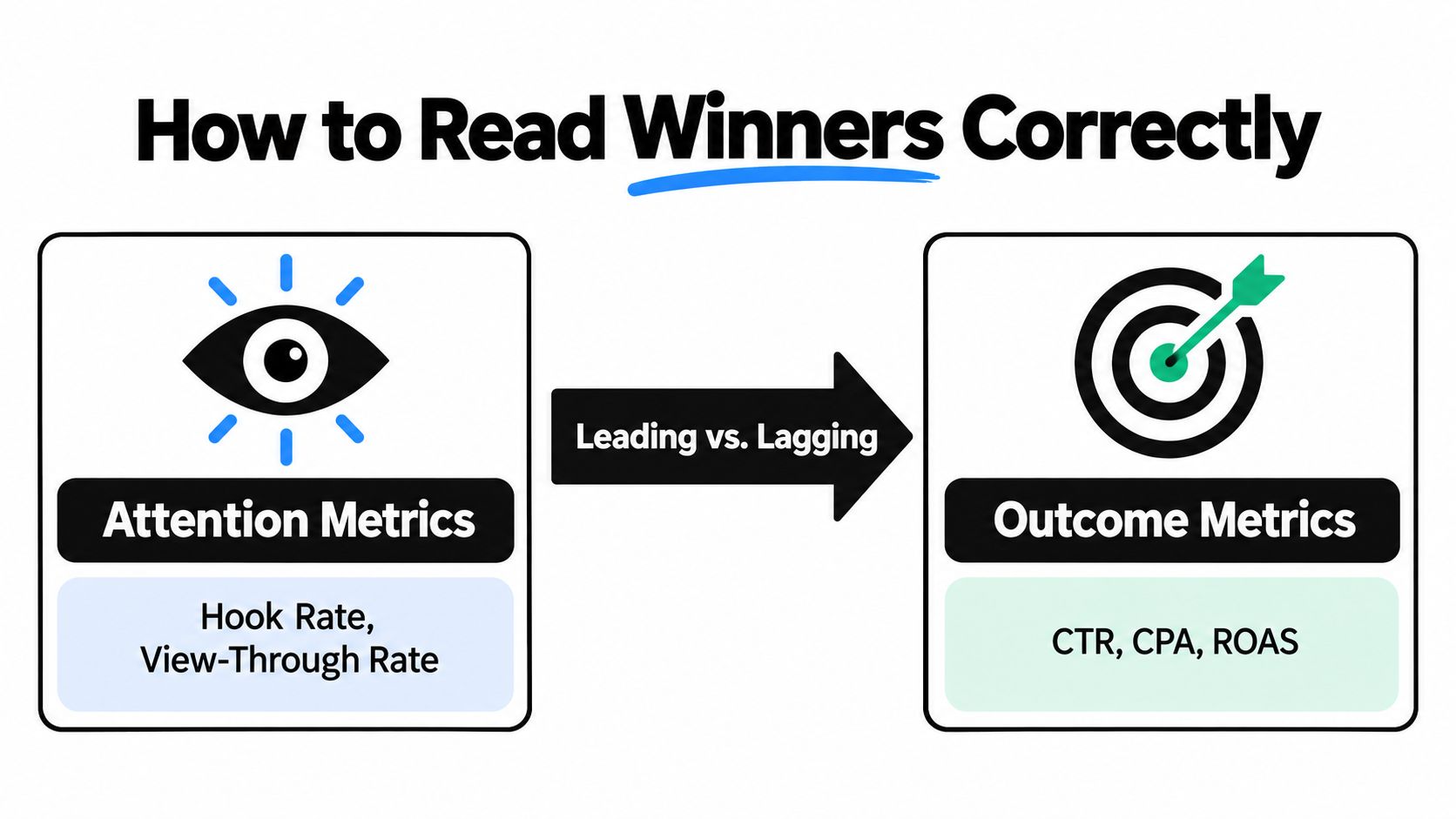
Separate attention from outcome
Split the read into two layers. Attention metrics tell you whether the ad earned a look: hook rate (most teams define it as 3-second video views divided by impressions) and hold rate or view-through rate on video. Statics have no view count, so for them the first attention read is usually CTR. Outcome metrics tell you whether that attention turned into business: link CTR, conversion rate, cost per result, and ROAS.
A creative can win the top of the funnel and still lose at the bottom. That’s why CTR alone is a weak finish line. A better read follows the whole chain, from hook to click to CPA or ROAS, and asks where the drop starts. For video-heavy accounts the same logic belongs in your wider video marketing strategy: a high-attention cut that doesn’t support the downstream goal is still a weak asset.
Read the result against your own control
The cleanest winner beats your current control on the metric that matters to the business. If a variant gets more clicks but a worse CPA, it’s a false winner. If it gets fewer clicks but better downstream conversion quality, it may still be the right ad.
Compare against your own rolling control rather than published industry averages. Click-through and conversion norms swing widely by vertical, audience and placement, so a generic “good CTR” number tells you almost nothing about your account. Ask one question instead: what is the minimum evidence needed to declare a winner in this account? Answer it from your own history, write it down, and the read becomes much harder to fake.
Turning winners into a production pipeline that scales
The real work starts after the winner. A single good ad doesn’t create scale. A repeatable production loop does.
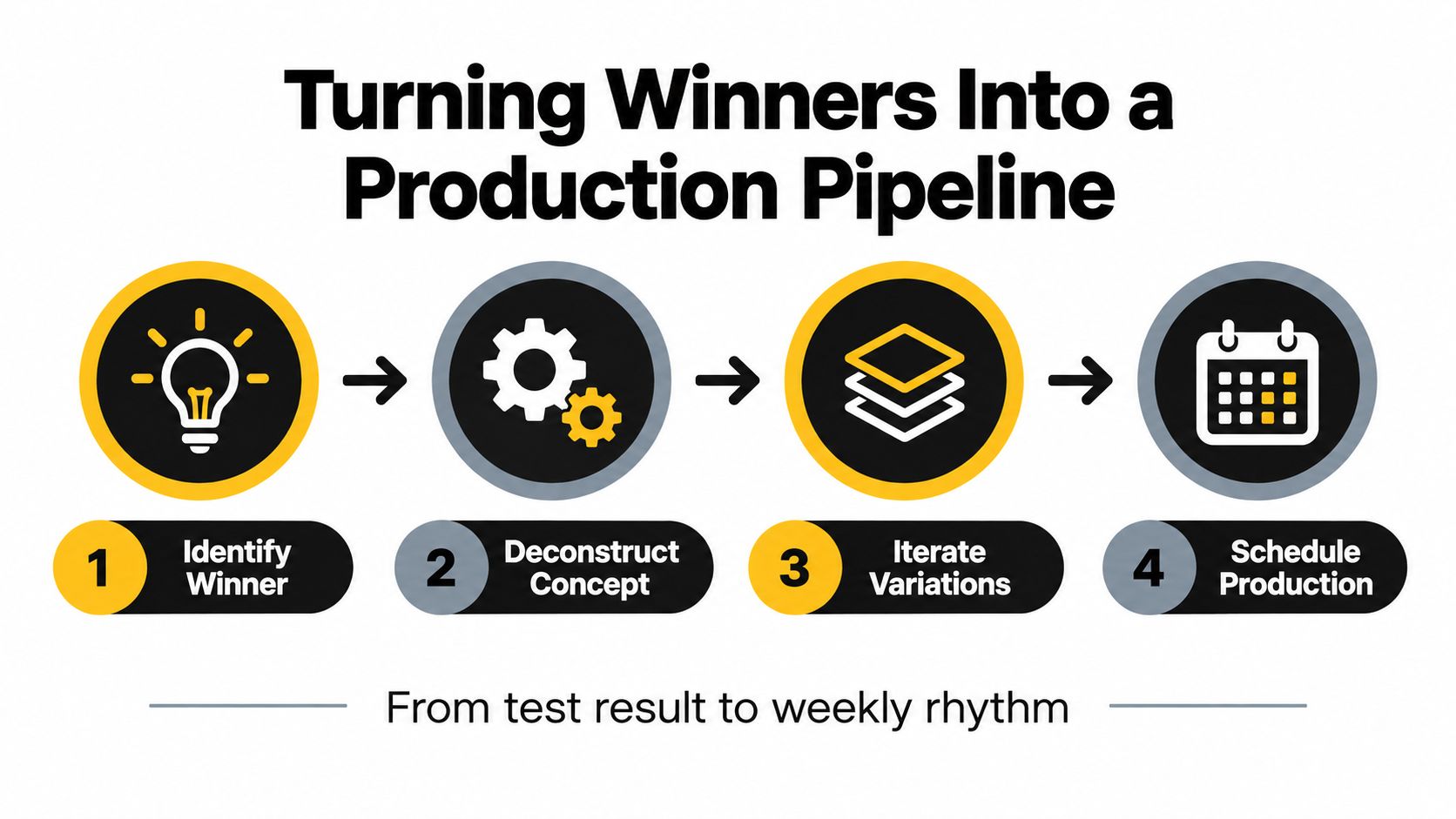
Deconstruct the winning concept
First, take the ad apart. Separate the hook, structure, pacing, proof, and call to action, and work out the mechanism that made it land. That mechanism is what you carry forward. That’s how you keep the brand consistent while still moving fast.
Then brief the next round from the parts that won. If the opening frame won attention, keep its emotional logic and vary the edit. If the message won, hold the promise steady and test a new visual treatment. Keep a running library of hooks, openings, proof points and CTAs, tagged with the test that validated each one, so one winner becomes ten structured variations instead of one exhausted asset.
This is where most programs stall, and the cause is usually production capacity. The team needs the next round of cuts in review while the current round is still being read. Put the four steps on a weekly calendar: read results on a fixed day, brief the variants the same day, produce during the week, launch the following week. Whether that capacity comes from an in-house team or an outside creative team matters less than the rhythm holding.
Watch fatigue by exposure
Creative fatigue doesn’t follow a neat schedule. Meta defines creative fatigue as what happens “when an audience has seen the same creative too many times,” and it flags it in the Delivery column of Ads Manager. It considers “all recent exposures of the ad’s image or video, including those from other campaigns from your Page,” and compares your cost per result with ads you ran in the past. An ad set shows “Creative limited” when cost per result is higher than your past ads but less than twice as high, and “Creative fatigue” when it is at least double. The feature applies to ad sets running a single creative.
Meta’s first recommended fix is to “create a new ad with a new image or video that is materially different from the original creative,” and it notes that keeping the original ad running rather than pausing it “may maximize results.” Nielsen’s research points at the same mechanism from the media side: past a certain point, “most new impressions end up reaching the same people.”
So every winner goes on a watchlist. Track frequency next to cost per result for every scaled winner. When frequency climbs and cost per result starts to drift up, ship the next variation from your library. Small audiences burn through a creative faster than large ones, so rotate faster where the pool is narrow.
Mistakes that create false winners and how to avoid them
False winners usually come from process errors. The creative looked good because the test was weak, and that’s a painful place to scale from, because the next round exposes the mistake fast.
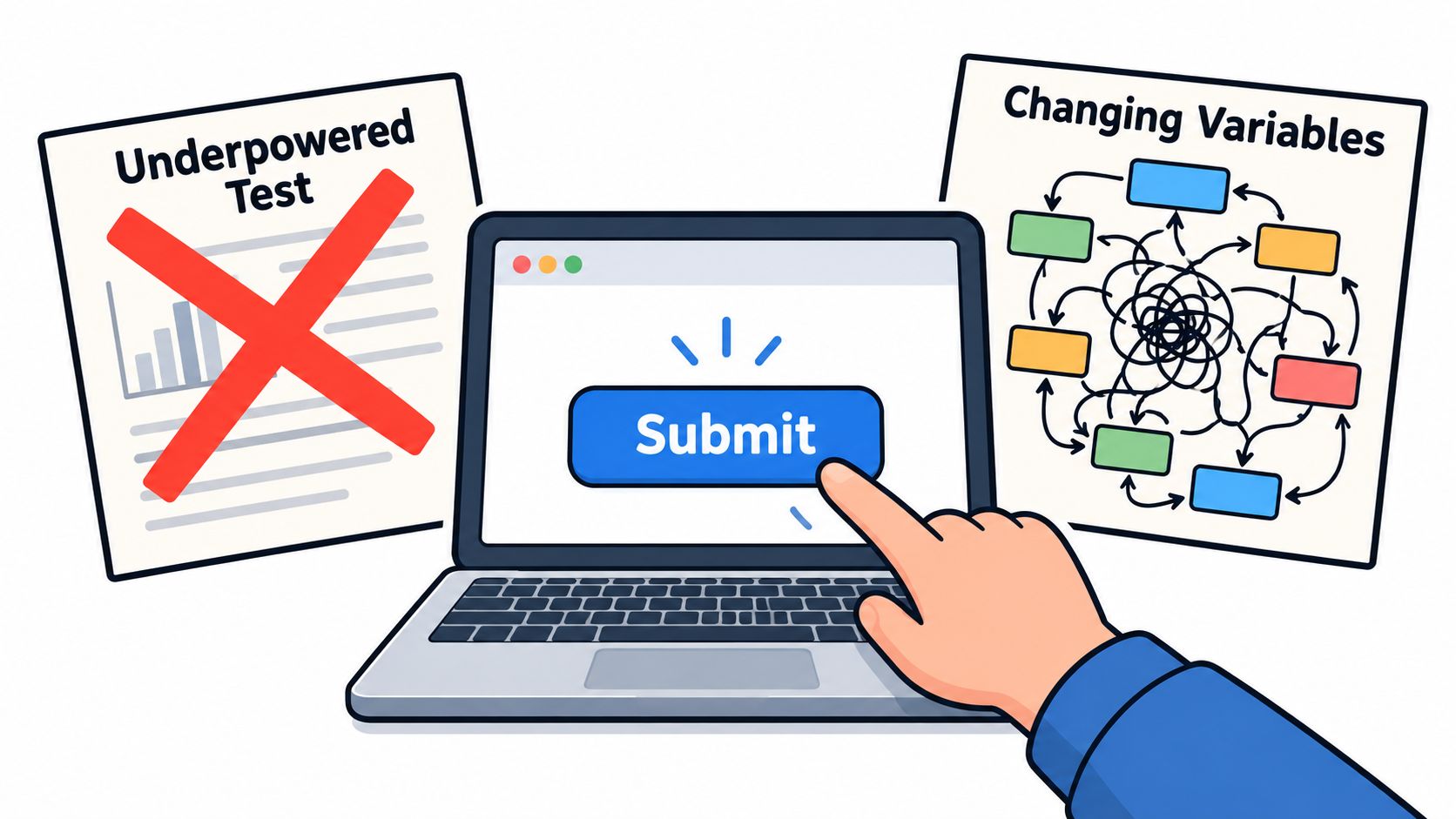
Underpowered tests create noise that looks like signal. The fix is to size spend so each variant can reach the platform’s learning threshold, or to accept that the read is directional and act accordingly.
Changing several variables at once makes the result impossible to attribute. If the new version has a different hook, a new offer and a shorter cut, you have learned that the bundle won, not which piece did. Isolate one variable and keep the rest steady, which is why the matrix above matters.
Testing informally, by pausing one ad set and switching on another, lets audiences overlap and delivery drift. Meta explicitly warns against it. Use the native split-test tool so each person sees only one version.
Stopping early rewards short spikes. Commit to a window of at least seven days before the test is eligible for review, and don’t edit mid-test, since on Meta a significant edit resets learning.
Ignoring seasonality creates bad comparisons. A variant launched into a holiday week is not comparable with a control that ran in a quiet one. Run control and variant at the same time, never back to back.
Chasing generic benchmarks sends you in the wrong direction. Compare against your own control.
Running too many variants at once is the newest trap. Generative tools make it easy to produce dozens of versions, and every extra variant is another chance for noise to look like a winner. If you use an AI creative testing platform to generate or rank variants, tie it to attribution you trust and keep a real control in every round. Before launch, ask one question of each variant: what changed, and why? If the answer is broader than the planned variable, the variant needs another pass.
The same discipline applies to creator-style edits. Our guide to UGC video covers how to keep raw, authentic footage structured enough that a test on it still teaches you something.
Frequently asked questions
Usually one to four variants of a single variable, plus a control, depending on the tool: Meta's A/B test compares up to five versions, while TikTok's native split test and Google's basic video A/B test compare two. The limit is spend, not ideas: each variant needs enough budget to reach the platform's learning threshold (on Meta, about 50 results in a week) inside the test window. If your budget cannot fund that for every variant, cut the number of variants before you cut the window, or the result will only be directional.
Use them for different jobs. Automated creative tools are good at finding the best mix to deliver right now, but they optimize delivery rather than isolate a cause, so they rarely tell you why something won. When you need a learning you can brief the next round from, such as whether a new hook beats the old one, run a proper split test with one variable changed and a fixed control.
Retest when the conditions that produced the win change: a new audience, a new placement, a big seasonal shift, or a fatigue flag in Ads Manager. A winner is a result for a specific audience in a specific window. Running it again as the control in the next round is the simplest way to confirm it still holds before you commit more spend behind variations of it.