Promotional Video Production: A Buyer's Walkthrough
What promotional video production includes, what drives the quote, and how to choose between freelancers, production companies, and dedicated teams.

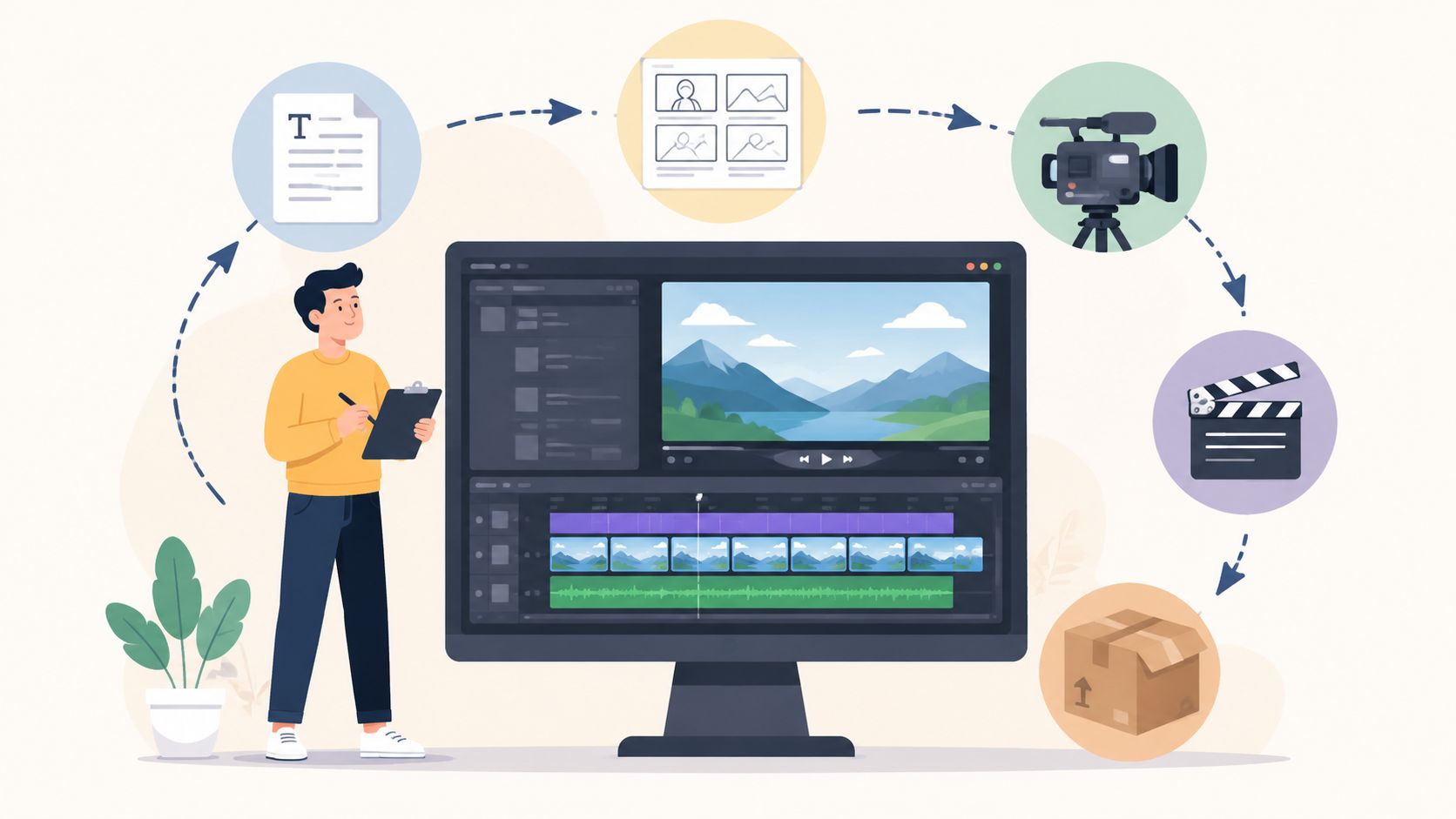
Promotional video production is the planning, scripting, filming or animating, editing, and versioning of short marketing videos, usually 15 seconds to 2 minutes long, made to promote a product, service, launch, event, or brand. The work runs through strategy, pre-production, production, and post-production, and most projects land in a three to six week window; live action, talent, or multiple locations stretch that out. Buyers usually choose between a freelancer, a per-project production company, an agency, an embedded creative team, an in-house hire, or AI-first tools.
I work at Moonb, and a decent share of my week goes to reading the production quotes clients forward me. The pattern repeats. Earlier this year an enterprise SaaS team sent over three quotes for the same 60 second launch promo; the numbers were far apart, and not one of the three scoped the cutdowns their media plan clearly needed. The video was never the hard part. Knowing what the quote should contain was. This walkthrough is the checklist I wish those buyers had before they signed.
What promotional video production means
Promotional video production is the operational work behind a marketing video. It turns a message into a usable asset through decisions about the hook, script, visual style, distribution channels, and the versions each placement requires.
Video sits inside regular marketing planning now, not next to it. In HubSpot’s State of Marketing research, 93% of marketers say video is an important part of their marketing strategy (HubSpot marketing statistics), so production choices ripple into campaign planning and budget decisions rather than sitting off to the side.
What the work usually includes
A production flow begins with the message and ends with approved deliverables. The creative team shapes the idea, writes the script, produces footage or animation, and edits versions for the platforms that matter. Approval gates sit between those steps. A late change to the audience, offer, or script can force new scenes, voiceover, animation, or aspect ratios, which is why a clear sign-off process protects both schedule and budget. My rough test: if nobody can describe the video in one sentence before production starts, revisions will make the project more expensive.
For buyers, the decision is which operating model fits the work: a freelancer, a per-project production company, a traditional agency, an embedded creative team, or in-house production. Each option trades off cost, strategic input, production capacity, and the amount of coordination your team must provide. If channel planning comes first, this guide to video marketing strategy covers the wider planning context, while this walkthrough concentrates on choosing and managing production.
B2B marketing teams running regular campaigns may commission several cutdowns, aspect ratios, or message variants from one core concept. A launch team may need one tightly controlled asset instead. That difference changes the brief, the review load, the partner fit, and the final quote. Video is a standard marketing deliverable now, but its cost and timeline still depend on how clearly the work is defined and how many approved versions are required.
Promo videos, explainers, and brand films do different jobs
A launch team may ask for a “promo video” when the actual requirement is a product demonstration, customer proof, or a brand story. Those formats can share footage and distribution channels, but they create different approval questions, production demands, and costs. The deciding factors are the audience’s knowledge, the job the video must do, and how much explanation it must carry on its own.
If you want the cleanest reference for what a promotional video is supposed to do, the launch film that built Dollar Shave Club still holds up: one message, one voice, and a call to action you cannot miss.
If the asset will run in paid placements, this overview of types of video advertising maps the format families. Brand-led anchor pieces usually need a brand film brief, while animated work may suit an explainer approach.
| Format | Typical length | Where it runs | Live action or animation | Best for |
|---|---|---|---|---|
| Promotional video | Short, usually under 2 minutes | Product pages, launches, social, paid media, events | Either | Fast promotion with a clear call to action |
| Explainer video | Often 60 to 90 seconds | Landing pages, onboarding, sales support | Often animation, sometimes hybrid | Showing how something works |
| Brand film | Short or long-form | Website, campaigns, presentations | Usually live action, sometimes hybrid | Building brand feel and narrative |
| Commercial | Very short, channel-specific | TV, streaming, paid social | Usually live action or mixed | Broad reach and polished persuasion |
| Testimonial | Usually short | Website, sales decks, social proof sections | Live action interview style | Credibility through customer or employee voice |
Where the lines blur
A promotional video can build brand preference, explain a product, or use a customer’s experience as proof. Its category depends mainly on intent, not on whether it uses live action, animation, or a particular visual style. For a broader view of the format families, the RemotionAI video guide provides useful categories.
Buyers should therefore brief the business problem rather than select the most attractive label on a service page. A launch asset that must explain a software feature needs a different script, review group, and production allowance from a brand piece designed to establish trust. A testimonial can strengthen either approach, but it rarely replaces the broader message and call to action.
The practical test is simple: identify the viewer’s next decision. If the video must prompt an immediate action, keep the message focused and the approval path short. If it must teach or build confidence first, allow room for context and plan reviews with product, legal, or customer teams. That choice affects the partner you need, the number of versions to approve, and the final quote.
The four stages of a promotional video project
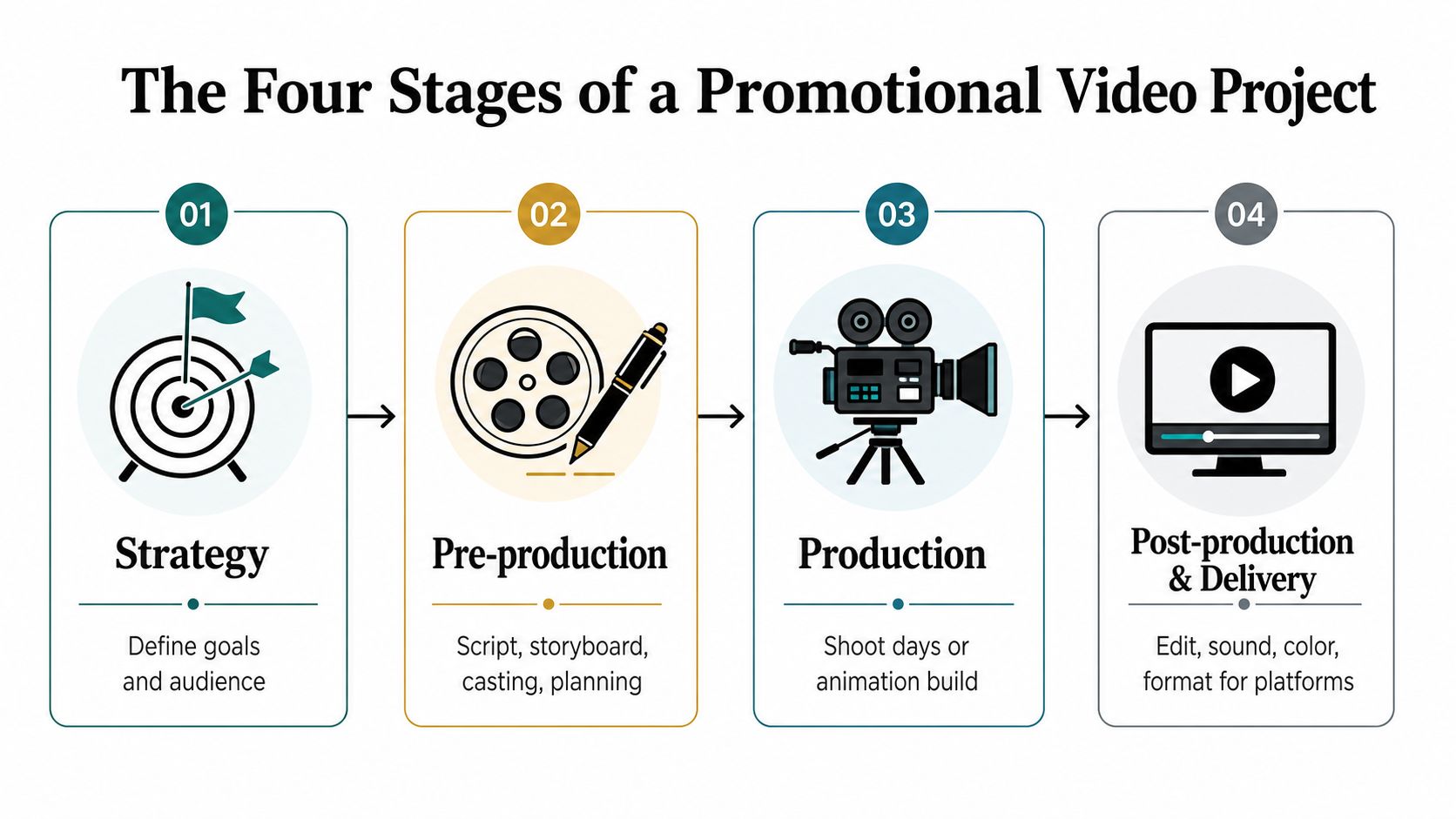
A promo project usually moves through four gates, and each one needs a clear owner. That is how you keep scope, feedback, and spend from drifting. A video production checklist helps teams track the handoffs, but the value is in knowing who decides what, and when.
Strategy and pre-production
Strategy sets the objective, audience, single message, placement, and success metric. Pre-production turns those choices into a script, storyboard or animatic, casting plan, locations, brand assets, and music direction. The buyer’s job is to give useful inputs, then sign off before anything visual is locked.
That first approval matters because changes get expensive once design or animation starts. Missing brand files, vague feedback, and a loose approval group are the usual points where work slows down. In practice, the best projects keep one decision-maker at each gate and keep that approval in writing.
Production and post-production
Production is the shoot day or the animation build. Post-production covers edit, motion graphics, sound, color, captions, cutdowns, aspect ratios, and the revision rounds that shape the piece for each channel. A workflow guide such as efficient video production with Taja AI helps compare handoffs, but the harder issue is partner fit.
Many projects land in a three to six week band, with live action, talent, or multiple locations pushing longer. Workflow templates help teams compare handoffs, but the harder issue is partner fit. A live-action production company usually needs faster access to locations, talent, and client decisions. An animation studio may move more slowly at first, then handle revisions with less disruption once the visual system is set. If the buyer waits until the edit to decide where the video will run, the cut usually comes back wrong for the placement, so decide the master format and the cutdowns during storyboard, not after the edit is underway.
One software launch I sat close to shows the trade-off. The team needed a feature promo plus cutdowns for LinkedIn, YouTube pre-roll, and the product page. The concept owner locked the script early, the storyboard planned a 60 second master with 15 second and 30 second versions, and the vertical cut was planned from the start instead of being retrofitted later. On-screen text was written to work without sound, and the product UI was recreated in motion so it stayed accurate after release. Planning those versions early avoided a second production round.
Where projects usually stall
Stalls do not look the same across partner models. With freelancers, the weak point is usually continuity, because the buyer may need to coordinate several specialists who do not share one workflow. With a single agency, the risk is often slower internal routing, especially when feedback comes from more than one department. With a specialist studio, the issue can be a narrow process that works well for a clear brief but resists late scope changes.
That is why the project owner has to set the rules before work starts. Clear handoffs, one approval path, and a known reviewer for brand files matter more than a long comment thread. If the process is written down early, the team spends less time chasing decisions and more time finishing the video.
What drives the cost of a promotional video
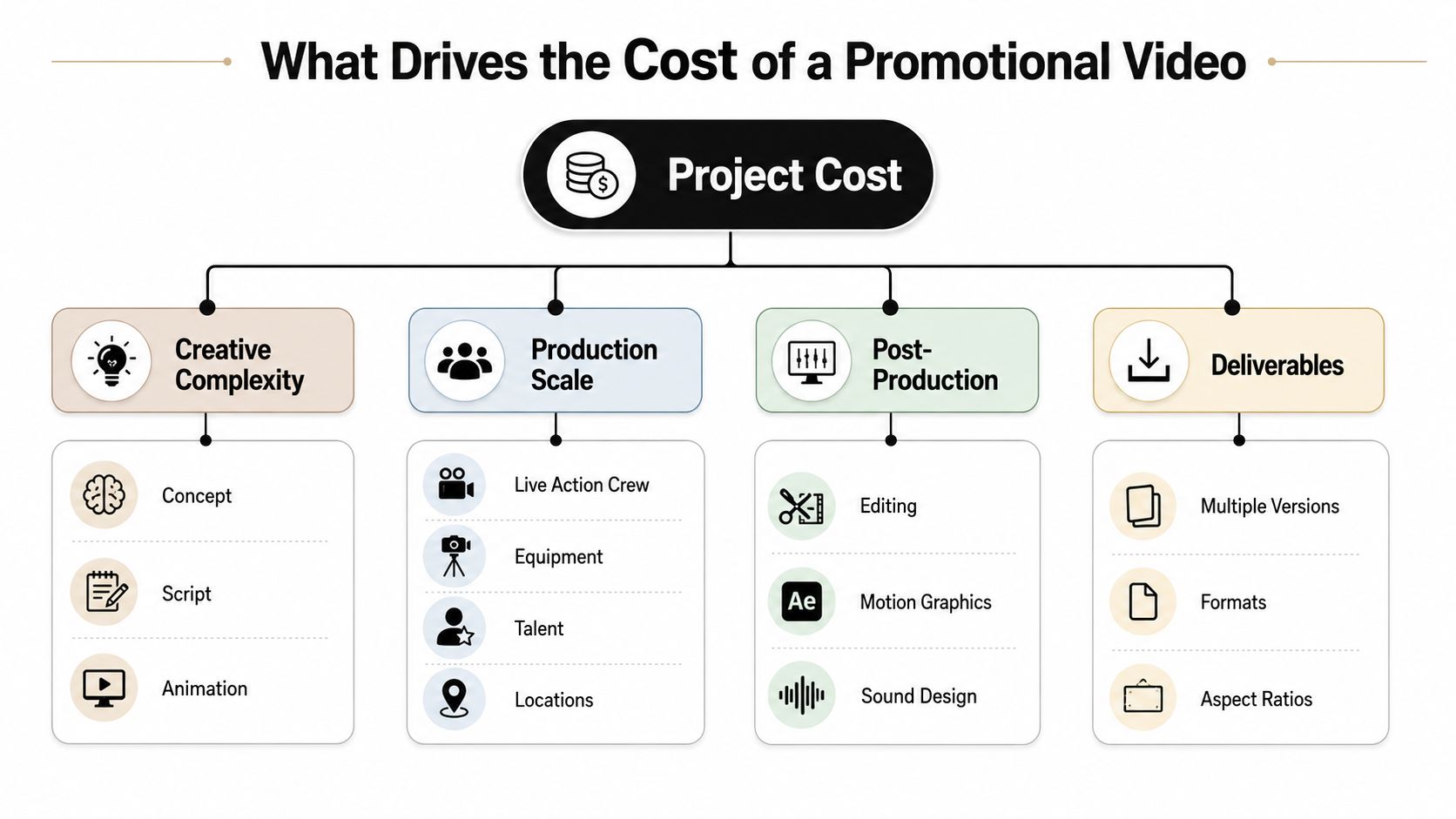
Cost is easier to understand as a set of drivers than as a price tag. The quote changes because the brief changes, and the team’s job is to separate the creative decisions that move scope from the ones that don’t.
The big cost levers
Live action usually carries more moving parts than animation because it needs people, locations, equipment, and time on set. Animation shifts more effort into design and motion, which can be simpler to revise later, especially when the product changes or the messaging still isn’t stable.
The other big drivers are the ones buyers can control. More shoot days mean more crew time. Talent and usage rights add complexity. Locations and travel add logistics. Motion graphics depth changes post-production load. More cutdowns and aspect ratios mean more versions to finish. Revision rounds also matter, because each extra loop costs time even when the shot list doesn’t change. If the brief asks for more formats, more versions, and more approval layers, the quote should reflect that, even when the concept looks simple on paper.
For a sense of where live-action money actually goes (talent, location, rigging, rehearsal), Volvo Trucks’ most famous promo is a useful extreme.
Why modular production changes the economics
A useful shift in the market is the move from one hero asset to a modular system. Teams are now designing shoots around reuse, with separate cuts for vertical, square, and longer trust-building formats. That can reduce cost and turnaround when the source material is planned for repurposing from the start.
It can also create more revision overhead if the team decides too late that every platform needs a different message. In that case, the modular idea turns into more versions without a stronger plan. The most efficient setup is the one where the master edit and the cutdowns are planned as one system, not a sequence of afterthoughts.
Budgets in this category vary more than most buyers expect. HubSpot’s video marketing survey found that almost 40% of companies spent under $5,000 producing videos in the prior year, while on the promotion side 41% of companies spent under $20,000 on video promotion and advertising in 2025 and 28% spent over $20,000 (HubSpot state of video marketing data). Teams are scoping the same category in very different ways.
If you’re comparing line items, this breakdown of video production cost is a useful companion. Don’t chase the lowest number; work out which parts of the scope are driving the quote.
Six ways to get a promotional video made
Different partner models fit different volumes and levels of control. The right choice depends on how often you need video, how much of the creative process you want to own, and how much coordination your team can absorb.
The tool environment also includes AI-first products, which can help with drafting and speed, but they shouldn’t be confused with a full production partner. If you’re comparing tools as part of your shortlist, ShortGenius is one example of the drafting-side category.
| Partner model | Best for | Typical turnaround | How you pay | Control | Main risk |
|---|---|---|---|---|---|
| Freelancer | Small, focused projects | Fast to start | Per project or day rate | High for the buyer, if they can manage it | Coordination and continuity sit on you |
| Per-project production company | Polished one-off videos | Medium | Per project quote | Shared | Changes trigger new scope |
| Traditional agency | Bigger campaigns with strategy layers | Medium to slower | Per project or retainer-style engagement | Shared across more stakeholders | Slower handoffs and more overhead |
| Embedded creative team | Steady flow of promos and cutdowns | Fast once embedded | Set monthly cost | High, with a consistent team | Poor fit for a single one-off |
| In-house hire | Deep brand familiarity | Depends on the hire | Salary and tools | Very high | One person rarely covers every skill |
| AI-first tools | Drafting, ideation, rough scripting | Very fast | Tool access or usage pricing | High at the prompt level | Output still needs real production judgment |
What each model really gives you
A freelancer is fast to start and often the lightest-touch option, but the buyer has to coordinate the moving pieces. A per-project production company is better when the shoot needs polish and management, but every new video gets scoped again. A traditional agency adds strategy and broader campaign thinking, though that usually means more layers between the brief and the edit.
An embedded creative team is the right fit when video is part of weekly output, not a once-a-quarter event. This is the model I work inside: a dedicated creative team delivering on a steady weekly rhythm, on brand and ready when needed. In-house gives you control and context, but it’s rare for one hire to cover scripting, shooting, motion, and edit well at the same time.
If you want a broader market view before talking to vendors, this roundup of the best video production companies is a better place to compare styles. The decision, though, should come down to volume, not hype.
How to write a brief and evaluate a proposal
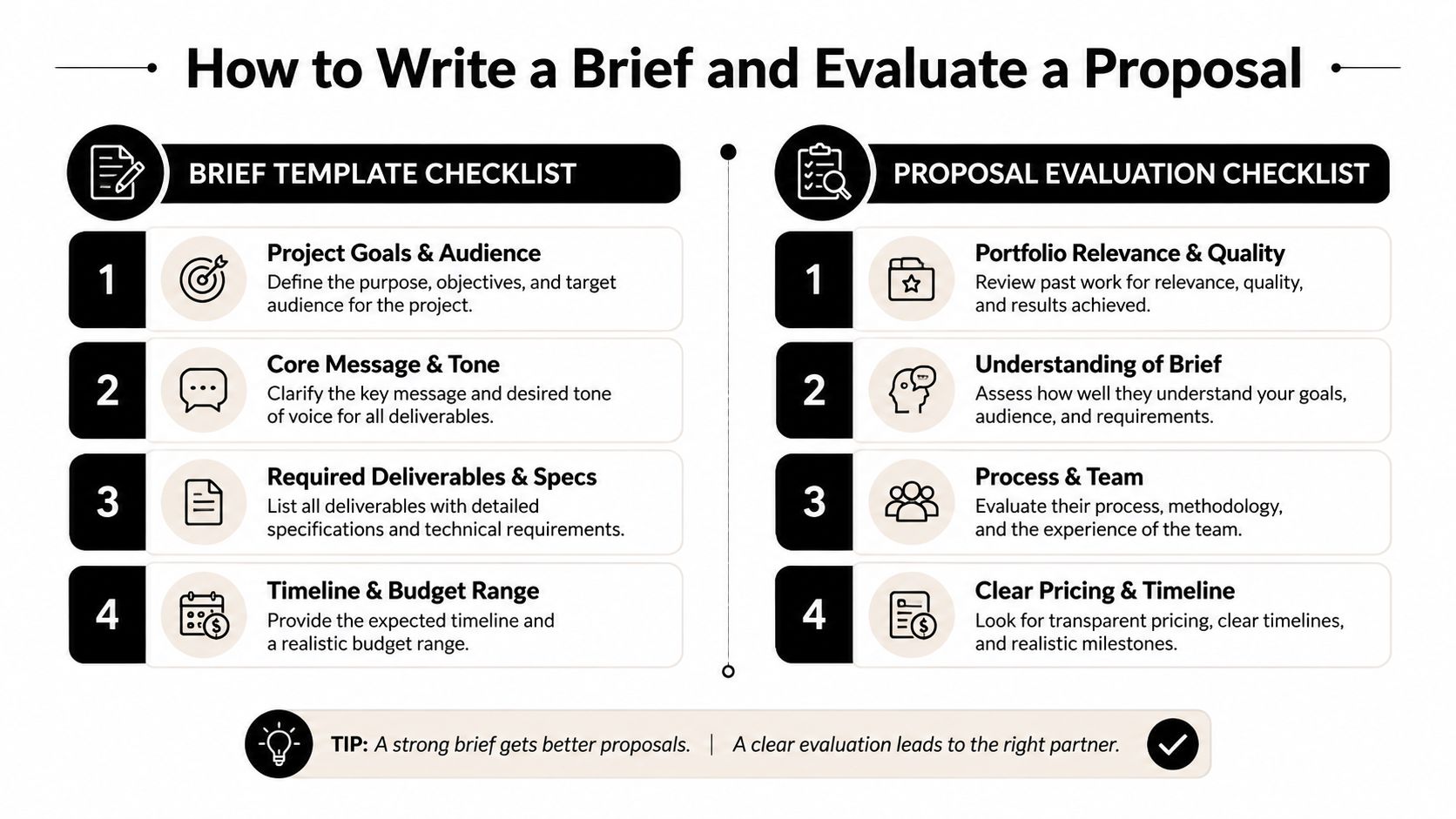
A good brief gets you a useful quote. A vague one gets you a number that looks neat and behaves badly later.
For a clean briefing process, this creative brief guide is a solid reference point, especially if your team needs to standardize how requests come in.
Brief template
- Project goal and audience. State what the video needs to do, and who it’s for.
- Single message. Write the one thing the viewer should remember after watching.
- Placement and format. List where it will run, plus any aspect ratio, caption, or export needs.
- Deliverables. Include the master version and every cutdown you expect.
- Timeline. Share the date you need the first draft, the review window, and final delivery.
- Brand assets. Note what’s available, including logo files, fonts, product UI, and approved copy.
- Approval process. Name the decision-maker and the people who can review, but not veto late.
Proposal and portfolio checklist
- Named creative lead. Ask who owns the concept and who will direct the work.
- Process match. Check whether their workflow follows strategy, pre-production, production, and post-production.
- Revision handling. Confirm how many rounds are included and what counts as a scope change.
- Usage rights and file ownership. Make sure music, talent, and footage rights are clear before the project starts.
- Cutdowns from the start. Look for a plan that includes versions, not just one hero file.
- Relevant examples. Review whether the portfolio shows work similar to your format, not just glossy reels.
- Who did the work. Ask whether the person on the reel is the person who will lead your project.
A polished showreel is useful, but it doesn’t tell you who solves problems when the script changes or the brand files are incomplete. The proposal should answer that, plainly.
Common mistakes buyers make with promo videos
Most promo failures I see trace back to the brief, not the edit. A video that starts from “make it cinematic” usually ends up with a weak brief; state the business outcome instead, so the creative team can make choices that support the actual job. No single message means the video tries to do everything, so pick one point of view and push the rest into supporting assets. And too many approvers with no owner slows every decision; assign one decision-maker and keep the sign-off in writing at each gate.
Timing mistakes are the expensive ones. Signing off the script late, then changing it after animation or the shoot, creates rework, so lock the script before visuals move forward. Ignoring where the video will run until the edit is finished produces the wrong lengths or aspect ratios; decide placement early and build for it. Producing one hero video with no cutdowns makes the asset harder to use, which is why the master plus versions belong in the storyboard stage.
The rest are contract and judgment problems. Skipping usage rights on music, stock, or talent turns paid media into a licensing problem later, so clear rights before delivery. Choosing on the showreel alone can hide weak execution; ask who does the work and who leads creative. And treating AI-generated video as a substitute instead of a drafting tool leads to generic output. Use it to move faster on ideas, then judge the result like a real production.
If you are about to request quotes, start with the brief template above, decide who owns approvals, and ask each partner to show the process, the revision rules, and the versioning plan in writing before you sign.
Frequently asked questions
One person who is close to the launch and empowered to approve, usually a product marketer or brand manager. The owner writes the brief, collects internal feedback into a single voice, and signs off at each gate. Committees can review, but they should not all approve. Every stalled promo project I have watched up close had either no owner or three.
Two structured rounds is the common baseline: one on the rough cut, one on the near-final version. What matters more is the definition of a revision. Timing, music, and pacing notes are normal rounds; a new script or a new target audience is new scope. Get that boundary in writing before production starts, not during the edit.
Only if the contract says so. Many production companies deliver finished files but keep raw footage and project files unless buyout terms are agreed upfront. If you expect future cutdowns, ask for raw footage rights, editable project files, and music licenses that cover paid placements and renewals. Negotiating this before the shoot is far cheaper than after.
Not cleanly, because each platform measures attention differently. Nielsen research published by Think with Google found attention to video ads on YouTube was 1.8 times higher than on social media platforms, so judge a video against its own placement context, not against another channel's norms. Tie the measure to the objective in the brief: reach and completion for awareness, click-through and trial requests for consideration.
Live action fits tangible products, real people, and physical spaces, and it usually carries the strongest trust signal. Animation fits software, abstract services, and anything that will keep changing, because scenes can be revised without a crew and it travels better across languages. Match the format to what you are selling and how often it will need updating, not to whichever looks more impressive in a reel.