UGC Video vs Polished Video: When Each One Wins
When UGC video beats polished production and when it does not, with a side-by-side comparison, eight scenario verdicts, and a two-layer system that runs both.

UGC video is video made by a customer, fan, or paid independent creator who films a product in a native handheld style rather than through the brand’s production team. It earns its keep in cold paid social and social proof; polished production earns its keep in launches, brand work, sales enablement, and anything with legal or consistency stakes. Most teams need both, with each asset assigned to the job it does best.
I work at Moonb, and the question behind most of the briefs I see is not “which format is better” but “which format is better for this placement.” A consumer-app client of ours ran the same offer with a creator clip and a produced cut in the same week; the creator clip won the cold audience and the produced cut won the retargeting pool, which is roughly what the rest of this article will tell you to expect. The teams that struggle are the ones that pick a side and force every brief through it.
What UGC video actually is and when to use it
UGC video is made by a real customer, creator, or user instead of the brand, usually in a native handheld style. The creator may post it organically, make it under commission, or grant the brand permission to publish it across paid, owned, and social channels. The format works because it looks closer to the content people already choose to watch than to a conventional commercial, and audiences read that proximity as credibility long before they read the caption.
That makes UGC useful for cold paid social, product-page proof, retargeting, and rapid creative testing. Use the format when the audience needs to see a peer using the product, handling an objection, or showing a result. Beauty, supplements, apparel, consumer apps, and other categories driven by peer validation benefit most from that closeness. UGC also lets teams test hooks and messages cheaply before committing to a larger production.
Reach for polished video when the message is complex, the brand itself carries the value, or the asset needs to look consistent across markets for a long period. That covers launches, homepage films, sales decks, investor updates, event content, regulated claims, and flagship campaigns.
The trade-off is straightforward. UGC gives you speed, volume, and social familiarity, but less control over delivery and visual consistency. Polished production gives you control, clarity, and a longer usable life, but it takes more planning and can feel like an ad to people who don’t know you. For a quick visual reference, browse these examples of user generated content. If you want a sense of what the structured end of the spectrum looks like, our testimonial video examples show how produced storytelling handles the same proof job. Pick the format that matches the job, not the format that flatters the brand.
Three things that count as UGC today
The label UGC video now covers three distinct types of content. They share a handheld look, but their rights, approvals, and disclosure obligations differ.
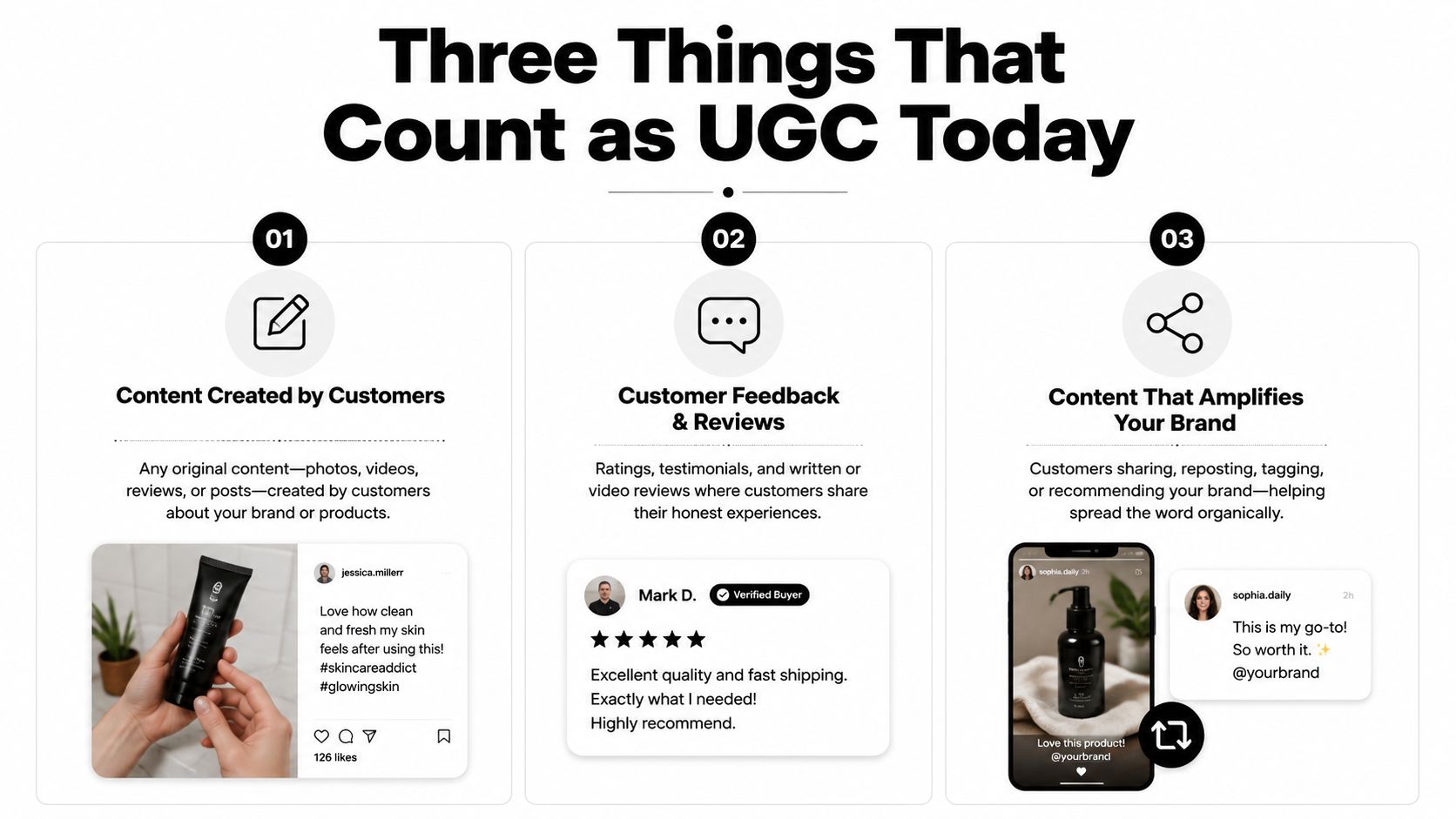
Organic customer content
This is footage a customer creates without being commissioned. It might be an unboxing, a review, a routine, or a spontaneous product demonstration. A brand should ask for permission before reposting or placing it in advertising, clarify where it may appear, and credit the creator where appropriate.
Organic content can feel especially credible because the creator made it independently. It can also be hard to control. The framing, claims, sound, and product depiction may not meet your standards, so review it before publication.
Paid creator UGC
A brand commissions an independent creator to film to a brief. The creator may never post the video on their own account. The value is the creator-native performance, not necessarily the creator’s audience.
Paid relationships need clear disclosure when the content runs as an endorsement or sponsored post. The FTC’s Endorsement Guides explain how endorsements, material connections, and disclosures should be handled. Use clear labels such as #ad or the platform’s paid partnership tool, and keep the disclosure visible rather than buried in a caption.
AI-avatar synthetic UGC
AI-avatar content uses a generated presenter, synthetic voice, or other artificial production method to imitate a first-person creator format. It can be efficient for versioning, but it raises a different trust question. Brands should label synthetic content wherever platform policy or law requires it, and should never present a generated person as a real customer.
Treat all three as separate production streams. Organic UGC needs permission and curation. Paid creator UGC needs contracts, usage terms, and disclosure. AI-avatar content needs labeling, review, and a higher bar for reputational risk.
Common UGC formats and what each one is best for
The format should follow the buyer’s question. A testimonial answers “did this work for someone like me?” An unboxing answers “what arrives, and what does it feel like?” A tutorial answers “how do I use it?” The strongest brief gives the creator one audience, one surface, and one takeaway.
| Format | What it shows | Best for |
|---|---|---|
| Testimonial | A customer or creator explains a real experience and outcome | Consideration and retargeting, where peer proof helps resolve doubt |
| Unboxing | The package, product details, texture, size, and first reaction | Paid social hooks and product pages, especially when presentation matters |
| Tutorial | A clear demonstration of setup, use, or a specific feature | Search, discovery, and onboarding, where the buyer has a practical question |
| Day in the life | The product used inside a normal routine or workday | Lifestyle, replenishment, and habit-led products |
| Before and after | A visible contrast between the starting problem and the result | Beauty, fitness, home, and cleaning, where the change carries the message |
A testimonial can be warm and persuasive, but it turns weak when the creator makes broad claims without evidence. An unboxing can stop the scroll without ever explaining why the product matters. A tutorial earns attention through usefulness, and it needs one focused demonstration rather than a feature tour.
Before commissioning, write the destination into the brief. A TikTok or Reel needs a fast opening and readable captions. A product-page video can spend more time on detail. YouTube’s own Shorts documentation confirms the format runs vertical and can now be up to 3 minutes long, which changes what a single Shorts brief can carry. For the platform-level editing decisions UGC briefs tend to miss, our guide to short-form video and Reels goes deeper.
HubSpot’s social team tracks which of these formats are actually earning reach this year, and their rundown is a useful sanity check before you assign one to a campaign.
UGC vs polished video, side by side
UGC and polished video are different production tools, and the better choice depends on the job. Assess the required control, turnaround, number of variants, distribution channel, and audience familiarity before choosing a format.
| Dimension | UGC video | Polished video |
|---|---|---|
| Cost model | Creator fee plus editing and usage rights | Project quote covering crew, production, direction, and post |
| Turnaround | Often faster because creators film in their own spaces | Longer because planning, filming, and post need coordination |
| Volume | Well suited to many hooks, creators, and variants | Better suited to fewer, more deliberate hero assets |
| Creative control | The brand controls the brief, not every performance detail | The brand controls script, casting, camera, design, and edit |
| Brand consistency | Can drift across creators and locations | Stronger visual and verbal consistency |
| Trust with cold audiences | Often feels native and peer-led | Can feel more obviously commercial |
| Shelf life | May fatigue quickly in paid social | Can remain useful across launches, sites, decks, and events |
| Usage rights | Must be negotiated for paid ads, websites, duration, and whitelisting | Usually defined within the production agreement |
| Disclosure | Paid or gifted relationships need clear disclosure under FTC rules | Standard brand advertising is already identified as advertising |
UGC usually wins when the team needs many creative tests quickly, at the cost of control over performance, setting, continuity, and brand presentation. Produced video takes longer and costs more to coordinate, but it gives the team a reliable visual system for launches, product pages, presentations, and long-lived campaigns.
Native framing still matters. Across the major short-form platforms the practical baseline is 9:16 vertical at 1080 x 1920. Vertical footage fills the mobile screen and protects captions, on-screen text, and face-centered hooks from interface cropping. Burn in captions, keep the subject in a center-safe area, and capture source footage that supports multiple exports. The opening needs its own edit plan too: a creator may deliver a natural first line, but viewers still need to understand it without sound, and guidance on why certain TikTok captions work can help shape how the caption reinforces the spoken idea instead of repeating it.
On cost, resist the urge to anchor on a published per-video rate. Creator fees vary widely with experience, category, usage rights, and whitelisting, and the editing, licensing, and revision work around the clip often costs as much as the clip. Our video production cost guide breaks down what moves the produced side of the comparison, and the honest answer on the UGC side is that the contract terms move the number more than the filming does.
Eight scenarios and the verdict for each
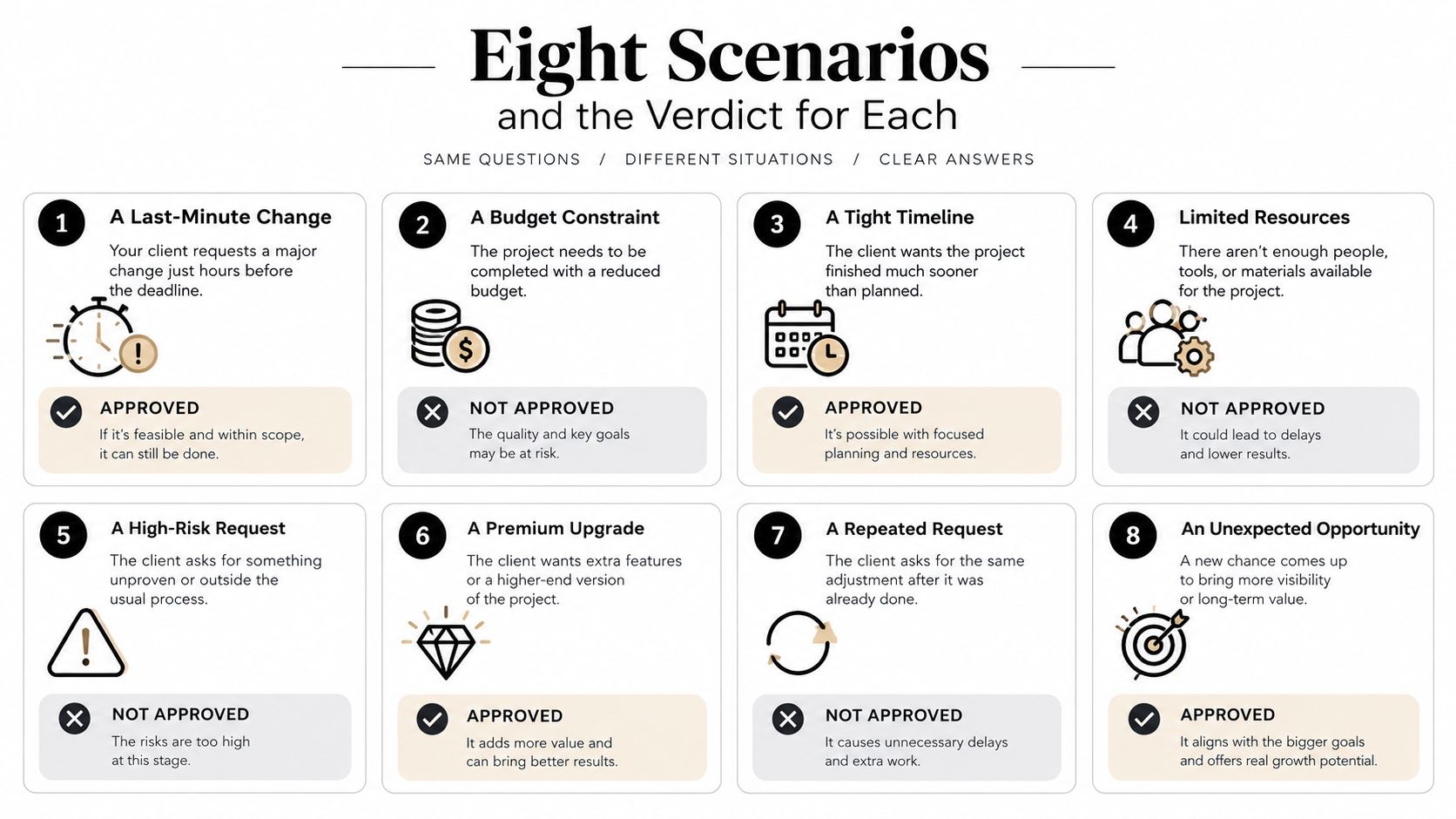
The right choice becomes clearer when the brief is specific. A cold acquisition ad has a different job from an investor update, and a product demo has a different burden of proof from a brand film.
1. Cold paid social
Use creator-style footage for TikTok, Reels, and paid social prospecting. The native look, direct hook, and first-person delivery give unfamiliar audiences a reason to pause.
Verdict: UGC wins. Put most testing effort into creator variants, then reserve polished work for brand reinforcement outside the first-touch ad set.
2. Product launch
A launch needs a clear product story, controlled visuals, approved claims, and a consistent reveal across channels. That combination favors directed production.
Verdict: polished wins. Add UGC after launch to answer real objections and show the product in ordinary use.
3. Retargeting and cart recovery
People who already visited usually need reassurance rather than another broad brand message. A testimonial, tutorial, or objection-led creator clip supplies that proof.
Verdict: UGC wins. Pair it with a clean product-page asset that confirms specifications and purchase details.
4. Brand film or manifesto
A brand film carries the company’s voice, visual language, and larger promise. It needs direction that stays coherent across scenes, markets, and future edits.
Verdict: polished wins. UGC can support the campaign as social texture, but it shouldn’t carry the central brand statement.
5. App store and onboarding video
The answer depends on the app. A consumer app may benefit from a creator showing the first-use experience. A complex B2B product needs a controlled walkthrough that makes the workflow easy to understand. For software and technical products, a tutorial often carries more weight than a lifestyle clip; customer-story libraries such as Trupeer Inc. customer results show how real product experiences get structured.
Verdict: split the job. Use UGC for discovery and produced video for onboarding, feature explanation, and support.
6. Influencer collaboration
The creator’s own voice is the asset in an influencer partnership. A rigid script can make the work feel paid before the viewer understands the product.
Verdict: UGC first. Move to polished production only when the creator becomes part of a larger campaign or hero film.
7. Lifecycle and retention email
Existing customers respond to practical reminders, new-use ideas, and familiar voices. UGC can be made in a repeatable way and cut into short modules.
Verdict: UGC wins. Use produced design and motion around the clip when the email needs stronger brand structure.
8. Trade shows, sales decks, and investor content
These settings put more weight on message control, reliability, and visual authority. The audience may include buyers, executives, partners, or investors who need a coherent story.
Verdict: polished wins. Keep creator footage for supporting social proof, not the central presentation.
How to source UGC and run it with produced work
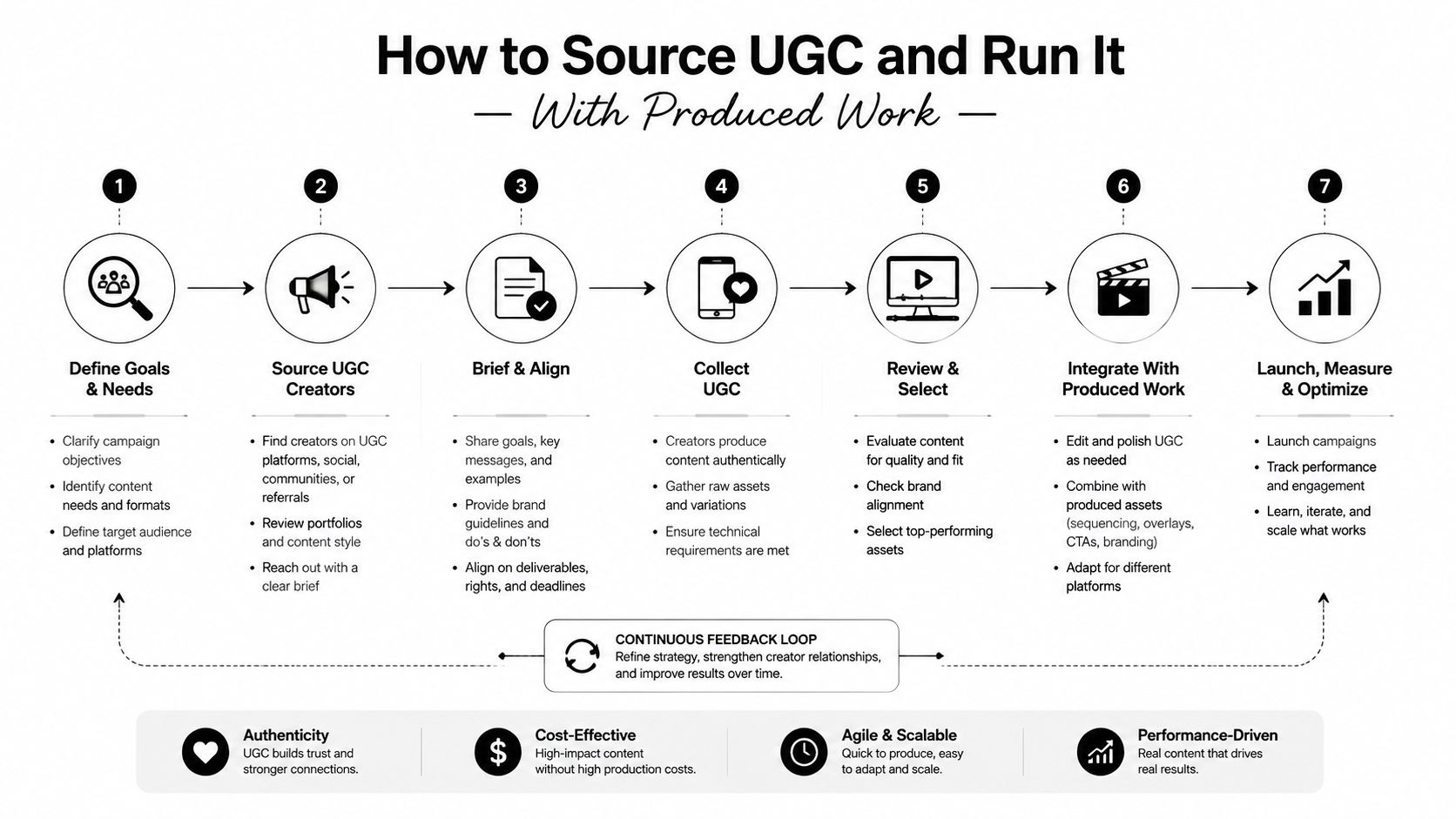
UGC sourcing starts with the creator pool, but the quality of the program depends on the brief and the contract. Creator marketplaces speed up discovery. Direct outreach works when a brand already knows the right niche voices. Customer recontact programs produce stronger product familiarity, and they need permission and careful selection.
The brief should be short enough to use and specific enough to protect the message:
- Opening hook: state the viewer problem or surprise in the first beat.
- Three beats: show the situation, the product in use, and the takeaway.
- Product visibility: specify when the product must appear and which features are essential.
- Text rules: set the caption style, claims limits, and any words that need exact approval.
- Brand safety: list restricted claims, sensitive topics, competitor references, and required legal review.
Don’t write every sentence for the creator. Give them the point, the proof, and the boundaries; their natural phrasing is part of why the format works.
Rights need to be written down
A creator agreement should specify organic use, paid advertising, website placement, duration, territories, exclusivity, editing permission, and whitelisting. Whitelisting, sometimes called creator licensing or paid partnership authorization, lets a brand amplify content through the creator’s account or identity where the platform supports it. It should never be assumed from a basic video fee.
The supply side keeps growing: Collabstr’s 2025 creator economy report describes UGC creators increasing 93% year over year. More supply doesn’t remove the need for selection. It makes the brief, the review process, and the rights checklist more important, because the floor of the market gets noisier as it widens.
Combine both in one funnel
Use polished video for the website, launch page, sales deck, and core explanation. Feed UGC variants into paid social, retargeting, and lifecycle placements. A SaaS company might run a produced brand video and product demo on its site and in sales decks, while independent creators film first-person walkthroughs for cold paid social. The produced layer explains and reassures later in the funnel. The creator clips stop the scroll and build trust earlier.
UGC clips still need branded end cards, captions, cutdowns, and matching feed assets to run as one campaign. Moonb’s social media design service covers that packaging work as part of a dedicated creative team that delivers on a steady weekly rhythm, on brand and ready when needed.
Plan the complete asset system rather than collecting isolated clips. A monthly content planning approach helps the team assign each source asset to a placement, owner, approval path, and version name before production begins.
Common mistakes and fair metrics for comparing both
UGC programs usually break between creator footage and media operations. A brand commissions a few clips, launches them without a test plan, then treats a weak sample as a verdict on the format. Produced video has its own failure mode: teams polish one film so heavily that they learn too little about the hooks, objections, or audiences that matter.
The recurring mistakes are practical:
- Writing the creator’s script: brand language removes the natural phrasing viewers expect from a creator.
- Buying one hero video: one asset cannot show which hooks, creators, or objections deserve more budget.
- Ignoring rights: agree on paid usage and whitelisting before filming, never after an ad starts working.
- Running raw footage: missing captions, weak openings, and no end card make useful footage feel unfinished.
- Skipping legal review: claim-heavy and regulated products need the same review discipline whether the footage looks casual or polished.
- Dropping produced work entirely: a website, sales deck, or launch loses coherence if every surface uses social-first clips.
- Leaving produced footage untouched: a polished shoot still needs short cutdowns, vertical versions, and feed edits.
Disclosure belongs in the production plan. The FTC’s endorsement guidance covers material connections and deceptive presentation, and an undisclosed paid or gifted relationship exposes both the brand and the creator.
Compare the job, not the format
Use the same offer, audience, landing page, budget, placement logic, and flight window for a fair head-to-head test. A UGC ad built for cold discovery cannot be compared fairly with a polished film shown to a warm audience; the result would measure audience and funnel conditions as much as creative quality.
| Variable | Hold constant | Decision metric |
|---|---|---|
| Offer | Price, promotion, and call to action | Incremental CPA or MER |
| Audience | Same prospecting or retargeting definition | Conversion quality |
| Landing page | Same page and checkout path | Conversion rate |
| Placement | Comparable feed and format placements | Placement-adjusted CPA |
| Budget | Comparable delivery opportunity | Spend efficiency |
| Flight length | Same test period | Fatigue and stability |
| Creative role | Hook, proof, explanation, or reassurance | Job-specific performance |
For paid social, track thumb-stop rate, midpoint hold rate, click-through rate, cost per acquisition, and the number of days until frequency-driven CPA rises. For product and landing pages, compare conversion rate with and without the video. For brand and sales assets, review completion, recall or brand-lift studies where available, demo requests, and time on page.
The metric must match the assignment. A creator clip may win attention and objection handling, while a produced video carries the brand promise or explains a complex product more clearly. Judge each asset on the work it was hired to do, track the full journey with a proper video marketing ROI setup, and ask vendors for raw account data instead of curated averages.
A two-layer system for steady, on-brand video
The most workable model is a two-layer system.
The first layer is produced. It carries the brand promise, product truth, visual language, pack shot, pricing story, and complex explanation. Its success metric is brand lift, recall, and assisted conversion.
The second layer is UGC. It carries proof, demonstrations, objections, reactions, and creative variation. Its success metric is incremental CPA, conversion quality, and creative refresh rate.
This split maps almost exactly onto the brand-building versus activation distinction that Les Binet and Peter Field spent two decades documenting, and their conversation on it is worth an hour of any media planner’s time.
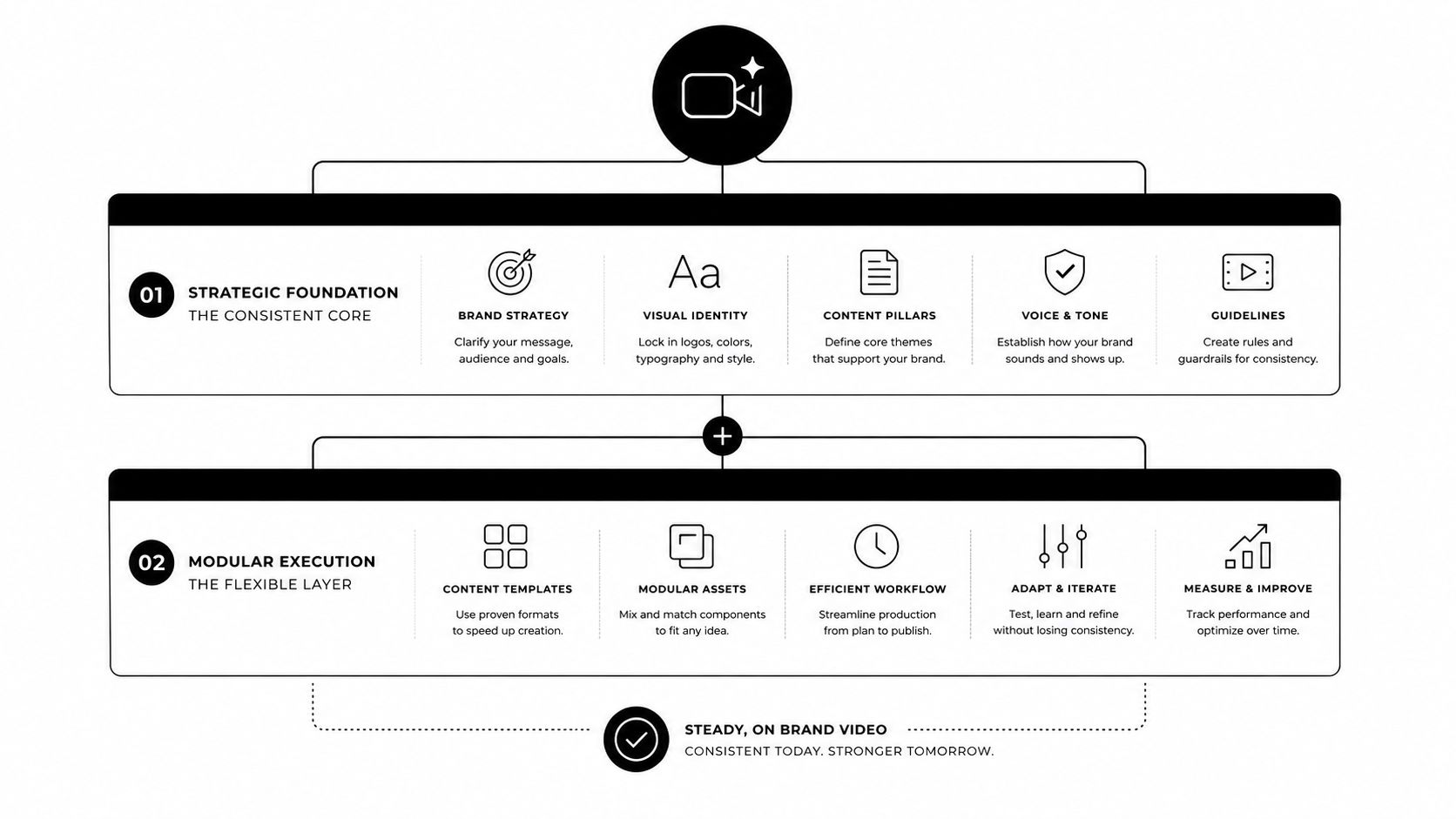
Give each layer its own brief, owner, review path, and measurement plan. Don’t force them to compete in the same ad set. Let UGC show the product in real use, then let produced assets explain the brand and the deeper value.
Start with the next campaign. Mark every existing video as UGC proof, produced brand, or needs repackaging. Then route new requests through the matching brief, with rights and disclosure agreed before filming. That simple split will tell you whether your next investment belongs with creators, a production team, or both.
Frequently asked questions
Yes, the moment you want to do anything beyond engaging with it on their post. Reposting to your own account, running it as an ad, or placing it on a product page all need explicit permission, and paid usage needs written terms covering duration, placements, and editing. A public post grants you nothing; it is still the creator's content.
Start with three to five creators producing two or three variants each, not one creator producing ten. Creator delivery varies more than script quality does, so spreading the same brief across several voices tells you quickly which style your audience trusts. Scale spend toward the one or two whose clips clear your cost target, and refresh the pool as their content fatigues.
Yes, but the peer has to change. A B2B buyer trusts a practitioner walking through a real workflow, not a lifestyle creator holding a laptop. First-person screen recordings, founder or operator explainers, and customer walkthroughs play the same role UGC plays in consumer feeds. The handheld aesthetic matters less than the sense that a real user, not the vendor, is doing the talking.