Super Bowl Ad Cost in 2027
What a Super Bowl ad costs: about $8 million for 30 seconds of airtime in 2026, $8 to $9 million for 2027, plus production, talent, the price history and the ways in for less.

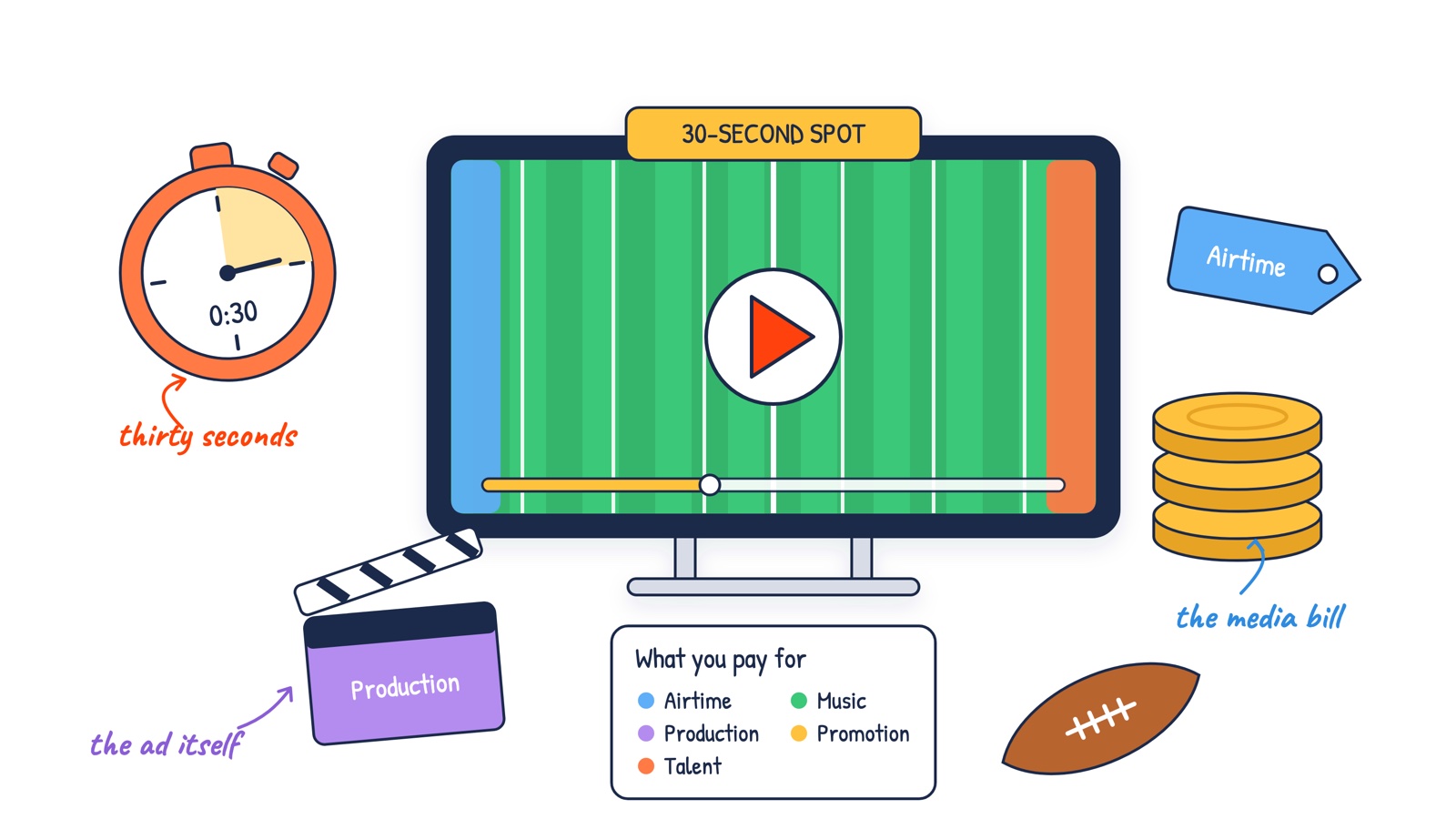
A 30-second Super Bowl commercial cost about $8 million in airtime for the 2026 game on NBC, and a handful of spots went for $10 million or more, which had never happened before. For Super Bowl LXI on February 14, 2027, Disney asked $10 million per spot and most of them reportedly sold for $8 to $9 million. Making the ad and paying the people in it comes on top, and for a big-name spot the whole campaign can run from $15 million to $50 million.
I work at Moonb, a creative studio, and every January someone forwards me a Super Bowl ad with a note that says “can we do something like this?” Usually they mean the creative, and sometimes they mean the airtime too. So this guide answers both halves: what the network charges for the slot, what the ad itself costs to make, how the price got here, and the smaller ways into the game that cost a fraction of $8 million.
A 30-second spot costs about $8 million
The national price for 30 seconds has sat around $8 million for two years running, after climbing roughly $1 million every couple of years before that. Networks never publish a rate card, so every number below comes from buyers and the trade press, and the top spots always sell above the average.
| Year | Game and network | Reported price for 30 seconds | Average audience |
|---|---|---|---|
| 2027 | LXI, ESPN and ABC | $8M to $9M for most spots, after Disney asked $10M | Not yet played |
| 2026 | LX, NBC | About $8M on average, a few at $10M or more | 125.6 million |
| 2025 | LIX, Fox | $8M for the top spots, a record at the time | 127.7 million |
| 2024 | LVIII, CBS | $6.5M to $7M, some above $7M | 123.7 million |
| 2023 | LVII, Fox | $6M to $7M, the peak above $7M | 115.1 million |
| 2022 | LVI, NBC | Some spots at $7M | 112.3 million |
| 2021 | LV, CBS | About $5.5M | 96.4 million |
The 2026 first, the $10 million spot, came from NBCUniversal’s own ad sales chief, who told Adweek how a handful of buyers paid it. For 2025, Fox sold at least ten spots at $8 million each, according to CNBC’s reporting via NBC News. The audience column comes from Nielsen, whose 2025 release recorded the biggest average audience in TV history, 127.7 million people, and whose final count for the 2026 game landed at 125.6 million.
One thing I always point out when a client reads a table like this: prices rise as the game gets closer. Networks sell the first spots in spring and summer and add to the price as inventory runs out, so two brands sitting next to each other in the same break can have paid very different amounts.
Super Bowl LXI sold out in August 2026
Every 30-second slot in the 2027 game was gone by August 5, 2026, more than six months before kickoff. Disney sold the game across ESPN and ABC, the first time ESPN has carried a Super Bowl, and its advertising arm announced 58 brands across 34 categories, nine of them advertising in the game for the first time. The game itself is at SoFi Stadium in Inglewood, California.
That sell-out came about a month earlier than NBC managed for 2026 and around three months earlier than Fox for 2025, Front Office Sports reported, which also said Disney opened at $10 million per spot and settled at $8 million to $9 million for many of them after buyers pushed back. Disney itself has not published a price.
What that means in practice: if a brand wants national airtime in the big game, the decision gets made in the spring, nearly a year before the ad runs. The creative, in my experience, often gets finished in the last few months before the game, which is why some Super Bowl campaigns feel rushed even with that much money behind them.
What a Super Bowl ad costs to make
Airtime is the number everyone quotes, but it is only the media bill. A big-game campaign also pays for the production, the talent, the music and everything that promotes the ad before and after the game. CNN put the total for a star-led Super Bowl commercial at $15 million to $50 million, with $10 million to $15 million of that going to the talent alone.
| What you pay for | Reported range | Source |
|---|---|---|
| 30 seconds of national airtime | About $8M (2026), $8M to $9M (2027) | Adweek, Front Office Sports |
| A cameo from a famous face | $25,000 to $10M | A talent agent at WME, via CNN |
| Most bigger stars | $1M to $3M | A talent agent at WME, via CNN |
| The top celebrity fees | About $10M | CNN |
| The whole campaign, star-led | $15M to $50M | CNN |
The talent figures come from Tim Curtis at the talent agency WME, who told CNN that cameos run from $25,000 to $10 million, that most bigger stars get $1 million to $3 million, and that the shoots usually take one or two days. CNN also reported that Ben Affleck was paid about $10 million for Dunkin’s 2023 spot.
On the production side, I can tell you where the money goes, because the line items are the same ones we see on any commercial, only bigger. The director and the crew, the cast and their usage rights, the set or location, visual effects, the music license, the edit and the color grade, and then all the versions: a 60-second cut, a 15-second cut, vertical and square versions for social, the teaser that runs a week before the game. On a big-game spot, that last group is where I see budgets grow the most, because the ad has to work on YouTube and social for weeks after the 30 seconds on TV. Our breakdown of what a 30-second commercial costs walks through those lines for a normal broadcast spot, and the video production cost guide covers the rest of the range.
Is a Super Bowl ad worth $8 million?
Measured per viewer, the price is lower than it sounds: about $64 for every thousand people watching in 2026, against roughly $58 in 2022. That is my own arithmetic, dividing the reported average price by Nielsen’s average audience, and since Nielsen changed how it measures in both 2025 and 2026, treat the trend as approximate.
| Year | Price for 30 seconds | Average audience | Cost per 1,000 viewers |
|---|---|---|---|
| 2022 | $6.5M | 112.3 million | About $58 |
| 2023 | $7M | 115.1 million | About $61 |
| 2024 | $7M | 123.7 million | About $57 |
| 2025 | $8M | 127.7 million | About $63 |
| 2026 | $8M | 125.6 million | About $64 |
The reason brands keep paying is that nothing else on TV gathers that many people live, all at once, watching the ads on purpose. NBC News’s Jesse Kirsch looked at exactly that question in 2025, why companies spend record amounts on a TV event while viewers move to streaming, and the piece is worth four minutes:
Where I push back with clients is on the creative. The airtime buys the audience, and what the ad does with that audience decides whether the money comes back. The research we pulled together for our 2026 Brand Creative Report points the same way: positive-emotion campaigns have been associated with 47% higher return on ad spend and six times the lift in intent to act. An $8 million slot with a forgettable ad is the most expensive way I know to waste a media budget, and the ads people still talk about in March are almost always the ones with one clear idea and a feeling attached to it. If you want examples, our list of the best recent TV commercials includes several big-game spots worth studying.
Ways into the game for less than $8 million
You do not need a national spot to advertise during the Super Bowl. Local TV stations sell a small share of the breaks in their own markets, there are pregame and postgame slots, and since 2024 the streams have sold some ads of their own.
| Option | Reported price | What you get |
|---|---|---|
| Local spot in a smaller market | From about $10,000 to $50,000 | The game audience in one city |
| Local spot in a top market | Around $1.4M | New York, Chicago or San Francisco only |
| Pregame, just before kickoff | Up to $4.5M (2025) | A big live audience, before the game starts |
| Postgame | About $4M (2025) | The audience that stays on |
| Streaming-only spot | Roughly half the TV price (2026) | Viewers watching on the network's streaming service |
Local stations get roughly 14 of the 100 or so commercials in the game, and a Colorado Springs station was charging more than $10,000 for one in 2022, the Denver Gazette reported. Marketing Brew put the range in 2025 at about $50,000 in smaller cities and about $1.4 million in the biggest ones, and found brands buying several markets at once, from Busch Light across 11 southern markets to Duolingo with a five-second spot in seven markets in 2024.
The pregame prices come from TheWrap’s 2025 reporting, which put the slot just before kickoff at up to $4.5 million and postgame at about $4 million. For 2026, CNBC reported that NBCUniversal held back about a tenth of its inventory for streaming-only ads on Peacock at roughly half the TV price.
For a regional brand, a local spot is the move I would look at first. The people watching are still paying attention to the ads, and the spot can be made to the same standard as a national one, with the money left over going into running it online for weeks afterwards.
A 60-second spot costs about twice as much
Networks do not publish a rate for 60 seconds, but the price scales roughly with length, so a minute costs about double a 30-second spot. In 2020, Kantar’s analysis of the game’s spend put Anheuser-Busch InBev at about $41 million for four minutes and PepsiCo at about $31 million for three, which works out to just over $5 million per 30 seconds, the going rate that year.
Longer ads have become more common, too. Kantar counted 26 of the 59 paid spots in 2020 running 60 seconds or longer, a record, while 30-second spots fell to 44% of paid ads from an average of 63% over the decade before. The biggest single purchases on record, by Statista’s estimate, are Amazon’s $26 million in 2022 and Cadillac’s $22 million in 2021.
How the price went from $42,500 to $8 million
The first Super Bowl, in 1967, aired on both NBC and CBS, and a 30-second spot cost about $42,500. The price passed $1 million in the mid-1990s, reached $3 million by 2010 and has nearly tripled since.
Adjusted for inflation, that 1967 spot comes to around $372,000 in 2022 dollars, Front Office Sports worked out, so the real increase is about twenty-fold, driven by an audience that kept growing while the rest of TV split into hundreds of channels and then into streaming. CBS News put that value question to Adweek’s chief content officer, Zoë Ruderman, in 2024, the year spots were selling for around $7 million, and the segment runs about seven minutes:
How I would plan a Super Bowl ad
If a client of ours were buying a spot for February 2027, the airtime would already be booked, so everything below is about the creative and the weeks around the game. Here is the order I would work in:
- Write the brief before anyone pitches an idea. Agree on the one message and who it is for, before the first concept meeting. Our creative brief template is built for exactly this, and it saves the round of “we liked all three concepts”.
- Budget the versions, not just the spot. Plan the 60-second cut, the 15-second cut, the vertical edit and the teaser from day one, because shooting them later costs far more than shooting them on the same days.
- Script it in two columns. Picture on one side, sound on the other, with a time for every line. Our free video script template does this, and it is how you catch a 34-second script before it reaches the edit.
- Release it before the game. Many big advertisers now put their spot or a teaser online in the week before kickoff, so the TV airing becomes the second wave rather than the only one.
- Leave money for after. The ad keeps working on YouTube and social for weeks, and that is often where a smaller brand gets its real return.
For a view from outside the industry, Colorado State’s Todd Donovan talked to Denver’s 9NEWS before the 2026 game about whether the exposure justifies the expense and which trends to watch:
We make commercials and the cutdowns around them for brands that run campaigns all year, so if you are weighing a local big-game spot or a national one, the production side is something I am happy to talk through. And if you are choosing who makes it, our guide to commercial production companies compares the options.
Frequently asked questions
Earlier than they used to. Disney sold every national spot in the February 2027 game by August 5, 2026. NBC announced its 2026 game was sold out in early September 2025, and Fox sold out the 2025 game in November 2024. A brand that wants national airtime has to commit in the spring or early summer, nearly a year before the ad runs.
Yes, through a local TV station. Each local affiliate sells a small number of the commercial breaks in its own market, so a regional brand can buy the game audience in one city or a handful of cities without paying for a national spot. Contact the stations' local sales teams early, because these slots sell out too.
No. Thirty seconds is the unit networks price, but brands also buy 15-second and 60-second slots, and the biggest advertisers buy several minutes across the game. Longer ads have become more common, and a brand can run a shorter cut of the same ad in local markets.


