12 presentation design companies for keynotes, sales decks, and templates
12 presentation design companies for keynotes, sales decks, training decks, and template systems: which job each one suits, what it publishes on price, and one limitation apiece.


Every presentation design company has one kind of deck it does best, and the firm you’d trust with a main-stage keynote can be the wrong call for a sales template your whole team will use (and the other way around). These are the twelve I’d look at today: my own studio, then Duarte, Buffalo 7, Presentation Partners, BrightCarbon, SlideRabbit, SlideGenius, Presentation Studio, The Presentation Designer, Prezlab, 16X9, and 24Slides.
I run Moonb, and it sits at number one on my own list, which you are entitled to hold against me. Decks are one thing my team makes, next to video, motion, and brand design, and our limits are in the card like everyone else’s.
Investor decks are left out on purpose. They come with due diligence questions and a data room behind them, and our guide to pitch deck design services covers the firms built for fundraising. That leaves conference keynotes, where the slides have to read from the back of a ballroom, and the sales deck a rep runs forty times a quarter. Training decks too, since they usually end up as course material, plus the template a few hundred employees use with no designer in the loop. I took prices and turnaround times from each company’s own site in October 2026, so ask again the month you buy.
The 12 presentation design companies
1. Moonb
How deck work runs here
Our team sits inside the marketing departments we work with, at companies of every size, and deck requests rarely come one at a time here; they bunch up around launches and events, then again at quarter end. The presentation service covers pitch decks, sales decks, board reports, keynote decks, deck templates, and one-pagers. Whoever you hire, us included, test the handover. Ask to see a template that people outside the design team have been using for six months, and look at what happened to it.
2. Duarte

What a Duarte keynote can include
Duarte says it has been helping brands communicate since 1988. Its keynote page lists what a single event can include: main-stage keynotes, one narrative structure running across multiple presenters, breakout sessions for business units and divisions, leave-behinds and other event collateral, digital signage, booth and kiosk content, and reusable asset systems that live on afterward as sales tools and internal decks. It builds in PowerPoint, Keynote, and Google Slides. Template systems are a separate service, and the firm says one global technology company that commissioned a PowerPoint template system nearly ten years ago came back for the refresh. This is who I'd call for the event where five leaders each want stage time and nobody owns the through-line.
Nancy Duarte has put her thinking on talk structure in public, so you can judge the fit before a call. In her TEDxEast talk she explains the model she developed for designing presentations, then pulls apart speeches by Martin Luther King Jr. and Steve Jobs to show it working. I’d watch it before briefing anyone on a keynote.
3. Buffalo 7
The design side and the training side
Buffalo 7's menu splits in two. The design side covers presentation creation, PowerPoint templates, infographics, and print. The training side teaches virtual presentation skills, PowerPoint template training, and storytelling. Example decks are published by type, a conference presentation and a CPD presentation among them, so you can see the house style before you talk to anyone. On timing, its homepage says about two or three weeks from first consultation to final delivery.
The CPD work is why Buffalo 7 is on this list. Continuing-education decks get pulled two ways, because the governing body wants every technical detail on the slide and the people in the room need something they can follow after lunch. Its copy talks about balancing exactly those two, which suggests someone there has sat through plenty of CPD sessions.
4. Presentation Partners
Story first, slides second
Nobody else here puts story ahead of slides this openly. Its FAQ says the deck isn't the real deliverable and that the goal is a story you own and can tell. On the revenue side it covers sales stories, business development presentations and RFPs, conference decks and keynotes, board presentations, and orals coaching, with a separate practice for investor stories. It reports more than 600 clients, 37 of them in the Fortune 500, and says its storytelling white paper won a 2016 HERMES Platinum award.
Sales decks for technical buyers go wrong in their own way, usually because the presenter knows too much and puts all of it on the slides. If your presenters are solution engineers, SE Rockstars has a practical guide on how to give a killer presentation as a solution engineer that covers building each slide around a claim, setting an evidence-density budget, and keeping the main story apart from the reference material. My notes on sales presentation design pick up from there, with the deck that has to keep selling after the call ends.
5. BrightCarbon
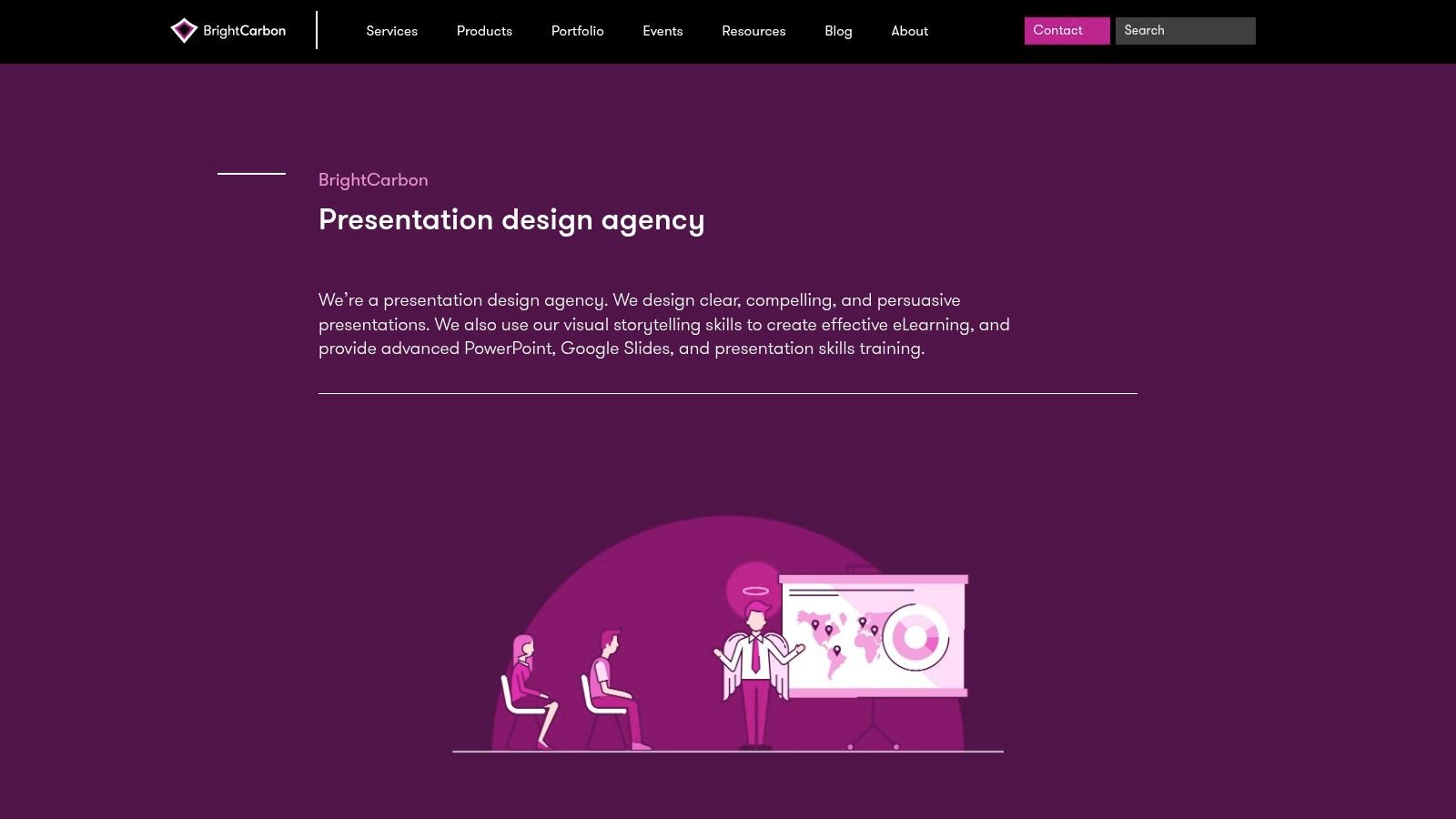
How the Helpdesk works
Under the Helpdesk model you decide who can request work, which approvals apply, and what service levels you need. Requests go in by phone or email, and invoicing and reporting come back consolidated.
BrightCarbon says something to L&D teams that most vendors would soften. Most departments, by its account, use text-heavy slides for classroom training, webinars, storyboarding, and rapid eLearning, and those slides don’t work. I agree, and I’d add that the same wall of bullets usually gets copied straight into the eLearning module and stays there for years. If you’re still writing the course content, my guide on how to create training materials covers the structure the slides should follow.
6. SlideRabbit
Services, and the training question
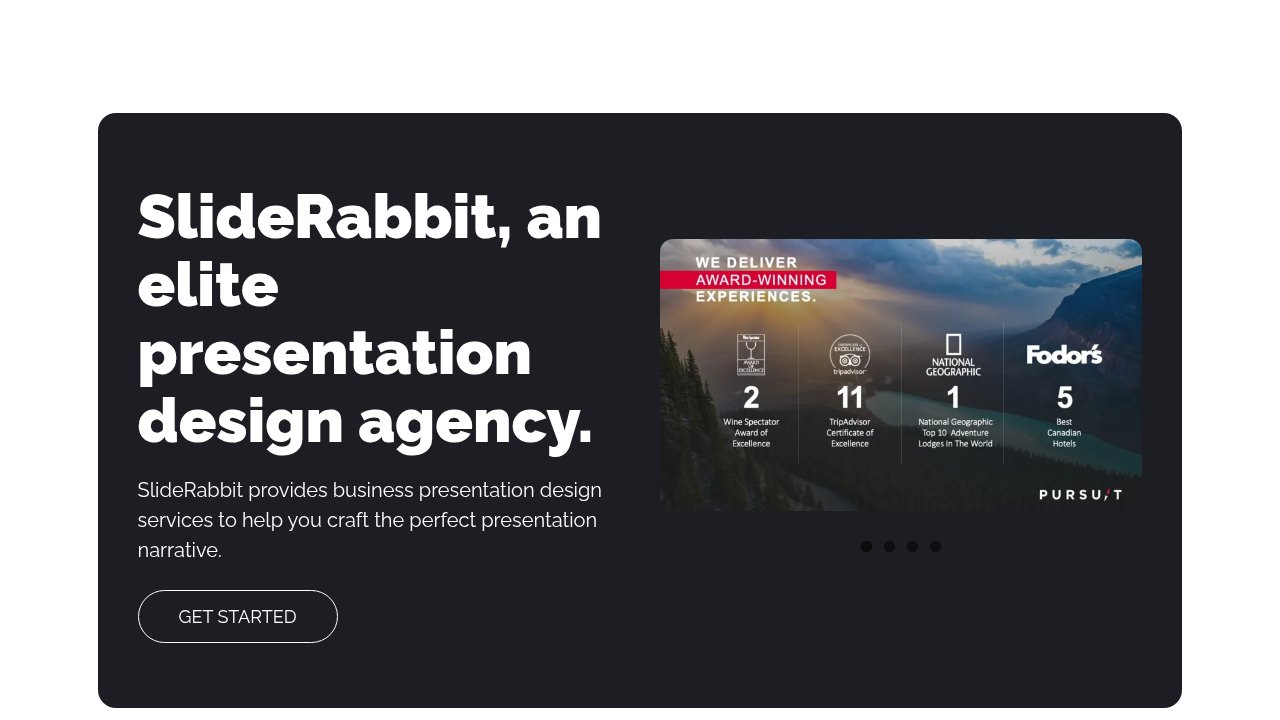
SlideRabbit's service list looks built for the template-system job, with custom templates, narrative consulting, data visualization, and concept generation next to presentation design and a workshops arm. Its homepage says it designs investor presentations, sales pitch decks, and conference presentation materials, and the portfolio filter includes event collateral and data design. The team is remote and meets once a year for an in-person summit (Portland, in 2026). On a template project, I'd spend most of the first call asking about that training.
7. SlideGenius
Why the platform work matters
The site is sorted by business situation (sales enablement, conferences and events, marketing and financial communications, sales and pitch decks, internal communications), and training decks sit among its deck types. Its process runs ideation, interpretation, iteration, and implementation, with accuracy, brand, and compatibility checks before delivery. The platform work is what I'd pay for: a Templafy master or a Seismic page library has rules the platform enforces, and a designer who has built for it before saves you a round of broken placeholders.
8. Presentation Studio
The tidy-up lane
It calls itself Australia's leading PowerPoint presentation design agency and works in Canva, PowerPoint, or Google Slides throughout. The tidy-up lane aligns fonts, colors, layouts, and assets to your brand for strategy decks, investor briefings, and internal reports. Testimonials include Scotland's Charity Air Ambulance, whose corporate presentation became the template for the whole organization, and a co-founder of Man of Many on its speaking-to-camera and public speaking training.
9. The Presentation Designer
Case studies
Three services (PowerPoint templates, sales presentations, speaker decks) and case studies that include a cabin crew presentation for IATA and a hand-crafted template for a digital agency. A testimonial names the designer, Illiya, so it looks like you deal with him directly. For one keynote and one speaker, I'd start here.
10. Prezlab
Arabic layouts and the free evaluation
Prezlab offers a presentation agency service (full support from a specialized design team) next to its standard slide design. It also runs Evaluate My Slides, where you send slides in for a free professional evaluation. I'd do that before paying anyone.
Bilingual decks are where I’d be pickiest on this whole list. An Arabic version mirrors right to left, so timelines and charts often have to be flipped by hand, and a font that looks fine in English may have no proper Arabic support at all. Plenty of studios will translate the text and leave the layout pointing the wrong way. For regional work I’d weight a team that works in both languages every day heavily, and Prezlab is built around that.
11. 16X9
The process, step by step
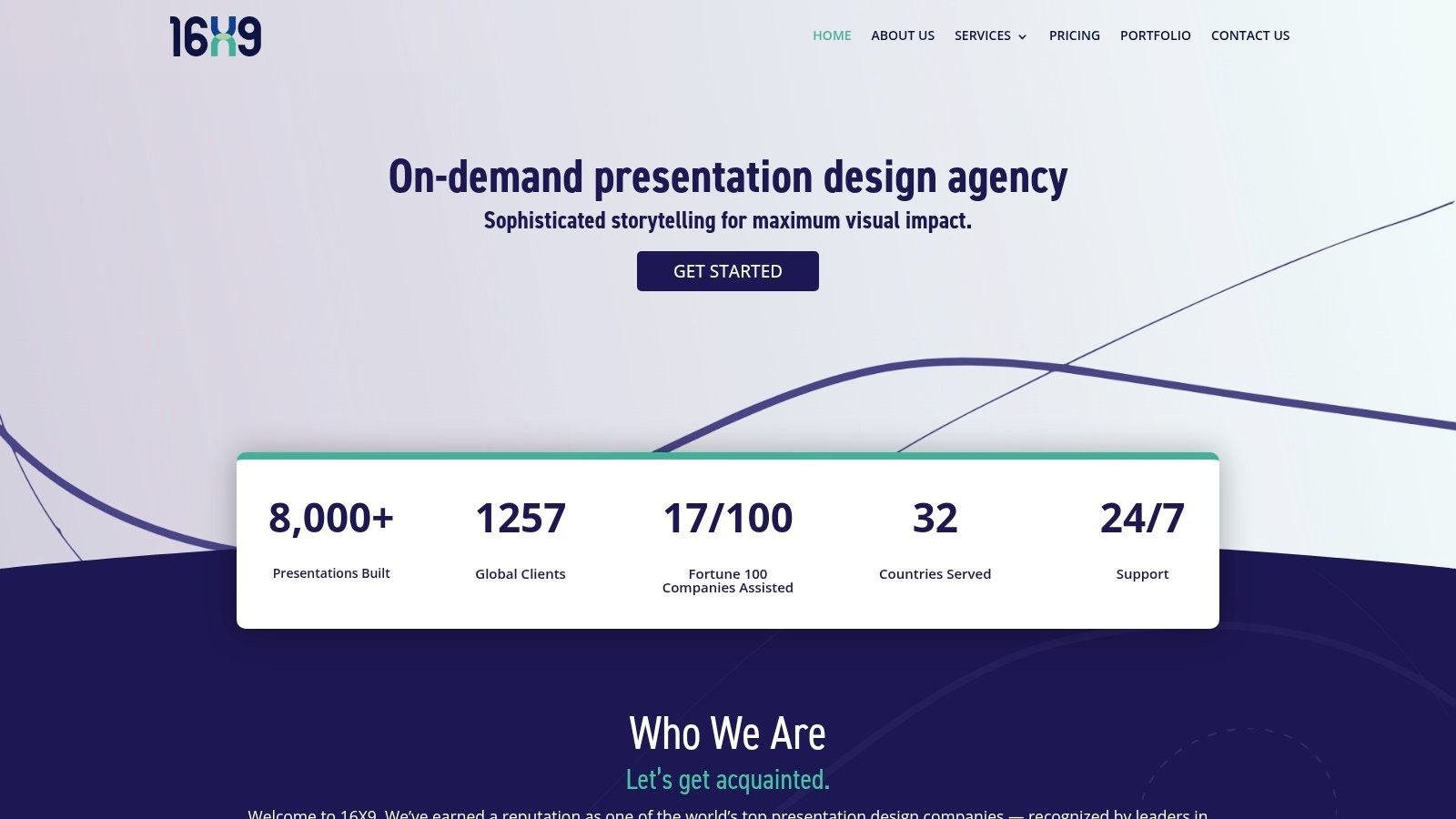
An enterprise presentation design firm, by its own description. A project goes kickoff call, intake form plus your files, proposal and timeline, sample slides to set the look, client review, final deliverable. I'd ask every vendor for that sample-slide step, since it settles colors and layout before forty slides get built in the wrong direction. All contractors work under strict NDA and the team works virtually around the clock, which matters when a deck carries unannounced numbers.
12. 24Slides
Tiers, templates, and Medly
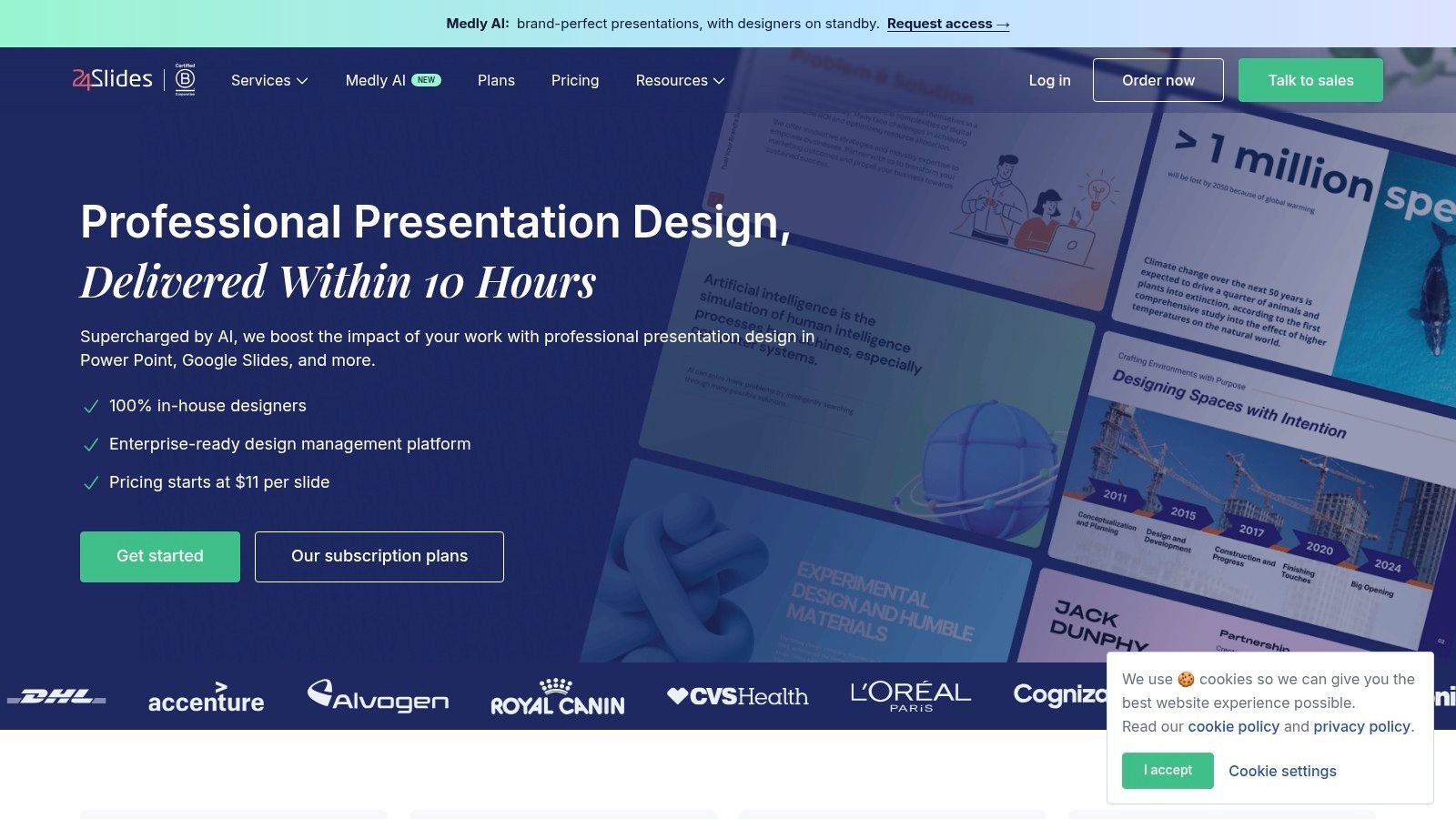
24Slides says it works with 100% in-house designers and reports more than 16,000 customers and 2 million slides created. Its tiers scale with commitment: Pro adds faster turnarounds, better pricing, and a dedicated customer success manager, and Premium adds a dedicated design team. It also builds branded master templates, runs AI-powered brand compliance checks, and has a new AI product called Medly, which it describes as brand-perfect presentations with designers on standby. If you send twenty small jobs a month, a public per-slide price makes planning easy. For one keynote I'd go to someone higher up this list.
Other routes, without a company attached
Plenty of deck jobs don’t need a firm at all. If the slides are fine and it’s the presenter who struggles, I’d spend the money on a coaching-only firm. When your template already works and the content is approved, a freelance designer from a marketplace can handle a one-off tidy-up, though they rarely stick around for the next deck. For a lot of internal reporting, a paid template library and a capable in-house marketer are enough, even if the library was designed for nobody’s brand in particular.
At a glance
| Company | Strongest fit | Deck types it leans toward | Price signal on its own site |
|---|---|---|---|
| Moonb | Ongoing deck work next to video and brand design | Sales decks, keynote decks, board reports, templates | One set monthly rate, or a per-project quote |
| Duarte | Main-stage keynotes and multi-speaker events | Keynotes, sales presentations, template systems, data stories | Scoped per engagement, no rates |
| Buffalo 7 | Conference talks and CPD sessions | Conference, CPD, product, and marketing decks | Ballparks from £1,900 (Refresh) to £8,550 (Ultimate) |
| Presentation Partners | B2B sales stories and RFP orals | Short story-led decks, typically six slides | Not published |
| BrightCarbon | Training decks and eLearning | Sales presentations, training decks, eLearning | Helpdesk retainer, minimum spend over typically 12 months |
| SlideRabbit | Templates plus team training | Templates, data visualization, investor and sales decks | Contact form bands from $1,500 |
| SlideGenius | Decks inside enablement platforms, batch rebrands | Sales enablement, conference, internal, financial decks | Not published |
| Presentation Studio | Canva, Google Slides, and PowerPoint templates | Tidy-ups, keynotes, branded templates | Monthly retainer options for tidy-ups |
| The Presentation Designer | One speaker deck or one template | Speaker decks, sales presentations, templates | Not published |
| Prezlab | English and Arabic decks | Presentations, information design, motion | Not published |
| 16X9 | Recurring enterprise PowerPoint work | Investor, sales, and internal decks | Estimate after a consultation |
| 24Slides | High volume, fast turnaround | Fix-ups, redesigns, master templates, rebrands | $16 to $66 per slide pay as you go; tiers from $99 a month |
Quotes you can actually compare
Two companies can price the same deck very differently because each read the brief as a different job. So send every firm on your shortlist the same short packet.
- The job and the audience: keynote, sales deck, training deck, board update, or template system, and who has to decide or act after seeing it.
- Where the content stands: your current file, raw data, which sections are approved, which are still being written, and who signs off on changes.
- The format: slide count, software (PowerPoint, Google Slides, Keynote, Canva), screen ratio, and whether the deck is presented live, sent ahead, or both.
- Brand assets: guidelines, fonts with their licenses, the current template, and chart styles. If your guidelines are thin, our walkthrough on how to create brand guidelines shows what a designer will ask for.
- Accessibility requirements: slide titles, reading order, alt text, and contrast. WCAG 2.1 AA asks for 4.5:1 contrast or higher on normal text and 3:1 on large text, as James Madison University’s PowerPoint accessibility guide sets out. Check your brand colors against it before the template is built.
- The delivery shape: the date, the review owners, rehearsal time if there is any, editable source files, and the export formats you need.
Then put the same questions to each of them. How many revision rounds are included? Who writes copy if the content is weak, and who checks the numbers on the charts? Do the charts stay editable, and who owns the template and custom illustrations afterward? I’d push hardest on the writing and the number checks, because plenty of firms design whatever you send and leave both of those with you.
For teams buying through UK public procurement, Bidwell keeps a live page of UK public-sector tender awards for graphic design services, listing recent contract titles, who won them, and typical award sizes. I’d skim the contract titles before writing your own brief, just to see how public buyers word design work. For the structure of the deck itself, my guide to the perfect presentation deck and my roundup of sales deck examples are worth an hour before the first call.
If you build decks yourself, Harvard Business Review covered the same ground in an episode of its Christine vs. Work series, where the host talks deck building with Dan Zedek.
Frequently asked questions
Most quote per project, and what moves the number most is how finished your content is and whether the firm has to build the story with you. A few do publish numbers: 24Slides lists pay-as-you-go prices of $16 to $66 per slide, Buffalo 7 gives ballparks starting at £1,900, and SlideRabbit's contact form starts its budget bands at $1,500 to $5,000. Narrative work, custom illustration, and animation cost more than tidying up approved slides, so ask every firm to price those as separate lines.
The day the date and the speakers are fixed. Slide production on approved content can move in days, but a keynote also needs time for every executive to agree on the story, then design, then a rehearsal on the final file in the real screen ratio. Late stakeholder feedback causes most of the delays I see, so name one person who can approve content before work starts.
Usually you want both, for different jobs. A good template system covers the everyday decks your team builds alone. An outside firm is worth paying for keynotes, major sales pitches, and rebrands. And a template only holds up if a few people inside the company are trained to use and defend it, so ask any template vendor what training and handover it includes.


