12 pitch deck design services worth comparing
I checked 12 pitch deck design services against their own sites, with published pricing where it exists, who each one fits, and one honest limitation apiece.


Pitch deck design services are specialist firms that turn a fundraising or sales story into a designed, presentable deck, and the twelve worth comparing right now are Moonb (my own team, disclosed below), Slidebean, SlideGenius, Stinson Design, Buffalo 7, SketchDeck, 24Slides, BrightCarbon, HighSpark, Hype Presentations, Fully Decked Up, and Presentation Geeks.
Part of my job is reading the proposals clients forward me when they are choosing a deck partner, and the pattern is always the same: every vendor sounds identical on the first page, then the differences show up in the invoice and the third revision round. So this list focuses on what actually separates these firms. I verified every company against its own website in September 2026, quoted pricing only where the company publishes it, and wrote one honest limitation for each. Nobody on this list paid to be here.
One framing note before the list. The biggest cost decision is not which vendor you pick; it is whether you need design only or narrative plus design. Design only fits when your story, numbers, and slide order are settled. Narrative plus design fits when you cannot state the ask in one sentence yet. Buying design only for an unfinished story produces a polished version of the wrong deck, and you pay twice. If you are still working out the raise itself, this plain walkthrough of how to get startup funding covers the stages where the deck starts to matter, and it is worth reading before you brief anyone.
Y Combinator’s Kevin Hale makes the same point better than any vendor site; this talk is the fastest free narrative pass you can run before paying for one.
1. Moonb
Slot one is my employer, so read it lightly and let the specialists below earn your shortlist on their own.
More on Moonb
Moonb is a creative studio that works as a dedicated team inside marketing departments, and [presentation design](/services/presentation-design) sits inside a wider set that also covers video, motion graphics, animation, and brand design. The reason it belongs on a pitch deck list at all is the repeat case: a fundraise deck becomes a sales deck, then a partner deck, then a board update, and each one is supposed to look like the same company made it. A specialist is built for the single high-stakes artifact; an ongoing team is built for the fifth one. The honest read is that both models are right for different buyers, which is why the rest of this list exists.
2. Slidebean

More on Slidebean
Slidebean was founded in 2014 by Caya, Vini, and Jose, and it has grown into a strange but useful hybrid: an AI-assisted pitch deck builder on one side and a human consulting team on the other. The consulting menu is unusually transparent, with Pitch Deck Writing plus Design listed at $3,500 with two to three weeks of delivery, and a Strategy plus Pitch Deck Sprint starting at $6,000 over three to four weeks. The company says its clients have raised over $500 million in venture capital, which is its own number, so treat it as marketing rather than audit, but the depth of fundraising content it publishes for free, including a large YouTube startup channel, backs up that this team lives in the deck world daily. The best fit is a pre-seed to Series A founder who wants the story and the financial model challenged rather than recolored.
Two details I like from the buyer’s side: the published prices make it easy to benchmark every other quote you collect, and the deck stays editable in normal tools after the engagement. The limitation is the flip of the strength; a company with settled content and a demanding brand system may find the startup-shaped process lighter on custom visual craft than the pure design shops below.
3. SlideGenius
More on SlideGenius
SlideGenius, Inc. was founded in San Diego in 2012 and describes itself as serving more than 5,000 clients globally across all industries, with Fortune 500 teams among them. Its service range goes well past static slides into motion graphics and data visualization, which matters when your deck has to carry an animated product story or a dense chart sequence. The process it publishes is a straightforward four-step loop of kickoff, design, review, and delivery, with a phone number on the site header, which tells you something about how sales-led the intake is. Because there is no public pricing, ask early how the quote moves with slide count, animation, and revision rounds; on an operation this size, scope definitions do the work that a rate card would.
The honest read: this is where I would send an investor relations or sales enablement team with a steady pipeline of presentations, and not the first place I would send a two-person startup. If your material needs the deck plus a moving version of the deck, having both under one roof saves a handoff.
4. Stinson Design
More on Stinson Design
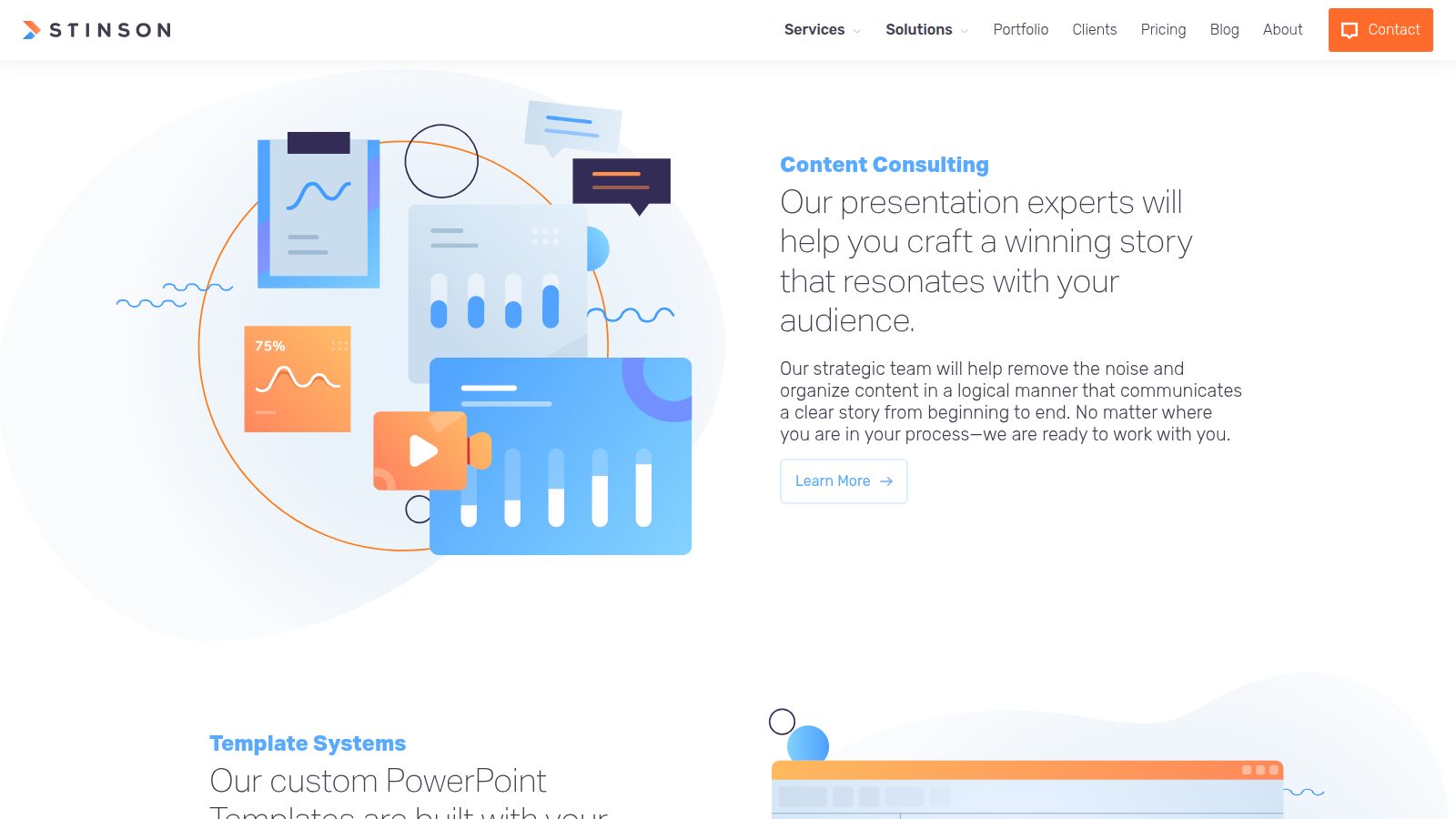
Stinson (legally Stinson Communications Inc.) runs out of Toronto and is one of the few pure presentation firms that puts its pricing logic in writing: projects are quoted individually, with a stated minimum of $1,500, and the site walks through the factors that move the number. The service menu covers content consulting, custom PowerPoint design, template systems, and motion graphics, and its portfolio includes named case studies for companies like ZoomInfo and Octapharma. The template systems work is the quiet differentiator; several people presenting the same material is exactly when a one-off deck falls apart, and Stinson builds the system that stops the drift. Its client logo wall skews to recognizable global brands, and the firm promises a consultant reply within 24 hours of contact.
I would shortlist Stinson when the deck is really an ecosystem problem: a sales team of nine, each rebuilding the master deck their own way. A template system with rules beats another beautiful one-off, and this is the entry on the list most explicitly built around that idea.
5. Buffalo 7
More on Buffalo 7
Buffalo 7 is a UK presentation specialist with offices in Manchester and London and, by its own account, over ten years spent refining its PowerPoint design process. Its designers work in Figma and the Adobe suite behind the scenes but deliver in the tool your presenters will actually open, and the firm publishes worked examples of pitch decks, investor decks, and product decks so you can judge the house style before a call. Beyond design it sells structured training: virtual presentation skills, PowerPoint template use, and storytelling courses, which is a sensible follow-on once a new deck lands with a team that has to present it. Pricing is quoted per project through its contact flow rather than published.
The pitch practice here starts with narrative development, which is what you want when internal edits have grown a deck sideways for two years. If you want to see what a strong argument looks like slide by slide before briefing anyone, my teardown of real pitch deck examples pairs well with this entry.
6. SketchDeck
More on SketchDeck
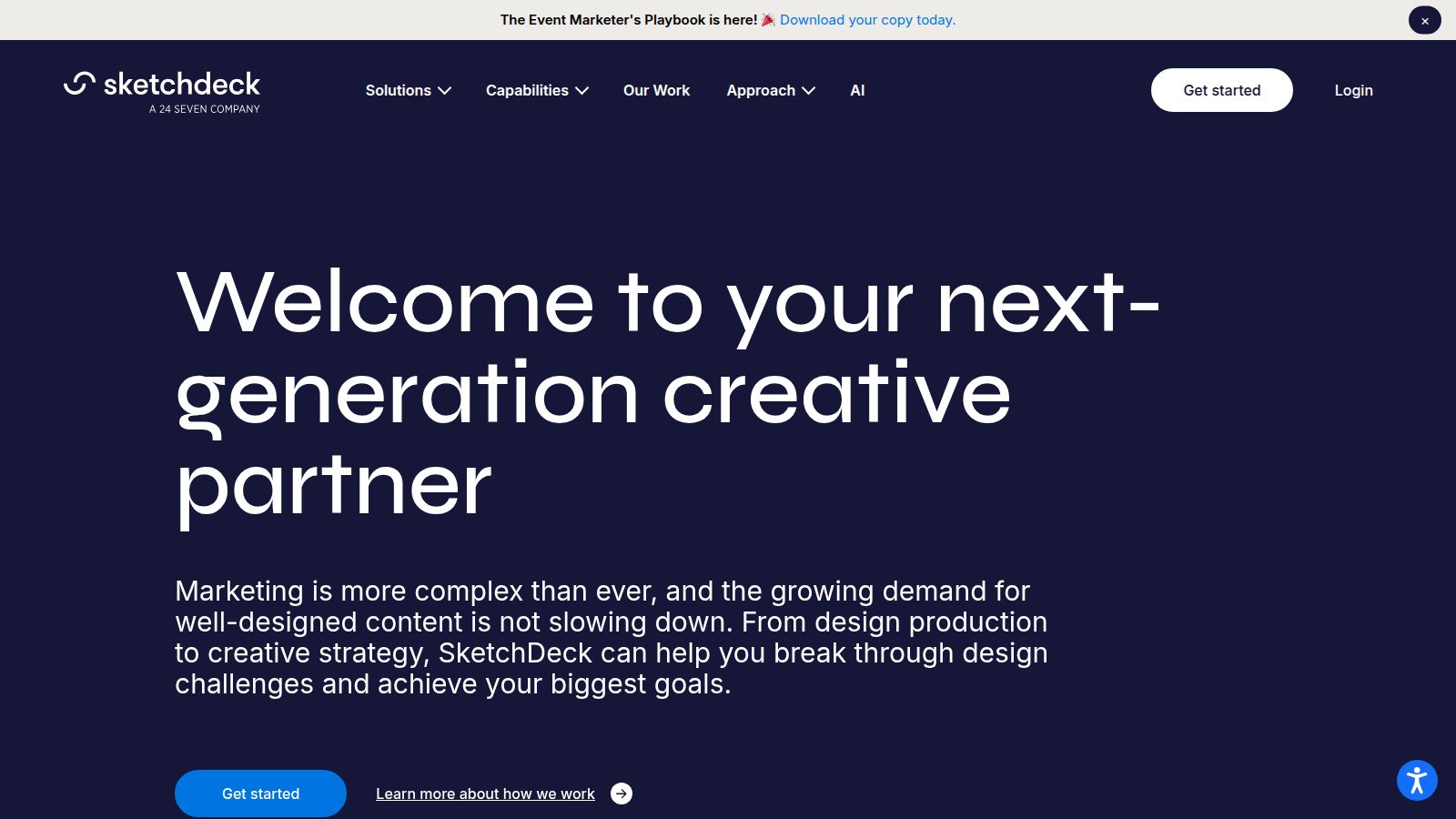
SketchDeck started as a deck-focused design startup founded by Chris Finneral, a Y Combinator alum who still leads it as CEO, and the name gives away the original specialty. Today it operates as part of 24 Seven and positions itself as a full creative partner, with solutions that run from design on demand to agency-of-record arrangements, and capabilities across branding, communications, events, and sales enablement. That evolution changes who it fits: the sweet spot is a marketing team that wants presentation production connected to campaign and brand work rather than handled by a separate specialist each time. The delivery claim on its own site is thousands of projects per year, which is the scale argument, and the platform layer is real, with briefing, feedback, and asset history in one system.
If your launch deck has to match the landing page, the booth graphics, and the sales one-pager in the same month, one accountable partner beats three. Teams weighing that broader model against hiring should read my notes on creative services for startups first, because the decision is about workflow more than portfolio.
7. 24Slides
More on 24Slides
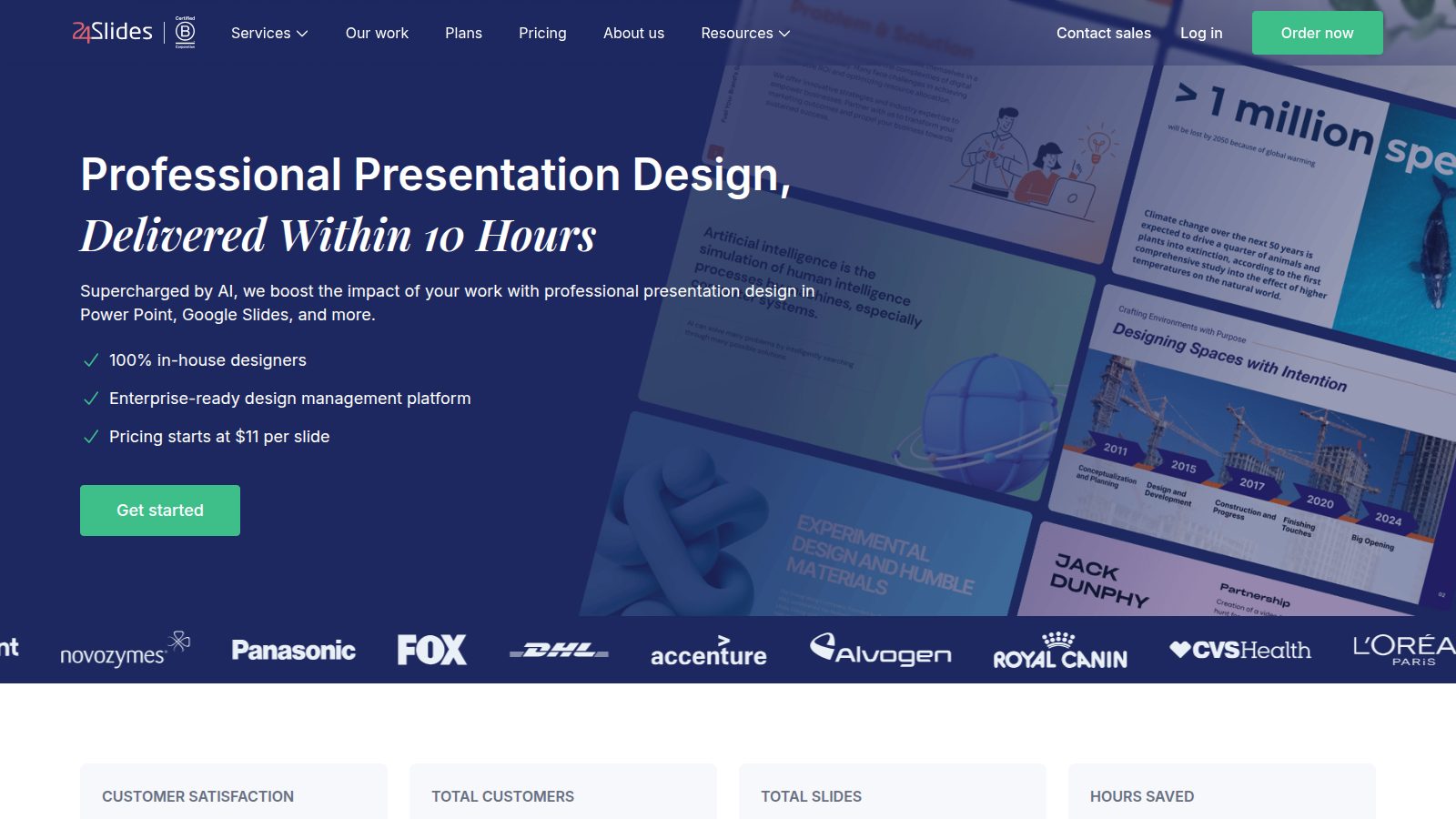
24Slides was founded in 2010 by Tobias Schelle, and its structure is unusual: headquarters in Copenhagen, design teams in Malang, Indonesia and Lima, Peru, and a stated purpose of building fair creative jobs in emerging markets, formalized in its Certified B Corporation status. The company reports more than 250 team members and around 17,500 slides produced per month, which makes it one of the highest-volume presentation operations anywhere. Pricing is published in detail: pay-as-you-go per-slide rates of $16 for a fix-up, $43 for a redesign, and $66 for a full redraw, with lower rates and 10-hour turnarounds on the $99 monthly tier and dedicated teams on the tier starting at $2,950 per month. Its client logo wall includes global names like Panasonic and DHL, and the whole workflow runs through its own platform with briefs, comments, and revisions in one place.
For a marketing or internal comms team feeding a steady stream of decks into a queue, this cost model is the easiest on the list to budget and defend. Just be clear-eyed about the division of labor: you own the argument, they own the polish.
8. BrightCarbon
More on BrightCarbon
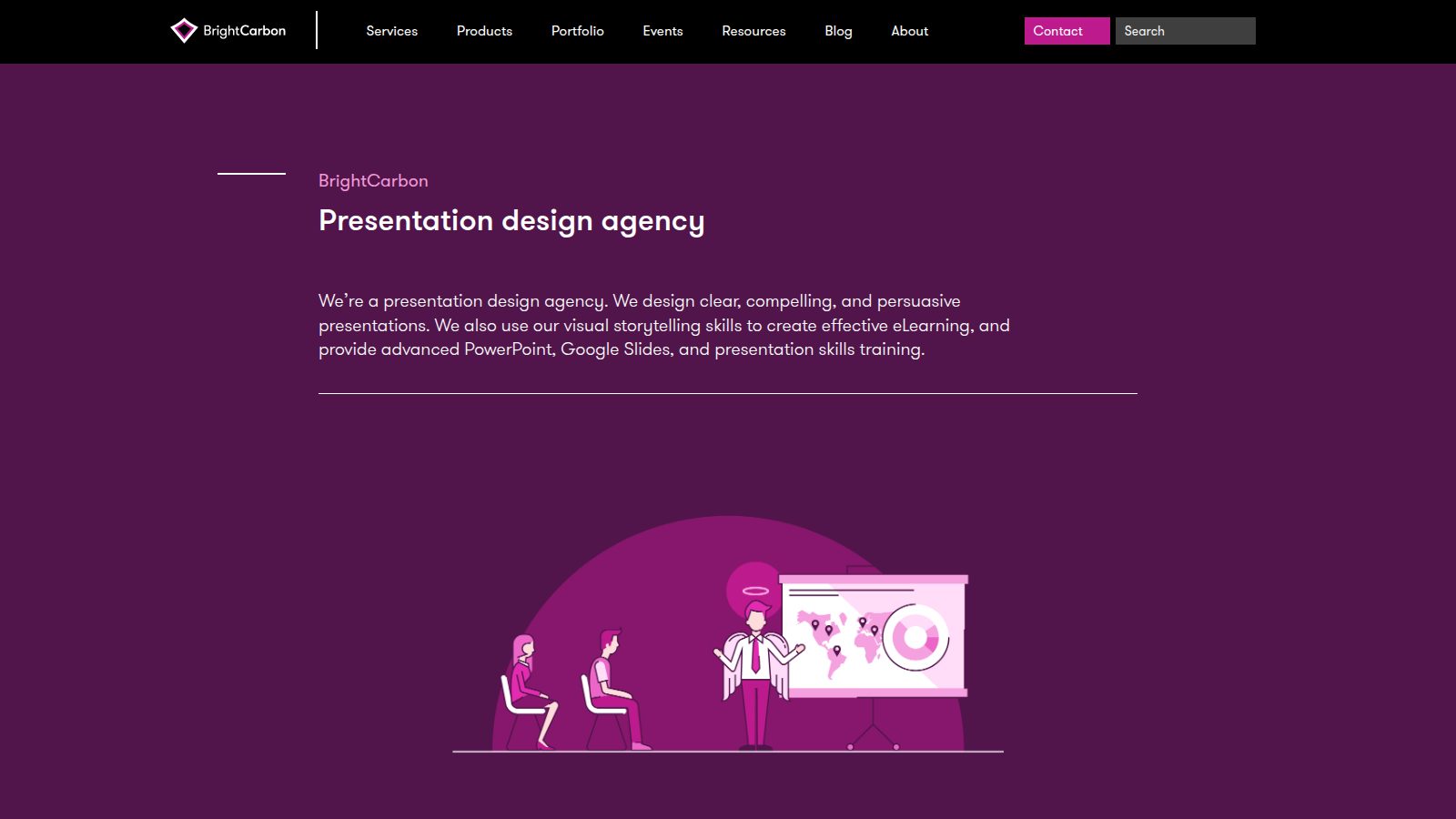
BrightCarbon is a UK-registered presentation and eLearning specialist with offices in Manchester, Bristol, and London plus a US base in Boston. The philosophy on its site is consistent everywhere: swap walls of text for visual sequences a business audience can follow, then teach the client to keep doing it, through advanced PowerPoint and Google Slides training. The services page spans presentation creation, eLearning development, and an ongoing helpdesk arrangement, which suits organizations that want a long-term presentation capability rather than a single rescue job. It publishes an unusually large free resource library on presentation technique, which is a fair way to audition the thinking before you spend anything.
I rate this entry highest for the sales engineering use case: a product with systems, processes, and moving relationships that a static bullet list cannot explain. The same visual-explanation muscle behind good visual storytelling is what BrightCarbon sells by the slide.
9. HighSpark
More on HighSpark
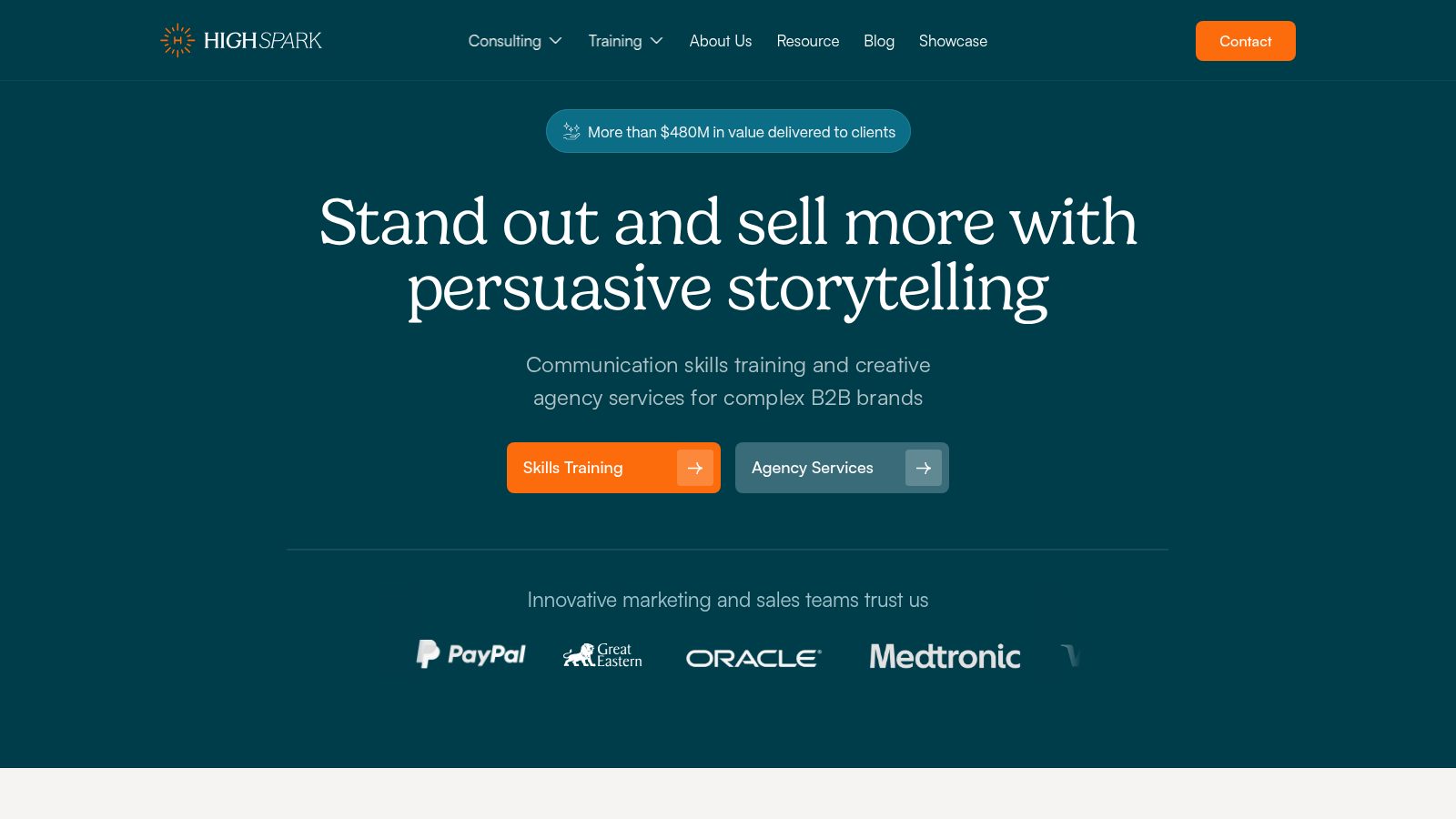
HighSpark Pte. Ltd. is a Singapore-based consultancy serving complex B2B brands, and it claims more than $480 million in value delivered to clients, its own figure. What makes it different from the pure design shops is the pairing: on one side, consulting services that include fundraising narratives, messaging, and presentation design; on the other, communication skills training for the people who will stand up and deliver the material, including corporate workshop formats. That combination matters when six people present the same deck and each one emphasizes a different slide. For US or European buyers the Singapore base mostly shows up as a timezone question for live workshops, the same planning issue as the UK firms on this list in reverse.
A deck is a script for a performance, and HighSpark is the entry that takes the performance half seriously. If your last raise died in the delivery rather than on the slides, that is the signal this is your category.
10. Hype Presentations
More on Hype Presentations
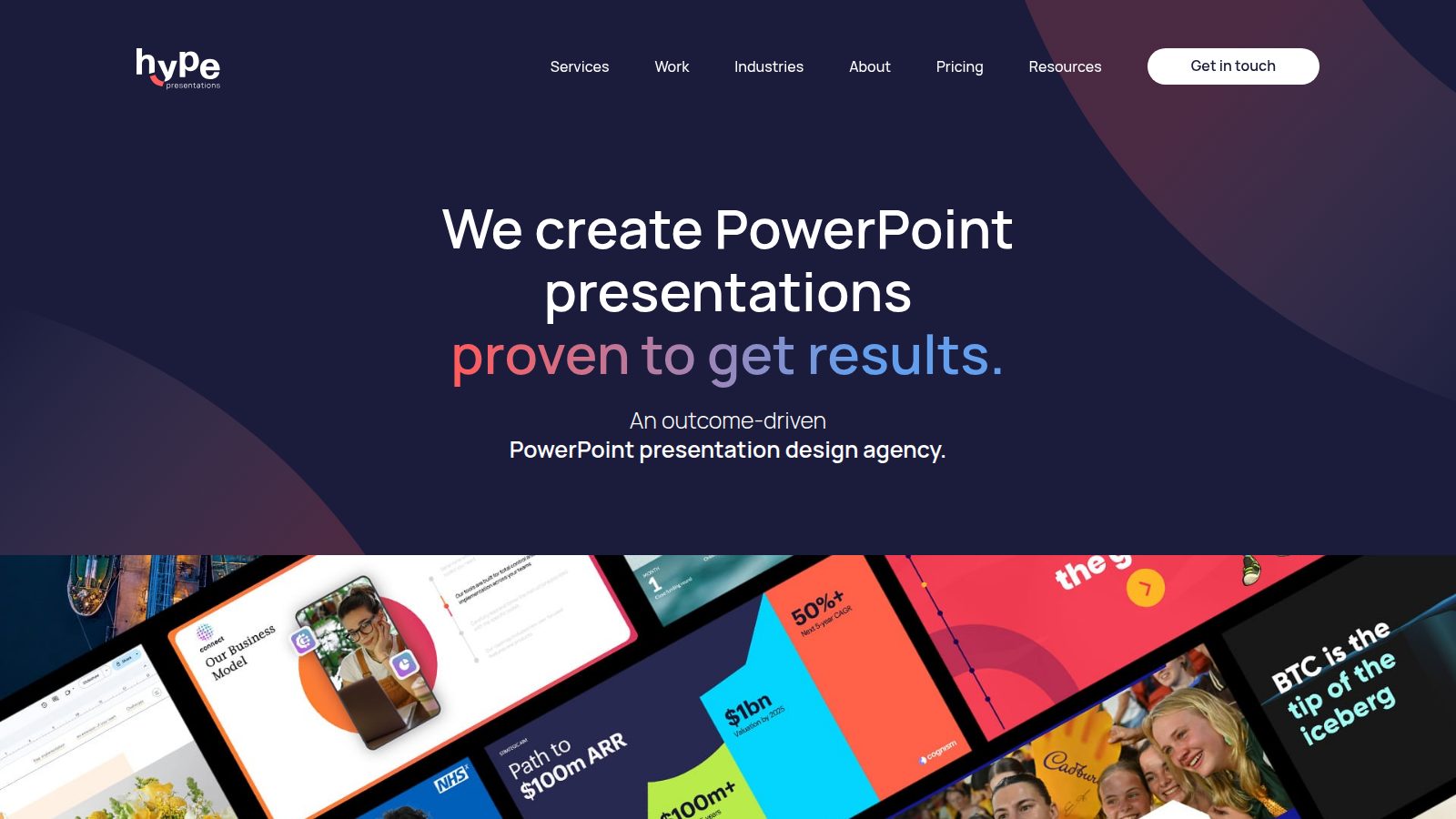
Hype Presentations Ltd. operates from Manchester with a second office in Brooklyn, New York, and focuses on what it calls high-stakes business communication: investor decks, pitch decks, and sales presentations where the room has to move. Its own buying guidance is refreshingly concrete for this category, stating that a typical pitch deck project runs one to three weeks from brief to delivery and that rush timelines cost more, which is a useful baseline for any quote you collect elsewhere. The portfolio leans on outcome stories, including a deck it built for the B2B sales technology company Cognism, which Hype says supported an $87.5 million raise; that attribution is the vendor's own, and no deck raises money by itself, but the case is documented in detail on its site. The white-label service is worth knowing about too, since it means some decks sold by other firms are quietly built here.
Of the UK entries, this is the one I would brief for a make-or-break fundraising deck with an unfinished story, and the one whose published expectations make the least room for surprise. Pair the engagement with a hard look at your own narrative first; my walkthrough of corporate storytelling is the homework that shortens what a firm like this has to fix.
11. Fully Decked Up
More on Fully Decked Up
Fully Decked Up is an India-based presentation design firm covering sales decks, financial presentations, conference decks, and fundraising material, and it leads its homepage with a 48-hour delivery promise. The three service tiers map neatly to how broken your current deck is: presentation repackaging restructures and animates the whole thing, the visual makeover redesigns existing slides, and the touch-up cleans a raw draft into something professional. Rich-media PowerPoint is the specialty, meaning animation and custom graphic elements inside the file you keep editing, rather than a locked export. For a cost-sensitive founder the timezone can work in your favor; a deck sent at the end of a US or European workday comes back while you sleep.
The distance from your brand team is the trade to weigh: a specialist supplier this focused executes the brief it receives, so the brief has to be right. Send content that is final, brand assets that are complete, and a clear note on what the deck must achieve.
12. Presentation Geeks
More on Presentation Geeks
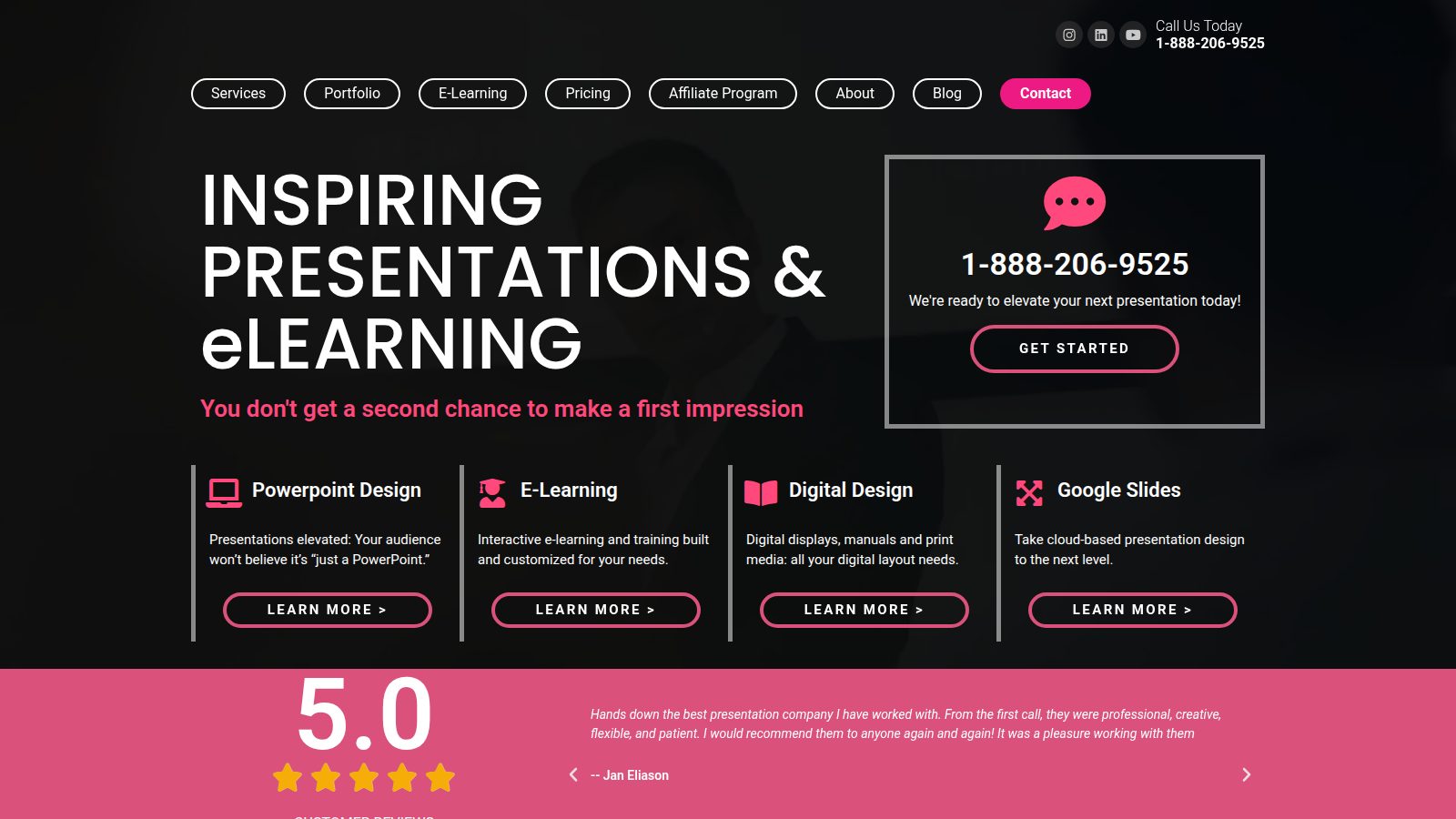
Presentation Geeks is a North American presentation shop whose homepage splits its practice into four lines: PowerPoint design, eLearning, digital design, and Google Slides. The customer reviews it publishes emphasize speed and recovery jobs, including turnarounds of under five business days on projects other vendors had stalled, and the firm runs an affiliate program alongside its direct sales, which tells you it grows through referrals. The practical strength is unglamorous and valuable: presentations that stay usable by the people who inherit them, with layouts that do not collapse when a regional manager swaps a chart. Intake starts with a call or form quote rather than published pricing.
If the phrase “the deck breaks every time someone edits it” sounds familiar, this is the profile of vendor that fixes it. Bring the strategic questions somewhere else; bring the 60-slide beast that nobody can maintain here.
The whole list side by side
| # | Service | Best for | Published pricing | Limitation |
|---|---|---|---|---|
| 1 | Moonb | Teams whose deck is one of many, and has to match the rest of the brand | One set monthly rate, or a per-project quote | Not a single-deck specialist; a one-off seed deck fits the firms below better |
| 2 | Slidebean | Founders raising a round who want narrative and financial help | Deck writing + design $3,500; strategy sprint from $6,000 | Software layer is noise if you only want bespoke design |
| 3 | SlideGenius | Large organizations with ongoing presentation programs | On request | Volume machine; a single seed deck is a small ticket |
| 4 | Stinson Design | Teams that want a deck plus a reusable template system | Quoted per project, $1,500 minimum | Not shaped for quick one-slide favors |
| 5 | Buffalo 7 | Decks with information but no argument yet | On request | UK hours; plan workshops across timezones |
| 6 | SketchDeck | Marketing teams needing decks inside a wider creative stream | On request (partnership scoping) | Heavy machinery for a single deck |
| 7 | 24Slides | Settled content, fast production at scale | From $11/slide; pay-as-you-go from $16; tiers $99 and from $2,950/month | Production strength rather than fundraising strategy |
| 8 | BrightCarbon | Technical stories that need visual explanation | On request | Animation-led work loses power in silently read decks |
| 9 | HighSpark | Teams where presenters need training too | On request | Consulting wrapper is excess for a pure file rebuild |
| 10 | Hype Presentations | High-stakes decks with unfinished arguments | On request; typical project 1 to 3 weeks | More engagement than a visual refresh needs |
| 11 | Fully Decked Up | Fast, focused rework of rough decks | On request; 48-hour delivery claim | Deck-only shop; wider creative needs a second partner |
| 12 | Presentation Geeks | PowerPoint files that must survive internal editing | On request | Not a strategy partner for a blank page |
How these engagements actually run
Almost every firm above follows the same sequence, whatever its marketing says. Intake first: a questionnaire, kickoff call, or workshop that establishes the audience, the goal, the deadline, and what already exists. Then a content pass if you bought one, where the provider maps slides to the questions investors or buyers will actually ask. A concept review follows, usually one or two visual directions applied to a few sample slides, and only then the full build across charts, diagrams, and imagery. Two or three revision rounds are standard; the contract should define what counts as a round and who consolidates feedback on your side, because “everyone emails the designer separately” is how budgets die. Final delivery should mean editable files in the software your team uses, with source assets and template ownership stated in writing.
The slow points are predictable, and they are usually yours rather than the vendor’s. Unsettled content stalls hierarchy decisions. Missing brand assets stall production. A senior stakeholder who joins at 90 percent reopens the slide order. Handle those three and the published timelines on this list, from 10-hour slide turnarounds to three-week strategy engagements, are actually achievable.
On judging the output, ignore the billions-raised logos on vendor sites; capital raised is never attributable to a deck. Run a cold-read test instead. Hand the deck to someone uninvolved, give them three minutes alone with it, then ask them to state the problem, the solution, the evidence, and the ask. If they cannot find the ask, more polish will not save it. The same three-minute logic applies to the deck’s visual load; this talk on why slides fail their audiences has shaped how I review every deck that crosses my desk.
Three questions worth asking on every first call: who does the work day to day, and is it the senior person from the pitch; what counts as a revision round and who consolidates feedback; and which editable files, source assets, and template rights are included at delivery. The answers separate the firms that sell a process from the firms that sell a PDF.
One more piece of homework belongs before any of this. A deck is built for a specific audience, and fundraising decks especially are built for a target list rather than for investors in general. Resources that map investors who back creative businesses exist for exactly this; knowing the fifteen funds you are actually pitching changes what the traction slide has to prove. And if the deck in question is a sales deck rather than an investor deck, the structural logic is different enough that my breakdown of sales deck examples is the better starting point.
Before you sign with anyone, send the same brief to the two or three firms that fit your situation, ask for workflow and editable-file terms in writing, and run the cold-read test on your current deck so you know what you are actually buying: design, narrative, or both. If you want to sharpen your own eye first, my guide to building a presentation deck that holds a room covers the structural rules these firms charge to apply.
Frequently asked questions
Published prices run from about $11 per slide at production-focused shops to $3,500 for a written and designed fundraising deck, with strategy-led sprints starting around $6,000; most specialist firms quote per project instead of publishing a rate. The variables that actually move a quote are how much narrative work is included, slide count, animation, and how revision rounds are defined, so pin those four down in writing before comparing any two proposals.
Anywhere from 10-hour per-slide turnarounds at production services to one to three weeks for a full project, and longer when narrative strategy is part of the scope. The schedule risk is usually on the client side rather than the vendor side: unsettled content, missing brand assets, and a senior stakeholder joining at the end are the three delays that reliably blow published timelines, so lock those down before kickoff.
Buy design only when the story, numbers, and slide order are settled and have been tested on a real audience; buy narrative plus design when you cannot state the ask in one sentence. A quick self-test: give the current deck to someone uninvolved for three minutes and ask them to name the problem, solution, evidence, and ask. If they miss the ask, paying for design alone will produce a polished version of the wrong deck and you will pay twice.