12 interactive video examples and what each one was for
Twelve real interactive video examples from 2019 to 2024, from Netflix branching films to Virgin Voyages' personalized invites and Macy's shoppable special, plus what interactivity costs.

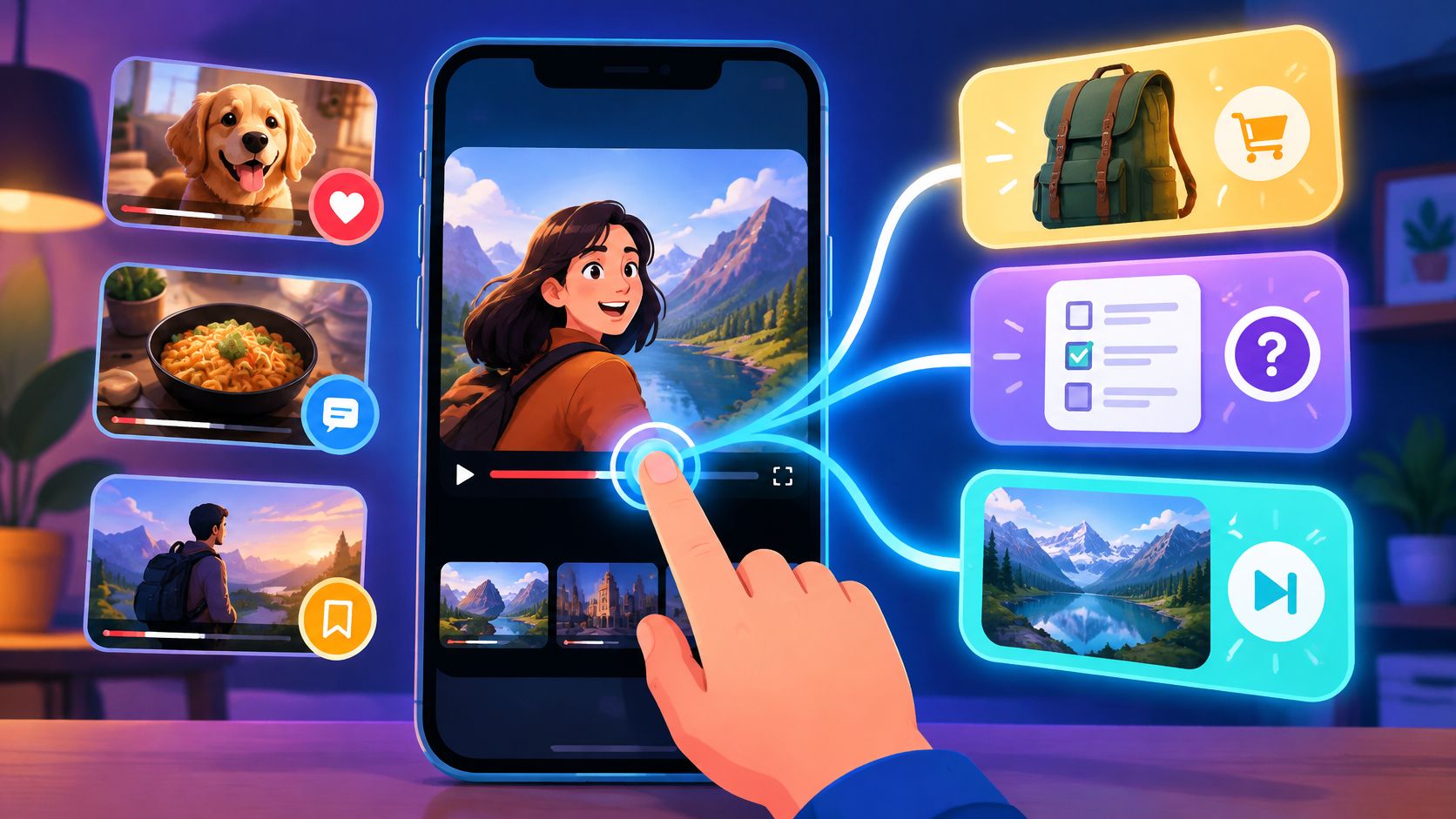
An interactive video is one where the viewer does something inside the piece (picks a path, answers a question, scans a code, feeds in their own details) and what they do changes what happens next.
I work at Moonb, and what I want to know about any interactive idea is what the viewer gets to do that a straight cut could not give them. All twelve pieces below have some answer. A few of those answers are weak. And before you fall for the branching ones, know that Netflix, which had two dozen of them on its service, took almost all of them down in 2024.
I skipped Bandersnatch and Walmart’s shoppable series, since our guide to interactive video marketing already covers both, along with the formats in more depth.
If someone in the room wants a reason to bother, a 2017 Magna study reported by Marketing Dive found interactive video ads drove a 47% gain in time spent with the message compared with non-interactive ones. The option to interact also made an ad 32% more memorable, even when viewers did not click, and that second number is the one I find more interesting.
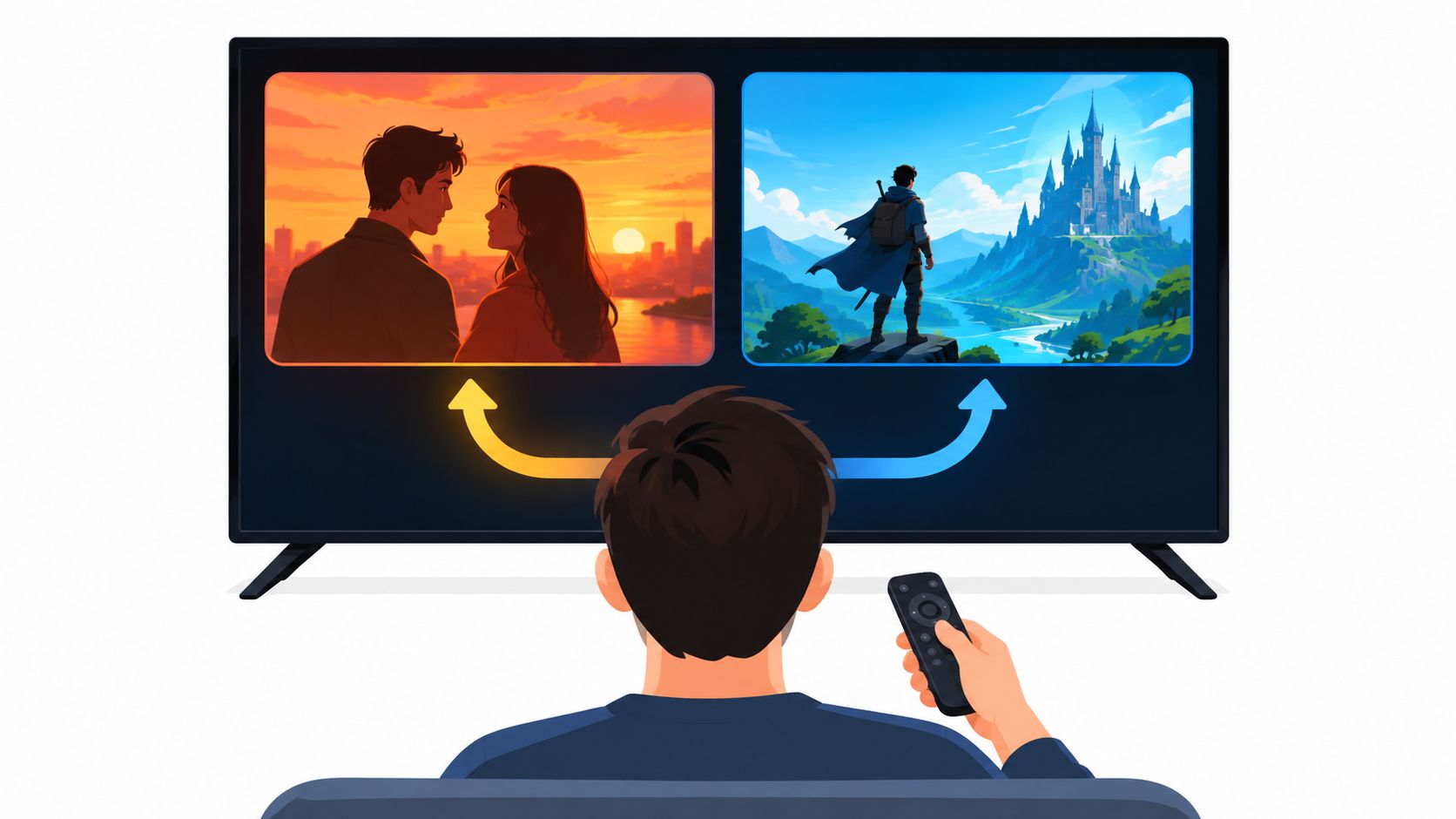
1. Choose Love (Netflix, 2023)
Netflix’s first interactive rom-com came out on August 31, 2023. Viewers make choices for Cami, played by Laura Marano, as two men from outside her relationship turn up in her life (Wikipedia); Variety’s review describes her as a recording engineer with a steady job. The first choice comes during a tarot reading (hear the good news or the bad news first), there are six possible endings, and once you have seen where a choice leads you can go back and pick the other one.
Netflix was hoping choices would make a familiar genre worth replaying, and critics did not buy it. Variety’s review ran under the headline “Netflix’s First Interactive Rom-Com Promises Fun, But Ends in Frustration,” and the film was removed from the catalog on December 1, 2024, a little over a year after release.
My problem is the kind of choice. The trailer shows one of the prompts, a small “Choose Paul” button over the scene, and who a character dates comes down to taste. Once you have seen who Cami ends up with, there is little pull to go back for the other men. Survival calls like the ones in the next entry at least give you a reason to try again.
2. Ranveer vs Wild with Bear Grylls (Netflix India, 2022)
Gulf News, carrying an IANS report, called this India’s first interactive adventure reality special. Bollywood star Ranveer Singh heads into the forests of Serbia with Bear Grylls to find a rare flower for his “lady love,” and you decide how he handles each obstacle. It premiered on July 8, 2022, produced by Banijay Asia with The Natural Studios (Gulf News, via IANS), and Netflix India’s content VP said the format would “give audiences all over the world the controls to test Ranveer Singh.”
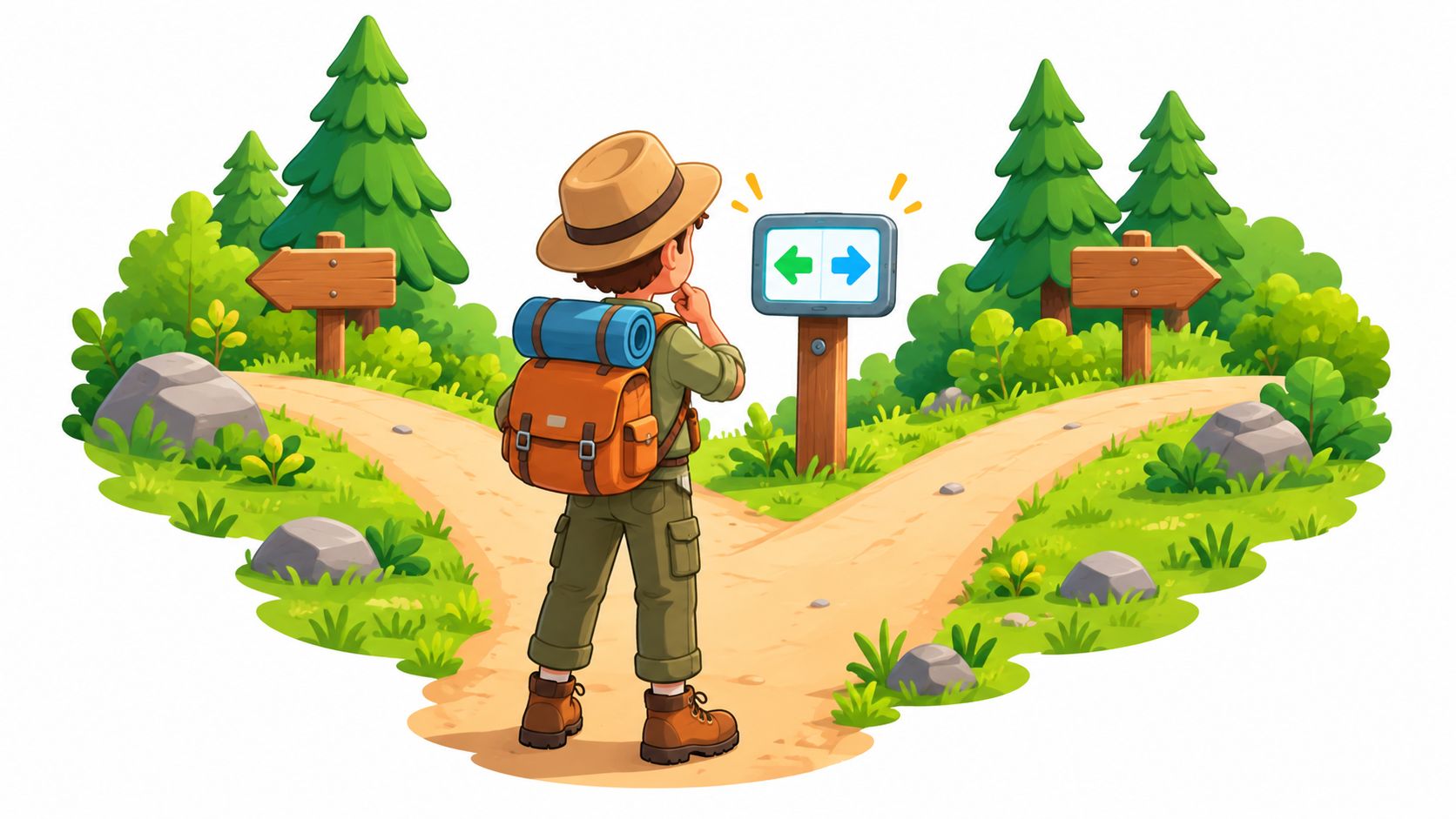
Same host and survival setup as Netflix’s You vs. Wild, with a Bollywood star in front for the home market. When Netflix cleared out the format in late 2024, this was one of only four interactive titles it kept (VGC). The reprieve was short. By May 2025 Variety reported that the last two interactive titles on the service were Bandersnatch and the Kimmy Schmidt special, so the choose-your-move version had gone by then.
A wrong call in the forest shows up on screen right away, which is why the survival setup works with choices. I could see a safety or customer-service training video working the same way, with the viewer making the call and then seeing where it leads.
3. Barbie: Epic Road Trip (Mattel and Netflix, 2022)
The first project under a multi-year content partnership between Mattel and Netflix debuted on October 25, 2022. Barbie “Malibu” Roberts, Barbie “Brooklyn” Roberts, Ken and Skipper drive across the country to find homes for shelter animals, and the Hollywood Reporter reported that viewers could shape the story through more than 100 decisions and 500 possible story combinations.
Mattel’s quote in the same piece says the special “further strengthens Barbie’s ability to inspire, empower and entertain kids on a global level.” What Mattel got was time: kids stay inside its world longer than a one-pass episode would keep them, and every replay is more time with the characters.
It was on the removal list Netflix confirmed in November 2024. That is five hundred story combinations for a title that lived about two years, and I would not have wanted to sign off on that build.
4. Unbreakable Kimmy Schmidt: Kimmy vs the Reverend (Netflix, 2020)
The interactive special that closed out Unbreakable Kimmy Schmidt arrived in 2020, and Netflix’s description set up the mechanic plainly: “Kimmy’s getting married, but first she has to foil the Reverend’s evil plot. It’s your move: What should she do next?” (Variety). It outlasted almost everything else Netflix made in the format. Netflix removed it on May 12, 2025, together with Bandersnatch, and Variety noted those were the last two interactive titles left on the service.
I like this use more than most on the list. It was a send-off for a comedy that had already finished, one more piece for its fans that played differently each time. Fans who sat through every season already had opinions about what Kimmy should do, and the special let them act on those.
5. Swipe Night (Tinder, 2019)
This is the oldest entry here, and it stays because I have not seen a cleaner case of interaction feeding a product. Swipe Night was an end-of-the-world adventure played inside the Tinder app, directed by Karena Evans. Viewers had seven seconds to make each choice by swiping left or right, and some of the critical decisions were then added to their profiles, where they affected who they matched with (It’s Nice That). It launched in the US on October 6, 2019, with episodes going live on Sundays in October from 6pm to midnight. Tinder took it international in September 2020, and the trailer below comes from that launch.
Tinder’s chief product officer, Ravi Mehta, explained the thinking in the same piece: “Our hope is that it will encourage new, organic conversations based on a shared content experience.”
The short window mattered as much as the story. Everyone watching on a Sunday night had the same thing to talk about with a match, which is what a dating app wants out of content in the first place. I also like that the choice was a swipe, the gesture every user already made a hundred times a day.
6. Headspace: Unwind Your Mind (Headspace and Netflix, 2021)
Headspace’s third Netflix title, made with Vox Media Studios, was released on June 15, 2021 (BBFC). The Netflix Media Center describes “three customizable paths: Meditation (a simple guided session), Relax (for a daily wind-down), or Sleep (to calm the mind and body before bed).” You build a session around your mood and the time you have, and the Sleep path can end with a bedtime story. Headspace co-founder Andy Puddicombe and Eve Lewis Prieto voiced it.
Headspace’s own Netflix page points people from the special to the Headspace app with a 14-day trial, which gave a show on someone else’s platform a clear road back to the brand’s product.
I would send a B2B or service brand here before anywhere else on the list. The choices are about the viewer’s situation (the trailer puts “sleep” and “meditate” right on screen), and each path is short.
7. Cat Burglar (Netflix, 2022)
Black Mirror creator Charlie Brooker made Cat Burglar, which Cartoon Brew reported was billed as “classic cartoon craziness meets interactive trivia.” You help Rowdy the cat get past Peanut the security pup and steal a priceless artwork, and you have to answer trivia questions correctly to move forward or Rowdy loses one of his three lives, which the trailer tracks with a counter in the top corner (Wikipedia). It debuted on February 22, 2022, with animation by Dublin’s Boulder Media.
The quiz set the pace, since the story only moved on when you got a question right. Cartoon Brew put a viewing at ten to fifteen minutes, with more than an hour and a half of animation to discover across the routes.
Cat Burglar was removed on December 1, 2024.
8. Trivia Quest (Netflix, 2022)
Netflix’s first daily interactive trivia series was based on etermax’s game Trivia Crack. From April 1, 2022, a new episode went live every day of the month, 30 in total, each with 24 multiple-choice questions split between standard and hard (Netflix, TechRadar). Getting them right helped the hero, Willy, rescue the citizens of Trivia Land from the Evil Rocky.
Netflix’s announcement framed it as a way “for our members to interact with Netflix.” In practice that meant a reason to open Netflix every day in April, the way a daily puzzle works for a news app.
Trivia Crack players walked in already knowing how it worked. It was on the November 2024 removal list as well.
9. Immortality (Half Mermaid, 2022)
Immortality is an interactive film game by Sam Barlow, published by Half Mermaid Productions. It came out on Windows and Xbox in August 2022, and on Android and iOS through Netflix in November 2022 (Wikipedia). It follows Marissa Marcel, a fictional actress who starred in three films that were never released, and who then disappeared.
Nothing else here works like it. You start with one clip, pause it and click on a person or an object in the frame, and the game pulls up other clips from the three films, behind-the-scenes footage and interviews that contain the same thing. You follow those threads to work out what happened, and there is no menu or map doing the work for you, only footage. Of the twelve, it is the one I would actually sit down and play.
Few brands have a mystery to sell, but I keep coming back to this mechanic for product video. Picture a big product library where clicking the thing you care about in a frame brings up every clip that shows it. Somebody would have to tag the footage properly first, and each clip would still need to show plainly what the product does, which our piece on making product demos clearer gets into.
10. Jen AI (Virgin Voyages, 2023)
Virgin Voyages built a digital twin of Jennifer Lopez, “Jen AI,” and let customers create personalized invitations to book a cruise that they could send to friends or family. CNBC reported that the campaign used generative AI to mimic her voice and appearance, and quoted Brian Yamada of VMLY&R: “Jen AI is a combination of two different generative technologies. The first is generative voice and the second is generative video.” The launch spot turns the joke around, with Jen AI malfunctioning to reveal “a guy named Kyle.”
According to the company, the campaign, launched in June, had produced more than 1,000 bookings by late July 2023, and a Virgin Voyages executive told CNBC the budget was on par with a Super Bowl ad, in the millions of dollars. Adweek’s making-of video, below, shows the invite page itself (“Welcome to Jen AI”).
What I admire is who each video was for. A fan made it and a friend watched it, so every finished invite arrived as a personal message from someone the viewer knew, with Jen AI’s face on it. Most referral programs I have seen ask far more of the person doing the referring.
11. Kick of Destiny 2 (FanDuel, 2024)
FanDuel’s 2024 Super Bowl campaign was a run of spots about Rob Gronkowski trying to redeem a missed field goal from the year before, ending with a live kick on game day before the national anthem. Marketing Dive reported the interactive layer. Viewers could make a free “Make or Miss” pick in the FanDuel Sportsbook app, those who picked correctly would split $10 million in bonus bets, and a second-quarter spot during the game was set to play the outcome back.
The goal was getting people into the Sportsbook app around the Super Bowl, and the spots carried the story. Because the pick lived in the app, the spots themselves stayed linear. Only the second-quarter outcome spot depended on the result. FanDuel’s own upload of the kick, with “LIVE” and “25-YD ATTEMPT” graphics on screen, shows how little it took, one live kick and a yes-or-no question. If you are weighing a big broadcast buy, our Super Bowl commercial cost breakdown shows what the airtime alone runs to.
12. Macy’s Parade of Deals with Jill Martin (Macy’s on Peacock, 2024)
Macy’s tied a shoppable streaming special to its Thanksgiving parade. The 30-minute show, hosted by TODAY contributor Jill Martin, went up on Peacock on November 27, 2024 and also aired on E! (TODAY). Retail TouchPoints reported that it was shot inside the 34th Street flagship and that a QR code stayed on screen throughout, taking viewers to a dedicated page on Macys.com.
The special sat inside Macy’s wider Parade of Deals campaign for the Black Friday window, with daily offers and influencer posts around it. You point a phone at the TV, and that is the whole interaction; in TODAY’s segment the QR code sits beside a product price card.
Shoppable TV with a QR code is a normal linear shoot with a product list and a landing page attached. That makes it the least expensive format on this list to try, and the easiest one to read, since every scan goes to a page you control. If a client wanted to test interactivity once before committing to anything bigger, this is where I would point them. Our guide to mobile video advertising covers the shoppable formats that do a similar job inside a phone feed.
What viewers did, and which ones survived
| Example | Brand, year | What the viewer did | Platform | What the interaction was for | Still interactive today |
|---|---|---|---|---|---|
| Choose Love | Netflix, 2023 | Chose Cami’s romantic path, six endings | Netflix player | Replay value in a familiar genre | No, removed Dec 1, 2024 |
| Ranveer vs Wild | Netflix India, 2022 | Picked Ranveer Singh’s survival moves | Netflix player | Star-led reach in a home market | No, gone by May 2025 |
| Barbie: Epic Road Trip | Mattel and Netflix, 2022 | 100+ decisions, 500 combinations | Netflix player | More time inside the Barbie world | No, removed Dec 1, 2024 |
| Kimmy vs the Reverend | Netflix, 2020 | Steered Kimmy’s wedding-day plot | Netflix player | A finale for fans of a finished show | No, removed May 12, 2025 |
| Swipe Night | Tinder, 2019 | Swiped choices in seven seconds | Tinder app | Choices on profiles to spark matches | Limited event, US in Oct 2019, international from Sept 2020 |
| Unwind Your Mind | Headspace and Netflix, 2021 | Built a meditate, relax or sleep session | Netflix player | A route back to the Headspace app | No, removed Dec 1, 2024 |
| Cat Burglar | Netflix, 2022 | Answered trivia to keep Rowdy’s lives | Netflix player | Quiz as pacing for a cartoon heist | No, removed Dec 1, 2024 |
| Trivia Quest | Netflix, 2022 | 24 questions a day for 30 days | Netflix player | A daily habit through April | No, removed Dec 1, 2024 |
| Immortality | Half Mermaid, 2022 | Clicked people and objects to jump clips | PC, Xbox, Netflix mobile | Footage as the interface for a mystery | Game, PS5 port added in 2024 |
| Jen AI | Virgin Voyages, 2023 | Made a personalized invite from Jen AI | Web, generative voice and video | Fans recruiting friends to book | Invite site no longer loads |
| Kick of Destiny 2 | FanDuel, 2024 | Free Make or Miss pick on a live kick | Super Bowl TV plus FanDuel app | App picks around the big game | Kick and pick closed Feb 2024 |
| Parade of Deals | Macy’s, 2024 | Scanned an on-screen QR code to shop | Peacock and E! | Holiday sales on Macys.com | Streamed Nov 27 to Dec 1, 2024 |
What interactive video costs against a linear edit
On cost, Macy’s and FanDuel sit at the low end. Each made an ordinary linear piece (a shopping show, a live kick) and hung the interaction off it, either a QR code and a landing page or a pick in an app the company already ran. The extra work sits outside the video: a landing page or an app flow to build, and someone on a couch checking that the code actually scans.
Branching sits at the other end, because every choice multiplies what has to be scripted, shot, animated and checked. Cat Burglar needed more than ninety minutes of animation to give one viewer a ten-to-fifteen-minute watch, and Barbie: Epic Road Trip had more than 100 decisions and 500 story combinations. A marketing piece runs smaller, with the same arithmetic. Two choices with two options each leaves four versions of the ending to finish and review, where a linear edit has one. The interactive video marketing guide linked above walks through what that did to the Bandersnatch shoot.
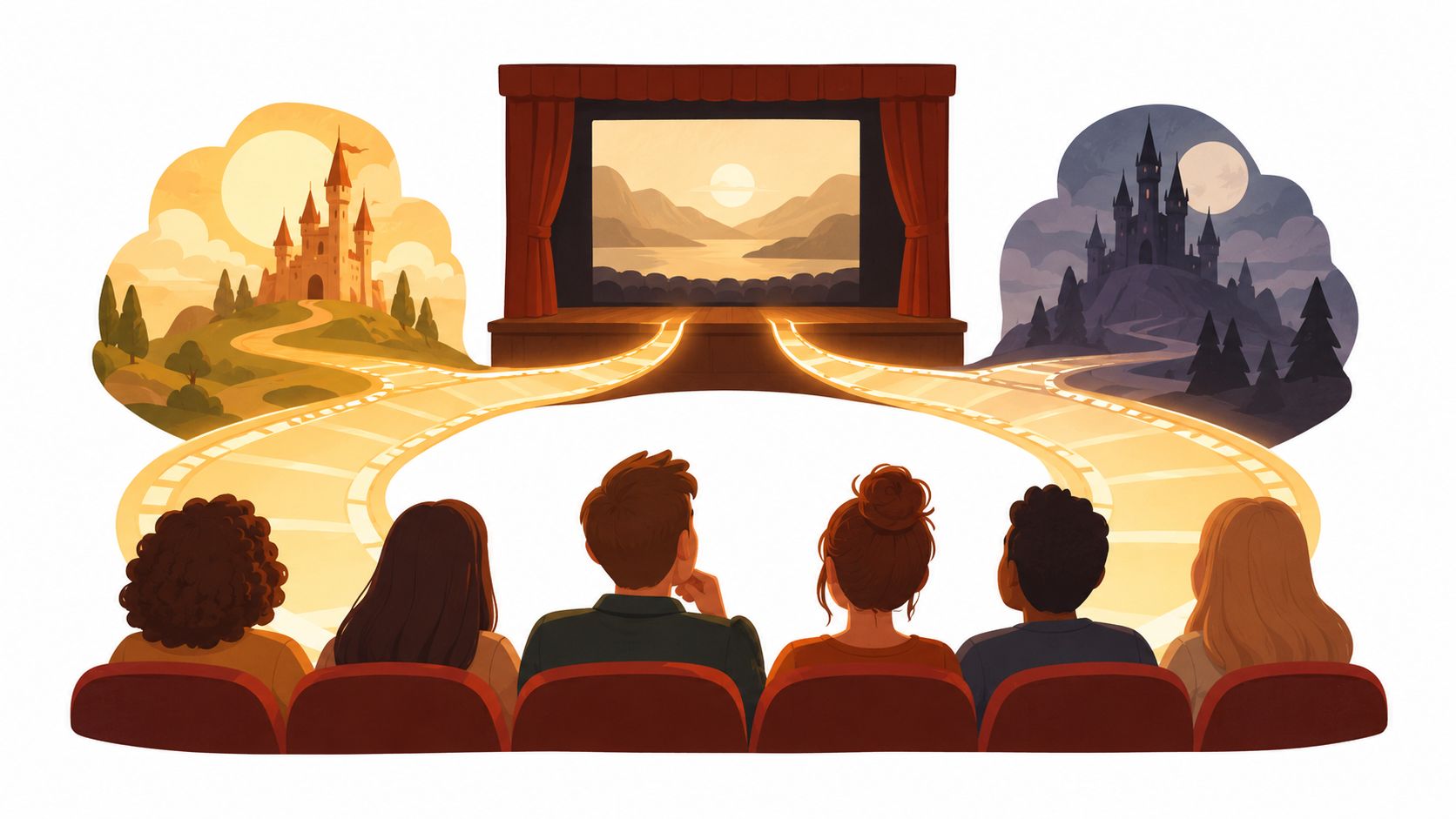
I would price personalization closer to branching than to a QR code. The template is one shoot, but the system that generates and delivers each version is its own build, somebody has to check what it puts out, and the brand owns every output. Virgin Voyages told CNBC its Jen AI budget was on par with a Super Bowl ad.
Upkeep is the cost I see left out of nearly every interactive brief. Netflix confirmed in November 2024 that it would remove 20 of its 24 interactive specials, with a spokesperson saying the format had “served its purpose, but is now limiting as we focus on technological efforts in other areas” (VGC). Every one of those specials needed the Netflix player to keep supporting choices, and once Netflix moved on, they came down.
When interactive video is not worth it
Short-lived pieces are the clearest case. A branching film for a single quarter’s launch will cost more to make than it can earn back before it is retired, and Netflix, with a player of its own, still retired most of its titles inside a few years.
I would also pass when nobody has a use for what viewers choose. In the best entries above, the choice went somewhere, onto a Tinder profile or into the Jen AI invite itself. If nobody on your team will look at which path people took, the extra versions are just extra footage, and a linear video aimed at one decision will do the job. Routing viewers once they have told you something is its own topic, covered in our guide to video for lead generation.
Same if your ad already runs somewhere a tap or swipe takes people to the page. Building interaction into the video there adds work and no extra step. Our list of types of video advertising helps match the format to the job.
A brand film that depends on a slow build is the last thing I would make interactive. It loses its shape as soon as you stop it to ask a question.
If the interactive piece is meant to sell something that does not exist yet, look at how crowdfunding creators run pre-launch lists, backer surveys and post-campaign upsells; PledgeBox’s case studies for crowdfunding creators cover those stages, from Nothing Phone’s pre-launch list to the timing of Pebble Time’s post-campaign upsells.
Frequently asked questions
A linear video with one action attached, such as an on-screen QR code or a single question with two answers. Macy's 2024 Peacock special worked that way, a normal 30-minute shopping show with a QR code on screen the whole time, leading to a dedicated Macys.com page. Nothing extra gets shot, and because every scan reaches a page you can measure, you find out whether your audience will act before you pay for branches.
In November 2024 Netflix said the format had served its purpose and was now limiting as the company focused on other technology, and it removed 20 of its 24 interactive titles by December 1, 2024. The last two, Bandersnatch and the Kimmy Schmidt special, came down on May 12, 2025. If you build one, budget for keeping it running, because the piece only works as long as the player behind it supports choices.
Usually one decision point with two options, two at most. Every choice multiplies what you script, shoot, edit and review, and two choices with two options each already leaves four endings to finish. Build the first branch around the decision your viewer is really making, usually which product fits them, and add a second only if the data shows people splitting in a way you can act on.


