Interactive video marketing: formats, examples and what to measure
Interactive video marketing explained: the main formats, real examples from Walmart, Booking.com and Netflix, what production takes, and how to measure it.

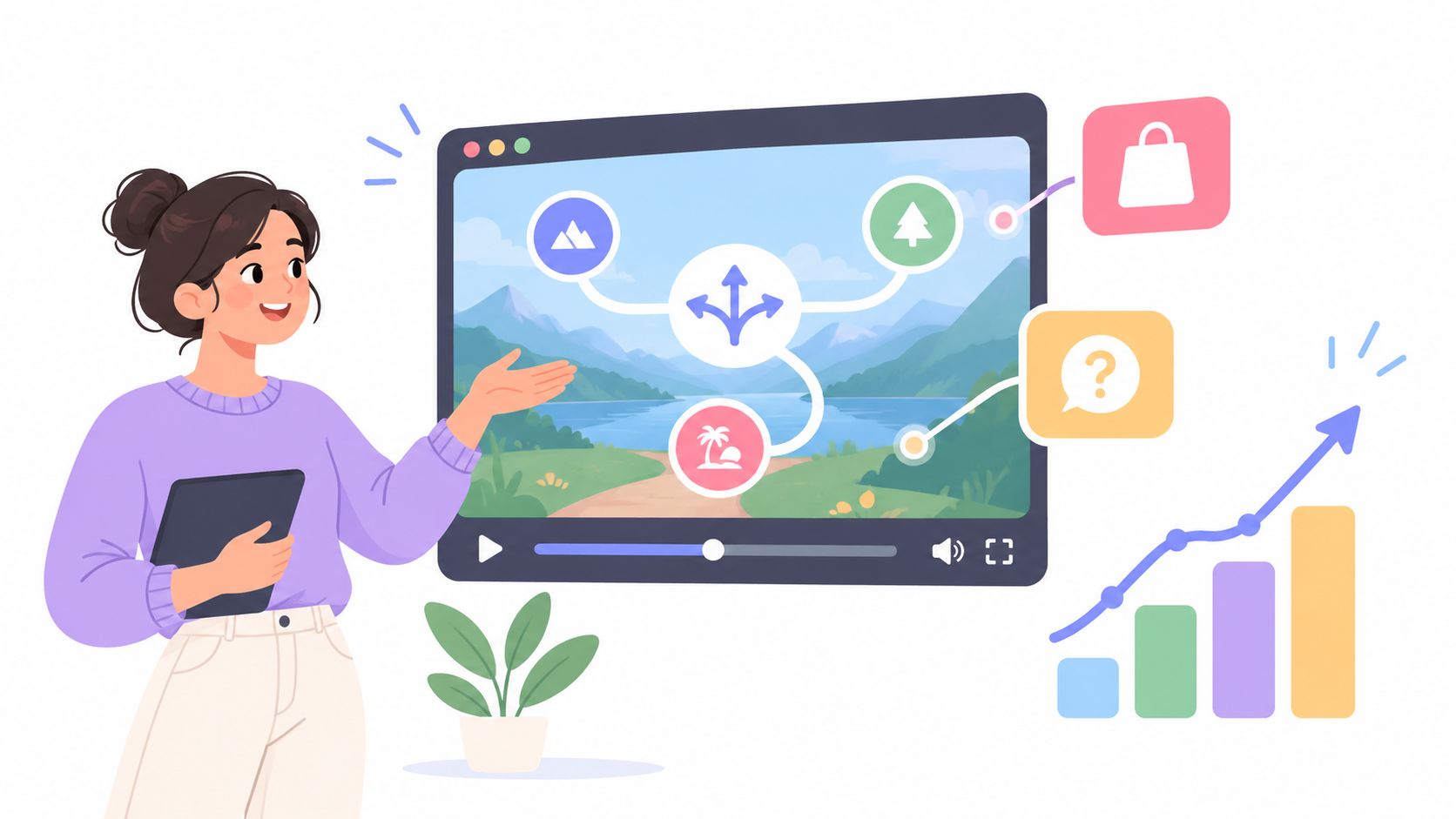
Interactive video marketing is video the viewer can act on inside the player. They pick a path, tap a product, answer a question or get a version made for them, and you keep a record of what they did.
Before anyone storyboards an interactive video, I want the client to finish one sentence about what the viewer gets to do here that a straight cut can’t give them. If they can’t finish it, I’d sooner make a good linear video. Most of the interactive briefs I work on at Moonb start with someone who saw a slick branching demo and wants one, and sometimes that’s the right call. More often the video would play fine start to finish, and a menu halfway through would only slow people down and bloat the edit.
What counts as interactive video
HubSpot calls interactive video “a non-linear form of media that allows viewers to engage with the video they’re watching,” where viewers “can click on hotspots, answer questions, choose their own paths” (HubSpot).
Too loose for me. A button on a linear edit that sends everyone to the same page is a call to action (most videos should have one anyway), and nobody’s path changed. I only call a video interactive when the viewer’s input changes what they see next, or tells you something you’ll act on afterward.
You feel that difference from the first planning call. A real branch means writing and cutting alternate versions of the video. Even a shoppable cut, which looks simpler, needs the product feed locked before the shoot.
None of this is new, by the way. At Expo 67 in Montreal, the Czechoslovak pavilion screened Kinoautomat, described as the world’s first interactive movie. Nine times the film stopped, a moderator came on stage, and the audience voted between two scenes. Whatever they picked, the story ended with the hero’s apartment in flames, which was the satire. Plenty of branching marketing videos still work that way, minus the joke, with every path ending at the same demo form.
Online, YouTube added clickable annotations in 2008 and switched them off on January 15, 2019 (Wikipedia). The main tool left on YouTube is the end screen, which holds up to four clickable elements in the last 5 to 20 seconds of a video, per YouTube Help.
The channel sets most of the limits, so choose it alongside the rest of your video marketing strategy, well before the storyboard. If most of your views will come from feeds, PostSyncer’s guide to video marketing for social media has a quick reference of platform video specs.
Where interactive video outperforms linear video
The best recent numbers come from ad platforms, which also happen to sell the format.
In January 2026, Amazon Ads and Publicis Media released a study of interactive video ads on streaming TV, fielded by the research firm Latitude with more than 7,800 respondents and ten brands. 79% of viewers found interactive ads more engaging than standard video ads, 78% found them more attention-grabbing, and 72% said they felt more relevant. Brands that sell on Amazon saw interactive ads drive 3 to 4 percentage point lifts in brand opinion, consideration, purchase intent and recommendation, and brands without a direct purchase option still got a 4-point lift in brand opinion (Amazon Ads).
My favorite line in it is about effort, and I’d pin it above every storyboard. Viewers “don’t want to type in phone numbers. They want convenience.”
Amazon’s own guide to interactive video adds Kantar figures from 2024: a 30% uplift in brand awareness and a 28% uplift in purchase intent for its interactive formats against non-interactive control groups. Its internal data from October 2024 to April 2025 showed streaming TV ads with interactivity getting 4.1 times more add-to-carts and 1.7 times more orders than those without it.
Innovid, an ad-serving and measurement platform, analyzed nearly 380 billion video ad impressions it served in 2023. Interactive CTV campaigns reached engagement rates 4.6 times higher than mobile video and 10.3 times higher than desktop video, and interactive ads earned an average of 92 extra seconds of time compared with standard pre-roll (Innovid, March 2024).
Enough to get a test approved. I wouldn’t put any of it in a forecast, though, because every figure comes from a company that sells or serves interactive inventory, and someone clicking a TV remote hasn’t bought anything yet.
Then there’s the tidy set of lift figures that gets copied from blog to blog: 25% more conversions, 18% more leads, 21% more web traffic. They bug me every time. I traced them to a Demand Metric benchmark report from November 2015, built on 515 survey responses, where they are the shares of respondents who picked each item as a benefit. Nobody measured a lift.
IAB’s 2025 Digital Video Ad Spend and Strategy report explains the buyer’s side better than any of those numbers: “Although content quality is the top criterion in digital video buys, failure to deliver outcomes is what limits deals with streaming partners” (IAB). Put an add-to-cart button on a TV ad and the streaming buy has an outcome to report.
Amazon’s Maggie Zhang went through the Publicis study with Beet.TV at CES 2026.
Where interaction adds cost for nothing
Netflix launched its interactive specials in 2017 with Puss in Book, then told The Verge in November 2024 that it would delist all but four of the 24 titles on its Interactive Specials page. “The technology served its purpose, but is now limiting as we focus on technological efforts in other areas,” a spokesperson said (The Verge). The last two, Bandersnatch among them, were reported to be leaving in May 2025 (The A.V. Club).
A choice in a feature-length film asks far more than a tap in a short ad, so I wouldn’t stretch the comparison. It does match what I see on briefs, though. Interaction helps when the choice sits right next to something the viewer was already deciding, like which product to look at or what to do next. Brand films are the worst fit; nobody wants to stop and pick an option in the middle of a story they’re enjoying.
Common interactive video formats and when to use them
Buyers tend to ask for branching first because it demos best. In production I nearly always start with something simpler, a format that adds one useful action without multiplying the edit.
Branching stories
Branching only pays when the audience really does split, like a software buyer choosing between the administrator, developer and finance paths, or a trainee picking the scenario closest to their real day.
It’s also the heaviest of the five to build, and Bandersnatch is my go-to example when someone underestimates that. Netflix’s Black Mirror: Bandersnatch premiered on December 28, 2018 and gave viewers ten seconds at each choice before a default was picked for them (Wikipedia). The Hollywood Reporter reported that it was filmed in 35 days over a seven-week shoot and needed 250 segments of video to cover all the possible scenes, while director David Slade’s season four episode “Metalhead” had a 12-day shoot. “There’s a complexity that just needs really skilled people at every level to execute this well,” Slade said (The Hollywood Reporter).
Marketing branches are far smaller than Bandersnatch. Three paths still come out to roughly three short videos, each one scripted and signed off separately.
In Netflix’s own tech featurette for the film, one interviewee calls Black Mirror “the perfect show for interactive storytelling.”
Shoppable video
Retail, launches, cooking and demos are the obvious fits for shoppable video, anywhere the viewer sees something and wants it now, because the product details or a buy button sit right there in the player.
If a team asked me for one campaign to study, I’d send them Walmart’s “Add to Heart” series. Announced on November 28, 2023, it was a 23-part holiday rom-com released on TikTok, Roku and YouTube from December 2, with over 330 products to shop across the series. TikTok’s Video Shopping Ads and Roku’s “Ok to Text” feature carried the purchase, and Walmart called it TikTok’s first fully shoppable holiday series (Walmart).
The same release says almost everything in the series was sourced from Walmart, from the furniture and holiday décor to what the whole cast wears. Produce something like that and the product list gets settled before the shot list, because every hero product has to read on a phone as clearly as on a TV.
The Wall Street Journal’s explainer calls the format “rom-commerce” and looks at where it sits in Walmart’s wider push into shoppable content.
Clickable hotspots and overlays
Product tours are the natural home for hotspots. The viewer taps a feature and gets a short detail panel, or jumps to the right product page, while the video keeps playing. Keep the labels sparse, because a frame crowded with them gets ignored, and put each one where the viewer’s question comes up (Taja’s video marketing best practices make the general version of that point, with one primary action tied to the viewer’s intent).
On streaming TV the hotspot becomes an overlay you click with the remote. Amazon’s interactive video ads let viewers add a product to their cart with the remote or their phone, and brands that don’t sell on Amazon can use overlays such as “get a quote” or “book an appointment” that let the viewer send themselves an email or push notification with a link to the brand’s landing page (Amazon Ads).
Amazon’s Brand Innovation Lab also builds custom interactive campaigns around Prime Video titles. Booking.com’s “Travel the Screen” ran alongside the Amazon Original film The Idea of You in 2024, and Amazon’s case study describes it as an interactive experience that follows Anne Hathaway’s character on tour, from Coachella to the Côte d’Azur, with each city spotlighting a Booking.com stay inspired by scenes from the movie. It says almost nothing about the mechanics, which is a shame, but between May 2 and June 10 the campaign reached 22.3 million unique users, and Booking.com reported a 10% increase in aided brand awareness and a 9% increase in brand opinion (Amazon Ads case study).
Quizzes
A quiz can sort prospects (a B2B team asking which workflow a buyer runs today) or check that a trainee understood one lesson before the next. Vimeo’s interactive tools, for example, include quizzes and polls with SCORM and LMS integration for training (Vimeo).
The answers are first-party data, but only if someone has decided in advance what each one changes. Settle that before writing a single question. On a lead-gen quiz, most of the decision is where each viewer goes once they’ve told you who they are, and our guide to video for lead generation has more on that routing.
Personalized video
In 2021, Lay’s Messi Messages let fans send personalized videos from Lionel Messi, in 10 languages, to invite friends to watch a match (PepsiCo). Most personalized video is less of a show than that. Amazon’s location-based formats swap the local promotion, the nearest store and the landing page depending on where the viewer lives, and Innovid’s 2024 report found that dynamic ads personalized to the viewer earned more than 38 seconds of additional time.
Keeping it all coherent is a grind. Each variable you swap, a name or a city, multiplies the versions somebody has to check before anything ships.
When a marketing team is stuck between formats, I sketch out something like this with them. It leaves out the linear types of video advertising, which are still the right answer for plenty of briefs.
| Format | Best use | Production lift vs a linear video | What to measure |
|---|---|---|---|
| Branching story | Audiences with different needs or scenarios | High: every path needs its own script and its own edit | Path chosen, completion per path, the next action on each path |
| Shoppable video | Product discovery and purchase | Medium: the product list shapes the shot list, and every product has to read on each screen size | Product taps, add-to-carts, orders |
| Clickable hotspots | Product tours and feature education | Low to medium: one edit plus an interface layer and links | Hotspot opens per viewer, detail views, qualified visits |
| Interactive TV overlay | Streaming TV ads that need a measurable action | Low to medium: a standard spot plus an overlay and a landing page | Overlay engagement, add-to-carts or sent links, brand lift against a control |
| Quiz | Segmentation, lead routing and knowledge checks | Medium: question logic, routing rules and an owner for the answers | Answer completion, answer mix, quality of routed leads |
| Personalized video | Account, role or location-specific messages | Medium to high: templates, a data feed and QA on every version | Render and delivery errors, response rate against the generic version |
Platforms that host interactive video
Vendors here come and go, so make sure one still sells the product before you build on it. Wirewax, which made objects in video shoppable, was bought by Vimeo in November 2021 (TechCrunch). Brightcove announced on October 14, 2021 that it would acquire HapYak’s interactivity technology from Newsela (Streaming Media). And if an older roundup sends you to Eko, look at eko.com first. When I checked in October 2026, the homepage was selling product-data software, with no interactive video product on it.
These five were still selling interactive video at the time:
- Vimeo lists interactive video among its enterprise features, with quizzes, shopping with add to cart, branching and sticky hotspots.
- Brightcove Interactivity does quizzes, polls, clickable hotspots and personalized calls to action, for live and on-demand video.
- Mindstamp is aimed at training, demos and lead capture, with questions, branching and response tracking.
- Stornaway is the one I’d open first for a real branching story. It’s built for branching scenarios on the web, in an LMS, on mobile and in VR.
- Cinema8 bundles hosting, interactive tools and analytics in one product.
If your library already sits on Vimeo or Brightcove, try the built-in tools before moving it anywhere for one feature.
In paid environments the platform decides what’s possible. Amazon, for one, says interactivity is now enabled by default across its streaming TV inventory, which spans Prime Video, Twitch, Fire TV channels and third-party streaming apps. You give up some of a web player’s freedom there in exchange for reach, so find out what each environment supports while the script can still change.
How interactive video production differs from linear video
On top of the story people see, an interactive video carries alternate paths, an interface layer, data events and a test plan. Teams that leave those for the final polish usually end up redoing the edit.
Start with the decision tree
Map the viewer’s decision first, ahead of any dialogue: the entry point, each choice, the scene it leads to and the final action. I like it drawn as a flowchart-style storyboard, because then the editor, the designer, the developer and whoever owns analytics all work from one plan, which is the purpose of a storyboard anyway.
The order I work in:
- Settle the outcome. Should the viewer explore a product, qualify themselves, ask for information or buy?
- Map the paths, and cut any choice that leads to the same scene as another.
- Script every route with its own lines, visuals, transitions and ending.
- Edit in modules (scenes, end cards, overlays, CTA states) you can reuse across placements.
- Build the interaction in the player or ad environment you chose.
- Test every state: links, labels, timing, mobile behavior, sound-off viewing, and what happens when the interactive layer fails to load. I check that last one first.
If this is going to be more than a one-off, keep a library of approved scenes, end cards and brand elements, and write down what was agreed before production. Don’t leave the number of paths or the owner of the final files vague; put both on your video production checklist with a name against each before the first shoot.
Plan delivery before the shoot
If the video is also running as an ad, the specs reach back into the master file. Adobe Advertising’s DSP, for example, asks for VPAID 2.0 JavaScript tags (VAST for CTV), MP4 with H.264, 1280x720 for 720p or 1920x1080 for 1080p, and progressive scanning (Adobe). While you’re at it, ask your ad server which interactive standard it supports. In 2019 the IAB Tech Lab laid out a plan to phase out VPAID in favor of SIMID, a specification built for interactive video ads, partly because VPAID didn’t work on mobile or within over-the-top (AdExchanger).
That’s one reason to keep the master clean, with no buttons or labels baked into the picture, so the same footage works whichever standard the placement runs. Interaction points still have to read on a phone, and a short cutdown should make sense even where the interactive layer never loads.
Review takes longer, too. Besides picture and sound, somebody has to do a logic pass, clicking every route, submitting every answer, opening every product link and confirming analytics recorded the event you meant to record.
Metrics that matter and where attribution gets messy
I’m wary of click counts on interactive work. One viewer taps a hotspot out of curiosity and leaves. Another ignores every overlay, watches the whole explanation and comes back a week later through search, and your measurement plan has to tell those two apart.
Match events to the funnel
Brand pieces live or die on completed views and brand lift. For anything closer to a sale, look at what the viewer did after the interaction (product detail views and return visits first, then add-to-carts, form completions, booked meetings or purchases). Feature selections and chapter choices are useful too, mostly for telling you which path needs fixing. In the Beet.TV interview, Zhang said Amazon measures interactive ads with traditional brand metrics and with real-time engagement signals such as clicks and scans, and encourages advertisers to review the two together.
Run a control. Put the interactive asset up against a standard video, with audience and placement as close to identical as the campaign allows, and if a static landing page is the real alternative, test against that as well. Skip this and there’s no clean way to turn the results into a video marketing ROI figure.
Credit gets hard to assign when a viewer picks a branch, opens a product page, comes back through another channel and converts later. If there’s a buying committee, several people may touch that path before anyone signs. Sourceloop’s comparison of B2B attribution models makes the case for adding an account-based layer to a standard model, and I’m with them on that.
Design for friction
Phones leave little room for labels, and nobody wants to read a menu on one. Anyone watching muted also misses whatever instruction only exists in the voiceover. Check every branch on an actual phone with the sound off.
Keep actions few and clear, and label them by what they do (“See pricing for teams”), never “Option A” and “Option B”. Log the path chosen, when it was chosen, whether the resulting scene was finished and what the viewer did next. If people drop off the second the interaction appears, my first suspect is the choice itself.
Try it on one video first
Pick an existing video where the viewer already has a choice to make or a product to look at, add a hotspot or an end-of-video choice, and leave the rest of the campaign alone. Decide on the success event before launch and run it against the linear version. When the results come in, weigh the leads or purchases it produced as heavily as the interaction data.
Frequently asked questions
Shoppable video is one kind of interactive video. Interactive covers any video the viewer can act on inside the player, whether they pick a path, tap a hotspot, answer a quiz or get a version made for them. Shoppable is the part of that built around product actions inside the player, like tapping an item to see it or adding it to a cart. In Walmart's 23-part Add to Heart series, for instance, viewers could shop more than 330 products on TikTok, Roku and YouTube.
Only a little. YouTube switched off clickable annotations on January 15, 2019, and the main tool left is the end screen: up to four clickable elements in the last 5 to 20 seconds of a video that runs at least 25 seconds, which viewers on mobile web can't see. For branching or questions inside the video, host it on an interactive player such as Vimeo, Brightcove or Mindstamp, and put a linear cut on YouTube that sends people there.
Plan on roughly one short video per meaningful path, because each path is written and cut on its own. Hotspots and TV overlays sit at the light end (one edit plus an interface layer) and branching stories at the heavy end. Leave time for testing as well, since someone has to click every route, answer every question and confirm each analytics event fires on desktop, mobile and TV before launch.