Brand architecture: how to choose the right model
What brand architecture decides, the four models compared side by side, verified public examples, a seven-question decision checklist, and what changes once you pick.

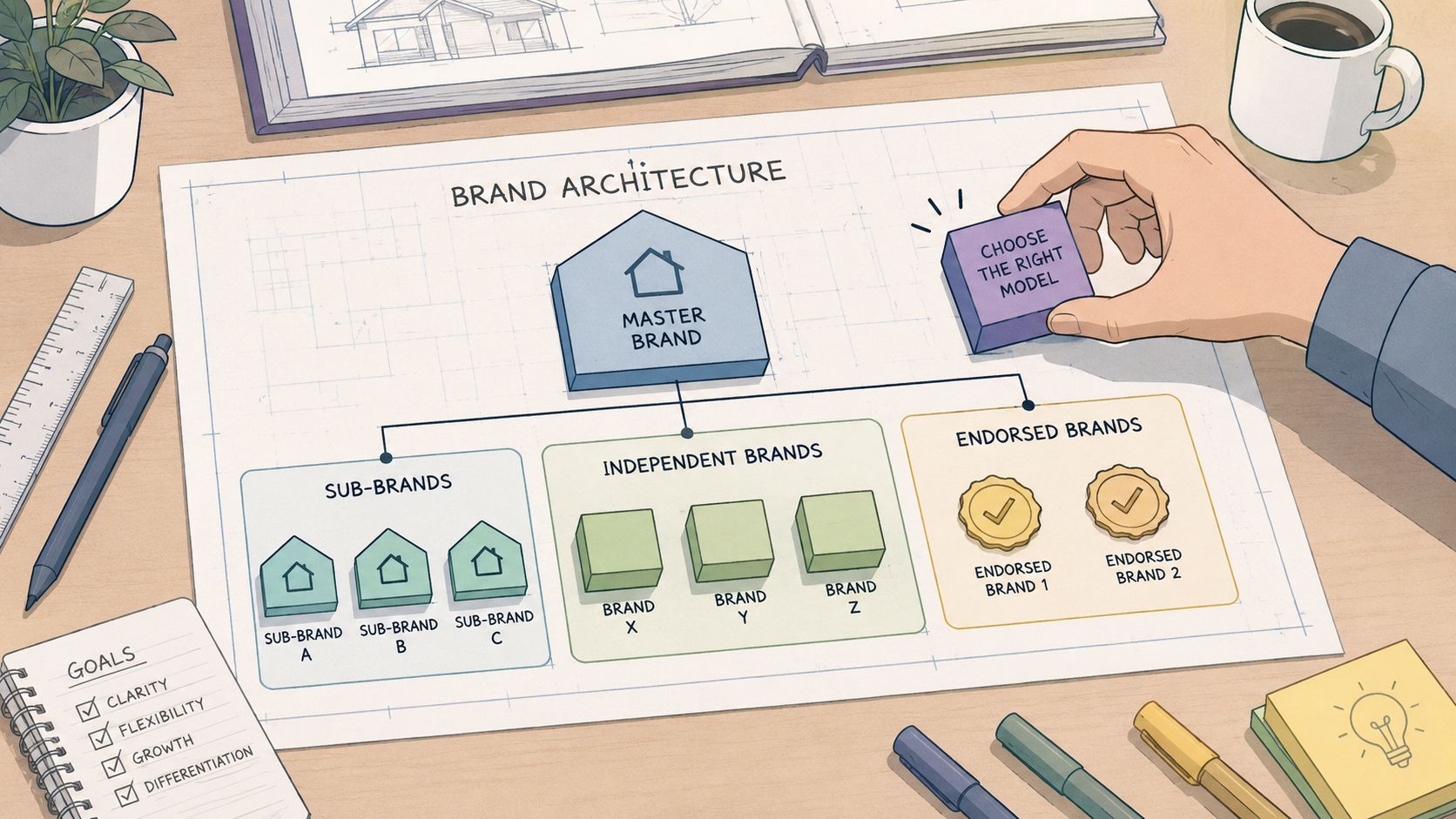
Brand architecture is the way a company organizes and names its brands, sub-brands, and products so customers understand what belongs to what. There are four common models: branded house, sub-brand, endorsed brand, and house of brands, and most large companies end up running a hybrid mix of them. The real decision behind all of them is how much equity the master brand should lend, and how much independence each offer needs to do its job in market.
I work at Moonb, a creative studio, and this question usually reaches me sideways. A client forwards a thread where a naming argument has gone in circles for weeks. The new product line wants its own logo, the CEO wants one brand everywhere, and the acquisition nobody integrated still runs its old website. None of that is a design problem. It is an architecture problem, and until someone decides the model, every asset downstream stays up for debate. Get the choice wrong and the mess compounds: naming drifts, logos multiply, video end cards stop matching the website, and sales decks tell one story while the portfolio tells another. If you want a refresher on how identity and branding differ before we get into structure, our guide to brand identity versus branding is a clean place to start.
What brand architecture really decides
Brand architecture is a leadership decision before it is a creative one. It tells the market whether one master brand does the heavy lifting, whether each offer stands alone, or whether the company wants a mix. That choice shapes naming, logos, video end cards, sales decks, website taxonomy, and even how legal entities are positioned. It sits upstream of production.
Three questions do most of the sorting. Does the parent name help the new offer, or does it get in the way? Does the offer need to reach a buyer the parent cannot credibly reach? Does the offer need its own pricing, channel, or reputation because the risk profile is different? For a plain-language companion on how brand recognition builds for smaller brands and creators, this overview from Viral.new is a useful read.
A test I use in client work: if you cannot explain the portfolio in one sentence without hand waving, the architecture is already doing too little or too much. The academic side backs up the customer half of this. A 2018 study in Cogent Business and Management argues that the key concept behind brand architecture is customers’ mental organization, meaning how the brands are arranged in consumers’ minds so people can locate each one and understand what it stands for. If the structure on your org chart does not match the structure in the customer’s head, the customer’s version wins. Positioning sits directly underneath this layer, and our guide to brand positioning covers it in depth.
Governance matters as much as the model. Someone has to own the rules, approve exceptions, and keep the system honest when several teams are producing content fast. And the first practical step is rarely a brainstorm. It is a portfolio audit. Pull every name, domain, social handle, and owner into one spreadsheet, and the decision usually surfaces on its own. Our brand audit guide walks through that process.
The four models and where they come from
Most strategy teams still sort portfolios with the Brand Relationship Spectrum, the framework David Aaker and Erich Joachimsthaler published in California Management Review in 2000. It arranges brand relationships by how closely the parent and child should relate, and the four models fall out of it.
- Branded house: one master brand carries most or all offers. Think Google Search, Google Maps, and Google Cloud. The parent name does the trust building.
- Sub-brand: the parent name leads and a descriptor follows. The offer gets its own flavor while the parent keeps most of the equity.
- Endorsed brand: a standalone brand gets visible backing from the parent. The child keeps its own identity, and the parent adds credibility.
- House of brands: the parent stays mostly invisible and each brand stands on its own. Procter and Gamble is the classic case, with Tide, Pampers, and Gillette.
In practice, most large companies end up running a hybrid, a mix of these patterns across one portfolio, whether they planned to or not.
The distinction leaders miss most often is sub-brand versus endorsed brand. In a sub-brand, the parent leads the lockup and a descriptor follows, like FedEx Express. In an endorsed brand, the standalone name leads and the parent appears as support. Reading order tells you the model: parent first usually means sub-brand, child first with the parent behind it usually means endorsement. The difference decides who owns the equity in the customer’s mind, so it changes logo hierarchy, motion systems, website structure, and how much each offer must prove on its own.
Architecture also leans on differentiation. A new offer only deserves its own identity if it has a genuinely different story to tell, and this guide to B2B brand positioning and differentiation is a useful companion for making that call.
The four models side by side
| Model | What it looks like | Best for | Cost to run | Main risk |
|---|---|---|---|---|
| Branded house | One master brand across most offers | Shared promise, shared audience, simple governance | Lower, because the system is centralized | One weak offer can spill into the whole portfolio |
| House of brands | Separate brands with little visible parent connection | Distinct audiences, different price tiers, risk insulation | Higher, because each brand needs its own support | Every brand builds awareness from scratch |
| Endorsed brand | Standalone child brand with visible parent backing | Credibility plus autonomy | Mid-range, because every lockup has to stay consistent | The endorsement rule drifts and looks accidental |
| Sub-brand | Parent name leads, descriptor differentiates the offer | Familiar family with distinct variants | Moderate, because hierarchy must stay tight | Descriptors pile up until the parent meaning gets muddy |
A branded house wins when the offers share an audience and a promise, and when the company wants one clear story. It loses when one product line starts creating reputational drag for the rest.
A house of brands wins when separation is the point: different price points, different channels, different risk insulation. It loses when every brand has to fund its own awareness and the parent’s reputation cannot help.
Endorsed branding sits in the middle for a reason. It lets a child brand keep its own face while borrowing credibility from the parent. The downside is operational. Every lockup, social template, motion system, and sales asset has to apply the endorsement rule the same way, or the portfolio starts to feel inconsistent.
Sub-branding fits when the family name matters but the offer needs a clear descriptor. It works inside a known system. It fails when descriptors multiply so fast that nobody can tell what the parent stands for anymore.
What the public examples show
Alphabet and Google are the cleanest branded house illustration in public view. Google announced the restructure in August 2015, with Larry Page writing that “we are creating a new company, called Alphabet” to sit above Google as a holding company. The parent structure absorbs risk from the experimental bets while Google keeps doing the visible, consumer-facing work. PBS NewsHour covered the move when it happened, and the segment is still one of the better short explainers of what a holding structure does for a brand.
P&G is the classic house of brands. The company runs its portfolio through five sector business units covering 10 product categories, and the point is that Tide, Pampers, and Gillette never need a shared shelf identity to make sense. Each one targets a distinct shopper and a distinct use case, which is exactly why the parent stays in the background.
Marriott shows the endorsed logic at scale. The company describes 30-plus brands in its portfolio, and the Marriott Bonvoy loyalty layer ties them together without making every hotel look identical. Some brands carry the Marriott name visibly, like Courtyard by Marriott. Others, like The Ritz-Carlton or W Hotels, keep more distance. One company, one loyalty system, and several deliberate levels of parent visibility. Marriott’s own explainer for Bonvoy shows how a single loyalty brand stretches across the whole portfolio.
FedEx and Gap Inc. split the two remaining patterns between them, which makes the pair a useful final example. FedEx Express is a sub-brand: FedEx leads the lockup and the descriptor follows, and the same rule repeats across FedEx Ground and FedEx Freight. Old Navy is the opposite call, a standalone brand Gap Inc. keeps at arm’s length so it can chase a different shopper without pulling the Gap name along with it. Customers who know the link still credit the parent’s scale, but the storefront never says so.
The habit worth building from all four: read the lockup, not just the logo. The visible hierarchy tells you who is borrowing equity and who is keeping distance. A portfolio can look tidy and still be strategically wrong if the market reads the relationships differently than leadership does. For more teardown material, our collection of rebrand examples covers several companies that changed their structure in public.
The decision checklist to brief against
-
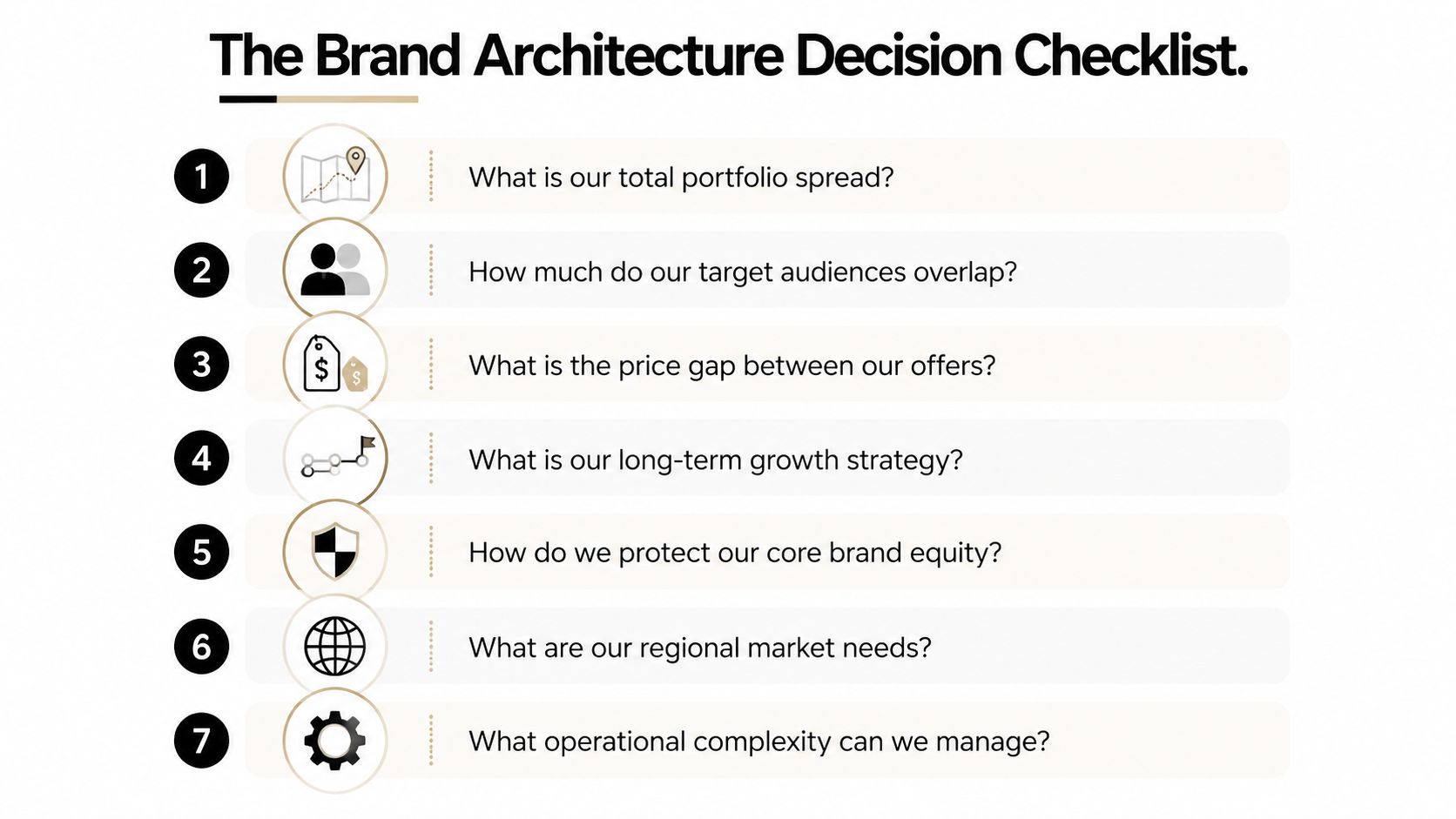
What is our total portfolio spread? A broad, expanding portfolio needs a structure that scales without chaos. A narrow one usually supports more unity.
-
How much do our target audiences overlap? Heavy overlap points toward a branded house. Low overlap points toward separation, because one promise will not serve both groups well.
-
What is the price gap between our offers? Big gaps often need clearer distance. Offers that sit close together can share equity more easily.
-
What is our long-term growth strategy? If acquisitions or new lines are coming, the model has to absorb change without a rework every quarter.
-
How do we protect our core brand equity? If one offer carries category risk, the parent may need distance. If the parent is the main trust signal, keep the link visible.
-
What are our regional market needs? Some markets need local flexibility, others need a strict global system. The architecture has to survive both.
-
What operational complexity can we manage? If the team cannot maintain multiple rulebooks, sites, and design systems, do not pretend it can. Simpler usually wins.
The defensible default is a branded house, unless one of those questions gives you a specific reason for separation. Every independent brand needs its own marketing effort, its own maintenance, and its own discipline. And if the portfolio changes materially, revisit the decision; a major acquisition or a shift in market risk can make yesterday’s structure too rigid for tomorrow’s business. When you are ready to turn the answer into an actual brief, our creative brief template is built for exactly that handoff.
What changes once you pick a model
The architecture decision does not stay on paper for long. It forces naming rules, trademark discipline, and approval paths. If a product team can still name things freely after the decision, the architecture was not really decided.
The visual system changes next. The master mark needs a documented relationship to every sub-brand or endorsed mark: lockups, size rules, placement, and endorsement patterns, all written down before new assets get made. Website structure follows the same logic. Some portfolios work best with a single domain and clear taxonomy, others need separate sites with a visible parent connection. The choice should follow the architecture rather than the preferences of whichever team built the last website.
Then comes the part I see skipped most: retemplating. Video end cards, lower thirds, decks, product demo openers, and social templates all have to signal the same structure. If the video says one thing and the homepage says another, buyers notice the mismatch fast. Governance keeps all of it real. Someone owns the master brand, someone owns each child brand, and approvals follow a clean path; without that, the system drifts the first time a deadline gets tight. This is the stage where a Creative Director led team earns its keep, because brand strategy work only holds up if the naming rules, visual system, and recurring creative output all move together.
One more thing. If you change the structure, update the asset library at the same time. A new architecture with old decks, old end cards, and old social templates is not a transition. It is a mess with a deadline.
Common mistakes and how to fix them
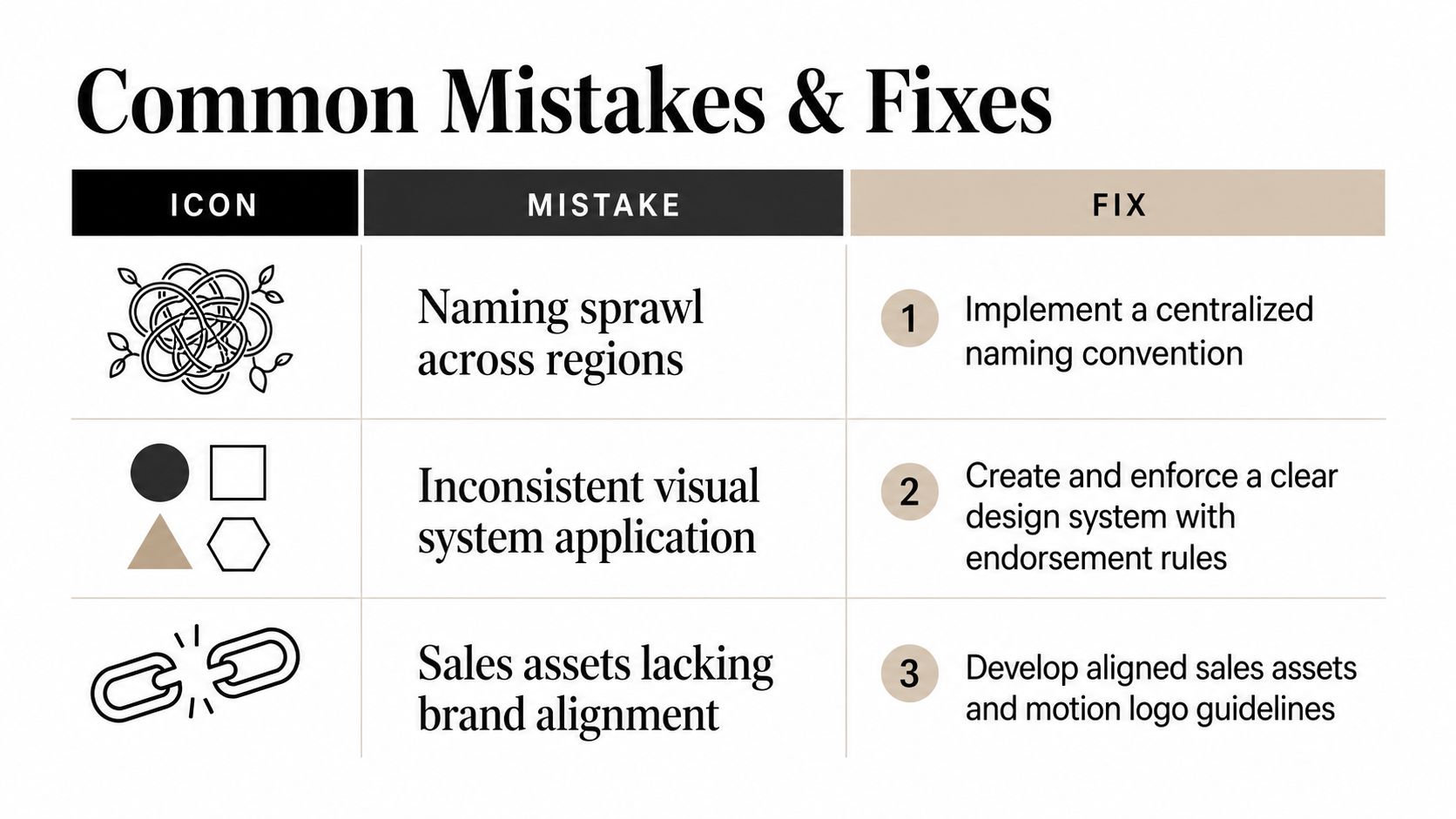
Naming sprawl across regions
The symptom is obvious: different teams name similar offers in different ways, and nobody can explain the rule. It happens when launches move faster than governance. The fix is a naming convention with one approval owner, not a loose style preference.
Sub-brand logos that compete with the master
This shows up when the child mark gets bigger, louder, or more decorated than the parent. The cause is usually pride, not strategy. Decide whether the offer is a descriptor or a brand, then build the lockup around that answer.
Treating architecture like a logo exercise
A lot of teams stop after the visual refresh and call it done. That fails because architecture is about portfolio relationships, and a refreshed logo cannot fix a confused structure. Write the rulebook first, then design to it.
Keeping acquired brands alive out of sentiment
You will hear this as “customers like the old name.” Sometimes that is true. Sometimes it is internal politics. The test is whether customers would notice if the brand disappeared. If not, the equity case is weak.
Leaving video and sales assets behind
Old motion graphics, old decks, and old end cards keep circulating after the structure changes, and the market feels the mismatch. The fix is an asset inventory, a retirement date, and one team assigned to replace the stale pieces.
A clean architecture only works if the production system can keep up. Otherwise the market sees a portfolio that is half new and half old, and that ambiguity costs more than the rework.
If your portfolio has outgrown one name, do not let the next launch happen on instinct. Pull the names, domains, and logos into one audit, decide where the parent should lend equity and where it should not, then brief the rulebook before creative starts. The companies that get this right treat it as a working system with an owner, and it shows in every asset they ship.
Frequently asked questions
Compare the company against its own baseline rather than an industry benchmark. Track aided and unaided recall of the master brand, share of search between the master brand and sub-brands, cross-sell behavior, the number of logos and design systems the team maintains, and how often naming disputes reach leadership. If those measures improve after a change, the structure is doing its job.
Audit first, then decide. Put every brand, product name, logo, domain, and social handle in one spreadsheet with an owner beside each. Interview stakeholders about where the company is going, map each offer on the Brand Relationship Spectrum, draft two or three candidate structures, and test them against a decision checklist before rolling anything out. Skipping the audit is what makes the later work shaky.
No. Sometimes the architecture calls for one site with clearer taxonomy, and sometimes for separate sites with a visible parent link. The website should follow the portfolio structure rather than forcing the structure to fit the old navigation.