How to read and compare a video production quote
How a video production quote is built line by line, what to send a vendor so the number comes back accurate, how to compare two quotes that look nothing alike, and what usually sits outside the total.


I read the total on a video production quote last. First I want the plan it pays for (the crew and their days, the kit and locations, how the edit gets finished, the rights you end up holding), and I only put two totals side by side when the plans underneath them line up.
A fair part of my week at Moonb goes on quotes that clients forward me from other production companies. One vendor lists crew, kit and post as separate lines. Another sends a single figure called “production”. Both promise a finished film. Nobody reading them can tell which includes the 15-second cutdowns the campaign depends on. For price ranges, our guides to corporate video production prices and what a commercial costs to make have the numbers.
How a quote is built, line by line
Wikipedia’s film budgeting entry describes a budget “typically divided into four sections: above the line (creative talent), below the line (direct production costs), post-production (editing, visual effects, etc.), and other (insurance, completion bond, etc.).” A quote for a two-minute brand film is far smaller, but the four buckets are still in there. When I can’t sort a quote into them, I send it back and ask the vendor to regroup it.
Read the lines in the order the work happens, starting with creative development: is the vendor writing the concept and script, or shooting yours? I like the storyboard to get its own approval point, especially when the film leans on animation, product demonstrations or planned camera moves. Then come the shoot days, the edit and finishing, and rights and delivery.
| Line item | What it covers | What to ask |
|---|---|---|
| Creative development | Concept, script or treatment, storyboard | How many script and concept rounds are included? |
| Crew | Director, camera, sound, lighting, production assistant | How many people, on which roles, for how many days? |
| Kit and equipment | Cameras, lenses, lights, audio, grip, drones | Package or per-day rental, and which shot needs each specialist item? |
| Location | Site fees, permits, travel, parking, catering | Who finds, books, pays for and insures each site? |
| Talent | Presenters, actors, voiceover, creators | Is usage priced on top of the shoot or session fee, and for which media, territory and term? |
| Post-production | Edit, color, sound mix, graphics, captions | How many edit hours or revision rounds per cut? |
| Music | Original score, library track or commercial release | What does the license cover (media, territory, term), and what does renewal cost? |
| Usage rights | Where the film may run, and until when | What transfers to you on final payment? |
| Versions and delivery | Cutdowns, aspect ratios, languages, source files | Is every format named, and are project files included? |
| Insurance and contingency | Production insurance, a reserve for overruns | What does contingency cover, and who approves spending it? |
Don’t get stuck on the camera model. Ask what each person on the crew does on the day. A sound recordist watching levels through a whole interview is a different job from a camera operator checking audio between takes, so ask which one the sound line pays for. An editor on set belongs on the sheet only if the plan calls for same-day selects.
Each equipment line should map to something you will see. Product close-ups, moving shots and seated interviews need different setups, and a drone or specialist lens should point at a shot on the storyboard that the producer can show you.
A single “edit” line can hide most of the finish. Color, the sound mix, motion graphics, captions and exporting every format all happen after the story is cut (our guide to what video editing costs covers what graphics, color, sound and extra versions add to an edit), and I want each listed with its own hours.
StudioBinder’s Making It series follows director SC Lannom and producer Herman Wilkins through pre-production on a pilot; episode one covers film budgeting and script breakdowns, where line items come from in the first place.
Then find insurance, travel and contingency. For contingency, ask what it’s for, who signs off on spending it and what happens to whatever goes unspent. If the producer can’t say what it’s for, I usually read it as padding and ask them to tie it to something specific.
What to give a vendor so the quote comes back accurate
Whatever the vendor doesn’t know, they pad for. Close what you can before you ask, and put anything still undecided in as an assumption, priced as a separate option.
- Every deliverable, counted. A 60-second master plus 15- and 6-second cutdowns in 16:9, 1:1 and 9:16 is nine files, and a vendor quoting “one video” may have priced one. Add languages and captions.
- Where it will run (paid social, broadcast, your website, sales decks, an internal portal) and in which territories, because “digital” tells a producer almost nothing.
- How long you need the rights. Say whether music and talent must stay cleared past the first year, and get renewal prices now if the campaign could run longer.
- Proposed shoot days, locations, access limits and who provides each site. If you don’t know how many days, ask the vendor to recommend a number and show the reasoning.
- What gets filmed, what you supply (screen recordings, product shots, old footage) and what comes from stock.
- The person with sign-off, plus any legal or brand reviewers and how long each review window runs.
Ask for a schedule next to the price, scoping through to delivery, with each stage naming what the vendor needs from you before it starts; the calendar in our video production timeline guide is a fair yardstick for it. The creative brief guide turns campaign notes into something a production team can price, and the creative brief template collects input before the request goes out.
Decide early whether the music is an original score, a library track or a commercially released song, because each one is bought differently. WIPO’s rights clearance guide for independent filmmakers notes that to clear recorded music “a filmmaker normally must contact two groups of rightsholders”: the record label, which owns the recording, and the publisher, which owns the rights or represents the authors of the music (lyrics and composition). The same guide says projects assign “a significant percentage of the budget” to music, “more or less 5 percent,” and at that share I want the license written out as carefully as the crew. If the vendor’s music line reads like jargon, Spotify for Artists has a short explainer on sync licensing from the musician’s side.
A request template you can copy
Paste this into an email and fill in the brackets, leaving unresolved items in plain sight. If you don’t know an answer yet, write “recommendation needed” in the field, and the vendor has to propose something you can see and push back on.
Subject: Video production quote request for [project name]

Project and purpose: [campaign, business goal, key message, launch date]

Audience and placements: [who watches, where it runs, territories, paid or organic, how many months]

Deliverables: [each cut on its own line with length, aspect ratio, language, captions and delivery date]

Creative materials: [brand guidelines, reference films, approved claims, existing script; what still needs writing]

Music: [original, library or commercial track; license term, media and territories; renewal price in writing]

Talent: [number of people, presenter or actor or voiceover, union or non-union, usage term and territory]

Shoot: [proposed days, locations, who books each one, access limits, travel and catering]

Footage: [what we supply, what you film, stock needs, screen or product capture]

Post-production: [edit hours or revision rounds per cut, finishing tasks itemized, sign-off owner, review window]

Changes and extras: [price per extra version and per extra revision round; written approval before extra work starts]

Files and delivery: [raw footage, project files, graphics files, caption files, export specs]

Quote format: [line items by category, crew roles with day rates and days, post hours, contingency and its purpose, insurance, validity date]

Schedule and payment: [milestones, what you need from us at each one, delivery dates, payment terms]

Please return the quote in this order, with assumptions and exclusions next to the line they affect.
Check the attachments against the email before sending. If the media plan calls for localized ads and the deliverables list only has the master, add the localized versions to the list before the email goes out.
How to compare two quotes that look different
Move both quotes onto one top sheet using the line items from the first table. Copy each vendor’s amounts exactly; you are only sorting them into matching categories and flagging anything bundled, excluded or unclear.
Start with crew, since a lower day rate can hide a bigger total. For each quote, multiply day rate x number of people x shoot days. Say Quote A has the lower rate per person but puts six people on set for three days, while Quote B charges more per person for three people over the same three days, so A can easily come out higher. That doesn’t make it wrong (extra hands might let the crew light one setup while shooting another), so ask what the extra people do and whether both schedules capture the same material.
| Comparison point | What to put side by side | Worth a follow-up when |
|---|---|---|
| Crew | Roles, day rates, number of people, number of days | The rates differ but nobody explains the crew size |
| Post-production | Edit, color, sound, graphics and revision hours | One lump post line with no hours |
| Versions | Cutdowns, aspect ratios and languages counted one by one | One master quoted, extras not listed |
| Revisions | Rounds included and price per extra round | “Reasonable revisions” with no number |
| Talent | Shoot or session fee plus usage by media, territory and term | A day rate with no usage line |
| Music | License term, media, territory and renewal price | A library track with no renewal terms |
| Location | Who finds, pays for and insures each site | No location line at all |
| Contingency | Share of the total and what it applies to | Missing, or present with no explanation |
If a quote promises “reasonable revisions”, ask for a number. If the totals still differ, name the row responsible and have both vendors price it against the same assumptions. Some things never appear on a quote at all, like portfolio fit and who your single point of contact will be, and those sit in a separate checklist: how to choose a video production company. Any gap left between the totals usually comes from how each team plans to shoot and cut the film, so get each of them to walk you through their plan.
What usually sits outside the number
Most quotes I see price the shoot and the edit and say much less about running the film afterward: talent usage, music renewals, media, new markets. I ask about each of them before signing.
In the UK, Equity’s guide Working in Commercials explains that a performer is paid a fee for the shoot day. “Then there is payment for how the advertiser intends to use the commercial, where it will be shown, how long for.” It also notes that “Featured Artists are eligible for Usage Fees. Walk On and Background Artists are not,” and that if the advertiser wants to keep running the commercial “after the expiry of 3 years from first use, then a new BSF must be negotiated and a new contract issued to cover additional use.” BSF is the guide’s short name for the Basic Studio or Session Fee, the shoot-day payment. Union rules vary by country, so ask the producer which agreement covers your cast and get usage terms in writing before you plan how long the campaign runs.
Creators are similar. If influencers also post campaign content to their own audiences, price that apart from the filming. Social Cloud’s guide to influencer marketing rates has a line worth forwarding to procurement: “A creator’s organic post and a brand’s reusable advertising asset are different products.”
| Item | How it often appears | What to ask at quote stage |
|---|---|---|
| Talent usage | Shoot or session fee only | Usage fee by media, territory and term |
| Music renewal | License covers the first term only | Renewal term and price in writing |
| Media placement | Not in the production quote at all | Who buys the media, and from which pot |
| Extra versions | One master quoted, cutdowns extra | Every cutdown, ratio and language priced |
| Revision rounds | Rounds not defined | Rounds included and price per extra round |
| Stock and fonts | Licenses not listed | A list of licensed assets and their terms |
| New markets | Relicensing not priced | Price for re-edits and relicensing per territory |
| Source files | Only final exports delivered | Which project files, footage and graphics you receive |
A production quote that says nothing about media is normal, because the cost of showing the film sits on a separate plan. App teams keep the same split when they launch; LetsDeployIt’s guide to what it costs to publish a vibe-coded app puts the store fees in a different bucket from building the app. What the production quote does have to price is every version you’ll run, and for a commercial that list gets long (our page on commercial video production lists the usual cuts and formats).
Controlling changes after the quote is signed
A signed price only covers the scope written on it. An extra review cycle or a deliverable added mid-edit is new work, so agree what it costs before anyone starts on it.
I’d have one decision-maker settle conflicting comments before notes go back, and define a round as one consolidated set of notes against a named cut, answered by one revised cut. Each review window should have a set number of days, and everyone should know up front what late feedback does to the delivery date. Comments work best in a shared tool where they attach to the right cut, next to a change log recording what was asked, when, by whom, what it cost and where it stands.
I’d also write into the agreement itself what counts as a revision (fixing or developing work you already agreed), so anything outside the agreement is clearly a change.
Say your team wants a 15-second cut after the main edit is approved. The producer logs it, prices the editor hours, checks whether the music and talent licenses cover a new length and tells you the effect on delivery. You approve before anyone opens the timeline. The change order names the labor, the schedule change, any third-party costs and who can approve it.
Sign only when the quote is complete
The commercial terms are the last thing I go through before anyone signs.
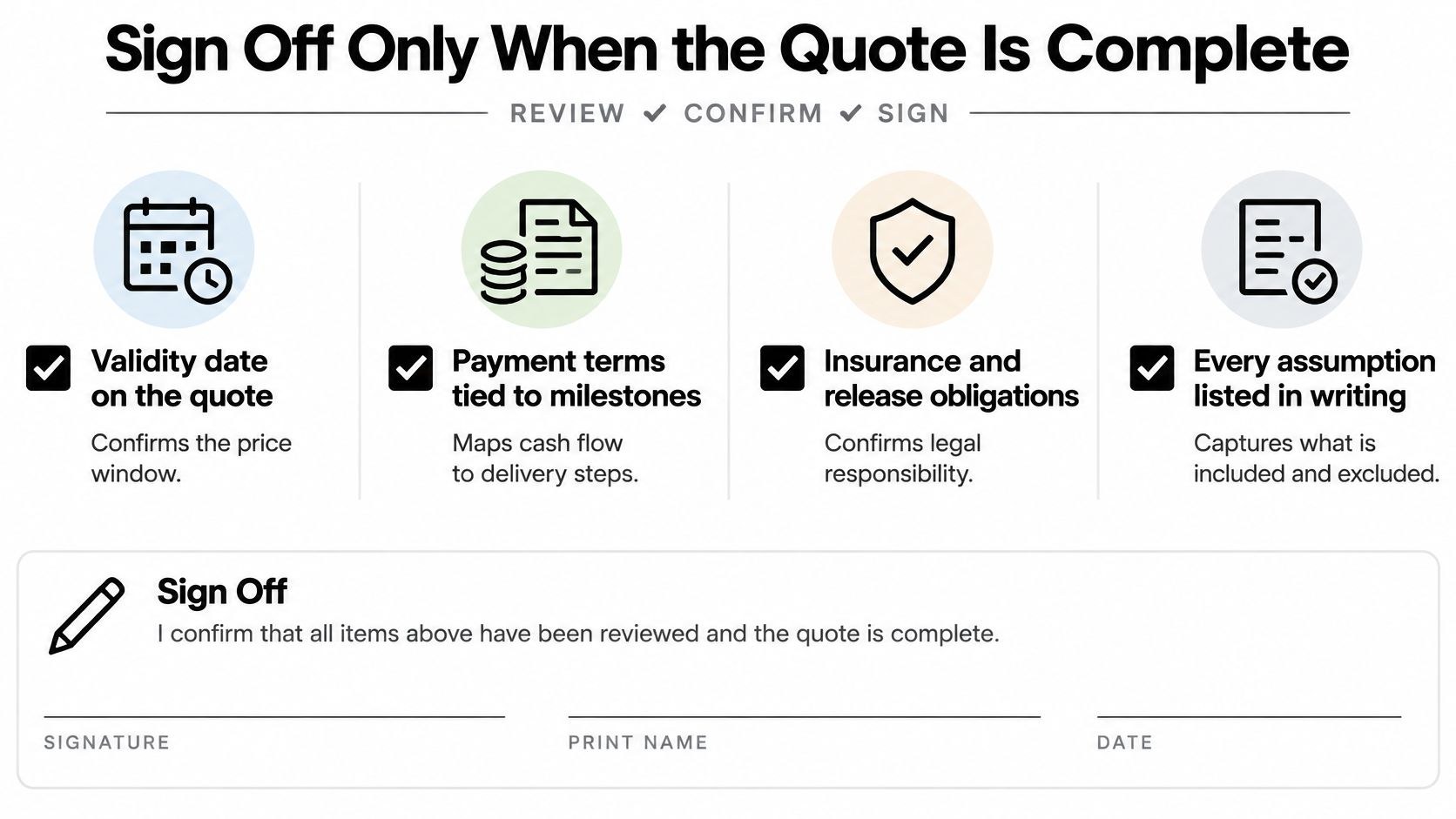
- A validity date, saying how long the price stands and which bookings are still provisional.
- Invoices tied to named milestones such as creative approval, shoot completion and final delivery, with a definition of acceptance.
- Who owns the final files and the project files, when ownership transfers, and which third-party restrictions remain.
- The change-order rule and the price method for each extra, attached to the agreement.
- Who carries production insurance, and which talent and location releases you receive.
A company’s general website terms are a different document from a production contract. Those, like Sensoriium’s terms and conditions, deal with use of the site and liability for it, and say nothing about your deliverables or payment schedule. Those belong in the production agreement or statement of work, with the quote attached.
Last, keep the paperwork proving you can use what you bought. WIPO’s guide defines chain of title as “the unbroken record of ownership of the copyright and other legal rights in the film property” (WIPO). Alongside the exports, ask for talent releases, location releases and music licenses, and file them with the signed agreement.
Frequently asked questions
Three, usually. That's enough to see a pattern, provided every vendor gets the same written brief and deliverables list. Past three you mostly add reading time, and with fewer it's hard to tell whether one odd line is unusual or just normal for the job.
Yes. A production quote covers shooting and editing the film, and buying the ad space to run it is budgeted separately. Talent usage often gets priced on its own as well, since it depends on where the film runs, for how long and in which territories, so ask for it as its own line once you know the placements.
Get the vendor to put a validity date on the quote itself, and treat any crew, location or talent holds as provisional until you sign. If your approvals tend to be slow, say so at the start and ask which bookings would need re-confirming if signing slips.