Video production timeline: stages, durations and calendars
How long a video takes from brief to delivery, week by week: calendars for three project sizes, approval rounds, rush jobs, busy seasons and a pre-booking checklist.

When a video schedule slips, the camera day is rarely the reason. Moonb, the creative studio I run, sends out a lot of these schedules and I sign off most of them, and the usual culprits are the script decision before the shoot and feedback that sits in someone’s inbox during the edit.
The video production timeline for most business videos, signed brief to delivered files, runs somewhere between two weeks (one speaker, one setup) and three months (a branded film, or a campaign cut for several channels). The shoot is usually the shortest stretch of it. So every calendar below names who holds the next decision each week. Book those people before you book a crew.
How long each type of video takes
These week counts are mine: the ranges I put in front of a client before we commit to a date. Your reviewers, locations and versions will move them, so adjust from here.
| Video type | Typical runtime | What I schedule, brief to delivery | Shoot days | Review rounds |
|---|---|---|---|---|
| Talking-head explainer | 60 to 90 seconds | 2 to 3 weeks | 1 | 2 |
| Interview-led branded film | 2 to 5 minutes | 8 to 12 weeks | 2 to 3 | 2 to 3 |
| Broadcast or streaming commercial | 15 to 60 seconds | 8 to 12 weeks | 1 to 3 | 3, plus clearance checks |
| Multi-format campaign | A hero cut plus platform versions | About 8 weeks | 1 to 2, shared | 2 per format |
| Social cutdown set from existing footage | 6 to 30 seconds each | 1 to 2 weeks | 0 to 1 | 1 to 2 |
| Recurring series episode | Set per episode | About 1 week each once templates exist | Batched | 1 to 2 |
Look at the review column first. Each round waits on one specific person sending comments before the next stage can begin, which is why that column moves dates more than any other, so check it against the reviewers you actually have. More reviewers than the row assumes, or more locations or versions? Push the date now, while nothing is booked against it.
A talking-head piece can come in under two weeks if you accept fewer takes to choose from and no slack if the speaker needs a pickup line. If the date matters more than choice, put that in the brief and the team will plan around it.
For the task list in each phase, see my video production checklist; for the money, our breakdown of what video production costs. This one sticks to time.
The four stages and where the time goes
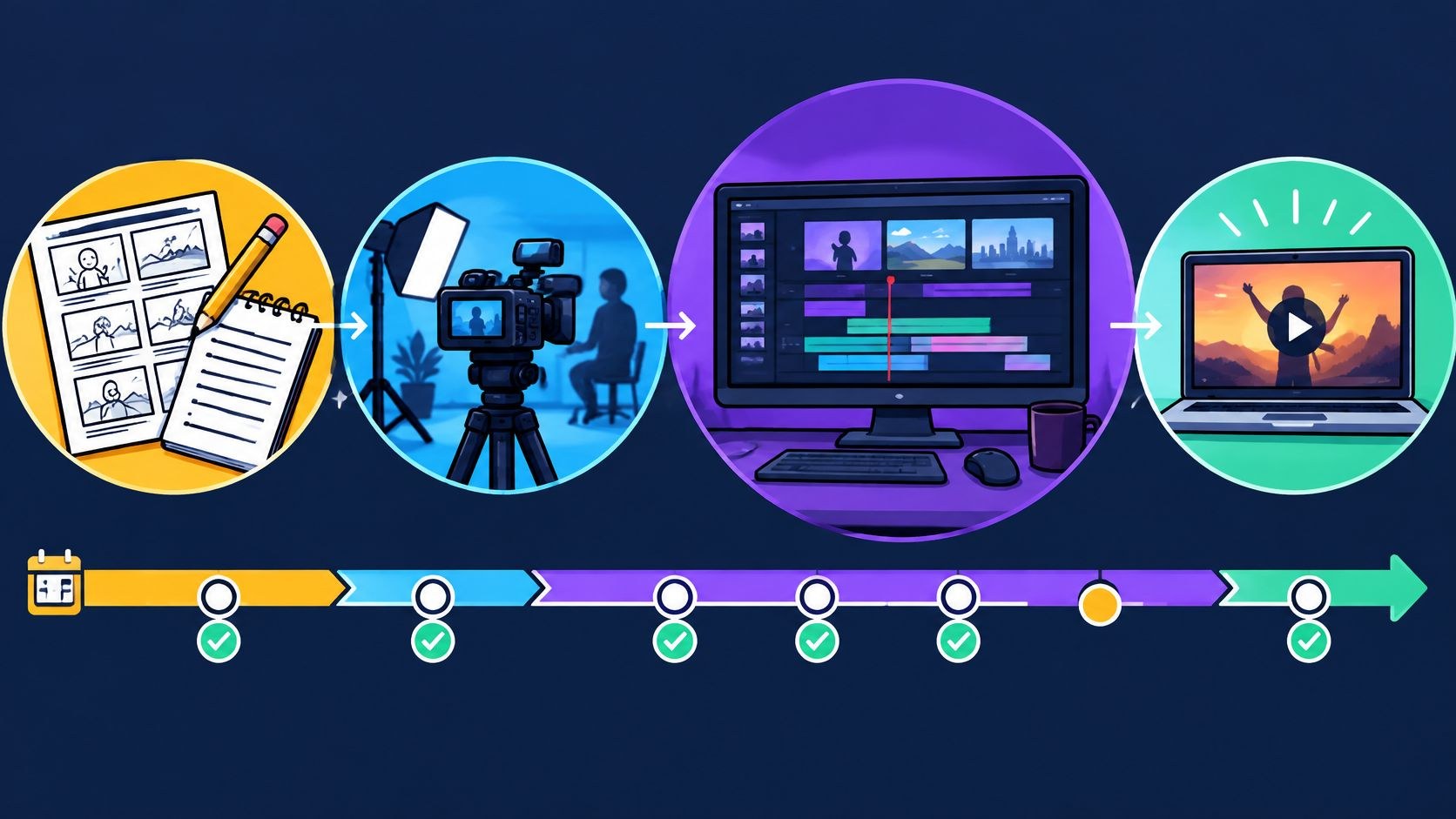
Preproduction is the brief, script, storyboard, casting, location scouting and script approval, and once the brief is clear several of those can run side by side. Production is the shoot itself: lighting, sound, camera setups, direction and the reset between setups. Postproduction turns footage into a finished piece through ingest, rough cut, fine cut, sound and music, graphics, color and captions.
Then delivery, the stage teams forget to schedule. Exports for each aspect ratio and platform, caption files, a quality check and the handover all happen after the cut is approved, and the right files usually reach the right place a few days later. That is when I call a video finished.
Every stage on my schedules gets a named owner and a date. It also gets something you can point at when it ends (a signed script, an approved cut), since stages without one tend to drift. freispace has a more formal guide to what a production schedule is that walks through milestones, tasks and resources, and it separates the overall production schedule from the shooting schedule, which only covers on-set logistics.
Why postproduction sets the date
Watch the shooting ratio, minutes recorded divided by minutes in the finished piece. The Cyber Film School post-production rules of thumb put the warning line for fiction films at 10:1, the point where extra footage starts squeezing the edit schedule. At that ratio a 90-second explainer hands the editor about 15 minutes of material, and a 60-second social cut about 10.
The same page gives planning rules too: about one hour per finished minute to reach a rough cut, another hour per finished minute for the fine cut, and another for sound effects and music. They were written with narrative film in mind. On a 90-second corporate piece I treat them as a floor, since ingest, syncing, organizing and the first watch-through take roughly as long whatever the runtime.
So agree a target ratio before the shoot and keep an eye on recorded duration during the day; when capture runs past it, the director and producer should talk. Afterward, recalculate edit time from the footage you really have, especially if several aspect ratios are coming. On longer interview-led films the edit and its reviews run to weeks, which is how a two-day shoot ends up inside a ten-week calendar. Our guide to video production shows how the stages connect across formats.
Week-by-week calendars for three project sizes
A list of stages hides who is waiting on whom. These are the calendars I schedule for each size of project, and the right-hand column names the person or decision that can stall that week.
A simple talking-head piece, three weeks
| Week | What happens | Who or what can block it |
|---|---|---|
| 1 | Brief agreed, script written and approved, shoot booked for early week 2 | No named decider for the script |
| 2 | Shoot day, ingest, rough cut, first review | Speaker availability; reviewers not booked |
| 3 | Second review, color and sound pass, captions, export and delivery | Script changes that force caption rework |
It is finished when the captioned files go out at the end of week 3, a few days after cut approval, so those two or three days of finishing work belong in the calendar too.
A branded film, ten weeks
I quote eight to twelve weeks for an interview-led brand film. Ten is the version where nothing unusual happens.
| Week | What happens | Who or what can block it |
|---|---|---|
| 1 | Brief, treatment and interview list; one decider named | The decider is not named |
| 2 | Script outline, casting and location scouting in parallel | Talent and location dates |
| 3 | Interview questions, shot list and storyboard approved | Sign-off from the decider |
| 4 | Shoot days (two or three), ingest starts | Setups and resets running long |
| 5 | Selects and rough cut | Capture well past the target ratio |
| 6 | First review round | Reviewers not booked for the window |
| 7 | Fine cut, graphics, music | Feedback arriving in pieces |
| 8 | Second review round, color and sound mix | Brand or legal notes that come in late |
| 9 | Captions, accessibility check, final approval | The final approver’s calendar |
| 10 | Exports, quality check, delivery | A missing version nobody listed |
Weeks 11 and 12 are the buffer, for a third review round or a brief that moved. If the brief did move, expect that third round; it usually traces back to a message nobody agreed before the shoot.
A multi-format campaign, eight weeks
One shoot feeds several deliverables here, typically a hero film, platform cutdowns and stills.
| Week | What happens | Who or what can block it |
|---|---|---|
| 1 | Brief, channel list, key messages, list of every deliverable | Open brand questions |
| 2 | Scripts and storyboards for each format | Notes arriving format by format |
| 3 | One shoot plan covering every format; shoot day set | Location dates |
| 4 | Shoot, ingest | Capture past the target ratio |
| 5 | Rough cuts for every format, review window booked | Feedback not consolidated |
| 6 | Fine cuts, graphics templates finished | Brand references still changing |
| 7 | Captions, platform versions, final sign-off | Export queue for many versions |
| 8 | Delivery across formats, publish dates set | The publishing calendar |
It runs shorter than the branded film because the shoot is shared and every format gets planned in week 1. That is also why adding a format in week 5 breaks the calendar. The new format never had a script or a shot list.
Count setups when you plan shoot days
No table shows how much of an interview day goes to lighting changes, sound checks, moving the camera and settling the person in the chair, and it is a big share. Extra interviews or locations do not add time in a neat line either, because each setup brings its own lighting, audio, blocking and reset. I count setups, reserve reset time and set a capture target for the day. Runtime tells me very little on its own.
On a branded film I plan three to six interviews across the shoot days, plus a separate block for supporting footage. The interview questions get approved in advance, everyone works from one shared shot list, and brand references stay locked in one folder, so less time goes on standing around on set and a reshoot is less likely.
StudioBinder, which makes production management software, put out an explainer on keeping a shoot on schedule. Watch it before you build your shoot days.
Animation has its own version of this. Asset preparation and design approvals should be done before final animation starts, since that earlier work decides whether the render happens once or three times.
Before anyone promises a date, a production schedule template gives you somewhere to write each week’s owner.
How approval rounds stretch the calendar
When a date slips, people blame the edit. Editing does take time. But on plenty of projects the footage just sits there while the team waits for comments, and feedback has to be collected, merged and returned before the editor can act on any of it. If three reviewers send separate notes across three days, the edit has lost three days before a single revision starts.
For one round I put this in the calendar: two working days for reviewers to watch the cut and respond, one day to merge conflicting notes into a single list and decide what changes, and one day for the editor to make those changes. Call it four working days. Two rounds is normal. When a project needs a third, scope or message usually was not settled before production.
That is why the calendar should name who can hold up each week: whoever signs off the rough cut and whoever resolves conflicting notes, plus the owners of the legal, brand, accessibility and platform checks.
Review tools help with the mechanics. Adobe’s own channel has a short walkthrough of a client review and approval flow in Frame.io, its review tool for video, shown on an After Effects project.
How to keep rounds short
Name one accountable decision-maker, and one person who consolidates feedback and settles contradictions before the notes reach the editor. Otherwise reviewers who never talk to each other send opposite notes and the editor ends up as referee.
I also split structural feedback (story, message, order) from polish (wording, color, timing). Structure belongs on the rough cut. Arguing about a lower third while the story is still moving wastes a round, and it is the thing I push back on most in reviews.
Legal, brand, accessibility and platform checks each need their own window, because each has a different owner asking different questions. A clear creative workflow management process stops them all landing on the last day.
Before you commit to a date, get two things agreed in writing: how many business days each approval gate gets, and what happens to the date when feedback arrives late (does it slide day for day, or does the next window shrink?).
Rush jobs, busy seasons and other schedule factors
When a schedule gets compressed, the buffer weeks go first, then the review windows shrink, and after that the edit keeps fewer options and color and sound get less attention.
Say someone wants a talking-head piece inside a week. You can shoot early and edit fast, but you will have fewer takes to choose from, less time to test an opening and little room if the speaker needs a pickup. I say that trade out loud before I agree to the date.
The quality loss shows up in predictable spots. A weak answer stays in because there is no time to find a better one, rushed sound keeps room noise and uneven levels, rushed color leaves shots that do not match, and captions built on an unsettled script need redoing. Cost goes up in specific places too. Crew and editors asked at short notice may charge more, and a reshoot means another crew day and location booking, with all the setup again. A rushed shoot on an unapproved script is the most reliable way I know to end up paying for one.
Simple pieces compress reasonably well. A branded film with unsettled scope I would not compress at all, because the message keeps moving through the edit whatever day the shoot happened.
| Factor | What it does to the schedule | Quality or cost risk |
|---|---|---|
| Timeline compressed below the usual window | Removes buffer weeks and edit options | Weaker selects, rushed sound and color, possible rush rates |
| Script change after the shoot is booked | Forces pickups or a reshoot | Extra crew day and setup costs |
| Shooting ratio well past 10:1 | More footage to ingest, review and select | Longer edit and review windows |
| Three to six interview subjects | Each setup adds lighting, audio and reset time | Shoot days grow faster than runtime |
| Several languages or aspect ratios | Each version adds exports and checks | Versioning time after the master locks |
| Captions and accessibility files | Caption review becomes a finishing task | Extra days if the script is not final |
| Busy periods for your team or your crew | Editors are booked and approvers are away | Queues form and slots slip |
Booking around busy seasons
Year-end reporting, product launch windows, trade show season and the run-up to holidays all play out the same way. Editors and crews get booked, approvers are away or buried in their own launch work, and locations get harder to hold. Because the queue forms weeks before the busy period does, I book editors and reviewers before it starts.
A lot of the people you want are freelancers booking project to project, and in a busy month the good ones go first. It’s a small pool, too: in 2025 there were about 39,400 film and video editor jobs and 32,600 camera operator jobs by the US Bureau of Labor Statistics count, with 35% of each group working for themselves.
With several languages or aspect ratios, put versioning after the master locks and give it its own quality check before anything is exported.
Running tasks in parallel without losing a week
Casting, location scouting and script approval can overlap without hurting the work. Graphics can be built while the edit comes together, since lower thirds, title cards and caption styles do not need a locked cut once the brand references are settled. Logos, product shots, screen recordings and approved photography can be gathered while the script is in review. Design approvals are the exception on the asset side: finish them before animation starts, or animators end up rebuilding approved elements at the end.
Feedback cannot run in parallel at all. Stack reviewers and every task after them slows down, which is why my review windows sit on fixed dates in the calendar.
A few habits protect the overlapping work. I get the shot list approved before the shoot, so setup time goes on planned material, and settle the core interview questions in advance while leaving the director room to follow a good answer. Fonts, logos, color references and examples live in one shared folder that does not change mid-edit. And when pieces share a speaker or a location (or just a lighting setup), capture them in one session.
That last habit matters most for recurring work, where one session can produce a main piece plus short cuts and stills if the shot list plans for them. Keeping the same people on a recurring series helps as well, since they carry the brand knowledge from one piece to the next; our post on the video production team covers who those people are.
Confirm the calendar before you book the shoot
Shoot dates tend to be held first and checked last. A location goes on a verbal hold, a speaker clears one afternoon, and the calendar fills up around a date nobody tested against the review schedule. Then the shoot happens on time and the video still ships late, because nobody asked who owes an approval in each of the weeks after it.
Run this before you hold anything.
- Name one decider and one consolidator. One makes the final call, the other turns all feedback into a single list.
- Agree the brief and script first. No shoot dates while the message is still open.
- List the setups for the day by counting interviews, locations and resets. Finished runtime does not matter for this step.
- Confirm talent and location dates in writing, because verbal holds disappear.
- Set a shooting ratio target, and agree the point where extra capture triggers a director and producer conversation.
- Book editor and reviewer slots so every review window is in calendars before the shoot.
- Plan captions from the start, tied to the final script.
- List every export version: aspect ratios, platform versions and languages.
- Set publish and delivery dates with two to three days of buffer for the final export and quality check.
- Write the calendar down, with a named owner and a due date for every blocker.
I put captions that high on purpose. WCAG 2.2, the W3C accessibility standard, includes success criterion 1.2.2, which asks for captions on all prerecorded audio content in synchronized media. Captioning is quick work when it is planned with the script. Bolt it onto a locked edit and it can drag in script fixes and a fresh round of exports.
The same goes for anything else your audience needs to follow the piece. If important visual information is not carried by the audio, plan audio description and a descriptive transcript, check that your player supports them, and put both on the delivery list from week 1.
Frequently asked questions
Count back from the publish date. Two to three weeks of notice is usually enough for a talking-head piece. For an interview-led brand film, hold crew and locations once the script is approved (around week 3 of a ten-week schedule) and book your reviewers for the edit weeks at the same time. Year-end and launch windows need a few extra weeks, since freelance editors and crews fill up first.
A short, single-speaker video can be, as long as the script is approved before the week starts, one person makes the final call and the review round is already booked. Expect fewer takes to pick from, and if the speaker fumbles a line there is no day left for a pickup. I would not squeeze a film with several interviews or an unsettled message into a week, because the time saved on the shoot comes back as a reshoot or a third review round.
A production schedule runs the whole project, brief to delivered files, with owners and deadlines for script approval, review rounds, captions and exports. A shooting schedule only covers the shoot days: call times, setups, scene order and locations. Most late deliveries come from holes in the production schedule (usually review windows nobody booked) even when the shoot itself ran on time.