Live action video production, from crew list to final delivery
What live action video production involves: the crew and kit, the preproduction to post workflow, published cost inputs, timelines, and delivery specs.

Live action video production is the work of filming real people, places and products with a camera crew, then editing that footage into finished video. It runs in three phases (preproduction, the shoot, postproduction) and needs a crew sized to the job, talent, kit, a location you’re allowed to use, and a schedule that holds when the light or the weather turns.
Shoots that go wrong almost never go wrong on camera. I work at Moonb and read a lot of shoot plans, and usually the trouble is a location nobody scouted properly, or a talent agreement that only covered one channel and nobody noticed until the media plan grew. So most of this guide is about everything around the camera. If you haven’t decided whether to film at all yet, jump to the live action or animation section further down.
What a live action shoot involves
A live action shoot is a logistics job with a creative brief attached. Even a small product shoot can pull in a director, a producer, a camera operator, a sound recordist, a gaffer for the lights, hair and makeup, and a production assistant who keeps the day moving. Scale up and you add a director of photography, camera assistants, a grip team, an art department or stylist, and someone whose whole job is the schedule.
That’s only the crew. You also need on-screen talent (actors, employees, customers), a location with written permission, the kit (camera, lenses, lights, microphones, grip, media cards and drives) and a call sheet telling everyone where to be and when.
If crew titles still blur together for you, RØDE and Full Sail University made a behind-the-scenes series about their own short film, Off The Record, and episode 5 walks through ten essential crew roles. Good primer.
Most of it went digital a long time ago. A National Bureau of Economic Research working paper that categorized US-released films, using IMDb data, from 1995 to 2018 found the share shot digitally reached about 21% in 2008 and passed 94% by 2018 (the working paper is on the NBER site). On a brand shoot that means the footage only ever exists as files, from the first take on. Somebody has to own backups, file naming and the handoff to the editor, and I want that person’s name on the call sheet.
The workflow, phase by phase
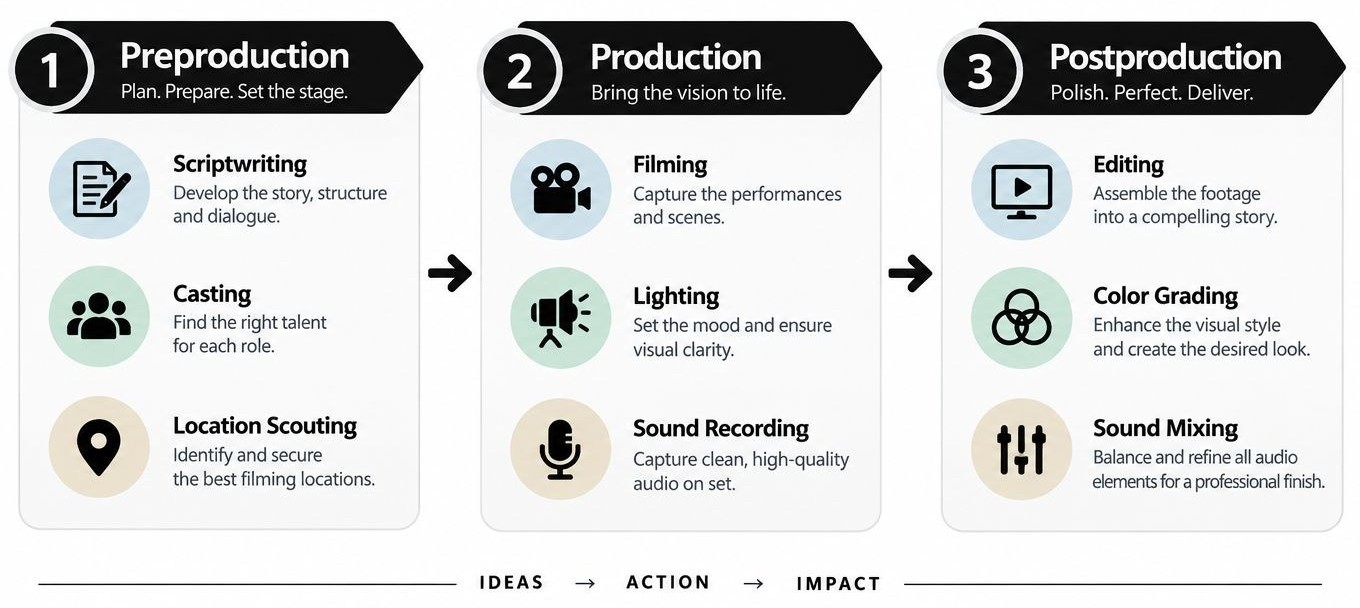
Preproduction
Most of the money is saved or lost here. The script turns into a shot list, the shot list into a schedule, and locations, talent, kit and permissions get locked against that schedule. Plan a scene’s coverage early (say, a wide plus a clean product insert) and you book the right lens and the right people once. Leave that thinking for the set, and a dozen people stand around while two of them work it out.
The tool for this is a scene breakdown. Contesimal’s scene breakdown template explains the filmmaker’s habit of breaking a script (or any piece of content) into story elements and logistical needs, scene by scene. Our video production checklist covers the rest of the prep, and I’d draft the shot plan itself in the free shot list template.
Production
On the day, the producer holds the schedule and the director watches performance and framing, while the gaffer and camera team light and capture each setup and the sound recordist makes sure the dialogue survives.
Sound is the department I see underfunded most often, which drives me a little mad, because it’s the one the edit can’t save. A soft image can sometimes be graded or reframed. Muddy dialogue usually means a voiceover patch or a trip back to shoot it again.
Ric Viers’ episode on booming a scene, from RØDE’s location sound series, covers finding your frameline, rehearsing and room tone.
Postproduction
Edit, color, sound mix, graphics, captions, approvals, exports. Good footage gets weakened here all the time, usually by too many rounds of notes or by nobody owning the final call. It goes faster when the team agreed on the story before ingest. EventUploader argues for exactly that in its guide to planning and storyboarding event recap videos before the event starts, and the logic holds for any shoot.
What live action costs
Nobody can give you one number before the brief exists, me included. What I can point at are the published inputs most quotes get built from. Our video production cost guide and the corporate video price breakdown have typical ranges by format, and if you’re still working out who to hire, my map of video production services compares freelancers, project studios and embedded teams.
Crew time is the biggest line. According to the US Bureau of Labor Statistics, camera operators in television, video and film earned a median $74,990 a year in May 2025, and film and video editors $75,420. The same page lists 35% of each group as self-employed, which fits how many crews get pieced together from freelancers job by job (BLS Occupational Outlook Handbook).
Locations come next, with paperwork attached. New York City’s film office shows how specific it gets. You need a permit once a production uses an equipment package, which the city defines as anything more than a handheld camera, a camera on a tripod or handheld items like bounce boards and boom mics. The fee is a non-refundable $500 for each consecutive 14-day period, and the permit holder needs commercial general liability insurance of at least $1,000,000 per occurrence (NYC Mayor’s Office of Media and Entertainment, on when a permit is required and its insurance requirements). Every city sets its own rules. Call the local film office before anyone scouts.
Talent agreements catch people out too. They set where the footage can run and for how long, so a clip cleared for one paid social flight may need a new agreement before it goes into a TV spot or runs another year.
Then the notes. Once footage exists, legal wants a line changed and leadership wants the pacing tightened, and each round costs edit time. A single hero film is one production event. A monthly series of social cuts costs less per asset, but only after the review process settles down.
If part of the film will be animated, our guide to what animation costs covers that side of the quote.
How long it takes
The shoot is often the shortest stretch on the calendar. Everything around it runs on approvals: script sign-off, talent and location confirmation, then rounds of edit review.
Approve the script late and the shoot still happens on the booked date, so the edit gets squeezed. Let edit notes arrive in waves from different departments and the schedule stretches again. What I push for is dull, and it works. One named approver per phase, with the number of revision rounds agreed before anyone shoots and every note kept in one shared place. When a lot of people need to say yes at different times, pad the edit schedule, because that’s where the extra days go.
Live action or animation
Film it when the subject exists in the world and gets more convincing with real people around it. Animate it when it’s abstract or not built yet, or when it changes too often to keep reshooting. Our animation vs live action guide goes through the trade-offs properly; the table is the short version.
| Use case | Where I’d start | Why |
|---|---|---|
| Founder or executive message | Live action | A real face does the persuading |
| Demo of a physical product | Live action | Viewers watch it work |
| Customer story | Live action | Their voice, their setting |
| Event recap | Live action | Only real footage records the day |
| Software workflow explainer | Hybrid | Film the user, animate the interface logic |
| Product that isn’t built yet | Animation | There’s nothing to film |
| Training that changes often | Animation or hybrid | Sections update without a reshoot |
A lot of briefs end up hybrid. You film the people and the proof, animate what the camera can’t see, and later you can update the animated section without booking a crew again.
Technical deliverables
Good footage can still look amateur if the delivery basics are off, which is why I treat specs as a preproduction job.
Loudness first. The European Broadcasting Union’s R 128 recommendation (current version R 128-2023) normalizes program loudness to a target of -23.0 LUFS, allows plus or minus 1.0 LU where hitting the target isn’t practical (live programs, for example), and says the true peak shouldn’t exceed -1 dBTP during production, measured with a meter compliant with ITU-R BS.1770 (EBU R 128). If a European broadcaster is on the media plan, ask early whether they deliver to it. The same document notes that the permitted maximum true peak may need to be lower for some distribution systems and data-reduced formats. Online, ask each platform or media buyer for its delivery spec, mix to that, and check true peak on its own.
SMPTE’s RDD 18 metadata document records capture frame rate in frames per second and can express shutter speed as an angle, where 360 degrees equals a full frame period (SMPTE RDD 18). A 180-degree shutter, for example, means an exposure of half the frame interval: 1/48 second at 24 fps, 1/120 second at 60 fps. Keep the angle and frame rate the same and motion blur matches across cameras and shoot days. I’d put frame rate and shutter angle in the camera notes so nobody has to guess in the edit. In DPReview TV’s explainer, Chris walks through what shutter angle is and why it’s often more useful than shutter speed for video.
YouTube’s help center gives 16:9 as the standard aspect ratio on a computer, says the player may add padding around vertical 9:16 video in desktop browsers, and asks you not to add black bars to the file yourself (YouTube Help). Where shoots actually go wrong is composition. A subject framed for 16:9 can crop badly to 9:16, especially once captions and on-screen buttons cover the edges. Pick the platforms before the shoot and frame for the tightest crop, or shoot dedicated vertical takes when one setup can’t serve both. For planning, Increditors keeps a handy video aspect ratio cheat sheet by platform, and Bulk Image Generation’s social media video ads playbook goes into platform specs, building exports for adaptation and where generated imagery fits into an ad workflow.
On a campaign, write the deliverables list before the shoot: the master edit, cutdowns, native versions per platform, caption files, and a clean version without on-screen text for reuse later. It all comes out of the same shoot days, so the camera team needs that list in hand.
A preproduction checklist
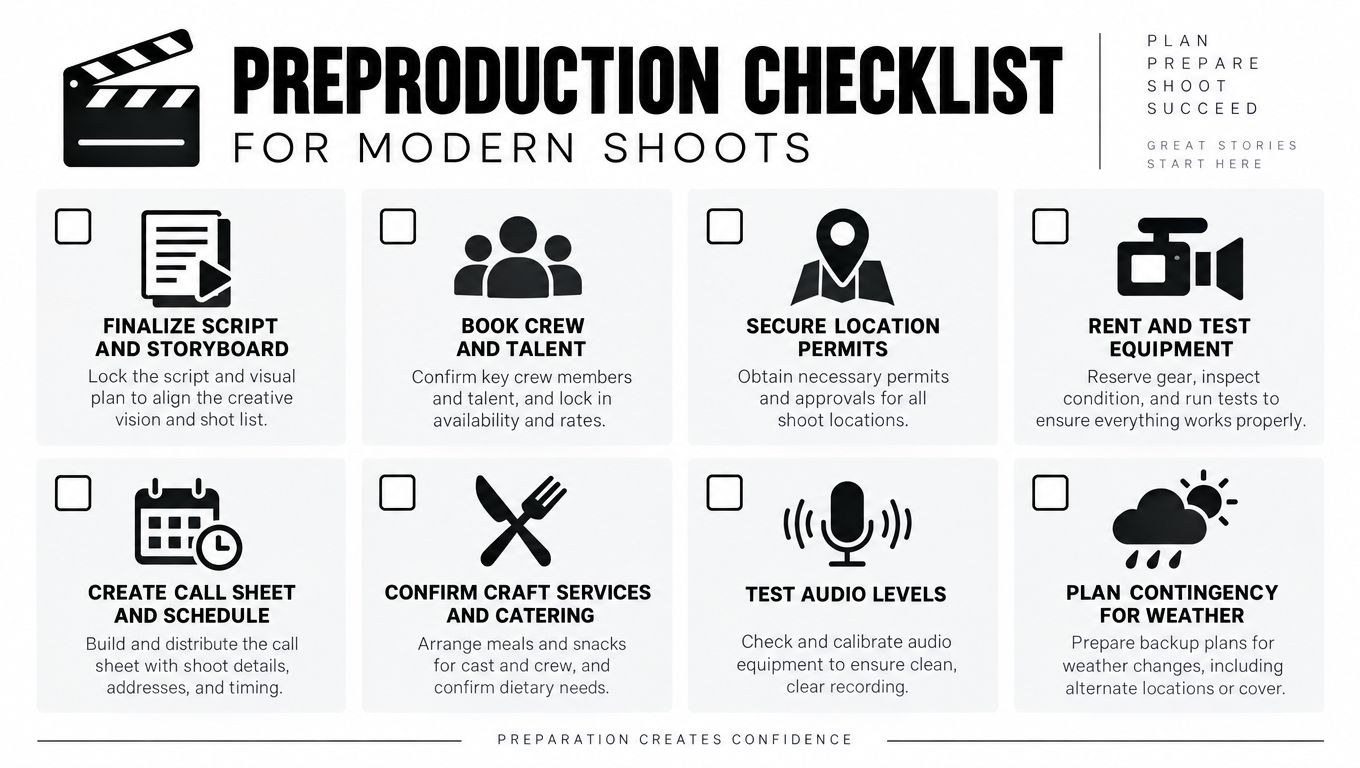
Before the dates and the money are locked, walk the plan through the actual shoot day and check that the crew can get into the location and work there safely, and that the footage will cut together. Ask cast and crew about access needs when you book them, and pick locations that work for the people you hired. Then confirm:
- The script and storyboard are locked, and every scene has a reason to be in the film.
- Crew and talent are booked, with rates, availability and usage terms in writing.
- Permits, location access and insurance certificates are confirmed.
- Cameras, audio, lights, media and backups were tested before call time.
- The call sheet went out with the schedule, contacts and addresses.
- Meals and water are planned for cast and crew.
- Audio levels were checked at the actual location.
- Anything outdoors has a weather fallback.
Frequently asked questions
Size it to the hardest scene in the script. A seated interview can run with a very small team, one person on camera and another owning sound. Bring in a gaffer once the lighting has to match across setups, and a dedicated producer once there's talent, a location contract and a schedule to hold. Sound is usually the first role to get cut, and it's the one the edit can't rebuild.
Often, once you bring more than a basic camera setup. New York City is a good example: a production with an equipment package (anything beyond a handheld camera, a camera on a tripod or handheld items) needs a film permit. The fee there is a non-refundable $500 per consecutive 14-day period, and the permit holder needs at least $1,000,000 in commercial general liability insurance per occurrence. Other cities set their own rules, so check with the local film office before you scout.
Depends where it airs. For European broadcast, EBU R 128 sets a target of -23.0 LUFS and a true peak no higher than -1 dBTP, measured with an ITU-R BS.1770 compliant meter. Online platforms and media buyers usually have their own delivery specs. Get the spec for each placement, export a separate mix wherever the targets differ, and check true peak on every file.