Commercial Video Production: A Buyer's Expectation Map
What to expect when you buy commercial video production: the four milestones, the full deliverables package, rights to settle, and the questions that reveal a partner.

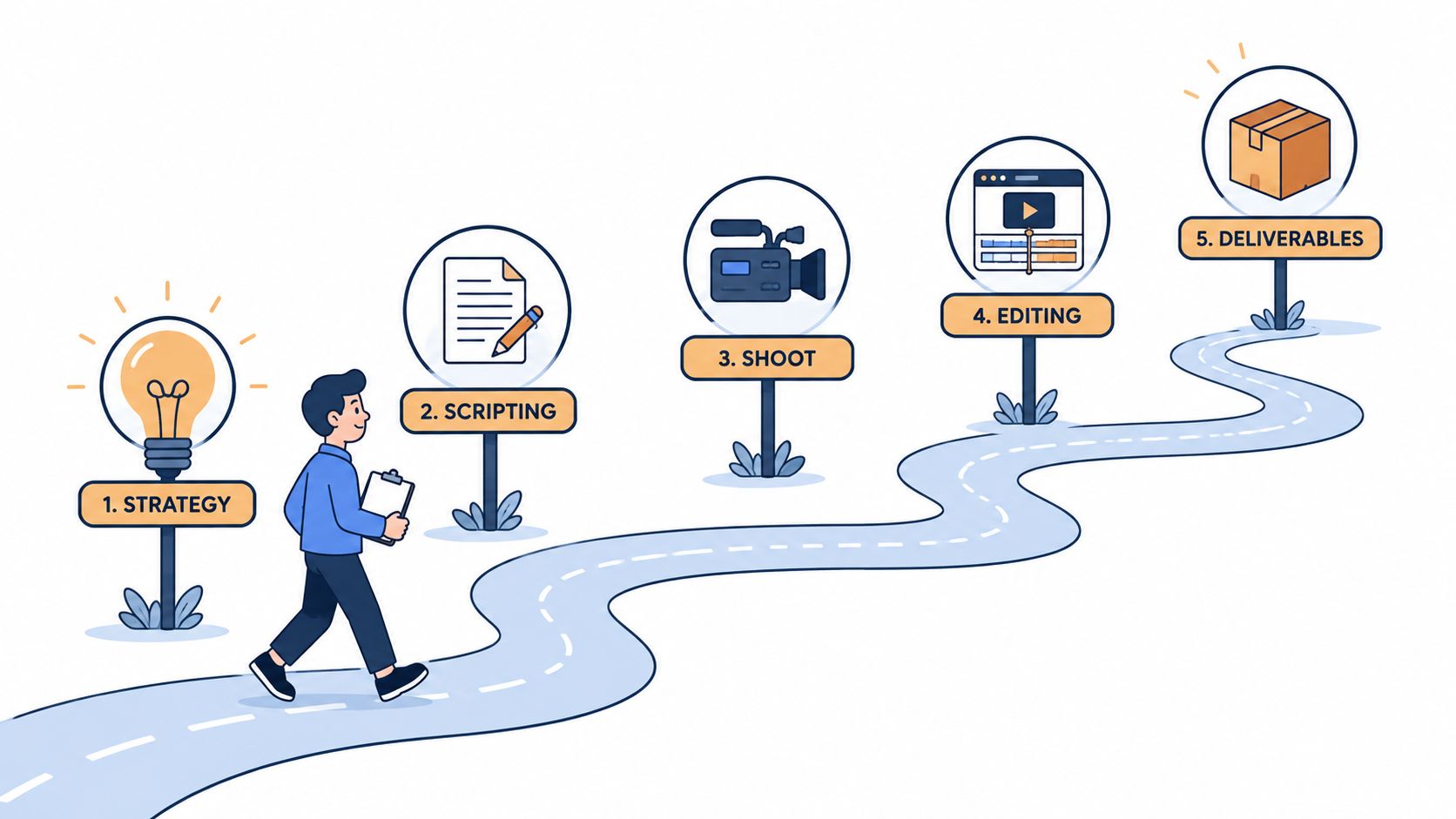
Commercial video production is the end-to-end making of a short promotional spot, delivered as a family of cuts rather than one file, and a modest spot commonly moves from kickoff to delivery in four to eight weeks. From the buyer’s side the work passes through four visible milestones, and there are four main ways to buy it.
I run Moonb, and the pattern I see with first-time commercial buyers is always the same: the brief and the launch date are clear, and the uncertainty starts right after the first call. What exactly arrives at delivery? Who supplies the legal language? How many versions are included? Who approves the script, and what happens when a stakeholder joins late with a new opinion? One enterprise client of ours once discovered at export week that their “one video” needed eleven files their media plan assumed and nobody had scoped. This guide maps the engagement from your side of the table: expectations, deliverables, rights, approval gates, and volume. For the vendor category itself, see our guide to commercial video production companies.
A commercial is a production job, but it is also a sequence of decisions. The buyer supplies the business objective, audience, channels, brand assets, legal requirements, and one clear approver. The creative partner owns the concept, script craft, casting recommendation, shot design, edit rhythm, and production management. Most bad projects trace back to those two lists getting mixed up.
What commercial video production covers
Commercial video production means creating a short promotional spot for paid or owned distribution, then delivering the related cuts, formats, captions, stills, and usage documentation needed to run it. The four-to-eight-week band stretches with locations, talent, approvals, and deliverables.
From the buyer’s chair, four milestones matter:
- Strategy and concept approval, where the message and creative direction are chosen.
- Pre-production lock, where the script, storyboard or shot list, casting, locations, and schedule are approved.
- Shoot day, where the team captures the agreed material and the buyer checks that the message is landing.
- Post-production delivery, where the edit is approved and the complete cut family is exported.
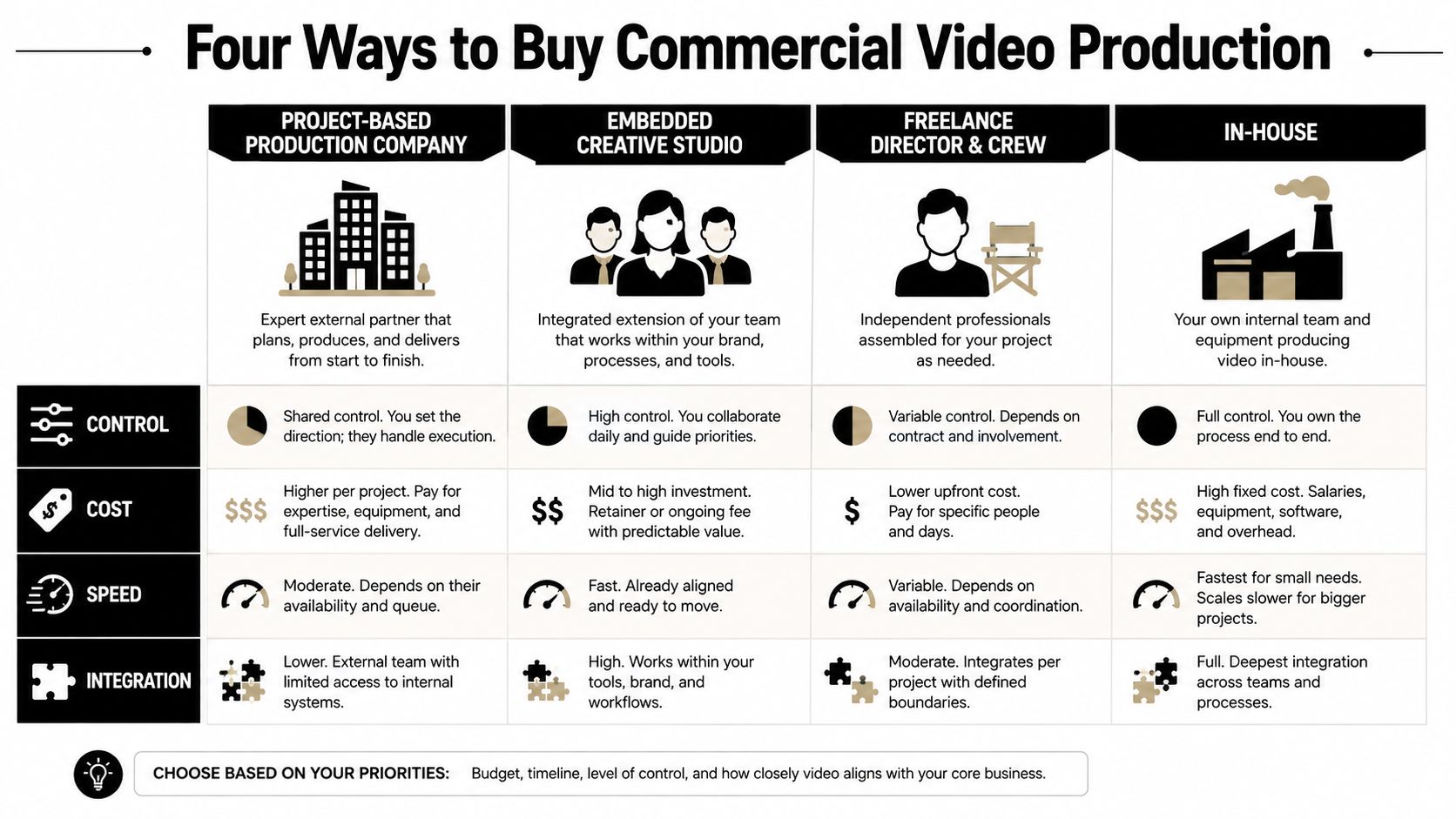
The four main ways to buy the work are a project-based production company, an embedded creative studio team, a freelance director and crew, or an in-house team. We compare them below.
Commercial production differs from a brand film or an organic social post because distribution shapes the work from the start. A paid spot must survive channel specifications, media placements, legal review, and repeated exposure. A 30-second master may be the centre of the idea, but it rarely represents the full delivery.
If you want the maker’s-eye view of what happens between the milestones, Mark Bone’s walkthrough of a commercial shoot is the clearest ten minutes on the internet about it.
What a commercial is now
A commercial concept has to work across a matrix of lengths, aspect ratios, captions, and delivery environments. The days of one 30-second master are over; commercial work now spans social, streaming, performance creative, and broadcast, and the media plan usually touches several of those at once.
Google’s own ad format documentation is the cleanest illustration: its lineup includes 6-second bumper ads, non-skippable in-stream ads, and skippable formats, and each creates a different editorial job. A bumper must establish a message almost immediately. A skippable spot needs a reason to continue. A longer master has room for proof, context, or a more developed emotional turn.
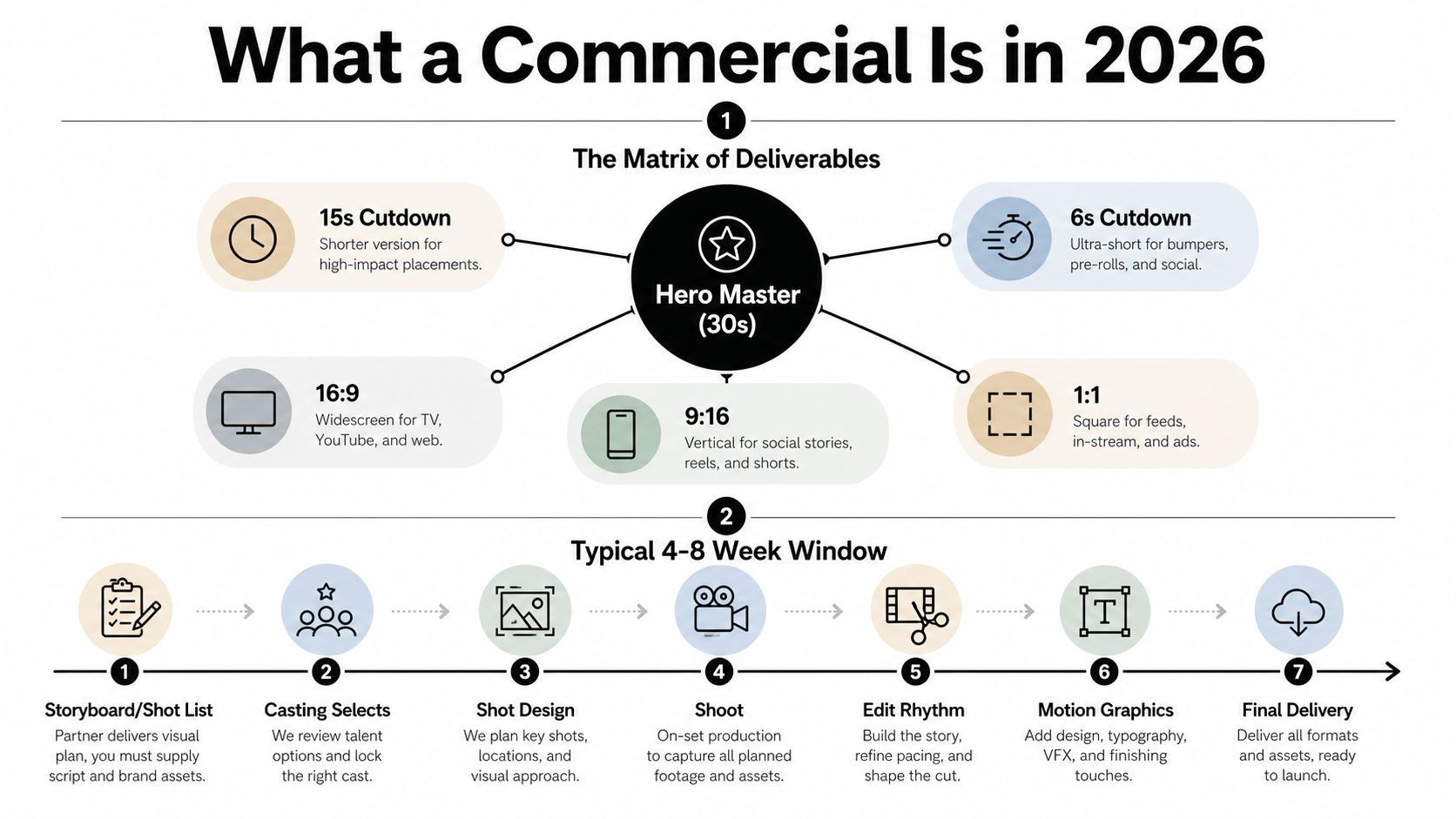
Aspect ratio changes the creative too. Short-form placements default to vertical 9:16 at 1080 x 1920. A vertical cut framed during production preserves the subject, product, text, and action; a master cropped afterward may lose the very information the ad needs.
That has a direct scope consequence. “One video” should be treated as a concept with a deliverables plan, not as one exported file. More versions can require additional edit decisions, graphics layouts, caption files, music clearance, and talent usage coverage. They don’t necessarily require separate shoots, but they do need to be planned before the camera rolls. The buyer question that matters: who owns the creative thread from the hero master through every cutdown?
The strongest commercials survive all of this because the central idea is distinctive enough to work at any length. Heinz’s Draw Ketchup is a good calibration point: the idea reads in six seconds or sixty.
For a broader look at how commercial ideas get shaped for different placements, see these advertisement examples.
What to expect at each milestone
Projects stall when the buyer’s decisions aren’t assigned to a person and a date. A good partner makes the gates visible, explains what changes after each one, and keeps the approval record clear.
| Milestone | Partner delivers | Buyer supplies | Approval gate |
|---|---|---|---|
| Strategy and concept approval | Creative brief refinement, two or three concept directions, written rationale, one recommendation | One-page brief, single message, audience, channels, media assumptions, brand assets, legal mandatories, one named approver | Approve the concept, core message, and route into scripting |
| Pre-production lock | Final script, storyboard or shot list, casting selects, location plan, schedule, format framing approach | Script approval, casting sign-off, location confirmation, product access, brand and legal checks | Confirm that changes after lock add cost and days |
| Shoot day | Direction, camera and lighting, sound capture, talent management, set coordination, agreed coverage | Attend or monitor remotely, answer factual questions, check that the message lands | Confirm the required product, action, and mandatory details are captured |
| Post-production delivery | Offline cut, fine cut, colour, sound, graphics, captions, exports, stills, delivery archive | Consolidated feedback from the named approver, legal clearance, final channel check, sign-off | Approve the final master and complete cut family |
At kickoff, hand over the things the partner can’t responsibly invent: the business objective, one message, audience, channels, brand assets, legal mandatories, and approval owner. A partner should challenge a crowded message; that pushback is part of the service.
During the shoot, your job isn’t to redesign the lighting. Watch whether the product is clear, the claim is accurate, the performance feels right, and the mandatory language is present. If you can’t attend, establish a real-time feedback route before the day begins.
Post-production needs a defined review structure: an offline cut focused on structure and message before colour, sound, graphics, and final exports. The contract should state how many rounds are included and what qualifies as a round. In my experience most overruns trace back to committee approval, line-by-line buyer rewrites, a changed message after storyboard lock, or distribution decisions made after the shoot; none of those are production problems.
A one-page video production checklist helps your team gather the inputs before kickoff. The point isn’t paperwork. It’s preventing a late stakeholder from becoming the project’s unofficial creative director.
The deliverables package you should expect
Ask for the deliverables list at quote stage, not after the final edit. The list should show every cut, aspect ratio, caption state, audio requirement, still, license document, and source asset that will be handed over.
A sensible starting package includes:
- Hero master: usually a 30 or 60-second master in the agreed mezzanine and review formats.
- Cutdowns: 15-second and 6-second versions aligned with the ad formats your media plan buys.
- Aspect ratios: 16:9, 9:16, and 1:1 versions framed during production, never cropped only in post.
- Caption states: captioned versions and clean versions without captions or burned-in text.
- Localization file: a text-free version where graphics and supers can be replaced for other markets.
- Audio assets: final mixed audio, plus stems when future localisation or media delivery needs them.
- Still assets: thumbnail options, keyframes, or campaign stills when included in the scope.
- Usage records: copies of music licenses, talent releases, and any usage limitations.
- Archive terms: a clear statement about raw footage, editable project files, and project archiving.
| Asset | Social-first package | Broadcast TV package |
|---|---|---|
| Hero master | Platform-ready master, often with social framing | Broadcast-ready master plus required technical QC |
| Cutdowns | 15-second and 6-second versions | Approved cutdowns where the media plan requires them |
| Aspect ratios | 16:9, 9:16, and 1:1 | 16:9 master, plus other formats if scoped |
| Captions | Captioned and clean versions | Captioned, clean, and accessibility requirements confirmed |
| Localization | Text-free version if markets need it | Text-free version and documented replacement workflow |
| Audio | Stereo mix suitable for the planned platforms | Loudness and true-peak compliance checked during QC |
| Stills | Thumbnails or selected frames | Broadcast or campaign stills if contracted |
| Rights file | Music and talent records | Music, talent, and broadcast usage records |
| Source materials | Raw footage and editable files only if negotiated | Raw footage, project files, or archive only if negotiated |
Two delivery environments deserve special attention. U.S. broadcast spots have to meet the ATSC A/85 loudness standard under the CALM Act, which is why loudness and true-peak compliance sits inside broadcast QC rather than being an editing preference. And streaming TV has its own gates: Amazon’s published requirements for Streaming TV and Prime Video ads specify 16:9 delivery at a minimum of 1920 x 1080 along with file, frame-rate, and audio requirements that a social-first export will not automatically satisfy.
Captioning and transcript workflows can be planned early with tools such as transcript.im, but the contract should still say who reviews the text. For the money side of the same scope conversation, see how much it costs to make a commercial. The price matters, but the deliverables matrix tells you what you’re buying.
Four ways to buy commercial video production
The right model depends on how often you need spots, how much production complexity you carry, and who should retain the idea between projects. Taste alone shouldn’t decide it.
| Model | Best for | How you pay | Who holds the idea between projects | Weak spot |
|---|---|---|---|---|
| Project-based production company | A single high-stakes spot with a large shoot | Project scope, production costs, post, and usage quoted per job | The buyer holds the approved assets; the production team moves on | Every new brief can restart from zero |
| Embedded creative studio team | Brands shipping spots and cutdowns continuously | An agreed ongoing engagement with defined scope and rhythm | A dedicated creative lead or team holds the thread | A very large shoot may still need a specialist production partner |
| Freelance director and crew | Founder-led films or smaller social spots | Individual crew, equipment, production, and post costs | Usually the buyer, if they can manage the continuity | The buyer becomes the producer |
| In-house team | Fast iteration and close daily collaboration | Fixed headcount and internal operating costs | The internal team | Fixed capacity and a defined skill ceiling |
A project-based production company gives you a strong production spine for a substantial shoot. The trade-off is continuity: the idea, visual language, and production knowledge may walk out with the project unless you deliberately document them.
An embedded creative studio team suits a brand that needs a steady stream of commercials, cutdowns, motion, and supporting content. Moonb is one example of this model, a dedicated creative team that delivers on a steady weekly rhythm; a large shoot day may still call for a specialist production partner alongside it.
A freelance director and crew can work well when the scope is contained and the buyer can manage logistics, approvals, locations, releases, and post. You gain direct access to the maker, and you also inherit more coordination than most marketing teams expect.
In-house teams iterate fastest because the people, brand knowledge, and approvals sit close together. The limitation is capacity: a team may know exactly what it wants but lack the crew, specialist craft, or time a larger commercial requires. If the film has to carry the whole brand story rather than one offer, that is a different engagement; our guide to brand video production covers it.
The in-house versus agency comparison helps with the wider staffing decision. The practical test is simple: occasional large spots favour project production, recurring output favours an embedded team, contained shoots suit freelancers, and daily iteration favours in-house.
Rights and terms to settle before you sign
A finished file isn’t the same thing as unrestricted permission to use it. Rights determine where, how long, and in which channels the commercial can run.
Talent usage
The release should state media, territory, term, and exclusivity. A digital campaign may have a different scope from broadcast or connected TV. If the talent’s usage expires, extending the campaign may require a new negotiation or a re-shoot. Union work has its own contractual structure; when union talent is involved, the SAG-AFTRA commercials contract is the framework your production partner should be able to walk you through.
Music and sound
Music needs a defined sync license, media scope, territory, and term. A track cleared for web use may not cover broadcast or CTV. A buyout and a term license create different future obligations, and a missing master or sync right can lead to takedown risk or re-licensing.
Production assets
State who owns the finished spot, raw footage, outtakes, project files, graphics, and derivative edits. Buyers normally own the finished commercial when the agreement says so, while raw footage often remains with the producer unless it’s purchased or transferred separately. Without this language, a successful spot may be hard to adapt for a new market, language, or channel; you may end up paying for access to source material or rebuilding an edit that already exists.
Portfolio rights
The agreement should say whether the production partner can show the work in a portfolio, when that permission starts, and whether confidential launches or unreleased products are excluded. Procurement and legal teams care about this more than the creative team expects.
Revision rounds and cancellation
Define the number of revision rounds and what counts as one. A consolidated set of notes on an edit is different from a new concept, a new script, or a structural change after approval. Cancellation terms should cover what happens at each milestone: if the project stops after casting, location booking, or a shoot, the agreement should explain the obligations already incurred.
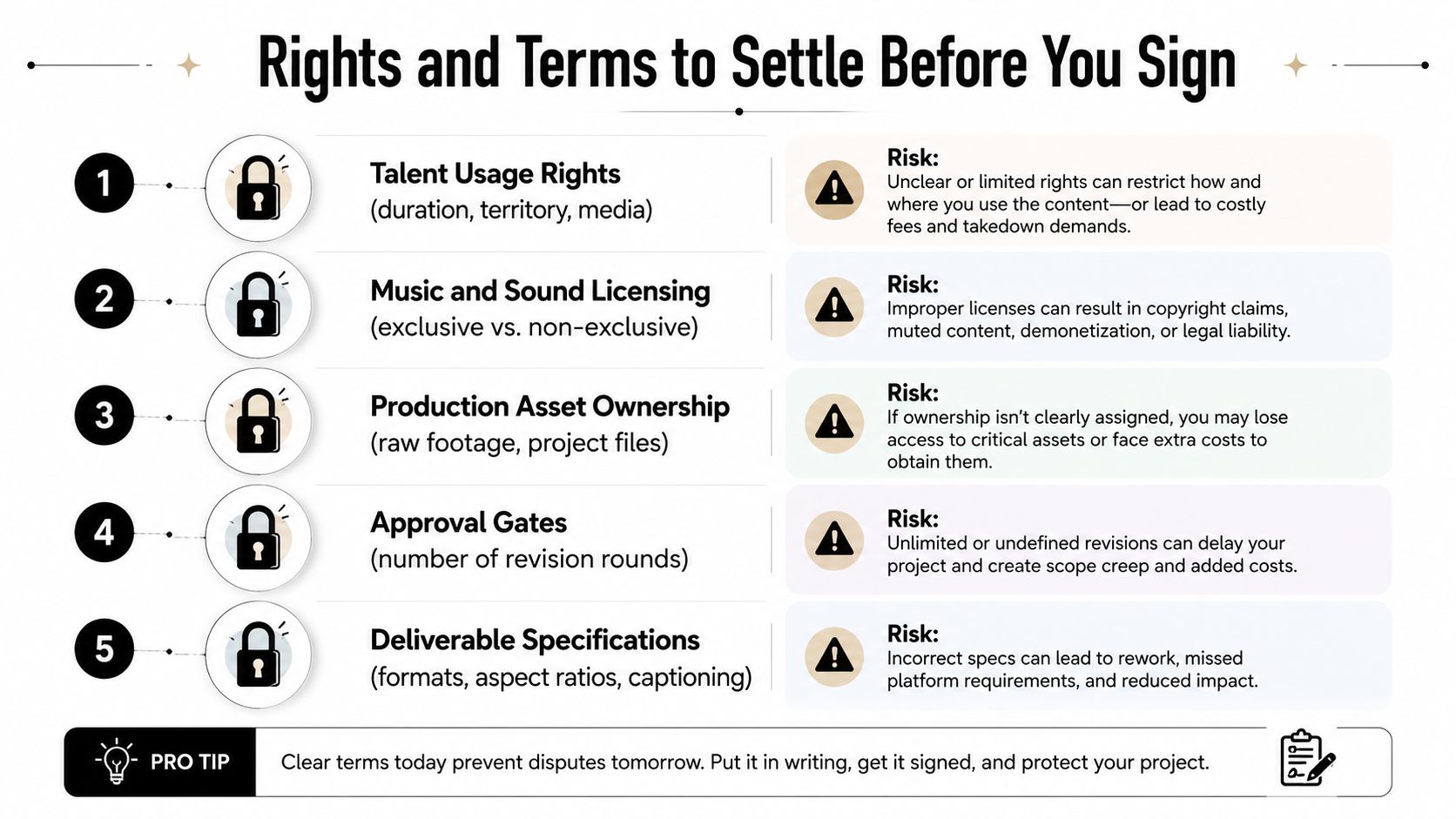
Before signing, ask legal or procurement to confirm:
- Usage: which channels, territories, terms, and exclusivity restrictions apply?
- Music: does the license cover every planned placement and future adaptation?
- Talent: are releases aligned with the campaign’s actual distribution?
- Ownership: who receives raw footage, project files, outtakes, and final assets?
- Approvals: how many rounds are included, and who signs off?
- Cancellation: what is owed if the project pauses or ends at each milestone?
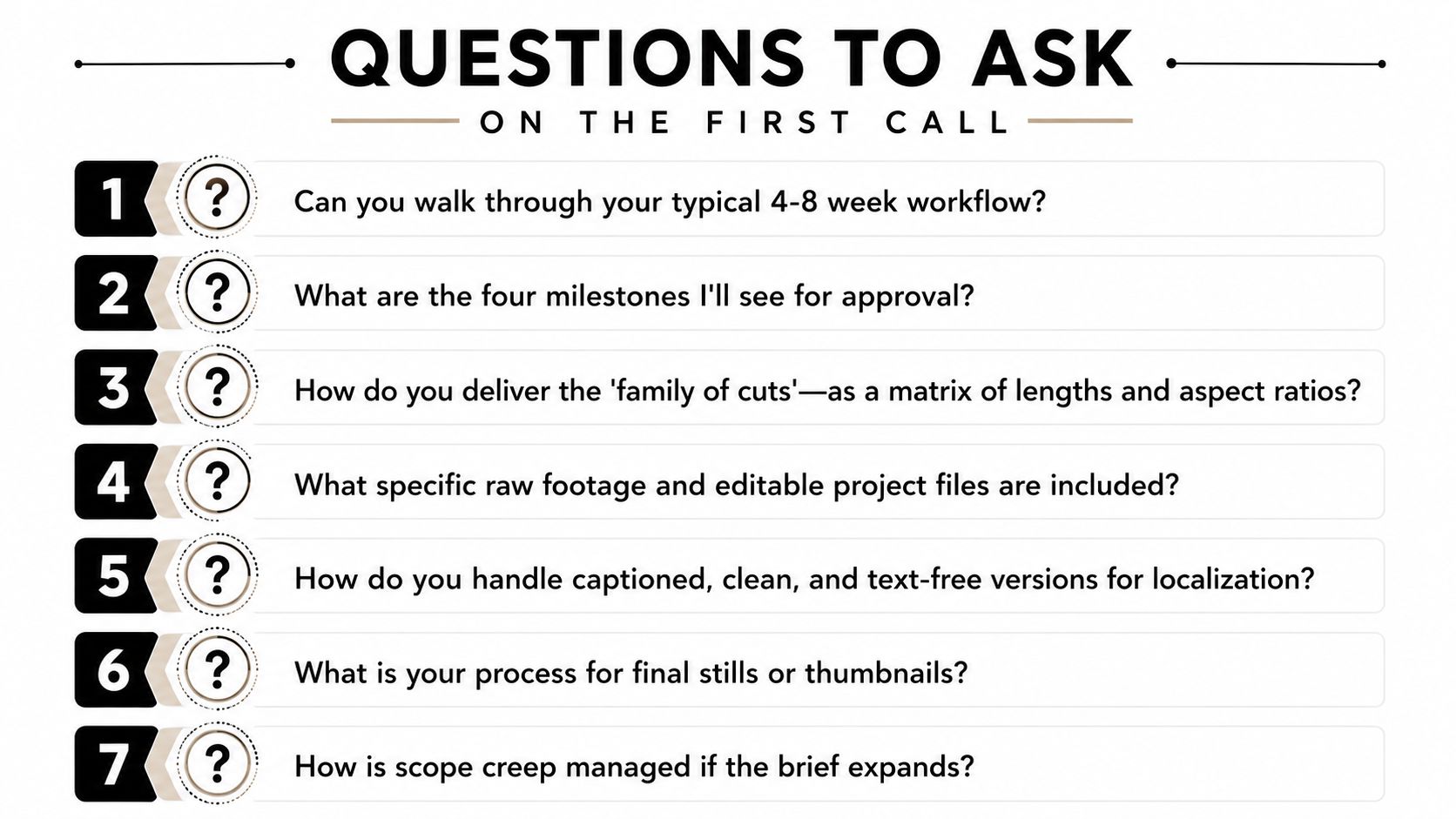
Questions to ask on the first call
The first call should reveal how the partner works under real constraints. Ask questions that force a useful answer rather than a polished sales description.
- How will you define success before scripting begins? The answer should connect the spot to an objective, audience, channel, and measurement plan.
- What decisions do you need from us at kickoff? Look for the one-page brief, single message, brand assets, legal mandatories, media assumptions, and named approver.
- How many concept directions will we review, and how is the recommendation explained? You should understand why one route is being advanced.
- What changes after storyboard or shot-list lock? A credible partner will explain the effect on cost and schedule.
- How will you frame 16:9, 9:16, and 1:1 versions on set? If vertical is treated as a late crop, ask what material will be protected.
- What exactly is included in the cut family? Ask about hero length, 15-second and 6-second cuts, captions, clean versions, text-free versions, stills, and audio.
- What raw footage and editable project files are included? Don’t assume they’re part of the handoff.
- Who clears music and talent usage? Confirm the licenses match the planned media, territory, and term.
- How are feedback rounds managed? Ask who consolidates notes and what counts as a new round.
- How is scope handled if the brief expands? The answer should describe a written change process, not an informal promise.
Vague timelines, reluctance to identify the working crew, or pressure to skip strategy and jump straight to storyboards should make you pause. The same applies to a partner who can’t explain how the final exports will match your media schedule.
Judging the work, and when to bring it in-house
Start with the objective agreed at kickoff. Awareness work can be assessed through view-through rate, cost per completed view, and brand lift studies for larger spends; direct-response work is better tied to click-through and landing-page conversion. Use platform-native measures such as YouTube view rate and Meta ThruPlay, then compare the family of cuts over a meaningful run. A single spot rarely changes brand metrics by itself; the fair unit of judgment is the full set of cuts running consistently against the intended objective.
On the build-versus-buy question, your internal team can take over when it has the capacity, craft coverage, equipment access, rights knowledge, and approval authority to manage the entire delivery package. The handoff should include the brand rules, source files, release records, music documents, templates, and a clear archive. If the team can produce a spot but can’t maintain the cut family, captions, licensing records, and channel exports, the apparent handoff is only a transfer of editing work, and the operational gaps will return later.
The first move is the same either way: write a one-page brief with the job to be done, one message, audience, channels, legal mandatories, delivery date, and named approver. Then ask prospective partners to respond to the deliverables matrix, rights scope, approval gates, and engagement model, not only to the creative idea.
Frequently asked questions
Plan the matrix before production, even if you release it in stages. The hero master gives the campaign a central idea; shorter cuts and alternate framings give media teams usable assets for each placement. What matters is protecting the framing and the rights during the shoot. Adding a version later is sometimes possible, but it can require new graphics, new editorial structure, or additional licensing.
Clearing a track or talent for one channel, territory, or term, then assuming the permission covers the whole campaign. It often doesn't. A track cleared for web may not cover broadcast or connected TV, and an expired talent release can stop a working campaign cold. Get the scope in writing before the shoot, especially if broadcast, CTV, localization, or future reuse is on the table.
Buy lengths to match placements, not preferences. A 6-second bumper has to land the message immediately, a 15-second non-skippable cut needs one clear claim, and a 30 or 60-second master carries the full idea for landing pages and TV. The strongest approach is one distinctive concept that survives every length, which is why the cut family should be planned before the camera rolls.