Branded content strategy: how to build one that works
How to build a branded content strategy: pick a subject your brand can own, plan a series, map distribution and rights, and measure more than views.


When I say branded content strategy, I mean a written plan for one subject your brand wants to be known for, turned into a series a specific audience picks on purpose. Distribution, rights and measurement get settled before anyone films anything.
Series plans that reach my desk at Moonb mostly look alike. A folder named after a show somebody meant to run. A moodboard, two scripts, a shoot date that moved twice, and a spreadsheet of views from the one episode that actually shipped. Then the head of sales asks what the video did for pipeline and nobody answers.
Brand content gets treated as a production job. Planning is rushed, and nobody thinks about measurement until after the edit, when it’s too late to change anything. This guide is for whoever owns the calendar and has to defend it in a budget meeting, and it follows the order I’d work in myself.
Branded content compared with advertising and content marketing
Planning meetings use these three words loosely, which is fine until someone picks the success metric.
Branded content is content your brand funds around a subject it wants to own, often told by a publisher or creator in their own voice, so it gets attention from someone else’s audience. Advertising is paid placement that puts a message in front of a chosen audience and usually asks for a response. Content marketing is your own program of articles, videos and guides, published mostly on channels you control.
| Branded content | Advertising | Content marketing | |
|---|---|---|---|
| Main goal | Tie the brand to a subject over time | Prompt a specific response to a product or promotion | Teach, help or entertain to grow an owned audience |
| Who pays for distribution | The brand funds the work; a publisher, creator or platform partner often supplies the audience | The brand pays for every placement | Mostly the brand’s own channels, with paid boosts for the best pieces |
| How it’s usually measured | Reach in the target segment, completion across episodes, branded search, assisted conversions | Click-through rate, cost per result, conversions | Organic visits, subscribers, leads, return visits |
| Typical length of commitment | A season or more, since a series needs several episodes to build recognition | A campaign flight, often a few weeks | Ongoing, with no natural end date |
Look at the “how it’s measured” row and the commitment row together. A series builds its effect over several touchpoints, so if someone reviews it weekly against a click-through target, a perfectly healthy show looks dead by episode two. That’s an easy way to kill a good series.
My test before any brief goes like this. If the idea only works with your logo on it, you’re making an ad. If it only works on your own site, it’s content marketing. If it works because someone else’s audience already cares about the subject, it’s branded content. When it turns out to be an ad after all, these ad campaign examples show how paid concepts get built.
The six building blocks of a branded content strategy
The first check I run on any series idea is whether someone scrolling a feed on a Tuesday afternoon, with nothing riding on it, would stop for it. A surprising number of pitches don’t survive the question.
Most teams I talk to are busy, and the plan is usually the weakest part of the work. The Content Marketing Institute and MarketingProfs 2025 B2B content marketing research surveyed 980 B2B respondents between June 25 and August 16, 2024. Content marketing was doing its job for most of them: 87% said it helped create brand awareness in the previous 12 months, 74% said it helped generate demand or leads, 62% said it nurtured subscribers or leads, and 52% said it grew loyalty with existing customers.
The strategies behind that work scored far worse. When marketers who have a content strategy rated it, only 29% called it extremely or very effective and 58% said moderately effective. Of those who rated theirs moderately effective or worse, 42% blamed a lack of clear goals.
So fill in these six blocks, in this order:
- Audience and goal. Who the series is for, and the single change you want in that audience. One measurable objective per program, written as a result, for example demo requests from finance leads at mid-sized companies.
- Subject and pillars. Three to five subjects the brand can lead on, each tied to a named audience. Five is already a lot to sustain for a year; I’d usually start with three.
- Series and formats. What repeats, in what shape, and which stage of the buying process each format serves.
- Distribution. Every version mapped to owned, paid, earned and partner channels before the shoot, since framing and length get decided on set.
- Production and governance. Who makes it, how often, who approves it. I want one named owner per pillar, because a series waiting on a review committee tends to miss its dates.
- Measurement. A KPI sheet tied to each objective and agreed before production, while the format can still change.
The programs I see stall almost always jumped straight to block three. Agreeing on a monthly video is easy; agreeing on what should change for a buyer takes an argument, so teams skip it, and somewhere around episode six somebody asks what the series was for.
How to pick a subject your brand can own
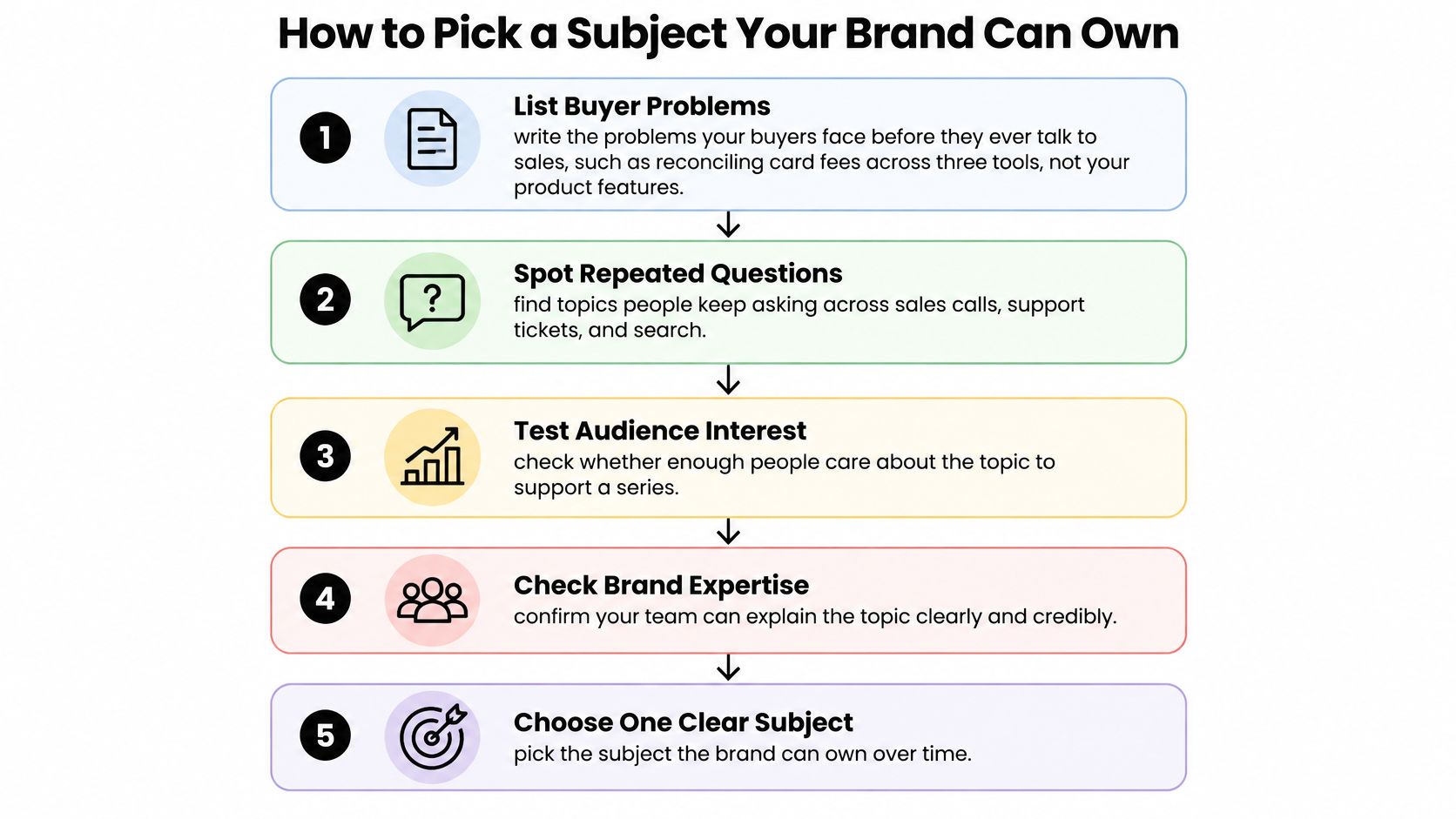
Get the subject right first, because no script can rescue a series about your roadmap that buyers never asked for. Do this in one workshop with marketing and whoever talks to customers most.
- List buyer problems. What do people struggle with before they’d ever call sales? Reconciling card fees across three separate tools counts; a new dashboard doesn’t, since that’s a feature.
- Find the questions that keep coming back. Sales calls and support tickets show them, and so does search data.
- Run each problem through three tests. Does it connect to something your company knows well? Would the audience come back for another episode on it? Could a competitor claim it just as credibly? Keep the ones that pass the first two and fail the third.
- Keep three to five, each written as a pillar sentence: one line, phrased as a buyer question, with the audience named in it.
- Name the segment and the stage. A finance lead comparing options and a new customer learning one workflow can sit in the same pillar, but they need different episodes.
- Attach one measurable objective per program, such as qualified demo requests from a named segment.
The same CMI study points at expertise and paperwork. Among B2B marketers who rated their content marketing extremely or very successful, 70% credited industry expertise and 47% credited having a documented strategy.
Once the pillars are written down, every asset, small ones included, gets a one-page brief: audience, the job the piece does, funnel stage, proof point, the action you want, owner, channel, reuse plan, and the leading and lagging KPIs.
Take a hypothetical payments software company. “How small businesses reconcile card fees across tools” passes as a pillar. “Introducing our new reporting suite” fails, because it has a launch date and no audience question.
Subject choice follows from brand positioning, so if yours is still vague, sort that out first. For the narrative side, what corporate storytelling is and why it works goes into how a company story gets built.
How to plan a content series, with a worked example
A series needs one pillar, one recurring slot and one job per episode. The last part is where teams usually slip. They ask every episode to build awareness and close the sale at once, and then nothing can be measured.
The recurring slot can be very simple. Moz, the SEO software company, calls Whiteboard Friday “the longest-running and most popular SEO video series,” says “each weekly episode delivers actionable SEO training,” and its listing on moz.com showed a new episode dated November 13, 2026. The episode embedded below is the format in a nutshell, a host talking through a topic at a whiteboard.
The production model I like for this is an anchor plus cutdowns. Once a month you record one longer expert walkthrough, and from that session you cut a short explainer, two or three vertical clips, a newsletter section and a link sales can send. Decide the cutdowns on shoot day, while the person who knows the subject is still in the room.
Back to the hypothetical payments company. This table pairs each of its episode types with a channel and a way to measure it. It’s illustrative only; there’s no client behind it and no results.
| Episode type | Funnel stage | Format and length | Channel | Success measure |
|---|---|---|---|---|
| Problem explainer | Awareness | 60 to 90 second animated explainer with captions | Short-form social and LinkedIn | Completed views and profile visits from target job titles |
| Expert walkthrough | Consideration | 6 to 8 minute interview, chaptered for the site | Brand site and email | Viewers who watch past the halfway mark, demo requests from the segment |
| Customer story | Decision | 3 to 4 minute interview film | Sales follow-up and paid retargeting | Assisted conversions from accounts that watched |
| Monthly newsletter recap | Retention | Short written recap with one clip | Customer newsletter and partner newsletters | Click-through rate and returning readers |
| Quick fix clip | Adoption | 30 second screen recording with captions | Help center and in-app pages | Support requests on the same topic over time |
Only the problem explainer has to reach strangers. That’s why it gets the vertical frame and an opening line that carries the idea with the sound off. The walkthrough answers comparison questions, so it belongs on the site with chapters, and I wouldn’t push it into a feed. The customer story mostly serves sales. A rep is going to send it cold, so the proof has to show up in the first twenty seconds.
I’d argue hardest for the newsletter recap. It costs the least and most teams skip it, even though it’s the piece that keeps the series in front of people who already bought.
Captions belong in the edit. Write the opening line so it reads as text. Keep faces and product detail out of the caption area, pick a reading speed a person can actually follow, and make one version that makes complete sense on mute.
Judge the series stage by stage. If the awareness episodes hit their completion and profile-visit targets three months running, put more episodes into that stage. If viewers drop off the walkthroughs before the first answer arrives, I’d re-cut before touching the subject. Shorten the opening so the answer comes sooner and add chapters; a couple of weeks of editing usually sorts it out, and a new subject would eat a quarter.
Distribution and partner deals
The IAB and PwC Internet Advertising Revenue Report for 2024 put U.S. internet advertising revenue at $258.6 billion. Digital video took $62.1 billion (up 19.2% year over year, 24.0% of the total) and social took $88.8 billion (up 36.7%, 34.3% of the total). That’s where the captioned vertical cuts of a series end up, so plan them alongside the main edit.
| Channel role | What it does in the strategy | Typical use | Common mistake |
|---|---|---|---|
| Owned | Hosts the full series and keeps the archive | Brand site, video channel, email list | Episode pages that don’t point to a next step |
| Paid | Puts the strongest episode in front of target segments | Paid social, retargeting, sponsored placements | Promoting a video with no clear next action |
| Earned | Carries the story through people who choose to share it | Press, creator features, partner newsletters | Coverage that names the brand and skips the subject |
| Partner | Brings an audience the brand doesn’t have yet | Publisher co-productions, creator series | Unclear usage rights and missing disclosure labels |
I’d put most of my time into the partner row, because that’s where rights and labels go wrong. For a view from inside the business, this 2025 panel from TellyCast’s Digital Content Forum, a TV and digital industry event, talks about where branded entertainment is heading.
Rights and disclosure before anyone signs
For each cut, write down who may reuse it, for how long, in which territories and on which channels. Publishers sometimes want exclusivity for a window, and that one clause decides whether the episode can go on your own site next week. Agree who approves facts and claims, with a named person on each side.
On disclosure, read what the regulators actually wrote and have your lawyer apply it to your markets. I keep two documents open.
The FTC’s Disclosures 101 for Social Media Influencers, which points readers to its Endorsement Guides, says an endorsement “should make it obvious when you have a relationship (‘material connection’) with the brand.” For video, “the disclosure should be in the video and not just in the description uploaded with the video,” and it lists “advertisement,” “ad,” and “sponsored” as clear terms.
In the UK, the ASA and CAP influencers’ guide to making clear that ads are ads is now in its fourth edition (October 2026) and was developed with the Competition and Markets Authority. It recommends labels such as “#Ad” and “#Advert.” It advises against “Sponsorship / Sponsored / Spon / Sp,” which it says the ASA has ruled insufficient “because they don’t clearly show the advertiser has editorial control.” It also says “the disclosure should be at the very beginning of the advertising content.”
So a word the FTC page calls clear is one the ASA guide tells you to avoid. You can’t assume one label covers every market. I keep the rights and disclosure grid inside the strategy document for that reason, where the producer and the editor will actually see it. When the channel plan gets complicated, this video marketing strategy framework covers how formats and placements fit together.
Before the first partner episode goes live, check that reuse terms are signed (territory, channel, duration), that each side has a named fact approver, and that the label each regulator and platform expects sits where its guidance says. Keep a log of which assets exist in which version too, so nobody republishes a cut you’ve lost the rights to.
Measuring branded content beyond views
In the Content Marketing Institute’s 2025 enterprise content marketing research, 48% of enterprise marketers agreed their organization measures content performance effectively, and 38% disagreed. In the B2B study, 56% named difficulty attributing ROI to content as a measurement challenge, and the same share cited difficulty tracking customer journeys.
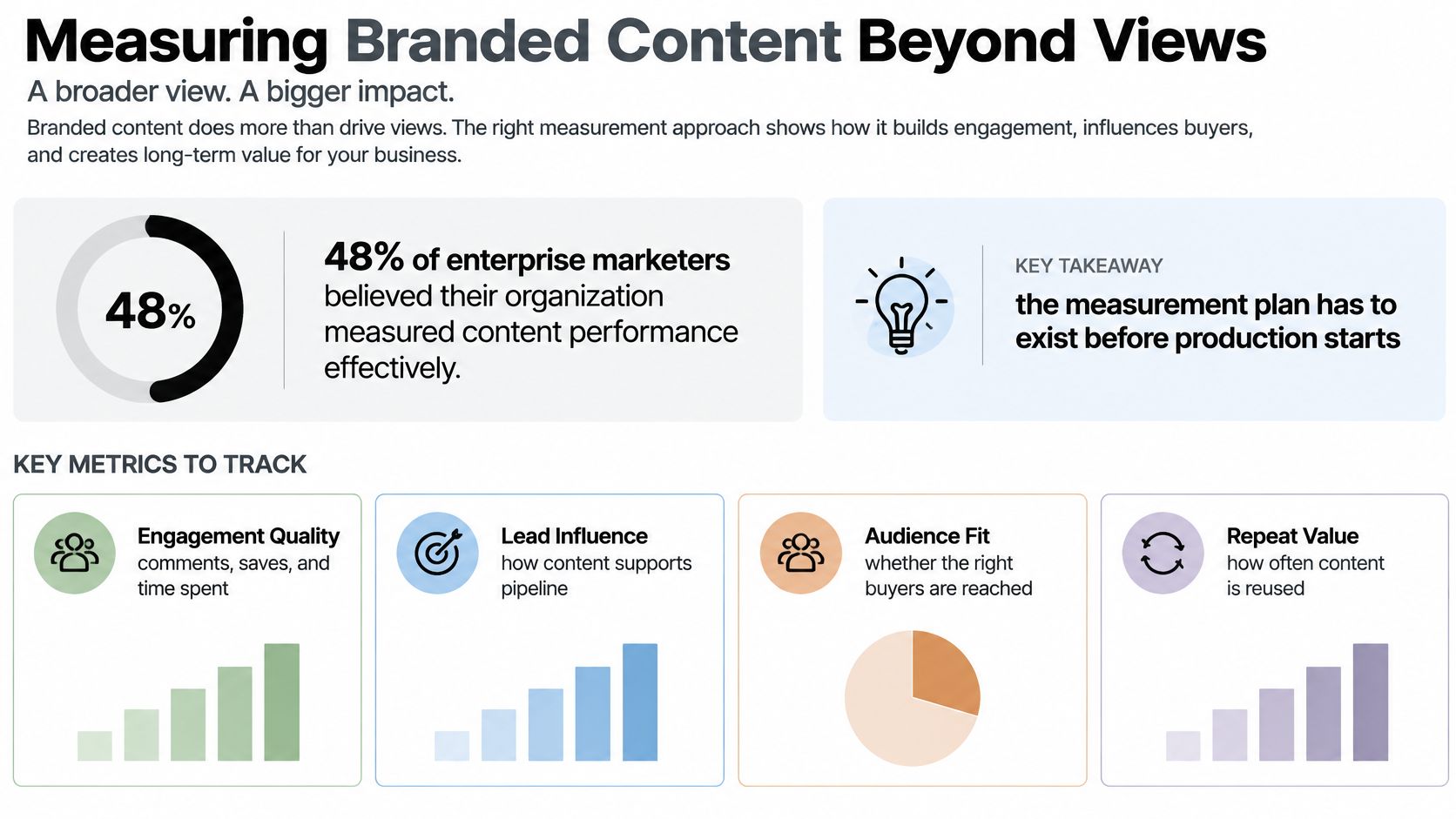
I measure in two layers. Leading metrics tell you within weeks whether an episode is doing its job: completed views among a named segment, say, or visits to a product page from an episode link. Lagging metrics tell you whether the program moved the business, meaning demo requests from that segment, pipeline the content assisted, or renewals among readers who came in through the series.
| Objective | Leading metric | Lagging metric | Review cadence |
|---|---|---|---|
| Awareness | Completed views among the target segment | Branded search volume for the subject | Monthly |
| Consideration | Share of viewers past the halfway mark, return visits | Demo requests from the named segment | Every two weeks |
| Demand | Visits to product pages from episode links | Pipeline the content influenced or assisted | Monthly |
| Retention | Newsletter clicks and repeat visits | Renewals and expansion among readers | Quarterly |
Raw reach hides whether the right people saw it; tens of thousands of views, mostly outside your segment, say nothing about consideration. Segment the reporting by job title or account list, and only compare episodes that share a stage and a job.
A monthly routine that takes an hour
- Pull the leading metrics for each live episode and hold each one against the objective in its brief.
- Make one call per episode: keep it, reformat it, or retire it. Reformatting means the same idea with a new opening, length or channel.
- Write down your assumptions. Attribution is never exact, so note next to each number what you counted as influenced.
For the reporting setup under this routine, Maxi Journal’s guide on how to measure content performance walks through turning business goals into content KPIs, tagging traffic with UTMs and building a central content dashboard. For the video version, including tying watch behavior to pipeline, see our guide to measuring video marketing ROI.
Set your cadence and owners before the first shoot
Approvals are where I see good series stall. Give each pillar an owner, name an editorial owner for facts and claims, a legal reviewer for partner and creator work, and a producer who keeps the calendar and briefs moving. In a small team one person often covers two of these roles, which works if everyone knows who is doing which.
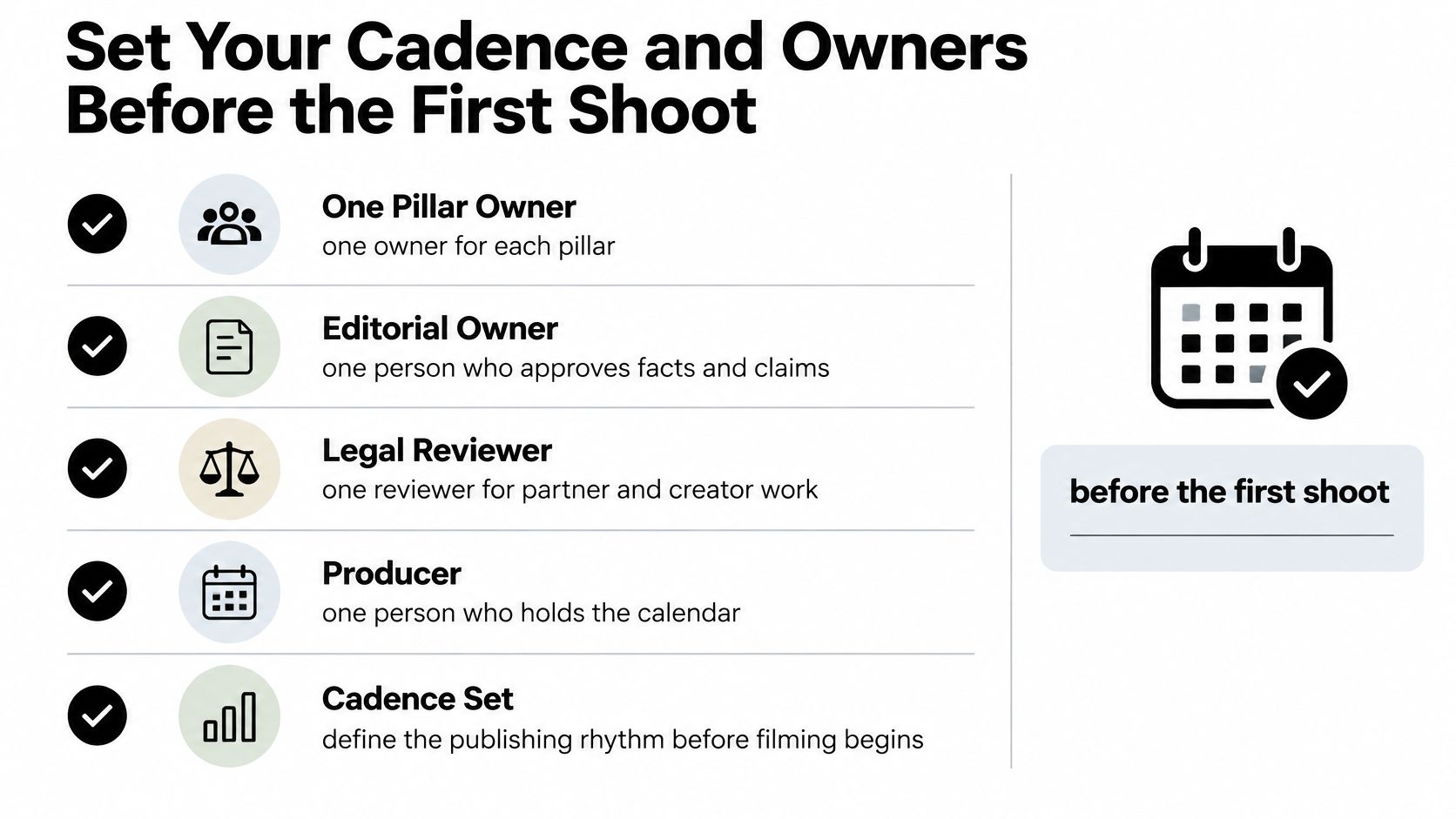
Pick a rhythm the team can keep. One anchor piece a month and a few short cuts a week, with a fixed review slot before publishing, is a sensible start, and you can add more once the team has kept it up for a while.
Decide early who makes the work. If your team can’t cover the volume, an outside creative team can take production and specialist work like motion and animation while your people keep strategy and brand. Whoever does it, agree scope and output before the first shoot. If you’re weighing outside help on the story side, here’s what a brand storytelling agency does and how to choose one.
Don’t book the shoot until you have:
- a named owner for every pillar;
- a finished brief for each episode, with one audience problem, one job and one success measure;
- an eight-week calendar showing the anchor and its planned cutdowns;
- a rights and disclosure grid the editorial and legal owners have approved;
- a measurement sheet, ready before production starts;
- a reuse plan for each cut, with channels and shelf life.
From there each production cycle runs the same loop. Script and shot list with any claim that needs support flagged, cutdowns chosen before editing, factual claims to the editorial owner and partner cuts to the legal reviewer. Publish where you planned, check early results against the target, and decide what happens to each cut.
A plan for a month of content turns the cadence into a working calendar, and this content marketing plan template gives the strategy document a skeleton. If I were starting tomorrow, I’d pick one subject and make three episodes, each with its own measure, a named owner and a review date a quarter out.
Frequently asked questions
A quarter at least, or enough episodes that each stage shows a trend. Judge every episode against the single job in its brief. If something underperforms, change the format first (the opening, the length, the channel) and leave the subject alone, because a new subject resets the audience you had started to build.
Whoever the contract names, so get it in writing before production. Spell out who may reuse each cut, for how long, in which territories, on which channels, and whether the partner holds an exclusivity window. Raw footage, music and talent appearances often come with their own separate terms, so go through them one by one with your legal team.
They overlap, but you can't swap the terms everywhere. Sponsored content usually means a paid placement on a publisher's or creator's channel, which is one way of distributing branded content. Regulators look at the commercial relationship whatever you call it, and they accept different labels: the FTC lists "sponsored" as a clear term, while the UK ASA guidance advises against it and recommends "#Ad" or "#Advert".