B2B Video Marketing: A Practical 2026 Guide
A practitioner guide to B2B video marketing: which formats earn their keep, how to map them to the funnel, where to distribute, and how to measure pipeline impact.


B2B video marketing earns its place when it helps a deal survive committee review. I have watched it happen more times than I can count: a champion sees a product demo, then forwards it to finance, IT, and their manager. The video did not close the deal on its own. It gave the champion something clean enough to pass around.
That is the real job. B2B video is built for long sales cycles with several people involved, the kind where buyers need proof and a reason to keep the conversation moving. The market already treats it this way. eMarketer projects B2B video ad spending will reach $2.86 billion by 2027, about 11.1% of total B2B digital ad spend (eMarketer). LinkedIn reported that video was the most popular form of B2B marketing in 2024 and the top planned content type for 2025 (LinkedIn).
Why B2B Video Is Its Own Discipline
A consumer video can lean on speed, mood, and a single decision maker. B2B usually cannot. A software purchase might involve one person who wants the demo, another who wants customer proof, an IT lead who wants security answers, and procurement who wants terms. Each of them asks a different question, and the video has to help answer several of them without wasting anyone’s time.
Every B2B video has to carry one idea cleanly enough that a stakeholder can repeat it. Julian Treasure’s TED talk on making a message land is a good primer on that discipline.
This is why recycling DTC advice tends to miss. Virality does not matter much when the buyer is a committee and the cycle runs for months. What matters is whether the video helps a champion move the conversation forward inside the account. A short demo gives them something concrete to send around. A customer story helps a manager justify budget. A clear founder point of view lowers doubt about whether the vendor actually understands the problem.
Practical rule: if a buyer has to forward the video to someone else, it needs a job beyond attention. It has to carry one idea cleanly enough that the next stakeholder can repeat it.
That is also why account-based targeting and sales enablement carry so much weight in B2B. You are not trying to entertain everyone. You are trying to help specific accounts understand the risk and see the next step. A good program gives sales and marketing assets they can reuse across outreach and follow-up, which is the difference between video as a campaign and video as infrastructure.
Core B2B Video Formats and When Each Earns Its Keep
Start with the formats that do a clear job. You do not need all of them at once. Most strong programs begin with two or three, then add more once they know where the pipeline is leaking.
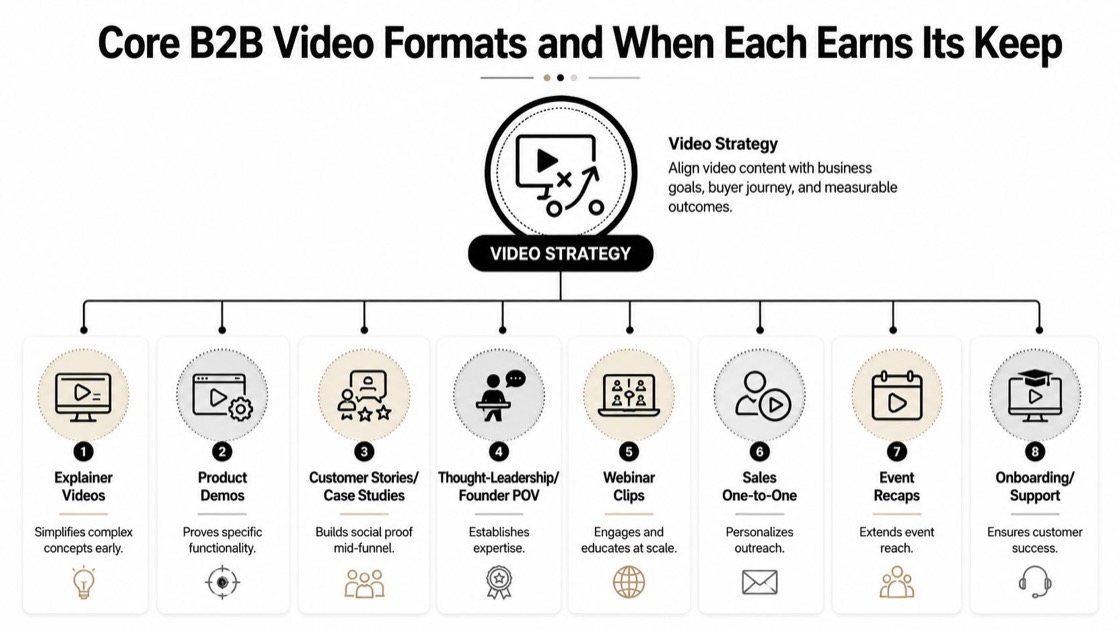
Explainer videos and product demos
Explainer videos simplify the category. They earn their keep when the problem is complex or the product sounds abstract. HubSpot has leaned on educational video for years to make inbound concepts land, and Slack’s product films do the same for team workflow. These usually sit at early awareness or first-touch consideration. If budget is the question you keep hearing internally, it helps to understand how much an explainer video costs before you commission one, since scope drives the number more than anything else.
Product demos and walkthroughs do a different job. They prove how the thing actually works. In B2B that matters because a buyer often wants to see the exact workflow before booking a meeting or pulling in a stakeholder. Demos are especially useful when the champion needs something to send around the building.
Customer stories and thought leadership
Customer stories and case studies are the trust layer. They help a manager, director, or finance lead believe the product works in a real environment. Zendesk has made this format a visible part of its B2B storytelling, which tells you something about its value. It lowers perceived risk before anyone has to defend the purchase.
Thought leadership and founder point-of-view videos are more useful than they get credit for. They are not there to look flashy. They explain how a company thinks and why the product exists at all. In committee buying that can matter, because people need to sense that the vendor understands the operational reality, not just the feature list.
Webinars, sales videos, event recaps, and onboarding
Webinars still earn their place when a topic needs depth. Most of the value arrives after the live session, when you clip it into shorter pieces for social, nurture, and sales follow-up. Event recaps do something else: they extend the life of an event and give sales an asset for the people who did not attend.
One-to-one sales video, the Loom-style clip, is one of the most underused formats in mainstream B2B advice. It is strong for objection handling, proposal follow-up, and late-stage nudges. It feels personal because it is personal, which is exactly what a stalled deal often needs.
Onboarding and support videos belong in the same strategy because they protect retention and expansion. Support content is not just a service layer, it is part of the buying promise. Good motion graphics tend to carry a lot of this work, since a clean animated walkthrough explains a workflow faster than a screen recording with a voiceover ever does. For a broader look at what is available, a rundown of corporate and brand video types is a practical companion. When that work has to reach buyers in more than one market, localizing video content covers subtitles, dubbing, and the cultural details that decide whether it lands.
Mapping Video Formats to the B2B Funnel
Keep the funnel simple. Match the format to where the pipeline actually leaks, not to a content calendar.
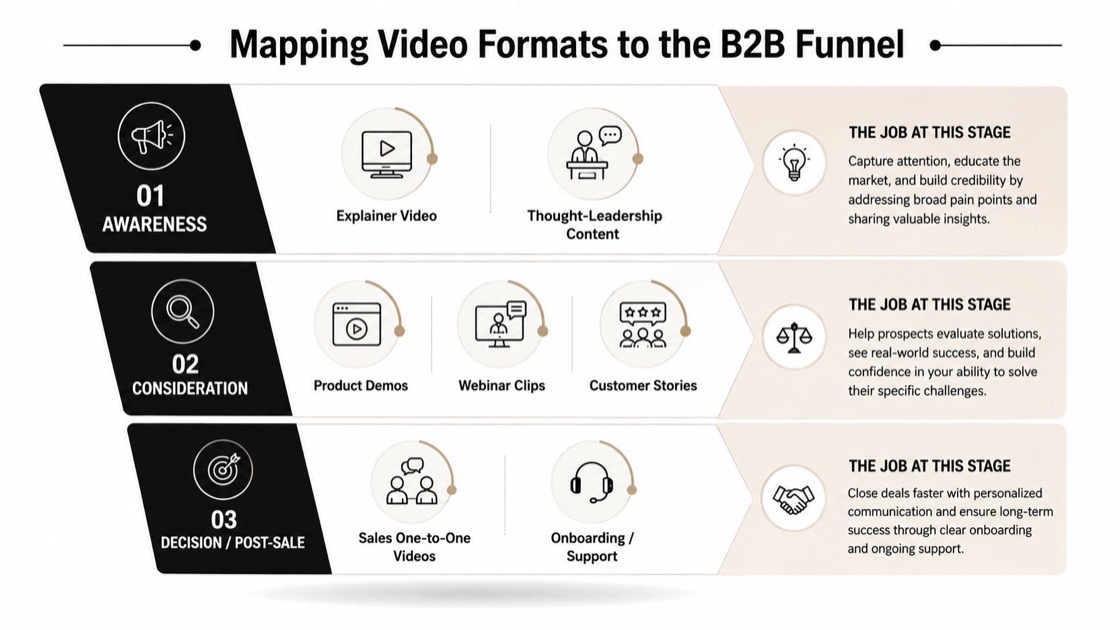
| Funnel stage | Formats that fit | What the video has to do |
|---|---|---|
| Awareness | Short explainers, thought leadership | Make the category easy to grasp |
| Consideration | Product demos, comparisons, customer stories | Show how it works and lower perceived risk |
| Decision | ROI framing, proof, one-to-one sales video | Give the champion something to forward |
| Retention and expansion | Onboarding, product adoption content | Protect renewals and grow the account |
That is enough to make production decisions without turning the program into a spreadsheet exercise. If your biggest problem is low awareness, do not spend three months on a deep technical demo. If your problem is stalled late-stage deals, a polished brand film will not fix it. Build the format that matches the leak.
Length matters here too. Short video works to open a door. Long video earns attention only after someone already has a reason to keep watching, so reserve it for qualified audiences who came in wanting the detail. If you want the deeper version of this logic, the guide on video for lead generation picks up where this leaves off.
Short rule: short video opens doors. Longer video earns attention only once interest is already there.
Distribution Channels That Fit B2B Buying Behavior
LinkedIn is usually the first channel B2B teams reach for, and that makes sense. It is where buyers already expect business content. Native organic video works for education and credibility. Paid LinkedIn video makes more sense when you want to reach specific accounts or job functions. Adobe’s LinkedIn guidance also points to short-form social video as a strong format for B2B decision makers, which matches how most people consume content in-feed (Adobe).
Distribution is where marketing money actually gets spent, and it pays to be clear-eyed about it. Morgan Spurlock’s TED talk on the economics of marketing is an entertaining reminder of what you are buying.
Treat YouTube as a searchable library, not just a social channel. Buyers go there to watch a demo, compare approaches, or revisit a longer explanation months after they first saw it. Email and nurture sequences are where video gets tactical: a short clip can sharpen a follow-up or make a nurture step feel less generic. Sales outreach is more direct still, since a one-to-one clip can say more than a long email thread ever will.
Landing pages and product pages deserve their own cuts. A homepage video and a demo-page video should not be the same edit. One orients a visitor, the other reduces friction for someone already leaning in. Distribution works best when it is built around stakeholder intent, not channel habit.
Gating is the hard trade-off. A gated video captures leads, but it also limits reach and makes internal sharing harder, which hurts in committee buying where the champion needs to forward the asset. Ungated video travels further but gives you fewer form fills. Pick the model based on the stage and the goal, not out of habit.
Measuring Video Impact on Pipeline and Revenue
Raw views are easy to count and hard to trust. In B2B they rarely tell you whether the video helped a deal. Watch time, engagement, influenced pipeline, meetings booked, SQLs, and sales-cycle acceleration are better signals, because they connect the asset to actual selling motion.
The attribution problem is real. B2B buying is multi-touch, so video usually works alongside email, search, sales calls, and landing pages. Look for direction, not fantasy precision. Holdout thinking helps: compare accounts or campaigns with and without a given asset, then watch for differences in downstream action.
Connecting video behavior to your CRM gives the asset a place in the revenue story. The cleaner that connection, the easier it is to see whether a clip moved a lead forward or just collected attention. Keep the measurement tied to business outcomes instead of vanity metrics, because that is the number a leader will actually defend.
The gap in most B2B video work is that it stops at engagement. That is too shallow for leaders who need proof that ongoing production earns its place. A useful stack starts with view-through and engagement, then checks whether viewers turn into meetings, SQLs, or faster-moving opportunities. For a revenue-focused breakdown, the guide on measuring video marketing ROI goes further. The formats worth betting on shift year to year, and this year’s video marketing trends shows where attention is moving.
Where B2B video programs stall
Most B2B video does not fail on the shoot. It fails on the decisions around it, and the same patterns show up again and again.
The first is one big hero video followed by six months of silence. A single expensive film feels like progress, but B2B buying runs for months across several people, so one asset cannot carry the whole cycle. A steady stream of smaller, useful pieces beats one showpiece almost every time.
The second is treating B2B like DTC. Chasing views and virality makes sense when the buyer is one person deciding fast. It does not when the buyer is a committee that needs proof, so optimize for whether a champion can forward the video and have it do a job, not for the view count.
The third is gating everything. A form on every video captures leads but chokes the internal sharing that moves committee deals, so reserve gating for the assets where a lead is genuinely worth the friction.
The fourth is measuring the wrong thing. If the only number you report is views, leadership has no reason to keep funding the work. Tie the video to pipeline, meetings, and sales-cycle speed from the start.
The last is forgetting sales. The team closest to the buyer is often the one nobody tells the video exists. Hand new assets to sales with a one-line note on when to use each, and the same footage starts doing double duty.
A Realistic Starting Plan for Small Teams
Pick one or two formats tied to the biggest gap in your pipeline. If deals stall because buyers do not understand the product, start with a demo and an explainer. If trust is the issue, start with customer stories and a founder point of view. Do not start with a giant content map. Start with the thing that removes friction fastest.
Then build a cadence you can sustain. A webinar becomes clips. A demo becomes ad cutdowns. One customer interview can produce a main story, a set of short quote edits, and a sales follow-up asset. That reuse is the point, because the common failure mode is one expensive hero video followed by six months of silence.
A steady weekly rhythm beats a burst of perfection. A dedicated creative team, the kind a studio like Moonb runs, can produce B2B video on that kind of rhythm for teams that need ongoing production support. The model matters less than the consistency.
Before any of it, write the brief. A tight creative brief keeps the pilot from drifting and saves you from reshooting because nobody agreed on the goal in the first place.
For a small team, a practical first quarter looks like this:
- Choose one business goal: tie the video to a real gap, such as demo-to-meeting conversion or late-stage trust.
- Plan a small pilot: four videos is enough to learn something without overbuilding.
- Reuse the source footage: cut the webinar, repurpose the demo, and pull stills for sales.
- Distribute through a few core channels: LinkedIn, YouTube, and email are usually enough to start.
- Track one primary metric: pick the signal that matches the goal, then improve from there.
If you are deciding whether to staff the work internally or bring in outside help, a look at B2B video production is a useful reference. The key is to keep the first system small, clear, and easy to repeat.
If you are planning your first or next B2B video program, start with the one format that matches your biggest pipeline problem, then build distribution and measurement around it. The teams that win with video rarely do more. They do the right pieces, and they do them again next week.
Further reading: Komet Media, 2026, Levitate Media, 2026, KPIs that reflect real profitability.
Frequently asked questions
B2B video marketing is the use of video to move business buyers through long, multi-stakeholder sales cycles. Its main job is to help a champion carry one clear idea to the other people who have to sign off, from a demo that proves how the product works to a customer story that justifies budget.
Start with one or two formats tied to your biggest pipeline gap. If buyers do not understand the product, begin with a product demo and an explainer. If trust is the blocker, begin with customer stories and a founder point-of-view video. Add more formats only once you know where the pipeline is leaking.
Look past raw views. Track watch time, engagement, influenced pipeline, meetings booked, SQLs, and sales-cycle acceleration, then connect that behavior to your CRM. Because B2B buying is multi-touch, use holdout comparisons: measure accounts with and without a given video asset and watch for the difference in downstream action.