22 Company Culture Videos Worth Watching
A curated gallery of 22 real company culture videos, each still live on the brand's own channel, with one specific thing to steal from each.

Most company culture videos fail for the same reason: they try to say everything. You get the recruiting pitch and the founder story, the office tour and the stated values, all of it crammed into two minutes until the whole thing reads like a brochure with a soundtrack. The ones that work pick a single job and commit to it, and that discipline is the first thing I look for.
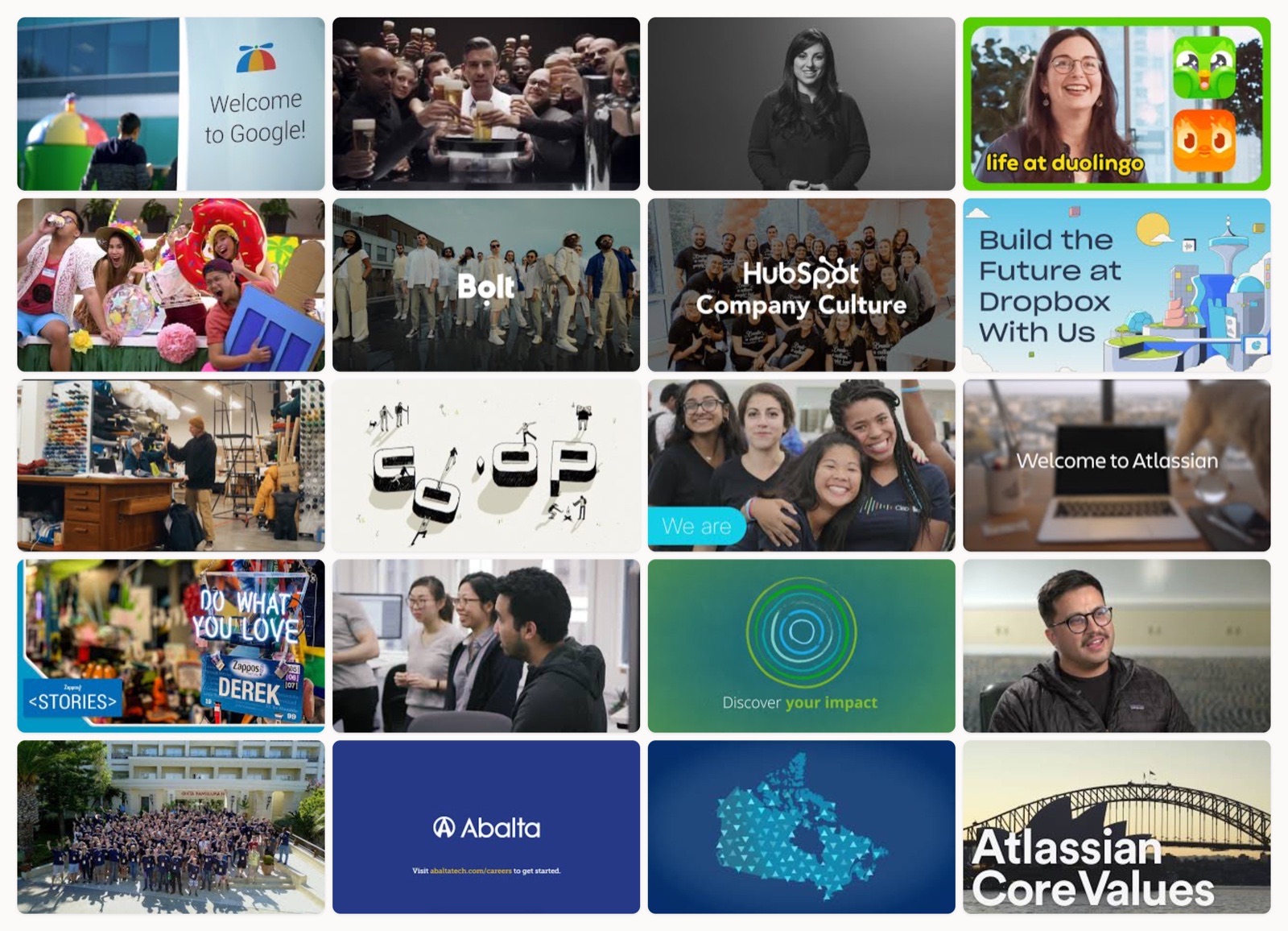
I produce these for a living, so I spend a lot of time watching other companies’ culture films to see who actually pulled it off. Below is a curated gallery of 22 that are still live and, importantly, still hosted on each company’s own channel (not reuploaded by some third party). Under each one I’ve written the specific thing you can steal, because “great storytelling” is not a takeaway you can act on. If you want to see where a culture video sits among the other types of corporate videos first, that context helps, but the examples are the real value here.
What a company culture video actually is
A company culture video is a short film that features real employees (not actors) talking about their real experience at the organization, usually intercut with workplace footage and moments from company events. The point is authenticity: you show the people you want to hire the human side of how a company works, instead of describing it in a careers-page paragraph.
The best ones, in my experience, pick one of three jobs and do it well. Some are built to recruit, which makes their closest cousin the recruitment video. Some exist to put a company’s values on screen and show those values doing actual work, and some are pure “life at” pieces that answer what a normal day feels like. When a video tries to be all three at once, it usually lands as none of them.
The styles worth knowing before you brief anyone
Culture videos come in a handful of recognizable formats, and I keep six of them in my head. Naming them makes it far easier to decide what fits your company and the people you can realistically get on camera.
- Live-action documentary. Employee testimonials cut against workplace B-roll. The default format, and for good reason: it feels like a real place.
- Single-employee story. One person, one specific narrative. Lower cost, higher emotional hit than a montage.
- Satire or comedy. Subverts the tired recruitment-video genre on purpose, then earns the culture point through the joke.
- 2D motion graphics. An animated explainer that needs no crew and no on-camera staff. Right for distributed teams or complex work.
- Interactive or musical. The most ambitious end. Rare and expensive, but memorable when the brand can carry it.
- Cinematic brand film. Purpose-led, shot like a commercial. This overlaps heavily with brand video production and works when your mission is the draw.
22 company culture videos worth watching (and what to steal)
1. Google: What’s It Like to Work at Google?
Real employees from engineering to sales narrate their own days over campus footage, and the whole thing lives on a dedicated Life at Google channel rather than a single upload. The structure is what I’d copy here: treat employer brand as a library you keep adding to, one that outlasts any hero film that would otherwise age out within a year. A channel compounds while a lone video decays.
2. Heineken: Go Places, Take the Interview
Heineken turned a job interview into a Dr-Seuss-style musical starring actual employees, produced with the ambition you’d expect from one of their beer campaigns. The lesson I keep coming back to is permission: HR content is allowed to be as bold as your consumer advertising. Most companies water their culture videos down into something safe, and safe is forgettable.
3. Netflix: Taking Risks, Making Bets
Instead of flashing a value like “freedom and responsibility” on screen, employees walk through one specific event they botched and then rebuilt. That single concrete story does the abstract idea more justice than any slogan could, and it is the move I steal most often: pick one story that dramatizes the value so you never have to recite it.
4. Duolingo: Life at Duolingo
This one spotlights how the team functions day to day, and the mascot-brand personality carries through without tipping into a gimmick. The restraint is the takeaway. You can have a loud brand voice and still show a workplace that reads as believable, so let the real texture of the office carry it.
5. Canva: What’s It Like Working at Canva?
Canva ties its product mission (helping anyone design) straight to how the team operates, so purpose and culture reinforce each other. If your company is mission-led, this is the cleanest model I found in the set: show that mission living inside the daily work, so it is doing something rather than painted on a wall behind the reception desk.
6. Bolt: Come Build With Us
A scaling European startup makes “come build with us” feel like a calling, shot with real cinematic ambition. Bolt puts the argument plainly: culture is about how teams and workflows actually function, and the snacks-and-game-rooms clichés barely appear. Worth stealing if you’re recruiting people who care about the work itself over the perks around it.
7. HubSpot: HubSpot’s Company Culture
HubSpot pairs its famous public Culture Code with real office life on the careers-focused HubSpot Life channel. It’s the best example I know of making a written values document feel lived-in rather than aspirational. If you already have a values doc gathering dust, this shows how to put it in front of a camera.
8. Dropbox: Life Inside Dropbox
Dropbox frames the workplace around collaboration and a “virtual first” way of working, so the remote policy becomes a reason to join rather than a caveat buried in the FAQ. Take your most-questioned policy and make it the headline, and if remote or hybrid is your reality, name it with confidence.
9. Patagonia: What We Do
Patagonia leads with its environmental mission and the people who live it, so “we hire people who care about this” is inseparable from the brand’s activism. It’s magnetic for values-aligned talent and a turn-off for everyone else, which is the point. A strong, specific point of view filters your applicant pool before they even apply.
10. REI: The REI Co-op in 94 Seconds
REI compresses its people-and-nature ethos into a 94-second animated piece with no film crew and nobody on camera. It’s proof that motion graphics can carry a culture story on their own. If coordinating a shoot across a distributed team is what’s blocking you, animation is a real route to a finished, polished video.
11. Cisco: We Are Cisco
A giant enterprise hands the mic to employees on a dedicated We Are Cisco channel, which keeps a company that size from feeling faceless. If your headcount runs into the tens of thousands, this is the template. Let named, specific individuals stand in for the whole, because nobody connects with an org chart.
12. Atlassian: Welcome to Atlassian
A clean “welcome” film that explains who they are and how they work, tied back to explicit company values. It’s an easy format to copy for a careers page or onboarding flow, and it doubles nicely as an internal communication video for new hires. Copy their running order, which opens with who they are and how they work before it ever gets to what they believe.
13. Zappos: Why Company Culture Matters
Leaders explain how Zappos protects its famously weird culture as the company scales, “Create Fun and a Little Weirdness” value included. It’s a case study in owning an unconventional identity on camera without flinching. If your culture is truly unusual, resist the urge to sand it smooth for the video.
14. Zendesk: Life at Zendesk Melbourne
Zendesk scopes the whole video to a single office and lets the local team describe it in their own words. That narrow frame makes the culture feel specific and place-based instead of generic HQ messaging. Steal the scope: one team in one location reads far more true than a global sizzle reel.
15. Deloitte: What Makes Deloitte a Great Place to Work?
A professional-services giant uses plainspoken employee answers on its Life at Deloitte U.S. channel to make a huge firm feel approachable. It’s a strong model for consulting and finance, or any enterprise brand that tends to read as buttoned-up. Plain, unpolished answers beat a slick script here, every time.
16. Thumbtack: Germán’s Story
One employee, Germán, tells a specific story: a remote-first setup let him be home for his daughter’s first steps. That single detail lands harder than any perk montage, and it’s the clearest proof in this list that one real story beats a benefits checklist. It sits right at the heart of what good employee testimonial videos do.
17. GitLab: This Is GitLab
One of the largest all-remote companies in the world shows its distributed team gathering in person at its annual Summit. It makes “we’re fully remote” tangible instead of abstract, because you finally see the humans behind the handles. If distributed work is your model, film the rare moments people do come together.
18. Abalta Technologies: Who We Are
A small tech firm opens strong (“we shape the future and we want you to help”) and names the exact roles it’s hiring for. It’s proof that a compelling culture video does not need a big-brand production spend. Steal the specificity: naming real openings turns a bit of inspiration into an actual application.
19. Avaleris: About Avaleris
A smaller company uses simple animated icons to speak directly to what candidates weigh, like career growth and time for a life outside work. It’s a no-crew route to a message that still looks polished. Animation lets a small team punch above its size without ever booking a studio or a shoot day.
20. Atlassian: The Value of Values
A second Atlassian cut, this one focused specifically on how their values shape products and hiring decisions. It’s useful if you want a values-first piece that’s distinct from a general welcome film. The move worth copying is to show values doing real work, rather than parading them as a list of adjectives.
21. Duolingo: An Office Tour
A lighter office-tour format that pairs well with Duolingo’s main culture film. It’s a good example of the day-in-the-life subgenre, the kind that answers “what would my Tuesday actually feel like.” A tour is quick to shoot and surprisingly effective, because people picture themselves in the space.
22. Salesforce: Blazing a Trail to a New Kind of Workplace
A workplace-focused film built around the Ohana idea of treating colleagues like family. Keep it as a reference if you want an enterprise culture film centered on the physical space and the people in it. Steal the single organizing metaphor: one idea (Ohana here) gives an otherwise sprawling piece a spine.
| # | Video | Brand | Style | Length |
|---|---|---|---|---|
| 1 | What's it like to work at Google? | Live-action documentary / employee testimonials + B-roll | ~3 min | |
| 2 | Go Places with HEINEKEN - Take the Interview! | Heineken | Interactive live-action / musical, employee-cast | ~2 min |
| 3 | Netflix Culture: Taking Risks, Making Bets | Netflix | Live-action, interview-driven storytelling | ~2 min |
| 4 | Life at Duolingo - What it's like working here | Duolingo | Live-action office / documentary | ~2-3 min |
| 5 | What's it like working at Canva? | Canva | Live-action documentary / values-and-culture | ~2 min |
| 6 | Come Build With Us | Bolt | Cinematic live-action brand/culture film | ~2 min |
| 7 | HubSpot's Company Culture | HubSpot | Live-action culture film (HEART values) | ~2 min |
| 8 | Build the Future at Dropbox With Us (Life Inside Dropbox) | Dropbox | Live-action 'life inside' / employer brand | ~1-2 min |
| 9 | Patagonia | What We Do | Patagonia | Cinematic documentary / purpose-led brand film | ~2-3 min |
| 10 | The REI Co-op in 94 seconds | REI | 2D motion graphics / animated explainer | ~1:34 |
| 11 | Who are we? We are Cisco! | Cisco | Live-action employee montage | ~1-2 min |
| 12 | Welcome to Atlassian | Atlassian | Live-action + light motion, values-led | ~2 min |
| 13 | Why Company Culture Matters | Zappos Stories | Zappos | Live-action interviews / core-values story | ~2-3 min |
| 14 | Life at Zendesk Melbourne | Zendesk | Live-action office / 'life at' local team | ~1-2 min |
| 15 | What makes Deloitte a great place to work? | Deloitte | Live-action employee testimonials | ~1-2 min |
| 16 | Thumbtack Testimonials - Germán R | Thumbtack | Live-action single-employee story | ~1-2 min |
| 17 | This is GitLab | GitLab | Live-action, all-remote / summit footage | ~1-2 min |
| 18 | Who we are , Abalta Technologies, Inc. | Abalta Technologies | Mixed media / animation + live footage | ~1-2 min |
| 19 | About Avaleris | Avaleris | 2D animation / icon-driven | ~1-2 min |
| 20 | The value of values at Atlassian | Atlassian | Live-action, values explainer | ~2 min |
| 21 | Life at Duolingo: An Office Tour! | Duolingo | Live-action office tour / vlog | ~2-3 min |
| 22 | Salesforce: Blazing a Trail to a New Kind of Workplace | Salesforce | Live-action / workplace film | ~2-3 min |
How to choose a format for your company size
The right style depends less on taste than on scale and how many people you can realistically put on camera.
If you’re a large enterprise, build a channel rather than a single film, the way Google, Cisco, and Deloitte do, and scope individual videos down to one team or one office like Zendesk so a huge company still feels human. If you’re a mid-size company or a scaleup, one cinematic brand film with a real point of view (Bolt, Patagonia) or a focused values piece (Atlassian) will do more than a broad overview. If you’re small and have no crew, animation and motion graphics (REI, Avaleris) or a simply shot single-employee story (Thumbtack) get you a finished, credible video without a production circus. And if you’re remote-first, name it directly the way Dropbox and GitLab do, because the thing candidates are unsure about is exactly the thing you should address head-on.
What separates the ones that work
After watching enough of these, I stopped missing the patterns. A few of them hold up across every example above.
Tell one story rather than list perks. This is really just corporate storytelling applied to hiring: follow a day, or a challenge the team overcame, and let one narrative carry the piece. A story holds attention; a perk list gets skipped.
Cast real people and let them talk unscripted. Nielsen’s global research has long found that recommendations from people we know are the most trusted source, well ahead of brand advertising, and LinkedIn’s employer-brand work lands in the same place: candidates weigh what current employees say more heavily than anything the company says about itself. Over-polish it and you sacrifice the exact credibility you were filming for.
Balance work with play. Show the actual work your team is proud of, not just the parties and the ping-pong table. The collaboration is more persuasive than the celebration.
Include your remote and hybrid people. If part of your team is distributed, leaving them out of the frame tells its own story, and not a good one.
End on one clear call to action. Point viewers to the careers page and nowhere else, one ask stated plainly.
On runtime, keep it tight. Wistia’s video data consistently shows engagement holding steadiest on shorter pieces, with drop-off climbing as a video runs long, which is why most of the examples above sit comfortably under three minutes.
The most common mistake I see is hosting the finished video on a random third-party channel instead of your own. Put it on your branded channel so it stays attributable to you and surfaces when someone researches your company, which is also how you start building the library that makes the next hire easier.
Who actually makes videos like these
A culture video is rarely a one-and-done. The companies with the best examples treat it as an ongoing effort, cutting a fresh film when the team grows and a new tour or values piece once the values get rewritten. There are a few ways to get there. A freelancer or a one-off shoot covers a single film, while an in-house hire starts to make sense once the volume justifies a full-time role. The middle path is an embedded creative team, a creative director working alongside editors and motion designers who already know your brand and keep producing employer-brand work as you need it. That last model is the one we run at Moonb. Whichever route you pick, start from the examples above and build the whole thing around the one job your video needs to do.
Frequently asked questions
A recruitment video is aimed squarely at filling open roles, so it leads with the pitch and closes with an apply-now ask. A company culture video has a wider job, showing how the place actually works, which can serve recruiting or the broader employer brand. Plenty of culture videos support hiring, though the strongest ones commit to one purpose instead of doubling as a job ad.
The range is wide, and it tracks the format more than anything else. A live-action piece with a full crew and a director across several shoot days sits at the top end, while a simply filmed single-employee interview is the lightest lift. 2D animation lands somewhere in between and needs no shoot at all. Decide the format first, because that choice drives almost everything else about the spend.
The companies with the strongest employer brands treat it as a small library rather than one hero film. Google, Cisco, and Deloitte all run dedicated channels where each video does a single job, from a values piece to a one-office tour. Start with one video that nails one purpose, then add to it as the team and the story grow.